



Abstract
In this study, we explore how students in Year 4 (10 years old) utilize different semiotic modes while designing a comic displaying the evolution of a lizard with a particular trait: armor. Situated use of comic design for natural science didactics is an understudied practice, and, thus, based on video observations of three case students working throughout seven lessons, we draw on designs for learning when exploring how different semiotic modes are utilized in meaning making to create an evolutionary trait in designing a comic. The analysis demonstrates how the lizards’ armor is designed, and how this semiotic content is transformed and transduced by the students through different semiotic modes. The results demonstrate that the students’ process develops from mainly verbal discussions to drawn images, to writing, to finally producing the multimodal ensembles of their comics. However, this process is not linear, and the analysis shows how sometimes an individual student’s drawing, gestures, or writing can also become the origin of an idea that is developed through transductions to other modes. Thus, in comic design, transductions between modes support students’ understanding of the biological content, as well as their ability to formulate more general conclusions in the classroom.
Introduction
In this study, we explore primary students’ multimodal design process as they engage in the making of comics to display their learning about evolution, and how this process may inform students’ meaning making in biology. In meaning making, different modes of communication (e.g., speech, image, or gesture) are used to make representations of semiotic content (i.e., the meaning). When interacting about, for example scientific content, we produce representations of a phenomenon—through words, drawings, or gestures—and re-representations—new words, drawings, or gestures of the same phenomenon. Re-representations can be made in the same mode as the original representations, then called transformations (Bezemer and Kress, 2008). For example, a student drawing an image of a lizard (mode, image), based on a sketch of a lizard (mode, image), constitutes a transformation of the semiotic content (the lizard). Semiotic content can also be re-represented in another mode—then called transductions—for example, when drawing an image (mode, image) re-representing that which you have described verbally (mode, speech) (see, e.g., Newfield, 2014). Both types of re-representation always change the semiotic content in some sense (Bezemer and Kress, 2008), which could be argued to be the point of producing the re-representation in the first place—even if this might not be obvious to the sign makers themselves. The process of creating multimodal scientific texts, such as science comics, can be viewed as both representing and generating knowledge; students making transductions between written text and images expand their scientific meaning making, their understanding of the science content, at the same time as it offers them different ways to communicate meaning with others (Nichols et al., 2025), and we know from other studies in science education that allowing students to make transductions between different modes might provide students with “a more holistic understanding of the phenomenon” (Patron et al., 2021: 1196).
Previous studies have demonstrated the usefulness of natural science comics for student meaning making, when it comes to appreciating the form and format of comics and the versatility of the medium allowing for students to engage in meaning making using multiple modes (Aringer et al., 2025a; Pantaleo, 2021b), as well as using the format for science learning (Aringer et al., 2025a; Nesmith et al., 2011). Although many studies have shown how comics can be used in primary classrooms (for reviews, see, e.g., Tilley and Weiner, 2017; Wallner and Eriksson Barajas, 2020), and how making comics provides students with opportunities to synthesize and represent their knowledge of scientific facts and demonstrate their creativity (Pantaleo, 2021a, 2022, 2024), there is still little knowledge about the actual meaning-making process taking place as students engage in making science comics. By analyzing the process of creating science comics, this study provides insight into how students design representations of science phenomena, including choices made in relation to both the comic and science narrative. In this way, the purpose of this study is to increase knowledge on how students’ transformations and transductions in comics design may enable their natural science meaning-making process. To fulfil this purpose, we will answer the following research questions: (1) How are different semiotic modes used to create an evolutionary trait when designing a comic? (2) How are aspects of the trait (physical, functional, etc.) transformed within and transduced between different semiotic modes throughout the meaning-making process of designing a comic?
By answering these questions, we demonstrate how the multimodal format of comics enables these students’ meaning making in natural science, how a pattern of different semiotic modes is used, and how an evolutionary trait, as an example of natural science content, becomes designed and re-designed across a sequence of lessons.
Theoretical framework
Building on a social semiotic perspective of multimodality (Jewitt et al., 2025; Kress, 2010) and designs for learning (Selander, 2022), we are interested in how students make use of different semiotic modes in meaning making about evolution, and the different affordances (e.g., Kress, 2010; Lindstrand, 2022), or potentials for meaning making, of the modes used. In interaction and text creation, the choice of what signs to use (speech, gestures, images, writing, etc.) is based on the available modes as well as what choices appear to be functional, given, for instance, the content being communicated about and the participants in the communicative situation. Therefore, interaction can be viewed as a kind of design (e.g., Kress, 2010). In the same vein, teaching and learning can be seen as design processes (Selander, 2022), where teachers, through their didactical choices, make designs for their students’ learning. Students, on their part, make their design in learning, based on, for example, the teacher’s design—including the available modes and learning resources—as well as, for example, their interests and previous knowledge. In their design in learning, students make changes of semiotic content within (i.e., transformations) and between (i.e., transductions) modes.
In the current study, we explore the design process of three focus students by analyzing the students’ transformations and transductions of semiotic content, both during their interaction with each other, and in their comics. To distinguish between the ongoing multimodal interaction process and the created (more stable) texts (i.e., the comics), we use the terms multimodal orchestration for the former and multimodal ensemble for the latter (Kress, 2010).
Multimodal “orchestration describes the processes of selecting/assembling/designing the semiotic ‘materials’ which seem essential to meet the rhetor’s interests and which will be given shape as the semiotic entity of text as an ensemble, through the processes of design” (Kress, 2010: 162, emphases in original). For example, when talking about a specific species in evolution, one might use speech to describe the animal, while also gesturing the size of it, and then draw a picture of the animal on a piece of paper. The three different modes collectively contribute to specific semiotic content and a meaningful whole. “The results of these processes of design and orchestration” (Kress, 2010: 162) are referred to as multimodal ensembles. In our study, students use transformations and transductions of semiotic content in comic book design. For example, written text and drawn images in the same panel convey similar meaning through different modes (cf. Magnusson, 2005), which, in turn, can affect the reader’s interpretation of the story, and understanding of the evolutionary semiotic content.
Studying science learning through a multimodal lens
Since science classrooms are multimodal learning contexts, several scholars utilize multimodal perspectives to study learning in science education. Students can use their bodies to communicate ideas about science phenomena and explore and test those ideas (Gregoric, 2024). Gregoric suggests that teachers need to pay attention to students’ use of their bodies and create space for embodied engagement. For example, iconic and deictic gestures seem to play a central role in students’ science communication (Gregoric, 2024, see also Sjøberg et al., 2023). In chemistry education, Chue et al. (2015) show that iconic gestures facilitate communication about the size of, the relative positions of, and the movements of particles. Furthermore, Sjøberg et al. (2023) describe the role that drawings, talk, and gestures play in undergraduate students modelling in biology. In modelling activities, student-generated drawings serve as important resources, enabling creativity and collective meaning making. The students use deictic gestures to point out details in the drawings, which are then further explored through speech and iconic gestures. This finding suggests that collaborative drawing promotes student engagement in deepened discussion about the scientific topic at hand. With younger children, Frejd (2018) shows that six-year-olds use materials in combination with deictic gestures, making the material relevant as a shared semiotic resource, enabling different meaning making around evolution. The different material representations afford students different possible interpretations.
Student-generated comics in science education
This study combines two inherently multimodal practices: the biology classroom (Jaipal, 2010) and making comics (see, e.g., Bolling, 2020; Eisner, 1996/2008). When students create science comics, they need knowledge about both the literary conventions of comics (see, e.g., Wallner, 2020) and the scientific topic. In the SARABANDES project, de Hosson et al. (2018) demonstrated how teenagers integrate a comics narrative with scientific discourse about the physics of the sun and micro-organisms. Building on data from a series of Comics & Science workshops, comprising PhD students and high school students, the findings show that the participating teenagers sometimes struggled to integrate comics conventions with scientific discourse, and that they sometimes included incorrect scientific information to ‘improve’ the comic narrative. These findings stress the importance of teachers discussing student’s representations with them to get a fuller understanding of the student knowledge. de Hosson et al. (2018) comment on the richness of the interaction taking place during the workshops, but state that data from the workshops were not included in the analysis. Therefore, the interactive aspects of the process of creating comics were not explicitly studied.
The task of creating comics in science education may provide students with opportunities to represent their knowledge of scientific facts and demonstrate their creativity. Over the years, Pantaleo (2021a, 2022) has conducted several studies where students create comics to represent science phenomena. Pantaleo shows how knowledge and understanding of visual art, design, and comics conventions are combined to communicate scientific information. However, Pantaleo concludes that students might choose not to incorporate all their scientific knowledge into the comic but instead make deliberate decisions to craft a compelling narrative (Pantaleo, 2021a; see, also, de Hosson et al., 2018).
Recent studies of the use of comics in natural science didactics (Aringer et al., 2025a, 2025b; Brovold et al., 2026) demonstrate the comics format aligning with the curricula for natural sciences, and how primary school students utilize comics as means of communication in natural sciences, for example producing complex scientific processes over time through sequential comics narratives, as well as utilizing images to display evolutionary concepts, such as variation, heredity and selection (Aringer et al., 2025a, 2025b) and immune response (Brovold et al., 2026). Furthermore, Brovold et al., argues that the narrative frame evokes the use of analogies, which can promote a more holistic understanding of the scientific content. However, these studies do not explore the students’ design processes, instead focusing on the end product: the comics. In a study of students’ science comics (Aringer et al., 2025), we show how students convey evolutionary principles such as heredity, variation, and natural selection. In the current study, we explore the process through which these comics are conceived, produced, and discussed, to see how students transform and transduce content within and between modes (Kress, 2010; Newfield, 2014). Thus, we explore the process through which the students create comics, what modes are used along the way, and whether these modes change or remain the same, and how this appears to inform the students’ meaning making in science.
Methods and participants
The following section presents the method of data collection, the context of the study, the participants, as well as the method of analysis.
Participants and context
Evolution is part of the Swedish curriculum for year 4–6 ([SNAE], 2022). Two of the researchers joined a Grade 4 class in a Swedish primary school (19 students, 12 girls, 7 boys, aged 9–10), and their teacher, for a 7-week science unit on evolution, targeting evolutionary concepts such as variation within a population, heredity of traits, selection pressures, and adaptation. The students come from different socioeconomic backgrounds, but most have Swedish cultural backgrounds. The teacher, who teaches the group in Science, English, Mathematics, and Social Sciences, designed and led the lessons, which allowed for a study of naturalistic classroom interaction, increasing external validity (Guba, 1981).
The observed unit includes a total of 17 one-hour lessons held two to three times per week where evolution was taught using different resources, for example videos, a science textbook, and work sheets. Among these resources, the comic Cats on the Run (Anderson et al., 2024) was read and discussed as an introduction to the topic of evolution. In addition to the science content, the teacher also introduced and discussed comics literacy conventions, for example, onomatopoetic words, how to interpret differently shaped speech and thought bubbles (e.g. scream, icicle, thought), and how images, verbal lines, and caption boxes can be combined to tell a story (cf. Wallner, 2017b; Wallner, 2019).
As a finale to the 17 lessons, the students were tasked to produce an individual comic, but most were seated in groups, and they were encouraged to discuss their ideas with each other. This work was done over seven lessons, sketching, writing and drawing, before presenting on the final lessons of the unit. The students worked with their comics through a process of brainstorming (lesson 1–2), scriptwriting (lesson 3), visual and structural design (i.e., writing and drawing their comic, lesson 4–7), and, finally, presenting the comic to a small group of other students and the teacher. The teacher initiated the brainstorming process by showing a read-aloud version of How the Borks Became (Emmett and Dolan, 2018) and repeating some of the previous principles for the assignment on how to structure the comic (comic conventions) and what to include in it (scientific, evolutionary content), as well as providing a timeline (the seven lessons) of the upcoming work. Alongside the creative task of making the comics, the teacher continued her teaching about evolution through, for example, short lectures.
The student comics illustrate the evolution of a real or imagined animal or plant (in this paper called a ‘focus object’). Each comic includes at least four panels and shows how the focus object had evolved—building on students’ knowledge from previous lessons. The teacher prompted the class to not only draw images but also provide writing together with their sketches and in their comics, detailing their focus object and its environment—further adding that there should be some sort of “danger” (selection pressure, environmental or predatory) included in the narrative. She also stressed that she would assess the students’ knowledge about evolution based on both their comics and their oral presentation 1 (not included in this paper). For a full rundown of this process and the students’ end products, see Aringer et al., 2025.
The case: Three students and their armored lizards
For the current article, we detail the work of three case students—Eddie, Anton, and Henry 2 —who were seated and worked together. Occasionally other students would join them during one or two lessons—one of these is Sebastian, who is included in Example 6, below. We have chosen the trio as our case based on three criteria: (1) they are verbally active on task during class, (2) they are continuously present throughout most of the lessons, and (3) they have supplied us with their finished comics. As such, it was possible for us to follow the process of when they created their comics. Thus, the analyzed material for the current article consists of audio and video recordings (using 360 GoPro Max cameras) of seven lessons, as well as the students’ sketches—or manuscripts—and final comics.
As per the teacher’s instruction, each student comic was to include at least four panels and depict a focus object, its environment, and selection pressures. After some deliberation, the three boys in our case study chose to create comics about a lizard creature, which came to develop different attributes throughout the evolutionary process. To focus the analysis, we have chosen to trace the development of one of the traits—armor—throughout the talk, drawing and writing done in the seven lessons. The armor was continuously addressed in the boys’ discussions and seemed to be of great importance in their work. For example, they spent a large part of a lesson discussing what to call their focus object, finally naming it armis lecerta, a Latin translation of ‘armored lizard’ that they found online. Hence, our choice of focus in the analysis acknowledges the interest and focus of the boys, even though other attributes could have been traced in a similar way.
Method of analysis
For this article, we focus on the transformations and transductions done in the meaning-making-processes of three case students’ (see, e.g., Björklund Boistrup and Selander, 2022)—displayed through their interaction with each other as well as their individual sketches and finished comics. As we are interested in both the students’ final comics and the process in which these are created, we take our analytical starting point when the students begin working with the assignment of creating their comics and consider the analytical loop to be closed as the students have handed in their final comics.
As a first step, we made a verbatim transcription in Swedish of the seven video recordings of the case students’ working process in order to trace any use of words pertaining to ‘armor’ in the boys’ talk—since this was the first term used to describe the trait in their focus object. Initially, we found 24 video sequences of such instances this way. In some instances, armor was discussed at length, while some were only brief mentions, for example a boy reading his text aloud. Then, similar searches were made for related terms, for example, ‘shell’ or ‘protection’. This added another 11 video sequences, making a total of 35 analytically relevant units of verbal talk.
As a second step, we rewatched the videos of the students’ working process in full, to find sequences of non-verbal actions, for example when the boys use gestures, create drawings, or write words, engaging in meaning making around armor. Gestures were produced in connection to the above-mentioned verbal utterances, whereas drawing was sometimes done in silence. This step added another 10 video sequences wherein the armor was drawn or written about but not spoken of. The number of sequences found across the seven lessons demonstrates an external validity (Guba, 1981) of focusing on the armor as a recurring aspect of talk—this is not an isolated event, but an aspect that repeats throughout the data. Thus, the talk about armor provides us with a useful example phenomenon to explore how transformations and transductions are produced.
As a third step, all chosen sequences were analyzed, focusing on what aspects of the armor are actualized in the students’ process of creating the comics and what semiotic modes the students used to communicate these aspects. This was summarized in a chronological overview of transformations and transductions across the seven lessons.
In the results, we present examples of the students’ use of different semiotic modes and how aspects of the armor (flexibility, color pattern, hardness, etc.) are transformed and transduced throughout the lessons. Moreover, we relate these examples to those aspects of the armor captured in their finalized comics. The examples are chosen to show the richness in the transformation and transduction taking place throughout the design process. All verbal statements are idiomatically translated into English.
Ethical considerations
The project adheres to the ethical guidelines of the Swedish Research Council (2024). Legal guardians and the teacher provided written informed consent. Students gave continuous oral consent, which could be withdrawn at any time. They also consented to having their comics displayed in our writing on the project. All names used in this article are pseudonyms.
Results
In the following section, we demonstrate the use of different semiotic modes, and how aspects of an evolutionary trait are transformed and transduced in the students’ design process. The evolutionary trait—armor—is designed and re-designed by the boys (Eddie, Henry, Anton, and, occasionally, Sebastian) throughout seven lessons, using speech, writing, images, and gestures to suggest, illustrate, exemplify, and negotiate different aspects of the trait: the function and placement, color and shape, and hardness of the armor. The examples are shown in chronological order, presenting both the students’ utilization of different semiotic modes in the meaning-making process and how they re-design the content into multimodal ensembles in their final comics. We have chosen to display our analyses in the form of comic-book strips, to display participant interaction. Using speech bubbles to show the talk displays the sequential, multimodal interaction of participants, the gestural and verbal aspects of the talk, and tone of voice, in a manner that adheres to comic conventions (cf. Laurier, 2014; Laurier, 2019; for an expanded rationale on this, see Wallner, 2017a).
The function and placement of the armor
The following Example shows how the boys initiate armor as an evolutionary trait and how they transduce what placement and function the armor should have, between different modes.
Example 1. The armored lizard is introduced and negotiated verbally
Although the teacher instructs them to draw individual comics, the boys establish a joint discussion around their focus species—a common social practice in this classroom. Initially, Eddie announces his intention to draw a ‘strange insect’, Henry is going to draw an ‘oink oink’, and Anton does not yet know what to draw. The boys speak amongst themselves, their pronoun use shifting back and forth between an individual ‘I’ to a collective ‘we’, as Anton decides he wants to draw something “cooler”.
Already during the first lesson, the boys collectively establish the origin of the attribute of ‘armor’ through spoken interaction. A lizard becomes their focus species, but the armor as an attribute precedes this. Eddie and Henry together pinpoint the function of this armor as protection against the threat of birds, implying that the predators can come from above (“birds can put their claws down”, Figure 1, panel 6). Introducing the armored lizard.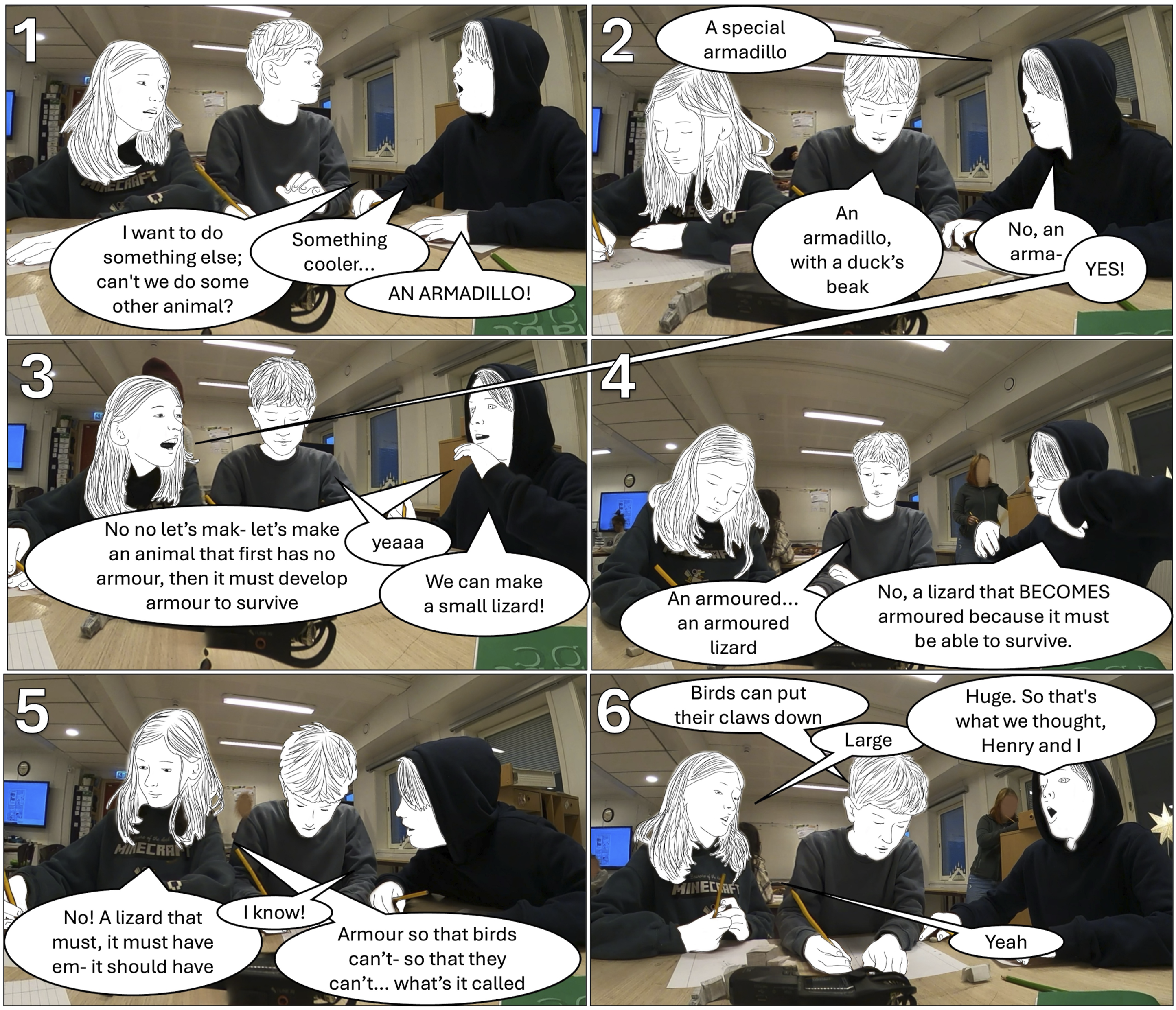
Example 2. Multimodal orchestration places the armor and identifies its function
At this stage, as the physical placement of the attribute is in focus, Anton springs into action. He uses iconic and metaphoric gestures and speech to make the placement explicit, further highlighting the function of the armor.
Here, Anton verbally affirms the previously established idea that the lizard “get[s] armor”, while, at the same time, using a gesture where he moves his hands from his head down his back (Figure 2, panel 1–2)—to illustrate the placement of the armor on the lizard. This gesture is metaphoric (Norris, 2004), in the sense that he makes explicit the abstract protective function of the armor. Continuing, he now produces the causal selection pressure, shifting perspectives from the lizard to the predator bird, illustrating how the birds are attacking. Now his gestures are iconic (Figure 2, panel 3–6): while he verbally explicates the events, his hands embody the direction of the birds’ movements, the swiftness of the attacks; how the birds would swoop down on the lizard. Anton uses gestures and speech to demonstrate the placement and function of the armor.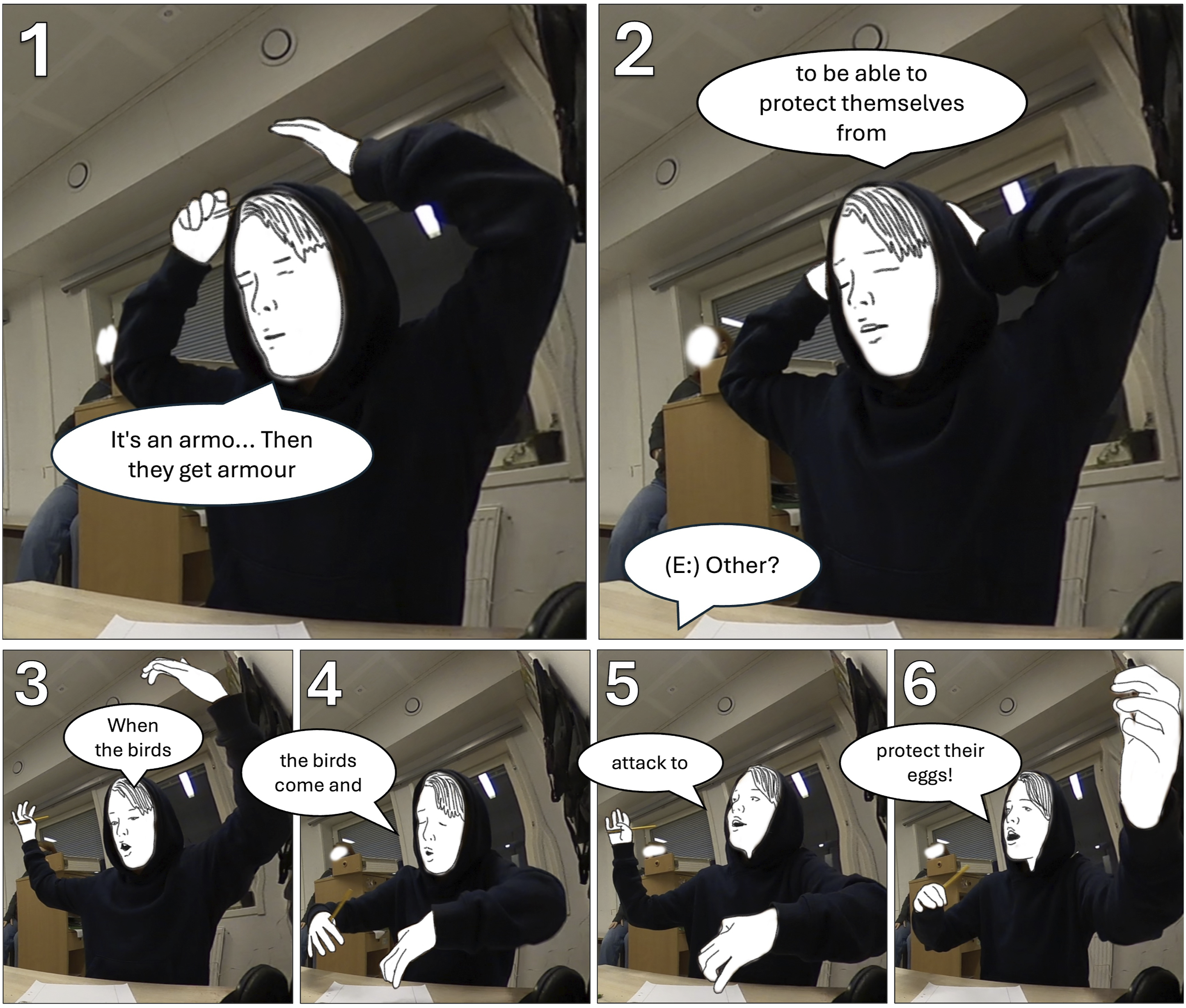
Taken together, Anton, through his multimodal orchestration, transduces and expands Eddie and Henry’s previous spoken suggestion, that birds can put their claws down on the lizard (see Example 1). Furthermore, Anton’s development of the armor idea is also placed in a narrative biological context, where Anton sets the scene, highlighting the biological, evolutionary function of the armor as protection, allowing the lizard to survive.
Example 3. The flexibility of the armor in bodily illustration
While the previous example illustrates a process of moving from primarily verbal interaction to a multimodal orchestration, our next example demonstrates another way of interactionally producing meaning, moving instead from a drawing to a multimodal orchestration.
In the next example (Figure 3), Anton points to four drawings he has made of his armored lizard in a manuscript—deictically making the lizard in his manuscript relevant as the topic of conversation—using this as a drawn basis for an elaboration on how the lizard can move, and how the armor is flexible enough to curl up in. Anton uses gestures and speech to demonstrate the lizard curling up.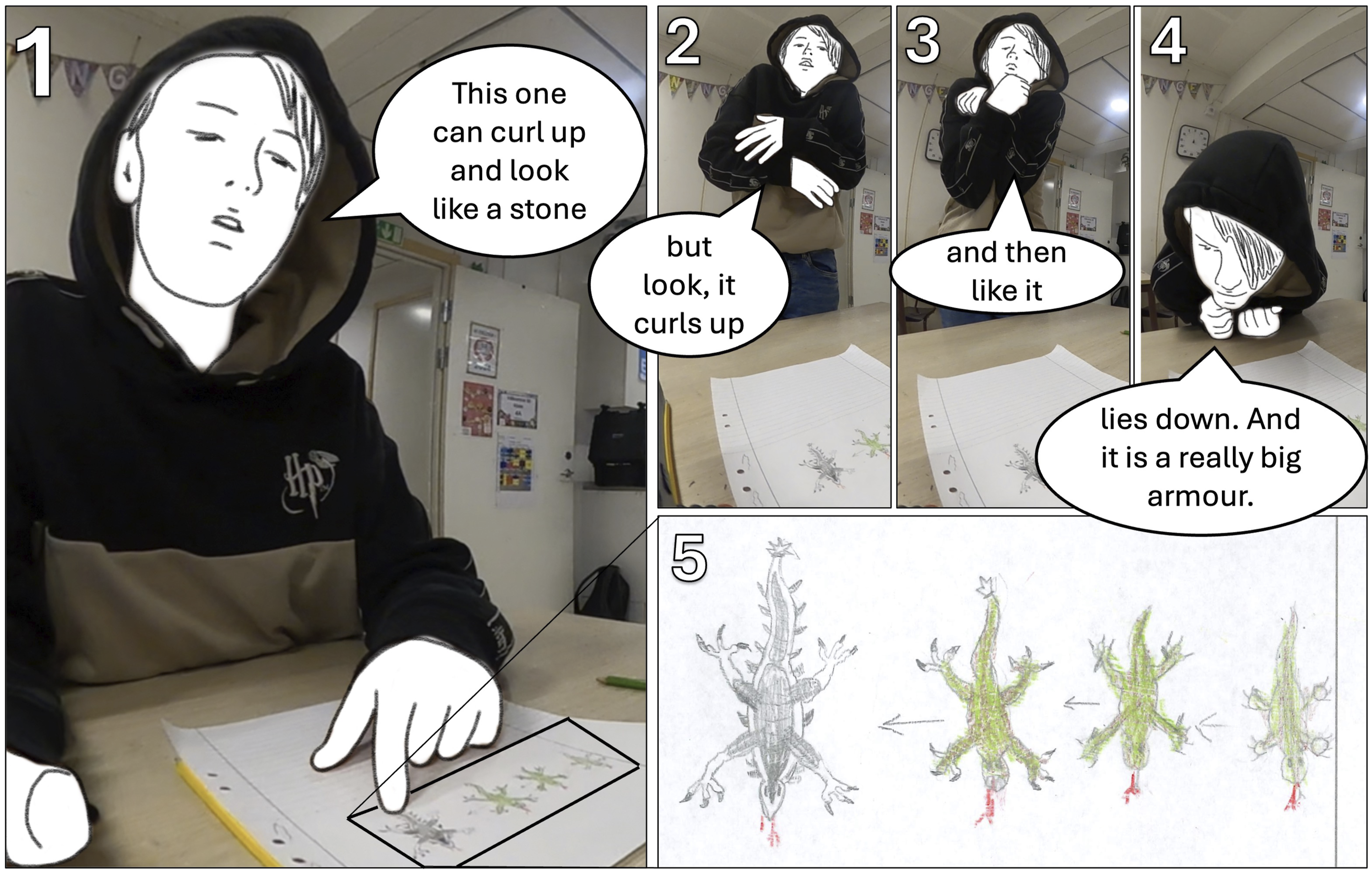
While rising from his chair (Figure 3, panel 2), Anton verbally describes that the lizard can curl up to look like a stone. Meanwhile, his actions embody the lizard’s movement—curling up his body with his arms against his chest, finally leaning his whole body down against the table. This helps to communicate this idea to the others. Compared to his drawn images (Figure 3, panel 5), where the placement of the armor is depicted, but no movement can be discerned, this verbal and bodily illustration together shows the flexibility of the armor, possibly paraphrasing the previously discussed armadillo (see Example 1), which curls up to protect itself from predators. This transduction from a drawn image to an embodied reenactment, wherein an image is ‘acted out’ (Wallner, in press) not only exemplifies the way that the armor functions as protection but also effectively animates the image of the lizard in Anton’s drawing (which is drawn as the opposite of curled up) for the other participants.
Re-designing the function and placement of the armor in the finished comic
In all three boys’ re-design of the armored lizard in the finalized multimodal ensembles (the comics
3
), the placement of the armor is consistent with Anton’s embodied illustration in Figure 2. Moreover, even though the attacking predator birds are re-represented in all comics, we can see in Anton’s comic that he is the only one who re-represents the narrative relationship between the protective function of the armor and the attacking bird. In Figure 4, taken from the boys’ comics, Henry and Eddie (top) show how attacking birds fly off with lizards in their mouths or claws. The attacking predator birds indicate the function of the armor, and what happens to lizards without armor. Panels from Henry’s comic (top left), Eddie’s comic (top right) and Anton’s comic (bottom). Panels shared with permission.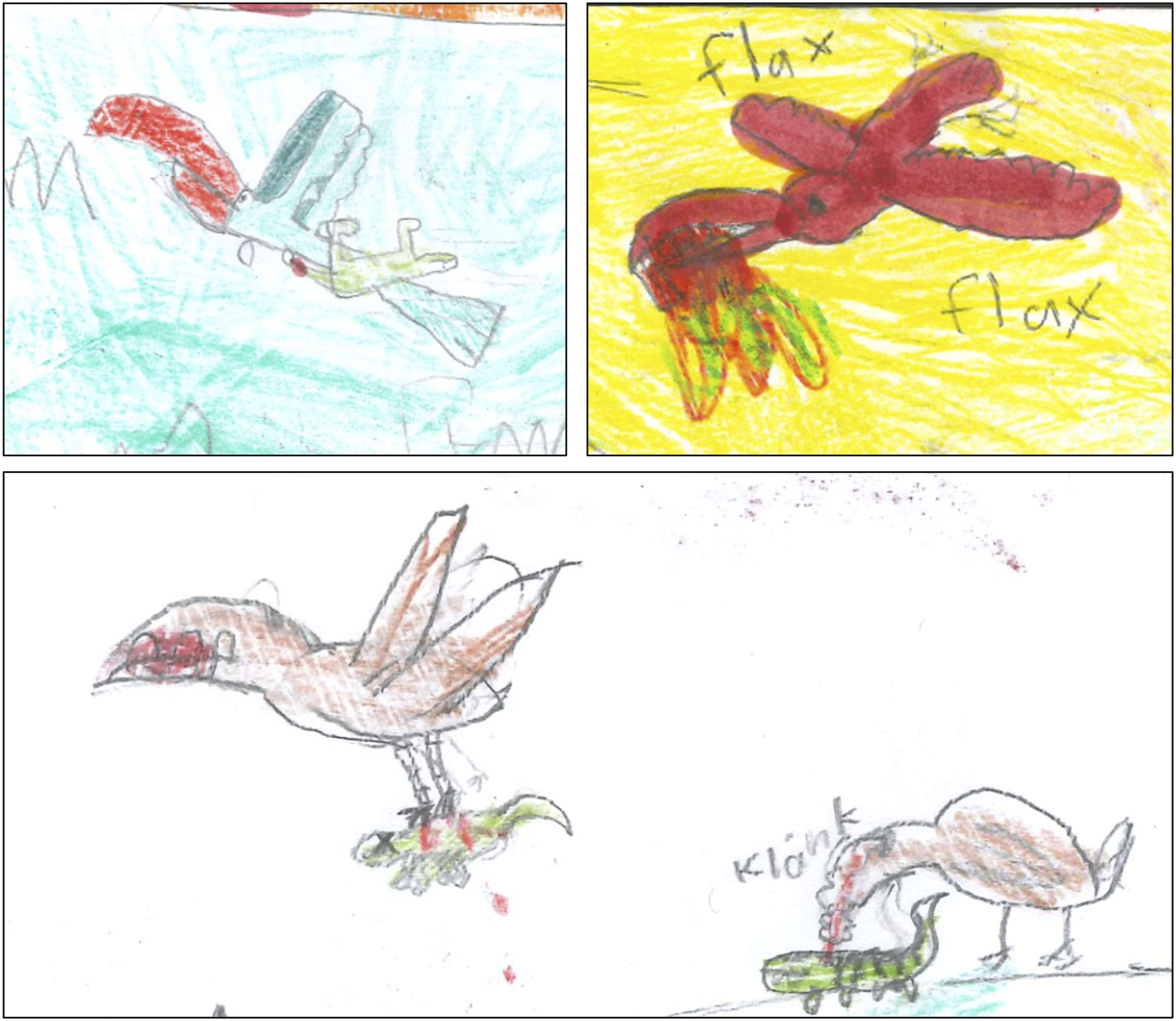
In Anton’s comic (bottom), one bird takes off with an unarmored lizard, while the other lizard is protected by its armor. Furthermore, in caption boxes (not shown in Figure 4), Anton has also written “But after a while some giant birds arrived. Those with armor survived. But those without armor died out”. Thus, in his multimodal ensemble, image and writing complement each other, and Anton demonstrates a transduction from speech and embodied actions (in Example 2) into image and writing in the final product. The writing explicates the selective process linked to the lizards’ survival, while the image shows the connection between the predatory behavior of the attacking birds, the placement and function of the armor, and how these aspects interact in the selection process.
Unlike the armored shell, the curling up suggested by Anton (Figure 3) is not found in the finished comics; no lizards appear curled up in the armadilloesque fashion that he has previously suggested in the interaction between the boys. This goes to show that, indeed, not all suggestions from the interaction are utilized in the final comic.
In this section, we have demonstrated how the boys utilize two different starting points for negotiating different ideas about the lizard: one starting in the verbal description, the other in a drawn image, moving through multimodal orchestrations of using gestures, embodied action and speech to illustrate different conceptions of the function of the armor, resulting in different outcomes in the multimodal ensembles of the finished comics.
The color and the shape of the armor
In the next section, the design process again moves from speech to image, and then again from image to speech, illustrating this as both an individual and collective undertaking in the student group.
During the second lesson of the unit, Eddie and Anton have started drawing and writing, sitting next to each other, mostly working in silence. The two boys are sketching their lizards on their manuscripts and writing a short summary of the narrative—this will make up the concept idea for their final comic, where their images and writing are re-designed.
Example 4: Transducing ideas into drawn sketches
In Example 4 (Figure 5), we can see how Eddie creates his lizard with pencil and paper on his manuscript, transducing the verbal and gestural illustration of the armor (seen in Examples 1 and 2) into an image. He starts by drawing the head, outlining the length of the body, then adding dorsal plates, or spikes, that he pencils in. Eddie drawing the four stages of his lizard on his sketch.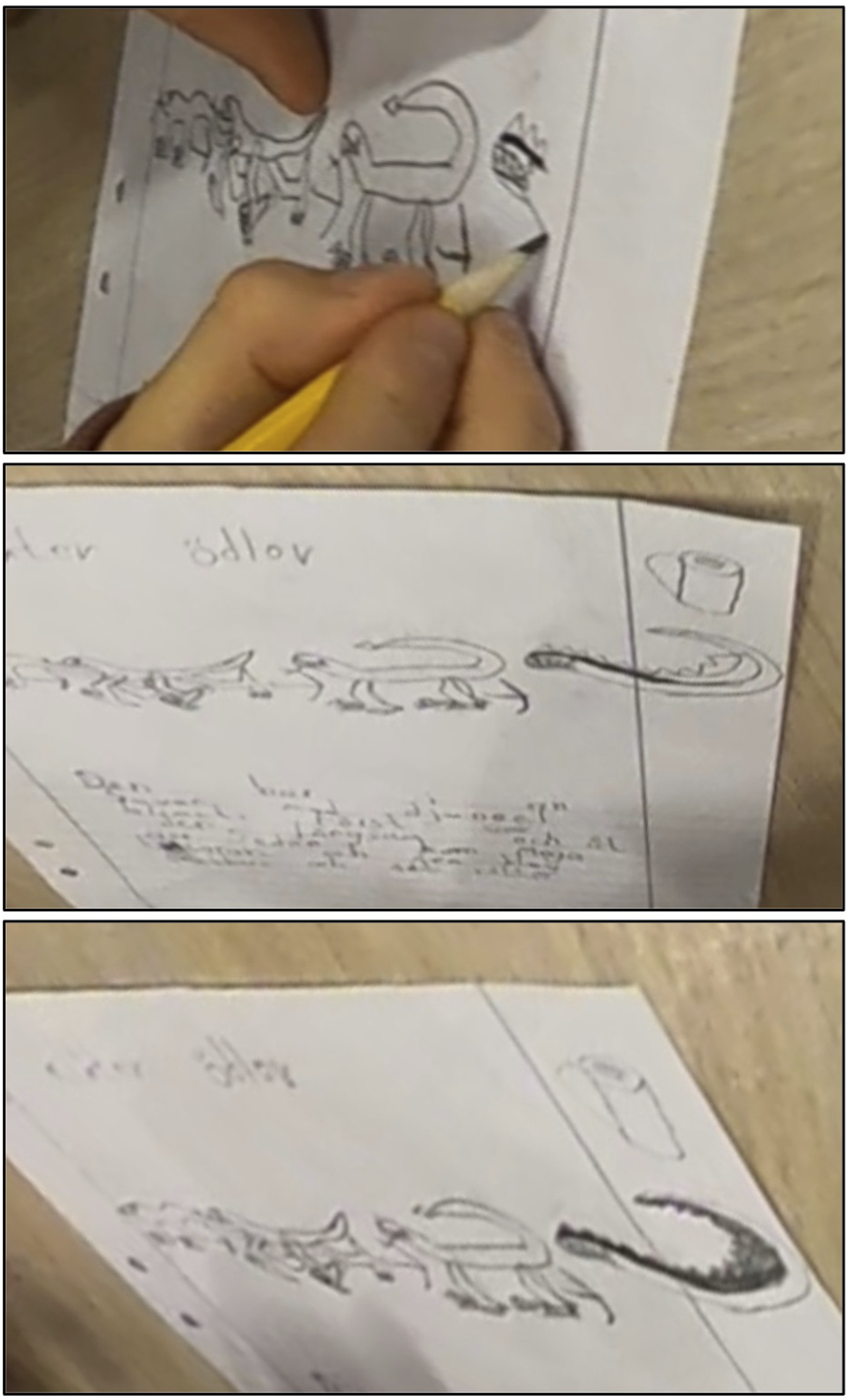
Eddie not only transduces the design of the previously, collectively, agreed upon armored back plate—putting to paper this version of the lizard—he also further develops this idea by adding attributes to the lizard, which redefines its shape, as well as adding a shade and color by using his pencil to fill in certain pieces of the design (Figure 5). Thus, apart from transducing the previous speech and gestures from the collective discussion (Examples 1–2) into his individually drawn image, Eddie also adds his own individual aspects to the design.
Example 5. Collaboratively creating a striped shell
In the next example (Figure 6), Eddie and Anton have their manuscripts in front of them, with four versions of the lizards drawn on each manuscript. Anton (left) pulls Eddie’s (right) manuscript closer to himself. Anton drawing stripes on Eddie’s lizard.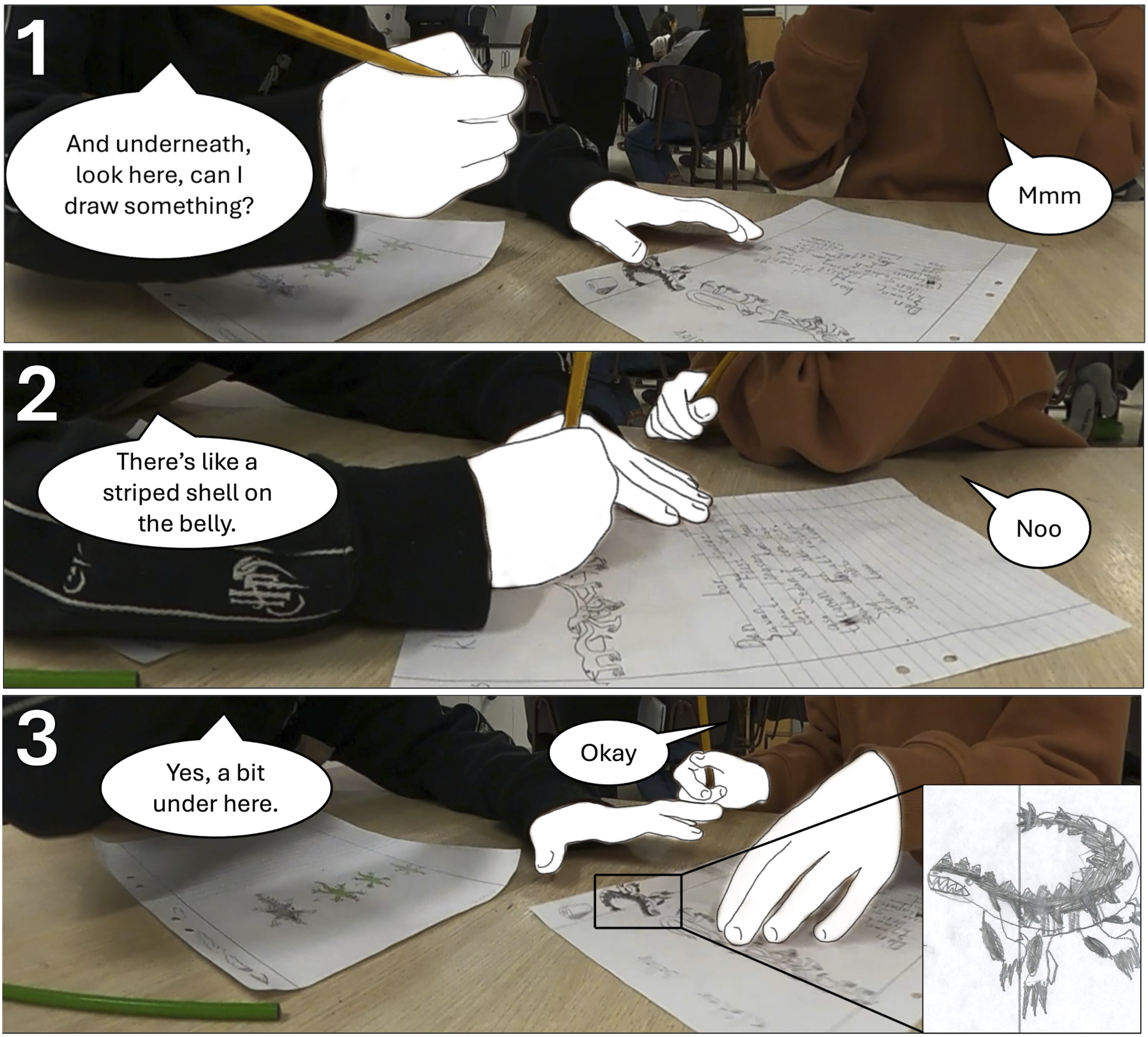
In Figure 6, we see how Anton physically interferes with Eddie’s image, using his hand to drag Eddie’s paper to himself (Figure 6, panel 1–2). He uses his pen to add armor to the lizard’s belly, while verbalizing that he is drawing a “striped shell … a bit under”, before letting go of the paper as Eddie takes it back (Figure 6, panel 2–3). In this sequence, the individual act of transduction, drawing the armored lizard—from Example 4—again becomes a collaborative act. Furthermore, the affordances of the different drawings, which Eddie and Anton have made, allow for different interpretations and developments in the design. Anton’s manuscript (see Figure 3, panel 5) portrays the lizards from above, while Eddie’s lizards are depicted in profile (Figure 5). This means that, unlike in Anton’s manuscript, the bellies of Eddie’s lizards are visible, making it possible to make this addition of stripes to his sketch, necessitating Anton’s physical interference with Eddie’s representation.
Re-designing the color and the shape of the armor in the finished comic
Looking at Anton’s re-design in his finalized comic (Figure 7, lower left), the armored lizards have changed from his manuscript (Figure 7, upper left) in two distinct ways: an addition of stripes on the bellies and the depiction of the lizards in profile—both aspects mimicking the way Eddie’s lizard looks in his manuscript, after Anton has added stripes to it. However, in Eddie’s finalized comic (Figure 7, lower right), the lizards do not have striped bellies. Anton’s (left) and Eddie’s (right) armored lizards as designed in their respective manuscripts and final comic.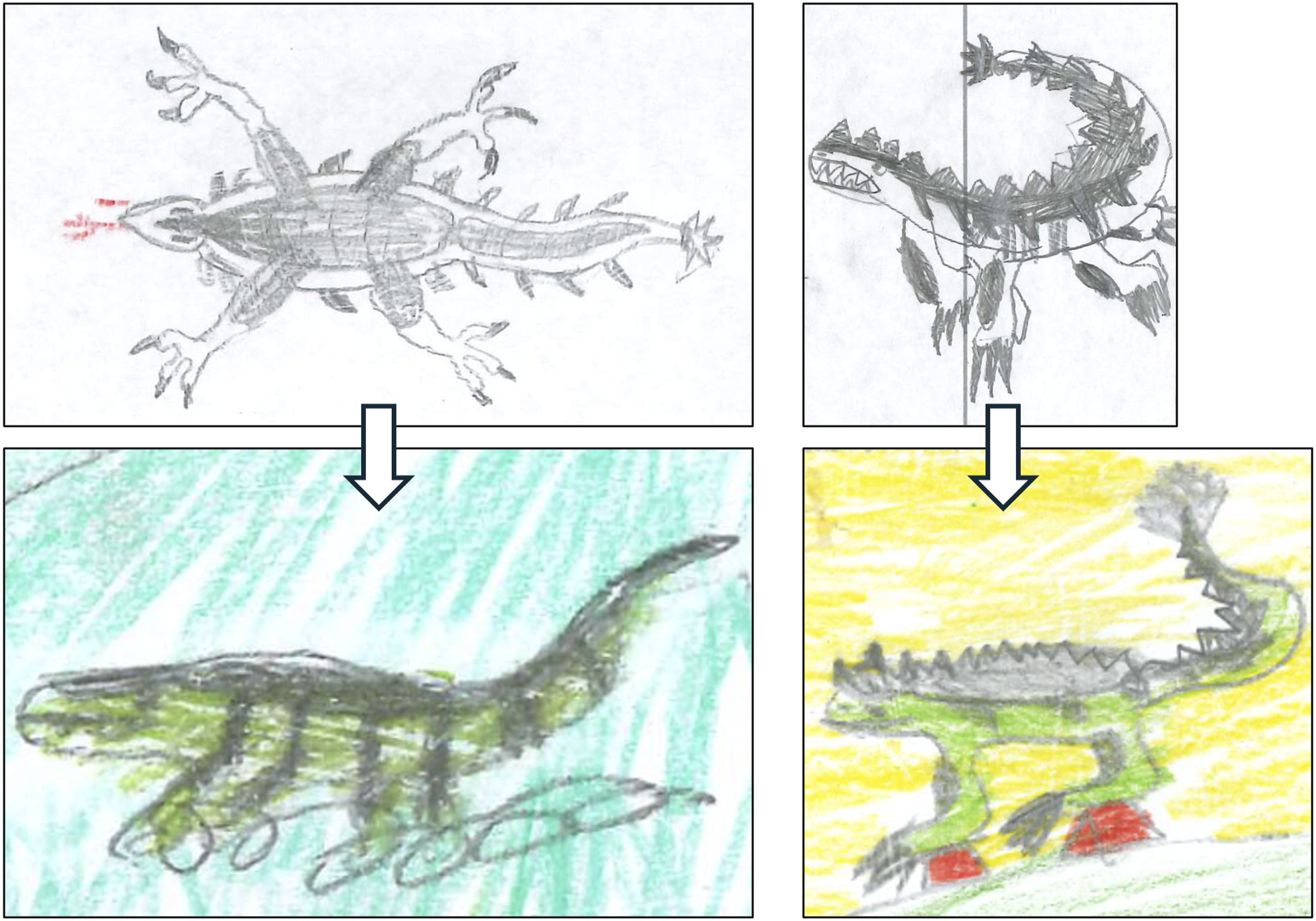
Thus, despite the collective act of drawing in the manuscript phase (Anton adding stripes to Eddie’s lizard), the choices in the re-design of the armored lizard in the final comics are individual—Anton chooses to change his pictorial design of his lizard, whereas Eddie chooses to keep his—both boys ending up following their own ideas.
The hardness of the armor
In the final section, the design process focuses on a multimodal orchestration demonstrating the armor as hard, which is then re-designed as a multimodal ensemble in the comic. In the following, two of the boys are using a combination of speech, gestures, drawing and writing to produce a quality of hardness in the suggested armor.
Example 6. Multimodal orchestration of a characteristic
After a couple of lessons where the boys have collaboratively and individually worked with creating their comics, Eddie and Henry are finished, while Anton is still working. As the following example begins, Anton has moved over to one of researchers, showing the progress of his comic, accompanied by a peer, Sebastian. In conversation with the researcher, Anton reflects on how to represent the function of the armor as protection against predator birds (as was displayed through speech, gestures and embodied reenactment in Examples 1 and 2). The researcher suggests that the birds could say something in a speech bubble as they try to capture the armored lizards, but Anton rejects this idea, instead suggesting the use of a sound effect to put the effect of the birds’ pecking beaks into narrative focus. This idea is then further elaborated by Sebastian.
In Figure 8 (panel 1), Sebastian verbally suggests that Anton should draw an armored lizard and a bird, initiating the use of images to illustrate the function of the armor. Anton’s response “or like this peck peck peck” (Figure 8, panel 1) pinpoints the predator bird’s pecking action as a sound (cf. Wallner, 2019). Here, Sebastian uses a deictic gesture to draw their attention to a (for us, unknown) detail in Anton’s comic (Figure 8, panel 2), while he verbally accentuates the bird attacking, following this with an iconic gesture (panel 3). Through multimodal orchestration, Sebastian represents how the predator bird’s beak is compressed as it slams against the armored lizard (Figure 8, panel 3–4), indicating that the armor not only acts as a protective shell, but also that it is hard enough to damage the beak of the attacking bird. Anton responds with a smile, while also saying “clank!” (Figure 8, panel 4). Thus, Anton, as part of the collaborative meaning making, produces the sound effect, illustrating the metallic sound of the bird’s beak meeting the hard armor of the lizard, further strengthening the meaning of the hardness. The sound effect is then repeated by Sebastian (Figure 8, panel 5), together with another iconic gesture of the compression of the beak, further enhancing the collaborative nature of this interaction. Sebastian suggests that the beak should become flat.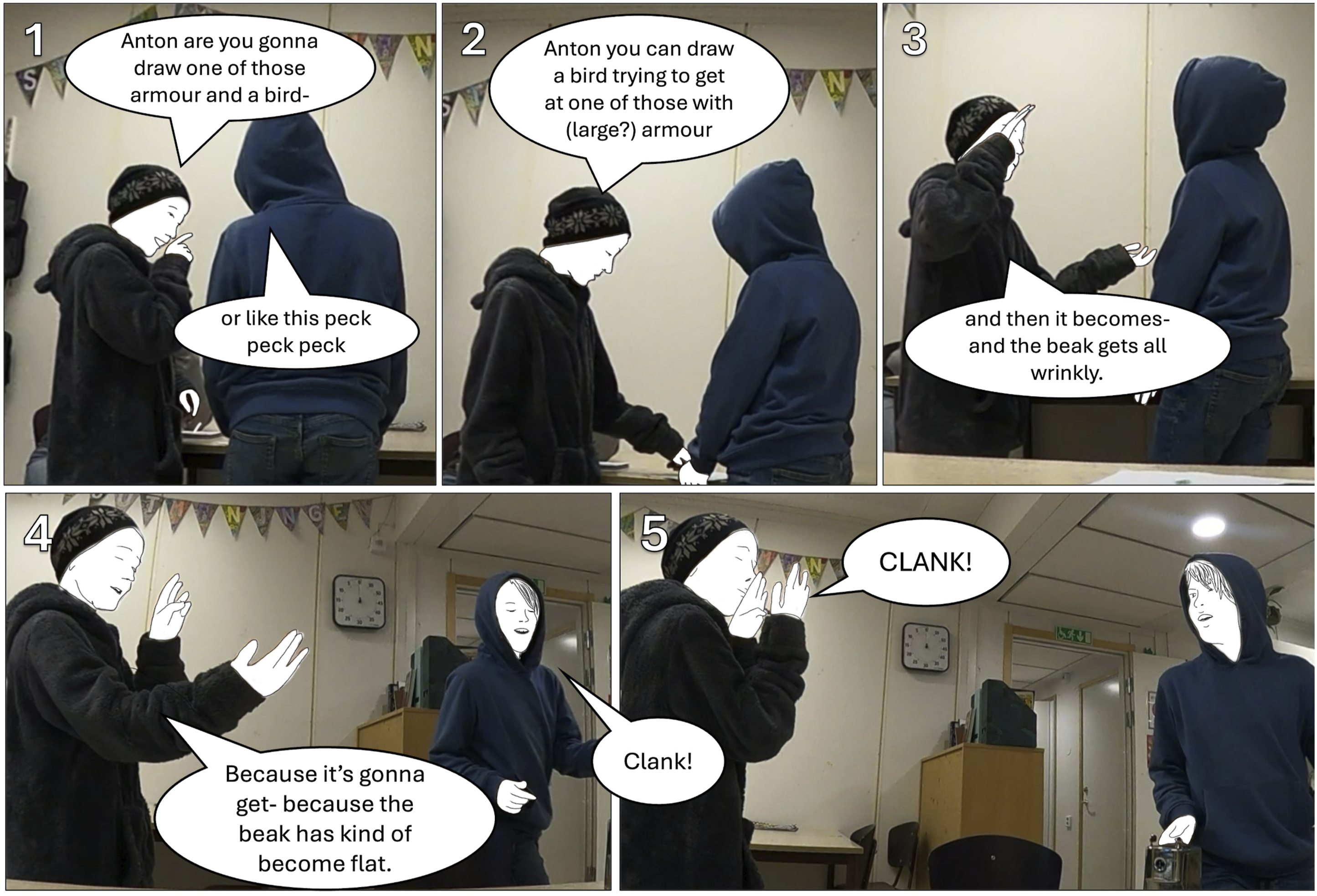
Re-designing the hardness of the armor in the finished comic
In Anton’s finished comic, we can see how he has transduced the meaning of the interaction with Sebastian into images and words.
Figure 9 shows how Anton creates a joint meaning of the hardness of the armor in his finalized comic through a combination of sound, writing and image. In his task of representing the characteristics of the lizard’s armor, he draws the predator bird attacking an armored lizard and receiving a wrinkly beak as a result of this effort. Furthermore, Anton has added the sound effect, “clank” (Swe: “klånk”), in writing—next to the bird’s head. Thus, Sebastian’s suggestion of a wrinkly beak and iconic gestures in Example 6, are here re-designed as an image of a bird with a wrinkly beak, and as written text as a sound effect, “clank”. The predator bird getting a wrinkly beak, trying to penetrate the lizard’s armor.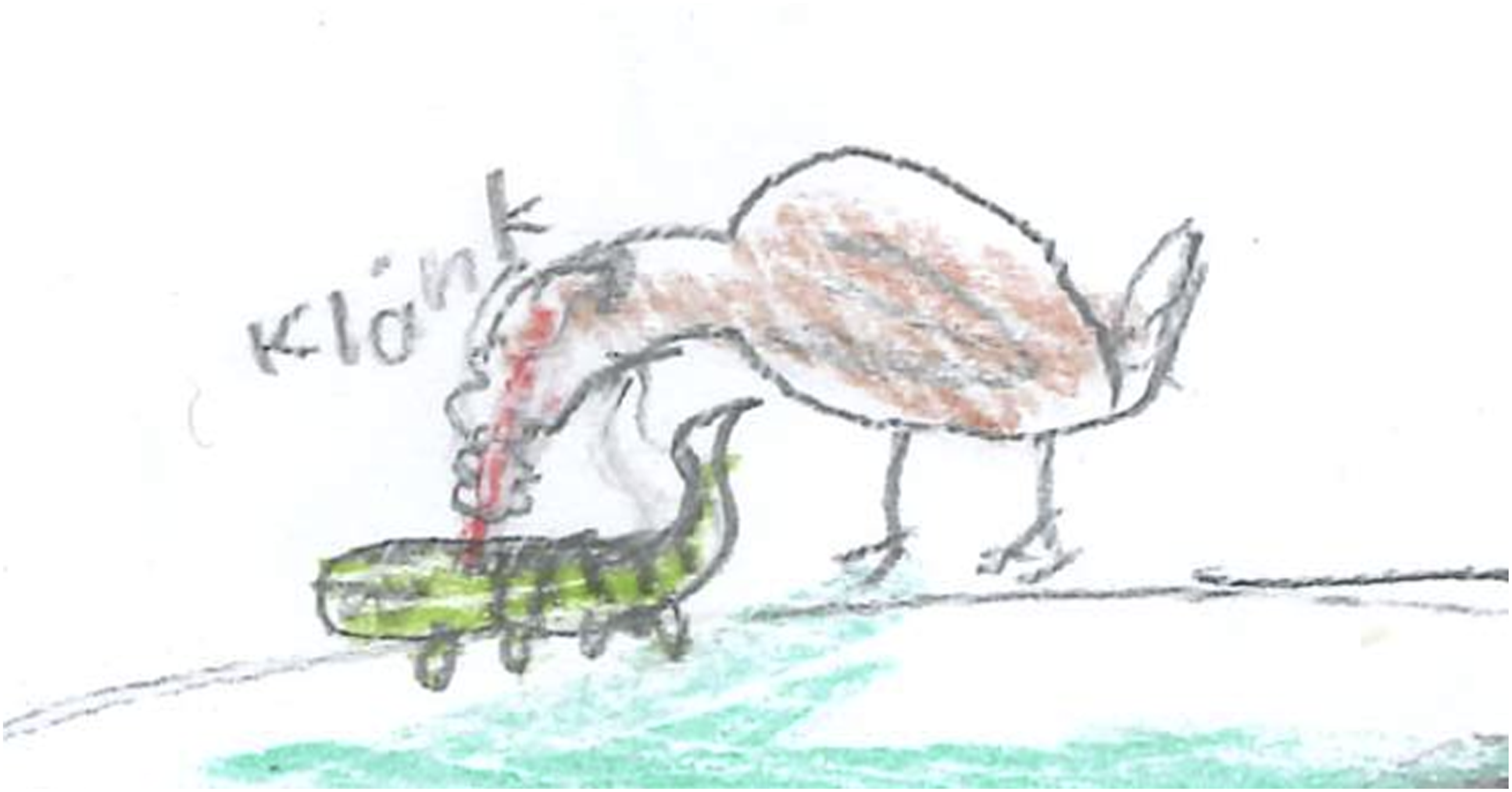
Discussion
In the current study, we explore how different semiotic modes are used when three students design a comic to create an evolutionary trait, armor; how aspects of the armor are transformed within and transduced between different semiotic modes throughout the meaning-making process. Our analysis demonstrates that the students’ design process is not linear, but rather multifaceted and complex, which shows the benefit for teachers to document and assess the students’ process itself, rather than simply assessing the final product of—in this example—the comic (cf. Newfield, 2014). For example, the analysis shows that these students make design choices in their comics design process, which are never realized in the final product, such as Anton’s embodied reenactments in Example 3, illustrating how a lizard can crawl up to protect itself from predators, which are not transduced into either images or writing in his final comic.
The affordances of the comic book medium allow for the boys to express their knowledge about evolution through a combination of writing, drawing, sequence, and sound. In a previous study (Aringer et al., 2025), we have analyzed 14 student-generated comics, produced by the case study students and their classmates. Compared with other individual writing tasks, the narrative frame and creative freedom directed the students’ focus toward evolutionary principles (variation, heredity, and selection) rather than reconstruction of a ‘true’ evolutionary history of a species. Furthermore, the multimodal nature of the comic media allowed the students to transduce their ideas into multimodal ensembles, where they utilized the affordances of different semiotic modes (image, writing, sound effects) into a joint whole—representing their understanding of evolution through natural selection (for more details, see Aringer et al., 2025). In the current article, we have analyzed the process through which some of these comics are produced, and we find that students also experiment, discuss, and negotiate different design choices—some that end up in the finished comics, and some that do not. Thus, focusing our analysis on the creative process, we see that the collaborative nature of the task provides students multiple opportunities to engage in meaningful interaction that expands and deepens the meaning making (cf. Sjøberg et al., 2023).
Our analysis shows that students draw on modal affordances in their representations of the armor. More specifically, we see a pattern where verbal and gestural orchestrations function as prompts for the subsequent drawing and writing. For example, the students talk about the placement and function of the armor before transducing this content into the drawings and writing. This pattern is in line with findings from, for example Park et al. (2021), who have shown that students often start with verbal planning before engaging in drawing. However, we also see that the discussion can be prompted by pictorial or gestural representations. For example, Anton uses his sketched drawings of his lizard, transducing the drawings into a verbal and gestural characterization of how the lizard ‘curls up’—something not actually shown in the drawings themselves (Figure 3). Similarly, Sebastian’s iconic gestures, illustrating the compressed beak, are transduced into an image in by Anton. Thus, both drawings, iconic gestures and verbal talk serve as triggers for further exploration of the armor. This finding aligns with results presented by Sjøberg et al. (2023). Similar to how their undergraduate students use deictic gestures to point out details in drawings, which are subsequently elaborated through speech and iconic gestures, our analysis suggests that the collaborative nature in the task of making comics promotes student engagement in more in-depth discussion of the evolutionary content.
Previous studies on student-generated comics in science education have primarily focused on analyzing the finished multimodal ensembles (Aringer et al., 2025; de Hosson et al., 2018; Pantaleo, 2021, 2022). This study contributes knowledge on how students engage in the creative process. To enable students to make general scientific arguments, they need to be able to make transformations and transductions of their ideas across different semiotic modes. We argue that the creation of comics invites students to engage in transformation and transduction of the content, which in turn provides them the opportunity to generalize, abstract, and perceive connections beyond a single representation (cf. Patron et al., 2021). In this study, the students’ verbal reasoning about the armor is gradually transduced into iconic gestures, sketches, and later writing and images. Hence, through the process of creating a comic, these transductions appear not only to support the students’ understanding of the biological content, but also to function as a prerequisite for their ability to formulate more general conclusions about function, selection, and adaptation. This further suggests the importance of providing students with time and space to engage in activities to build their multimodal competency in science communication (Nichols et al., 2025, see also Gregoric, 2024).
We also see that comics and science are complementary in this study. de Hosson et al. (2018) and Pantaleo (2021b, 2022) show that students combining these aspects sometimes include incorrect scientific information, or exclude scientific aspects, to ‘improve’ the comic narrative. In our study, we see examples that the two (the comic and scientific conventions) are not mutually exclusive. Figure 9 displays a convincing combination of the scientific and comic narrative, conveying the armor as a protective trait. Even though the design of the crooked beak can be seen as part of a humoristic comic convention—as it is not particularly realistic—it also plays an important role in the scientific narrative in Anton’s comic demonstrating a ‘hardness quality’. That is, the choice of not following the scientific convention (portraying a straight beak), but instead applying a more humoristic approach, rather emphasizes the scientific content. Moreover, the scientific content of the task, explaining evolution, is ever-present in the boys’ work. They continuously negotiate the function of the armor, for example addressing its placement in relation to the predator threat (see Example 1–3). Nevertheless, the artistic aspects of the task are also actively discussed, such as how to depict the shape and color of the armor in their drawings (Example 4–5), or if the armor would also appear as stripes on the belly (Example 5). In the end, the individual designs in the comics show a range of how the boys portray the visual aspects of the armor (see, e.g., Figures 7 and 9).
In conclusion, we see several possible implications for classroom work from the current study. Our analysis demonstrates how teachers can work with the comic book narrative to encourage students to make transductions between different modes in their design of natural science narratives, something that actively encourages sequential natural-science reasoning, as well as thinking in different semiotic modes. Although we are only able to demonstrate the work of three students, the analysis shows a method of great potential for future work in primary school classrooms. If teachers are able to organize classroom work in smaller groups, find ways of documenting students’ work processes (not just the end product), and actively encourage students to transform and transduce scientific ideas as part of their classroom work, this would enable teachers to see in greater detail how students engage in meaning making around scientific phenomena through transformations and transductions, and how multimodal interaction is an active learning process in the classroom.
Footnotes
Acknowledgments
The authors wish to acknowledge and appreciate the partaking teacher and students, and our colleague Ammie Berglund at Uppsala University, without which this study could not have been conducted. We also thank the research environment at Pedagogical Work in Norrköping, whose collegiate were kind enough to provide feedback on an early version of the manuscript.

Ethical considerations
The data was collected according to the ethical standards of the Swedish Research Council and following Swedish law.
Consent to participate
Written informed consent was provided by all participants. The study has been approved by the Swedish Research Council with the approval number 2023-07836-01.
Funding
The authors disclosed receipt of the following financial support for the research, authorship, and/or publication of this article: The work underlying this article was funded by the Swedish Research Council (Grant Number 2023-04108).
Declaration of conflicting interests
The authors declared no potential conflicts of interest with respect to the research, authorship, and/or publication of this article.
Data Availability Statement
No data is available from this project.