




Abstract
As they undertake the globe-spanning work of trade and commodity distribution, container ships are often said to exist in the strangely hidden and largely inaccessible networks characteristic of capitalist modernity, literalising globalisation’s metaphors of seamless flow. But what is the effect when this flow is ruptured, and the container ship or the shipping container come to a sudden halt? This article analyses literary texts that reflect on moments when container ships become eerily immobile in coastal waters and when shipping containers make unexpected and unsettling landfall in ports and on beaches. Such sequences hinge on a gothic imaginary that locates the uncanny qualities of the shipping industry not in its haunting invisibility, but in the horrors that attend the too tangible, too material, too abundant presence of ships and their containers. The texts examined here see in the immobility of shipping a suggestive figure for two forms of apocalypse: the end of the world and the end of narrative possibility. Relatedly, the shipping container functions as a hyper-modern iteration of the gothic crypt, an ambivalent site of death and powerfully inscrutable, an object that will not yield the secrets it conveys. Authors under discussion in this article include Horatio Clare, John Ajvide Lindqvist, Emily St. John Mandel, and Lucy Wood.
Introduction
In an iconic sequence from the Planet of the Apes film series, a human survivor of the apes’ uprising is travelling along the seashore of an apparently strange new world when a ruined but still familiar object looms up, wrecked and partially buried in the coastal sands. At the climactic moment of the original Planet of the Apes (1968) this object is the Statue of Liberty: a symbol that, by the logic of the film at least, stands in for all that humanity can be imagined to have lost – namely, those imperial forms of freedom, liberty, and democracy particular to the US in the mid-twentieth century. Something similar happens in the most recent entry in this film series, 2024’s Kingdom of the Planet of the Apes. Again, a captive human survivor is being drawn along the sands of a beach, but what we see hove into view is not a recognisable symbol of national identity, but the rust-eaten hull of a decrepit container ship (Figure 1) – one of many such vessels shown to be wrecked along the coast (Figure 2). The dramatic spectacle of this moment, beyond the ships’ imposing scale, has to do with the vision they offer of collapsed infrastructure and the decimation of globalised networks of trade and trafficking characteristic of the neoliberal world order the film elegises. The wrecked ships symbolise the loss of a globe-spanning and transnational ocean-bound capitalist economy without which, it is suggested, we are beached, literally and figuratively. Global trade – and the work of the modern container ship in enabling this trade – is revealed as the haunting wreck at the heart of Kingdom of the Planet of the Apes. Moreover, part of what renders this sequence in the film so striking is the fact that the narrative unfolding in Kingdom of the Planet of the Apes betrays no real interest whatsoever in these wrecks: where the Statue of Liberty prompts a moment of existential anguish for the human survivors, the nameless container ships, by contrast, do not elicit a passing remark. Indeed, by receiving effectively no comment within the film itself, the narrative goes some distance to render invisible or unspoken the vessel in ways that strangely replicate the invisibility and odd sense of intangibility that is often said to envelop such vessels and the oceanic trade networks they voyage through in our world.
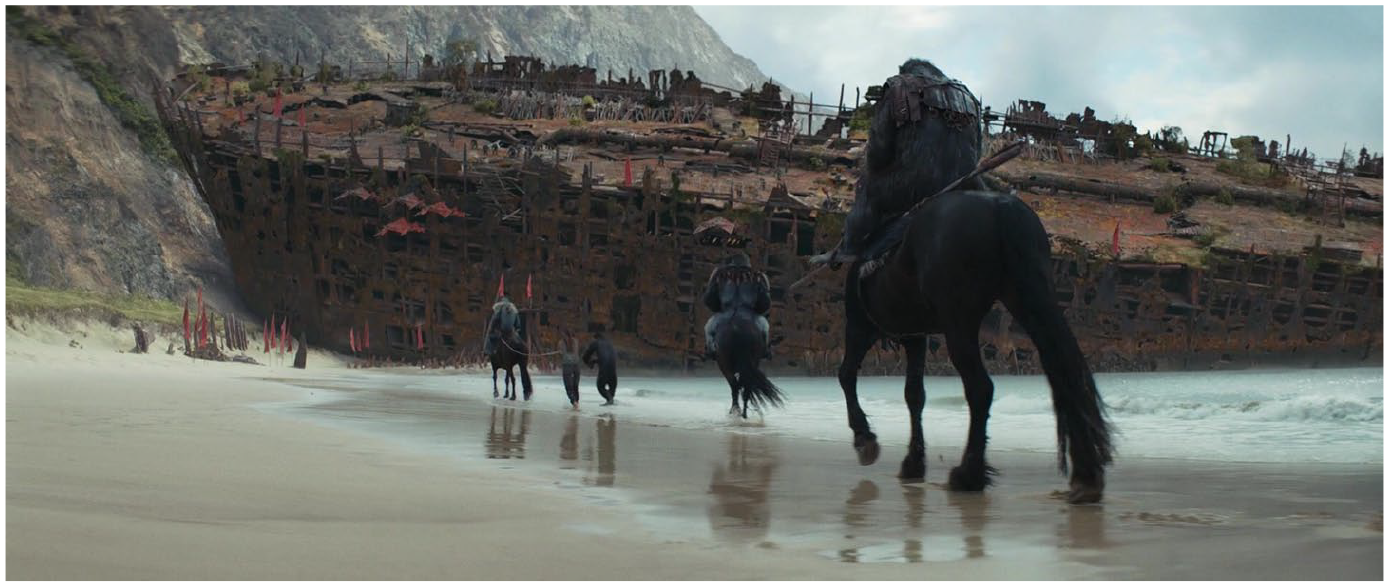
A wrecked container ship in Kingdom of the Planet of the Apes (20th Century Studios, 2024).

Another view of wrecked container ships in Kingdom of the Planet of the Apes (20th Century Studios, 2024).
Dwelling with such visions of wreck-strewn littoral zones, in this article I discuss the container ship and the shipping container as they exist at moments of rupture: in those moments where these objects no longer sit somewhere beyond the horizon line – apparently seamlessly performing the work of globalised trade and commodity distribution – but have instead come to a stop, making unexpected and unsettling contact with the terrestrial spaces of ports, harbours, and beaches. In particular, I am interested in fiction and nonfiction that conceptualises the container ship and shipping container in strikingly and meaningfully gothic ways – as we see in works by authors such as Horatio Clare, John Ajvide Lindqvist, Emily St. John Mandel, and Lucy Wood. By adopting this focus, this article has several intersecting aims. First, I want to examine the role of the container ship and its cargo in contemporary literature. While there are several notable studies of the political histories of container shipping – most influentially in the work of Allan Sekula and Laleh Khalili 1 – I am specifically interested in the ways in which the container ship, and the horror and terror that might stem from its monolithic presence, functions as a potent hyper-modern iteration of gothic literature’s enduring fascination with haunted (and haunting) seafaring and maritime wreckage. Second, I am interested in the container ship as a productive bridge between the field of gothic studies – specifically the critical field of the globalgothic – and littoral studies. My aim in this respect is partly to make a case for the profoundly littoral and oceanic qualities that saturate, but remain under-theorised within, globalgothic studies, a mode of scholarship concerned with the gothic’s globalised presence and the relationship between gothic media and globalisation. This article thus explores popular depictions of ships and containers that have washed ashore or have otherwise become static objects in order to emphasise the value of a language of uncanny stasis, stagnation, and immobility to reflections on global capitalism. Such language, I argue, functions as an important counterbalance to the more familiar rhetoric of flows, fluidity, and mobility, that pervades popular and critical accounts of capitalist modernity.
The container ship is not really meant to be especially visible at the shoreline for prolonged periods of time; this notion is felt especially forcefully when such vessels collide with littoral infrastructure, as evidenced when the MV Ever Given ran aground in the Suez Canal in 2021 and when the MV Dali struck the Francis Scott Key Bridge in the Port of Baltimore in 2024 – an event described by the Governor of Maryland as ‘a global crisis’. 2 The container ship is performing its work most efficiently while it remains, for the vast majority of us, largely spectral. ‘The machinery of capital’, Khalili writes, thrives when it is ‘inaccessible, invisible, hidden behind the veils of security and bureaucracy and distance’. 3 The task of bringing the notionally peripheral workings of capitalism into view – while reminding us of the logistical and ethical labour that goes into defining and maintaining the conceit of peripherality – sits at the heart of much scholarship in the field known as ‘globalgothic’. Theories of the globalgothic seek to articulate critical frameworks through which we might better apprehend the (non-)presence of globalised networks of trade and commerce, the hegemonies such networks serve, and the localised forms of exploitation that go into upholding them. Initial theorisation of the globalgothic sought to demonstrate how the gothic has ‘energetically participated in the cultural flows and deterritorialisations that characterise globalisation’, while also registering the ‘transforming and defamiliarising’ of traditional gothic tropes as a result of ‘the increased mobility and fluidity of culture’. 4 This gothic mode gives ‘form to anxieties attendant upon the processes of globalisation: anxieties about such issues as the stability of local or national identities and cultures, about the impact of transnational capitalism or the workings of technology’. 5 This emphasis on metaphors of liquidity echoes the language of neoliberal capitalism and its attendant ‘hydroculture’: a language, Sharae Deckard notes, of ‘fluidity, hypermobility and ubiquity paradoxically conjoined with occulted visibility’. The result of which is that ‘[t]he material global infrastructures of pipes, pumps and container ships is less tangible than the liquid that emerges from the tap’. 6
The gothicised narratives of container shipping that I discuss below participate, I argue, in the globalgothic tradition, and thus do much to help recentre the oceanic at the heart of this particular offshoot of the gothic. If globalgothic has often been curiously blind to the sea – to this (deliberately) ‘forgotten space’ of modernity, as Allan Sekula has it – then to echo the language of capital(ism), via a rhetoric of flows and liquidity, is not merely to be speaking figuratively, but to implicitly register that ‘[g]lobal capitalism is a seaborne phenomenon’. 7 It is a phenomenon, moreover, wherein ‘the sea is coded as smooth and seamless background’ to – and thus silent and occluded presence behind – its daily functioning. 8 Yet, in what follows, I am less concerned with forms of flow and liquidity, and, relatedly, the desire to be rendered spectral (to operate unseen and unobtrusively) that inheres within the infrastructure of global capitalism. I am interested, instead, in using globalgothic narratives of container shipping in order to foreground the moments when the illusion of flow, liquidity, and spectrality break apart, moments where ordinary humans are forced to contend with the (ironically) immovable behemoths that are container ships and the haunting, devastating abundance signified by the shipping container. Following Rebecca Duncan’s compelling revisionist approach to the theory, globalgothic is valuable for ‘the challenge it mounts precisely to that vision of the global as a frictionless and dematerialised space of transnational commodity and cultural flows’. 9 Coastal encounters with the ship and the container offer especially rich opportunities in this regard, as the coast – the port and the harbour – is where the ‘seaborne phenomenon’ of global capitalism makes landfall. In the following sections, I am interested in what happens when that landfall is not ‘smooth and seamless’, when it is disrupted and disruptive, when mobility and flow become stasis – become, in turn, deterioration or putrefaction.
In the next section of this article, I discuss how we can begin to apprehend the relationship between the gothic and the world of container shipping, focusing on accounts in which static and immobile container ships are imaginatively aligned with the ends of the world: one such vision is offered by Kingdom of the Planet of the Apes, as discussed above, and further examples can be found in Horatio Clare’s Down to the Sea in Ships (2014) and two novels by Emily St. John Mandel, Station Eleven (2014) and The Glass Hotel (2020). In the final part of this article, I move focus from the ship to the container, and to stories in which these objects either wash ashore or are deliberately abandoned in port-towns, and become globalgothic iterations of the gothic crypt: I dwell in particular on the example of Lucy Wood’s ‘Flotsam, Jetsam, Lagan, Derelict’, a tale from her 2018 collection The Sing of the Shore, and connect it with John Ajvide Lindqvist’s novel The Kindness (2020). Finally, what emerges across both sections is the failure of narrative – especially narratives that foreground a privileged, largely Western, neoliberal perspective – to reflect on or make space for globalisation and its implications when confronted by the tangible fact of the immovable and unreadable agents of global trade. The container ship and its contents exist beyond the horizon of narrative possibility, and the texts thus dramatize the mystification of critical apprehension occasioned by individual encounters with the oceanic operations of capitalist modernity – conjuring a state of perplexity that enables these vessels to slip quietly back into their occult worlds and beyond reproach.
Cyclopean Machines at the End of the World: The Container Ship
The ship, and its often violent encounter with littoral space, occupies something of a privileged position within the gothic literary tradition. If the gothic is a literary mode that trades substantially on the eerie affordances of the coast, 10 the ship functions as an effective means by which thwarted heroes might be ferried away from their landlocked love interest, as a vehicle for uncanny returns and monstrous intrusions into not-so-safe havens, and, by their wreckage, as a potent spectacle of death and disaster. As Emily Alder has argued in her pioneering work on the place of the ship in the gothic imagination, oceangoing vessels elegantly embody the genre’s fascination with unsettlement, dislocation, and isolation: for ‘[a] ship in transit is constantly shifting on a shifting surface, self-contained and often out of communicative reach, functioning between lands, nations, or systems of governance, especially in times before modern telecommunications’. 11 The ship places the human voyager into a state of abeyance, drawing them, as it were, out of circulation for a time (or, worse, permanently). This is an existential condition that, as we will see below, continues to inform gothic reflections upon modern shipping, even as the container ship is no mere ‘adjunct’ of circulation, ‘but is central to the very fabric of global capitalism’, is, that is, circulation itself. 12 The typical or iconic gothic ship is perhaps a vessel from the age of sail – those ships liable to be becalmed, as in Samuel Taylor Coleridge’s The Rime of the Ancient Mariner (1798/1817), or most susceptible to a battering by tempestuous and unnavigable conditions, as in Charles Maturin’s Melmoth the Wanderer (1820) and Bram Stoker’s Dracula (1897). As Alder has shown elsewhere, these vessels continued to haunt the seas of nautical gothic fiction even as (and because) they were eclipsed by steam-powered ships that ‘revolutionis[ed] sea travel and warfare’, as well as maritime commerce. 13
Yet there remains something monstrous, too, about modern shipping; indeed, what comes to the fore as the gothic imagination turns to contemplate these new, faster, more capacious maritime vessels is not so much their potential for spectrality and eerie vanishment, but their horrific tangibility, a monstrously imposing and inhuman presence. If this is a hallmark of the gothic’s engagement with the container ship, we can glimpse the emergence of this trope in works that interrogate capitalist modernity’s industrial origins. Part way through the first volume of Capital (1867), Karl Marx reflects on upheavals to modes of production attending industrialisation’s reliance on increasingly colossal machinery and complex infrastructure: the means of communication and transport became gradually adapted to the modes of production of mechanical industry, by the creation of a system of river steamers, railways, ocean steamers, and telegraphs. But the huge masses of iron that had now to be forged, to be welded, to be cut, to be bored, and to be shaped, demanded, on their part, cyclopean machines [. . .]. Modern Industry had therefore itself to take in hand the machine, its characteristic instrument of production, and to construct machines by machines.
14
It is specifically railways and modern forms of ocean transport and their channels of communication – infrastructure foundational to the development of modern container shipping – that drive this change. As Marx reiterates: ‘the construction of railways and ocean steamers on a stupendous scale called into existence the cyclopean machines now employed in the construction of prime movers’. 15 There is something in the manner of the eldritch monstrosity and the creatures of the weird in Marx’s description of this outsized industrial machinery: from amidst the propulsive, mechanical rhythm of Marx’s own prose (‘to be forged, to be welded, to be cut. . .’) emerges a hauntingly gothic vision of self-generating monsters that exist independent of any human agent. It is ‘Modern Industry’ that has ‘take[n] in hand’ the creative process; it is the infrastructure that has ‘called into existence’ these ‘cyclopean machines’ – turns of phrase suggestive of weird inhuman sentience and utterly mindless replication. In Marx we find an early account of the way in which capitalist modernity and its mechanised and ocean-bound infrastructure might fire the imagination to operate in gothic terms. 16
This is something that continues to inform commentary on the world of the modern container ship. Horatio Clare, for example, offers a disorienting vision of the Port of Felixstowe at the start of Down to the Sea in Ships, his account of travelling as a passenger aboard two Maersk container ships in 2012 and 2013: Along the quays the giant machines are moored, higher than castles, longer than villages. This close to them you cannot see any entire. Vast hulls loom like steel walls at the end of the world, their bows the axe-heads of titans [. . .] My sense of scale is hopelessly overrun [. . .] At first the ship is a cliff-edge of dark red steel.
17
Like Marx, who we may well hear echoed in this passage, Clare’s words resonate with the language of myth (where Marx invokes the cyclops, Clare sees the titans) and of Romantic-era gothic. There is, however, a significant perspectival shift to note, here. As Clare journeys into the nebulous world of contemporary shipping, he does not stand like a Romantic wanderer at the cliff-top, enjoying a sublime panorama of the world at his feet. Instead, the encounter is bathetic, undercutting the promise of sublime encounter, as he clambers into the vessel from the foot of the ship’s ‘cliff-edge of dark red steel’, which forecloses for the time any view of anything else.
Clare’s vaguely unsettling encounter with the material reality of the shipping industry – with the thing itself – extends to his reflections on travelling aboard such vessels. Often operated by remarkably small crews, the human is a distinctly recessive presence amid the ‘cyclopean’ magnitude of the container ship and its cargo. ‘You are quite alone in these places’, Clare writes from the forecastle: The ship is alive to the swells and the wind and the beat of its diesel heart. The refrigerated containers, the reefers, moan and whirr. Steel boxes grate together, screaming and wincing. There are bangings and knockings from places in the stacks, as though ghosts or stowaways are imprisoned in the towering boxes.
18
I return to ghosts and stowaways in more detail below. What is significant for the moment is the sheer physicality and potential for being affectively overwhelmed that is underscored through passages such as these. By emphasising physical encounters and the materiality of the ship, and the role these play in forging gothic imaginaries of container shipping, these moments cut against a pervasive discourse of spectrality and invisibility that inflects much writing on the networks and infrastructure that support the work of container ships.
Undoubtedly, a haunting intangibility and inaccessibility is central to the operations of neoliberal capitalism in many ways. The working ports that service container ships often exist ‘behind layers of barbed wire and security – invisible, even forgotten. As ports and ships become ever more distended, they have also aspired to automation, with fewer and fewer seafarers and stevedores’. 19 Such distancing has profound ethical implications, especially when it concerns the livelihoods of the industry’s human workforce, as ‘inaccessibility shapes not only landscapes but labour regimes and living and working conditions’. 20 Perhaps the most notorious form this inaccessibility and displacement of authority and moral responsibility takes in the world of modern shipping is via so-called ‘flags of convenience’. While all ships are required to fly a national flag, it need not be a flag that aligns with the state or nationalities of its owners or operators. It is ‘a legal ruse, a lawyerly piratical dodge’ that enables shipowners to ‘circumvent national labor legislation and safety regulations’, by registering the ship to a nation with rather less robust regulation and oversight. 21 For many years Panama offered the most popular flag of convenience; it was overtaken by Liberia in 2022. 22 As others have noted, the result of this practice is ‘depressingly predictable: lower taxation, poorly enforced labour and environmental regulations, and fewer fuel efficiency standards’. 23 The effect is also to enshroud the issue of ultimate culpability in a convoluted web of shell companies and stooges. 24 When, in Emily St. John Mandel’s The Glass Hotel, a woman named Vincent, hoping to start a new life at sea, falls overboard from a container ship, an investigation into her disappearance acknowledges the difficulties they face. Vincent disappears near Mauritania in international waters, but the ship is flagged to Panama, which has ‘neither the incentive nor the manpower to investigate a disappearance off the west coast of Africa’: ‘It is possible to disappear in the space between countries’, the novel concedes. 25 Indeed, the container ship at sea is just such a space itself: Vincent has already wilfully disappeared from landed life.
But if such vanishments and spectral agencies are part of container shipping’s operational norms, then the gothic inveigles its way into this world by reminding us of the profound kinds of presence that might be concealed in the hidden and labyrinthine dimensions of such operations. For it is the work of the gothic to bring to light ‘everything [. . .] that ought to have remained secret and hidden’. 26 The gothic continuously implores its readers to see not what is not there, but rather to see what is, and has always been, there: our focus is drawn to the presences in our peripheries. The question of what might be made of those peripheral presences once they have been identified – and, moreover, as they fail to disappear back beyond the horizon line – is a paramount concern to the globalgothic visions of container ships in the work of Emily St. John Mandel.
Mandel is sufficiently fascinated by the hidden business of merchant shipping and the uncanny qualities of the container ship to make them a central feature of two novels: The Glass Hotel, as we have briefly seen, and her more famous (post)apocalyptic novel, Station Eleven. The fact that the books share characters who work in shipping (Leon Prevant and Miranda Carroll) suggestively conjures, at a level akin to metafiction, the unstable drift and shiftiness of this world. To be in the shipping industry, Mandel’s characters suggest, is to be behind the workings of the world, lodged in the interstitial space between global narratives, giving shape to those narratives; it is to be part of the process of (literal) global enlightenment. ‘Being in shipping’, reflects a former shipping executive in Glass Hotel, ‘had made him feel like he was plugged into an electrical current that lit up the world’. 27 The vessels suggestively offer the opportunity of communion with another world. Indeed, where Station Eleven proposes that the ships signify a ‘fairy-tale kingdom’, whose ‘lights might not be quite of this earth’, 28 Glass Hotel ends with a swift movement from container ship to spirit world. The final chapter of Glass Hotel provides an account of Vincent’s death by falling overboard, during which we follow her spectre as it finds its way to a coast at which she finds her mother – who disappeared in Vincent’s childhood – where ‘[s]he has waited so long for me. She was always here. This was always home’. 29 This begins to suggest a strange kinship between the container ship and oblivion and end-times that is given its fullest treatment in Station Eleven’s sustained meditations on the fleet of vessels moored outside Singapore harbour – a feature of the novel inspired by the actual so-called ‘ghost fleet’ of container ships that was moored outside Singapore as a result of the financial recessions in the first decade of the twenty-first century. 30
Station Eleven tells the story of a swine-flu pandemic that devastates the global population: the novel traces the pandemic’s emergence and details its aftermath by following a small group of survivors in Canada. Against the central narrative, the inoperative container fleet in southeast Asia exist as a curiously peripheral plot-point: yet what they ultimately offer is a countervailing vision of the end of the world. We discover the history of this fleet through the character of Miranda – whose name highlights her affinity to both water and the spectacle of shipwreck.
31
The ships, constituting ‘12 percent of the world’s shipping fleet’, have been left anchored and immobile some time prior to the collapse of civilisation, ‘laid dormant by an economic collapse’ that precedes the spread of the virus: these vessels are the forebears of the more ruinous freighters glimpsed in Kingdom of the Planet of the Apes.
32
Later we learn that this stagnant armada includes two new Panamax-class vessels that had yet to carry a single cargo container, decks still gleaming from the South Korean shipyards; ships ordered in a moment when it seemed the demand would only ever grow, built over the following three years while the economy imploded, unneeded now that no one was spending any money.
33
Local fishermen have come to suspect ‘a hint of the supernatural in these vessels, unmoving hulks on the horizon’, and Miranda wonders if there might be some truth in this. 34 After the spread of the pandemic, Miranda comes to realise that the skeleton crews aboard the vessels ‘wouldn’t have been exposed to the flu’; she ‘smile[s] at the thought that there were people in this reeling world who were safe’. 35 Modernity’s global networks, and the vehicles that navigate them, are both the monstrous agents of the pandemic’s spread and curiously exempt from its annihilatory force. Yet Miranda’s comforting sense of safety conspicuously disregards the alienation, loneliness, and horrors of stagnation that mark the experiences of those workers senselessly tasked with safeguarding these vessels.
Mandel’s container ships perform a ritual function in the midst of apocalypse. As Alexandra Campbell and Michael Paye argue, ‘[t]he behemoths on the ocean assure the CEO class of the strength of global regimes of accumulation, while indigenous communities recognise in these ships yet another round of invasion’. 36 For Diletta De Cristofaro, the endless construction of new vessels, which simply loom on the horizon line, bespeak a ‘neoliberal apocalyptic construction of the future as more of the same’; the system continues, unprofitably belligerent, in the face of economic collapse and the apparent failure of capitalism. 37 The ships embody a globalgothic vision of excessive industrial capitalist production that refuses to die despite the end of the world. They are, in fact, imagined as a refuge from apocalypse: they represent a site – and, perhaps, an ideology – that apocalypse cannot touch. Indeed, as Campbell and Paye suggest, the survivors of Station Eleven ultimately will not imagine a world in which the ships are not about to sail off again into the sunset, as they cling to something that might be ‘a utopian need for a form of globalisation’, ‘a latent colonialist desire’, or ‘entitlement to mobility in a post-pandemic world’. 38 In this respect, the container ships have a distinctly occult relationship with narrative itself. If apocalypse might be understood as an emphatic ending – an end to the possibility of further narrative – the ships exceed this moment, exceed narrative structure itself: the world of shipping slips tangibly between texts in the work of Mandel, and stands out as an uncanny remainder at the very limit-point of narrative possibility. A haunting connection between container shipping and (the death of) narrative also comes to the fore in texts that deal with littoral encounters with shipping containers that have been cast ashore. In the next section, I discuss the relationship between the container, the unintelligible, and the crypt(ic).
Down to the Sea in Crypts: The Shipping Container
The sudden, dramatic appearance on a beach of a shipping container or its spilled contents is often reported in such a way that foregrounds wondrous abundance while also highlighting the covetous behaviour of the crowds of people come to salvage what they can from this miraculous gift from the sea. Perhaps the most iconic example of this in recent British history is the running aground of the storm-damaged MSC Napoli off the Devonshire coast in January 2007: the vessel lost 114 of its 2,318 containers, eighty of which were washed ashore. The event was sufficiently notable to prompt ‘tenth anniversary’ press releases in 2017, reflecting on and commemorating the ‘nightmare scenario’, the rescue operation, and the ‘hoards [sic] of people’ involved in the ‘ransacking of cargo’. 39 A particularly striking part of the UK Environment Agency’s retrospective account of the incident concerns the loss of oil from the Napoli (approximately 302 tonnes of oil ‘was lost’): ‘The cargo’, we are told, ‘absorbed a lot of oil – dog biscuits lost from one of the ship’s damaged containers, proved particularly effective!’ 40 The environmental devastation threatened by the leaching of oil into the coastal waters is, in these remarks, fortuitously curtailed because of the abundance of other materials that have been swept into the sea. (What luck.) One excess of global trade is counteracted by another form of excess. The question of when excess might finally prove too much sits at the heart of the two stories of globalgothic abundance under discussion in this section: Lucy Wood’s short story ‘Flotsam, Jetsam, Lagan, Derelict’ and John Ajvide Lindqvist’s The Kindness.
‘Flotsam, Jetsam, Lagan, Derelict’ follows a married couple, Mary and Vincent Layton, who have retired 41 to a Cornish coastal village. Mary’s strolls on the nearby beach become disturbed when she begins to notice the accumulation of waste along the shoreline. She begins a cleanup operation that quickly becomes unmanageable: every day new and more material is strewn across the beach. ‘All along the tideline, as far as [Mary] could see, the beach was covered in small, sharp fragments’: ‘The more she picked up, the more she saw’. 42 It is also unclear where any of this waste can go, and Mary begins to keep it in her garage, which quickly fills up. At the end of the tale, Mary and Vincent find a locked shipping container washed ashore: it is an object they cannot possibly hope to remove, and the story ends as the couple are simply ‘stood there, together, watching it’. 43
Wood’s tale is fascinated with ‘the uncanny durability and endless disposability of plastic’. 44 While spillage from shipping containers is hardly solely responsible for marine and littoral plastic pollution, narratives of plastic items lost from these containers, most famously concerning rubber ducks and Lego pieces, offer an evocative frame for encounters with plastic at the tideline. 45 ‘Flotsam, Jetsam, Lagan, Derelict’ prompts us to make the connection between the abundant matter strewn on the beach and the shipping container, which, while locked, is shadowed by the prospect of all that it has failed to contain. Further, as Wood’s tale illustrates, the beach is the point at which the matter that has been swept out of the supposedly seamless flow of global trade, and has since been caught in the (literal) flow of ocean currents and tides, ceases, finally, to flow: it is where plastic detritus becomes, for a time at least, static. At the same time, Mary’s efforts to systematically restore order on the beach provide a form of reassurance to her unsettled mind, a means of establishing certainty in the face of material upheaval and inundation.
Following recent work by Timothy C. Baker, we can productively read Wood’s tale – particularly Mary’s response to the beach waste and the final appearance of a shipping container – as a gothicised kind of beachcombing. Accounts of beachcombing, Baker shows, frame their encounter with objects at the water’s edge ‘in terms of surprise and delight’, while ‘collection and display are shown as fundamentally narrative acts, and reveal the stories embedded in detritus and debris’. 46 Wood enables us to tune into the gothic potential of this conception of beachcombing via a disquieting reversal of what Baker identifies as the usual beachcombing narrative: Wood’s protagonist does not sift through the coastal sands in search of buried treasures, but must sift through the continuous accumulations of plastic debris and other manufactured materials in search of the sand that, presumably, still exists somewhere beneath the new inorganic topsoil of the Anthropocene. It becomes difficult, in the end, to tell where the inorganic ends and the organic begins, as Mary encounters ‘bits of Styrofoam that were exactly the same colour as the sand’, coming to learn that ‘[s]ometimes things looked like sand, but they weren’t sand, really’. 47 The tale hints towards a littoral biome wholly fabricated by inorganic materials that have come to uncannily mimic the organic world, as a form of gothic doppelgänger: nylon rope is mistaken for seaweed; microplastic ‘translucent beads’ appear ‘like clutches of eggs’; ‘a mass of hub-caps’ seems ‘like a stranding’; and the shipping container appears ‘draped in seaweed and barnacles’ – a sign, too, of the object’s long immersion in the ocean. 48 The globalgothic unveils the capitalist world as simulacrum.
Moreover: Mary’s response to the littoral pollution leaves something to be desired. The first unsightly apparition on the shoreline in the story is a small plastic bottle; Mary views this object with a curious ambivalence, less as pollutant, but as something out of place: ‘It didn’t look right. It didn’t look like it was supposed to be there’.
49
Instead of removing the bottle, Mary, we are told ‘scraped up a handful of sand and pressed it over the top of the bottle. Then she dug up another handful and did the same, until it was completely covered’.
50
This beach cleanup activity is starkly superficial – performing, as Maximilian Viatori puts it in his discussion of Lima’s polluted beaches, ‘the symbolic act of making local beaches less visibly “dirty”’.
51
The effect is really to transform the beach into a burial ground for the abject matter – plastics and other spilled or spilled cargo – of consumerist capitalism. Other solutions prove ineffectual, too: when Mary attempts to leave the rubbish out for the bin lorry to take away, she wakes the following day to find the bags burst and waste splattered across the road and caught in hedges. Mary ultimately discerns a futility in her work: Where would it all go, after it had been collected? It wouldn’t really be gone, wouldn’t it? It would just be somewhere else. It would be somewhere else, instead of here. Maybe, eventually, some of it would end up back on the beach.
52
In Wood’s short story, the ‘uncanny durability’ of this ongoing influx of stock and commodities that have already become superfluous matter engenders an economy of endless waste. Caught in the inefficient gyres of capitalism’s waste management infrastructure, these material goods-as-waste enter into endless circulation, even threatening haunting returns to the shores on which they first arrived (if, indeed, this is the point of first arrival). In this way, such goods-as-waste perform an eerie replication of the circulation of goods-as-commodities accomplished by the unseen container ships that implicitly float somewhere in the waters beyond the beach. In this system, nothing is truly gone; everything carries with it the capacity to haunt, to make tangible returns.
The uncanny aesthetics of ‘Flotsam, Jetsam, Lagan, Derelict’ are given final form via the appearance of the shipping container at the tale’s end. If encounters with found objects at the tideline suggest an object’s latent potential as narrative, as their ‘collection and display’ help to ‘reveal the stories embedded in detritus and debris’, Wood’s shipping container exists as something of a limit-point to narrative – the point at which narrative can no longer continue, the object beyond which narrative cannot see, akin in this respect to the ghost fleet in Singapore’s coastal waters. Prior to the container’s coming ashore, Mary’s patient gathering of rubbish from the beach has turned her garage into an ad hoc and largely unintentional site of curation; it is haphazard and excessive, and not so much conducive to narrative as queasy enumeration. The garage floor becomes a teeming mass of boxes and crates, ropes, plastic bottles, wet shoes, chipped and broken toys. There were reams of greasy netting with tins and plastic beads and pen lids caught in them; and a heap of oil cans and rubber gloves and mouldy bits of fabric.
53
Catalogued in this way, the matter – here, not so much vibrant matter as eerily teeming matter – does not tell stories so much as reiterate itself as matter, gesturing only back to itself as hauntingly, abundantly present. The container marks the dead-endpoint of this litany, the point at which Mary will no longer be able to restructure her world to soothe her unsettled mind. Mary spots the object on the beach and, we are told It towered up next to the cliff. Then she saw dark red metal. There was some kind of writing painted on the side. It was a shipping container, almost the size of the house, draped in seaweed and barnacles. It was padlocked. The metal was thick and corrugated. One side was bent inwards, like a chest when someone is holding their breath [. . .] It was, perhaps, unmovable.
54
The almost incantatory quality of the prose, which reiterates over and again what ‘it was’ like, probes at the container, but does not get very far: it reveals nothing of the inner life of the shipping container – neither what it contains, nor where it was from, nor the stories it might tell. Withholding its own narrative, the container also precludes narrative generally: confronted by the immobility of the object, Wood’s story ends.
The container is an unreadable text. Marked by ‘some kind of writing’, it raises the spectre of legibility while remaining nonetheless unintelligible. It is, in this regard, a preeminently gothic figure, both cryptic and crypt. The object (and its status as illegible text) ‘stands on the border of divulging and hiding, remembering and forgetting’. 55 The crypt – gothic literature’s foundational architecture – ‘is the repository of the secrets of the past [. . .], the site on which are stored all the stories which have been too painful, too embarrassing, too revealing to tell’. 56 In contrast perhaps to the work of the beachcomber, the crypt is the site of narrative entombment. If the shipping container is ‘the representative object of capitalism’, 57 then in the context of a globalgothic imaginary, we register the sepulchral dimensions of this identity. As crypt, and as cryptic, the shipping container is not only the vault through which the thanatic ‘teeming’ matter of global trade is conveyed, it is the inscrutable monument that refuses to divulge the hidden networks and invisible infrastructures out of which it has been unceremoniously torn. Unforeseen and uncanny encounters with the global trade of neoliberal capitalism, the globalgothic suggests, signal the mortal end of our ability to narrate, to know and make sense of the world, to soothe ourselves with the illusion that we, the human, are the planet’s ‘prime movers’. 58
The horrific human cost of the container-crypt sits at the gothic heart of John Ajvide Lindqvist’s recent novel, The Kindness. Much of this 800-page novel is concerned with the lives and loves of a small group of friends in the Swedish port town of Norrtälje. But these stories unfurl against a backdrop of increasing hatred and violence in the community, an apocalyptic breaking down of the social fabric, caused, it seems, by the inexplicable appearance one day of a locked, blank, and undamaged yellow shipping container in Norrtälje’s harbour. When the container is opened, it is found to contain the dead bodies of twenty-eight refugees from Syria and Afghanistan and a ‘brownish-black sludge’ that might be ‘something living’. 59 It is fear of this substance that prompted the dumping of the container in Norrtälje by the container ship’s crew, who have named whatever it is inside the container ‘Multo’ – signifying ‘a dead person, a ghost, or Death itself in the form of the ultimate horror’. 60 In much more overtly gothic terms than Wood, then, Lindqvist portrays the shipping container as a crypt, and as cryptic, as the folk of Norrtälje struggle to discern exactly what the object means and what it portends. At its heart, Lindqvist’s novel is oddly ambivalent about the global refugee crisis it engages as its source of supernatural gothic horror. The text is evidently fascinated by hatred, and perceives the ‘mutually constitutive relationship between violence and maritime commerce’, between neoliberal capitalism and war, especially in the context of Western involvement in the Middle East. 61 Yet The Kindness struggles to see a meaningful way beyond what the container comes to symbolise: namely, the racism at the heart of Norrtälje’s community, and the violence and displacement imposed by economies of the Global North and global petrocultures upon vulnerable and less-privileged populations.
As gothic crypt, Lindqvist’s shipping container, which envelops the port-town ‘in a cloud of death and putrefaction’, offers a suggestive updating of Bram Stoker’s account of a seaborne epidemic in Dracula. 62 The Demeter – the vessel engaged by Dracula as a means of travelling from Varna to Whitby – makes landfall and, as Emily Alder writes, ‘unleashes the vampire on an unsuspecting England’. 63 Dracula offers a compelling prototype of the narratives of globalgothic container shipping I discuss, especially in its preoccupation with the ‘Fifty cases of common earth’ that Dracula has conveyed to, shipped on, and unloaded from the Demeter. These cases function in their uniformity and easy haulage as proto-shipping containers; they are, moreover, mobile crypts in which the vampire might conceal and transport himself. 64 Indeed, Dracula offers a prescient insight into the murky networks of international trade and its infrastructures: following the Count’s arrival in England, much of the narrative is concerned with the vampire hunters’ efforts to track down all fifty ‘earth-boxes’, which have slipped quietly out of sight via an array of middle-men and go-betweens. 65 Half a century before the development of the shipping container, gothic literature imagined an affinity between intermodal containerisation, the sepulchral, and catastrophe.
Updating Dracula’s vision of coastal terror, Lindqvist’s novel suggests two ways we might read the shipping container and the death that it carries within it. Dumped into an outdated port in northern Europe’s Baltic coast, the container brings a ‘plague’ that is quickly aligned by the port’s residents with the arrival of Middle Eastern migrants on European shores: when the refugees are described as a ‘mass’, they are rhetorically aligned with the ‘black sludge that oozed out of the container’. 66 The townsfolk admit that they read ‘in the papers more or less every day about people who drown in the Mediterranean Sea and are washed ashore on Europe’s beaches’; but this is such a distant phenomenon that ‘it could be fake news, something that doesn’t happen’. 67 Lindqvist’s characters thus participate in what Pope Francis, in the context of the Mediterranean refugee crisis, termed a ‘globalisation of indifference’. 68 Rather myopically, these characters acknowledge that things are ‘different when a whole container-full [of refugees] lands on our doorstep. The state of the world had reached Norrtälje’. 69 The container’s contents suggest a kind of reckoning for this European community: an enforced confrontation with the displacements and abjections upon which neoliberalism’s global trade networks are founded. Yet such a confrontation leads nowhere, only to division and violence. Racist, Islamophobic, and anti-immigrant violence breaks out across Norrtälje as a consequence of the disgorging of the container’s contents, predicated on the belief that migration is another form of capitalism’s excesses – generating an excess in the population and causing ‘difficulties with integration’. 70 The novel ultimately portrays a failure among the inhabitants of the Swedish town to see beyond the container, to see and acknowledge the way it implicates them in a humanitarian crisis.
The other way of reading the shipping container in The Kindness stems from the few glimpses we are given of the refugees’ experiences as they stowaway inside it. 71 They, too, are haunted and provoked into violence by the oozing black matter that has somehow been shut up inside the container with the human travellers: to come into contact with it is to be struck by ‘the realisation of the utter emptiness of everything’, to see ‘the entire cosmos transformed into a scornful smile’ and ‘the horror beyond and within everything’. 72 Recalling Horatio Clare’s sense that ghosts or stowaways might be imprisoned in containers at sea, the refugees in The Kindness see themselves as ‘hollow-eyed, emaciated, despairing’, as if they were ‘an army of ghosts’. 73 The four chapters set inside the shipping container during its prolonged sea-voyage emphasise existential horror and liminality, and a sense of having become temporally and ontologically dislocated from the real world (even as the container becomes a figure for the ‘state of the [real] world’). Reading from inside the container, the black sludge, I want to suggest, becomes symbolic not of the refugee narrative or economic migration, but of an apocalyptic petroculture. Apprehending the black sludge as a fairly literal image of crude oil, The Kindness’s globalgothic imaginary chimes with those texts Sharae Deckard has termed ‘Extractive Gothic’, wherein ‘petrolic ooze’ operates as ‘a sentient agent of violence’ and ‘expression of the global logic of fossil capital’. 74 Composed of long-dead organisms, oil lubricates the machinery of global trade, it is essential to the manufacturing of plastic, it is a powerful factor in the causes of modern war and population displacements, and its uncontrolled spilling heralds the toxification and annihilation of ecosystems – many of the most dramatic instances of which occur across littoral environments. 75 Lindqvist’s text registers the apocalyptic horrors that arise from a global over-reliance on oil. The oil-powered, oil-conveying container ship functions as a modern version of the gothic’s death ships and spectre-barks: the container is a crypt conveying the thanatic matter of oil, and a space of tragedy in which some of the most vulnerable people risk entombment. The Kindness proposes this vision, but does not quite know where to go having glimpsed it: as we have seen already, the ship and the container present a monolithic limit-point to further thought.
The dispiriting conclusions of the texts addressed here speak either to a haunting fracturing of one’s worldview or, worse, a falling-back on existing norms. This is the view of the future offered, for example, at the end of The Kindness. The black sludge is finally defeated by Alva, a young girl with supernatural powers, who, it so happens, is a descendant of the prophetic sybils of antiquity. The Horror, Alva explains, has been displaced ‘Into the future [. . .] About a week. Almost two [. . .] It can’t live for that long without food’. So, ‘you moved it to a future where it doesn’t exist?’, she is asked, optimistically. ‘In a way, yes. In another way, no’. 76 The infrastructures and capitalist centres of power that produced the Horror in the first place remain, in this denouement, unchallenged. The Kindness resolves its gothic encounter with the tangible presence of globalisation and humanitarian crises by displacing it to the near-future, returning it to the invisibility it craves, where its violences and injustices may continue unchallenged.
Across the varied globalgothic narratives of container shipping provided by Clare, Mandel, Wood, and Lindqvist, several common threads pertaining to coastal imaginaries come into view. The coast is imagined as a powerfully uncanny realm, its haunted condition rooted in issues of heightened visibility and enigmatic revelation. Preoccupied by the effects of globalisation, these writers are not so much concerned with the coast as a national boundary, even as it might function as a potent site of nationalist and xenophobic discourse; instead, they figure the coast as a hazy yet fundamental middle ground between the local and global, and a zone of strange apprehension – in more than one sense. Whether uncanny tales, gothic horror stories, or other forms of writing that adopt a gothic vocabulary as they address the subject of container shipping, the texts discussed above insist foremost on the disorientation produced by physical encounters in littoral space with the machinery and infrastructure of globalised trade. These moments are also consistently framed as encounters with the end of the world, in spatial as well as temporal terms. The immobilised container ship is freighted with apocalyptic significance and their containers, cast upon the shore and associated with toxic abundance, evoke the gothic’s preeminent site of death and nonbeing, the crypt. As crypt, too, these objects precipitate the death of narrative, establishing a fixed horizon beyond which the storytelling and imaginative capacities of the privileged neoliberal subject or text cannot voyage. These visions of the supposedly hidden world of container shipping suggest a transgressive glimpse into the inner workings – and profuse failures – of modern, globalised capitalism. But they suggest, too, that capitalism is at its heart founded on inscrutable ciphers tending towards blankness and nothingness: the infernal powers have already vanished, final authority lies with, and is disavowed by, the cyclopean machine.
Footnotes
Acknowledgements
For their recommendations and enthusiastic conversation, I’d like to thank Toria Johnson, Roslyn Irving, and all participants at the ‘container shipping’ session of the Coastal Gothic reading group. For our many great discussions, I am indebted, too, to all the final-year students who took ‘Literature at Sea’ at Birmingham in the 2024–2025 academic year, during which several aspects of this article were first formulated.

Funding
The author received no financial support for the research, authorship, and/or publication of this article.
Declaration of Conflicting Interests
The author declared no potential conflicts of interest with respect to the research, authorship, and/or publication of this article.