




Abstract
In light of the increasing tendency to view extreme weather events as experiences of climate change, we revisit how weather and climate are measured and experienced, contributing to an ongoing dialogue on the atmospheric between phenomenology, media studies and geography. We make use of and complicate the concept of sensing to make sense of the heterogeneous modes of experiencing and measuring weather. First, we detail the history and phenomenology of weather between experience and measurement. Providing evidence for our theoretical account, we go through two ethnographic examples of weather-sensing, looking at the work of meteorologists and a weather-machine. From weather-sensing, we extrapolate the possibility of climate-sensing to aid in the comprehension of climate change. Sensing, we conclude, promises to reconnect weather and climate, the measured and experienced, the proximate and remote, the bodily and abstract.
Introduction
How weather is known and experienced is of special interest in light of the more conspicuous impacts of climate change: extreme weather events (Ettinger et al., 2021; IPCC, 2021: 8–9). Although these current events have been reported to be ‘evidence of global warming [. . .] hanging visibly in the air’ (Branch and Plumer, 2020), in theoretical approaches, climate change has been conceptualised beyond weather, taking place on scales of space and time that elude both human perception and comprehension (Chakrabarty, 2018; Morton, 2013). Rudiak-Gould (2013: 121) coined the term invisibilism for scientific approaches to climate and its changes.
But if extreme weather events are attributable to climate change, then the weather one experiences becomes a site not only of a materially but also of a conceptually unsettling experience: different scales of space and time collapsing into each other; carbon emissions from distant places in distant eras shaping current weather in one’s immediate surroundings. As Malm (2018: 15) writes of this experience, ‘we inhabit the diachronic, the discordant, the inchoate’. Instead of ‘climate science [cutting] against the grain of ordinary human experience’ (Jasanoff, 2010: 237), experiences of extreme weather shred the very conceptual fabric that keeps weather and climate apart (see also Colebrook, 2012).
Bawaka Country et al. (2020: 296) challenge such ‘dominant Western assumptions around climate, weather and time, for example the tendency to set climate (as abstract and measurable) and weather (as ephemeral and embodied) in opposition’ by retelling the Yolngu songspiral Wukun, which ‘points to weather and climate as patterned, relational, affective and deeply situated; as co-becomings in, with and as Country’. Opening up ‘pluralist configurations’ between the human and non-human is of particular import, as they render legible the ‘formations of power and violence that drive climate change’ (Bawaka Country et al. 2020: 302) and which are inscribed in certain practices of conceptualising and measuring the atmosphere.
In light of concerns around new, weird or extreme weather due to global warming, we want to revisit how weather is measured and experienced through the prism of sensing, questioning ‘dominant Western assumptions’ (Bawaka Country et al., 2020: 296) from within said tradition (on the weird in geography, see Turnbull et al., 2022).
To do so, we build on the media theory work of Schneider and Zemanek (2020), which asks one to reconsider the distinction between experience and measurement, suggesting a new ‘taxonomy of the senses’ (Schneider and Zemanek, 2020: 4, translation by first author) instead. Schneider and Zemanek (2020) emphasise the ambiguity of sensing, meaning both ‘to feel’ and ‘to measure’, to argue that one experiences one’s environment through instruments (and their infrastructures) as new sensor(y) organs (see also Gabrys, 2016, 2019; Helmreich, 2019; O’Reilly, 2016; Scholz, 2022).
Our approach contributes to an ongoing debate in geography and beyond concerning the phenomenal nature of weather and climate (Barry et al., 2020; Diaconu, 2022; Hitchings, 2022; Horn, 2018; Neimanis and Walker, 2014; Schnegg, 2019; Verlie, 2022) and sensing (Engelmann, 2020; Förster, 2021; Gabrys, 2019; McCormack, 2008; McCormack and Engelmann, 2021). How are weather and climate experienced (differently)? How does measurement relate to experience? How do we make sense of weather and climate across spatial and temporal scales? The concept of sensing, we argue, helps elucidate the messy epistemologies of weather and climate (Horn, 2018); it ‘foregrounds the multiple ways that atmospheres are sensed and made sense of’ (Engelmann, 2021: 2).
We begin by reviewing historical, phenomenological accounts that illuminate the early beginnings of assemblages of human experience, technological measurement and atmospheric phenomena. Responding to the problems we thus raise, we give an overview of work on the phenomenology of weather. We then present ethnographic descriptions of more formalised practices of weather-sensing by weather forecasters and by a weather-machine that facilitate an updated, empirically informed conception of sensing. Building on our concept of weather-sensing, we extrapolate climate-sensing as a novel approach to making sense of climate and its changes.
Our arguments draw from our own specific backgrounds, fieldwork and from an interest in the relationship between experience and measurement. They question the very dichotomy between experience and measurement at the heart of some contemporary or ‘mainstream’ (Bawaka Country et al., 2020: 206) scientific framings without purporting to offer a universal view.
Instead of assuming an ‘epistemological-ontological divide’ (Watts, 2013: 24) at the centre of ‘traditional Euro-Western thought’ (Watts, 2013: 21) – the very divide phenomenology calls into question (Zahavi, 2018: 27) – the concept of sensing promises to undo such dichotomous thinking from within so-called Euro-Western thought. We hope that our work opens up further possibilities of conversation between various ways of knowing (see Watson and Huntington, 2014), in particular with respect to experiences of weather and climate change (see also Schnegg, 2019).
Weather and climate: felt, measured, sensed?
In his study of weather (Witterungslehre) from 1825, Goethe too considers the gap between experiencing and measuring. ‘The weather’, Goethe writes, ‘reveals itself to us [. . .] through warmth and cold, through humidity and dryness, through measure and excess of such conditions, and we feel [empfinden] all this in immediacy, without further thought or investigation’ (Goethe, 1970 [1825]: 244, translation by first author).
However, merely feeling the weather, Goethe suggests, has its limits. We appear to find comfort in the fact that the thermometer allows us to sensualise (versinnlichen) and articulate the exact degree to which we are ‘languishing or freezing’ (Goethe, 1970 [1825]: 244, translation by first author). Measuring instruments here function as hermeneutic devices to better articulate one’s experience.
Other elements of the weather, such as air pressure, escape experience altogether, except among those who have a ‘sickly nature’ (Goethe, 1970 [1825]: 244, translation by first author), and require instruments to be made apparent at all. Sensing weather in this way is how the field of meteorology historically evolved: developing instruments and calculation procedures to render meteorology more useful on the basis of bodily observations (Ebert et al., 2013; Murphy, 1993; Nebeker, 1995: 3).
The inception of climatology begins with the insight that experience and measurement are inseparable as well. Humboldt himself developed a concept of climate which ‘was directly linked to the experience of humans. Only those atmospheric phenomena which had an effect on the human senses were regarded as elements of climate by Humboldt’ (Heymann, 2010: 587; Humboldt, 1849 [1845]; see also Schneider, 2018).
In his later climatology, the German geographer Hettner, (1881, 1911, 1941) critiques the one-sided quantification of climate in the wake of Humboldt’s work. Hettner (1911: 426) agrees that only the broad availability of meteorological instruments in the 19th century allowed both modern meteorology and climatology to develop. But he goes on to argue that this ‘one-sidedness [. . .] will take bitter revenge, if one completely limits oneself to it and disregards ordinary observation’, because ‘there are some weather-processes which one cannot capture, but which are only perceptible to the eye or feeling’ (Hettner, 1911: 426–427, translation by first author).
The one-sidedness Hettner warned of seems to have reached its logical conclusion in weather as a contemporary ‘post-Enlightenment’ mode of knowing, where climate models represent another layer of abstraction from bodily experience. This mode of knowing is caught up in the ambiguous facticity of statistical models which destabilises the meaning of truth (Knox, 2020: 155): Environment is strictly mediated through technology because future weather and future climate cannot be felt in the present. However, ethnographic evidence from several contexts shows that in operational meteorology, the body remains a means of getting a sense of the weather (Daipha, 2015a; Fine, 2007; Lüder, 2019).
Side-stepping this Enlightenment/post-Enlightenment frame, Indigenous scholars have long highlighted the multiplicity of experiencing and knowing weather and climate (see Bawaka Country et al., 2020; Wright and Tofa, 2021). Contributions to this debate drawing largely from the history of European thought and ethnography from Europe, such as this one, must then be careful not to ‘advance and consume arguments that parallel discourses in Indigenous contexts without explicitly nodding to them’ (Todd, 2016: 8).
In the two sections to follow, we explore the relationship between weather and climate, between experience and measurement through a phenomenology of sensing weather (with instruments) and give an ethnographical account of such weather-sensings.
Phenomenologies of weather-sensing
Weathering
In his work on weather-worlds, Ingold (2005, 2007, 2010) offers a systematic account of how weather is experienced (see also Barry et al., 2020; De Vet and Head, 2020; Schnegg, 2019). Given the ubiquity and everydayness of weather experiences, such an account may at first seem trivial. However, in his discussion of the ‘visual perception of the weather’, Ingold (2005: 97) highlights two key difficulties in accounting for how we experience the weather: (1) experiences of weather are ‘invariably multisensory’ and (2) there is no ‘thing’ called weather we can point to, ‘weather is not really an object of perception at all’. Hence, locating weather turns out to be a key difficulty, both concerning how weather is given in experience and what the object of weather-experience even is.
To locate weather in experience, Ingold considers the differences in perceptions of landscape and weather. Landscape, according to Ingold (2005: 102), is perceived through surfaces; we see, hear and touch ‘things’. Weather, conversely, is experienced as a medium of experience: we do not experience ‘objects’ of weather, but light, sound and feeling themselves as we are weathered (Ingold, 2005: 102; on elemental media, see Peters, 2015; Starosielski, 2019). This leads Ingold (2005: 102) to conclude that perceiving landscape is a ‘mode of observation’, whereas ‘perceiving the weather is a mode of being’ (for a critique of Ingold’s account of landscape as object of observation, see Wylie, 2006).
To experience weather as a medium means to experience the very capacities through which we sense themselves: Changes in weather (in sunshine, rain, wind, etc.) underwrite ‘our capacities respectively – to see [sunshine], hear [rain], and touch [wind]’ (Ingold, 2007: 30). As ‘weather changes we do not see different things, but we do see the same things differently. [. . .] Strictly speaking, the weather is not what we have a perception of ; it is rather what we perceive in’ (Ingold, 2005: 102; see also Hepach, 2018). Weather then underlines a deeper phenomenological insight, namely that experience is always already the result of a certain sensing or mediation between subject and object.
Scientific sensing without instruments
Ingold’s account of weather may at first seem to address a problem we are confronted with in everyday experience alone. Turning to the history of meteorology, however, quickly reveals that scientific approaches to weather phenomena faced similar difficulties to the ones Ingold identifies.
In his recollection of the invention of the Beaufort scale, Huler (2004: 90) highlights that, much like the weather in general, ‘the wind is invisible’ in a distinct way (see also Schneider, 2021). As a medium, the wind cannot be pointed at: You can’t describe it because you can’t see it. You can only describe what it does to things that you can see–sails, the sea, trees, roof tiles. To describe clouds, trees, or anything else, you focus in on that specific thing, ignoring everything else. To describe the wind, you do the opposite: you look at everything else. It’s mind-expanding. (Huler, 2004: 90)
This ontological nature of wind presented early meteorologists, namely Francis Beaufort, with a difficult problem: How do you categorise and track over time something that is, in a sense, invisible? Beaufort famously came up with a scale to measure the wind to tackle this problem in 1806, initially introducing 13 wind conditions ranging from Calm to Storm (Huler, 2004: 70).
Although a scale of this sort gave the categorisation of different wind conditions a veneer of objectivity, it had one key flaw: How do you define and distinguish between a moderate, brisk, fresh, and hard gale? One (wo)man’s gale might be another (wo)man’s breeze.
Beaufort’s key innovation came a year later, in 1807, when he noted down another scale in his journal. Instead of merely focussing on the wind itself, Beaufort assigned each wind condition an experience on a ship: for example, for 1 on the scale, Beaufort says, ‘that which will enable a man of war to steer’. [. . .] and by 5, fresh breeze, she must reduce her sails – [. . .] [a]t 11, storm, the wind is ‘that which would blow away any sail made in the usual way’. Of 12 he simply repeats himself: ‘Hurricane!’ (Huler, 2004: 74–75)
The ship here functions as an instrument to sense the wind: when the wind changes, we do not see different things, but the same things differently. Beaufort’s remarkable contribution was to attach his list of words to ‘something real, something actual and observable’ (Huler, 2004: 75, emphasis by first author). As the example of wind shows, sensing weather is an exercise in being attentive to the mediated nature of one’s experience. The ‘language of wind is a lesson in sight’ (Schneider, 2021: 191, translation by first author; see also Carpenter, 2022).
The instrumental hermeneutics of weather-sensing
Recollecting Goethe’s and Hettner’s observation that some aspects of weather escape one’s immediate perception, the question arises what a phenomenological account of sensing with instruments might look like.
Such an account has been omitted in phenomenological accounts of weather, such as Ingold’s work, which focus on immediate subjective experience. From the vantage-point of his approach, ‘objective’ measurement and the recording of data is antithetical to the weather we experience: ‘climate is recorded, weather experienced’ (Ingold and Kurttila, 2000: 187).
The phenomenological philosopher of science Ihde (1998: 51) poses the somewhat provocative question: ‘How many phenomenologists does it take to detect a greenhouse effect?’ Following a subjectivist understanding of phenomenology, an answer to this question is not feasible; we cannot experience the greenhouse effect, as Ihde admits: ‘Indeed, all the entities to be measured – ozone, CFCs, CO2 – are subperceptual in any direct perceptual sense. One cannot directly sense them’ (Ihde, 1998: 51, emphasis by first author).
However, Ihde suggests, ‘direct perceptual’ experience is not the only way we experience or sense. He finds evidence for this in the fact that science does not somehow take place ‘in our heads’, but is embodied (Ihde, 1998: 53; see also Latour, 1987). The shape this ‘embodied science’ takes is the ‘technological extension of primary perception through instrumentation’ (Ihde, 1998: 53). In Ihde’s model, experience and measurement are not opposed to one another. Rather, perceivability itself is ‘technologically mediated’ (Ihde, 1998: 53). The measurements recorded are then not something we look at, but look through (Ihde, 1998: 53), we see ‘through, with, and by means of instruments’ (Ihde, 1998: 159, see also Kirkman, 2007): ‘Greenhouse gases are not “inferred,” they are instrumentally “perceived”’ (Ihde, 1998: 57).
Although the perception of greenhouse gases may appear far fetched at first, Ihde makes a convincing case that ordinary perception is comparable to ‘scientific seeing’ (Ihde, 1998: 57) on the basis that both experiences are hermeneutic in nature.
To make this point, Ihde draws on Heidegger’s Being and Time, where Heidegger argues that ‘Initially’ we never hear noises and complexes of sound, but the creaking wagon, the motorcycle. We hear the column on the march, the north wind, the woodpecker tapping, the crackling fire. It requires a very artificial and complicated attitude in order to ‘hear’ a ‘pure noise’. (Heidegger, 2010 [1927]: §34, 153)
Heidegger’s argument here is that one always already understands one’s experiences in certain ways before one is able to abstract away from them in an ‘artificial’ manner. This hermeneutic nature of experience means that all experience is always already mediated through how it is understood (or sensed) by oneself (on hermeneutic realism, see Schnegg, 2019: 832).
Ihde argues that scientific seeing through instrumentally produced images and measurements is hermeneutic in much the same way (on the hermeneutics of climate imagery, see also Schneider, 2016): ‘I am arguing that it likewise takes an artificial and complicated frame of mind to see a “mere picture” or an “image” [or mere “data”, by first author] – this is an effect of a modern epistemology’ (Ihde, 1998: 57).
What scientific seeing allows one to do is to sense beyond the ‘passively real’ by ‘bringing out the phenomenon’ (Ihde, 1998: 59) through ‘technologies, the instrumentarium, as perception-mediating and perception-transforming devices’ (p. 185).
Ihde’s account then begins to call into question what one might contrast as ‘proximate’ and ‘remote’ sensing. Through measuring a changing variable of the atmosphere, Ihde is arguing, one no longer relies on what is passively present to one’s senses, but ‘brings out the phenomenon’ of, for instance, changes in global carbon dioxide levels. Through different stages of ‘bringing out the phenomenon’ – measuring, collating data, creating graphs, conceptualising visualisations and so on – the remote is rendered proximate. ‘Remote’ sensing, as the next section will highlight, becomes an extension of how the world is experienced phenomenologically.
The spectrality of aerostatic sensing
To conclude this theoretical section, we briefly reflect on the ‘terrestrial bias’ (Jue, 2020: 10) at the heart of our analysis so far: What happens to our account of sensing when we leave the ground (or ship-deck) beneath our feet?
McCormack (2018: 35) gives a detailed account of ‘atmospheric sensing’ centred, in part, around ‘being and becoming airborne’ with a balloon. In line with Ingold’s observations, McCormack (2018: 38) shows that ‘becoming atmospheric’ is ‘never only about vision’, about looking down at earth from a previously impossible perspective. Instead, becoming atmospheric ‘is also about the emergence and elaboration of an array of techniques and experiences of sensing what are often fine, barely noticeable differences’, such as during ‘the elusive moment of lift’ (McCormack, 2018: 38, emphasis by first author).
Building upon Bachelard’s (1988 [1943]) work, McCormack (2018: 38–39) develops an account of ‘[a]erostatic sensing’ as a ‘process by which buoyant bodies immersed in a gaseous, elemental atmosphere prehend and are affected by the conditions and variations of that medium’. This mode of sensing not only applies to the human body, but to the balloon itself: ‘What the balloon envelope is sensing in many instances is a variation, a gradient, or a change’ (McCormack, 2018: 43). The balloon, then, is ‘an entity with the capacity to sense the elemental force of atmospheric variation’ (McCormack, 2018: 43). Observing a balloon’s buoyancy, like observing a ship’s movements, means sensing different, individually measurable atmospheric elements in a distinct ensemble or ‘ongoing equilibrium’ (McCormack, 2018: 43) between the balloon and the atmosphere.
Of the various modes of sensing introduced above, one might assume that ‘[b]eing and becoming areostatic’ (McCormack, 2018: 49) resembles the most complete sensing of the atmosphere. Instead of privileging bodily sensing over forms of remote sensing, however, McCormack (2018: 50) argues that ‘[a]erostatic sensing is a modified version of remote sensing: it never escapes the kinds of distancing implied by the impossibility of presence’.
Remote sensing simply turns conspicuous what is true of all sensing, namely ‘the condition of sensing the force of something without direct contact or touch with an entity as such’ (McCormack, 2018: 50). Undoing the dichotomy between experience and measurement, between the proximate and remote in a further dimension, McCormack (2018: 50) writes, Remote sensing via satellite or aerial observation might therefore be understood as really only a more technologically sophisticated iteration of a much more basic process of sensing without coming in contact with an entity.
Like in the various modes of bodily sensing introduced above, remote sensing involves sensing something that is not resolvable into an object. [. . .] In the kind of remote sensing proposed here, what is sensed is also something spectral: the atmospheric is spectral, because it is never reducible to the status of an entity or object whose existence is disclosed fully. (McCormack, 2018: 50)
In the ethnographic accounts to follow, we trace this spectrality of the atmospheric in various practices of weather-sensing. As the different examples will show, to sense weather means to be ‘haunted’ by it; to ‘not only [. . .] feel immersed in something’, but also ‘to feel the absence of that which is always held back [. . .] in ways that can be variously unsettling or joyous’ (McCormack, 2018: 50; see also Peters, 2022: 116).
Ethnographies of weather-sensing
Having outlined a broad theoretical account of sensing which blurs the boundaries between experience and measurement, between the proximate and remote, we now turn to two ethnographic accounts of sensing. How does one make sense of the weather with the help of instruments?
Sensing forecasts
In the course of an ethnographic study at a regional weather office of the German Meteorological Service (DWD), it became clear that meteorologists, in the practice of forecasting, sense the weather in much the same way as described above: by measuring and experiencing (for an ethnography of Namibian weather-sensing, see Schnegg, 2019). 1
Despite ongoing efforts to further automate forecasts and warnings, there remains a niche for human forecasters. By the time of the fieldwork discussed below (summer 2016), numerical weather prediction (NWP) and ensemble prediction systems (EPS) forecasting were judged better than human estimates of weather predictions by the weather forecasters in the study (Lüder, 2019). But notably in severe weather, human-made forecasts were described to have a better sense of the weather situation. While benefits and flaws of meteorological models are widely discussed in meteorology (see Marsigli et al., 2021; Murphy, 1993), the role of forecasters (especially, forecasters’ bodies) has not been subject to increased scrutiny by social or cultural studies. Only two studies by sociologists Fine (2007) and Daipha (2015b) conceptualise meteorologists’ working practices ethnographically. Forecasters’ practices are above all visually bound in ‘screenwork’ (Daipha, 2010), but the organisation of weather forecasting relies heavily on ground truth experiences of forecasters that they share with other members of forecasting agencies (Fine, 2007: 177).
How is weather sensed by the forecasters? During a typical day at a weather office of the DWD, weather is sensed in various ways that co-elucidate each other. Central to sensing the weather is the ability to, at once, keep everything ‘in your head’ and to ‘be in the weather’, as Lars,
2
one of the forecasters, explains below: Lars begins to explain to me how he works. His description begins with the beginning of his working day. He often arrives by bicycle and riding through the weather he already starts to gather weather data with his body. First of all, he emphasises: ‘It’s all in the head’, and looks at me insistently while speaking. This is very important to him, as he will emphasise again and again later. He always sets up his workplace in the same way. On the far right of the screens he opens the things that are not so important. On the two screens in the middle (there are always six) he has Autowarn,
3
which is standard for all forecasters in this office. On the left are the warning input windows and on the leftmost screen he has Internet, DaviD and, to the right, the reports. When Lars comes to work, he first looks at the satellite image on the large plasma screen, which immediately catches his eye when he enters the room. At the same time, he also feels the weather, he explains to me. Lars claims to have a general overview of the weather. He calls it ‘the art of weather forecasting’. If someone calls and wants to be advised, he can theoretically go out onto the balcony and give them general information without looking at the models. ‘Everything has to be in your head’, he repeats. As a weather advisor, he has to know the weather in general. He does not need paper. On the desk, all the keyboards lie neatly in front of the screens. The telephone is within reach to the left of the left screen. Otherwise the table is empty and clean. The big art is to have understood the system, you have to ‘be in the weather’. He always tries to teach this to the people he trains. He criticises that younger forecasters that he teaches often ‘click around’ a lot and still don’t know the weather. But you have to ‘be in the weather’! Whenever Lars says this, he brings his hands down from his head and closes his eyes for a moment. (Field notes by second author, July 2016)
In Lars’ recollection of forecasting weather, both feeling and measuring are held in a productive tension. Lars’ sustained practice of sensing begins as he cycles into work, exposing himself to the meteorological elements. This ground truth experience (Fine, 2007: 172) is part of the embodied process of weather-sensing. As soon as he enters the office, Lars is first faced with a number of screens displaying weather as it is measured: the large plasma screen, as well as the six monitors set up at his desk. He turns from competent experiencing to scientific sensing (Ihde, 1998: 57). While being outside, his body was literally in the weather. The ‘screenwork’ (Daipha, 2010) in the office then challenges him to combine his weather-sensing self with technological sensors (or sensor(y) organs) (Gabrys, 2016; Schneider and Zemanek, 2020).
Lars’ explanation that everything about the weather must ‘be in your head’ begs the question where the weather Lars is forecasting is. Although Lars emphasises that one has to ‘be in the weather’ in order to forecast well, this does not appear to mean that one has to literally stand outside. Being-in-weather is rather the result of a practice of sensing, both in immediate experience and through the data visualised on screens. As Lars’ critique of younger people evidences, an over-reliance on one aspect of sensing, such as measured data displayed on screens, leads to an incomplete sense of the weather. To be in the weather as the result of weather-sensing then does not mean to make a single object called ‘weather’ present but to navigate mulifarious modes of sensing.
On another day, Lars practices sensing in the multi-modal phenomenological or Goethean way discussed above: Lars and I are engrossed in conversation. Through the open window we suddenly hear leaves rustle. ‘Now the thermal lift is starting’, Lars immediately interrupts our conversation. With a glance at the clock above the door, he explains to me that if, for example, a balloonist were to call for a consultation–he would know right away that the thermal lift had started at 8.30 am. ‘You always have to observe nature. It is pressed into formulas, yes? Mother Nature is forced into it. But she’s out there too!’ (Field notes by second author, September 2016)
Lending further credence to Ihde’s phenomenological and hermeneutic approach to sensing, Lars’ practice of drawing weather charts partially by hand (as opposed to on the screen) highlights a further way we come to understand/come into the weather: Lars analyses the maps. He was already tired of drawing maps during his studies, now he is glad that they still do it at this weather office. He feels that he is right in the weather through the manual analysis. Lars draws the isohypses (lines of equal geopotential) with a pencil, the isotherms (lines of equal temperature) with a red crayon. This works a bit like painting by numbers. On the map of Europe the respective measured values of weather stations are then connected in the analysis by lines and symbols. However, it is not enough to simply connect the numbers, getting the shape of the line right requires a general knowledge of atmospheric processes and some experience in drawing. I, as a layperson, would not be able to estimate where an arc has to go and where not. Lars’ hand moves the pencil from number to number. In between, he pauses, but does not take the pencil off the page, and thinks about how to continue the line. And so, little by little, several lines assemble next to each other, whose distances are sometimes wider and sometimes closer. ‘Now you can see the fronts’, Lars shows me by running his fingers along the area where the lines are closer together. Then his finger moves on the satellite image on the screen, where a band of clouds can be seen along the same region that he has just shown me on the paper. ‘Now you can see it already: As an air parcel, I would fly along here now’. Again he runs his finger along the lines on the paper, the ‘jet’, as the band of strong wind is called. (Field notes by second author, September 2016)
Lars’ practice of analysing and drawing maps shows how being-in-weather can be made explicit, how weather is (literally) drawn out on to the page. Lars’ ability to move his finger from paper to screen without hesitation is a further example of how weather is sensed in hybrid ways. Weather is not merely experienced somewhere ‘out there’, but sensed in between feeling and measuring, paper and screen and head. This is a form of mediating between the spatiotemporal scales of proximate and remote weather phenomena. In his office, the forecaster is in a certain point in time. But through his multifarious weather-sensing, he combines multiple places and time periods into a communication format: the weather forecast.
In another instance, the entanglement between models, screens and decisions across scales becomes clearer. Svenja, another forecaster, is confronted with a complicated warning situation which is demanding her full attention. She cannot leave the room nor open the window as her workflow is so intense at this moment. Her weather-sensing is limited to her computer, making her warning decision uneasy: 4:15 pm. Svenja takes a caller. It’s a firefighter responsible for the safety of a youth venue. Svenja gives a description of a powerful cell moving towards the location of the firefighter, but adds that it is yet hard to tell exactly how it will develop. She listens briefly to the caller’s response, then asks back: ‘Can you be reached on this number?’ She warns him that the cell definitely has a potential [for a severe thunderstorm, CL], in light of what has already been measured. Simultaneously, she looks at a radar map on her screen.
4
It shows blue areas. But it is difficult to assess, Svenja adds. On the AutoWARN screen, Svenja draws lines from the cell toward the location of the caller with the mouse as she talks. This is used to estimate the movement of the cell based on the traction speed. She then arranges with the firefighter to speak again later and hangs up. (Field notes by second author, August 2016)
At this point, Svenja can only revert to remote technical measurements visualised on her screen, the information that there is a venue potentially under threat by the storm cell, and her formal and personal training and experience to be-in-weather. While her overall assessment of the weather situation is based on all of that, for the decision to make a specific warning she can only rely on what the screen shows her at the moment. Her weather-sensing becomes condensed to ‘screenwork’ (Daipha, 2010). The screen being her only sensor(y organ), Svenja does not feel comfortable with relying only on part of her senses: At that moment, Martina, a technical assistant, enters the room, holding her smartphone in front of her in Svenja’s direction. Martina was up on the tower taking pictures of the clouds. Svenja can’t react right away because she first has to finish her warnings in a concentrated way. Then, she briefly looks out of the window and expresses that she would also like to take a look from up there, but that she can’t leave. Martina replies that that’s why she took the photos. (Field notes by second author, August 2016)
Svenja’s practice of issuing an emergency forecast highlights the multiplicity of sensing in a further way. Sensitive to the necessity of being-in-weather to forecast the weather well, the assistant, Martina, takes a picture of what Svenja would see from the top of the weather station, were she able to leave her station. The digital image, however, does not appear to be sufficient: she would rather see it with her own eyes and feel the weather context outside, that is, avail herself of a multifarious weather-sensing: Svenja has to constantly adjust her polygons. A cell is moving in from the west, and the direction of the SCIT
5
is constantly changing. Svenja sits bent forward in front of the screen, her hand on the mouse. She scrutinizes the potentially dangerous cell, which will soon reach her warning area. ‘Looks messy’, she mumbles as she uses the mouse pointer in Autowarn to draw, delete and redraw. ‘Now where do I draw this’, she wonders. Several times she looks at radar images of radar stations located near the cell, and also consults the ASG proposal
6
in Autowarn. In her head, she has to process a lot of information at once. Finally, she decides, ‘I’ll go with this. Whoever gets the warning and sees the cell [on the radar image; CL] will know’. [. . .] To draw the polygon Svenja had zoomed in far on the cell to draw the polygon accurately. I ask for which of the cells she was doing this, because I can’t see it. Svenja zooms out briefly for me and shows the cell, again with her finger, and explains that she drew the polygon this way because that’s how she estimates the trajectory. That’s one problem with warning with polygons: zooming in for accuracy while keeping track with the overall situation. [. . .] To find out if there was hail, Svenja does some research on the Internet. She has her usual pages when looking for information on hailstone sizes, because the DWD hardly offers any measured values for this. So she looks at Twitter, Skywarn, the site for European medium-range forecasts (ECMWF), and also at online newspapers. On the satellite image Svenja shows me, with her finger, a dense cloud line accompanying a cold front. This one is getting faster and therefore brings more wind. (Field notes by second author, August 2016)
Returning to the question when and where the weather is, Svenja has to issue warnings by drawing polygons onto the map freehand, as opposed to selecting from a pre-given grid. By zooming in and out, she gets a sense of the visualised weather and its trajectory before zooming in to the level of detail she deems exact enough to forecast accurately. The freehand and iterative nature of this process appears important: by drawing, deleting and redrawing, she slowly disentangles the complexity of the weather system. Her disentangling is a mediating process between several spatiotemporal scales.
To complete her weather-sensing, Svenja not only draws on her own experience and the data available on screen but also on images posted to social media and on news websites. In line with Hettner’s insight, important meteorological variables, such as the size of hail, are not readily available in a quantified form. Instead, Svenja draws on the images taken by others – experts and laypersons alike –to get a sense of the weather on the ground to complement what she is seeing remotely through radar imaging from above. To sense the weather here means to layer images of different types and from different points of view – radar and camera – to parse these images and relate weather phenomena across different scales. In drawing the polygons which make up the final forecast, Svenja uses the mouse not so much as a device for clicking predefined options, but more like Lars used his pencil and crayon, as a device for drawing: letting her sense of the weather flow out on the screen.
Sensing machines
The cases of sensing forecasts, discussed above, might be viewed as successful examples of sensing. By way of contrast, we introduce an example of ‘unsuccessful’ sensing, or a form of sensing which turns conspicuous the multi-modal nature of being-in-weather by way of its incompleteness.
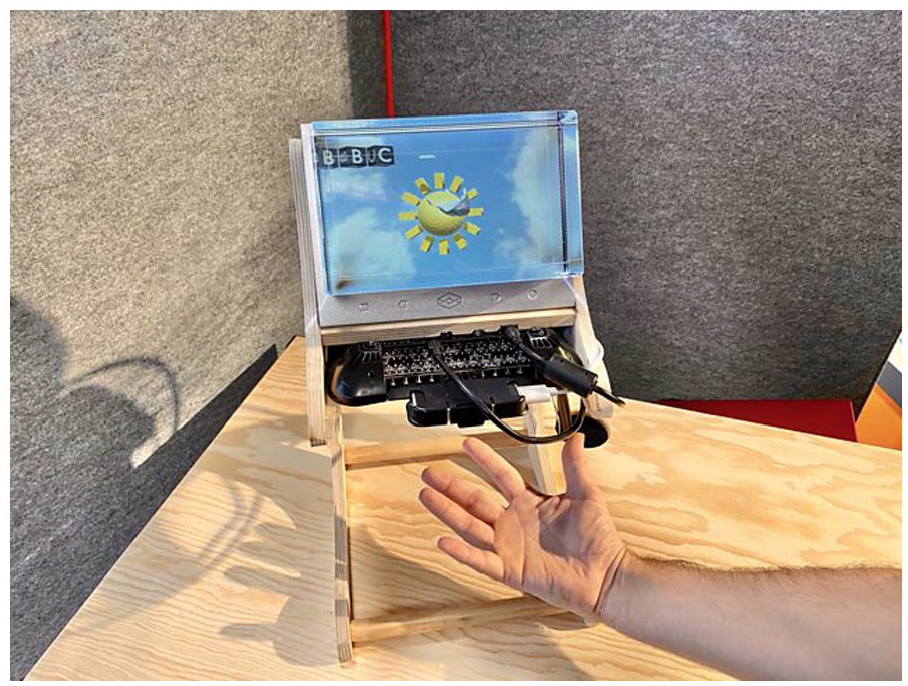
In early 2020, Spencer Marsden, a BBC Blue Room R&D engineer, designed the prototype for an ‘experimental device’ that allows you to ‘use your sense of touch to “feel” the weather forecast’ (Saihan, 2020, see also Figure 1). One motivation behind the development of this machine was to potentially ‘enable our audiences to receive their weather forecasts in a completely new way’ (Saihan, 2020).

‘Our “feel the weather forecast” haptics prototype device’ (Saihan, 2020).
The device is based on the ultrahaptics STRATOS Explore. As the product page for the STRATOS Explore explains, the device turns ‘ultrasound into virtual touch’ (ultraleap n.d.). It is composed of 256 transducers or ‘speakers’ which emit ultrasound waves at ‘too high a frequency for you to hear’ (ultraleap n.d., see also Figure 2). By triggering the speakers at different times, the ultrasound waves coincide in a ‘focal point’ (ultraleap n.d.). This focal point then creates ‘a tiny dent in your skin. We use this pressure point to create a vibration that touch sensors in your hands can detect’ (ultraleap n.d., emphasis by first author; see also Figure 3). These focal points, these tiny dents in one’s skin are the basis for the weather experience the device generates. To experience the weather-machine first hand, the first author travelled to the BBC Blue Room in Salford, England in March 2020: Spencer, the BBC Blue Room R&D engineer who kindly invited me to try out the weather-machine, picks me up from the lobby of one of the BBC’s office buildings in Salford. We take the elevator, enter a large colourful open office area, and turn to a smaller dark presentation space. Spencer sets up the weather-machine, which had already been disassembled, and loads up the first weather sequence from a laptop. I am faced with a skeleton version of the original machine without the screen, looking at blank wood and the electronic underbelly of the ultrasonic device. The first weather Spencer has me experience is rain. I place my hand under the ultrahaptics STRATOS Explore and begin to feel the dents on my skin. At first, I am a bit underwhelmed. Without the visual cues that accompanied the original machine through its display, I am left with little more than faint dents on my skin. I am experiencing rain devoid of the smells and sounds which accompany it in weather. I reflect on what precisely is so strange about this experience, and realise which element of weather is missing, such that the experience is so incoherent: temperature. I try to imagine rain on my skin without temperature: impossible. I then try to evoke the feeling of temperature in my imagination to complete the weather experience: I start feeling the rain. Spencer then introduces me to a number of other weathers. Snow feels similar to rain, but lingers longer on my skin and ‘falls’ more slowly. Given the reliance of the weather-machine on my sense of touch, I become more curious about how sunshine will feel, having seen ‘sunshine’ demoed in a demonstration film shared on the BBC’s website. Instead of feeling individual dents in my skin, as I had ‘in’ rain and snow, sunshine is ‘haptisized’ as a faint breeze I feel in the palm of my hand. Wind, it turns out, is a haptic experience. Having experienced all the weather the machine had on offer, I remark to Spencer that the machine’s rain felt like an abstraction from the real rain–incomplete rain–, perhaps due to the missing screen. After a brief pause, Spencer reaches for a tablet computer–one of the many multimedia devices in the presentation space–and searches online for a video of a puddle in the rain. It takes a surprisingly long time for us to find such a video. But Spencer comes across one and then places the tablet under the haptic sensor (see Figure 4). Instead of just feeling the rain through the dents on my skin, I am now also able to see and hear it, sensing rain through the recording of rain in a puddle on the screen and through the speakers. (Memo by first author, March 2020)
Full view of the sensor, which is installed face down in the weather-machine (ultraleap n.d.).

‘The place where all the ultrasound waves coincide is called the focal point’ (ultraleap n.d.).

Feeling the rain? (own picture).
The experiences this device generates are, following Ingold’s account, experiences of rain, snow, and sunshine without weather. It is as though one senses parts of the weather without being in the weather. This weather-machine, then, functions as a hermeneutical device for exploring the multi-sensorial nature of being-in-weather: Both the added screen (Figure 1) and tablet (Figure 4) make it easier to get a sense of the weather, to allow weather to ‘be in your head’ and not only on your skin. The device also reveals associations between weather phenomena that may not be obvious in everyday experience. It was, for instance, surprising how the ‘breeze’ generated by the ultrasound speakers elicited a feeling of sunshine.
Although this device clearly misrepresents weather in a distinctive way, by reducing weather to certain elements and discombobulating it, it also affords one the opportunity to sense weather with more fidelity. The device is hence an instrument for sensing the weather not by measuring some property of the atmosphere, but by emphasising and sounding out the sensorial capacities involved in being-in-weather.
Where Ingold’s account helps one understand how weather underwrites ‘our capacities respectively – to see [sunshine], hear [rain], and touch [wind]’ (Ingold, 2007: 30), the weather-machine facilitates such an understanding in practice. This machine is a Goethean instrument par excellence; a device which educates one’s senses instead of calling them into question.
From weather- to climate-sensing
Returning to the questions raised in the introduction one might ask: If weather is sensed, is climate too? Following the path outlined above by Humboldt and Hettner, one might extrapolate that analogous to being-in-weather, being-in-climate too draws together experience and measurement, albeit on a different spatial and temporal scale (see Horn, 2018). Where weather is a moment in time and space, the phenomenon of climate is characterised by distinct types of weather and their interrelation and progression across time and space (see Hepach, 2022; Knebusch, 2008).
The differences in the scale of weather and climate make climate ‘more invisible’ than the intangible wind described above. Climate and its changes resemble a ‘major problem of perception’ (Schneider, 2018: 21, translation by first author) too. This problem is, in part, met with an over-reliance on scientific modelling to make sense of the climate, cutting the air off from any phenomenal perceptibility, from both an individual and a collective understanding and from the culturally and regionally diverse images, narratives, dreams, observations, and cultural practices that human beings have historically used to come to terms with climate. (Horn, 2018: 18)
A renewed attention to sensing, as we have introduced the concept here, might help reconnect measured climates with those one bodily experiences (as changing). We here follow a line of argument brought forward by feminist and new materialist approaches (see Neimanis and Walker, 2014; Verlie, 2017), which build on concepts such as ‘entanglement’ (Barad, 2007), ‘trans-corporeality’ (Alaimo, 2008) and ‘intra-action’ (Barad, 2007; Tuana, 2008). Analogously to the indigenous account brought forward by Bawaka Country et al. (2020: 298), these feminist approaches emphasise the importance of how humans ‘emerge with and co-become time and weather’, re-conceptualising the very nature of climate in the process.
The weather-machine itself may also be used speculatively as a hermeneutical device to reflect on the experiential nature of climate and its changes. Experiences of climate change as ‘global weirding’ (Friedman, 2010) are experiences of uncharacteristic weather; of weather somehow out of joint. Much like the anticipation of certain weather-sensings becomes undone through how weather is disentangled by the weather-machine, expectations of future weather are undone through changes in climate. The weather no longer appears to make sense, both in the palm of one’s hand and globally in the face of climate change. What turns weird and alien through changes in climate are then not only individual (extreme) weather events, but whole ways of unprecedented being-in-climate.
The technological sensors/sensory organs (Schneider and Zemanek, 2020) through which one measures and models past, present, and future climates themselves resemble a sort of climate-machine, the sensings of which remain as incomplete as the weather-machine’s without the inclusion of phenomenological experience. Reflecting on her work in the field, Knox (2020: 5–6) explains that being-in-climate—or ‘thinking like a climate’—denotes a wider ecology of signs where climate seemed to shimmer into view through repetitious traces in computer models, where those models entered into workplaces via online training packages, where the complexity of ecological relations became smoothed into a curve on a graph, and where that curve on the graph had the capacity to create a knot in the stomach of a person confronted with its implications for their future and for future generations [. . .].
Through-out this article, we have presented sensing as ‘an analytical device for thinking through how experience and relations are reworked across entities, environments, and technologies’ (Gabrys, 2019: 724), for thinking through how weather and climate are made sense of across scales and modes of measuring and experiencing.
Conclusion
The concept of sensing, we have argued, helps one name the processes through which experience and measurement are drawn together to make sense of a (meteorological or climatological) situation. Both empirical examples help question the dichotomy of felt weather and calculated climate, a false dichotomy already identified in indigenous (Bawaka Country et al., 2020), feminist (Neimanis and Walker, 2014) and phenomenological (Schnegg, 2019) critiques of climate science.
In the forecasters’ ability to navigate being-in-weather as a cognitive-bodily entanglement of knowing processes, weather-sensing was surfaced as an interplay of technoscientific and embodied knowledge. Weather evolves as a technologically embedded, sociomaterial process (Lüder, 2019). The weather-machine facilitated an oblique perspective on this process. Both ethnographic examples then underwrite the broader critique of ‘Western’ approaches to weather and climate from within practices of measuring, forecasting, and technologically mediating the weather.
Beyond our examples, weather-sensing takes place in everyday experience, when one, for instance, draws together information from the weather one feels and what various weather forecasts predict. Going full circle, the DWD itself offers a weather map called ‘Danger indices for the weather sensitive’, which attempts to measure how one’s body and mind are affected by the weather. 7 This raises further questions around how the affective is bound up in weather- and climate-sensing, which future ethnographic work might explore (see also Engelmann, 2021; Verlie, 2019).
Beyond weather, we suggest that sensing can help make sense of climate and its changes too. As discussed above, climatology originated with the recognition of climate as something both felt and measured. Even as the development of climate science seems to have left behind experience altogether, the products of climate science, such as plots or maps of future climate scenarios, are themselves objects of experience and inform how climate is sensed.
As Schneider (2016: 13) shows, climate images and their colours ‘are blueprints to imagine and shape reality’. It is through these images that one senses future climate across spatial and temporal scales, the colour red (for rising temperatures) communicating more than ‘pure knowledge, pure numbers, models or findings’ (Schneider, 2016: 11). It is through more popular climate visualisations, such as the ‘Warming stripes’, 8 that one makes sense of the extreme weather one experiences too; not as an anomaly, but as a beat in an ever accelerating rhythm.
Differences between weather and climate are then not differences in modes of givenness (experience or measurement), but in the temporal and spatial scale of their sensing (on sensing across scales, see also Horn, 2018; Lindner, 2021). In climate-sensing, we position ourselves both spatially and temporally in the world. While weather-sensing involves specific places and time periods, climate-sensing has to grapple with global scales and a future beyond any individual lifetime.
If weather and climate are sensed in the way described above, future research on sensing might pay attention to how different modes of knowing and experiencing come together in one’s understanding of weather and climate (see also Schnegg, 2019). How might non-scientists be enabled to sense climate through what is measured and modelled? What alternate visualisations of future climate change might lead to a more complete sensing? What would a ‘climate-machine’, which might help one explore one’s being-in-climate, look like? Perhaps experiencing a changed climate is analogous to the experience of rain without temperature recounted above: an experience that is at first incomprehensible, causing a sense of alienation in the very way we experience the world. A next step might be to widen our theoretical concept of climate-sensing with empirical studies.
Reflecting on the position of this article in geographic and media theoretical research, the concept of sensing proves it ‘is necessary to develop a much wider conception of media studies, and of media geography, through which to grasp the circumstances under which the atmospheric comes to matter’ (McCormack, 2018: 143).
By widening this conception, we hope to connect with arguments from both feminist and indigenous approaches, which argue for a revaluation of the relationship between weather and climate too, albeit with much greater attention to the colonial, historical and political legacies and consequences of sensing (Bawaka Country et al., 2020; Neimanis and Walker, 2014; The Weathering Collective, 2022).
In future work, we hope to reflect more deeply on the political and social dimension of sensing weather and climate. Through a closer dialogue with indigenous geographies, we wish to explore how sensing might occur beyond the modes we discussed in this article drawing on our own background and experience.
Returning to a word of caution highlighted earlier, we conclude by acknowledging that through our reconstruction of sensing, we have advanced some ‘arguments that parallel discourses in Indigenous contexts’ (Todd, 2016: 10). Indigenous critiques of ‘Western’ or, more specifically, scientific approaches to weather and climate call attention to how these approaches erase Indigenous experiences and knowledges of weather and climate, construing a particular approach as a universal one. In doing so, said approaches risk repeating colonial violence on an epistemological level.
As (Sultana, 2022: 8) has argued, Epistemological and ontological work is needed to confront the universalization and Eurocentrism in how climate is presented and understood, filtered through colonial science and gaze, differential valuation of human and non-human life and systems across Eurocentric and Other spaces.
We hope to have confronted the ‘universalization and Eurocentrism in how climate is presented and understood’ by fissuring dichotomies at the heart of this universalisation, such as the dichotomy between experience and measurement, or between the proximate and remote. We leveraged the tools at our disposal: an immanent critique of ‘Western’ weather and climate concepts, as well as an ethnography of sensing weather.
Footnotes
Acknowledgements
The authors would like to thank Birgit Schneider, Desiree Förster and Friederike Hartz for their valuable feedback on earlier versions of this article, the forecasters at the regional weather office of the German Meteorological Service for their time and engagement in the ethnographic part, and Spencer Marsden, the R&D engineer of the weather machine who made this experience possible.
Declaration of conflicting interests
The author(s) declared no potential conflicts of interest with respect to the research, authorship and/or publication of this article.
Funding
The author(s) disclosed receipt of the following financial support for the research, authorship, and/or publication of this article: This work was supported by the Arts and Humanities Research Council Doctoral Training Partnership (AHRC DTP), the Cambridge Trust, the Arts and Humanities Research Council, and the German Research Foundation.
