




Abstract

Anthony Burke and Stefanie Fishel. The Ecology Politic: Power, Law, and Earth in the Anthropocene. The MIT Press, 2025
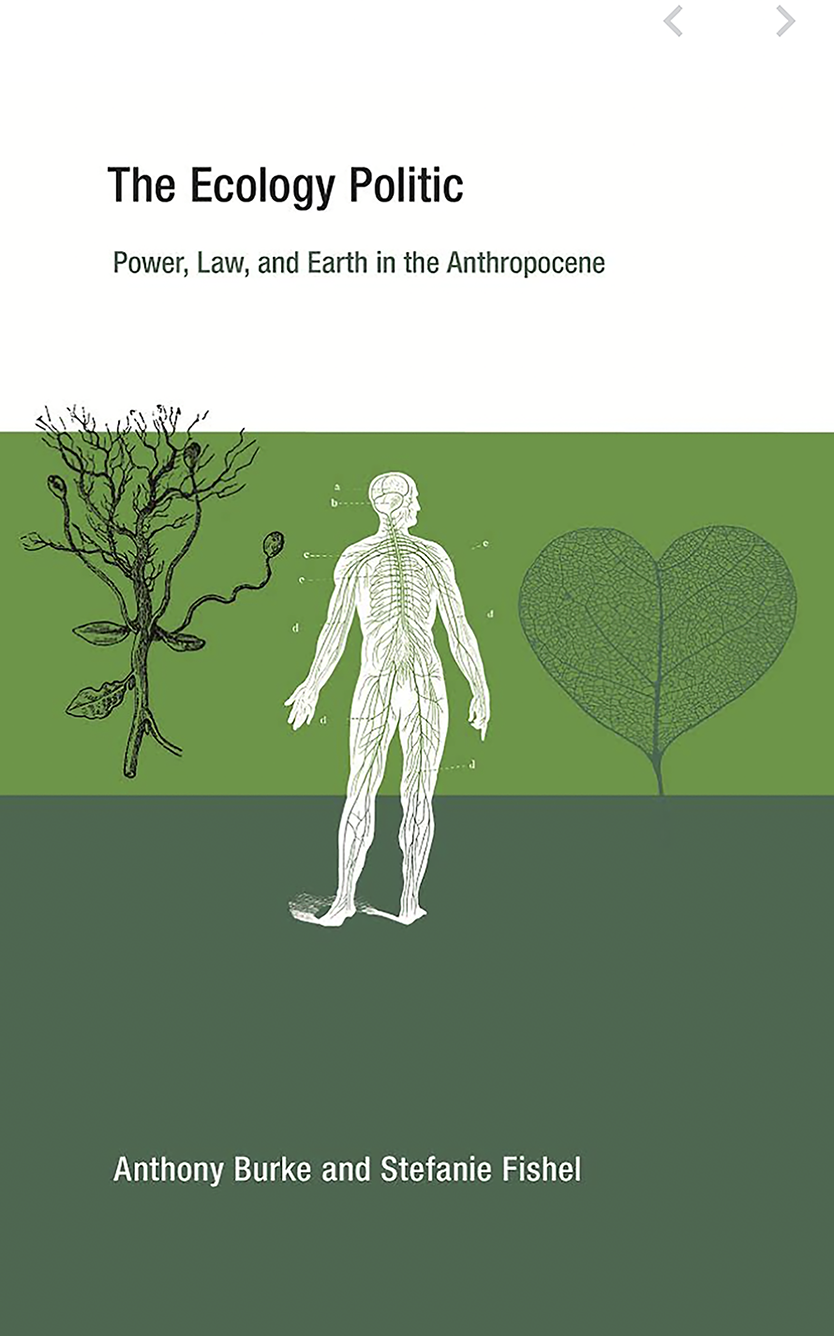
Anthony Burke and Stephanie Fishel, two Australian social theorists, are authors of The Ecology Politic: Power, Law, and Earth in the Anthropocene, a work that promises to spur discussion, dialogue, and debate within environmental and sustainable research and policy communities. It is a work that draws upon postmodern theories and foundations, requiring considerable mental effort, yet yielding substantial intellectual and practical rewards. In other words, this erudite and innovative work is not for the faint of heart.
Burke and Fishel deploy newly minted concepts and often unfamiliar methodologies—including deconstruction, genealogy, actor-network theory, and the critique of ontology—that test the ability of even contemporary political theorists to appreciate their epistemological foundations from “new materialist” and “material semiotic” theoretical perspectives. Readers of this journal who are brave enough to puzzle through the new vocabulary, test out the value of sometimes unfamiliar and daunting methodologies, and grapple with a critical analysis that questions many of the taken-for-granted assumptions of the social science research on climate change will be rewarded by a path-breaking approach and a new and restructured polity married to ecology that forms the alternative vision driving the writing of this daring and hopeful book.
In Part I of the book, many, if not all, of the concepts underpinning the Western political tradition are subjected to critical examination and deconstruction and are supplanted by more apposite ones. The body politic, political power, agency, law, scale, and democracy are subjected to thoroughgoing critique and reinterpretation in light of the planetary crisis that our present moment demands. To cite several examples, the body politic, the foundational political theory of the state—born in the writings of Plato and Aristotle in the Greek polis and turned into the substructure for politics in modern expressions in Hobbes, Locke, Rousseau, and Schmidt for the modern state (capitalist or state socialist)—lays the groundwork for the expropriation of land from Indigenous peoples and the fashioning of powerful ontologies of territory, property, and sovereignty that shape contemporary politics and economics. In the process, its sweeping role in shaping the modern state swells over and becomes “a core of customary law principle of international law,” generating “permanent sovereignty over natural resources” (p. 13). Against these consequences, the authors argue strongly for the rebuilding of a truly ecological politics populated by an expanded membership that includes nonhuman creatures, more-than-humans, and “things” never really granted citizenship in any functioning political order.
Political power in the Anthropocene, too, undergoes transformation in the ecology politic. Western notions of power have been too superficially linked to human beings and their transactions in the world, while myriad other beings, processes, and “things” have been denied their hidden or covert power in shaping and contesting politics. A central thrust of Burke and Fishel’s argument is to reconnect critical thought to human societies and the Earth system. So, they design an alternative theory of power that operates across “thing systems” in highly dynamic and complex ways. The authors call this ecological alternative “thing systems power,” where “power is shared between dynamic assemblages of human and more-than-human entities, actants, processes, and institutions that crisscross the boundary between society and nature” (p. 86). For them, this boundary is less a dividing line separating society and nature than a hybrid or fusion—“social\nature”—acknowledging the ineluctable imbrication of the two in the world today.
Closely tied to their ecological innovations of the body politic and political power is the effort by Burke and Fishel to open up and enlarge the Aristotelian notion of political animal to award representation to the nonhuman and the more-than-human in the ecology polity. This task proves to be a formidable one, given the weight of the Western political tradition and the hegemony and exclusivity historically attached to the rights of some humans. Here, Burke and Fishel draw upon the literature on animal rights and contemporary theories of ecological democracy. Their exploration of this subject in the works of Martha Nussbaum, John Dryzek, Robin Ekersley, and Donaldson and Kymlicka regarding representation, communication, participation, voice, and human proxies yields less a definitive answer to this knotty problem than efforts at dialogue and cross-fertilization of ideas and insights worthy of further conversation and hoped-for clarity.
If there is one central term that sews the book together, it is the concept of the “sovereign ban of nature” (pp. 26–29, 111–112, passim). The authors define the sovereign ban of nature as “a constitutional structure that enables the state to simultaneously appropriate nature as a resource and abandon it as a living totality and a bearer of rights under the national and international rule of law” (p. 2). Benefiting particularly from insights in the works of Italian philosopher Giorgio Agamben, this ban has its origins in fears that state power and authority, using vehicles of exclusion and coercion, may allow the state to create conditions where the human being disappears into the state through “inclusive exclusion.” To illustrate, these contradictory terms point to settler colonial situations where Indigenous peoples are incorporated into states in order to be excluded from the rights and privileges that their status should permit. No less so, nonhuman animals, ecosystems, and even the biosphere are at once appropriated into the state’s grasp and denied their political and planetary representation (pp. 169–170, 172–180, and 226).
In the subsequent chapters of Part II, Burke and Fishel entwine the topics of power, ecology, and law in international law and environmental policy. Researchers schooled in the complexities of biodiversity, the global issues of climate change, and international themes related to ecological justice will find sobering perspectives that build upon the ecological political vistas opened in Part I. The failure of treaties and conventions aimed at regenerating biodiversity is starkly outlined, along with the theoretical and practical shortcomings inherent in these international agreements. These deficiencies are attributed to the sovereign ban of nature embedded in the modern state and the limitations of international law. In their words, these factors include “the privileging of state power, cartographies, and commercial interests via the international customary law doctrine of PSNR [Permanent Sovereignty over Natural Resources]” (p. 140). However, key to the contradiction between the significant expansion of state authority over biodiversity and the poor record of biodiversity protection, in the authors’ view, is its transformation into a “biological resource” that gains value due to the “stores of energy, protein, and useful matter it contains” (ibid.). The role of the political economy of capitalism here shines through with a vengeance.
As the book’s critical analysis proceeds, the word “entanglement” becomes increasingly prominent. The conventional understanding of scale, rooted in linearity and hierarchy, is replaced by a more chaotic, entangled interpretation and conceptualization. Moreover, the strong humanist elements that inform notions such as scale give way to the book’s posthuman perspective. Thus, in Chapter 7, Burke and Fishel’s exploration of scale emphasizes how “the very small and the very large are entangled, engaged in complex modes of symbiosis, assemblage, and change across species, worlds, and societies” (p. 162). This renovation of scale then leads, for them, to a new research paradigm of earth system governance, which they hope others will adopt and advance. The value and importance of thinking of an ecological politics through this more nuanced understanding of scale is that they see the cardinal ecological issue of our time as “how humans orient themselves politically to the planetary” (p. 165). This stems from a simple set of assertions: Scale is a relational concept. Scale transacts across thresholds. Measuring scale is a fraught political matter. Those readers familiar with the Planetary Boundaries Framework, developed by Johan Rockström and Will Steffen, among others, will see how Burke and Fishel’s posthuman political scale builds upon the support of those who have constructed the former framework. They will also witness the slashing, but masterfully done, critique of the United Nations Framework Convention on Climate Change, failing—as it does—to engage the truly planetary in all its entangled complexity.
Taking flight from the suffocating grip of the modern state, social contract, and body politic entrenched in our Western tradition of modern and contemporary political thought, governing institutions, and environmental policies, the book’s authors proceed to foster ecological justice by substituting an ecology politics, a multispecies contract, and a set of sketchy transitional global institutions (a United Nations Earth System Council and an Ecoregion Assembly) that together offer a new vista for building an ecology politic and inventive international law and policy “designed to maximize inclusion and reduce potential frictions between urgency and democracy” (p. 225). As they recognize, none of this will be easy. To paraphrase them in another context (p. 109), new theories, by themselves, are not a new politics, but they can clear the pathway for such a novel and needful politics.
As ambitious and sophisticated as this postmodern work is, it is not without issues to foment questions and criticism. One point of contention concerns its title and central concept—“ecology politic.” Why ecology politic? Why not eco-polity? Do Burke and Fishel choose these two descriptive nouns to suggest that equal weight should be given to each term and ecology should not be treated as a subsidiary adjective to the master concept—that is, politic or politics? Would emphasis on the latter concept imply reversion to an antiquated Greek tradition whose residue still impacts contemporary Western notions that the authors are trying to overcome?
Another conundrum needs to be resolved. Although championing a posthuman political scale comprising crisscrossing entanglements and thing systems, these social theorists acknowledge that linear-hierarchical scales are at times warranted in critical analyses of power, law, and the Earth in the Anthropocene. Even the modern state, they concede, sometimes has its place. For example, in their argument for incorporating nonhuman animals and ecosystems into governing structures of the ecology politic, they state: “ecological democracy…must work at every governance level, from the most local to the planetary, and reach across communities, borders, and biomes” (p. 224). While the latter clause mitigates a simplistic reversion to outdated notions, other instances raise a question of when such traditional scalar terms are appropriate and when they are not.
Finally, if there is one dimension of nature-society that is underdeveloped, it is the discipline of economics and its linkages to the economy, law, and ecology. This perhaps offers an opportunity for economists to read this work and explore the fleeting treatment of this perspective in the book.
In spite of these oversights and criticisms, overall, Anthony Burke and Stefanie Fishel provide an insightful, re-envisioned polity and ontology to tackle anew emergent planetary challenges.