




Abstract
Introduction
The high level of agrochemicals applied for food production has resulted in greater amounts of empty containers, which are not properly disposed of by farmworkers and their families, particularly in developing countries. The risks posed by the empty containers themselves have received less attention even though there is evidence confirming high residue concentrations in empty containers (Damalas et al., 2008; Martínez et al., 2020; Mengistie et al., 2016; Sharafi et al., 2018). These residues may elevate pesticide concentrations in workers’ bloodstreams and local water sources (Khan et al., 2010). As empty container disposal is less effective in developing countries, this high residue concentration may increase health risks to farm workers and their families in these parts of the world. This creates a gap in their access to social justice and sustainable living. As risk is directly related with exposure, we chose to reflect on how farmworkers and their families come in contact with the residues in these containers. Moreover, risk is viewed differently depending on our perception and risk perception is crucial for comprehending how risk influences human behavior and decision-making (Stanojlovic, 2015; Stone, 2014). Considering the above, we will discuss risk scenarios associated with improper container disposal and examine agricultural workers’ risk perception theories. We will also discuss international regulations for empty container disposal and how this may contribute to decrease farmers’ risk if they are fulfilled.
Exposure of Agricultural Workers to Agrochemical Residues from Empty Containers
Chemical risk is defined as the probability of adverse effects on human health or the environment resulting from acute or chronic exposure to a hazardous substance (RIVM, 2006). Risk assessment comprises four steps: hazard identification, hazard characterization, exposure assessment, and risk characterization (WHO, 2021). Aspects such as the concentration of the chemical of interest, the duration of exposure as well as the exposure routes (ingestion, inhalation, and dermal contact) are necessary for risk assessment. A comprehensive risk assessment must also characterize uncertainties associated with chemical exposure (Gao et al., 2024).
Figure 1 illustrates common exposure routes resulting from the improper application and disposal of pesticide containers. Oral exposure results from ingesting a product containing a toxicologically relevant molecule (RIVM, 2006). The RIVM framework proposes two primary pathways for such exposure: (a) accidental ingestion and (b) ingestion of a fraction of orally inhaled aerosol products. While this model was designed for chemicals used by average consumers, its principles can be adapted to scenarios involving empty pesticide containers. Oral exposure routes specifically linked to improper disposal include consuming water or food contaminated with pesticide residues from empty containers (Aidoo et al., 2019; Latt et al., 2023). In both cases, water and food (crops) enter in contact with pesticide residues from abandoned or damaged containers. Rainfall and runoff transport residues into water bodies and soil, with contamination levels influenced by container proximity to water sources and rainfall intensity (Sishu et al., 2022). Burying containers facilitates residue contact with runoff, leading to soil contamination and subsequent migration to groundwater (Beltrán-Flores et al., 2024). Groundwater contamination subsequently compromises drinking water sources and irrigated crops (Miranda et al., 2022; Sivanesan et al., 2004). In many developing countries, reliance on well water for irrigation is common. The detection of high pesticide residue levels in such water sources raises significant concerns for public health. Therefore, while the primary source of this contamination is typically attributed to the intensive application of agrochemicals, the contribution from empty containers should not be considered negligible particularly when they are commonly discarded and the containers are broken and left on the soil. Improper disposal in landfills presents another contamination pathway, as nonbiodegradable materials persist and leach residues into soil (Damalas et al., 2008; Jin et al., 2018).
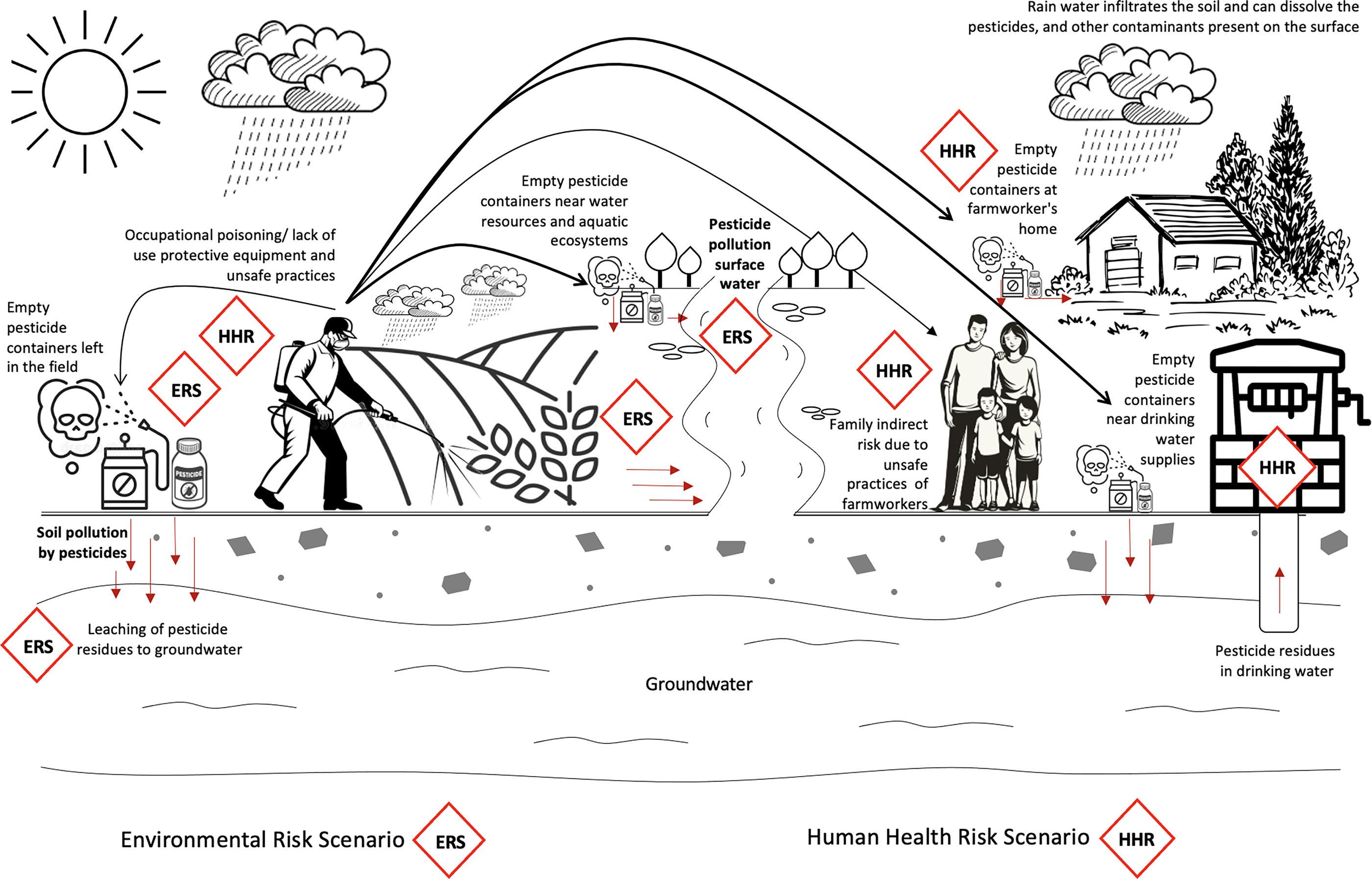
Exposure scenarios due to the improper disposal of empty containers.
Another example of accidental ingestion risk is the reuse of empty containers for storing water or food, a practice documented primarily in developing countries (Latt et al., 2023). This type of reuse represents a direct oral exposure scenario. As with other oral exposure pathways, the associated risk depends on the concentration of residues transferred from the container to the water or food, the consumption frequency, and the consumer’s body weight. However, data on residue levels in reused containers and their reuse frequency are scarce. Agrochemical residues are highly soluble in water, which facilitates this transfer. Calculations based on Briassoulis et al. (2014) indicate that empty containers can retain between 1 percent and 7 percent of the original product, depending on the specific molecule. According to FAO/WHO (2008) reports, empty pesticide containers can retain up to 50 percent of the original active ingredient mass, posing a significant exposure risk. Although scientific literature indicates that container reuse is common in developing countries (Aidoo et al., 2019; Latt et al., 2023), quantitative data on reuse frequency by individual farmers remains scarce. A frequently observed practice, for instance, involves using larger containers to store water for domestic purposes such as washing dishes. The regular consumption of water from reused pesticide containers likely represents a substantial health risk, highlighting a critical need for further research to quantify exposure levels and associated outcomes.
Inhalation exposure represents another significant risk pathway when empty agrochemical containers are burned, a common but hazardous field management practice (Damalas et al., 2008; Marnasidis et al., 2018; Miranda et al., 2022). Burning the plastic containers releases toxic compounds including dioxins, dibenzofurans, polycyclic aromatic hydrocarbons, and particulate matter (PM10 and PM2.5) into the air (Marnasidis et al., 2018). Although the smoke may not directly contain the original agrochemical residues, this practice is detrimental to both environmental and human health, exposing nearby individuals to harmful pollutants.
Risk Perception
How to carry out strategies to communicate risks and change health behaviors has been in the interest of scientific research for a long time. Researchers have found that risk perception is a key factor for a good risk communication (Ferrer and Klein, 2015; Rother, 2019; Stanojlovic, 2015; Stone, 2014). Particularly, it aids in understanding how risk impacts human behavior and decision-making (Stanojlovic, 2015).
One of the issues of most interest to farmers’ perception is the fact that many male farmers hardly believe they face risks from improper handling of agrochemicals (Arciniega and Fontalvo-Buelvas, 2024; Jibrin et al., 2021; Lovison et al., 2021). This phenomenon can be considered one of the most common forms of resistance to persuasive messages among individuals (Stanojlovic, 2015). Social Cognitions models, such as the Health Belief Model (Rosenstock, 1974), the Protection Motivation Theory, and the Health Action Process Approach, propose that there are factors that influence the adoption of preventive behaviors against health risks: (a) the perceived susceptibility (the individual subjective perception of the risk of contracting a condition), (b) the perceived severity (feelings concerning the seriousness of health consequences of an illness and possible social consequences), (c) the perceived benefits, (d) the perceived barriers, (e) the self-efficacy (the conviction that an individual can successfully execute the behavior required to produce an outcome). Under this approach, the low-risk perception of male farmers to the exposure of agrochemicals can be partly explained by the lack of fear of being threatened (lack of susceptibility and severity) by their current use (Fischhoff et al., 1978; Stretcher and Rosenstock, 1997). Others cite a low vulnerability to the exposure of these substances as one of the reasons for this behavior (Stanojlovic, 2015). Accordingly, Peres et al. (2006) identified that male farmers developed defensive strategies regarding the use of agrochemicals and empty containers. These defensive strategies could be interpreted as that men are strong so that pesticide exposure is not a threat to their health. This behavior can also be linked with the fact that the effects of exposure to agrochemicals as well as the consequences of an incorrect management of pesticide containers could be visible only after many years (chronic exposure). Gregolis et al. (2012) found in a study about risk perception regarding empty containers that this was a key factor. Similarly, farmers (and their families) may desensitize to exposure to agrochemicals and diminish their risk perception through psychological habituation (Recena et al., 2006; Slovic, 1987; Weber, 2006). Farmers chronically exposed to agrochemicals tend to normalize associated dangers, developing risk normalization that leads to underestimation of hazards from improper empty container (Arcury et al., 2002; Damalas and Abdollahzadeh, 2016). Desensitization has also been linked to mechanisms such as the familiarity with pesticides, the normalization of hazardous practices, and the effect of immediacy on decision-making. Familiarity with agrochemicals breeds false security since adverse effects (e.g., chronic poisoning, environmental contamination) are often nonimmediate (Hashemi et al., 2012). Indeed, past experience with pesticides is important for farmers’ risk perception (Ferrer and Klein, 2015; Huici et al., 2017; Ríos-González et al., 2013). This causes workers to disregard safety protocols such as triple rinsing or disposal at authorized collection centers (Lekei et al., 2014). As previously mentioned, absence of short-term consequences prompts threat minimization (Gregolis et al., 2012; Ríos-González et al., 2013). These normalization practices include reusing containers for water/food storage, reuse, or abandonment in open fields and become routine despite high residual toxicity (Atreya et al, 2012). As Stanojlovic (2015) also pointed out, if these actions are not perceived as directly impactful, corrective measures are less likely to be adopted. Humans prioritize visible, immediate risks (Gregolis et al., 2012; Weber, 2006). The cumulative effects of exposure to chemical residues (e.g., cancer, neurodegenerative diseases) lack immediate clinical manifestation, which reinforces desensitization (Recena et al., 2006).
Of course, differences between male farmers around the world and their working conditions impacts their behavior (Remoundou et al., 2015). High costs and limited accessibility to authorized collection centers can be perceived as barriers or obstacles impeding action adoption (Stretcher and Rosenstock, 1997). Such barriers can prevent safe practices even when risks are acknowledged (Ajzen, 1991). Therefore, those working in countries where there is less support to the recollection of empty containers can perceive that there is no point to ameliorate their behavior toward empty containers management. Countries should prompt the construction of collection centers alongside training activities (Ngowi et al., 2007; (Zhang et al., 2011). As we have already mentioned, risk perception should be key in these training plans (Peres et al., 2006; Rother, 2019; Stanojlovic, 2015).
There is a claim from some researchers to consider that risks are shared constructs that influence how communities and groups perceive and respond to risk scenarios so that it is important to study risk perception from this perspective (Joffe, 2003; Peres et al., 2006). Huici et al. (2017), for example, trained participants based on a participatory adult training method reporting good results. Ríos-González et al. (2013) pointed out that many solutions looking to diminish risk among farmers are formulated as the need for more formal education. They recognize that knowledge about is related with factors we have already discussed (formal education, first-hand experience with pesticide effects, knowledge acquired through social interaction, indirect messages embedded in regulation). However, more is needed to carry out meaningful communication about risks: trust in the institutions or people carrying the training. Indeed, trust is key in risk perception (Joffe, 2003; Stone, 2014). The lack of trust in institutions and/or people who communicate risk can ultimately cause people not to believe the message being portrayed. For Stone (2014) good risk communication forges trust between experts and the public. This is very important because some public institutions can invest money in farmer training without taking this into account. The same applies to farmer training by technicians (many regulations mandate this). In some cases, an option is to train farmers’ wives (Peres et al., 2006; Remoundou et al., 2015). Women have been shown to have higher risk perception and be more likely to engage in safety practices (Remoundou et al., 2015). However, it has been found that more women lack awareness and knowledge about chemical risks, health, and safety related to pesticide use (Gregolis et al., 2012; Peres et al., 2006). It has been discussed that it is not only pesticide risk knowledge but also risk awareness which should be achieved by interventions (Damalas and Koutroubas, 2018). Men farmers’ could be more sensitive to pesticide effects on their grandchildren or pregnant women in their community than in themselves.
Assessing risk perception related to exposure to agrochemicals is complex but it is key for good risk communication. We believe science should contribute for more adequate public programs on the subject.
Regulatory and Management Measures for Empty Pesticide Containers
In 1985, FAO proposed a voluntary framework for pesticide management named “Code of Conduct on Pesticide Management,” which has been actualized through the years. The Code includes several recommendations for avoiding the reuse of containers, the establishment of services to collect containers, and empty containers’ treatment (FAO and WHO, 2014). Particularly, the chapter referring to the reduction of health and environmental risks states two recommendations on the subject. Recommendation 5.3.3 states that Government and industry should cooperate in further reducing risks by “establishing services to collect and safely dispose of used containers and small quantities of left-over pesticides.” Recommendation 5.3.5 states that Government and industry should raise “awareness and understanding among pesticide users about the importance and ways of protecting health and the environment from the possible adverse effects of pesticides.” Indeed, some countries have legislations regarding training activities targeting occupational exposure to pesticides (Remoundou et al., 2015); however, few target exposure to pesticides from empty containers. Moreover, this last recommendation coincides with what was previously exposed: not only training but also pesticide awareness is key to reduce the risks associated with empty containers.
It is also possible to note that FAO suggested that the services to collect empty containers could be a parentship between the governments and the industry. In this regard, several countries-including Argentina (law 27279 and Campo Limpio Ar.), Australia (drumMUSTER), Belgium (Phytofar-Recover) and Brazil (InpEV), Canada (voluntary program), and the USA (Ag Container Recycling Council)-have established multistakeholder frameworks. The level of container collection and recycling seems appropriate; however, improper disposal remains pervasive (Campo Limpio, 2022; FAO, 2008; Xu et al., 2021). This shows that proper container collection only solves half of the problem. Again, good strategies to decrease improper disposal should also be developed.
It is important to note that some countries also recycle empty containers attending to the proposal of the FAO about integrating the life-cycle approach for a more effective container management (FAO, 2013). For this purpose, empty containers should be classified as non-hazardous. In many European countries, for example, empty pesticide containers should be ≤0.1 percent to be classified as nonhazardous. It should be considered that triple rinsing helps to attain this value, thus an empty container first classified as hazardous waste can be classified as nonhazardous after triple rinsing (Briassoulis et al., 2014). Developing countries not only in Latin America but also in other parts of the world have poor legislations on this subject and farmers training. These deficits generate severe consequences for both environmental integrity as well as human health for farmers, their families, and neighboring communities (Briassoulis et al., 2014).
Conclusions
Empty pesticide containers represent a persistent and under-recognized source of environmental and human health risk. Exposure occurs through reuse, environmental contamination, and burning. At the same time, risk perception, behavioral norms, and structural constraints limit the effectiveness of existing interventions. Current approaches focus primarily on technical solutions. While necessary, these do not address the behavioral and institutional dynamics that shape real-world practices. A more comprehensive response requires integrating environmental management with public health and behavioral insights. Without this shift, empty containers will remain a critical gap in efforts to reduce exposure and protect vulnerable populations.
Authors’ Contributions
I.G.-V. and A.R.M. contributed to the conceptualization and methodology of this literature review. I.G.-V. wrote the first draft of the article, and both authors participated in reviewing and editing subsequent versions. All authors read and approved the final article.
Footnotes
Acknowledgment
The authors would like to acknowledge the Ministry of Science, Humanities, Technology, and Innovation (SECIHTI) for the granting of the Postdoctoral Fellowship for Mexico.
Author Disclosure Statement
The authors declared no potential conflicts of interest with respect to the research, authorship, and/or publication of this article.
Funding Information
The authors disclosed receipt of the following financial support for the authorship of this article: This work was supported by the Ministry of Science, Humanities, Technology and Innovation (SECIHTI) by the granting of the Postdoctoral Fellowship for Mexico of I. Galaviz-Villa [CVU 216557].