




Abstract
This study provides new insights into what Swedish superintendents (SIs) highlight in decision-making documents to their school boards regarding improving equity in education. It is an examination of which actions SIs consider to be urgent. Two hundred documents written by SIs proposing measures to increase equity were analysed using qualitative content analysis, through the lens of power theory. The findings indicate that SIs share a similar understanding of the areas in which changes can enhance equity: organisation, finances, pupil health, systematic quality work, and pupils’ grades and staff competence development. The findings also indicate that SIs make use of institutional and direct power, which are also part of the public arena in which the SIs operate.
Introduction
Equity in education in Sweden is enshrined in the Education Act (SFS 2010:800). All pupils, regardless of where they are educated, should receive high-quality education. This is based on the view that high-quality education is of central importance and defines a country’s potential for development (SOU 2020:28). One of the features that characterises high-quality education is favourable student results based on successful teaching and leadership. Schools have the responsibility to provide compensatory education to achieve equity. As SIs bridge their local arena and national objectives, policies and intentions (Bjursell et al., 2023), they and their work are therefore important subjects for study. According to the Swedish Education Act (SFS, 2010:800, 2010, 2 cap. 8 §) school boards are responsible for the delivery of education in accordance with regulations. Understanding SIs’ expressed views on how to promote, maintain and enhance equity is therefore key to understanding equity in schools. This study aims to build knowledge about SIs’ proposals to improve equity in Swedish schools, and in particular, to address the research question: What characterises the equity measures the SIs suggest to their school boards?
Background: The role of equity in Swedish education
Equity is regulated in the schools’ governing documents, the Education Act and the curricula. However, what equity means in practice and how it should be achieved are not clear-cut (Enqvist et al., 2017). Studies in law consider that equity cannot be achieved, but rather it is a goal to strive for (Enqvist et al., 2017). However, in the Education Act and the curricula, there is a clear link between equity and the expectation of school’s compensatory mission (Ryffé, 2017). Hence, each SI and each principal may develop a notion of what equity in education consists of and which conditions need to be in place to reach equity.
In Sweden and the Nordic countries, for several decades, the concept of equity has comprised different content and ideas (Englund and Quennerstedt, 2008; Kofod, 2017). Equity has aspects of equality, justice, philosophy, measurability, economic redistribution, ideological interests, power, etc. (Leinesköld, 2022; Lindensjö, 2002; Lundgren, 2017; Rawls, 1971; Ryffe, 2017). The international perspective on equity emphasises equality and social justice (Rawls, 1971; Unterhalter, 2009).
The issue of equity has also been central in recent public enquiries (SOU: 2017:35, 2020:28, 2022:53). There is no clear definition of equality in Sweden (2020:28). However, there are a number of areas that recur in terms of equity such as economic redistribution, students’ study results, socio-economic background of the students, the compensatory mission. This study applies the following definition of equity: Equity means ensuring that all children and pupils receive an education that provides the conditions for them to achieve their fullest development potential, through guidance and stimulation.
One possibility for the SI to create conditions for equity in education is to propose various initiatives to the school board to facilitate action among principals, teachers and pupils. This can be reflected in the proposals SIs present to their school boards. Consequently this study investigates proposals presented by SIs.
The Swedish education system
In Sweden, the state decides the laws, while the government implements the decisions of the parliament. The government is assisted by several school authorities, which are an extension of the state. One of them, the Swedish Schools Inspectorate, is tasked with supervising the public and independent schools, reviewing and monitoring how school boards implement the education programme based on the laws. Through their decisions, they influence the governing of the schools (Eilard, 2022; Novak, 2018). The Swedish National Agency for Education (NAE) guides and supports school activities by providing advice and recommendations. NAE also works with developing grading criteria and distributing government grants. One of the major government grants aims to increase equity in Swedish schools. The Swedish Agency for Special Needs Education is an active advisor in the field of special needs education. Finally, the Swedish Institute for Educational Research produces research summaries and funds practice-based research on teaching and learning in preschools and schools.
The Swedish state regulates the schools, and the school boards are responsible for the implementation of the regulation. In the Swedish education system, there are both public schools (municipalities, regions and the state) and independent school (run by profit-making and non-profit organisations). The school boards are mandated to provide the conditions for high-quality operations in all schools in accordance with the Education Act (2010:800). However, it is the principal of each school who decides how to organise the inner life of the school. Note that it is often the SIs who recruits the principals.
One important prerequisite for the school boards is the population size of the municipalities, as this determines the tax base, which affects the financial conditions for all schools, regardless of their ownership. However, there is no consensus on the extent to which the municipality’s size affects school quality and student results (Adolfsson, 2014). Furthermore, some stakeholders have demanded the state take greater responsibility for the financing of the Swedish school system, to equalise the large existing differences (SOU 2020:28). The lack of financial management affects equality and the students’ opportunities to make the most of education (OECD, 2023). Today, the difference in investment between Swedish municipalities that invest the most and the least per pupil per year amounts to more than 7 thousand euros (SOU 2020:28).
The school board in the municipalities is led by leisure politicians (Jarl and Rönnberg, 2021). They are appointed to various committees and boards by their political parties, every 4 years, after the general elections. As the school board members do not have any expertise in the field of education, they need support from the administration and the SI (Moos and Paulsen, 2014; Quennerstedt, 2007; Seven, 2020). This power relation is recognised by the OECD (2015) regardless of whether the school boards are associated with public or independent schools.
The SI is employed either by a municipal or an independent school. The relationship can be complex, as the SI has a power advantage, with expertise in an area that the school board may lack. The SI both leads and is led by the school board, which can result in an inherent dependency between the two actors. As SIs have an advantage over the school boards in terms of competence, they can make proposals to the school board such as increasing the grants to the school, closing unprofitable schools. However, the SIs are centrally located in the chain of governance: they are both recipients and interpreters of national policy documents in a local context, involving external and internal interest groups (Moos, et al., 2017; Quennerstedt, 2007).
The regulation of the SIs in the Education Act does not create a new link in the governance chain. The relationship between the SI and the principal may vary, as the SI may or may not be the principal’s manager. At the same time, according to the Education Act, the principal has a clear mandate to oversee the internal school organisation (Bröms, 2023). This is to ensure the best possible conditions for equity in the interactions between teachers and pupils.
In addition to the actors mentioned above, there are international and national organisations that exert pressure on decision-makers. Guardians, trade union representatives, social media and the local community also have an impact. The power is distributed between different levels and in various arenas where diverse actors pursue their interests. It is within this maze of competing pressures that the SI is expected to promote equity in education.
SIs’ mandate over school boards’ decisions
The purpose of the regulation of the SI from 2018 is to assist the school boards by ensuring that the schools comply with educational regulations. The SI regulation can be seen as a continuation of the increased legal control that was the effect of the Education Act from 2010 (SFS 2010:800), which came into force in 2011, increasing the legal governing of schools (Novak, 2018). This change was partly due to the declining performance of Swedish schools (Arneback and Bergh, 2016). The regulation of the SI became a way for the state to place additional responsibility on the school boards as a response to the criticism of the education system and its lack of equity. This occurred during a time in which, according to Henrekson and Wennström (2022), the quality and results of Swedish schools declined.
The SIs were regulated in the Education Act from 1956 through 1989. Between 1990 and 2019 there was a similar position, albeit with a different title and without any regulations at the state level (Moos et al., 2017; Moos and Paulsen 2014). When the state chose to re-regulate the SIs in 2019, compliance was one of the key issues. Compliance primarily concerns the provisions of the Education Act and the curricula. In this study, equity in education is viewed as an overarching concept summarising the task of the SIs. The formulation in the Education Act is as follows: The school board shall appoint an SI to assist the school board in ensuring that the regulations pertaining to education are adhered to within the board's activities within the school system. The school board may appoint one SI for the entire organisation or several SIs for different parts of the organisation (Education Act 2010:800; Chapter 2, § 8a).
This examination of the provision of equity in the Education Act is performed by studying the decision-making documents SIs present to their school boards. The fact that the school boards are dependent on the competence of the SI is one of the reasons for the existence of the SI position. Several studies (Moos et al., 2017; Rapp et al., 2020) find that the SI is a central actor in the chain of governance, as well as an active networker in collaboration with other SIs (Foss and Aktas, 2022). Depending on the dominating aspects of power in the organisation, it may clarify the state of the organisation regarding equity. Furthermore, when we analyse the proposals formulated by SIs, their conception and understanding of equity may emerge. This can be evidenced by the fact that the proposals can be linked primarily to different parts of equity, which in this way, also reflects the dominant aspect of power that is present in the organization.
Research on SIs and their role in enhancing equity in schools
Research on SIs and their role in enhancing equity in schools has been limited (Epps, 2022). Roos et al. (2022) studied the new regulation of the SIs and conclude that the regulation has not changed the SIs’ work. Krantz (2022) examined the Swedish SIs’ perception of their role and found that SIs had difficulty balancing between various interests and finding a viable path for equity in education. The Swedish Agency for Special Needs Education has interviewed SIs who express similar views (SPSM, 2019). Some studies have highlighted SIs’ work with equity in education in the US. Epps (2022) claims that SIs need to change the organisational culture in schools to achieve equity in education. Wright and Harris (2010) emphasise that SIs’ leadership is a key aspect in achieving equity. Caviello and DeMatthews (2021) conclude that SIs encounter resistance in their work with equity when their ideas of equity do not coincide with those of the school boards and other stakeholders. At the same time, Caviello and DeMatthews (2021) emphasise the importance of understanding the context in which SIs work to achieve equity in education. Several studies highlight SIs’ work with equity with a focus on race, gender and ethnicity (Castillo et al., 2021; Arar, 2022; Joseph, 2023; Lewis et al., 2023). How equity in education is expressed and what it encompasses differs internationally, yet pupils’ achievement and social justice appear to consistently be the focus.
Finally, there is research on the earlier regulation of the SIs’ role in Sweden. One reason for the regulation was to give the state enhanced insight into the school boards. A gradual elimination of the SIs during the 1980s was linked to a change in the entire governance system (Nihlfors, 2003). The responsibility for education shifted from the state to the municipality. More than 25 years later, the state has once again regulated the SIs in the law and given them power to act, in the chain of governance for equity in education.
Theoretical underpinning
The theoretical approach in this study is based on different notions of power. Power can be defined as ‘an expression of the aspects that maintain or change human structures and aspects in a desirable direction’ (Christensen et al., 2014). Power may manifest in three categories: substantive, relational and institutional power.
Substantive power (Dahl, 1957, 1961) is linked to the resources and competences of the actors competing for power. In the context of this study, strategically important actors (e.g. the SIs) may be viewed as actors convincing other strategically important actors (e.g. their school boards or principals) of the validity and value of their cause. Substantive power has four aspects: - Direct power is characterised by the fact that the management or leader has a large scope of influence on the direct power, which is significant for the SIs (Christensen et al., 2014). By utilising both formal and informal arenas, managers can participate in and have direct influence over the decision-making process. This can be everything from managing the budget to organisational review. - Indirect power includes more processes and actors who have an impact on power relations in an organisation (Christensen et al., 2014). Even if there is a high degree of structural regulation in the organisation, there is still the possibility for the actors to establish informal arenas and raise issues that occur. - Power over people’s perceptions and interests is based on Lukes’ interpretation of power (Luke, 1974. Power can be exercised covertly by influencing people to support specific interests without recognition of whether these interests’ conflict with their own (Christensen et al., 2014). - Relational power arises in social interactions when people influence each other through transactions. Relational power deals with issues of different social actors influencing each other’s perceptions of reality - Institutional power emphasises the power that manifests itself through laws, rules, norms and instructions. Institutional power indicates a framework enabling individuals to operate within it (Christensen et al., 2014). This aspect of power occurs when actors’ performance is taken for granted. Thus, this aspect is mainly of a cognitive nature (Berger and Luckmann, 1967). By taking the initiative and setting the agenda, the SI enables what is possible to express in the organisation.
Power phenomena, power aspects, characterising features and characteristic quotes.
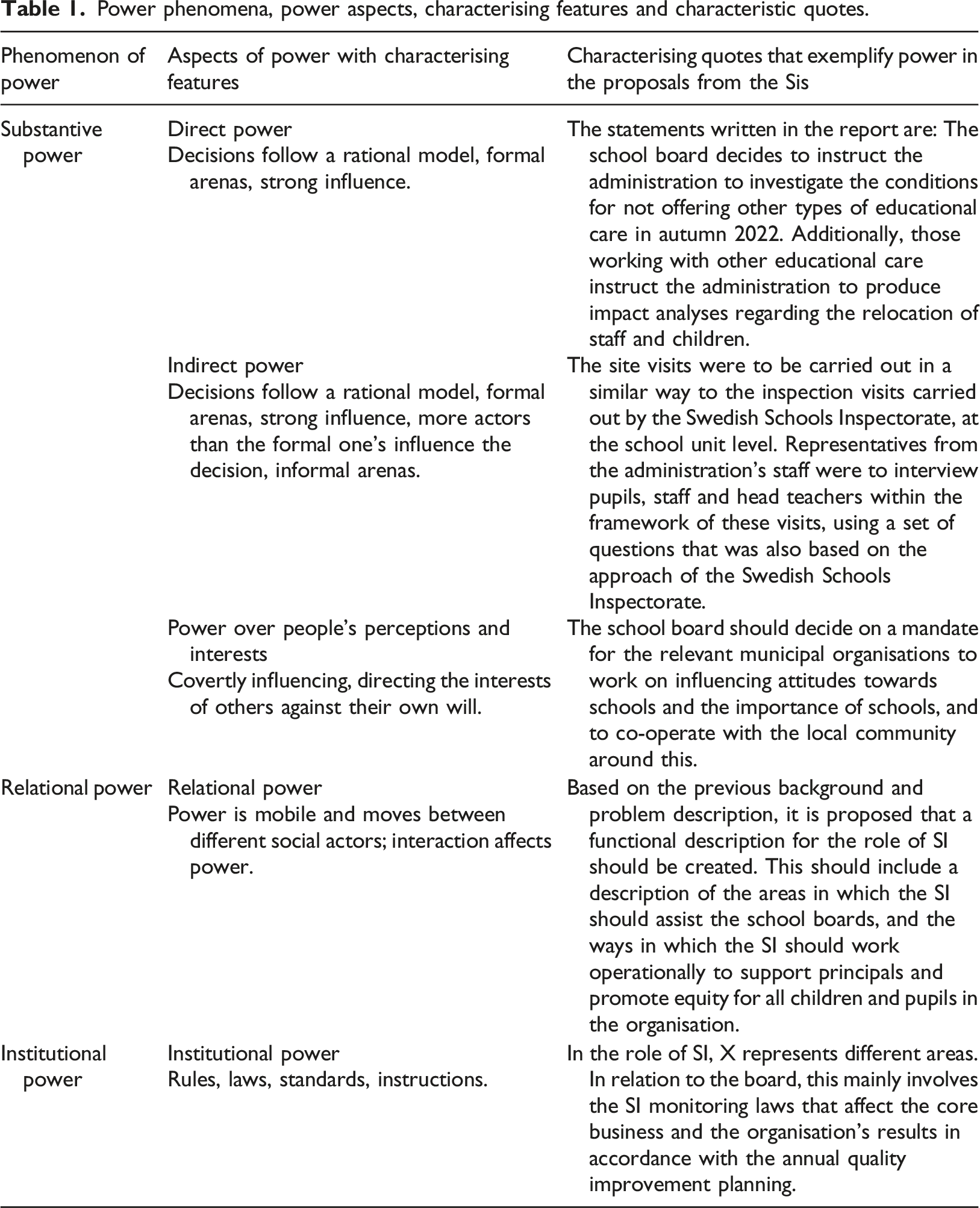
The different aspects of power can offer a more thorough understanding of the SI and the context in which they act and the way they approach equity in education. These power aspects may identify the underlying mechanisms that form the basis for the proposals for equity that the SI presents for the school board, based on the principal’s reports. The analysis can enhance the understanding of why an organisation operates as it does. The different aspects of power that emerge in the analysis also reflect the SI’s view of equity.
The empirical study and methods
We apply a descriptive research design for investigating 204 written documents by SIs from 2022 to 2023. These documents are written by the SIs as an examination after a 2-year training programme offered by the NAE. The documents are only read by the examiner, a researcher who, with the SIs’ approval, has made the material available for research. The SI’s task is to write a document for their school board, in which they suggest further measures for equity in education.
The information we have about each SI is gender, type of school the SI is affiliated with and whether the school is run independently or by a municipality. We have no information about the SI’s experience of being an SI, their educational background or their work experience as an SI. These factors were not recorded by the NAE, but may have an impact on SIs’ understanding and perception of equity in education. This, therefore, must be counted as a limitation of the study. The SIs’ own statements are analysed based on one or more aspects of power (see Table 1). In the material, the SIs are referred to as SC 22: xx and SC 23: xx, where 22 or 23 is the year in which the document was written, and xx stands for the number assigned each SI in the database.
We initially used an inductive approach to create an overview of the material. When investigating the material, the focus was on what the SI was proposing to the school board. This guided our understanding of which aspects of equity were emphasised in the proposals. In the next step, we discussed the findings and identifiable patterns. By coding the emergent areas, we were able to situate the categories of equity within each power dimension. We applied qualitative content analysis to investigate whether there were recurring areas in which the SIs believed that measures could make a difference in terms of equity. This allowed us to search for the SIs’ interpretation of equity in practice. Analysis was carried out by the first and second author independently, and the findings were then compared to ensure that the overall conclusions were reasonable and balanced. Through this approach, we identified different areas of equity in education that emerge and appear repeatedly in the SIs’ proposals to the school boards.
Results
Our analysis reveals that SIs across our sample have a similar understanding of equity, which can be categorised into five themes: (1) organisation; (2) finances; (3) pupil health; (4) systematic quality work; and (5) pupils’ grades and staff competence development. Competence development for staff almost always aims to influence pupils’ grades. Figure 1 summarises how frequently the different areas occur in the proposals. (Of course, SIs may suggest more than one area in a proposal to the school board.) We also included an ‘other’ category, in which the remaining topics not recognised elsewhere (e.g. student influence, democracy, access to libraries, digitalisation) were recorded. Important factors to increase equity according to SI.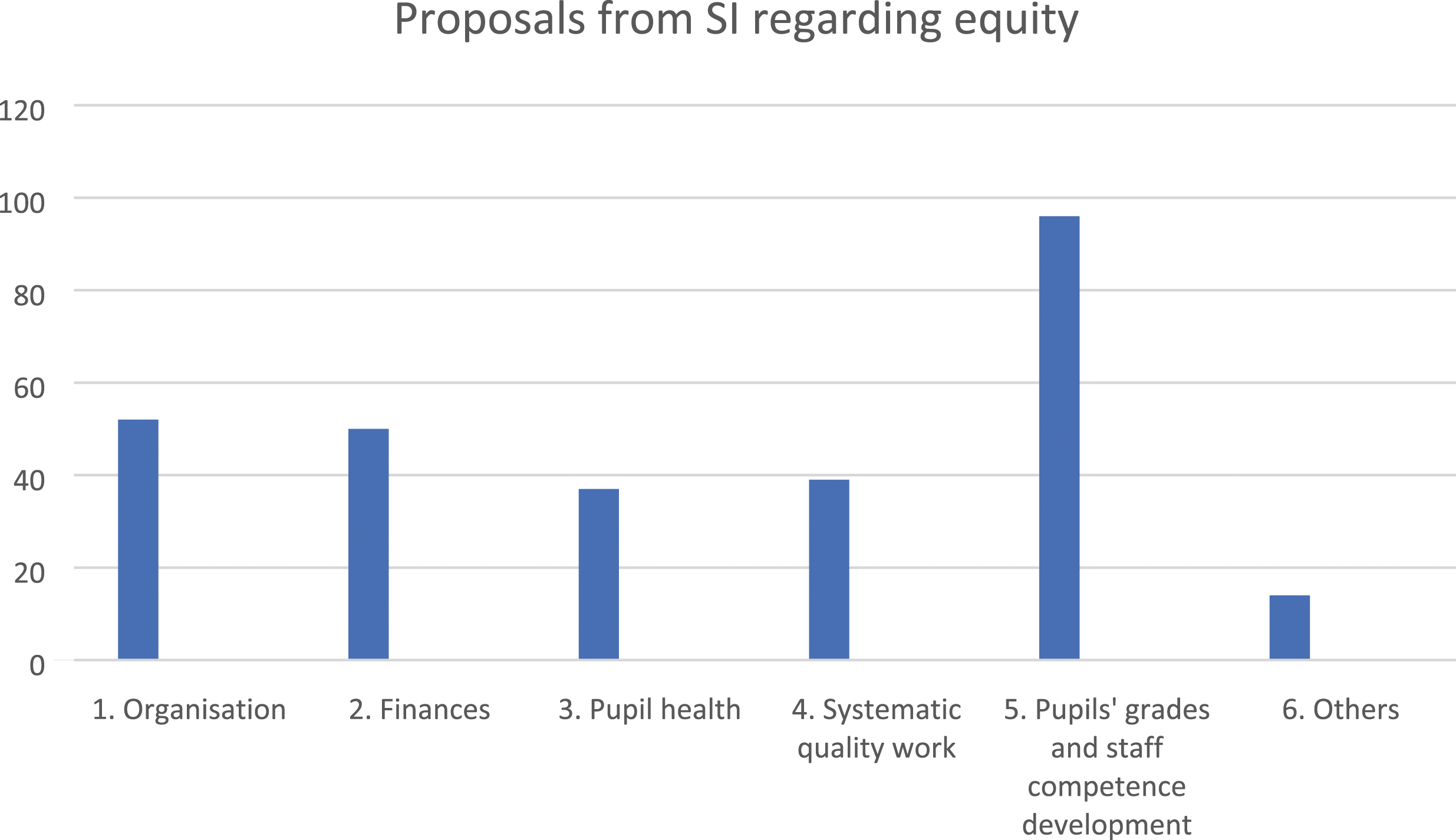
In the figure above, the bar representing pupils’ grades stands out. This reflects the high priority given to it by the SIs and other actors within Swedish schools. The question of students’ results is a recurring and dominant theme in Swedish schools (OECD, 2023).
Organisation
A recurring theme is the SIs’ desire to create organisational change. We attribute this finding to the SIs being actors with power, who seek to change organisational practices through the initiatives that they propose. In almost all cases, the proposals reflect the SIs’ perception that the organisation, at various levels, needs to address shortcomings, and that organisational priorities should be revised. To achieve the changes required, the SIs seek to steer the organisation towards greater equity through their proposals. The different areas that are highlighted in the proposals to the school boards are also an expression of the SIs’ interpretations of equity.
The SIs propose several organisational changes in order to enhance equity. These can be proposals for school closures due to lack of pupils, or difficulties in recruiting qualified teachers for small rural schools. The SIs therefore suggest moving pupils to more centrallylocated schools with higher teacher qualifications. Proposals for school closures tend to be met with strong resistance from the local community. In some cases, organisational mergers are proposed to create a more robust administration capable of meeting the state’s requirements. In other cases, organisational changes are proposed within the existing administration, for example, by adding human resources to improve the quality of the administration. An example of such a proposal by is: SIs intend to appoint a quality manager for the entire school group, a school developer for primary school, a school developer for pre-primary and primary school and an HR manager (the budget for this position is not within the scope of this service statement). These posts will be fully staffed for or during the 2022/2023 school year (SC 22:101).
Finances
Financing is another recurring theme, described as a prerequisite for achieving equity in education. This issue emerges when the SI requests more money from the school board, re-allocates existing funds or applies for government grants for their schools. An SI notes: The school boards also requested the government grant for 2021, when the money was distributed to all of the municipalities’ preschools… the amount was distributed based on the number of children enrolled at each preschool. The government grant will be used to strengthen language development in Swedish in preschool, especially for children who speak a language other than Swedish at home (SC 22:92).
Another SI suggests developing a new way of distributing money: The school administration proposes that the Children and Education Committee approves the report on the investigation into the distribution of resources to the organisations - and that the proposed measures are documented in the proposed detailed description of the resource distribution model for the 2023 budget (SC 22:12).
The majority of SIs who address issues of a financial nature in their proposals emphasise the need to target or provide resources. However, these proposals are not always specific.
Pupil health
In contrast to the generic way in which SIs discussed finances in their proposals, pupil health appeared as a specific and important area: Improving the competence in pupil health services means working for more equity in education. I think it is very important and I will propose a decision to allow the entire pupil health services to take the National Agency for Special Needs Education and Schools online course. This enables a common understanding and development of the entire schools (SC 22:36).
Another SI reports: The management of the pupil health team is central to ensuring that the pupil health teams function well, but also that the issues are prioritised in the organisation. The team also needs to have a good balance between remedial and preventive health promotion work. These measures should be able to be followed and evaluated through the quality work via activities linked to health promotion and prevention efforts. It is also of vast importance that the case flow is well known, within the entire staff group, and is sufficiently fast. In order to achieve this, the communication channels must be clear and known (SC 22:48).
A well-functioning pupil health service is an area highlighted by several SIs as a means of increasing equity in education.
Systematic quality work (SQW)
A fourth recurring theme for increasing equity is to improve SQW. (In the Swedish context, this work is to ensure the quality and equity of the activities based on legislation and the school curriculum). The following quote serves as an example: Both short-term and long-term measures are planned. To strengthen this work, we will employ a quality developer at a strategic level. This person will work together with the SI to improve and refine the tools used in the systematic quality work. A project manager is to be hired shortly. This person will focus on the implementation of the national digitalisation strategy. The work will begin with an analysis of the current situation (SC 22:98).
The work on developing systematic quality assurance is a recurring theme that emerges in the proposals. How systematic quality work is used to increase equity differs, depending on local conditions.
Another frequently appearing theme is the pupils’ study results. Many of the proposals are based on the notion that equity is synonymous with improving pupil achievement. This manifests itself in different ways, from proposing a focus on a particular subject to training programmes for teachers. One example is: Based on our initiative in science, technology, and mathematics in primary school to increase goal attainment in the subjects of science and technology, we acknowledge there is a need to extend this initiative to include preschools, and thus to improve the quality of preschool teaching in these subjects (SC 22:16).
Another SI writes: We acknowledge a need to conduct a dialogue with the principals regarding how the regulation on fair and equitable grading should be understood and implemented. In the same way, we need to strengthen the work of systematically analysing and comparing all data, in order to obtain clear indications of what needs to be addressed regarding grading in all units. At present, the analysis focuses on Swedish language, Swedish as a second language, English and mathematics. It is obvious when analysing the difference between the results of the national tests and the grades assigned, that we need to work on equity in grading (SC 22:48).
Pupils’ grades and staff competence development
One of the school boards’ tasks is to monitor pupils’ results. This includes monitoring trends in grading, and tracking the proportion of pupils who receive an upper secondary school diploma, and who have entered a national programme in upper secondary school after compulsory school. Several proposals from the SIs address grading results. Since "grades and assessment" is both a national and a local development area, it is necessary to describe the national dilemmas, the national measures undertaken and the local perspective. Both the national and the local measures aim to achieve a nuanced assessment that favours children's and pupils' learning and to ensure that the assessments and grading carried out are equivalent to those in the rest of the country (SC 23:12).
Competence development is another theme mentioned, often for specific groups linked to an explicit initiative. These may be teachers in a specific subject, study counsellors, first teachers
1
or principals, who need to act differently to improve equity for the students. In order to improve pupil learning, the professional capacity of both principals and teachers needs to be built up, so we need professional development throughout the chain of command. ... I therefore wish to continue the school's development in testing experiences and teaching on a scientific basis by starting a research co-operation with NN University (SC 23:25).
Other findings: democracy, libraries, digitalisation, etc
A couple of areas that are less prominent in the SIs’ proposals should also be acknowledged. First is the issue of equity linked to democracy. The fact that this is not specifically mentioned may be due to the fact that it is not requested by the reviewing school authority, the Swedish Schools Inspectorate or the school boards. Another reason may be due to difficulties in following up and evaluating the issue. Some emphasise the need for improving the pupils’ democratic participation in instruction: I want to develop the pupils' influence to effect teaching. That I, as a representative of the principals, listen to what the pupils think about the teaching. When? Where? and How? In which contexts pupils imagine they learn best? In order to get answers to these questions, I will conduct interviews with groups of 5-7 pupils at a time. These interviews will be recurring and will become part of the unit's systematic quality work (SC 23:95).
Another issue that is not highlighted by the SIs is the compensatory measurers, which means that the school have to compensate for the students’ socio-economic conditions or if they have other difficulties. We deem that the proposals relate to general measures to some extent, rather than addressing the needs of specific units. The lack of compensatory tasks has also been recognised by the Swedish Agency for Public Management (2021), a state administrative agency that evaluates and follows up on state-funded activities. They found that the targeted government grant ‘Equity in Schools’ generally works well, yet that it has shortcomings regarding grants to reach disadvantaged groups. The fact that SIs proposals to the school boards are at a general level, is likely due to that the analyses are being made at a general level and not at the local level, where they actually are needed, and thus, the proposals miss the target. This fact may also highlight the SIs’ dilemma in proposing measures that are the domain of the principal, which might cause conflict. This problem is not particularly emphasised in their proposals. Two SIs are cited for their suggestions for compensatory measures: The child and education administration are tasked with developing proposals for formulating goals for the 2024 operational plan to increase equity in municipal preschools and compulsory schools in grades K-6. The goals are to be formulated to reduce educational segregation, to support prior introduced measures, and to strengthen the Swedish language, language development and the transitions from preschool to compulsory school. Classes in the lower ages of compulsory school are strengthened. The proposal must be presented to the councils by September 2023 (SC 23:36). Based on the follow-up of the SQW, the Committee on Culture and Education may conclude that the pupils’ results and the proportion of qualified pupils in upper secondary school are strongly linked to the pupil’s background, gender, motivation, attendance and any functional variations. In order to provide all pupils with the opportunity to develop as far as possible, long-term compensatory work is required to increase equity (SC 23:62).
Finally, some of the SIs highlighted a few less frequently mentioned areas to increase equity. These include access to libraries, digitalisation, supporting pupils with disabilities, pupils’ influence on teaching, the physical environment, reducing sexual harassment and enhancing the conditions of immigrant pupils. The materials SIs refers to in their proposals for decision-making are mainly internal systematic quality work, national and local statistics, compilations of various surveys, conversations with principals and other managers in the organisation, their individual observations, etc. Furthermore, decisions from the Swedish Schools Inspectorate are used as a basis when the SIs are preparing proposals for decisions for the school board. Together with engagement with various interest groups and the local community, these constitute the SI’s basis for decisions on equity in education.
Characteristics of power in the SIs’ proposals for decision-making
Our findings support the conclusion that power is viewed as an expression of maintaining or changing human structures and aspects in a desirable direction. In this case, it is manifested through the SIs’ proposals. We have identified that the proposals can be classified in one, two or three of the different categories of power. Our results demonstrate that substantive power appears in 111 proposals, relational power in 72, and institutional power in 182.
A descriptive research design, does not allow for addressing the effects of the presented proposals. Our analysis addresses their content and character. Power is mainly evidenced in the fact that the initiatives aim to change behavioural patterns in a desired direction, which can manifest itself in different ways. We identified different themes (see above), recognising that the proposals are made in a formal arena in which the SI primarily engages with the school boards. Power (Dahl, 1957, 1961) is mainly manifested in the proposals in the public arena within the framework of what is legal and measurable. Thus, they are situated within the framework of substantive power, with its subcategory of direct power. Direct power is an aspect of power that appears frequently in our data. This suggests that the SIs utilise their formal mandate and the formal arena to put forward proposals to increase equity.
Institutional power is the most prominent category of power in the SIs’ reports. This is because they aim to bring about a shift in the organisation, according to the changes allowed by current laws and regulations. Ensuring compliance is central to the role of the SI. Through their proposals, the SIs want to create changes and frameworks for how equity should be handled by the parties involved: principals, teachers and other staff in the school units. Results also indicate that the Swedish School Inspectorate has a far-reaching impact on the SIs and other actors responsible for effecting equity and quality in the schools (Ehren et al., 2015; Eilard, 2022). This is in line with a far-reaching development, where the law exerts a strong influence over the actors within the school system. This pattern is also reflected in the SIs’ proposals.
Regarding relational power, the texts indicate that the power is not fixed. Those in positions of responsibility are constantly trying to exert influence those who are to implement change. The SIs’ proposals presuppose the implementation of recommendations and that this would be accepted by those affected. In some sense, this also gives power to the recipients of the SIs’ proposals, and there is a constant dialogue and negotiation between them. Thus, it could be argued that much of the development work has an inherent relational aspect and this is a prerequisite that the SIs need to consider.
SIs are actors who can influence and affect the school boards (Liljenberg et al., 2023). We observe that direct and institutional aspects of power are most prominent in their proposals to the school boards. However, we also observe a lack of proposals within the framework of areas that are not regulated, yet are within the SIs’ power to change, that is, SIs could propose to redistribute professionally skilled teachers to schools that have greater challenges, to allocate financial resources where they are most useful, or to work systematically with the professional development of principals on the issue of equity. These ‘non-decisions’ are also an expression of a power aspect that we recognise from Bachrach and Baratz (1963).
Discussion and conclusion
Our starting point is that SIs have the position, the ability and the capacity to act with autonomy. At the same time, the state, via the NAE and through targeted government grants, makes the SIs central actors in the local school governance. We also acknowledge that the Swedish Schools Inspectorate, through supervision and audits, is a strong actor that controls other actors within the school system (Eilard, 2022; Novak, 2018). While SIs have considerable autonomy, they actions are still constrained by other actors. This raises the question of how independent SIs may be in creating their proposals to the school boards and to what extent they can realise the legislator’s will, while being constrained by different stakeholders.
Our findings indicate that SIs are mainly concerned with financial and legal matters and monitoring. This suggests that SIs’ proposals conform to the traditional framework factors (Lundgren, 1981), that is, areas that are measurable and easy to follow up. This is also in line with new public management approaches (Bornemark, 2018), which form the prevailing norm that permeates the Swedish education system. Thus, it may indicate that the new public management mindset strongly influences the proposals put forward by the SIs. The dimensions that are more difficult to measure, which are mainly found in the values-based part of the curriculum, tend to be lacking in the proposals because it is difficult to follow up on them, even though these aspects also address the issue of equity (Bröms, 2023). This can also be considered as an expression of the context in which the entire chain of governance is situated.
Several proposals avoid measures that may face resistance, for example, if some units are allocated more resources, more qualified teachers, etc. than others. This is regardless of whether the needs are more pronounced in one unit than in another. Proposed changes within given frameworks where redistribution becomes necessary entail a risk of conflict both internally and externally. Perhaps this omission by the SIs may be viewed as an example of a non-decision.
The applied definition of equity in this study entails ensuring that education for all children and pupils provides them the opportunities to develop through guidance and stimulation. This definition emphasises that the SI is a central actor who can create these opportunities by convincing the school board to support the proposals from SI. Our results reveal many initiatives, yet the question is what effects they have if and when enacted. Our analysis suggests that the SIs’ proposals tend to be general. They may risk missing the needs of the individual school units, an issue also confirmed by the Swedish Agency for Public Management (2021). It appears from our results that students’ results and equity are closely linked at a general level. An in-depth analysis at local level from the SIs is missing in their proposals to the school boards. This may also be one of the reason why equity is not fully considered.
Our study indicates that, based on aspects of power and in relation to other stakeholders, SIs may have considerable room for acting to increase equity. Our data suggest a school system whereby equity in education is not achieved through any single activity, but instead, is characterised by its multifaceted content, terms and conditions. This fact is also reflected in the SIs’ expressions of equity. At the same time, we observed that many proposals are generic; the application of the concept of equity also tends to be instrumental, lacking in contextualisation that is specific to context. The SIs’ understanding and interpretation of equity determine the local agenda and the content of the proposals put forward. The SI is only one of the many actors in the arena, and power is held at every level. We recognise that for the SIs to fully meet the demands of the state, the issue of their autonomy needs to be addressed. Here, the SIs should consider which role and influence stakeholders should have. Regardless of this, we cannot dismiss the fact that compensatory measures are too often absent in the proposals, which indicates that something is lacking. When compensatory initiatives are proposed, the proposals are too general. In this sense, the SIs have missed an opportunity to take into account the specific conditions of a school unit.
The question of equity is one of the most challenging issues for school leaders (Möller, 2017). Consequently, future research should follow the process from conceptualisation to implementation by observing SIs in their everyday work. We need to expand our knowledge of SIs’ power when it is exercised in relation to principals as well as the school boards. Further, the environment in which the SIs work needs further investigation. Field studies on how various actors are involved in resolving issues may enhance our knowledge of how SIs work to create the conditions for equity in education.
Footnotes
Declaration of conflicting interests
The author(s) declared no potential conflicts of interest with respect to the research, authorship, and/or publication of this article.
Funding
The author(s) received no financial support for the research, authorship, and/or publication of this article.
