




Abstract
Our research explores and documents reasons why pupils in five local authority areas (LAs) in Southeast Wales (SEW), UK, are under-reporting incidents of racism/racist bullying in schools. We engaged with pupils from Black and Racially Minoritised (BRM) backgrounds, eliciting their views through focus group conversations with them, their parents and teachers. The research sample included 10 schools in the SEW area: five primary schools and five secondary schools. We adopted a social justice lens which is critical of ‘race’ and racialised social formations. Through this lens we uncovered a number of findings. We found that racist incidents/racist bullying impact and affect young people in detrimental ways. Pupils who had experienced racist incidents / racist bullying valued the opportunity of having their voices heard during the research process but were sceptical that it would make a difference to them in their everyday school lives. We suggest that schools put in place clear policies, which record and address incidents, along with robust training for all school staff. Our conclusions are currently being used in the co-construction and implementation of recommendations for professional learning for teachers, educational strategy and policy reform to negate racist incidents/racist bullying in schools within the SEW region.
Introduction
The research and policy landscape locating the topic of racist incidents / racist bullying (RI/RB) in UK schools, within which this study is situated, highlights a dearth of research in this area. A report by the YMCA (2020: 7), found that 95% of young Black Britons have heard or witnessed the use of racist language at school. In Wales, research by the Children’s commissioner (2024, online) found young people talked about the normalisation of racist language and the ‘everyday’ nature of racist experiences in school, which were not taken seriously or properly addressed. We found limited research providing definitional clarity on what constitutes ‘racist bullying’, as distinct from ‘bullying’. Categorisations of bullying broadly omitted the racial elements that were reflected in the reporting of these incidents in schools in Wales. Xu et al. (2020) suggest there is a body of research on bullying with little understanding on racialised bullying and its effects on children. We found most research to be from the USA, with scant research from the UK, and even less from Wales, thus we believe that our research is of particular note. Russell et al. (2012, online) found that ‘bias-based’ [racist] harassment was ‘more strongly associated with compromised health than general harassment’ for children and young people. Tippett et al. (2010, online) suggest that racially motivated bullying can be defined as prejudice against someone’s actual or perceived race, ethnicity, culture, citizenship status, or religion. A terminological shift has, however, been suggested, problematising the use of ‘bullying’ in favour of using the terms ‘racism’ or ‘racist incident’ in order to demarcate between the act and the perceived motivation, as often teachers address the behaviour under the premise of bullying without addressing the actual racism itself (CRER, 2022, online). As we set out later in this paper, we found a number of reasons for non-reporting. Our findings chime with work undertaken by the organisation Tackling Hate (2024, online) who point out reasons why ‘victims’ of racist incidents don’t report them. These reasons are ‘hopelessness’ – victims believe that it is a consequence of being different, ‘normalisation’ – abuse is an everyday occurrence and ‘structural oppression’ – the system works against them. This concurs with our research and equates to the school system and lack of teacher response.
We were commissioned to undertake this research by a local authority (LA) 1 in SEW. The LA had identified that Black or racially minoritised 2 (BRM) pupils were choosing not to report RI/RB perpetrated against them. They also realised that staff in LA schools were either not aware of incidents occurring or, if aware, were ill-equipped to deal with them or report them adequately (Pearce, 2014; SRtRC, 2016). SEW is not particularly diverse. The 2021 census shows that out of a population of almost 600,000 only 8.6% were from a BRM background (ONS, 2021). We decided between ourselves to define a racist incident as a specific racist event, and racist bullying as a series of events occurring incrementally over a sustained period of time. ChildLine (2022, online) define racist bullying as a type of bullying that specifically relates to being targeted due to ‘race, ethnicity or culture’. The Macpherson report, outlines that racism is: ‘conduct or words or practices which disadvantage or advantage people because of their colour, culture or ethnic origin’. The report defines a racist incident as: ‘any incident which is perceived to be racist by the victim or any other person’ (UK Gov, 1999: 28). The severity of racist incidents or bullying relate to the age of the perpetrator and can range from racist name-calling or social exclusion to physical violence (Cremin, 2003; Verkuyten and Thijs, 2002).
Our aims were to investigate the current ‘state of play’ in SEW, regarding the reporting or non-reporting of RI/RB and collate the testimonies and voices of the BRM pupils who recounted experiences within the school system. It was vital to build awareness of the effects of RI/RB on pupils and for schools to be aware of the need for implementing robust systems. These systems are fundamental for intervention, reporting opportunities, pupil support, and to reduce or negate RI/RB in future. This is particularly pertinent in a Welsh context as the Welsh Government has implemented a raft of measures relating to ongoing anti-racist policy. Their vision is that Wales will be an anti-racist nation by 2030 (Welsh Government, 2022a). There are now anti-racist statutory aspects and responsibilities which organisations, most notably schools, are tasked with adhering to. As with all issues related to racial power dynamics, there are many nuances to consider. When viewing ‘race’ we do so through our own personal, experiential, and cultural lens, it is apparent that racism maintains structures of power, which privilege white people (Oluo, 2019; Olusoga, 2016). Our research spans an age range of children from 9 to 13 years of age. It would have been pertinent to reflect more succinctly by age group, however, from conversing with our participants about RI/RB we found the issues they uncovered were not significantly different dependent on their age. We concur with Sapouna et al. (2023) and Hay et al. (2024: 1) who state – ‘there is a paucity of literature examining the issue’. They suggest some limited research is available in England around the barriers to embedding an anti-racist curriculum, but there is no research about how teachers respond to ‘racially motivated bullying episodes’. We hope that our research will support both understanding and future professional practice in this area.
Literature review
Unpicking why racist incidents / racist bullying occurs in SEW schools
The reasons why pupils do not report RI/RB in schools is a conundrum. It is to be noted that the issue is not new. Our research undertaking has led us to concur with the Runnymeade Trust who found that racism is deeply embedded in schooling, and that there is a duty on schools and wider education to ‘radically’ reimagine and commit to anti-racism (Joseph-Salisbury, 2020: 2). In line with this, following information provided by a Welsh LA that there was an under-reporting of RI/RB in SEW schools, we were commissioned to investigate and learn from the ‘chalk face’, what was being perceived by pupils and what was occurring. Bhavnani (2001) spoke about the importance of understanding the context of racism. She suggested that ‘off the shelf’ equity, diversity and inclusion (EDI) training was irrelevant and that understanding the relationships of power, between and within groups, was key in analysing the context of racism (p. 117). Sullivan et al. (2021) suggest that adults delay conversations with children about race, as they underestimate children’s understanding or processing of racial concepts. Thus, we must ensure that issues around race are not seen as ‘taboo’ or no-go areas for educators.
The role of teachers and educational professionals in negating racism
The role of teachers and educational professionals is key in negating racism or racist thinking within their professional settings. While a ‘colour evasive’ approach to racial difference is often the default (Apfelbaum et al., 2008), with avoidance and denial appearing to be a common stance for dealing with any racial dynamic in our schools (Asika, 2020), ignoring racial differences when talking to pupils is a missed opportunity. If pupils are taught about race in meaningful and constructive ways, they develop insight and empathy towards others. We are fortunate in Wales that our new curriculum for Wales emphasizes the need for cynefin (a Welsh word roughly translated as habitat/belonging for all) and that our young people should become ‘global citizens of Wales and the World’ (Welsh Government, 2022b, online). Research suggests that this type of outlook may cultivate a more robust sense of self identity in citizens (Alonzo, 2020; Hill, 2006; Quintana, 1998) as well as reduce racial bias (Aboud and Doyle, 1996).
We know that the concept of ‘race’ is socially constructed (Olusoga, 2016; Smedley and Smedley, 2005) and that biased ideas about race were historically constructed to enable the process of enslavement and colonisation of BRM people (Sanghera, 2021). Therefore, it is essential that educators engage with training on race and the effects of racism, so they are equipped with strategies, both to understand the nuances of racism and to deal with racism, should it occur. Essentially, they must become racially literate and, as Williams suggests (Welsh Government, 2021, online), it is essential that senior leaders in education, remove barriers, enabling school staff to engage with this priority area; something which requires, ‘time, resources, competence, knowledge and confidence’. Seeking parental support during any process of anti-racist action is also vital. Research undertaken by Wu et al. (2022) in the USA, (which has a very different racial backdrop to Wales), found that ‘Egalitarian parents were reluctant to talk about race to children due to three reasons: (1) talking about race will make their white children racist, (2) White children are too young to talk about racism, and (3) race and racism are irrelevant to white children’s lives’ (p. 1). Thus, it becomes imperative to put in place strategies to support schools, parents and pupils in understanding issues related to race.
Longer term effects of racism on pupils
It is necessary to ponder over the long-term effects of racial inequity within society as well as the school playground and reflect upon not just the moral argument of our anti-racist endeavours, but the implications of inequities in relation to the mental health and wellbeing of BRM pupils. Most educators are aware of the negative effects of adverse childhood experiences (ACEs) (NHS Wales, online) on young children and that these most notably relate to deficits in health, living in poverty or mental, physical and sexual abuse. In Wales ACEs do not currently include racial trauma or racialised bullying. This, we assert, is an oversight, based on the evidence we now have on the effects of racism on young brains and bodies. We know, for instance, that the effects are cumulative (Priest et al., 2013; Wallace et al., 2016) and that racial discrimination is a common everyday experience for children and young people from racialised communities. The resultant effect on health, especially in young people, is documented now within a growing body of empirical literature. It is apparent that much of the research does examine the effects on social and emotional development, with less literature investigating physical health outcomes. Currently, most of this body of work is from the US. However, the field of research is expanding to Australia and work with indigenous youngsters (Priest et al., 2013; Shay et al., 2021).
As this is not a longitudinal study, we are not able to predict long term implications of the effects of racism on our study participants. We have however, drawn from research undertaken around the ‘biology of adversity’ that there are specific effects from racism on health and mental wellbeing (Comoz Dias, 2016; Smith, 2010). Shonkoff et al. (2021: 115), for example, discuss the health effects of institutional/structural racism, cultural racism and interpersonal discrimination. They conclude that these factors offer persuasive evidence for the need to protect young children from what they term ‘the physiological disruptions of toxic stress that can undermine the building blocks of optimal health and development in early childhood’ (2021: 115), which is caused by exposure to racism. Currently there is little longitudinal research on the effects of racism over lifetimes, however, research is slowly becoming apparent. If children experience racism in their early years and this carries on into adolescence and then adulthood, there are factors of concern. In adolescence, this can tip into mental health issues and result in substance misuse or alcohol dependence (Faramand et al., 2020; Gibbons et al., 2010). In the UK, there is scant mental health support for young Black boys in particular (Bamford et al., 2021). There is a dearth of BRM mental health professionals working in health and social care (ONS, 2018; Ragavan, 2018; York, 2019). Young people experiencing racial discrimination or other associated societal problems are reluctant to access support in what Meechan et al. (2021: 106) call an ‘unapproachable system’. It is especially pertinent that the effects of racism are negated in early childhood as during this time racial trauma results in a ‘sensitive period’ for internalisation or the embedding of stress related factors of adversity (McEwen and Gianaros, 2010; Shonkoff et al., 2021). Schools cannot negate the tide of racism in a singular fashion. It is imperative that there is robust buy-in from parents / carers, and the wider community, in order to undertake a multi-pronged approach to its eradication; schools cannot do this work alone.
Methodology
Theoretical underpinning
It is important to outline the theoretical underpinning that has guided the current inquiry and offer some details about the contextual circumstances within which the study has been conceived. This is especially appropriate, given the unique policy milieu that is taking shape within the Welsh educational context, which has seen Wales become the first nation in the UK to make the teaching of Black, Asian and Minority Ethnic history mandatory within the school curriculum (Welsh Government, 2021). Furthermore, this project took shape following a period in which notions of race and understandings of racism have re-entered the British national conversation in new and powerful ways following the racist murders of Breonna Taylor and George Floyd in the US and the subsequent growth of race activist movements (Beaman et al., 2023). This backdrop has served to bring race-critical positionalities in research under increased focus, directing attention towards the theoretical basis upon which British race-consciousness is founded and making a sharpened awareness of scholarship in this area ever more relevant. In this section, we draw out the ways in which a conception of race as a tool for sociocultural mediation has informed this research. We situate the current paper within the intellectual traditions of British anti-racist scholarship in education; a field that has long been the site of intellectual production and political struggle for race equity seeking communities in Britain (Marcus and Van de Peer, 2023). Ontological readings of ‘race’ as socially constructed have, at times, been derided in the British context as an intellectual import from North American traditions of race theory, being assigned marginal status in British academia (Warmington, 2020). We contend that the recognition of ‘race’ as a ‘fully social relationship’ (Apple, 2001: 204) is central to a more comprehensive understanding of the causes and potential solutions to problems such as racist bullying and childhood experiences of racism in education.
Positionality
It is to be acknowledged that this research endeavour had personal and emotional relevance to us as a team of researchers from BRM backgrounds, our own racialised identities are Black, Asian and mixed heritage. At various points during the project, members of the team expressed elements of frustration and discomfort when listening to the testimonies of the young pupils and adult participants. While we believed that it was an important aspect of the process to reflexively share these feelings, we were also highly conscious of the risks involved in these subjectivities, particularly as they related to influencing the participants. In this regard, we took heed of Bourke’s (2014) suggestion that ‘We can strive to remain objective but must be ever mindful of our subjectivities’. Conversely, we took account of the potential benefits of our individual positionalities and the value our lived experiences of racism brought to the research. This enlivened a sense of duty towards the participants and an awareness that the young participants were relying on us to champion their perspectives, carry their voices into our research and authentically express the truths that were being silenced within the school system. This intent was informed by scholarship within the field of race equity which suggests that researchers from BRM backgrounds can provide an additional layer of understanding and empathy within the process (Vass, 2017). Furthermore, the theoretical position underpinning this research rejects what Neitz (2013, online) describes as the ‘neopositivist assumption that the researcher’s objectivity is essential to producing valid, value-neutral research, and that objectivity is produced through methodologies that reduce or even eliminate bias.’ Rather we assert that ‘research is not value neutral’ (Ghezae et al., 2002: 1). Indeed, all research is prejudiced by human interests and validity in research is achieved through careful interrogation of our own biases throughout the research process.
Research design
Data collection and analysis took place between March and May 2023, employing focus group research conversations. Shah (2013) alerts us to the epistemological resonance in the use of focus group, in which we framed conversations, exploring real life aspects and cultural matters. We also ascribed to the notion that any research interventions undertaken within racial paradigms should be labelled as ‘courageous conversations’ (Davis et al., 2023, online). This acknowledges the emotional toll which may be apparent in dialogue around racial harm. It also ascribes to findings from Davis et al. (2021) that the term ‘interview’ often had negative connotations for BRM research participants.
The fieldwork consisted of a series of focus groups, employing semi-structured questions, to elicit research conversations and conducted on Microsoft TEAMs. These were carried out within 10 schools across Southeast Wales, UK; in five Primary schools (pupils aged 9–11) wherein we conducted research conversations with 29 children, and five secondary schools (pupils aged 11–13) conducting research conversations with 27 children. One research conversation took place with seven adults, LA staff and Teaching Assistants. One further research conversation included a group of 15 parents. Each participating school nominated a range of learners, parents and staff to contribute to the focus groups, with a maximum of six individuals in each group. Schools were chosen to represent a mix of rural, inner city and faith schools as well as a range of school sizes and catchment areas. In total, we interviewed 78 participants during the period between March and May 2023. The research team consisted of four academic staff from Cardiff Metropolitan University and two schoolteachers, who expressed an interest in being involved. All researchers leading the research conversations were from BRM backgrounds. The article reflects upon data collected during the ‘courageous conversations’ (Davis et al., 2021: 14) that took place between the research team and the BRM participants, some of whom were from Gypsy/Roma/Traveler backgrounds in SEW. Ethical approval for this research project was gained through the base university ethics board.
It is pertinent to note here that, within this round of the research project, we have not been able to fully define the individual ‘racial’ identities of the sample. This was, in part, due to the remit of the funded project, which was limited to exploring the reasons for non-reporting of racist incidents / bullying in SEW schools. It was also, in part, due to the timing and context of the project. The research was undertaken during a period of teacher industrial action. Given our reliance on the co-operation and support of teacher colleagues in SEW schools during this time, our access was hampered. Additionally, as the availability of staff was limited, we found that the data shared with us identifying pupils’ ethic origins and ‘racial’ identifications was incomplete. These constraints meant that we were unable to fully interrogate experiential differences along racial lines on this occasion. We agreed, as a research team, that we would approach the project through a lens of ‘shared racialised othering’, (Davis et al., 2023) examining the commonalities of experience within and across BRM pupils. We acknowledge, however, that this does not negate the potential variations in experience between individual racial identity. We are hopeful that future research, in the form of a second round of this project, will enable us to look more closely at the experiences of individual racial groups.
Analysis
Data were analysed using a reflexive thematic framework (Braun and Clarke, 2006, 2013), which offered the accessibility and theoretical flexibility required to analyse qualitative data collected by a research collective with varying positionalities. Throughout the project, we conceptualised themes as patterns of shared meaning underpinned or united by a core concept relating to our research intent (Braun et al., 2019: 843), which in the context of the current paper was uncovering racism as a construct in the everyday lives of young people in SEW schools. Analysis of the data took place in six distinct stages that broadly reflect Braun and Clarke’s (2006) ‘six phases of analysis’ (p. 86). This included (1) a process of familiarisation with the data wherein we transcribed research conversations and reflected upon emerging ideas and themes, (2) the generation of initial codes based on features of analytical interest within the data, (3) the construction of further themes through the collation of codes into related categories, (4) a review of the logic of themes in relation to coded extracts and their relationship with other themes, (5) a process of refinement in which themes were reordered and renamed to reflect relevance to our research intent and (6) the co-construction of the initial research report and related dissemination activities. Figure 1 below demonstrates the research process: The research process.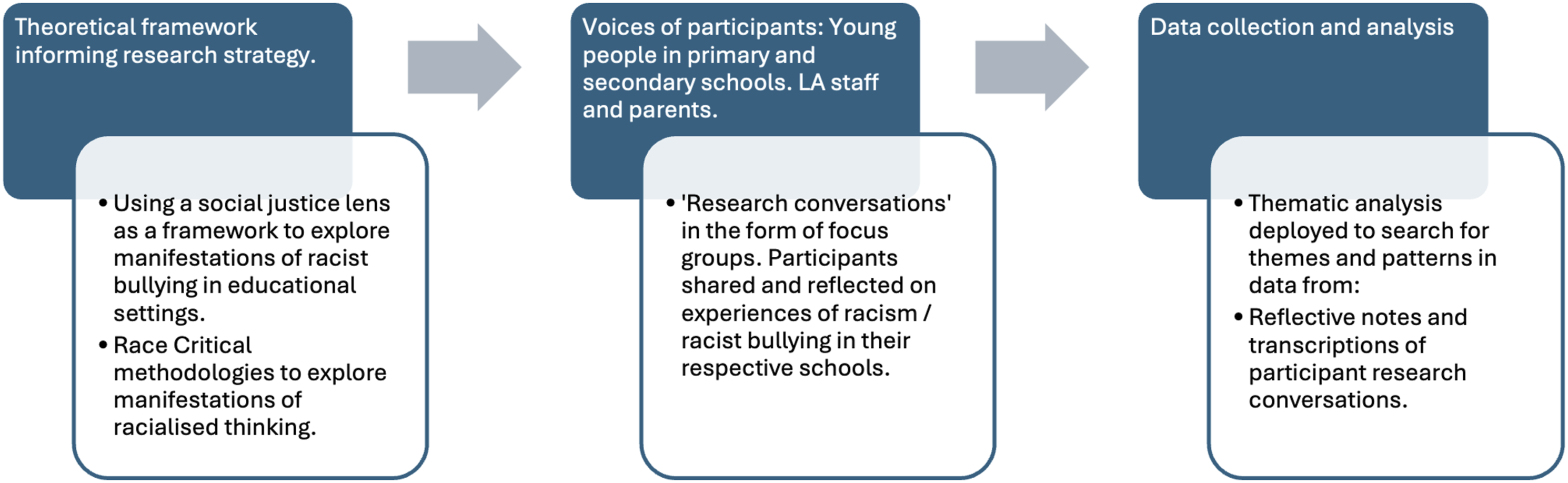
Research findings
Understanding why communities / pupils in the 5 LA’s do not report racist incidents / racist bullying
Andrews (2012) and Leath et al. (2019) suggest that BRM pupils fear repeated episodes of RI/RB and may ultimately feel less safe when at school compared to their white peers. Research also suggests that pupils will downplay the RI/RB bullying they have experienced, to safeguard themselves from further bullying from the same perpetrators (Cork, 2007; Fine-Davis and Faas, 2014). We also found this to be the case. Thus, we have not produced a detailed ‘tick list’ of the RI/RB or assigned any numerical value to these. Our research was instead focused on listening and learning from the pupils (Atiles, 2024; Ramasubramanian et al., 2017). Pupils recounted their experiences of events with the understanding that they were being given a non-judgemental space to talk and that their courage in speaking out would be taken seriously and taken forward.
Research themes.
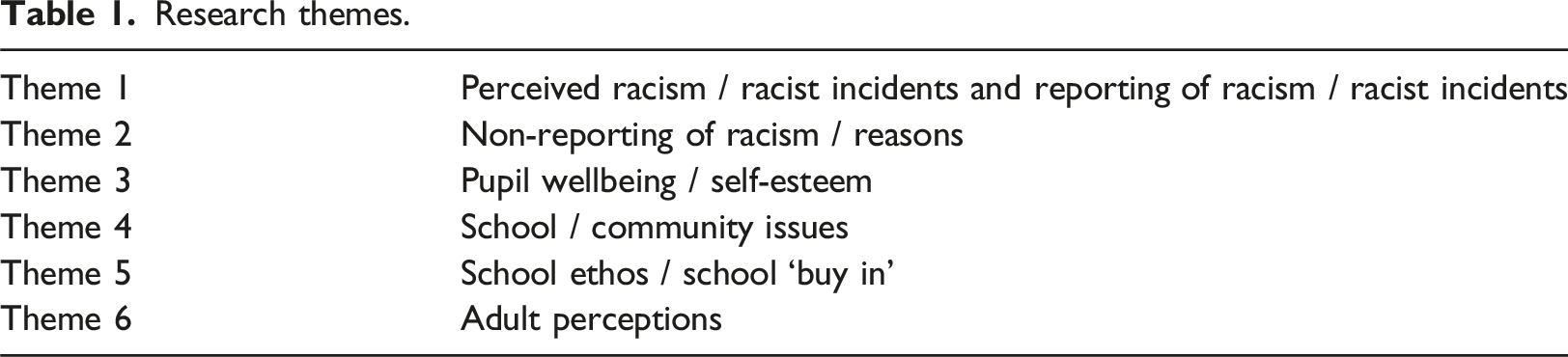
In what follows, we present examples from our data and highlight pupil voice to illustrate occurrence of these themes.
Theme 1. Perceived racism / racist incidents. Reporting of racism / racist incidents
Interestingly, pupils in all schools were able to give their definitions on what racism was and there was a consensus that racist bullying was picking on someone verbally or physically because of the colour of their skin, culture (religion) or based on appearance. Where pupils were unable to define this, a teacher told us, “Students may not provide an exact definition of racism/racist bullying, but they have a sound understanding of the things it encompasses” (Sarah,
3
teacher).
We were also heartened to learn that there were ‘pockets of good practice’ with regard to reporting in LA schools (Claire, LA staff). However, this was not widely embedded, especially with regard to the casual use of racist ‘banter’ or as one teacher described it to us, “The children in year 6 sometimes use ‘slang’ – [P word]” (Megan, LEA staff).
A pupil in school C recalled a past event, “when I was younger, I was young, it was dinner time and the older children (year 4’s) were laughing and calling me blackie (Ben, P1).
During the research process, we found that pupils engaged well with the research on the whole and were extremely articulate and knowledgeable. As a research team, we were frustrated by the sense that many of the issues revealed by the pupils could be easily solved through simple interventions. It was especially upsetting to hear one young pupil comment… “when are the adults going to sort out racism?” (Ahmed, P2).
Theme 2. Reasons behind non reporting of racist incidents
We found that pupils didn’t report racist incidents because they were afraid ‘friends’ would get into trouble: “I was called the N word. But I don’t think the child knew what it meant, so I didn’t report it. I didn’t want to get them into trouble” (Ruben, P4).
Or “There is a stigma in reporting, you are seen as a snitch” (Navin, C4)
This was an interesting discovery, demonstrating that victims of racist bullying sometimes doubted their peers’ understanding and application of racist terms. Notably, in some instances in which racist bullying was reported, “the pupil being racist started lying when they were reported” (Ahmed, P2).
Pupils who were recipients of racism also didn’t want to be seen as ‘telling tales’ on other pupils, and doubted whether, if they did ‘tell’, there would be any redress or justice for them: “There's a stigma behind reporting it. You're a snitch. When you actually report and they really don't do anything, you start to believe. It's not that deep [important]. So, then you have that lack of confidence that actually acknowledging what's happening and reporting it and actually getting some justice out [of it]” (Sasha, S1).
Despair and acceptance of the status quo [systemic issues / hierarchies] were evident: “There is no point in reporting, as it only causes more upset for us and our families (Zac, P2).
One of the adult participants told us: “When it is a microaggression, young pupils might not have the ability to communicate what has happened to them or why it is racist. Also, how can you report racism when a teacher is being racist? Pupils/staff feeling like this is something that they’re just going to have to deal with in their lives”. (Cora, LA staff).
As this LA staff member maintained, with some cynicism ‘Dealing with racism isn’t an entrenched behaviour in the school system’ (Linda, LA staff).
Theme 3. Effect on pupil wellbeing / self esteem
Whilst we were unable to ascertain the long-term effects on wellbeing or self-esteem of research participants, testimonies such as this allude to ongoing racial harm (Comas-Díaz, 2016; Smith, 2010). This implies a systematic problem with racism in schools (Esteves, 2018). Pupils reported that they found solace and strength within family support systems, rather than in school: “When I was younger and sometimes even now, my dad will remind me and be like Denisha, remember; You’re a black girl. You can’t act the way other people acting to act a certain way. And I feel like it’s also that mentality that then still keeps racism around. It’s kind of like, I shouldn’t have to act differently just because if I do something a white person does, they’ll get penalised less harshly than I will” (Denisha, S2)
It was obvious to us that this pupil was visibly and emotionally disheartened, when they reflected: “You just feel like the fact that we have to shrug it off when the racial slurs get said at you. I don't know. In my case it's more of a psychological thing where I feel like; maybe this is normal, because nothing really gets done about it, nothing. There's not really much awareness about it. It's like oh this is just normal. It’s just ‘banter’ but the thing is there's implications and there is history behind them [racial slurs], we have to take it more seriously” (Eric, S4).
Krystal told us her self-esteem was impacted: “Because I have experience of going to teachers when racist slurs were said to me and nothing happened, when they were said again...I lacked confidence to go to the teacher again and explain my situation. (Krystal, C4).
Leo said: “You don’t know how bad racism is [in school] until you have experienced it” (Leo, C2).
Theme 4. School / community issues
Focus groups were undertaken with a group of parents from the Roma community. They were united in their opinions and perceptions that ‘Racism is everywhere’ (Algar, parent). They worried, as a result, about their children both ‘inside and outside school’. They also highlighted that school sporting events held in the community would: “involve incidents of racist comments on the playing field” (Daval, parent).
LA staff told us they believed that: “the community trickles into the school – school is a melting pot” (Cora, LA staff)
Theme 5. School ethos / school buy in
At Secondary school 1, there seemed to be support for learners in terms of reporting. All learners knew they could speak to their safeguarding lead, there was also provision for anonymous online reporting. This was an exception as no pupils in the other schools, informed us of a system of reporting. The class teacher informed us that the school has a lot of support for bullying incidents, but, when pressed, agreed that this was not predominantly for ‘racist’ bullying.
We discussed with teachers the use of restorative measures to resolve conflicts. Clare, a teacher in primary school, also expanded on the benefits of restorative justice and explained that all teachers in her school were trained in restorative justice approaches. However, one pupil told us: “When talking about being made to take part in a restorative meeting “Going into that room there was the expectation that I was to forgive that person…. They treat it as if you they called you a petty nickname, not something very racist with history behind it…you're both brought in that room and you're both looked at like nothing has happened and that it's petty as a childish fight. And you have to forgive them. And so, then it put for me, at least, they put me in a position where I felt obliged to forgive them when I was still upset and hurt. And I never had the opportunity to convey that. And instead, I just let it go because I was expected to let it go” (Alfie, S4).
Theme 6. Adult perceptions
Adults who were LA staff told us that racism remains persistent in our schools; it is a: ‘dripping tap’ (Ruth LA staff).
BRM staff who were on supply cover told us: “As a woman who wears a hijab, I often have pupils laughing or name calling. I ignore it – its usual. I’m always wary when I go into a new school. I have never reported it to the head teacher / why would I?” (Samira, supply teacher).
BRM teaching staff have also been recorded as being less willing to bring these problems up because they feel that they may be seen as over-exaggerating a pupils claim (Scourfield and Davies, 2005). At school C1, the teacher felt that different religions and cultures were still not integrated in all activities. He felt that many cultures and religions stay in their groups and don’t mix. Kogachi and Graham (2021: 2143) suggest ‘friendships often remain segregated based on race, even in diverse schools’. This also suggests that there is a preference in friendships for homophily, or tendency to seek out friends who are similar to ourselves (McPherson et al., 2001; Mouw and Entwisle, 2006; Thijs and Verkuyten, 2014).
Parents spoke about the occurrence of racist incidents in local communities. They raised concerns about racism in high schools from students and teachers. They felt that teachers hold a bias against students of different communities, for example, discrimination against clothing worn. They mentioned Muslim students covering their legs and students questioning this or picking on them for doing so. Parents felt there was no representation for them in local council or in public services. They felt they could not report incidents of racism to the police, due to a lack of understanding. Parents also mentioned that they found it difficult to report incidents due to the language barrier. They said if they were angry, they could use google translate, but that this was not always effective.
Recommendations
Recommendations for schools / policy / research
Several recommendations emerged from the voices of the research participants. Recognising the lasting and devastating impact of racism and racist bullying on young people’s mental and physical health, we believe there is a strong case to categorise these incidents as Adverse Childhood Experiences (ACEs). The Anti-Bullying Alliance (2024, online) suggest that being bullied because of identity can have profound negative consequences compared to other types of bullying. They also say that since 2016 and Brexit, there is a lack of recent research in this area.
Tailored, sustained support, such as counselling, should be resourced for the targets of racism. Anti-racism needs to be threaded throughout school policies, including it as a safeguarding priority. The United Nations convention on the Rights of the Child (1989) mandates protection against discrimination as a fundamental human right. Therefore, these schools should not only comply but actively prioritise anti-discrimination measures, explicitly addressing racism within their policies and procedures. In addition to this, there is a need for a transparent process and clear criterion for reporting and addressing racism and racist bullying. This should extend beyond individual schools to encompass a broader, ‘Pan-Wales’ approach. All instances of racism or racist bullying should be mandatorily reported to parents / guardians of both perpetrator(s) and target(s), with consistent and graduated sanctions implemented along with an education package delivered to perpetrators uniformly across all schools.
Anti-racism should be integrated into the curriculum in collaboration with pupils, their families and the wider community, ensuring diverse and authentic representation. LA and school staff currently lack the necessary competence, confidence, and consistency in addressing racist incidents. This further highlights the urgent need for standardised professional learning across the board. The engagement and commitment of LA staff, senior leadership teams, and school governors is pivotal to enable sustained anti-racist approaches. This should also involve student teachers, support staff, and site teams, as well as being part of the induction process for any new staff that join the school.
Schools should consider working more closely with parents and the community stakeholders and professionals with lived experience of racism to establish anti-racist steering groups. These groups may enable collaboration through supportive and challenging local networks. Parents should be informed during the implementation of robust systems for reporting racist bullying. Opportunities for pupils to learn about other cultures must also be integrated throughout the educational lives of pupils and across all areas of the learning experience, with both pupils and staff developing their awareness and understanding regarding hate crime. Schools need to recognise that adults working within their institutions may also experience racism or racist bullying, necessitating an open space for proactive exploration of this issue. The funding of this research by the LA is to be commended. It is evident that this research project has only spotlighted a fraction of the issues that exists within schools, communities locally, nationally and globally. Additional funding and longitudinal research are essential to delve more deeply into these issues.
Conclusion
Summary of reasons why pupils do not report racist incidents in Southeast Wales schools.
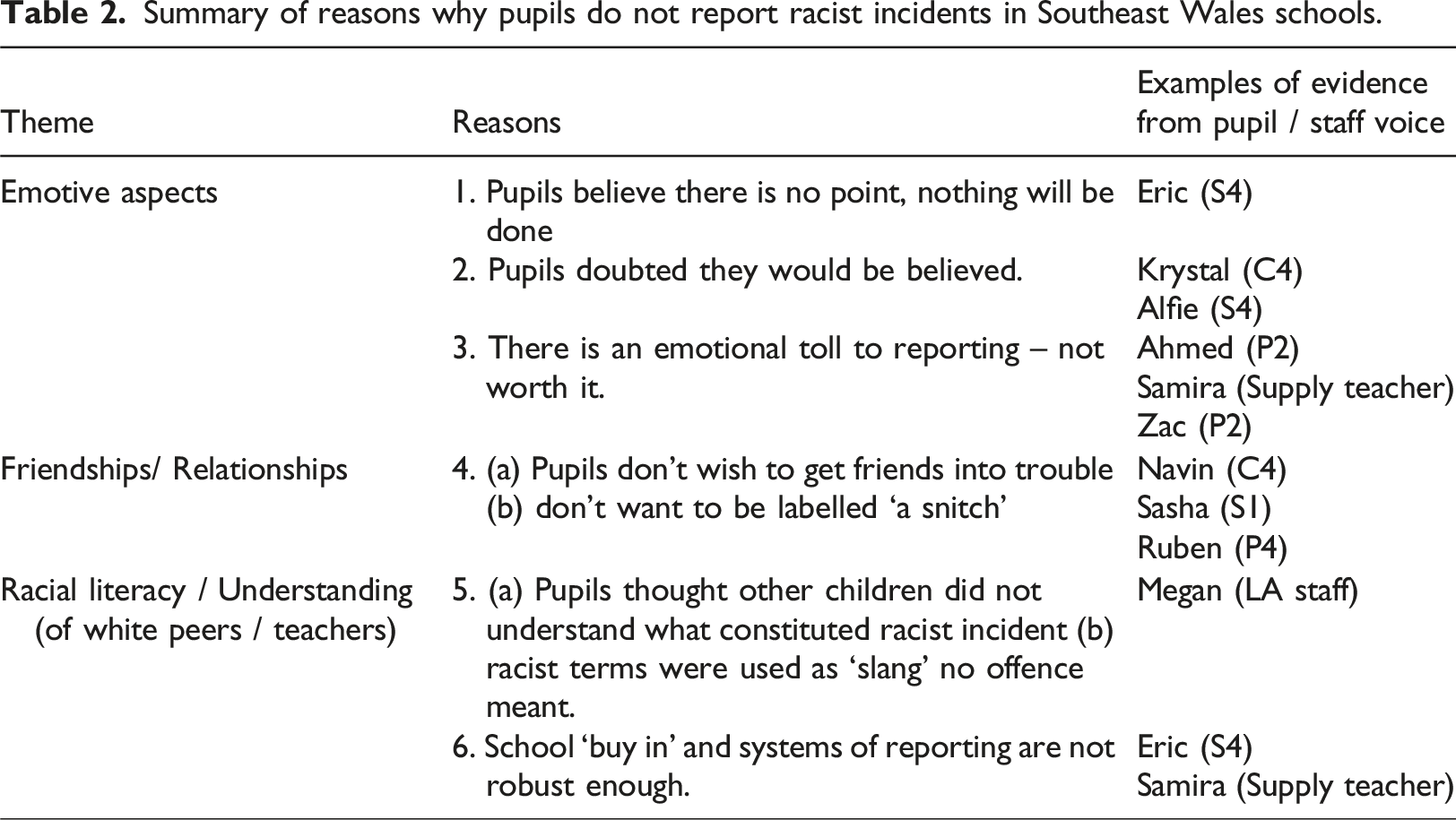
As set out at the beginning of this paper, as a research team, we assured the young participants that we would amplify their voices. As a direct result of this research, the Local Authority have now implemented an anti-racist action plan which they have mandated to all 57 schools in the area to adhere to. The plan addresses the research report and recommends that the six aforementioned themes of the research are addressed. Objectives included: • Strengthening anti-racist policy and practice within the LA and across educational settings. • Implementing key recommendations aligned to the 6 themes. • Provision of a range of services to support leaders to ensure equity of opportunity and promote the engagement and wellbeing of all pupils. • Head teachers in all 57 schools to have training on what constitutes a racist incident / racist bullying. (SEW LA, 2024).
In undertaking this research, we are aware that we have only touched upon a limited number of the reasons for the non-reporting of RI/RB in SEW schools. Because of time and resource restraints, we did not delve more deeply into reasons for RI/RB between and within racial or cultural groups. Xu et al. (2020) suggest that studies measuring differences in bullying prevalence by racial and cultural groups are inconclusive, and discrepancies in findings may be explained by differences in how bullying is measured and the impact of school and social environments. We appreciate that this article has highlighted significant gaps in the reporting of RI/RB in SEW. However, we were heartened to find that there were pockets of good anti-racist practice apparent and a cohort of teachers who expressed a desire to adhere to a social justice agenda. The answer to the question, of how to negate RI/RB in schools, may be indeterminable. However, as Verkuyten and Thijs purported in their seminal research, ‘if teachers react promptly to [racist] incidents, this had a positive effect on racism’ (2002: 310).
Footnotes
Acknowledgements
We are grateful to all the young people who took part in this research / adult research participants, for their contributions and participation. We are also grateful for the support of the funder.
Declaration of conflicting interests
The author(s) declared no potential conflicts of interest with respect to the research, authorship, and/or publication of this article.
Funding
The author(s) disclosed receipt of the following financial support for the research, authorship, and/or publication of this article: This work was funded by the Gwent safeguarding board.
Terminology
The terminology around ‘race’ and ethnicity is problematic. Therefore, we have used several conventions interchangeably, such as Black and Racially Minoritised and Black and brown, with the recognition that terms change over time, and it is always unsatisfactory to categorise people/ assign terminology to categorise people.
Ethical statement
This research was conducted within BERA guidelines (2018) and permissions were granted through the lead Institution’s Research Ethics Committee. Ethics no: CSESP20212262.
