




Abstract
In this article, we report findings from a narrative inquiry into why Black and racialized teachers quit the profession. Using intersectionality as a theoretical framework, five in-depth narrative interviews were analysed, yielding six thematic threads: emotional labour and cultural taxation, subtle and overt systemic racial violence, technology-facilitated harassment, a tension between identity and professionalism, and disillusionment with school leadership and institutional inaction in addressing harm. The findings reveal the compounded challenges Black and racialized teachers face, when professional demands intersect with systemic marginalization, particularly at the intersections of race and gender. They also show that while institutional shortcomings impact all teachers, contemporary challenges such as school underfunding and staff burnout are multiplicatively exacerbated for Black and racialized teachers as structural educational inequities intersect with systemic violence. Findings point to the need for robust and intersectional retention strategies. Schools should do the courageous work of confronting the structural and cultural harms that make teaching untenable for many, reimagining educational spaces as ones that value, support, and sustain racialized educators. Without this shift, retention initiatives will remain incomplete and unable to address the deeper inequities at play.
Keywords
Introduction
The shortage of Black and racialized teachers in Canada and the US is a profound challenge for educational equity. Research has shown that Black and racialized teachers positively impact academic outcomes, particularly for Black and racialized students, while contributing to a sense of belonging and cultural affirmation. However, the reality is stark: Black teachers make up only 6% of the U.S. teacher workforce, and their attrition rates are significantly higher than those of white teachers (Nir, 2024; Richard-Craven, 2024). This attrition trend reflects systemic inequities in the profession, where Black and racialized teachers face microaggressions, lack of institutional support, and limited resources in underfunded schools (Frank et al., 2021; Mawhinney and Cabral, 2024; Rauscher and Wilson, 2017). In Canada, the reality is also stark; however, the research is severely lacking in representing the narratives of Black and racialized teachers in the country.
The Canadian context
Teacher shortages in Canada have reached critical levels, exacerbated by systemic challenges and the lingering impacts of the COVID-19 pandemic. In Ontario, where a teacher surplus existed a decade ago, the current shortage is compounded by a rise in retirements and student enrolments. Canadian Ministry documents predict the crisis will worsen by 2027, especially in French and technical education, where the gaps are already significant (Jones, 2024). Teachers’ unions have flagged worsening working conditions, including classroom violence, oversized classes, and insufficient support for students with special needs, as major contributors to early-career attrition (Jones, 2024). Quebec has seen nearly 5000 teachers resign from permanent positions over the past 5 years, with unions attributing the exodus to heavy workloads, limited classroom support, and poor retention strategies (O’Malley, 2024). Administrators across Canada report struggling to maintain basic operations, often forced to combine grades, cancel music or physical education classes, or hire untrained individuals to monitor students (Amad, 2024; Wong, 2024). The pandemic accelerated these challenges. Many veteran teachers retired early, while others avoided substitute teaching due to health risks. Stopgap measures – such as reducing teacher preparation time, relying on uncertified staff, and pressing retired educators back into service – fail to address long-term needs (Amad, 2024; Wong, 2024).
Black teachers in Canada face systemic violence and exclusion within schools, which is often obscured by the country’s multicultural discourse (Lopez, 2020). Studies have shown that Black teachers experience racial microaggressions, are overlooked for leadership opportunities, and must navigate predominantly white institutional cultures that undermine their contributions and professional authority (Lopez, 2020; Mullings et al., 2016). Similarily, Ramjattan (2019) found that racialized teachers in Canada experience racist microaggressions that position them as perpetual outsiders as well as persistent interrogations of their nativeness, with students and colleagues questioning their legitimacy as teachers. These teachers are also subjected to insinuations of their foreignness to the English language, with assumptions that their linguistic skills are inherently inferior in addition to cues suggesting that they do not belong in the classroom (Ramjattan, 2019). Immigrant teachers in Canada face similar challenges, including a lack of credential recognition and systemic biases that construct their cultural and linguistic differences as deficiencies rather than assets (Schmidt, 2010). Our study does not capture the voices of Black and racialized migrant teachers, which is a worthy future direction for this research.
The American context
In the US, Black teachers often work in schools serving socio-economically marginalized communities, where they must navigate structural inequities such as insufficient classroom materials and high unmet student needs – including academic support, mental health services, and basic resources like food and stable housing – with minimal support (Mawhinney and Cabral, 2024). In Philadelphia, for instance, schools in predominantly Black neighbourhoods are frequently underfunded, creating an environment where Black teachers feel compelled to go beyond their professional duties to compensate for systemic failings, for example by purchasing books and materials with their own money (Mawhinney and Cabral, 2024). Moreover, Black and racialized teachers in majority-white schools report racial isolation, tokenism, and exclusionary behaviours from colleagues and parents. These experiences lead to diminished morale and higher turnover rates, particularly for educators who do not see pathways for long-term retention or professional satisfaction (Nir, 2024; Terada, 2021). Rauscher and Wilson (2017) identified racialized stressors as a significant challenge for Black and Mexican American teachers, who reported experiencing additional workloads, perceptions of incompetence, and a lack of support from administrators. These stressors contributed to a sense of exhaustion, impacting their mental health and ultimately their career longevity. They are also often compounded by the direct racial harms that racialized teachers experience.
Racialized teachers in the US often face ‘racial battle fatigue’, defined by Pizarro and Kohli (2018) as the ‘macro and microaggressions that teachers of color experience. . .on multiple levels simultaneously’ (p. 5). Grooms et al. (2021) found that racial battle fatigue directly affects Black and racialized teacher job satisfaction and psychological well-being, contributing to higher attrition rates compared to their white counterparts. Efforts to address the systemic challenges that racialized teachers experience have largely focused on recruitment, often neglecting the systemic factors driving attrition. Scholars such as Love (2023) and Grooms et al. (2021) emphasize the need to shift focus from recruitment to retention, highlighting that without meaningful change in how schools treat and support Black and racialized educators, even well-intentioned recruitment initiatives will fail. Structural barriers and harms – ranging from low pay to experiences of racism – make the profession unsustainable for many racialized teachers, who leave not because of their students but because of systemic neglect by educational institutions (Frank et al., 2021; Mawhinney and Cabral, 2024).
The current study
Building on previous research and the news articles discussed in this section, this investigation centres race and systemic racial violence as key axes of inquiry – an approach explicitly reflected in our recruitment strategy and aligned with our theoretical framework. The research question is Why do Black and racialized teachers in leave the teaching profession, and what factors and lived experiences contribute to their decisions to leave? Using an intersectional narrative inquiry approach, it examines the stories of five educators who left the profession in recent years, capturing both the complex challenges and the racial inequities they faced. It is important to emphasize that, while we recognize the impact of racialization on Black individuals, we have deliberately chosen to distinguish between the terms Black and racialized. This decision aligns with how our Black participants self-identified and reflects insights from previous researchers (e.g. Lopez, 2020) and Black activists (Darcel, 2020) who caution against combining the terms, arguing that doing so fails to adequately address issues such as anti-Black racism within Brown and Asian communities, among others.
Theoretical framework: Intersectionality
Although intersectionality originated in Black feminist thought decades prior, the term was coined by Crenshaw in 1989 in response to the failures of anti-racist and feminist theories in capturing the unique lived experiences of Black women. She argued that this deliberate erasure of Black women’s experience ‘reflects an uncritical and disturbing acceptance of dominant ways of thinking about discrimination’ (p. 150). While Crenshaw (1989) initially named this framework in relation to Black women’s experiences within a legal context, intersectionality has become an important analytical tool to theorize notions of difference, identity, discrimination, and oppression across various spaces, including education (Collins and Bilge, 2016). Intersectionality has provided scholars and activists with a tool to revisit and analyse existing literature and knowledge (Collins, 2019). Rejecting binary thinking, these core concepts promote an understanding of how social constructs, such as race, gender, class, contemporary social and political contexts such as technological innovation, work in relation to each other and thus, result in unique experiences of discrimination and oppression, that cannot be contained in an analysis of only racism or only sexism (Collins and Bilge, 2016). Our study aims to address gaps in understanding teacher attrition among Black and racialized teachers by examining the interconnectedness of race, class, gender, and other social categories. Recognizing these intersections is crucial for unpacking the unique experiences of groups such as Muslim and Black women, whose challenges in the profession are shaped by overlapping systems of oppression that extend beyond generic discussions of teacher attrition.
Importantly, intersectionality is both a critical theory and praxis (Collins, 2019). In our study, we use intersectionality to ‘attend to complexity’ (Collins, 2019: 44) and inform our research study’s method and analysis. We use intersectionality to frame our study, including in the initial stages. For example, we employed a purposive sampling strategy in which we sought Black and racialized teachers who had diverse social locations at the intersections of various socio-political markers such as race, gender, and ethno-religious identity. As an analytical tool, intersectionality recognizes the compounding effect of multiple identities alongside changing social and political contexts (Collins, 2019). These ongoing interactions give rise to distinct social experiences shaped by entrenched systems of power, including patriarchy, white supremacy, and colonization. The education system, in particular, is deeply implicated in both historical and contemporary forms of racist and colonial violence. The legacy of Canada’s residential schools – where Indigenous children were forcibly removed from their families and subjected to systemic cultural erasure and abuse – continues to reverberate through present-day educational inequities. These schools, designed to assimilate Indigenous children and uphold colonial authority, laid the groundwork for enduring institutional barriers that disproportionately impact marginalized communities today (Benn-John, 2019). The systemic effects of this legacy are evident in contemporary education through persistent disparities in resources, opportunities, and outcomes for Black and racialized teachers and students (Benn-John, 2019).
Literature review
Teacher attrition remains a persistent issue in education, with former teachers increasingly turning to social media platforms like TikTok to share their experiences. Using the hashtag #TeacherQuitTok, many express complex emotions such as guilt and sadness about leaving the profession. Muskin (2024) identified eight leading causes of attrition showcased in these videos: intense workload, heightened stress, inadequate compensation, poor administrative support, student discipline issues, lack of parental cooperation, and standardized testing. The existing literature supports Muskin’s (2024) findings that the factors contributing to teacher attrition often overlap. For instance, increased workload combined with a lack of support has been linked to mental health challenges that significantly shape teacher experiences (Buchanan, 2010; Muskin, 2024). Similarly, Marx and colleagues (2023) suggested that inadequate salaries, compounded by the need to take on extra classes with minimal administrative support, exacerbate these challenges. This intersection of factors is particularly pronounced among Black and racialized teachers (Marx et al., 2023). Systemic issues in education, such as burnout and low salaries, are compounded for Black and racialized teachers who also experience intersectional systemic violence. For example, Evelyn, a former teacher of Latinx identity in Marx and colleagues’ study (2023), shared her experiences of racism from her colleagues, feeling the burden of having to support her students with little to no support from other staff and administration and also having to take on more classes to sustain herself. Evelyn, like many other racialized teachers, pointed to the systemic issues that failed her as a teacher and ultimately influenced her decision to quit the profession (Marx et al., 2023).
Recent studies conducted across the US, the United Kingdom (UK), and Australia demonstrate that the pervasiveness of racism remains a main factor that pushes Black and racialized teachers out of schools (Bradbury et al., 2023; Frank et al., 2021; Kim and Hsieh 2022; Marx et al., 2023). Experiences such as microaggressions, racial stereotyping, a lack of career progression opportunities, discrimination at work, hate speech and verbal abuse by students, and lack of support from colleagues and administrators negatively impact teachers’ mental health and ultimately contributed to US and UK teachers’ decisions to leave (Bradbury et al., 2023; Frank et al., 2021; Kim and Hsieh 2022). Racialized teachers discussed the ‘battle fatigue’ (Bradbury et al., 2023: 339) associated with the burden of constantly addressing racism in schools. Kim and Hsieh (2022) also highlighted the deeply intertwined nature of racial and gendered violence in a study that aimed to capture the experiences of Asian American teachers, who mentioned they encountered sexualized and gendered violence specific to their racial identities. For instance, they reported being treated as exotic or being asked ‘what are you?’ (Kim and Hsieh, 2022: 102).
Race and gender significantly influence teacher mobility and attrition, particularly in diverse schools (Djonko-Moore, 2016). A recent study found that male special education teachers who shared the same race or ethnicity as their school’s demographics generally received more support than their female counterparts, except for Black male special education teachers, who experienced higher attrition rates (Scott et al., 2023). Demographics and geographic contexts of schools also play a key role in why teachers leave the profession (Djonko-Moore, 2016; Kohli, 2009; Scott et al., 2023). For example, schools with diverse student populations often saw higher rates of teacher mobility and attrition among white teachers (Djonko-Moore, 2016; Kohli, 2009). Additionally, Djonko-Moore (2016) asserts that ‘teachers’ perceptions of students, parents, and community appear to be more important in mobility decisions than their personal characteristics and school setting characteristics’ (p. 1080). The author concluded that teachers who have less critical understandings of the systemic issues that underlie their students’ experiences, such as the impact of capitalism on poverty in the school community, were more likely to leave their teaching positions (Djonko-Moore, 2016).
Methodology: Narrative inquiry
We employed narrative inquiry methodology, a qualitative research approach that centres on the lived experiences of participants to explore how they make sense of their personal and professional realities through storytelling. Well-established methodology in educational research (Clandinin and Connelly, 2000; Sonday et al., 2020), narrative inquiry offers a framework to examine how participants construct, interpret, and convey their experiences, making it an ideal choice for exploring the complexities that racialized teachers experience that ultimately lead them to the decide to leave the profession. Narrative inquiry is grounded in the belief that humans are storytelling beings who make sense of their world and identities through narratives. As Clandinin and Connelly (2000) state, ‘story is a portal through which a person enters the world and by which their experience of the world is interpreted’ (p. 477). This methodology focuses on the temporality, sociality, and place of experiences, allowing researchers to understand both individual and collective dimensions of experience (Clandinin et al., 2007). This approach is particularly relevant in educational contexts where personal and professional experiences are often intertwined.
Data collection
Participant social locations.
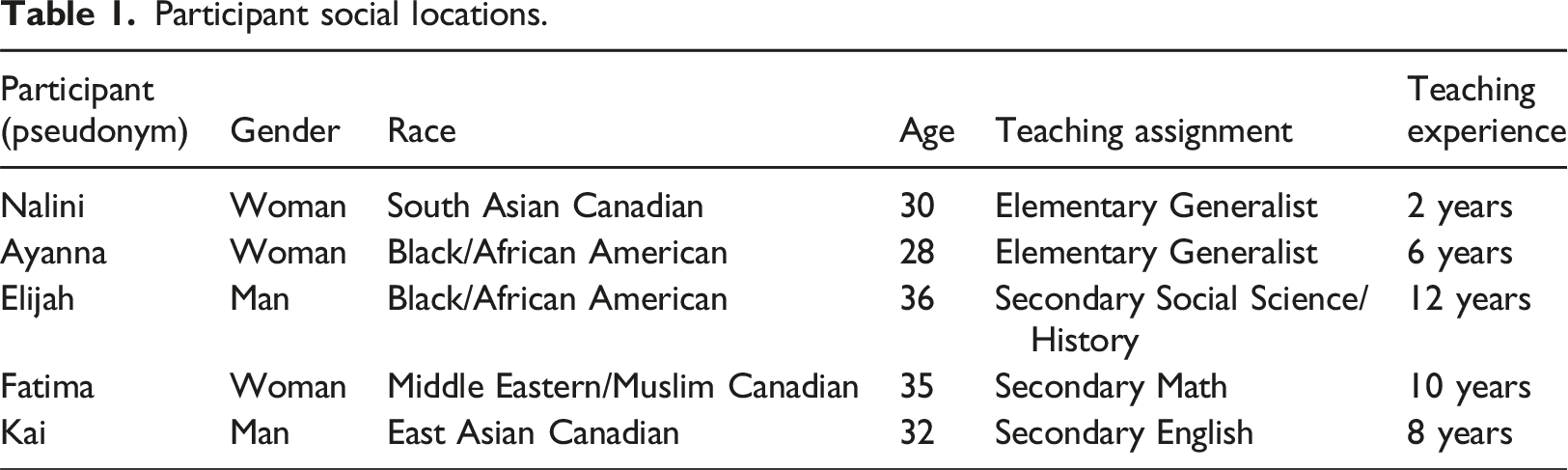
Interviews were between 35 min and 1 h in length and took place over Microsoft Teams through a secure connection. The decision to use narrative interviews aligns with the literature that emphasizes the importance of creating a collaborative space where participants can respond to story-based questions and share their experiences in an open-ended manner. According to Adhikari (2021), narrative inquiry ‘prioritizes the participants’ experiences, providing a platform for them to articulate the complexities of their lived realities’ (p. 73). This format allows the researcher to capture the complexities of participants’ experiences while respecting their narrative autonomy (Clandinin and Connelly, 2000; Sonday et al., 2020). The narrative interviews encouraged participants to recount their journeys into, within, and out of the teaching profession, with a focus on the systemic challenges they encountered. Key questions revolved around moments of decision-making, stories that stand out from their career, and the broader socio-political context of their teaching experiences. These guiding questions were designed to facilitate storytelling while allowing for flexibility, a hallmark of narrative inquiry that emphasizes the participant’s perspective and sense-making process. As noted by Sonday et al. (2020), ‘narrative inquiry is uniquely suited to understanding how personal and social contexts intersect in shaping individual experiences’ (p. 3).
Data analysis
The data analysis was conducted collaboratively by the two authors to contribute to the rigour and depth of the interpretation process. Analysis in narrative inquiry is iterative and interpretive, involving the identification of core themes or narrative threads that weave through the participants’ stories. In this study, the analysis followed several interconnected steps to ensure rigour and depth. First, all interviews were transcribed verbatim, and initial readings were conducted to immerse both researchers in the narratives. This stage involved annotating key points, emotions, and emerging patterns that appeared significant in the context of the research questions. Clandinin et al. (2007) emphasize that narrative inquiry ‘requires a particular kind of wakefulness, attending to the complexities and tensions present in participants’ stories’ (p. 24). The narratives were then ‘restoried’, a process of organizing the raw data into coherent and chronological accounts while preserving the participant’s voice. This step aimed to highlight the temporal aspects of their experiences – how past, present, and future expectations influenced their experiences and decision to leave the profession (Clandinin and Connelly, 2000).
Following the restorying phase, themes were extracted using a combination of inductive and deductive coding of narratives. Narratives were grouped into categories that aligned with the study’s objectives, leading to the identification of six narrative threads central to the participants’ experiences. These threads highlight the interplay between individual agency and structural factors, a focus consistent with narrative inquiry’s commitment to understanding the social context of personal stories. As Sonday et al. (2020) note, ‘narrative inquiry allows for a layered understanding of experience, where both the individual and the collective stories are given space to be heard’ (p. 4). A multicontextual analysis was also employed, examining how personal experiences intersect with broader socio-cultural and institutional dynamics (Sonday et al., 2020). As Head (2020) highlights, ‘multicontextual analysis within narrative inquiry provides insights into how the socio-political landscape influences individual narratives’ (p. 215). This analysis considered how each participant’s narrative was shaped by both internal (identity, personal values) and external (institutional expectations, racial dynamics) contexts, following the tradition of narrative inquiry to understand meaning construction within specific settings (Head, 2020).
Ethical considerations are paramount in narrative inquiry, particularly when interviewing people whose stories may involve sensitive or traumatic experiences. The researchers followed ethical guidelines by obtaining informed consent from all participants, including by sharing detailed information about the study before each interview, and ensuring confidentiality through the use of pseudonyms. Participants were given the opportunity to review and edit their narratives, allowing them control over the representation of their stories. This aligns with the ethical standards of narrative inquiry, where ‘the participant’s voice is respected, and their story remains central to the research process’ (Sonday et al., 2020: 3). This collaborative and respectful approach is essential to maintaining the integrity and trustworthiness of the research (Clandinin et al., 2007).
To enhance validity, several strategies were employed. Prolonged engagement with the data, member-checking, and peer debriefing were integral to validating the findings. The use of thick descriptions – detailed and context-rich accounts of participants’ experiences – allowed for a deeper understanding of their stories and provided transparency in how interpretations were formed. Adhikari (2021) emphasizes that ‘narrative inquiry requires a rigorous process of analysis to ensure that the complexity of stories is honoured and represented accurately’ (p. 78). Additionally, reflexivity was practiced throughout the research process, with the researchers acknowledging and documenting their positionalities, biases, and influences on the data collection and interpretation stages (Head, 2020).
Both racialized women, the authors’ intersectional social locations shape how they envisioned and conducted the study. The first author, an Arab Muslim woman in hijab, lives on the traditional territory of the Anishinaabe people of the Three Fires Confederacy: Ojibwe, Odawa, and Potawatomi. Her lived experience is informed by her background as a former middle school teacher who left the profession due to racial violence as well as her current role as a professor and scholar. The second author, an Eelam Tamil woman, resides on the traditional territory of the Mississaugas of the Credit, the Anishnabeg, the Chippewa, the Haudenosaunee, and the Wendat. Both authors arrived on Turtle Island, also known as ‘Canada’, as refugees. Their lived experiences within education systems as racialized women inform their approach to the study. For instance, all interviews were conducted by the first author, whose shared experiences with the participants enriched the conversations, creating a sense of trust in handling the complexities of story and allowing for deeper, more meaningful dialogue.
Results
The analysis yielded six major narrative threads that encapsulate the experiences of racialized teachers who decided to leave the teaching profession. They include emotional labour and cultural taxation, which examines the additional workload and expectations placed on racialized teachers, often tied to their identities and relationships with marginalized students. Subtle systemic racial violence reflects the accumulation of microaggressions and exclusionary practices that, while often dismissed as minor, deeply affect teachers’ sense of belonging and well-being, while overt systemic racial violence captures explicit acts of racial harm. The impact of technology-facilitated harassment reveals how digital platforms have become tools for enacting for racial violence, intensifying the harms experienced by racialized teachers. The tension between identity and professionalism highlights the challenges teachers face in navigating spaces that perceive their personal and cultural identities as incongruent with dominant norms in education. Finally, disillusionment with school leadership and institutional inaction reflects participants’ frustration with systemic failures, including the lack of meaningful responses to reported harms and the perpetuation of inequities by those in positions of power. Important to note is that while these threads reflect the core narratives from the data, they do not encompass the entirety of every participant’s story. Moreover, some thematic threads are grounded in the experiences of multiple participants, while others capture as little as one participant’s narrative.
Emotional labour and cultural taxation
A significant reason cited by participants for leaving the profession was the emotional labour associated with their roles, compounded by a phenomenon known as ‘cultural taxation’ (Padilla, 1994). Emotional labour, as defined by Hochschild (1983), refers to the effort required to manage one’s emotions to meet the expectations of a professional setting. For Black and racialized teachers, this labour is intensified by the need to navigate an educational environment that often does not reflect or support their identities. Cultural taxation, on the other hand, came out in the narratives in relation to the additional responsibilities placed on racialized individuals to serve as cultural interpreters, advocates, or role models due to their race or ethnicity, tasks for which they often receive no formal recognition or compensation.
Teachers expressed that they were expected to manage high-needs classrooms while also navigating personal and professional challenges, often without meaningful assistance. There was an implicit expectation that they, as Black and racialized educators, would bring cultural understanding and resilience to classrooms with diverse student bodies, thus shouldering additional emotional labour that their white counterparts were often not expected to perform. Ayanna, a Black elementary school teacher, reflected on her overwhelming experience during the pandemic transition back to in-person teaching: ‘I wasn’t prepared. No one was prepared. But I felt, you know, as all teachers do, I just felt like even if I'm not prepared, I have to do this and I have to kind of stick with it’. Her experience reveals how racialized teachers are often expected to manage diverse classrooms with minimal support, as they are viewed to be inherently suited to connect with students from marginalized backgrounds. This aligns with research by Kohli and Pizarro (2022), who argue that racialized teachers are often viewed as cultural brokers who are expected to connect with students of colour without the necessary institutional support.
Ayanna’s transition from a predominantly white, affluent private school in New York to a high-needs, largely Black school in Philadelphia revealed distinct expectations shaped by the socio-economic and racial demographics of each environment. ‘I was told to… be firm, but like, you know, be kind and speak softly’, she recalled of her time in New York, where her approach aligned more closely with her values. In Philadelphia, however, the expectations were different: ‘Everyone… was saying like, you had to be mean… you have to yell at [them]’. Ayanna found herself caught between her personal teaching philosophy and the imposed ‘orendemander’ persona she was expected to assume in Philadelphia. Navigating these contrasting roles, shaped by racialized and class-based assumptions about students, took an emotional toll on her. The pressure to conform to these shifting expectations, especially as a Black educator, was an added labour she shouldered.
Similarly, Nalini, a South Asian elementary teacher, shared the difficulties she encountered in her classroom, where a high percentage of students required additional support that was simply not available: ‘I had a very challenging class... I’d have to evacuate my classroom because of violence on a regular basis, and there wasn’t ever a replacement EA when my full-time EA was away’. Her story reflects the literature on cultural taxation, which highlights how racialized teachers are often assigned more challenging roles due to the perception that they are better equipped to handle difficult situations involving students of colour (Dlamini, 2002). This expectation to perform additional emotional and cultural labour without adequate recognition or support exacerbates the feeling of isolation and exhaustion for teachers.
This emotional labour was further intensified by a dissonance between the teachers’ personal teaching philosophies and the realities of the job. Ayanna, who described her natural teaching style as nurturing and relationship-driven, found herself being asked to adopt a more authoritarian approach, which conflicted with her values: ‘My spirit was crushed because that is not aligned with my teaching philosophy… being mean and being bossy and authoritative was never my teaching philosophy’. Such pressures to conform to a dominant, often eurocentric, pedagogical style highlight the emotional toll that Black and racialized teachers experience when forced to navigate between their own culturally responsive practices and the normative expectations of the educational system (Ladson-Billings, 1995). The stories of Ayanna and Nalini point to the intersectional nature of the emotional labour and cultural taxation that Black and racialized women teachers, in particular, face. Their narratives illustrate how these factors are intertwined with broader systems of oppression that undervalue culturally responsive approaches while simultaneously overburdening Black and racialized educators with responsibilities related to their identities and locations in the social world.
Subtle systemic racial violence
Another key narrative thread was the pervasive experience of systemic racial violence, including many stories of subtle forms of harm. Participants spoke extensively about how these subtle acts of racism made them feel alienated and undermined in their roles as educators. For many, this racial violence came in the form of microaggressions from colleagues, students, and parents. These acts were not isolated incidents but part of a broader pattern of intersectional harms that accumulated over time, ultimately contributing to the decision to leave the profession.
Fatima, an Arab Muslim secondary school teacher in hijab, described feeling constantly undermined by her colleagues and parents in the school community who questioned her legitimacy as a teacher: The microaggressions were relentless. There were so many little comments and behaviours that just chipped away at me over time. It was the colleagues who would say things like, ‘Oh, you’re so articulate for someone with English as a second language,’ even though I’ve lived here my whole life and English is my first language. Or the parents who would automatically assume I wasn’t the ‘real’ teacher, like they’d say, “Can we speak to the main teacher?” as if I was just an assistant or something.
Such comments illustrate how the intersection of Fatima’s racial, religious, and gender identities made her a target for biased remarks that positioned her as perpetually foreign and less credible, regardless of her qualifications.
Similarly, Kai, an East Asian secondary school teacher, shared his experience with racialized expectations and stereotypes: One time, during a parent-teacher interview, a parent literally said, ‘Oh, I thought you’d be teaching math or science, not English!’ It was like, really? Just because I’m Asian, I’m automatically supposed to be in those subjects? And, um, there was this other time during a class discussion, a student made a joke about me knowing kung fu or something. When I called him out on it, he was like, ‘I was just joking, sir, no need to get so serious.’ It’s those little things, you know? They add up and start to feel like a heavy weight you’re carrying around all the time.
These biases not only limited Kai’s professional identity but also conveyed an implicit message that he did not ‘belong’ in his chosen field, positioning him as an outsider within the broader educational community. As Kai noted, ‘It felt like no matter how hard I worked or how dedicated I was to my students, some people still saw me as out of place—like I was in the wrong room’. Speaking to subtle acts of harm experienced over time, Elijah, a Black male secondary school teacher, reflected on the ‘the racial battle fatigue’ he experienced, adding ‘once again, walking down the hall, the being ignored, the fake smiles…and I said, yes, it's time to go because I'm not about to be subjected to this repeatedly’.
Overt systemic racial violence
Overt systemic racial violence was another common thread among the participants. For Elijah, the experience of racial violence was most explicit as compared to the stories of other participants. His experience at a predominantly Black and Hispanic school highlighted the systemic racial biases embedded in school policies and training. Initially, he described a ‘honeymoon phase’, appreciating the diversity of the school and even recalled being placed beside another Black male educator, which provided some sense of community. However, this quickly shifted as he encountered racial violence against himself and his students. Elijah’s stories most strikingly captured this thematic thread.
He described a meeting where teachers were being trained on ‘gang awareness’, which disproportionately focused on Black and Hispanic students: So we have we have these gang awareness meetings. And I noticed every time we have this gang awareness meeting, it became a whole thing when we were talking about everything Black and Hispanic youth did… I raised my hand and I said, ‘excuse me, how come we never hear anything about white gangs or white supremacist gangs?’ And I say,for example, there was white supremacist graffiti this side of [city redacted].
Elijah’s question was met with silence and discomfort, further emphasizing the institutional reluctance to address systemic racial violence. He began to reflect on how his role increasingly felt like that of a ‘warden’ or ‘cop’, tasked with monitoring students rather than nurturing them. What are we doing? Like, I felt like in a lot of ways, teaching is like, I’m a warden. I’m a cop. The dean is the detective. And it just really is a school to prison pipeline. To continue to think about my role, when the prominent stories of police brutality happened, I began to really reflect and say, ‘You know what? How are we better than them? Yeah, we’re not out there with a gun killing people, but I’m with these kids or we’re with these kids for 12 years, you know, five, six hours a day. We’re killing these kids’ dreams. So by the time they leave our society, they’re dealing with intellectual cop and the actual cop.’ So instead of asking, ‘why would our kids want to join a gang that might be doing something nefarious?” we're just saying we need to find a way to punish them.
This experience strengthened his understanding of the school-to-prison pipeline (Skiba et al., 2014) and how these racially charged practices focused on punishment at the expense of student well-being and achievement. His disillusionment grew as he realized that if his students were viewed primarily as potential threats, he, as a Black educator, was also likely perceived through a lens of suspicion. The combination of institutional complicity in systemic harm and overt instances of racial violence, as well as their impact on both him and his students ultimately contributed to Elijah’s decision to leave the profession.
Technology-facilitated harassment
For some participants, the rise of tech-facilitated harassment, especially during the pandemic, played a key role in their decision to leave teaching. As schools moved to online platforms, Black and racialized teachers became targets of anonymous harms, which went largely unaddressed by school leadership who were more focused on what technology could afford to teaching and learning practices and less so with how it can be used to harm teachers. Kai shared his experience with harassment when unnamed students created a fake account impersonating him, posting xenophobic, racist comments under his name. Not long after this incident, during the online teaching phase of the pandemic, he was targeted again, receiving racist messages from fake social media accounts. The pandemic made everything worse. When we moved to online teaching, I started getting these random, hateful messages. They were saying things like, ‘Go back to China,’ even though I’m not even from China. I’m third-generation Canadian. But to them, it didn’t matter. I was just a convenient target. It was really, um, disorienting and scary. I couldn’t even figure out if these messages were coming from students, parents, or just random people online. But since the fake account issue, I felt like it might be a student.
Despite reporting the incident to his school administration, Kai was met with indifference. ‘The administration basically told me to ignore it, as if it would just go away on its own’, he explained.
Fatima also encountered tech-facilitated harassment, receiving racist emails from a parent who reacted aggressively to their child’s grades. ‘A parent emailed me, saying I was unfair and that “people like me” shouldn’t be allowed to teach Canadian kids’, she recalled. ‘It was clear that their anger was less about the grade and more about who I am’. Fatima felt these attacks were often fuelled by racist stereotypes, with parents assuming that her background influenced her grading. Despite bringing these emails to the administration’s attention, she found little support: ‘They told me to keep a record but didn’t do anything to address it’.
This lack of institutional support compounded the sense of isolation and vulnerability to technology-facilitated harm experienced by racialized teachers, who felt that their concerns were dismissed because they didn’t fit the school’s priorities. The rise of digital violence, combined with inaction from school leaders, left teachers like Kai and Fatima feeling unsafe both online and within the school community.
Tension between identity and professionalism
Participants highlighted the tension between their racial, religious, and cultural identities and the expectations of professionalism within the teaching profession. Many felt that their identities were both hyper-visible and scrutinized, creating an additional burden of having to perform their roles in ways that aligned with the dominant (often white) norms of the profession. These expectations, entrenched in systemic oppression, narrowly defined ‘professionalism’ in ways that marginalized and excluded culturally diverse practices and perspectives. Professionalism, coded in whiteness, often implicitly valued certain modes of speech, dress, and interaction that aligned with white, middle-class standards, leaving racialized teachers to navigate unspoken rules that devalued their authentic selves and expressions.
Fatima, for instance, spoke about the pressure to represent more than just herself because of her Muslim identity: ‘There was this constant pressure to be perfect because I felt like I was representing more than just myself. Like if I made a mistake, it wouldn’t just reflect badly on me, but on all Muslim teachers’. This pressure to be a flawless representative of her community reveals the weight of systemic expectations on racialized educators, who often feel that they must prove their competence in ways that white colleagues do not. Fatima also recounted how her identity was policed by her colleagues, who warned her not to show too much solidarity with Muslim students for fear of being seen as biased: ‘A white teacher pulled me aside and said, “You have to be careful not to be too sympathetic to the Muslim girls because it might seem like you’re giving them special treatment.”’ This policing of racialized educators’ interactions with students reflects the intersectional harm of having one’s identity weaponized as a barrier to building authentic relationships with students of similar backgrounds.
Kai described how his East Asian identity shaped his interactions with students and colleagues. He was subjected to stereotypical expectations, such as being seen as a disciplinarian or an expert in math and science, which did not align with his actual teaching style or subject matter expertise: ‘Some students expected me to be super strict or have some stereotypical “tiger teacher” attitude. And when I wasn’t, it seemed to surprise them’. The tension between maintaining their personal and cultural identities while conforming to professional expectations was a significant source of stress for teachers.
Elijah’s experiences illustrate the tension between his professional role and the racialized perceptions he faced from colleagues. He recounted an incident involving a Black student who received a referral from a white teacher for ‘staring at her in a threatening manner’. While Elijah worked to support the student and handle the situation diplomatically, he privately understood the racial undertones, noting, ‘In the back of my head, I’m like, I know she did’. His own experiences mirrored the student’s, as he too faced assumptions of aggression, such as when a colleague reported him for allegedly speaking ‘in a threatening manner’ despite his calm approach. ‘That threatening word just keeps coming up’, he noted, pointing to the persistent racial bias he encountered simply for engaging in professional conversations. Reflecting on these experiences, Elijah shared, ‘I love teaching, but I can’t be confined the way they want me to’, indicating his growing awareness that such racialized constraints limited his ability to meaningfully embody his role as an educator.
Disillusionment with school leadership and institutional inaction
A recurring narrative throughout the interviews was the disillusionment participants felt with school leadership and the broader educational institutions in which they worked. Many teachers expressed frustration with administrators who were more concerned with maintaining appearances and engaging in surface-level initiatives than addressing the systemic issues that affected both teachers and students. Participants noted that school leaders often focused on optics, such as diversity statements and symbolic gestures, while failing to implement meaningful changes that could address racialized teachers’ daily challenges. Their disillusionment was often tied to the sense that the institutions themselves perpetuated a culture of white normativity, where the concerns of racialized staff and students were relegated or ignored.
Fatima recounted several instances where she tried to raise concerns about the eurocentric nature of the curriculum and the need for more inclusive teaching materials. However, her concerns were consistently dismissed or ignored: ‘When I did try to have more serious conversations, like about how some of the curriculum choices were really eurocentric and alienating for our students, they’d just nod and say, “That’s an interesting perspective,” but nothing ever changed’. Her experience highlights the systemic barriers to implementing inclusive practices within an education system that often prioritizes maintaining a superficial sense of harmony over confronting the uncomfortable realities of racial exclusion.
Ayanna’s experience in a predominantly white private school deepened her disillusionment with the lack of support for racialized teachers. ‘I think racialized teachers definitely need affinity groups and spaces… especially in predominantly white spaces. I wish I had something like that when I was teaching in New York’, she said, reflecting on the isolation she felt with only one close confidant. She emphasized the importance of white teachers engaging in anti-racism work, suggesting, ‘white teachers need… an affinity group… to talk about how we contribute to racism in the classroom intentionally or unintentionally’. Without institutional support for such spaces, Ayanna felt the profession lacked a genuine commitment to equity and anti-racism.
Similarly, Kai described how his suggestion for a school-wide anti-racism project was shut down by administrators who feared it would ‘alienate’ some staff or students: ‘I suggested we do a school-wide project on anti-racism, especially given what was happening with all the anti-Asian hate. They shut it down, saying, “We don’t want to alienate anyone.”’ School leadership inaction on systemic racism, harassment, and violence contributed to a deep sense of disillusionment among the teachers in our study. They felt that the institutions they worked for were not only failing them but also failing the students they were supposed to serve.
Discussion
Some of the findings outlined in this study are consistent with the existing literature, whereas some of them offer new knowledge, providing further insights into the unique and intersectional experiences of Black and racialized teachers because of structural inequities and systemic violence. In relation the additional burdens expected of Black and racialized teachers, our findings align closely with other former teachers’ narratives that discussed the correlation between emotional labour and teachers’ reasons for quitting the profession (Wang et al., 2020; Wang and Hall, 2021). Former teachers in our study spoke to the tension between personal teaching philosophies and the realities of the job for Black and racialized teachers. This is also exemplified in Marx and colleagues (2023) study, wherein they shared an experience of a Black male teacher Matthew, who observed that existing educational practices, such as standardized testing, clashed with his attempts to make meaningful connections with students based on their shared lived experiences along racial lines. Black and racialized teachers’ philosophies often challenge the rigidity of existing practices and tend to reflect their interactions and understandings of what diverse school populations and students need (Bradbury et al., 2023; Marx et al., 2023).
Nalini and Ayanna expressed the tensions between their personal teaching philosophies and the prevailing educational practices, which they found exhausting due to heavy workloads and a lack of adequate support from colleagues and administration. Our study builds on existing literature that explores the ‘clash of values’ (Miller and Lashley, 2022: 14) by examining the intersections of identity and professionalism. One notable narrative from our findings highlights the parallels in how Black teachers and students are perceived and treated by their white counterparts. For instance, Elijah’s experience of being reported for ‘staring at [a white colleague] in a threatening manner’ connects to a recurring theme in the literature on Black teachers’ experiences (Bradbury et al., 2023; Frank et al., 2021; Kohli, 2009). Elijah’s account of white administrators and teachers framing gang violence as primarily a Black or Latinx issue aligns with Black educators’ experiences of white teachers routinely labelling Black students as ‘difficult to work with’ (Kohli, 2009: 248). Addressing anti-Black racism in schools, Lopez (2020) argues, requires educators ‘and in particular those who benefit from the system through existing norms and practices must engage in a process of unlearning and learning acknowledging the impact of neoliberalism in education in their everyday work’, (p. 1946). Moreover, while workplace stressors affect teachers more generally, the disillusionment experienced by Black and racialized teachers is rooted in institutional racism and sexism (Rauscher and Wilson, 2017). According to Miller and Lashley (2022) ‘disillusionment or being “fed up” as a factor in their decision to exit the profession and/or accept a change in role’, (Miller and Lashley, 2022: 16). Participants in our study reported feeling unsupported by administrators when attempting to implement inclusive teaching practices, and they described the dismissal of anti-racism initiatives they proposed. These experiences align with the concept of curriculum violence, which points to how systemic barriers within educational institutions hinder efforts to create more equitable learning spaces (Grooms et al., 2021).
Our findings on the subtle systemic racial violence that former teachers experience reinforce existing research indicating that Black and racialized teachers are frequently compelled to validate their teaching competence (Rauscher and Wilson, 2017; Schmidt, 2010). Fatima and Kai’s experiences of having their English language skills – and, by extension, their abilities and knowledge as educators – questioned by students and parents are directly linked to their racial, ethnic, and religious identities. These encounters contribute to the literature on microaggressions faced by racialized teachers and the subtle yet persistent forms of racism within schools (Schmidt, 2010). Our findings advance this area of research by illustrating how both narratives reflect the concept of racialized teachers as ‘perpetual foreigners’ (Ramjattan, 2019: 381), a perception that ultimately influenced their decision to leave the profession. This form of stereotyping, as argued by Frank et al. (2021), reinforces the notion that certain subjects, abilities, and knowledge within teacher education are framed as white intellectual property. As Ramjattan (2019) asserts, ‘this racist nativist association is often communicated by an everyday devaluation of racialized teachers, that is, those who are considered non-native to Canada and the English language’ (p. 386).
Our findings align with existing research on the racism experienced by racialized teachers while introducing a critical dimension – how technology facilitates this violence. Miller and Lashley (2022) identified the use of technology by colleagues and students to target Black and racialized teachers as a contributing factor to their departure from the profession. As Powell et al. (2021) emphasize, technology itself is not the root cause of online violence but rather a tool that amplifies and perpetuates it. This distinction is crucial, as much of the existing literature focuses on racist harm against teachers without accounting for the evolving role of digital platforms in its continuation. Notably, this finding emerged primarily in the narratives of the Canadian teachers in our study. However, due to the small sample size of five participants, we cannot conclude that this issue is specific to the Canadian context. Rather, it simply did not emerge as a significant factor in the quitting decisions of the American racialized and Black teachers we interviewed. In light of this, future research should explore technology-facilitated violence against Black and racialized teachers in both countries through both quantitative approaches and in-depth qualitative interviews. Furthermore, our study departs from the prevailing discourse that frames this issue as bullying or cyberbullying. Instead, we recognize it as technology-facilitated violence, a term that more accurately reflects the systemic and racialized nature of these experiences.
Concluding thoughts
These findings reveal the deep systemic inequities embedded in the teaching profession, which not only harm Black and racialized teachers and change the nature of their professional experience but also contribute to their decisions to leave the profession. Emotional labour and cultural taxation, combined with the pervasive impacts of subtle and overt racial violence, demonstrate a profession resistant to confronting the racialized burdens placed on its most vulnerable educators. The tension between identity and professionalism, compounded by technology-facilitated harassment, highlights how entrenched norms in education conflict with the lived realities of racialized teachers. Ultimately, participants’ disillusionment with school leadership and institutional inaction reflects a broader failure of educational systems to prioritize equity and accountability. The systemic neglect that drives racialized educators out of the profession points to the need for a shift in priorities – one that moves beyond symbolic inclusion toward substantive institutional change.
The findings from our study reveal significant opportunities for action across multiple levels within the education system. For researchers, our study highlights the need for targeted investigations into the specific ways Black and racialized teachers, staff, and administrators still in the profession experience racial violence, including the emotional and cultural taxation they endure and how these factors contribute to attrition. For Black and racialized teachers, our findings emphasize the importance of developing peer support networks and advocacy groups that provide professional affirmation and emotional solidarity, enabling them to navigate school environments while pushing for systemic change. Those supporting Black and racialized teachers – such as teacher unions, professional associations, and equity committees – can take actionable steps by advocating for policy reforms that address structural educational inequities, subtle and overt systemic racial violence, and technology-facilitated harassment, ensuring that racialized teachers receive meaningful institutional support. School leaders, including administrators and policymakers, have an opportunity to move beyond superficial diversity initiatives by embedding anti-racist policies into hiring, professional development, and retention practices. This includes providing ongoing training on systemic racism, ensuring accountability mechanisms for addressing racial harm, and actively creating school cultures that affirm the identities of Black and racialized educators. While the findings expose troubling patterns of institutional neglect, they also highlight tangible strategies that can disrupt these cycles of harm and create educational spaces where Black and racialized teachers are valued, supported, and retained in the profession.
Footnotes
Declaration of conflicting interests
The author(s) declared no potential conflicts of interest with respect to the research, authorship, and/or publication of this article.
Funding
The author(s) disclosed receipt of the following financial support for the research, authorship, and/or publication of this article: This research was funded by an OSSTF/FEESO Research Grant for Emergent Issues and Priorities.
