




Abstract
This study investigates how political ideologies influence university students’ perceptions of equity, diversity, and inclusion (EDI) discussions at a Post-92 university in the United Kingdom. In light of the increasingly contested nature of EDI within higher education, the study critically examines how political beliefs influence students’ engagement with these initiatives. This study reports on qualitative data gathered through open-ended survey responses from 224 students and analysed using Thematic Analysis and Critical Discourse Analysis. The findings identified four key themes: (1) student perceptions of university-led discussions on discrimination and EDI, (2) the impact of perceived bias on free speech and engagement, (3) discomfort among students with non-left-wing political views, and (4) scepticism regarding the university’s commitment to EDI. While some students valued the university’s proactive efforts in promoting EDI, others perceived these initiatives as ideologically biased and limiting to open discourse. Notably, conservative and right-leaning students reported feelings of alienation, citing concerns about ideological bias and a lack of academic neutrality. Scepticism also emerged about the sincerity of EDI efforts, with some students viewing them as performative rather than substantive. The study highlights the difficulties universities face in fostering EDI while upholding academic freedom of speech and embracing ideological diversity.
Keywords
Introduction
Discussions on equity, diversity, and inclusion (EDI) within higher education institutions (HEIs) have become increasingly contentious in recent years. Universities, often seen as microcosms of broader society, are influential spaces where issues of prejudice, discrimination, and racism can be debated, theorized, and also experienced first-hand (Osbourne et al., 2022). As HEIs negotiate the diverse political beliefs that students and staff bring to these discussions, they are simultaneously expected to foster and promote EDI and social justice. In the United Kingdom (UK), the challenge of achieving this balance is complicated by the socio-political climate. Research by Henderson et al. (2017) suggests that support for Brexit (i.e., the UK’s decision to leave the European Union) has led to intense debates about what it means to be British, who belongs in the UK, and how the nation should respond to its increasingly diverse population. These tensions have been further exacerbated by the global outcry following George Floyd’s murder in the United States, which prompted widespread anti-racism protests, including several demonstrations in the UK (BBC News, 2020). Furthermore, the toppling of monuments, such as the removal of the Edward Colston statue in Bristol, has become a symbol of the ongoing reparation with the UK’s colonial past. The dismantling of previously venerated figures has ignited heated debates within academic circles about the role of historical memory in public spaces and educational institutions (Collett, 2023). More recently, moreover, social media has been blamed for creating a ‘perfect storm’, where multiple killings in Southport, appeared to fuel far-right riots in the UK and widespread anti-immigration protests (Cadwalladr, 2024). These events serve to highlight the importance of universities in providing spaces for critical thinking and informed discourse.
Rationale for the study
Despite the growing body of literature concerning balancing EDI and free speech in academic settings, there remains a gap in understanding the intersection between political ideologies and perceptions of bias in these discussions. The present study plans to address this gap by providing an understanding of how these dynamics operate within a Post-92 university context, that is, an institution in the UK that was granted university status after the Further and Higher Education Act of 1992 (Legislation.gov.uk, 1992). Post-92 universities often serve a highly diverse student population, both in terms of ethnicity and socio-economic background, which means they are an important institution for exploring how political ideologies influence students’ discussions surrounding EDI. This research is particularly timely given the current socio-political climate, where across the world conversations about EDI have become increasingly contentious (Frey, 2024; Wendling and Epstein, 2025). By examining the diverse perspectives of students from various backgrounds, this study aims to provide insights that can inform university policies and practices.
Research questions
To address the gaps identified in the literature, this study seeks to examine the following research questions: • What are the prevailing perceptions among university student’s concerning discussions about EDI and social justice? • How do political ideologies influence these perceptions? • What are the implications of these perceptions for fostering an equitable, diverse, and inclusive academic environment?
Literature review
The concept of political identity has long been organized around a simplified left-right spectrum, a model originating in the French National Assemblies of 1789 and 1791. During these early sessions, those advocating for tradition, monarchism, and religious values positioned themselves on the right side of the assembly, while more liberal members aligned on the left (McPhee, 2002). Although this initial division was flexible, the polarization intensified during subsequent events, such as the Dreyfus Affair, which established truth, justice, religion, and national loyalty as defining traits of political ideology (Gauchet, 1997). Over time, this framework evolved into a more structured dichotomy, with each side associated with differing perspectives on governance, economy, and societal order. In the UK, this dichotomy is evident in the political arena, with the Labour Party representing leftist socialism, the Conservative Party advocating for right-leaning conservatism, and the Liberal Democrats embodying a centrist liberalism. Populist parties, including the United Kingdom Independence Party (UKIP) and Reform, have arguably pushed further right; challenging the established norms within mainstream conservatism, and capitalizing on perceived weaknesses in the centre (Kellner, 2024). Central to Western political thought, liberalism champions individual autonomy and is particularly influential in discussions of free speech, where the politics of tolerance and individual rights frequently intersect (Heywood, 2017).
The debate on free speech within UK universities, in particular, reflects this intersection and extends back to the 1970s, when the National Union of Students implemented a ‘no-platform’ policy to bar speakers espousing racist or fascist ideologies (Lewis, 2021). In recent years, this policy has attracted scrutiny, especially following incidents such as the Oxford University Society’s refusal to host former Home Secretary, Amber Rudd, owing to her role in the Windrush Scandal (Khomani and Naujokaityte, 2018), or the censorship of political commentator Douglas Murray, criticized for Islamophobic remarks (Meer and Modood, 2019). Supporters of ‘no-platforming’ argue that such policies are key to preventing harm and protecting marginalized communities, while critics warn that they compromise academic freedom and threaten democratic knowledge-sharing within universities (Simpson and Srinivasan, 2018). This ongoing debate exposes underlying tensions between open discourse and harm prevention. This is a dilemma further complicated by varying perspectives on what constitutes legitimate free speech within academic contexts.
In addition to these ideological divides, students and staff working and studying in UK HEIs experience considerable barriers to freely express their viewpoints. Eddo-Lodge (2017) contends that dominant cultural attitudes within academic spaces often fosters an environment where diverse voices are frequently undermined or ignored. Fricker (2007) and Dotson (2017) suggest that implicit biases hinder the contributions of people from racially minoritised backgrounds within academic discussions.
Linguistic diversity further complicates the issue of free speech within HEIs. Students from varied linguistic and dialectal backgrounds sometimes feel alienated or marginalized within academic settings, where implicit biases may affect how their voices are perceived and valued (Levon et al., 2022; Young, 2016). Such biases can discourage full participation in academic discussions and can diminish the sense of belonging for linguistically diverse students. This marginalization undermines the very principle of free speech by indirectly silencing specific voices within the university community.
In summary, this literature review provides the rationale for the present study, which seeks to explore how political ideologies influence students’ perceptions of EDI discussions at a Post-92 university in the UK. By examining these dynamics, the study aims to inform policy and practices that can better support balanced discourse, enhance student engagement, and prepare graduates to purposefully negotiate an increasingly pluralistic society.
Methodology
Research design
This study used a qualitative approach to examine how political ideologies influence university students’ perceptions of EDI discussions at a Post-92 university in the UK. Given the subjective and personal nature of differing beliefs regarding EDI, qualitative methods provided an apt framework for exploring students’ experiences and viewpoints.
Participants
The study involved a sample of 224 students from a Post-92 university in the UK, selected for its highly diverse student population in terms of ethnicity and socio-economic background. This diversity provided a valuable context for exploring a broad spectrum of perspectives on EDI.
Participants age and ethnicity.
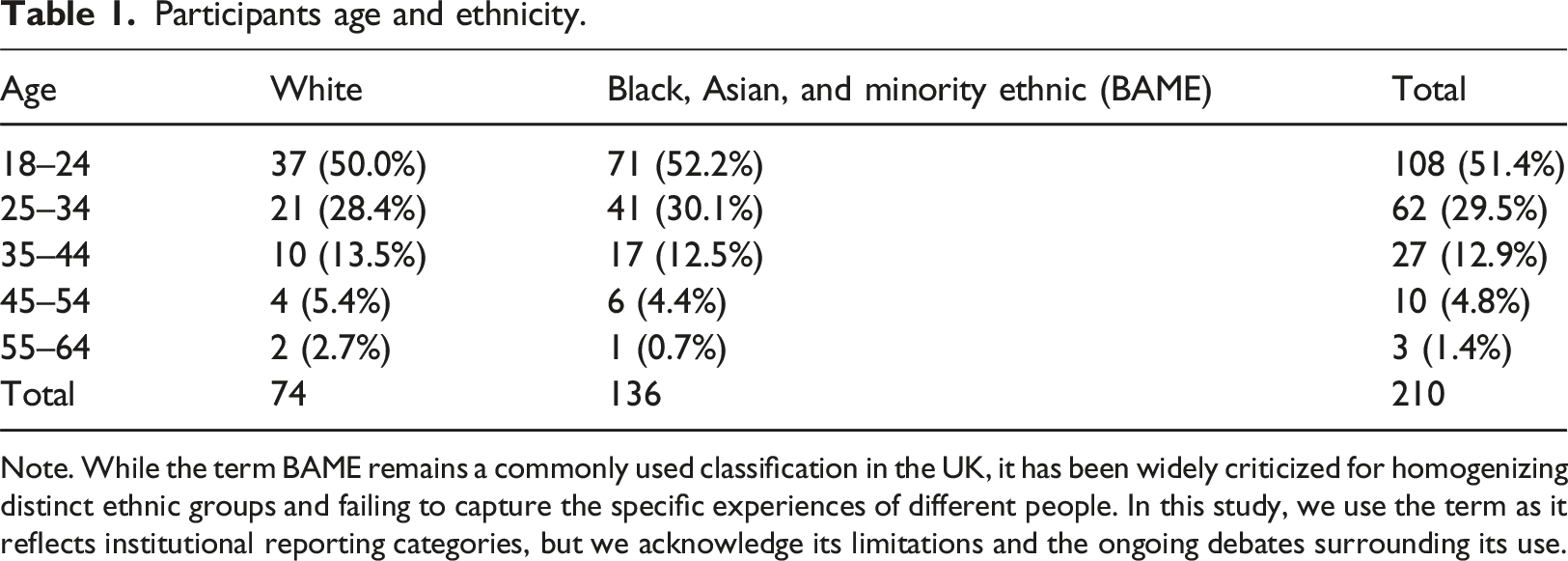
Note. While the term BAME remains a commonly used classification in the UK, it has been widely criticized for homogenizing distinct ethnic groups and failing to capture the specific experiences of different people. In this study, we use the term as it reflects institutional reporting categories, but we acknowledge its limitations and the ongoing debates surrounding its use.
Procedure
This paper draws on qualitative data from a larger study exploring student perceptions of equity, diversity, and inclusion (EDI) in higher education. Specifically, we focus on responses to two open-ended survey questions designed to capture students’ personal views and experiences: • What does ‘decolonising the curriculum’ mean to you? • Tell us more about your perceptions and/or experiences of prejudice, discrimination and/or racism.
Following ethical approval from the University’s Research Ethics Board, the survey was distributed through internal communication channels, including email, the student portal, and affiliated social media platforms. At the time of distribution, the university had introduced several EDI initiatives. Notably, it offered ‘inclusive curriculum’ workshops targeted at staff. These voluntary sessions encouraged reflection on teaching practices, course content, and student engagement. The university also marked Black History Month with a series of awareness campaigns. These included themed social media content, panel discussions, curated educational materials, and occasional speaker events organized by various Schools/Faculties across the university.
To encourage candid and reflective responses, interested students were invited to complete an anonymous Qualtrics survey. Before starting, participants reviewed an informed consent form outlining the study’s purpose, their rights, and confidentiality measures. Consent was required to proceed, and periodic reminders were sent to promote diverse participation.
All survey responses were securely stored in a password-protected database that was accessible only to the research team. To maintain confidentiality, any identifying information was removed before analysis, and responses were fully anonymized.
Data analysis
Researcher positionality
This study was conducted by a multidisciplinary team from the Schools of Human Sciences and Education. The lead researcher (DM) is a Black British woman with a background in educational psychology; co-researchers include a Senior Teaching Fellow and PhD researcher (AK) from a White racially minoritised background, and a White male academic (RM) with expertise in education. The team’s diverse lived experiences, particularly in relation to race, class, and ideological differences, informed the reflexive approach to data collection and analysis.
Data analysis was conducted collaboratively, with team members collectively coding responses during in-person and online meetings to compare and discuss themes. The research team recognised that qualitative research is influenced by the positionality of the researchers, hence they engaged in regular reflexive discussions throughout the research process to consider how their own beliefs and experiences might influence interpretation. Discrepancies in interpretation were addressed through dialogue until consensus was reached. This iterative process aimed to ensure consistency in theme development and to mitigate individual bias. Research notes and audit trails were maintained to document decision-making throughout the thematic and critical discourse analyses.
Thematic analysis
Thematic Analysis was conducted following the framework established by Braun and Clarke (2006, 2019), who define it as a method for identifying, analysing, and interpreting patterns of meaning within qualitative data. This study adopted a constructionist epistemology. It was acknowledged that student perceptions are shaped by broader ideological, social, and institutional discourses. Accordingly, the key steps involved in this analysis were as follows: (1) The research team began by thoroughly reading and re-reading the open-ended responses to gain an in-depth understanding of the data. (2) Initial codes were generated to capture significant statements, phrases, and ideas that were relevant to the research questions. These codes focused on key aspects, such as perceptions of bias, the influence of political ideologies, and the university’s approach to discussions on EDI. (3) The generated codes were then collated into potential themes. This involved grouping similar codes together to form coherent categories that reflected the main patterns in the data. (4) The developed themes were reviewed in relation to the entire dataset so as to ensure that they were consistent and that they worked together to provide a coherent narrative. (5) The final themes were used to structure the findings of the study. The analysis was supported by direct quotes from participants, which were selected to illustrate key points and add depth to the presentation of the findings.
Critical Discourse Analysis (CDA)
Critical Discourse Analysis (CDA) was applied in this study to further examine the identified themes from the thematic analysis. CDA is a research approach that seeks to understand how language is used to construct, maintain, and challenge power relations and social inequalities within specific contexts (Fairclough, 2013). CDA is particularly effective in analysing issues of social justice, as it allows researchers to uncover the subtle ways in which language can perpetuate or resist EDI initiatives (Van Dijk, 2008). The application of CDA involved the following key steps:
After the thematic analysis identified key themes related to students’ perceptions of EDI discussions, CDA was used to analyse the language used by students in their responses (Alejandro and Zhao, 2023). This involved examining specific words, phrases, and rhetorical strategies that students used to express their views on EDI. For instance, attention was given to how students described their feelings of alienation or support, the way they positioned themselves in relation to others (e.g. ‘myself’ vs ‘others’), and how they articulated their understanding of concepts such as ‘EDI’ and ‘decoloniality’. (1) CDA was then applied to explore how power relations and ideological positions are embedded in students’ language. This involved looking at how specific groups (e.g. those with non-left-wing political views) positioned themselves in relation to the perceived dominant discourse at the university. For example, students who felt marginalized by the university’s EDI efforts often used language that framed themselves as victims of a biased system. This highlighted the perceived power imbalance between themselves and the university. Conversely, students who supported the university’s approach used language that aligned with the dominant EDI discourse, which in turn, reinforced the existing power structures. (2) The study also used CDA to examine how social inequalities, such as race and political ideology, were reflected and reinforced in students’ responses. By analysing the discursive strategies that students used to talk about race, discrimination, and inclusion, the study was able to reveal how specific ideologies (e.g. those associated with the Black Lives Matter – BLM – movement) were either supported or contested within the university setting. For instance, students who perceived the university’s focus on BLM as politically biased often positioned their own views as being marginalized by what they saw as an ideological agenda.
By integrating CDA with Thematic Analysis, the study was able to offer a rich understanding of students’ perceptions and experiences of EDI initiatives within the university.
Findings
Student perceptions of the university’s approach to EDI: A thematic overview.
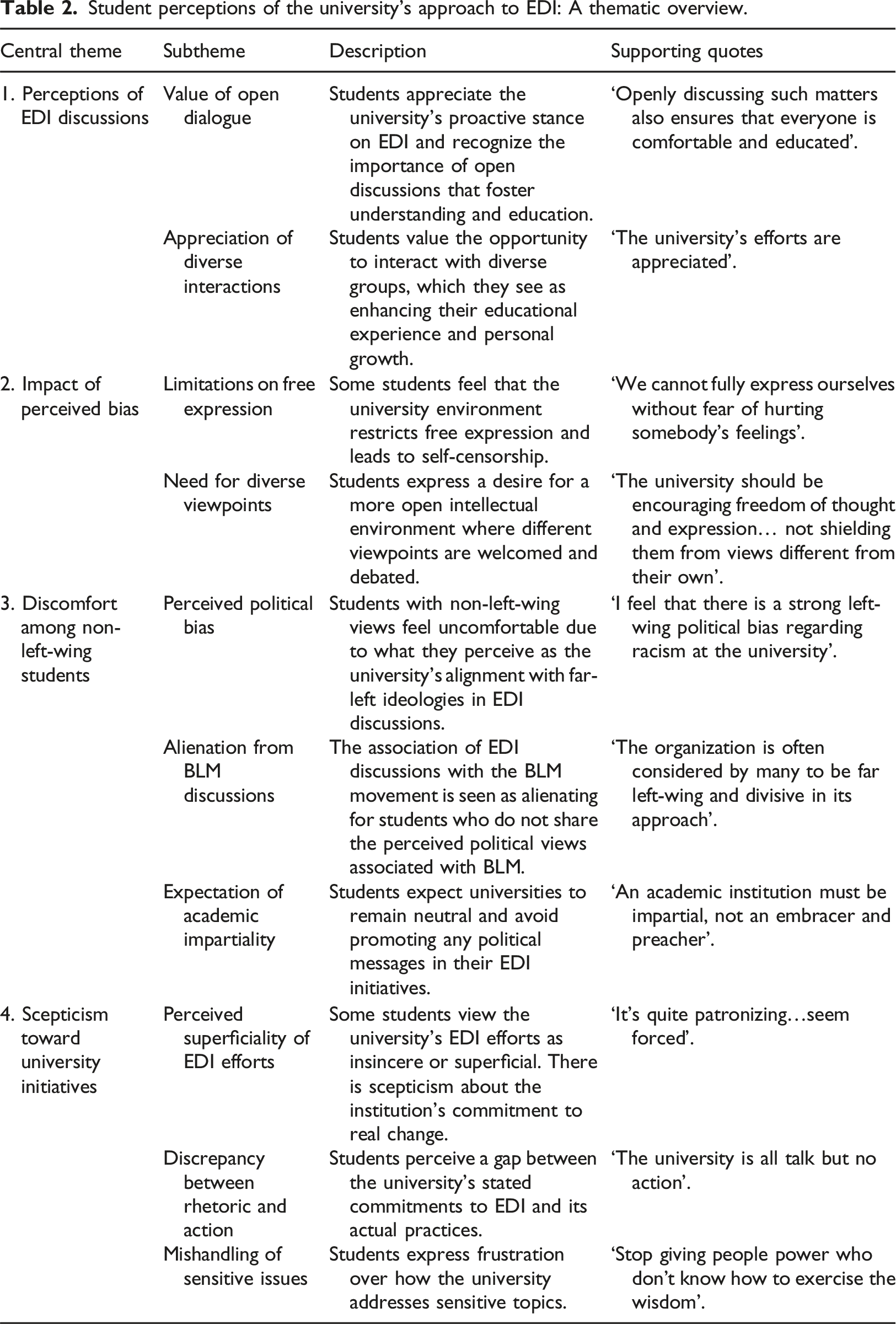
In the following section, each theme will be explored in detail with supporting verbatim quotes that illustrate the perspectives of students.
Theme 1: Student perceptions of university discussions on discrimination and EDI
This theme explores how students perceive the university’s engagement with issues related to Equity, Diversity, and Inclusion (EDI). While perspectives vary, many students express appreciation for the university’s proactive stance in addressing these issues. They recognize the importance of fostering open discussions that enhance understanding, promote education, and contribute to an inclusive academic environment. One student highlighted their positive perception of the university’s emphasis on these discussions: ‘The university already places great emphasis on highlighting such issues, more than any other institutions that I’ve seen. Openly discussing such matters also ensures that everyone is comfortable and educated’.
The student’s statement recognises the university’s efforts in prioritizing EDI conversations and suggests that such initiatives help to foster a sense of awareness and inclusivity. The phrase ‘ensures that everyone is comfortable and educated’ implies that students see value in these discussions as a means of creating a more welcoming environment while also promoting awareness of important social issues. By openly addressing topics related to discrimination and diversity, the university is perceived as facilitating meaningful dialogue that contributes to personal and collective growth: ‘So far I have no issues and have learned a lot of new stuff from interacting with people from all walks of life, which I wouldn’t have had the opportunity to do if I didn’t join…. The university's efforts are appreciated’.
This student highlights the tangible benefits of EDI-focused initiatives, particularly in providing students with opportunities to engage with others from various backgrounds. The phrase ‘learned a lot of new stuff’ suggests that students view these interactions as a valuable aspect of their educational experience. Furthermore, the direct acknowledgement that ‘the university’s efforts are appreciated’ signals a sense of gratitude for the institution’s role in fostering a diverse and inclusive campus culture.
Overall, this theme reflects the recognition that EDI discussions have a meaningful impact on students’ experiences at the university. By creating spaces where diverse voices can be heard and valued, the institution is seen as actively contributing to an enriched learning environment. Students acknowledge that these discussions promote inclusivity and encourage personal growth.
Theme 2: The impact of perceived bias
This theme examines the ways in which students’ perceptions of bias, particularly in relation to political ideologies, influence their willingness to engage in discussions about EDI. While some students express appreciation for the university’s efforts to foster inclusivity, others feel alienated by what they perceive as an environment that discourages open dialogue, particularly when viewpoints deviate from dominant narratives. This discomfort can lead to self-censorship, hesitation to participate in discussions, and, in some cases, disengagement from EDI-related conversations altogether. Indeed, a central concern voiced by students is that the university’s emphasis on EDI and sensitivity may inadvertently create a restrictive intellectual climate, one in which they feel unable to express their thoughts freely for fear of being misunderstood or causing offense. One student articulated this apprehension: ‘The atmosphere at university gives myself and others, both white British and otherwise, the feeling that we cannot fully express ourselves without fear of hurting somebody’s feelings’.
This statement suggests that some students experience the university’s approach to inclusivity as overly cautious or even suppressive. This approach leads students to self-monitor their speech so as to avoid potential backlash. This perception of restraint can be particularly concerning in academic settings, where open discourse and the exchange of diverse perspectives are fundamental to intellectual development. If students feel that specific opinions are unwelcome or that discussions must conform to particular ideological viewpoints, the ability to critically engage with complex social issues may be compromised.
The importance of free expression and robust debate is a recurring theme among students who feel that universities should foster environments that encourage intellectual challenge rather than shield students from discomfort: ‘The university should be encouraging freedom of thought and expression and teaching its students to productively and effectively combat opinions different from theirs, not shielding them from views different from their own. A university should be a place open to the exchange of ideas, not one of censorship’.
This sentiment indicates student’s belief that universities should actively promote a plurality of perspectives, so they can develop the critical thinking skills necessary to engage with opposing viewpoints in a constructive manner. In other words, rather than prioritizing the avoidance of controversy, some students argue that the university should facilitate open discourse that challenges assumptions and encourages thoughtful debate.
In summary, this theme highlights a tension between the university’s efforts to create an inclusive and respectful learning environment, and students’ concerns about the potential consequences of perceived ideological bias. While inclusivity and sensitivity are essential components of a supportive academic community, ensuring that these values do not come at the expense of free expression remains a challenge.
Theme 3: Discomfort among students with non-left-wing political views
This theme explores the discomfort experienced by students with non-left-wing political views when engaging in discussions on EDI. Some students feel that these discussions are dominated by a particular political ideology, and this makes it challenging for them to participate openly without feeling marginalized. They perceive the university’s approach to topics such as racism and social justice as being aligned with left-wing perspectives, which, in their view, limits the scope of debate and discourages alternative viewpoints. One student expressed frustration with what they perceive as a political bias within the university’s discussions on racism: ‘I feel that there is a strong left wing political bias regarding racism at the university. For example, George Floyd and the Black Lives Matter organisation are often mentioned. The agenda of a lot of the Black Lives Matter organisation is sadly different to the name Black Lives Matter’.
This statement reflects a broader concern that the university’s focus on movements such as Black Lives Matter, signals an implicit alignment with far-left ideologies. The student acknowledges the phrase ‘Black Lives Matter’ as an important principle but distinguishes it from the formal organization, which they believe promotes a broader political agenda beyond its core message. This perceived conflation between racial justice and specific political ideologies contributes to a sense of alienation among some students, particularly those who hold more conservative or centrist views. Students elaborated on this discomfort by emphasizing the expectation for academic neutrality in discussions about racism: ‘Black Lives absolutely do matter; however, the organization is often considered by many to be far left-wing and divisive in its approach. So regularly mentioning George Floyd and the Black Lives Matter protests when talking about racism makes people with right-wing values at the university feel less comfortable to participate in this very important discussion’.
This student’s perspective highlights a key tension; while they affirm the fundamental message that Black lives matter, they feel that the university’s repeated association of racial justice discussions with BLM and its protests creates an unwelcoming environment for those who view the organization as politically divisive. This perception can deter students with non-left-wing views from engaging in conversations about racism and EDI, as they may fear being mischaracterized or excluded from the dialogue. More frustration was expressed by another student, who voiced their concerns about the role of political ideology within academic spaces: ‘For me personally, as well as many of my colleagues, we came here and paid to study our fields of choice and not to be preached political propaganda. An academic institution must be impartial, not an embracer and preacher of dystopian political views’.
This student suggests there is a perception among some students that the university is overstepping its role as an educational institution by promoting what they see as ideological activism rather than academic inquiry. The use of terms such as ‘preached political propaganda’ and ‘dystopian political views’ reflects the intensity of their discontent and implies that they see the current environment as biased and potentially oppressive. The expectation of impartiality within academia is central to this concern, as these students believe that the university should facilitate open discussion, rather than advocate specific political perspectives.
In essence, this theme illustrates the challenge universities face in ensuring that EDI discussions remain inclusive for all students across the political spectrum. While many students appreciate the institution’s focus on social justice, others feel that it has become overly aligned with left-wing ideologies, and this means that they feel reluctant to participate in conversations they consider to be politically one-sided.
Theme 4: Perceptions of bias and scepticism toward university initiatives
This theme explores the scepticism and disappointment that some students feel regarding the university’s efforts to address racism and EDI. While the institution publicly champions these initiatives, some students perceive them as performative, forced, or inconsistent with real-world actions. This scepticism leads to disillusionment, as students question whether the university’s commitment to EDI is genuinely meaningful or simply a symbolic gesture. Indeed, one student expressed frustration with what they saw as the university’s overly scripted and performative approach to racism discussions: “It’s quite patronizing that at the start of the year for every module racism was a topic, where lecturers explained that there’s no space for racism at the university, the way it was spoken out by the university made it seem forced”.
The student’s statement highlights the belief that the university’s messaging around racism lacks authenticity. The student’s use of the word ‘patronizing’ suggests that they feel spoken down to rather than engaged in a meaningful way. The repetition of anti-racism statements across multiple modules, while well-intended, is perceived as mechanical and obligatory. This sentiment reflects a broader concern that institutional messaging on EDI can sometimes feel like a box-ticking exercise rather than an earnest attempt to foster change.
Students also expressed cynicism about the university’s actual commitment to addressing racism, and criticised it for failing to take substantive action: ‘The university is all talk but no action, have a look on twitter to see an incident that happened…and you will be able to tell with a bit of common sense if the roles were reversed the case would be treated differently’.
The student’s frustration appears to stem from the belief that the university selectively enforces its principles. The reference to social media suggests that students are turning to external platforms to highlight perceived inconsistencies and indicates a lack of trust in the institution’s internal mechanisms for addressing racial issues. This scepticism reinforces the idea that the university’s commitment to EDI is viewed by some as rhetorical rather than action driven. Similarly, another student shared their disappointment with the way colonial issues are handled within the university’s curriculum and discussions: ‘Another thought it was okay to play videos relating to slavery and another casually brushed it off as my problem. Stop giving people power who don’t know how to exercise the wisdom to see past colour’.
Students revealed concerns about how sensitive topics, particularly those related to race, are approached in academic settings. The student’s frustration appears to stem from two key issues: the perceived insensitivity of educators in presenting difficult historical content, and a broader criticism of those in authority who may not fully understand the sensitivity of racial discourse. The phrase ‘stop giving people power who don’t know how to exercise the wisdom to see past colour’ suggests a belief that people in decision-making positions lack the awareness or cultural competence to lead meaningful discussions on race and EDI.
Overall, this theme reflects the challenge universities face in maintaining credibility and trust when addressing issues of racism and inclusion. While institutional commitments to EDI are important, students are quick to recognize when such efforts feel performative or inconsistent with real-world actions.
Discussion
This study explored university students’ perceptions of discussions on prejudice, discrimination, and racism, and focused on how political ideologies influence their attitudes toward Equity, Diversity, and Inclusion (EDI) initiatives. The findings suggest that political beliefs play an important role in influencing how students engage with EDI discussions. While some students embrace these efforts as necessary for fostering inclusivity, others view them as ideologically biased and restrictive. This ideological divide impacts how students perceive academic freedom, institutional neutrality, and the effectiveness of university-led diversity initiatives.
For students with left-leaning political ideologies, the university’s proactive approach to EDI is generally seen as positive. These students believe that open discussions about discrimination and diversity are essential for fostering cultural awareness, reducing prejudice, and promoting social justice. They appreciate the opportunity to engage in dialogues that enhance personal growth and broaden their perspectives. This aligns with prior research suggesting that people with left-leaning ideologies are more likely to support institutional efforts to address systemic inequalities (Osbourne et al., 2022). Such students view the university’s emphasis on EDI as a natural extension of its role in preparing students to contribute to an increasingly diverse society.
Students with non-left-wing political perspectives, however, often perceive these initiatives differently. Many express concerns that the university’s approach to EDI is not politically neutral, and instead aligns with leftist ideologies. These students report feeling alienated from conversations on race and discrimination. They believe the dominant discourse does not allow space for alternative viewpoints. This finding echoes previous studies suggesting that conservative or right-leaning students frequently experience marginalization in academic settings, particularly when engaging in discussions on socially sensitive issues (Simpson and Srinivasan, 2018). The perception that some viewpoints are unwelcome or discouraged raises concerns about academic impartiality and the extent to which universities facilitate open and balanced intellectual debate.
A particularly striking aspect of this study was the intensity of alienation expressed by students with non-left-wing views. While some level of ideological disagreement was expected, the strong sentiments of frustration and exclusion (e.g. framed as experiencing ‘political propaganda’) were more pronounced than anticipated. Many of these students felt that EDI discussions were not conducted in an inclusive manner and that their perspectives were either ignored or dismissed outright. This reinforces findings from previous research indicating that ideological divisions can create barriers to open discourse and can make it difficult for students with dissenting views to engage meaningfully in conversations about EDI (Dotson, 2017; Fricker, 2007).
The findings reveal that conservative and/or white students often perceive themselves as outsiders in EDI discussions. Existing literature indicates that this group may feel blamed or targeted within anti-racism narratives, which can lead to defensiveness or disengagement. Stears et al. (2024) found that both conservative and liberal participants reported feeling anxious or silenced during EDI sessions. This suggests that institutional approaches may unintentionally alienate the very people they seek to engage. However, research also demonstrates that inclusive pedagogical strategies (such as structured intergroup dialogue and value-based framing) can support their participation without compromising EDI goals (Hartwell et al., 2017). Universities might consider integrating these approaches to bridge ideological divides.
Furthermore, the study highlights concern about self-censorship and the broader implications for academic freedom of speech. Several students reported hesitancy in expressing their views owing to fears of being misunderstood or facing social repercussions. This aligns with the concept of the ‘chilling effect’, where people refrain from participating in discussions because they perceive the intellectual climate as unwelcoming to particular perspectives (Lukianoff and Haidt, 2018). Universities, therefore, encounter the challenge of ensuring that EDI initiatives do not inadvertently suppress open discourse by creating an environment where students feel they must conform to a particular ideological stance to be accepted.
The findings also point to scepticism regarding the sincerity and effectiveness of university-led diversity efforts. Some students expressed doubts about whether the institution’s commitment to EDI translated into meaningful action or if it was primarily performative. This finding is consistent with previous research on institutional virtue signalling, where universities publicly endorse social justice causes without implementing substantial policy changes to support their commitments (Ahmed, 2012).
Limitations
This study has three key limitations that should be acknowledged. First, the reliance on self-reported student data introduces the potential for biases such as social desirability effects or selective memory. Additionally, since the study was conducted at a single university, the findings may not be generalizable to other institutions with different student demographics or institutional cultures. Expanding the study to multiple universities with varying cultural and political climates would improve the generalizability of the findings. Third, we did not directly ask students to report their political ideology. Instead, we inferred ideological leanings based on their responses to the survey questions. We acknowledge this as a limitation, and caution that conclusions about political ideology should be interpreted accordingly.
Implications for policy and practice
To create an inclusive academic environment, universities should consider several key recommendations for policy and practice.
Universities should ensure that discussions on sensitive issues remain balanced and inclusive of diverse viewpoints. This means fostering an environment where students with differing perspectives feel equally valued and are encouraged to engage in meaningful debate.
Additionally, efforts to address racism and promote diversity should be informed by an awareness of the potential impact on all students. This requires training for students and university staff on how to facilitate these discussions in a way that respects different perspectives and promotes constructive dialogue. However, the success of these initiatives also depends on how universities navigate internal hierarchies and overcome institutional inertia. Without structural support and commitment at all levels of governance, EDI efforts risk becoming superficial or inconsistently applied.
Many students in this study viewed EDI work as performative or symbolic; an impression that is often reinforced by rigid top-down decision-making that lacks transparency or accountability. When EDI is managed centrally, but implementation is delegated to under-resourced staff or departments, gaps can emerge between policy and practice. The absence of robust internal accountability mechanisms (such as metrics for evaluating impact or formal channels for feedback) can exacerbate this disconnect and contribute to student scepticism.
Moreover, EDI work may lose momentum when institutional priorities shift or leadership changes. This kind of policy drift, if not carefully managed, can result in short-lived commitments that ultimately undermine trust and engagement. To counter this, universities must embed EDI structurally across governance, resource allocation, staff development, and curriculum planning – not just in public messaging or annual reports.
Finally, supporting staff who deliver EDI-related content is essential. Academics and professional services staff are likely to encounter challenges in balancing institutional mandates with their own positionalities and workloads. Providing training, protected time, and recognition for this work can help to ensure that EDI is an integrated practice within the institution (not a performative gesture) and that those responsible for delivering it are adequately supported to lead meaningful sustained change.
Conclusion
The findings of this study have significant implications for how universities approach EDI initiatives. The diverse student perspectives suggest that a one-size-fits-all approach to EDI discussions may not be effective. Instead, universities should adopt a more individualised strategy that recognizes and addresses the ideological diversity within the student body. By ensuring that EDI efforts are genuinely inclusive, transparent, and action-driven, universities can create an environment where all students (regardless of political or ideological beliefs) feel respected, valued, and engaged in meaningful academic discourse.
Footnotes
Declaration of conflicting interests
The authors declared no potential conflicts of interest with respect to the research, authorship, and/or publication of this article.
Funding
The authors received no financial support for the research, authorship, and/or publication of this article.
