




Abstract
This study examines how integrating Minecraft into science, technology, engineering, and mathematics (STEM) education impacts seventh-grade students’ STEM motivation and spatial abilities. The research was conducted with 46 students during the 2021–2022 academic year and employed an explanatory sequential mixed-methods design. Over approximately 2 months, the experimental group (n = 24) participated in weekly Minecraft-based STEM activities, while the control group (n = 22) continued with standard instruction aligned with the national curriculum. STEM motivation and spatial ability were measured in both groups before and after the intervention using a motivation scale and a spatial ability test. Qualitative data were obtained through semistructured interviews with students in the experimental group. The results indicate that Minecraft-based STEM activities significantly enhanced students’ STEM motivation and spatial abilities. These findings suggest that actively integrating digital games into STEM education can effectively increase students’ interest in STEM fields and improve their spatial skills.
Introduction
With the increasing speed of information access and the transformation of societal structures by technology, it is widely believed that adapting to technology and responding to evolving needs have become essential in today's society (Hanafizadeh et al., 2023). Abankwa et al. (2021) highlight that a major challenge in adapting to technological change in the business world is the persistent reliance on traditional methods—namely, established routines and legacy processes that prioritize familiar practices over the adoption of new digital tools. Furthermore, education and open-mindedness are emphasized as essential elements for overcoming this challenge (Angwaomaodoko, 2023; Lee, 2025). In schooling, early exposure to technology-rich tasks can scaffold students’ readiness to adapt to an evolving technological landscape (Fullan & Langworthy, 2014). In this context, science, technology, engineering, and mathematics (STEM) education aims to increase student engagement by integrating these disciplines to solve real-world problems (Marrero et al., 2014). However, in many countries, educational systems present interdisciplinary learning within a limited framework, which can reduce motivation for STEM-based activities (Honey et al., 2014).
Spatial abilities, widely acknowledged as critical for success in STEM education, play a pivotal role in disciplines such as science, mathematics, and engineering, and underpin individuals’ strategic thinking and problem-solving skills in everyday life (Gilligan-Lee et al., 2022; National Research Council, 2006; Rahmawati et al., 2021). Recent meta-analytic evidence confirms a robust association between spatial and mathematical abilities, with spatial training demonstrating transfer to improved mathematical performance (Hawes & Ansari, 2020; Lowrie et al., 2019). Specifically, geometry learning relies not only on symbolic knowledge but also on students’ ability to interpret and transform spatial representations (Clements & Battista, 1992). In this regard, spatial abilities are not necessarily unitary; rather, the dissociation between processes such as mental rotation and perspective-taking supports the conceptualization of spatial ability as a multidimensional construct (Hegarty & Waller, 2004).
Given the multidimensional and malleable nature of spatial reasoning, innovative teaching approaches, particularly the use of digital games like Minecraft Education, have gained recognition for their potential to foster motivation and skill development in STEM environments (Carbonell-Carrera et al., 2021; Panja & Berge, 2021; Tablatin et al., 2023). Constructionist perspectives suggest that students develop deeper mathematical understanding when they actively build within digital game environments rather than passively consume content (Kafai & Burke, 2015). Against this backdrop, leveraging Minecraft's interactive and creative features within STEM education offers opportunities to enhance students’ motivation and spatial abilities (Pusey & Pusey, 2015; Tablatin et al., 2023). In this study, we foreground mathematics. Tasks implemented in Minecraft Education are explicitly aligned with middle-school geometry and measurement outcomes specified in the national curriculum (Ministry of National Education [MoNE], 2018)—including 2D and 3D representations, unit-cube measurement and surface area/volume, scale and proportional reasoning, coordinate geometry, and transformations, consistent with math-specific practitioner guidance (Minecraft Education, n.d.-a). Treating blocks as unit cubes and worlds as coordinate frames turns Minecraft Education into a manipulable mathematical environment rather than a generic game, where students can experience mathematical concepts simultaneously as academic content and as functional tools within gameplay (Jensen & Hanghøj, 2020), an approach associated with gains in mental rotation and problem solving, as well as increased engagement (Carbonell-Carrera et al., 2021; Chaleepliam et al., 2024; Fahraesa & Wulandari, 2025; Pusey & Pusey, 2015). Accordingly, we focus on two proximal targets directly linked to mathematics learning—students’ STEM motivation and spatial ability—while recognizing that effects can vary across learner groups (Tablatin et al., 2023). In a recent systematic review, Mirković Moguš and Gregorović (2025) concluded that while Minecraft facilitates outcomes including motivation and spatial reasoning, gaps remain in empirical research and curriculum alignment—underscoring the need for rigorous investigation in specific educational contexts. Building on this premise, the present study investigates the impact of Minecraft-based activities on students’ STEM motivation and spatial abilities.
Background and previous research
Digital games have been increasingly recognized as transformative tools in education since the early 21st century, valued for their capacity to enhance engagement, motivation, and immersion in learning (Gee, 2004; Prensky, 2001a, 2001b; Van Eck, 2006). While early educational games such as The Oregon Trail and PLATO demonstrated the potential of game-based learning, these platforms did not develop as rapidly as commercial games, which benefited from larger development resources and wider distribution (Egenfeldt-Nielsen, 2011; Korkusuz & Karamete, 2013). More recently, commercial sandbox games have been repurposed for educational use across various disciplines, with Minecraft emerging as a prominent platform in STEM education contexts (Nebel et al., 2016; Othman & Ching, 2024).
Accordingly, we focus on Minecraft and distinguish it from Minecraft Education—the version used in the present study—as this distinction has direct implications for STEM education research. Minecraft, first released in 2011, is a commercial open-world, block-building sandbox game that features creative and survival modes and supports multiplayer collaboration (Nebel et al., 2016; Minecraft Education, n.d.-b). While the standard version has been used in various educational contexts, it was designed primarily for entertainment and does not natively offer built-in pedagogical scaffolding, classroom management features, or curriculum-aligned content (Callaghan, 2016). Minecraft Education, by contrast, was purpose-built for formal educational settings and retains the core construction and problem-solving mechanics while adding features specifically relevant to STEM learning: classroom management and teacher controls, join codes that remove the need for separate server setup, programmable non-player characters for delivering task instructions, collaborative tools such as boards and slates for group-based knowledge construction, portfolio and camera tools for documenting learning processes, and a curated library of curriculum-aligned lessons (Callaghan, 2016; Checa-Romero & Pascual Gómez, 2018; Minecraft Education, n.d.-c; Sáez-López et al., 2015). Critically, the multiplayer environment in Minecraft Education is restricted to students within the same classroom or organization, ensuring digital safety in K-12 settings (Pusey & Pusey, 2015). These pedagogical affordances make Minecraft Education substantially more suitable for structured STEM interventions than the standard commercial version, as they enable teachers to align game-based activities with specific curricular objectives while maintaining instructional control. In the present study, Minecraft Education was used because its classroom management features, curriculum-aligned tools, and controlled collaborative environment align with the structured STEM intervention design employed.
Nevertheless, the effectiveness of such games in fostering deep disciplinary integration and sustained engagement varies by context and learner group and remains contested (Clark et al., 2015; Panja & Berge, 2021). Moreover, studies indicate limited shifts in general STEM interest, technical glitches, and difficulties regulating the cognitive load of open-ended tasks; combined with the omission of duration, documentation, and assessment steps in lesson designs, these issues may necessitate additional training, resources in the local language, and accessible technical support for effective use (Tablatin et al., 2023; Tonbuloğlu, 2024). Accordingly, clear goals, targeted scaffolding, reliable access and infrastructure, a carefully designed task–time–assessment sequence, and ongoing teacher professional development are critical preconditions.
Enhancing STEM motivation through Minecraft
Minecraft Education has been linked to increased student engagement and motivation in STEM subjects due to its capacity for active learning and hands-on exploration (Ellison et al., 2016; Hobbs et al., 2019; Lane et al., 2022). By enabling students to manipulate complex scientific and mathematical concepts within an interactive environment, the game can foster a sense of agency and ownership over their learning (Alawajee & Delafield-Butt, 2021; Chaleepliam et al., 2024; Kersánszki et al., 2023; Tablatin et al., 2023). Such features encourage collaborative knowledge construction, aligning with constructivist theories where learners build understanding through design and experimentation (Nkadimeng & Ankiewicz, 2022; Saricam & Yildirim, 2021; Sánchez-López et al., 2022). Moreover, Minecraft contributes to developing communication and creative thinking skills through teamwork and collective problem-solving that mirrors real-world STEM careers (Baek et al., 2020; Hewett et al., 2020), allowing students to express their understanding through building and designing (Hébert & Jenson, 2020; Shaw, 2023). Across studies, motivational outcomes are operationalized using related but distinct constructs (e.g., STEM interest, engagement, and enthusiasm).
However, the relationship between game-based learning and sustained motivation is complex. While some studies reported improvements in interest and scientific creativity, for example, Saricam and Yildirim (2021) found that digital game-based STEM activities with sixth-grade students increased interest in STEM fields, Pusey and Pusey (2015) reported increased engagement among eighth-grade students, and Sripan and Manyam (2025) demonstrated that Minecraft Education fostered creative thinking skills among fourth-grade students despite technical challenges. However, other studies suggest that these effects may be contingent upon implementation quality. Tablatin et al. (2023) observed only modest overall increases in STEM interest, noting that lower-performing students gained confidence while higher-performing students showed greater enthusiasm and sustained interest. Consistent with these mixed outcomes, Dichev and Dicheva (2017) note that insufficient evidence supports the long-term benefits of gamification, suggesting that motivational gains may be transient rather than sustained. Consequently, without careful scaffolding and alignment with curricular objectives, the initial excitement generated by gaming environments may diminish over time (Barzilai & Blau, 2014). Regarding career intentions, while earlier research identified relations between abilities/interests and later STEM commitment (Shea et al., 2001; Wai et al., 2009), recent work emphasizes that such pathways depend on how effectively game mechanics translate into meaningful pedagogical experiences (Othman & Ching, 2024).
Leveraging Minecraft to develop spatial abilities in STEM education
Spatial reasoning is a well-established predictor of STEM achievement, spanning spatial visualization, mental rotation, and perspective-taking (Bruce et al., 2017; Gilligan et al., 2017; Mix et al., 2016; Okamoto et al., 2015; Rule, 2016; Taylor & Hutton, 2013). Accordingly, some curricula have incorporated early spatial stimulation to support later STEM success (Aguilar Ramirez et al., 2021). Digital games, particularly sandbox environments like Minecraft Education, can enable learners to manipulate three-dimensional (3D) structures and coordinate frames in interactive, collaborative contexts, thereby engaging visualization and spatial transformation processes (Aktaş Kumral & Çam, 2023; Dias & Rosalen, 2014; Yang & Chen, 2024). These activities situate geometry and measurement in authentic tasks and can encourage reasoning about space, dimensions, and structure (Francis et al., 2016; Gilligan-Lee et al., 2022; Merino-Campos et al., 2023).
Empirical studies report targeted spatial gains with Minecraft-based tasks—notably in mental rotation and visualization—alongside enhanced problem solving and creativity within problem-based designs (Buckley et al., 2019; Carbonell-Carrera et al., 2021; Fan et al., 2022; Tablatin et al., 2023; Yang & Chen, 2024).
Nevertheless, reported benefits are conditional on task design, instructional supports, and context. Transfer from spatial training to broader mathematics is not automatic and depends on task type, explicit instruction, and intervention duration (Hawes & Ansari, 2020; Lowrie et al., 2019; Uttal et al., 2013). Open-ended game tasks can impose high cognitive load and may unevenly target distinct spatial processes (e.g., static vs. dynamic), underscoring the need for deliberate task sequencing (Newcombe & Shipley, 2015). Technical issues and insufficient scaffolding can further attenuate benefits (Barzilai & Blau, 2014; Tablatin et al., 2023).
Present study
This study investigates whether and how a structured sequence of Minecraft Education-based STEM activities influences seventh-grade students (ages 12–13) regarding two proximal outcomes: STEM motivation and spatial ability. We examine changes across the four STEM motivation domains (Science, Technology, Engineering, and Mathematics) and three spatial components (spatial visualization, spatial orientation, and spatial relations) using an explanatory sequential mixed-methods design. This design enables a richer understanding not only of whether changes occur but also of how students experience and interpret these changes. Accordingly, the study addresses the following research questions:
RQ1: Do students who participate in Minecraft Education-based STEM activities show greater gains in STEM motivation than control-group peers? RQ2: Do participating students show greater gains in spatial ability than control-group peers? RQ3: How do students describe their experiences of the Minecraft Education-based activities with respect to the four STEM motivation domains? RQ4: How do students describe their experiences of the Minecraft Education-based activities with respect to the components of spatial ability?
Methods
Research design
This study employed an explanatory sequential mixed methods design to investigate the effects on students’ spatial abilities and STEM motivation (Creswell & Plano Clark, 2018). Initially, quantitative data were collected with a focus on the research questions, followed by the gathering of qualitative data to examine these results in greater depth. The integration of quantitative and qualitative findings yielded a comprehensive conclusion informed by numerical results and detailed student perspectives. This mixed methods approach enhances the validity and richness of the findings by capturing both statistical trends and personal experiences (Johnson & Onwuegbuzie, 2004).
Participants
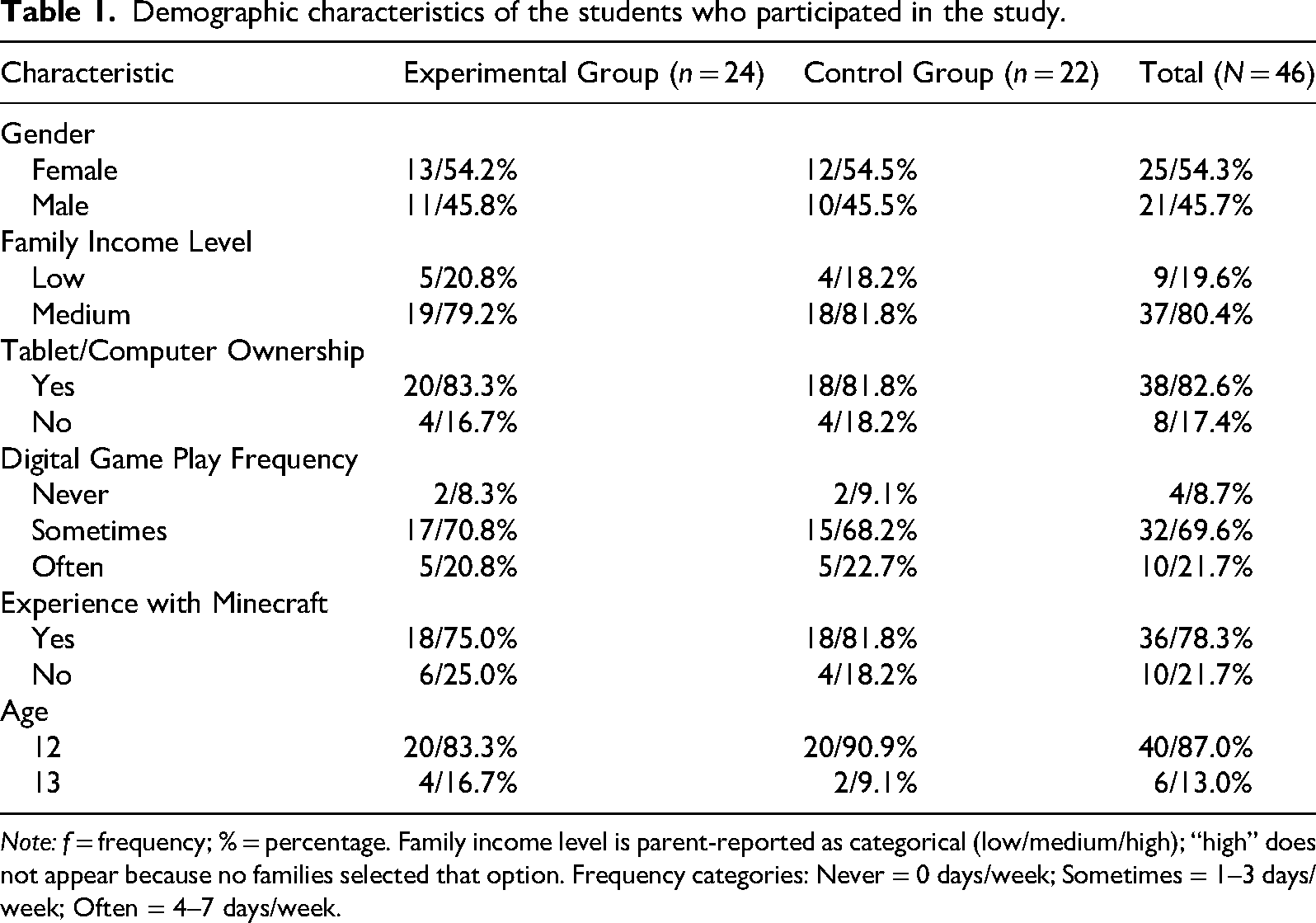
The study sample comprised 46 seventh-grade students (25 female and 21 male) attending a public school in the Çekmeköy district of Istanbul, with 24 students (13 female and 11 male) in the experimental group and 22 students (12 female and 10 male) in the control group. The participants were selected using convenience sampling, a common non-probability method (Yıldırım & Şimşek, 2008). One of the two classes was randomly assigned as the experimental group (see Table 1), enhancing the internal validity of the experimental design (Creswell, 2014). While Minecraft Education-based STEM activities were implemented in the experimental group, traditional teaching methods were employed in the control group. Qualitative data were collected from students in the experimental group, with necessary permissions obtained to ensure voluntary participation, in line with ethical research practices (Cohen et al., 2018).
Demographic characteristics of the students who participated in the study.
Demographic characteristics of the students who participated in the study.
Note: f = frequency; % = percentage. Family income level is parent-reported as categorical (low/medium/high); “high” does not appear because no families selected that option. Frequency categories: Never = 0 days/week; Sometimes = 1–3 days/week; Often = 4–7 days/week.
The data presented in Table 1 summarize the demographic characteristics of the participants in the experimental and control groups. Both groups are balanced in terms of gender distribution, with approximately 54% female students in each group. The family income level is predominantly “medium,” which is consistent across both groups. Family income level was parent-reported in categorical form (low/medium/high) on the Personal Information Form; in this sample, no families selected “high.” Additionally, over 80% of the students in both groups own tablet computers, indicating that an adequate infrastructure is provided for access to digital learning tools. Access to technology is essential for effectively implementing game-based learning interventions (Bebell & O'Dwyer, 2010).
Most students (70%) “sometimes” play digital games, and the percentage of students with experience playing Minecraft ranges between 75% and 81.8%. Frequency of playing digital games was recorded via a three-level self-report item. For clarity, we report “Sometimes” as 1–3 days per week and “Often” as 4–7 days per week. Most participants were 12 years old, and the age distribution was similar between the two groups. These distributions indicate baseline equivalence between groups, supporting valid between-group comparisons and enhancing internal validity (Shadish et al., 2002).
In the experimental group, Microsoft accounts were created to give students access to Minecraft Education. Minecraft Education is a paid platform; however, many educational institutions can access it at a reduced cost or through school licenses. In this study, the software was provided at no cost through the institution's academic license. Students accessed Minecraft Education on their personal computers/tablets from home. The initial orientation was delivered synchronously in an online session under the researcher's supervision; thereafter, one activity per week was completed individually outside school hours in Creative mode. This approach aligns with integrating digital tools to enhance learning experiences and student engagement (Gee, 2007).
Once a week, the experimental group of students individually designed various STEM activities in the creative mode of Minecraft Education outside of school. These activities included projects such as an Underwater Observatory, Tetris with Minecraft, Block Views, My Wonderful House, and Train Station. These tasks foster creativity, spatial reasoning, and problem-solving skills, consistent with the literature suggesting that game-based learning can enhance these competencies (Shute & Ventura, 2013; Squire, 2011).
In mathematics lessons, the experimental and control groups covered the topics of “Views of Solids from Different Directions” and “Polygons.” Learning outcomes included drawing two-dimensional (2D) representations of 3D solids, recognizing polygons, establishing area relationships, and solving related problems. Ensuring that both groups receive instruction on the same curriculum content provides a controlled basis for comparison, which is crucial for the validity of experimental studies (Cohen et al., 2018).
Data collection instruments
Quantitative data were collected using the STEM Motivation Scale adapted into Turkish by Dönmez (2020) and the Spatial Ability Test developed by Göktepe Yıldız (2019). The STEM Motivation Scale is a 25-item, 4-point Likert-type frequency instrument (1 = never, 2 = rarely, 3 = sometimes, 4 = often) comprising four subscales—Science, Technology, Engineering, and Mathematics—and a total score; higher scores indicate greater motivation. In prior validation, the total scale showed acceptable internal consistency (Cronbach's α = 0.84). The Spatial Ability Test comprised seven sections and 24 items, encompassing three subdimensions: spatial orientation (Sections 2, 5, and 7), spatial relations (Sections 1 and 4), and spatial visualization (Sections 3 and 6). Each item was scored dichotomously (1 = correct, 0 = incorrect/blank), and the same instrument was administered in both the pretest and posttest phases. The test demonstrated acceptable internal consistency, with the original validation study reporting a Cronbach's α of 0.802. Detailed mappings of the Spatial Ability Test items to the national mathematics curriculum learning outcomes, along with sample test items, are provided in Supplemental Appendix A.
Qualitative data were obtained through semistructured interviews with eight students from the experimental group. To select participants, the group was first divided into high- and low-motivation subgroups based on their STEM Motivation Scale scores, and four students were then randomly chosen from each subgroup to ensure diversity of perspectives. For anonymity and ease of reporting, the interviewed students were coded as S1 through S8. The high-motivation subgroup consisted of S2, S5, S6, and S8, while the low-motivation subgroup included S1, S3, S4, and S7. The interview form was developed in consultation with experts and administered to volunteer students. Semistructured interviews were employed as they allow for an in-depth exploration of participants’ experiences and perceptions (Cohen et al., 2018). The interviews included questions designed to elicit students’ experiences related to the process:
What are your thoughts on the use of Minecraft Education in lessons? In which activities did you experience difficulties? Which part of the activity was challenging? How did you overcome these difficulties?
These questions aimed to provide insight into student engagement and the challenges faced during the intervention. This information is essential for understanding the impact of game-based learning on student motivation and spatial skills.
Data collection procedure
The data collection process lasted approximately two months. At baseline, students in both the experimental and control groups completed the Personal Information Form, the STEM Motivation Scale, and the Spatial Ability Test as pretests under the researcher's supervision to collect demographic information and establish baseline equivalence (Shadish et al., 2002). Baseline data were used to assess initial differences between groups.
In the experimental group, the students were introduced to Minecraft Education, and introductory and familiarization sessions were conducted. Familiarizing students with software is crucial to ensure effective engagement with activities (Squire, 2011). Five Minecraft-based STEM activities were subsequently conducted individually, one per week for five weeks: Underwater Observatory, Minecraft Tetris, Block Views, My Wonderful House, and Train Station. Although the tasks were completed individually, students were encouraged to exchange ideas, observe peers’ progress, and provide feedback during the sessions. Questions related to teamwork and collaboration were also incorporated into the semistructured interview prompts to capture their perceptions of the social aspects of the activities. The activities were designed to align with the curriculum and promote student engagement, creativity, and problem-solving skills (Prensky, 2001a; Shute & Ventura, 2013). Each activity was explicitly linked to the mathematics topics concurrently taught in class: Underwater Observatory addressed 3D geometry and area calculations; Minecraft Tetris and Block Views focused on drawing and interpreting 2D views of 3D shapes; My Wonderful House integrated measurement, scaling, and spatial visualization; and Train Station incorporated symmetry, proportional reasoning, and geometric layout design. Embedding these concepts into construction tasks reinforced and extended the mathematics learning outcomes, providing authentic and applied contexts for practicing target skills.
Figure 1 presents an example of a Train Station design created by S4, illustrating both the hand-drawn preliminary plan and the corresponding 3D model built in Minecraft Education. This progression from concept sketch to virtual construction exemplifies the integration of engineering design processes, spatial reasoning, and creativity within the activity.
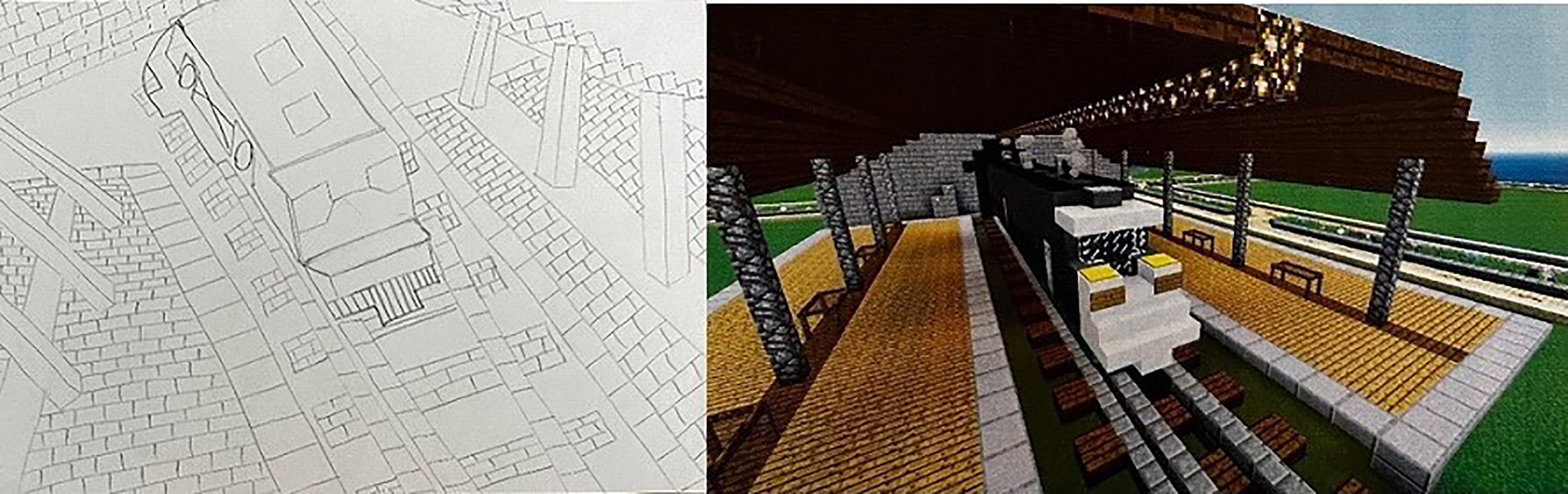
Example of a student's Train Station activity output, showing the initial hand-drawn design (left) and the final three-dimensional (3D) build in Minecraft Education (right).
In the control group, the same learning outcomes were taught via traditional teaching methods, maintaining consistency in educational content across groups (Creswell & Creswell, 2018). Ensuring that both groups cover the same curriculum content is essential for attributing any outcome differences to the intervention (Fraenkel et al., 2015).
After the five-week intervention, both groups completed the same instruments again as posttests under the researcher's supervision to evaluate change over time. Semistructured interviews were conducted with students in the experimental group to gather in-depth insights into their experiences with the Minecraft-based activities. Integrating quantitative and qualitative data provides a comprehensive understanding of the intervention's impact (Johnson & Onwuegbuzie, 2004). The overall data collection procedure is illustrated in Figure 2. Detailed descriptions of the activities and their associated STEM domains are provided in Supplemental Appendix B.

Data collection procedure.
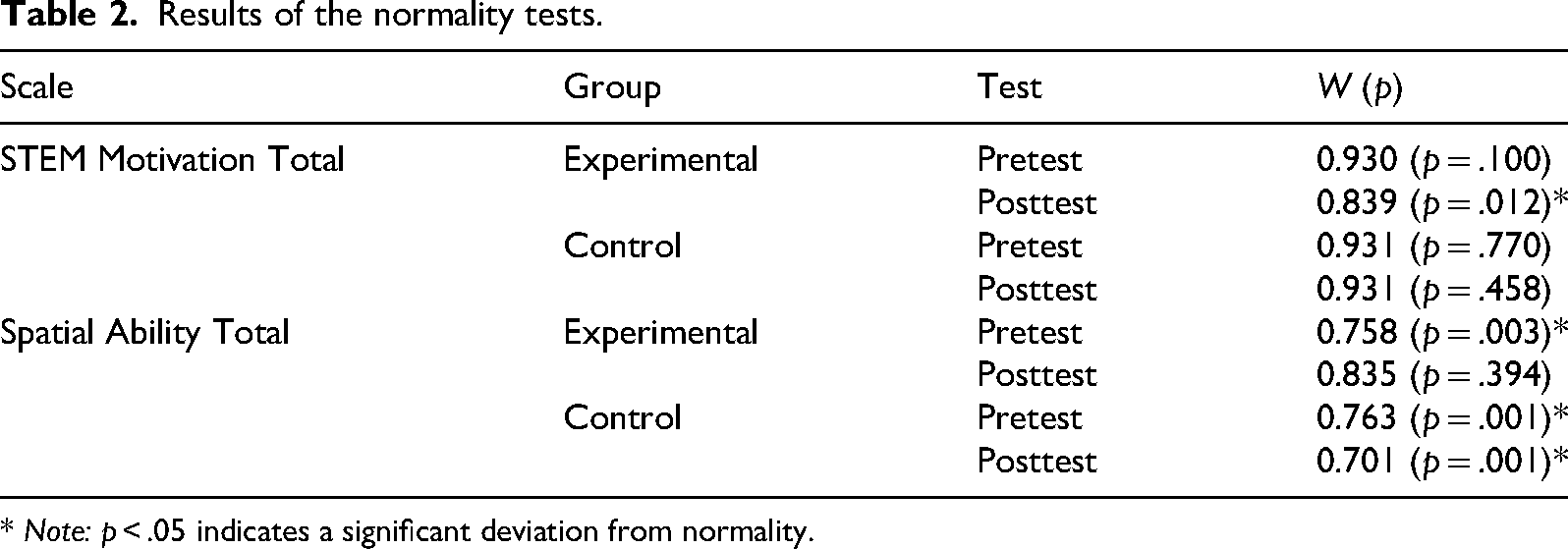
Data analyses were conducted via SPSS 25.0 software. Table 2 presents the Shapiro–Wilk normality test results for the STEM Motivation Scale (total score) and the Spatial Ability Test (total score) across the experimental and control groups at pretest and posttest. We report the Shapiro–Wilk W statistic and its corresponding p value; p < .05 indicates a significant departure from normality.
Results of the normality tests.
Results of the normality tests.
* Note: p < .05 indicates a significant deviation from normality.
For the STEM Motivation Scale (total score), the experimental group showed approximate normality at pretest (p = .100) and a departure from normality at posttest (p = .012). In the control group, both pretest (p = .770) and posttest (p = .458) met the normality assumption. For the Spatial Ability Test (total score), the experimental group deviated from normality at pretest (p = .003) but met normality at posttest (p = .394). In the control group, both pretest (p = .001) and posttest (p = .001) deviated from normality. Accordingly, within-group pre–post comparisons used paired-samples t tests when both time points met normality (otherwise Wilcoxon signed-rank tests), and between-group comparisons used independent-samples t tests when normality and homogeneity of variances (Levene's test) were met (otherwise Mann–Whitney U tests), consistent with the standard guidance on matching analyses to distributional assumptions (Field, 2018; Tabachnick & Fidell, 2019).
The study also gathered qualitative data through semistructured interviews with students in the experimental group to complement the quantitative findings. These data were analyzed thematically with a focus on STEM motivation and spatial abilities. Presenting direct quotations provided deeper insight and supported methodological triangulation (Creswell & Plano Clark, 2018; Denzin, 2012). This approach yielded a richer interpretation of the results and reflected the complexity of educational phenomena (Merriam & Tisdell, 2016).
The findings derived from this study are presented under the STEM motivation and spatial ability subheadings.
Findings related to STEM motivation
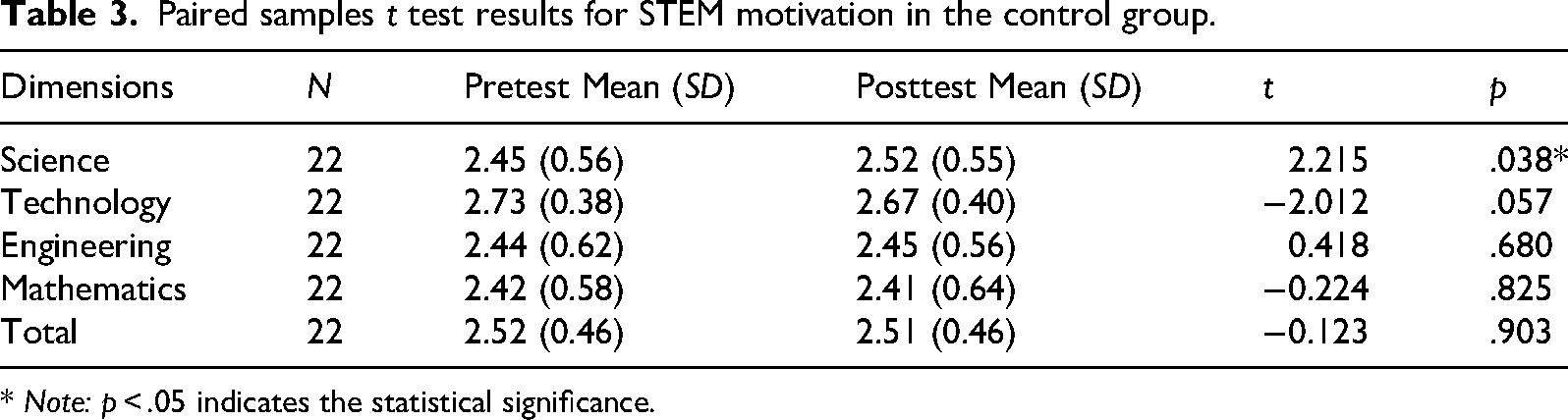
This subsection sequentially presents findings for RQ1 and RQ3 on STEM motivation and related qualitative insights. First, pretest and posttest scores were compared to examine group differences in STEM motivation across the science, technology, engineering, and mathematics components. Second, motivational experiences were illustrated with direct quotations from students. Table 3 shows the control group pretest and posttest scores on the STEM Motivation Scale, which were analyzed via paired samples t tests.
Paired samples t test results for STEM motivation in the control group.
Paired samples t test results for STEM motivation in the control group.
* Note: p < .05 indicates the statistical significance.
In the control group, only the Science dimension showed a small but statistically significant increase from pretest (M = 2.45, SD = 0.56) to posttest (M = 2.52, SD = 0.55), t(21) = 2.215, p = .038. This modest improvement may be attributable to the regular curriculum coverage during the study period. No significant changes were observed in the Technology, Engineering, Mathematics, or Total STEM motivation scores.
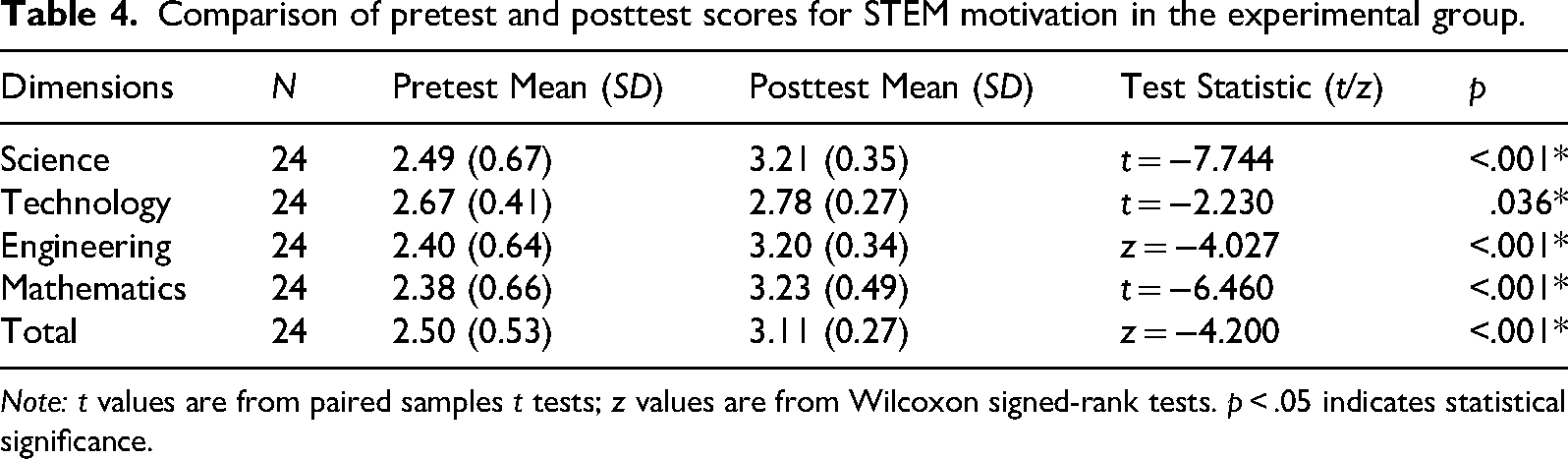
Table 4 compares the pretest and posttest scores for the experimental group on the STEM Motivation Scale.
Comparison of pretest and posttest scores for STEM motivation in the experimental group.
Note: t values are from paired samples t tests; z values are from Wilcoxon signed-rank tests. p < .05 indicates statistical significance.
In the experimental group, statistically significant increases were observed across all dimensions of STEM motivation following the intervention. Science motivation rose markedly from pretest (M = 2.49, SD = 0.67) to posttest (M = 3.21, SD = 0.35), t(23) = −7.744, p < .001, reflecting a clear improvement in students’ interest in scientific concepts. Similarly, mathematics motivation improved substantially (M = 2.38, SD = 0.66 to M = 3.23, SD = 0.49), t(23) = −6.460, p < .001, indicating that the integration of mathematical reasoning within Minecraft strengthened students’ engagement with the subject. Engineering motivation also showed a significant positive shift, rising from a pretest mean of 2.40 (SD = 0.64) to a posttest mean of 3.20 (SD = 0.34), z = −4.027, p < .001, suggesting that the design and construction tasks fostered engineering-oriented thinking. Although the increase in technology motivation was more modest (M = 2.67, SD = 0.41 to M = 2.78, SD = 0.27), it was still statistically significant, t(23) = −2.230, p = .036. Overall, the total STEM motivation score increased significantly from 2.50 (SD = 0.53) to 3.11 (SD = 0.27), z = –4.200, p < .001, underscoring the effectiveness of the Minecraft-based intervention in enhancing students’ motivation across the STEM domains.
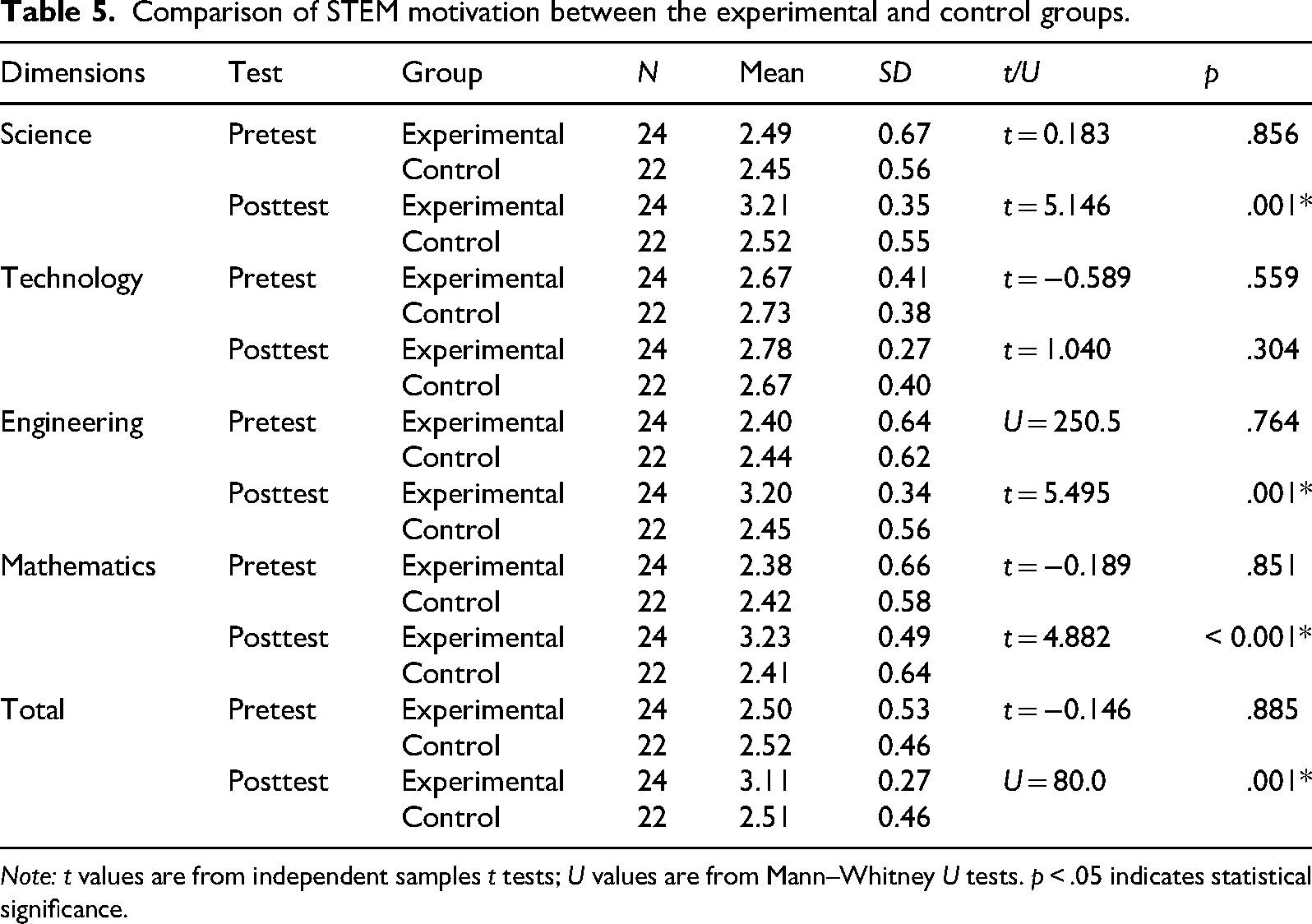
Table 5 presents a comparative analysis of STEM motivation between the experimental and control groups in science, technology, engineering, and mathematics, as well as the overall STEM score.
Comparison of STEM motivation between the experimental and control groups.
Note: t values are from independent samples t tests; U values are from Mann–Whitney U tests. p < .05 indicates statistical significance.
Comparisons between the experimental and control groups showed no significant pretest differences across any STEM motivation dimensions, indicating that the groups were initially equivalent. At posttest, however, the experimental group demonstrated significantly higher motivation in science (M = 3.21, SD = 0.35) compared with the control group (M = 2.52, SD = 0.55), t(44) = 5.146, p = .001, in engineering (M = 3.20, SD = 0.34 compared with M = 2.45, SD = 0.56), t(44) = 5.495, p = .001, and in mathematics (M = 3.23, SD = 0.49 compared with M = 2.41, SD = 0.64), t(44) = 4.882, p < 0.001. The total STEM motivation score was also significantly higher in the experimental group (M = 3.11, SD = 0.27) than in the control group (M = 2.51, SD = 0.46), U = 80.0, p = .001. By contrast, no significant differences were found in technology motivation, as both groups reported relatively stable levels. These findings suggest that the Minecraft-based intervention was particularly effective in enhancing motivation toward science, engineering, and mathematics, thereby strengthening overall STEM motivation, while its impact on technology motivation remained limited.
Thematic analysis of the qualitative data also provided evidence of increased motivation among students in the experimental group. These results are summarized in Table 6.
Themes from the content analysis of students’ views on STEM motivation.
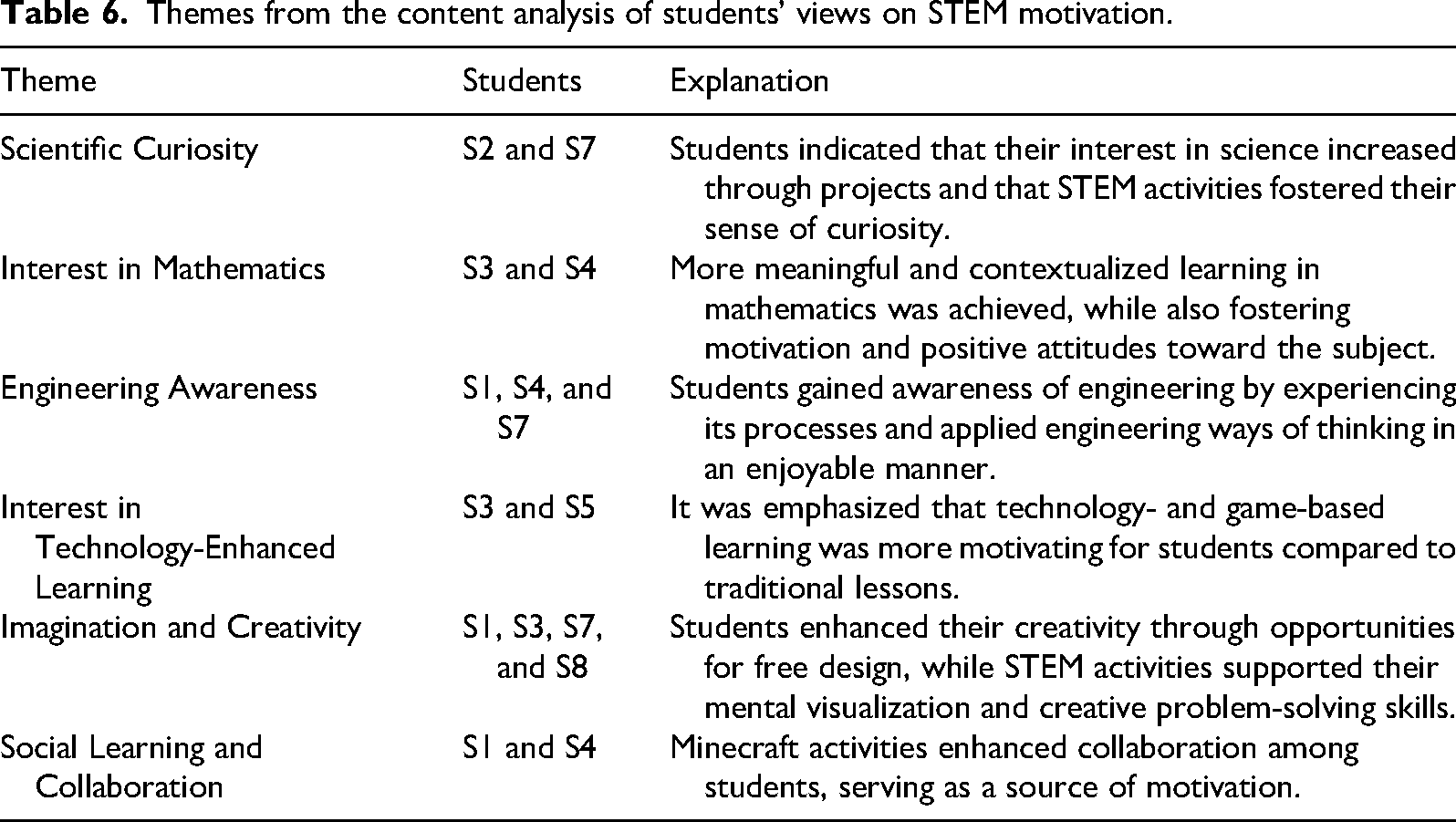
The analyses emphasize that Minecraft provides a multidimensional contribution to STEM motivation by integrating cognitive, affective, and social engagement in ways that traditional classroom practices often fail to achieve. Students demonstrated increased scientific curiosity through authentic projects and reported a stronger interest in mathematics when exposed to contextualized and engaging applications. The activities further fostered engineering awareness, as learners actively participated in design processes and adopted engineering modes of thinking. In addition, the integration of technology and game-based learning was consistently perceived as more motivating than conventional lessons. Beyond these cognitive outcomes, Minecraft was also highlighted as a medium that nurtures imagination and creativity, while simultaneously promoting social learning and collaboration through peer interaction.
The students’ narratives provided nuanced insights into how Minecraft-based STEM activities enhanced their motivation across multiple dimensions. With respect to scientific curiosity, for instance, one student emphasized that “the projects we did made science more exciting. I wanted to learn more about how things work in real life” (S2), while another explained that “building the underwater observatory in Minecraft made me more curious about marine life and how scientists study the ocean” (S7). In terms of interest in mathematics, students stressed the meaningful integration of mathematical concepts into authentic contexts. As noted by one participant, “I had to calculate the area for the underwater observatory, which helped me understand how math is used in real situations” (S3). Another student further added that “Minecraft made math more fun. In regular classes, I sometimes get bored, but with the game, I stayed interested” (S4). Similarly, engineering awareness was reinforced through the design-oriented tasks, as illustrated by the statement, “creating the train station in Minecraft allowed me to design like an engineer. It was challenging but enjoyable” (S4), and by the remark that “I could freely design any city I wanted in the virtual environment, which made me think like an engineer” (S7). The role of technology-enhanced learning was also evident, with one student describing that “using Minecraft in our lessons was more exciting than regular classes. It made me interested in how technology can make learning fun” (S5).
Beyond these disciplinary dimensions, imagination and creativity emerged as salient factors motivating engagement. As students reported, “it developed my imagination” (S8) and “I had to plan the design in my mind first” (S3), highlighting the contribution of Minecraft to visualization and creative problem-solving. Finally, social learning and collaboration were likewise emphasized as motivational drivers, with students noting that “working with my friends was exciting” (S4), suggesting that teamwork within the game environment not only fostered enjoyment but also provided a supportive learning experience.
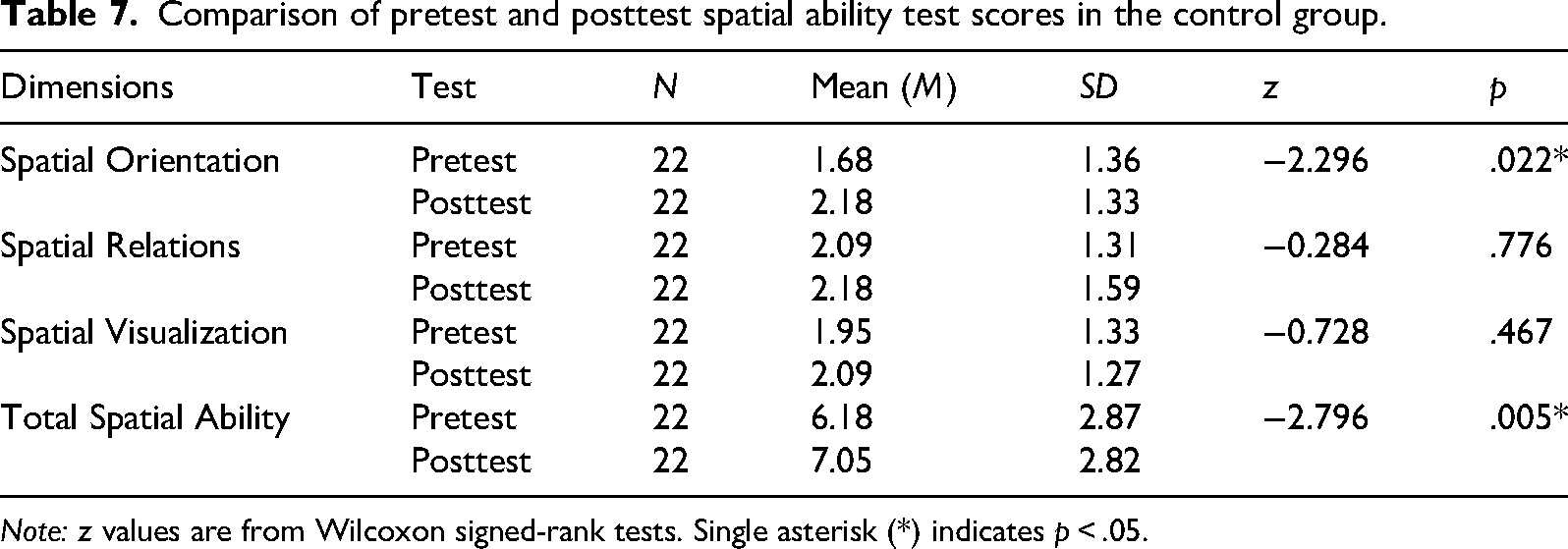
This subsection presents findings for RQ2 and RQ4, with a focus on spatial ability. Pretest and posttest scores for both groups were compared on spatial ability test components. Table 7 shows the control group scores and the total spatial ability scores, which were analyzed with the Wilcoxon signed-rank test.
Comparison of pretest and posttest spatial ability test scores in the control group.
Comparison of pretest and posttest spatial ability test scores in the control group.
Note: z values are from Wilcoxon signed-rank tests. Single asterisk (*) indicates p < .05.
For the control group, the analysis showed a statistically significant increase in spatial orientation, with mean scores rising from 1.68 (SD = 1.36) at pretest to 2.18 (SD = 1.33) at posttest, z = –2.296, p = .022. Similarly, total spatial ability increased significantly from 6.18 (SD = 2.87) to 7.05 (SD = 2.82), z = –2.796, p = .005, suggesting an overall improvement in students’ spatial ability over the course of the study. By contrast, the observed changes in spatial relations (from 2.09 to 2.18) and spatial visualization (from 1.95 to 2.09) were not statistically significant (p > .05), indicating that these dimensions remained relatively stable. Taken together, the results suggest that certain aspects of spatial ability may undergo natural development over time without intervention, whereas more targeted strategies may be necessary to achieve significant changes across all subdimensions.
Table 8 compares the pretest and posttest spatial ability scores for the experimental group across spatial orientation, spatial relations, spatial visualization, and total spatial ability. These scores were analyzed with paired samples t tests or Wilcoxon signed-rank tests based on data normality.
Comparison of pretest and posttest spatial ability test scores in the experimental group.
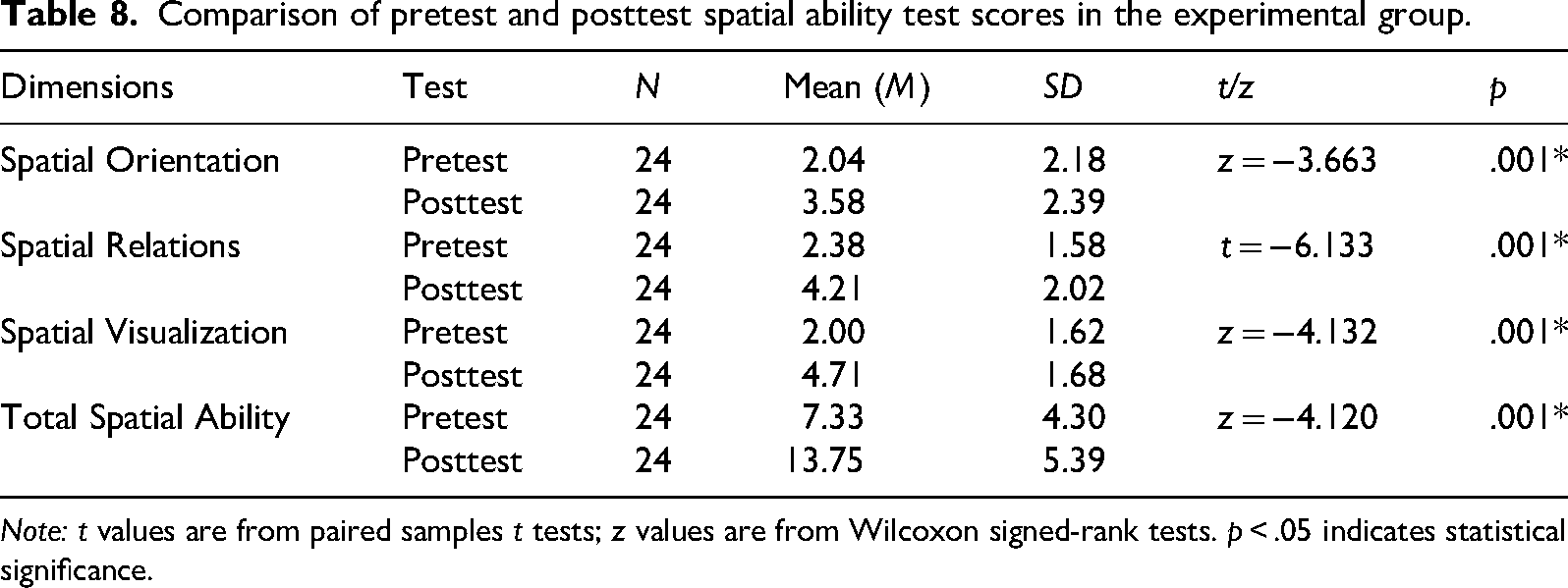
Note: t values are from paired samples t tests; z values are from Wilcoxon signed-rank tests. p < .05 indicates statistical significance.
For the experimental group, all dimensions of spatial ability showed statistically significant gains from pretest to posttest. Spatial orientation scores increased from 2.04 (SD = 2.18) to 3.58 (SD = 2.39), z = –3.663, p = .001, indicating a marked improvement in students’ orientation skills. Similarly, spatial relations rose from 2.38 (SD = 1.58) to 4.21 (SD = 2.02), t(23) = –6.133, p = .001, reflecting a substantial enhancement in students’ ability to perceive and process spatial relationships. Spatial visualization also improved significantly, with mean scores rising from 2.00 (SD = 1.62) to 4.71 (SD = 1.68), z = –4.132, p = .001. Finally, the total spatial ability score showed a highly significant increase from 7.33 (SD = 4.30) to 13.75 (SD = 5.39), z = –4.120, p = .001, demonstrating an overall improvement across all dimensions. Taken together, these results indicate that the intervention effectively enhanced students’ spatial skills, which are considered crucial for engagement and success in STEM learning.
Table 9 compares pretest and posttest spatial ability scores between the experimental and control groups across spatial orientation, spatial relationships, spatial visualization, and total spatial ability, analyzed with independent samples t tests or Mann‒Whitney U tests based on data distribution.
Comparison of spatial ability test scores between the experimental and control groups at pretest and posttest.
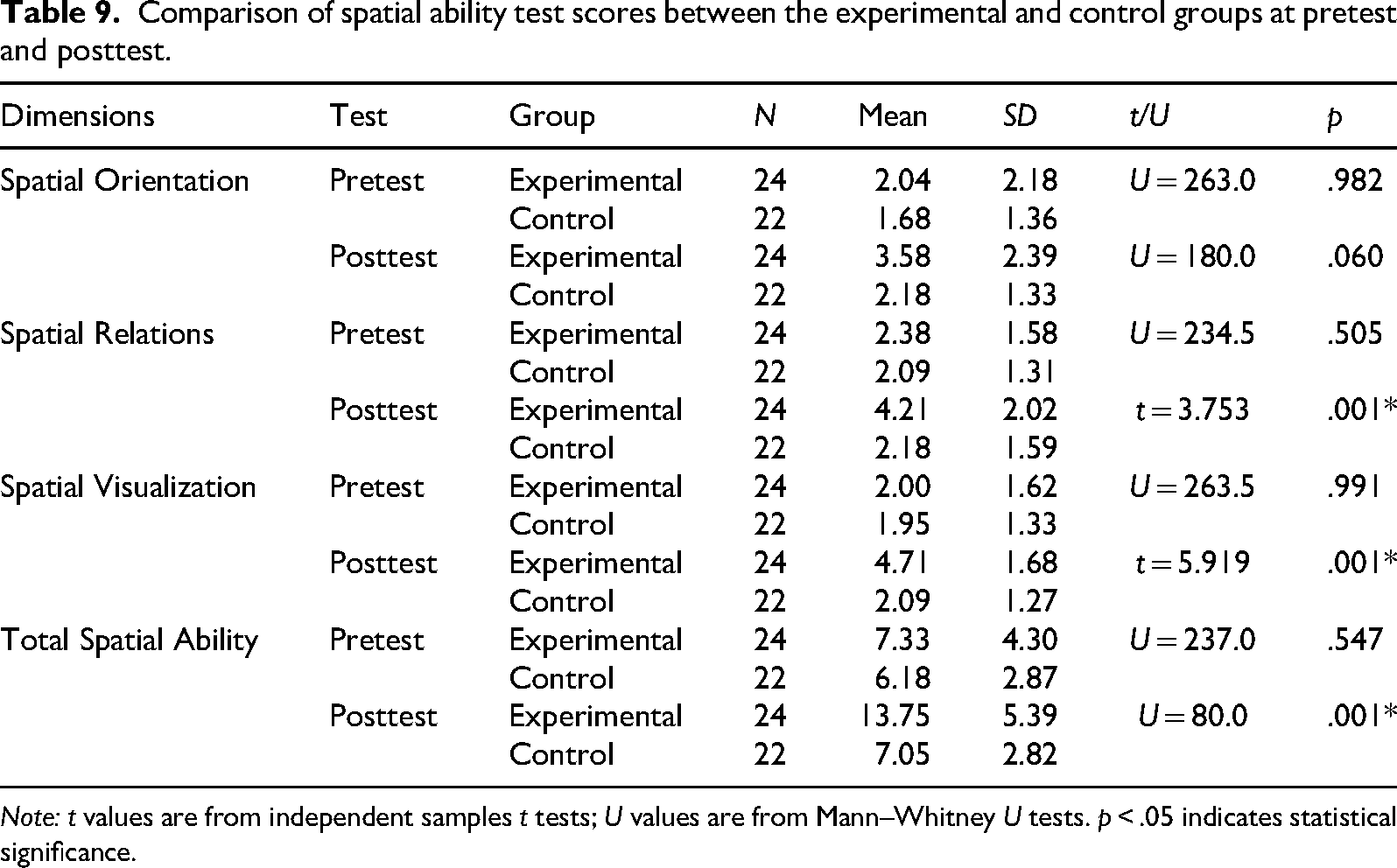
Note: t values are from independent samples t tests; U values are from Mann–Whitney U tests. p < .05 indicates statistical significance.
At the pretest stage, no significant differences were observed between the experimental and control groups across any of the spatial ability dimensions, indicating comparable baseline levels. At the posttest, however, the experimental group outperformed the control group in several areas. Specifically, significant differences emerged in spatial relations, where the experimental group achieved higher scores (M = 4.21, SD = 2.02) compared with the control group (M = 2.18, SD = 1.59), t(44) = 3.753, p = .001. Likewise, spatial visualization showed a marked improvement in the experimental group (M = 4.71, SD = 1.68) relative to the control group (M = 2.09, SD = 1.27), t(44) = 5.919, p = .001. Experimental group students also scored substantially higher in total spatial ability (M = 13.75, SD = 5.39) than their peers in the control group (M = 7.05, SD = 2.82), U = 80.0, p = .001. In contrast, the difference in spatial orientation approached significance (p = .060) but did not reach the level considered statistically significant. Taken together, these findings suggest that the intervention was particularly effective in enhancing students’ spatial relations, spatial visualization, and overall spatial ability, while its effect on spatial orientation remained inconclusive.
The qualitative analysis further illuminated how students in the experimental group demonstrated improvements in spatial skills; these findings are organized into themes and summarized in Table 10.
Students’ views on spatial skills.

The analysis indicates that Minecraft-based STEM activities supported students’ spatial skills in complementary ways. Spatial orientation improved as students navigated and positioned themselves within 3D environments, though larger and more complex structures posed challenges. Spatial relations were strengthened through tasks requiring the recognition of connections, alignments, and area calculations. Moreover, spatial visualization was enhanced as students mentally manipulated, rotated, and planned objects.
The qualitative findings illustrated that Minecraft-based activities fostered the development of students’ spatial skills across orientation, relations, and visualization. With regard to spatial orientation, navigating the 3D environment of the game supported students’ ability to position themselves and move effectively within virtual space. As one student expressed, “Exploring and building in Minecraft helped me get better at knowing where I am and how to move around in a 3D space” (S1). However, the demands of larger structures also created challenges, as highlighted by another participant: “I did not find it difficult to move around because I was already familiar with the game, but building larger structures challenged my sense of direction” (S5).
In terms of spatial relations, constructing objects in Minecraft helped students recognize how different components are connected and aligned, reinforcing the quantitative results on improved spatial relations. For example, one student noted, “When building my house in Minecraft, I learned how rooms connect and how the structure fits together” (S2), while another reflected that “Designing the train tracks and station helped me see how different parts have to align correctly” (S4). These insights suggest that engaging with structural design tasks enabled students to understand spatial interdependencies in a meaningful way.
Finally, spatial visualization was particularly evident in activities requiring students to plan, manipulate, and mentally transform objects prior to construction. As one participant explained, “I had to imagine how the Tetris blocks would look and fit together before I built them” (S6). Similarly, others emphasized the need for mental planning and visualization, such as “Creating the underwater observatory required me to plan the design in my mind first” (S3) and “I visualized different ways to arrange blocks to make my designs work” (S5). These accounts demonstrate how Minecraft offered opportunities for students to strengthen their ability to mentally rotate and reconstruct spatial configurations.
The qualitative evidence from this study indicates ways in which Minecraft Education may support spatial learning. As students designed and manipulated structures, they increasingly attended to how parts fit and align—reflecting gains in spatial relations—while planning and mentally rehearsing configurations before construction, indicative of stronger spatial visualization. At the same time, navigating and revising builds within a 3D world fostered better spatial orientation. This integrated experience of design, mental simulation, and embodied navigation aligns with the three components assessed in the spatial ability test and helps explain the quantitative gains, suggesting that Minecraft can serve as an effective context for developing spatial skills essential to STEM learning.
As an illustrative example, Table 11 demonstrates S2's design process, which highlights the development of spatial orientation, spatial relations, and visualization skills through Minecraft-based tasks. The analysis of the student's project report first shows how technical sketches on grid paper, drawn from multiple perspectives (front, side, top, and corner views), required the mental manipulation of 3D structures on a 2D plane. This process reflected both spatial visualization and orientation skills as the student imagined, rotated, and represented the building from different angles.
S2's house design process and evidence of spatial skills development.

Subsequently, the student transferred these sketches into the Minecraft environment. As documented in the step-by-step screenshots and explanations, the construction process involved planning the placement of rooms and walls, labeling spaces to avoid confusion, and incrementally building different floors. For instance, the student reported: “I first created the rooms roughly with blocks to decide their positions, then I used signs to mark which room would be where so that I would not forget.” This illustrates how spatial relations were actively considered and managed throughout the design.
Further, the construction of stairs, the alignment of windows, and the planning of upper floors required mental rotation and restructuring of objects, thereby underscoring the importance of visualization processes. As the student noted: “When I moved to the upper floor, I first built the floor and then constructed the walls.” Such reflections reveal an awareness of sequential spatial planning and a growing ability to reorganize spatial elements within a complex design.
Finally, the integration of interior design (e.g., placing furniture, arranging decorations, and adjusting room layouts) reflects a more advanced application of spatial reasoning, where the student reorganized spaces to improve both functionality and aesthetics. Overall, S2's project exemplifies how Minecraft-based tasks foster the interconnected development of spatial orientation, spatial relations, and spatial visualization, thereby corroborating both the quantitative outcomes and the thematic findings.
The integration of Minecraft into STEM education has demonstrated the substantial potential to increase students’ motivation, spatial abilities, and overall engagement, which aligns with previous research supporting the benefits of game-based learning in STEM contexts. This study's findings corroborate those of Sánchez-Rivas et al. (2024) and Saricam and Yildirim (2021), who emphasized Minecraft Education's high educational value and capacity to enrich traditional teaching methods. By creating an interactive and dynamic learning environment, Minecraft helps students bridge theoretical concepts with practical applications, offering a hands-on approach that stimulates sustained interest in STEM fields.
Building on these contributions, the findings of the present study also highlight the direct connection between Minecraft-based activities and mathematics learning outcomes. These skills make a direct contribution to students’ learning outcomes in mathematics lessons. In particular, they are closely related to outcomes such as drawing 2D views of shapes from different orientations, constructing polygons, and reasoning about geometric transformations. An examination of the MoNE (2018) mathematics curriculum reveals that the spatial abilities measured in our study overlap with several curriculum outcomes (see Supplemental Appendix A). Nevertheless, although some tasks (e.g., coordinate system, translation, and reflection) are formally included in the eighth-grade curriculum, our findings indicate that seventh-grade students have already begun to develop the prerequisite competencies required for these more advanced skills. Therefore, incorporating spatially rich environments such as Minecraft into seventh-grade mathematics instruction may not only reinforce existing curriculum outcomes but also facilitate students’ transition to more abstract spatial reasoning tasks encountered in the eighth grade.
Enhanced STEM motivation through game-based learning
The positive impact of Minecraft on students’ STEM motivation was clearly reflected in our quantitative findings. While pretest scores showed no significant difference between the experimental and control groups, posttest results revealed that the experimental group achieved significantly higher motivation scores (see Table 5). This improvement, as observed in the experimental group, supports the assertion that game-based learning fosters engagement, a critical factor in academic motivation (Alsawaier, 2018; Talan et al., 2020). Importantly, prior gaming experience was balanced across groups (see Table 1), indicating that the observed increase cannot be solely attributed to pre-existing familiarity with Minecraft. Rather, the structured and goal-oriented tasks embedded in the intervention appear to have fostered greater engagement and persistence among students. This finding resonates with previous research (e.g., Ilić et al., 2024) while providing stronger empirical evidence that carefully designed Minecraft-based activities can enhance STEM motivation, regardless of students’ prior gaming background.
In addition to individual factors, the collaborative and interactive features of Minecraft played a vital role in enhancing motivation. Qualitative interview data revealed that students frequently emphasized teamwork and shared decision-making as motivating aspects of the experience. For instance, one student explained: “When we couldn’t solve a building problem alone, we shared ideas and solved it together, which made the game more fun and kept us motivated.” This finding aligns with Saricam and Yildirim (2021), who reported that teamwork in Minecraft develops communication skills and respect for others’ ideas. Such social interactions, also noted by Hewett et al. (2020), not only increase motivation but also foster essential 21st-century skills such as collaboration and leadership.
Development of spatial abilities
The study results revealed a significant improvement in spatial ability among students engaged in Minecraft-based STEM activities. This finding is consistent with research by Carbonell-Carrera et al. (2021), who demonstrated that interacting with 3D objects in Minecraft enhances mental rotation skills, a crucial component of spatial reasoning. Similarly, Cheng and Mix (2014) reported that spatial training can directly improve mathematical ability, and our study suggests that the spatial reasoning tasks embedded in Minecraft provide students with authentic opportunities to apply and extend spatial concepts in meaningful contexts. These activities thereby support cognitive development in spatially intensive subjects, as noted by Uttal et al. (2013) and Harris et al. (2013).
Importantly, the significance of spatial ability extends beyond immediate academic performance. Kell et al. (2013) emphasized that spatial ability plays a unique role not only in assimilating existing knowledge but also in generating new knowledge, fostering creativity, and enabling technical innovation. Our findings align with this perspective: students’ improvements in spatial orientation, relations, and visualization through Minecraft-based tasks suggest that such environments can contribute to developing the foundational cognitive architecture necessary for creative thought and innovative production in STEM. For instance, students’ engagement in mentally rotating structures, reorganizing spatial elements, and planning multi-layered constructions reflects processes that are central to both problem-solving in mathematics and innovation in engineering contexts.
Given evidence that spatial abilities are associated with later STEM achievement (Shea et al., 2001; Wai et al., 2009), integrating digital games such as Minecraft into curricula may therefore be a promising pathway not only to reinforce foundational mathematical and spatial skills but also to nurture the broader competencies—such as creativity and innovation—that are essential for sustained success in STEM fields. Ensuring that these activities are aligned with learning goals and supported by appropriate scaffolding will be critical for realizing their full educational potential.
Implications and challenges for curriculum design
The findings of this study suggest that actively integrating Minecraft and other digital games into STEM curricula can significantly enhance student motivation, spatial reasoning abilities, and the development of essential skills. In particular, our results demonstrated how Minecraft-based activities supported mathematics learning outcomes by reinforcing spatial reasoning and fostering engagement in problem-solving tasks. These findings are consistent with prior research in mathematics and science education that emphasizes the importance of engaging learning environments for promoting cognitive and social development (Afari et al., 2013; Ernest, 1986; Hobbs et al., 2019). Moreover, the adaptability of Minecraft observed in our study highlights its potential to create inclusive learning opportunities for students with different levels of gaming experience and interest (Ilić et al., 2024; Sánchez-Rivas et al., 2024).
At the same time, several challenges must be acknowledged when integrating Minecraft into curricula. Not all students engage with Minecraft in the same way, making it necessary to account for individual differences such as prior gaming experience, interest levels, and learning styles (Fan et al., 2022; Panja & Berge, 2021). Open-ended learning environments, while stimulating, can also be demanding, even for high-performing students (Tablatin et al., 2023), underscoring the need for scaffolding. Consistent with Vygotsky's zone of proximal development (van de Pol et al., 2010; Vygotsky, 1978), scaffolding should provide temporary supports that enable students to perform just beyond their independent capability and gradually fade over time. Beyond moment-to-moment guidance, system-level “scaffolding by design”—such as structured task sequences, worked examples, assessment rubrics, teacher professional development, and reliable technical infrastructure—can help manage complexity in open-ended contexts (Quintana et al., 2004). This aligns with evidence that minimally guided inquiry may disadvantage some learners, whereas carefully scaffolded inquiry can be effective (Hmelo-Silver et al., 2007; Kirschner et al., 2006).
Finally, successful curricular integration requires careful planning and adequate teacher preparation. As Baek et al. (2020) emphasize, potential challenges include a lack of focused learning objectives, rigid curricula, and the prerequisite of gaming skills. Addressing these issues through teacher training and curricular alignment is essential for maximizing the educational potential of Minecraft and similar digital games.
Limitations
This study has certain limitations that should be considered when interpreting the findings. The small sample size and short duration of the intervention may limit the generalizability and sustainability of the observed effects on STEM motivation and spatial ability. Additionally, the study took place within a controlled, school-based setting, which may not capture the full potential of Minecraft in informal or out-of-school learning environments. While qualitative data offer valuable perspectives, incorporating additional data collection methods, such as focus groups, could provide a deeper understanding of students’ experiences and motivations.
Although this study used Minecraft Education tasks strictly aligned with curriculum goals and did not involve militaristic or violent content, game-based environments can be repurposed for purposes beyond education; this study did not evaluate such dual-use risks. Moreover, the effects of gamification may depend on design and may include unintended outcomes such as novelty-driven engagement or shifts toward extrinsic rather than intrinsic motivation; this study did not directly examine these possibilities, and longer-term motivational trajectories remain unknown.
Recommendations for future research
Given the positive outcomes observed in the study and the limitations noted, further research should examine the long-term effects of Minecraft-based learning on students’ STEM performance and engagement, using larger and more diverse samples with longer interventions. Future work should also investigate how learner characteristics (e.g., prior achievement and gaming experience) moderate outcomes (Panja & Berge, 2021) and identify effective strategies for teacher professional development and curricular integration (Baek et al., 2020). In addition, integrating Minecraft with complementary technologies—such as augmented reality, which has been associated with gains in spatial skills (Carbonell-Carrera et al., 2021)—warrants investigation across varied settings, including after-school programs.
Conclusion
This study demonstrates that Minecraft-based STEM activities can foster both motivation and spatial abilities by integrating cognitive, affective, and social engagement in ways that traditional instruction often struggles to achieve. Quantitative findings revealed significant gains in science, engineering, mathematics, and overall STEM motivation for the experimental group, while qualitative analyses further illustrated how contextualized and engaging tasks stimulated scientific curiosity and strengthened students’ interest in mathematics (see Table 6). These results emphasize the potential of embedding mathematical concepts into authentic, game-based tasks to sustain motivation and deepen learning.
In terms of spatial development, the experimental group showed significant improvements across all dimensions of spatial ability, whereas only partial gains were observed in the control group. Qualitative evidence corroborated these results: students’ reflections and project analyses (Tables 10 and 11) highlighted how navigating 3D environments, constructing multi-layered designs, and visualizing structures before building them supported the interconnected development of spatial orientation, relations, and visualization. These findings underscore the value of Minecraft as a medium that nurtures imagination, creativity, and sequential spatial planning, while simultaneously aligning with curriculum outcomes in mathematics, such as drawing orthographic views, reasoning about transformations, and constructing geometric structures.
Overall, the study contributes to the growing evidence base on digital game-based learning by showing that carefully designed Minecraft activities can bridge theoretical concepts and practical applications in STEM education. Beyond enhancing engagement, the integration of such environments into curricula offers a promising pathway to develop foundational skills essential for future STEM achievement. When aligned with learning goals and supported through appropriate scaffolding, Minecraft has the potential to enrich mathematics teaching and learning, while fostering 21st-century competencies such as collaboration, creativity, and problem-solving.
Supplemental Material
sj-docx-1-mea-10.1177_27527263261448836 - Supplemental material for The role of Minecraft in STEM education: A study on the development of motivation and spatial abilities
Supplemental material, sj-docx-1-mea-10.1177_27527263261448836 for The role of Minecraft in STEM education: A study on the development of motivation and spatial abilities by Mustafa Gök and Burcu Özen in Asian Journal for Mathematics Education
Supplemental Material
sj-docx-2-mea-10.1177_27527263261448836 - Supplemental material for The role of Minecraft in STEM education: A study on the development of motivation and spatial abilities
Supplemental material, sj-docx-2-mea-10.1177_27527263261448836 for The role of Minecraft in STEM education: A study on the development of motivation and spatial abilities by Mustafa Gök and Burcu Özen in Asian Journal for Mathematics Education
Footnotes

Ethical Considerations and Informed Consent
This study received approval from the Social and Human Sciences Ethics Committee of Van Yuzuncu Yil University (Meeting No: 2021/10, Decision No: 2021/10-5, Date: 10.08.2021). Informed consent was obtained from all subjects involved in the study.
Contributorship
Mustafa Gök led the conceptualization and design of the study, established the theoretical framework, performed and validated the data analysis, and wrote the manuscript. Burcu Özen carried out the implementation and data collection, contributed to the data analysis, and drafted the manuscript. Both authors revised the manuscript through multiple rounds and approved the final manuscript.
Funding
The authors received no financial support for the research, authorship, and/or publication of this article.
Declaration of Conflicting Interests
The authors declare that there are no conflicts of interest related to this study. This research was conducted independently, with no financial or personal relationships that could influence the results or interpretation of the findings. No funding was received from any organization, and the study is solely the work of the authors, undertaken to contribute to the field of STEM education and game-based learning.
Supplemental Material
Supplemental material for this article is available online.
Author Biographies
References
Supplementary Material
Please find the following supplemental material available below.
For Open Access articles published under a Creative Commons License, all supplemental material carries the same license as the article it is associated with.
For non-Open Access articles published, all supplemental material carries a non-exclusive license, and permission requests for re-use of supplemental material or any part of supplemental material shall be sent directly to the copyright owner as specified in the copyright notice associated with the article.
