



Abstract
In this column, I discuss how a student studying music in the International Baccalaureate Diploma Programme composed a soundscape for her experimentation report. When creating this composition, this student used GarageBand for Mac.
Keywords
In a previous column, I explored how iMovie for iOS can be used for soundscape composition in general music and provided an example of a task that I implemented with Year 4 students (9- to 10-year-olds), which involved students composing soundscapes inspired by their own triptych artworks (Norman, 2022). I concluded that “when iMovie for iOS is effectively incorporated into composition tasks, students are afforded the opportunity to engage in a cyclic process of composing, recording, and refining, which may otherwise be limited by traditional music notation” and that iMovie is “both a useful and intuitive app that has several advantages for music composition in general music education” (p. 40). Since writing this column, I now teach secondary music, including the International Baccalaureate (IB) Diploma Programme (DP). This has required me to pivot in how I use educational technology. In this column, I describe how a senior high school student used GarageBand for Mac when completing a creating task for her IB DP experimentation report.
Music in the IB DP
The IB DP “is a rigorous pre-university course of study” and consists of “six academic areas enclosing a central core” (International Baccalaureate Organization [IBO], 2020a, p. 2). The course “aims to encourage students to be knowledgeable and inquiring, but also caring and compassionate” and “there is a strong emphasis on encouraging students to develop intercultural understanding, open-mindedness and the attitudes necessary for them to respect and evaluate a range of points of view” (p. 2). Music falls within The Arts cluster of subjects and “has been designed to prepare the 21st century music student for a world in which global musical cultures and industries are rapidly changing” (International Baccalaureate Organization [IBO], 2020b, p. 1). The course aims to deliver a holistic music education “with the roles of performer, creator and researcher afforded equal importance” (IBO, 2020b, p. 1).
Within the music course, there are four areas of inquiry (AOIs), the fourth being “Music technology in the electronic and digital age” (IBO, 2020a, p. 23). When describing this AOI, the IB wrote, “this area focuses on music created, performed and/or produced using electronic or digital technologies. Such technologies are an important aspect of contemporary musical experiences, often transforming some of the ways that we understand and engage with music” (p. 23). By the end of their 2 years of study, music students in the IB DP will have “engaged with music technology as a compulsory part of the course” (IBO, 2020b, p. 2). When discussing the role of music technology, the IB wrote that “for 21st-century musicians, learning to make music by engaging with a range of technologies is now a fundamental skill and is therefore a central aspect of this curriculum” (IBO, 2020a, p. 7). I welcome the IB’s emphasis on music technology, as it is a key component of contemporary music-making practices, which are at times neglected by general music educators.
The Experimentation Report
The composition activity described in this column was completed by a student exploring AOI4. The IB DP music course consists of several assessment components, with one of these being an experimentation report—a “written work in the form of a rationale and commentary that supports practical musical evidence of experimentation in creating and performing” (IBO, 2020b, p. 2). Students experiment “with musical materials, musical findings, musical decisions and musical skills” as they adopt the roles of researcher, creator, and performer (IBO, 2020a, p. 31). At the end of their course of study, students submit their report alongside three related creating excerpts and three related performing excerpts that they have developed and recorded. For this assessment component, the IB DP student that I teach composed a soundscape using GarageBand for Mac. For context, this was the first of three possible creating excerpts, with the latter two still to be developed, as she is in her first year of study of the IB DP. As you read through the description of her creating experiment, I hope you will glean some useful ideas for your own classroom practice, regardless of the curriculum framework that you teach.
Soundscape Composition
First, however, it is important to establish what is meant by the term, “soundscape composition.” As I discuss in a previous column (i.e., Norman, 2022), a soundscape composition should contain “recognizable environmental sounds that invoke listeners’ associations, memories, and imaginations related to the soundscape” (Yanko, 2019, p. 274). However, as Truax (2008) observed, “music created through soundscape composition cannot be organised with much similarity to instrumental music; in fact, a broader definition of music such as ‘organised sound’ must be invoked” (p. 105). The student and I adopted this definition of a soundscape being “organised sound,” as we experimented with creating music in this medium.
To assist the student with the task, I directed her to a website authored by the electroacoustic Canadian composer, Barry Truax. On this website are several useful pages, most notably one discussing soundscape composition (i.e., Truax, n.d.-b). According to Truax, there are four principles of soundscape composition:
[1] listener recognizability of the source material is maintained; [2] listener’s knowledge of the environmental and psychological context is invoked; [3] composer’s knowledge of the environmental and psychological context influences the shape of the composition at every level; [4] the work enhances our understanding of the world and its influence carries over into everyday perceptual habits. (Truax, n.d.-b, Soundscape composition principles, para. 1)
Truax (n.d.-b) identifies three approaches to soundscape composition including a fixed perspective approach, a moving perspective approach, and a variable perspective approach. Regarding “the fixed perspective approach, it is the flow of sound events in time which determines the structure of the piece” (Truax, 2002, p. 8). In this approach, “time is created by the movement of the sound, not that of the listener” with soundscapes anchored “to an implicitly fixed location” (p. 8). A moving perspective approach involves the composer creating “the illusion of relative motion between the listener and the auditory space” (p. 9). For example, Traux refers to a soundscape in which the listener is taken on an auditory journey on a ferry from the entrance to Vancouver Harbour to the eventual docking of the boat. Last, the variable perspective approach is when composers “depart from the fixed or moving perspectives that have clear analogues in the real world, and invent new ways of organising and presenting their material” (p. 11). This approach is more abstract in nature when compared with both the fixed perspective and moving perspective approaches and may take multiple forms.
On Truax’s website is another webpage that contains several audio excerpts that collectively reflect the above three approaches (i.e., Truax, n.d.-a). As a preliminary activity, I asked the IB DP student to listen to some of these audio excerpts and classify them as reflecting either a fixed, moving, or variable perspective approach. The student recorded her answers in her music journal, for which we used Microsoft OneNote, as it allowed her to incorporate various file types (such as, pictures, audio and video files) alongside text and share her work in real time with myself for feedback.
Creating the Soundscape
As part of her experimenting with music assessment, the IB DP student created a soundscape using the fixed perspective approach. Her soundscape followed a simple narrative, as it depicted the coming and going of a storm over an ocean. Instead of recording her own sounds, the student made use of royalty free audio samples, which she obtained from the website, ZapSplat.com (see ZapSplat, n.d.). These included samples of sounds, such as seagulls squawking, waves crashing, wind, and the sound of rain on water. Her soundscape also contained composed music, which she recorded using synthesizers available in GarageBand for Mac and the musical typing feature. Musical typing allows users of GarageBand to play selected software instruments by using the keys on a computer keyboard (see Figure 1). Alternatively, software instruments can be played using the onscreen keyboard and clicking on the notes that one wishes to play using the cursor (see Figure 2; Apple, 2022). Last, a MIDI keyboard can be used to play and record software instruments.
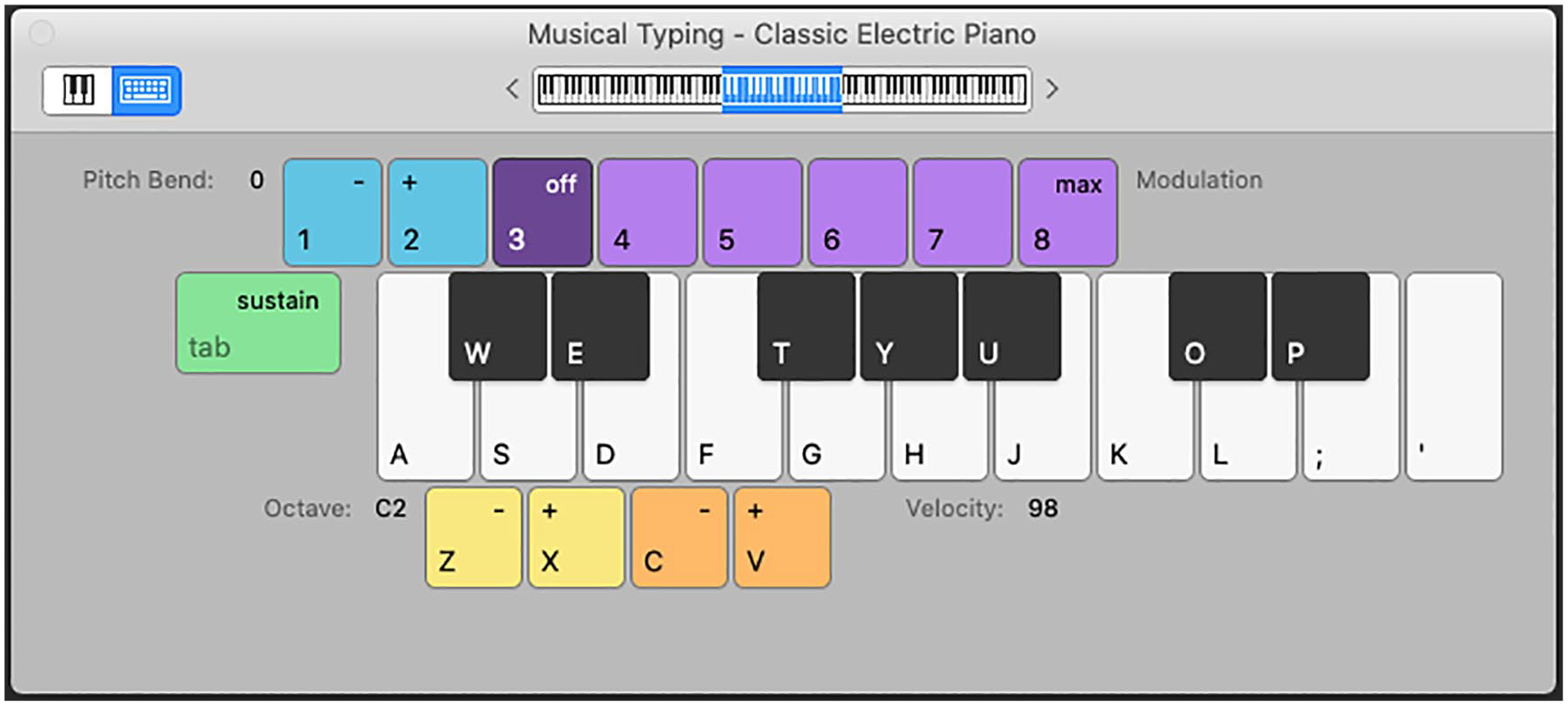
Musical Typing.

Onscreen Keyboard.
GarageBand for Mac was used by this student not only to play and record software instruments, but also to collate, edit, and arrange all the sound files she had collected into a single project which, when exported to mp3, became her composition. Some of the editing features the student used included adjusting the volume, reverb, and vibrato of individual tracks by adding automation points to selected tracks’ automation curves (see Figures 3 and 4). This manipulation of the audio samples helped the student to aurally depict the narrative of a storm forming, occurring, and dispersing over an ocean. To listen to the student’s completed soundscape, please go to the Supplemental Material section of this column. The student and I considered using other programs to create her soundscape, such as Logic Pro; however, as she only required relatively simple audio editing functions, GarageBand was deemed to be sufficient. However, if the student wishes to use more advanced techniques in subsequent creating experiments, then we will consider using other programs.
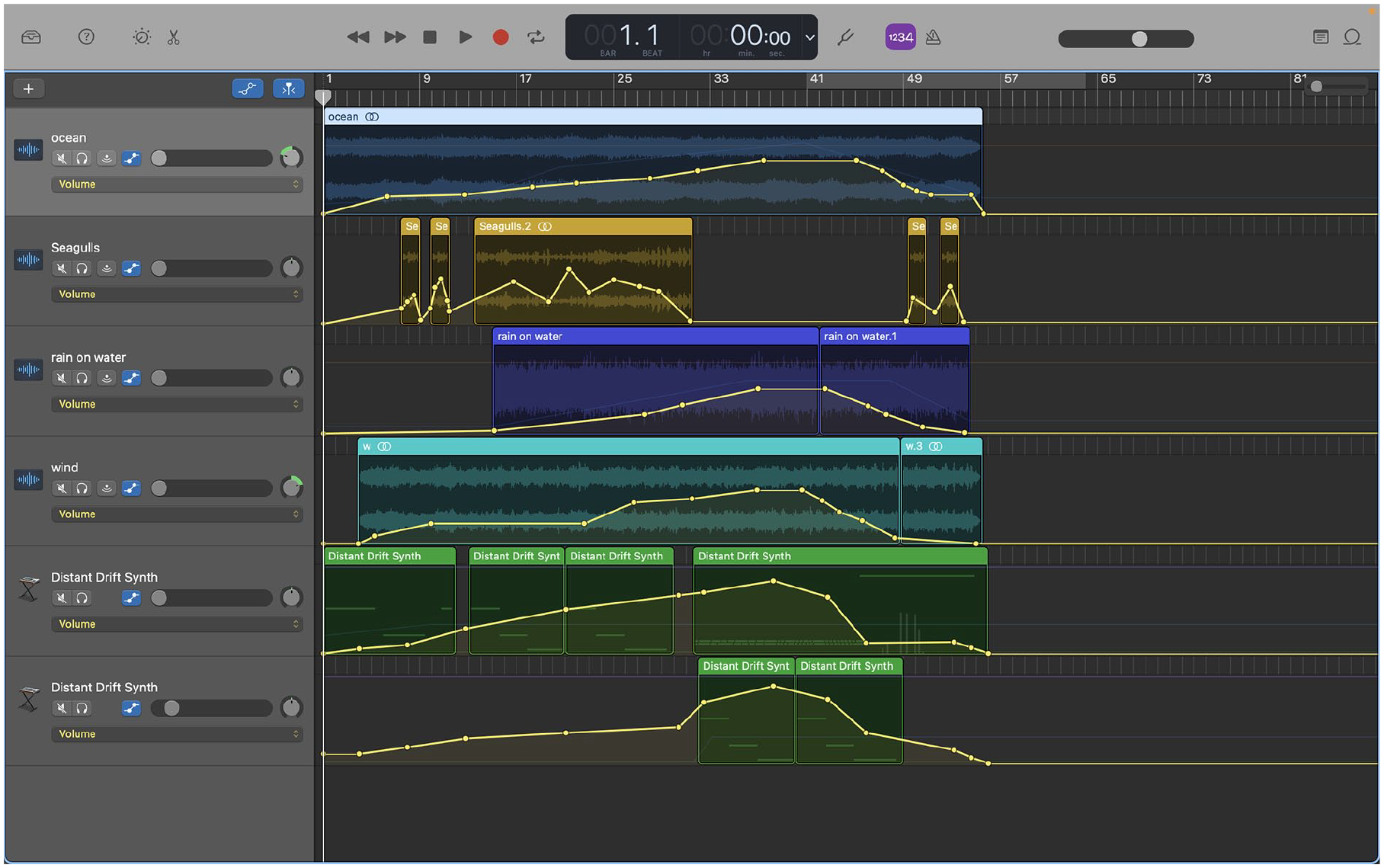
Volume Automation Points/Curves in GarageBand.
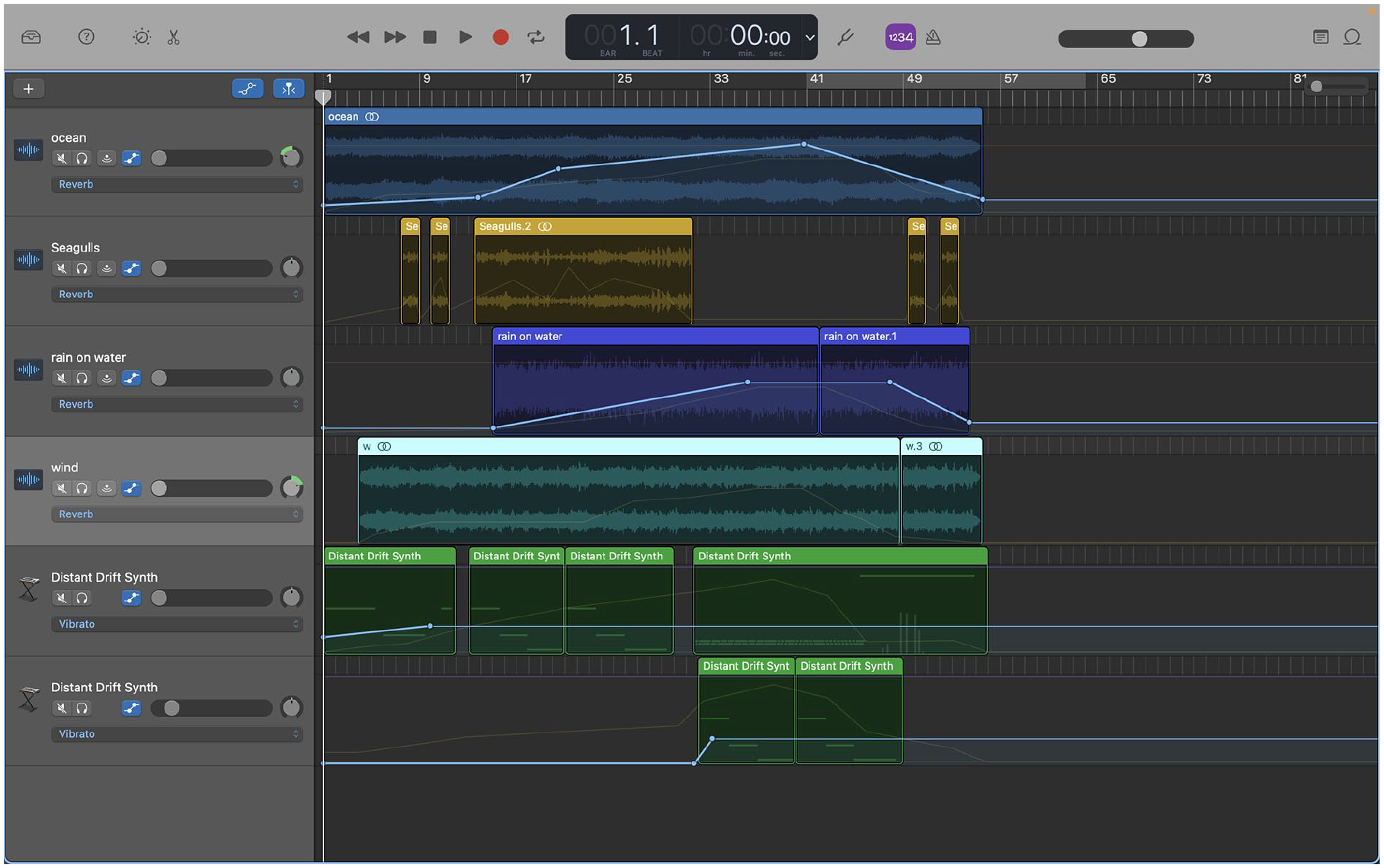
Reverb and Vibrato Automation Points/Curves in GarageBand.
Conclusion
In this column, I have described how an IB DP music student used GarageBand to create a soundscape composition for her experimentation report. This student is in her first year of the IB DP and may choose to continue experimenting with the genre of soundscape composition in her second year of the course. This is not the first time I have discussed soundscape composition in general music settings, and if you wish to find out how you can develop activities using this medium for primary/elementary classes, please see my previous column (i.e., Norman, 2022). Composing need not be limited to traditional forms and styles and with the ever-increasing prevalence of digital technologies in the classroom, I encourage you to consider how you could potentially incorporate soundscape composition into your practice.
Supplemental Material
sj-mp3-1-gmt-10.1177_27527646221142860 – Supplemental material for Experimenting With Music: Soundscape Composition in the International Baccalaureate Diploma Programme
Supplemental material, sj-mp3-1-gmt-10.1177_27527646221142860 for Experimenting With Music: Soundscape Composition in the International Baccalaureate Diploma Programme by Timothy David Norman in Journal of General Music Education
Footnotes
Declarations of Conflicts of Interest
The author(s) declared no potential conflicts of interest with respect to the research, authorship, and/or publication of this article.
Funding
The author(s) received no financial support for the research, authorship, and/or publication of this article.

Supplemental Material
Supplemental material for this article is available online.
Author Biography
References
Supplementary Material
Please find the following supplemental material available below.
For Open Access articles published under a Creative Commons License, all supplemental material carries the same license as the article it is associated with.
For non-Open Access articles published, all supplemental material carries a non-exclusive license, and permission requests for re-use of supplemental material or any part of supplemental material shall be sent directly to the copyright owner as specified in the copyright notice associated with the article.
