



Abstract
Although there is a consensus that it is important to teach jazz and the skill of improvisation inherent within it, many feel unprepared to do so. This article presents a simple way for beginners to improvise through the blues scale and harmonic progression at any present skill level in kindergarten through high school general music coursework. This practical method addresses the Creating pillar of the 2014 Music Standards while enhancing students’ and instructors’ musical skills and leadership skills, and presenting an avenue for live performance. Teachers and students alike can feel empowered to learn jazz improvisation with the “correct notes” provided through these friendly steps that I have been using in my own teaching for over 15 years.
Keywords
Like many music educators today, my background and experience was strictly in classical music—until I sought out an independent study class my final year of college on jazz improvisation. As both a clarinetist and vocalist, I was intimidated by a frightening new way of relating with already comfortable musical concepts and did not know where to begin to learn improvisation. Moving from performing music as written to creating spontaneous art can be intimidating; but it does not have to be so.
Why Teach Jazz?
Jazz was uniquely created in the United States, and while research shows that music teachers at all levels believe jazz should be a part of the curriculum and are interested in teaching this genre, many feel unprepared to do so (Tuck & Tuck, 2011; Watson, 2010; West, 2014a, 2014b). There can be comfort in trying to faithfully reproduce what a composer created, and a sense of bewilderment in creating while performing ourselves. Musicians of all kinds, however, find deep and lasting value in the skills obtained from improvisation. Jazz educator and author Jamey Aebersold puts it this way: Teaching young musicians how to improvise and play jazz gives them independence and promotes self-worth. Jazz teaches the importance of mastering scales, chords, articulation, and theory. It also stirs up one’s imagination and opens channels of creativity. (As cited in Webb, 2008)
Dr Willie L. Hill, former MENC and IAJE president states that Many of our music educators have come to realize that an education in jazz can develop stronger musicianship; build a student’s self-confidence; increase self-esteem; promote teamwork; enhance individual responsibility; develop keen listening skills along with good rhythm, feel, and intonation. (As cited in Webb, 2008)
The skills learned and practiced with improvisation have a multitude of benefits and can lead to increased musicianship and leadership skills in the instructor and students.
Improvisation fits the “Creating” strand of the National Association for Music Education’s (2014, 2022) 2014 Music Standards and is also one of the four core standards for all of the arts, as presented in the National Core Arts Standards by the National Coalition for Core Arts Standards (2014). While improvisation is certainly not the only way to create music, this skill addresses the “creating” music levels in an immediately accessible way and emphasizes student’s self-expression. The jazz genre in general, and improvisation in specific, places greater importance on the performer’s creation rather than on a faithful reenactment of the music on the page, as classical music does. If jazz improvisation, then, is truly important to teach in all music classrooms, how can it be incorporated into general music teaching in a way that is accessible for music teachers who come from any background and specialty?
Focus on the Blues
Instrumental jazz programs often begin improvising by focusing on the blues scale and harmonic progression, but this approach is not frequently used in choral or general music classrooms—and it can be! The blues scale presents a relatively easy method for beginning improvisation. Once the simple blues scale is learned, it can be performed anywhere in the blues progression as “correct” pitches, giving both the teacher and students an anchor for more comfortable improvisational exploration. This technique can be used at any level of musical expertise, from elementary through high school general music classrooms.
Step 1: The D Blues Scale
Begin with the blues scale. Introduction to this sound can be through listening activities, such as music performed by blues legend Bessie Smith. Vocalists can be taught the blues scale directly after these listening experiences. Instrumentalists may begin by learning the D natural minor scale (either on classroom keyboards or barred instruments, such as xylophones, glockenspiels, and the like) and then transitioning into the blues scale. The scale can be taught either by rote or with printed music and can be transposed to any key using a preferred sight-reading/aural training method (Figure 1). (Note: If teaching the scale on barred instruments, leave out the raised fourth, notated here as G-sharp, as shown in Doug Goodkin’s (2007) Now’s the Time.)
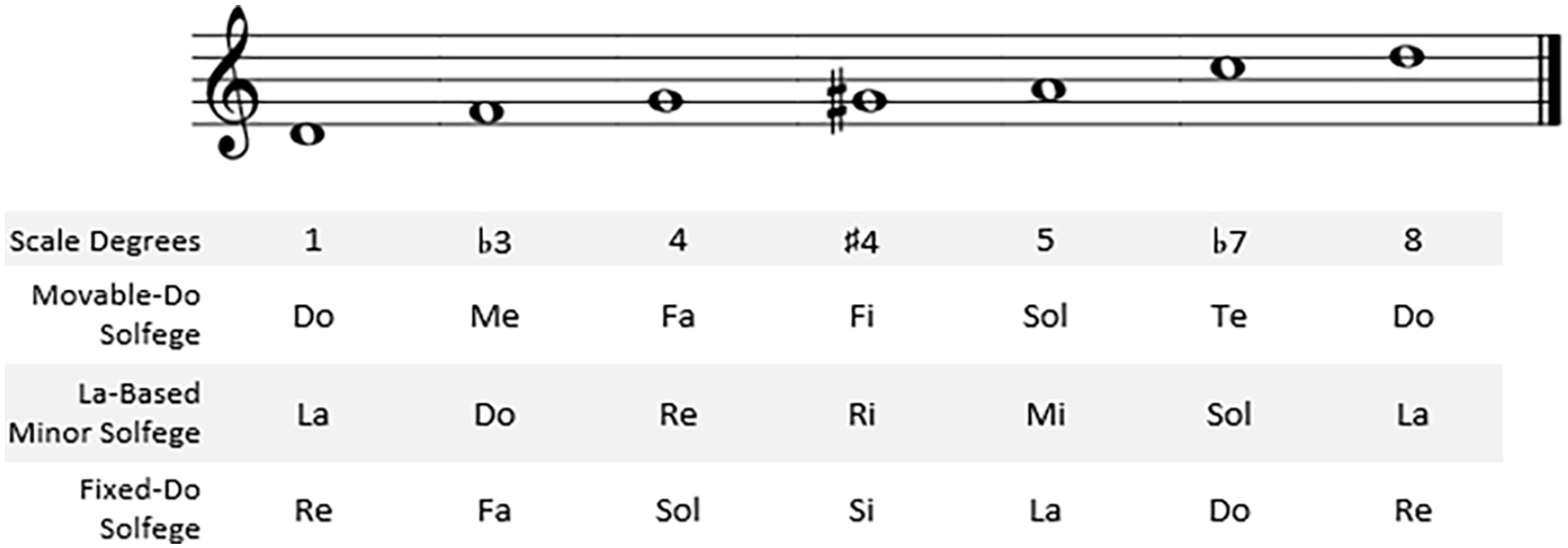
The D Blues Scale.
While repeating the scale for comfort and solidity, teachers can focus on its musical qualities. For instance, pay particular attention to the bluesy qualities of the scale: the lowered third, fifth (raised fourth, as notated here enharmonically), and seventh. When singing or playing a nonkeyboard instrument, these “bent pitches” should be performed slightly lower than in the tempered scale. Aural skills can be honed with this work and translate to other musical genres with an improved sense of pitch.
Vocalists can also perform this scale on scat syllables once they are comfortable. Scat syllables are made-up nonsense syllables that are common to one’s native language. Common English scat syllables include “doh, meh, ba, la, doo, bee” and the like (e.g., see Figure 2). Adding a dental “t” (a nonpercussive consonant) to the end of the above scat syllables closes off the sound and allows directors to practice jazz staccato or accented notation; “dot” is particularly common for this purpose. Teachers can vary the scat syllables they ask for each day as a fun way to work on various articulations.

Jazz Articulation Examples.
Jazz is known for its timbral effects—or manipulations to the quality of a sound—including glissandi (sliding between pitches), falls (sliding down after a given note), scoops (sliding up into the desired note), dips (hitting a note and then sliding a short way down and back up to it), and shakes (oscillating between the given pitch and the one above it). Students can have fun exploring these various effects while learning the blues scale (see Figure 2 for a short improvisatory example with timbral effects). While some of these effects require more rhythmic time to execute and can be added into improvisations later in this process, short glissandi, falls, and scoops can all be added to the scale itself. These effects again build a foundation for later improvisation and further jazz exploration.
Rhythmic qualities of jazz can also be taught while learning the blues scale. Begin teaching the scale in quarter notes and, once students are comfortable, progress to eighth notes. As the quicker pace becomes second nature, then ask students to swing. Swung eighth notes can either be taught by rote based on feel, or via a notated eighth-note triplet with the first two triplets tied (represented in Figure 3 as a quarter-eighth note triplet). When introducing swing first work with students on triplets in general, and then add the tie. It is common for students to rush when they first swing. Encourage them to “sit back” into the rhythm and delay the final note just a bit more than they may initially be inclined to do.
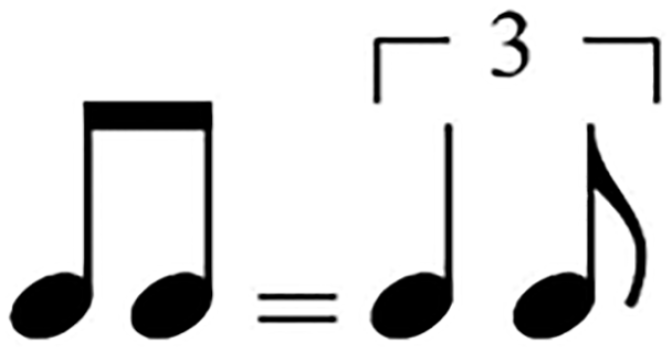
Swung Eighth Notes.
The final step in this rhythmic progression is to change the emphasis from the first eighth note (traditional in classical music) to the second eighth note when swinging. Teachers can use scat syllables for this work, speaking and singing “doo-ba” where the “ba” occurs on the second, shorter eighth that now receives the emphasis (e.g., see Figure 2). The open “ba” syllable lends itself to a louder sound than the closed “doo,” aiding students in the emphasis switch. A helpful tip is to point out to students that they need to deemphasize the “doo” and not simply sing or play all notes loudly. Incorporating swing into daily warm-ups allows students to work on their timing in multiple settings.
Step 2: The 12-Bar Blues Harmonic Progression
Now that the blues scale is thoroughly learned, students next need an accompaniment: the blues harmonic progression. The version shown in Figure 4 is common, although there are many variations of this basic progression (Gridley, 2012). Again, these chord changes can be transposed to any key to accommodate the desired vocal or instrumental range but are here shown in the key of D (Figure 4).
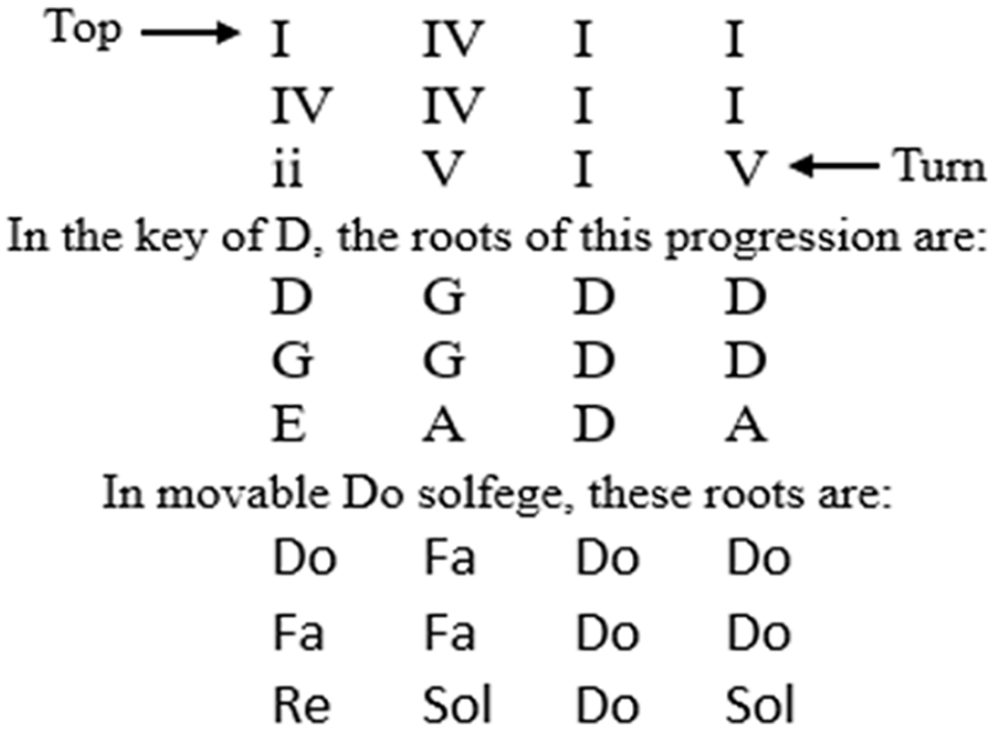
One Common Blues Progression.
When teaching beginning improvisation, older students may be concerned with wanting to sing or play “the right notes.” They often share a feeling of vulnerability in creating music on the spot without the security of a composer’s pitch notation. The blues scale and harmonic progression are perfect partners to allay this fear because the pitches of only one scale—the blues scale (in the same key as the progression)—can be used anywhere within the 12-bar blues as “correct” notes. This pairing can provide a sense of security for musicians of any level new to improvisation, from elementary students with barred instruments to high school students who proficiently read musical notation.
The blues progression also allows for exploration of other musical concepts, like chords, chord roots, and form. Begin by allowing students to listen to the progression many times without singing or playing along. The students work to hear the form of the progression and find the beginning, or “top,” of the sequence. The 12 measures can initially be tracked via each beat, with the goal that students can eventually hear the progression without counting and feel the “turn” that happens when the final V chord propels the progression back to its beginning I (see Figures 4 and 5). This is excellent aural training that even young musicians can develop. The ability to hear chord progressions is a necessary skill for advanced improvisation and can begin with this simpler form.
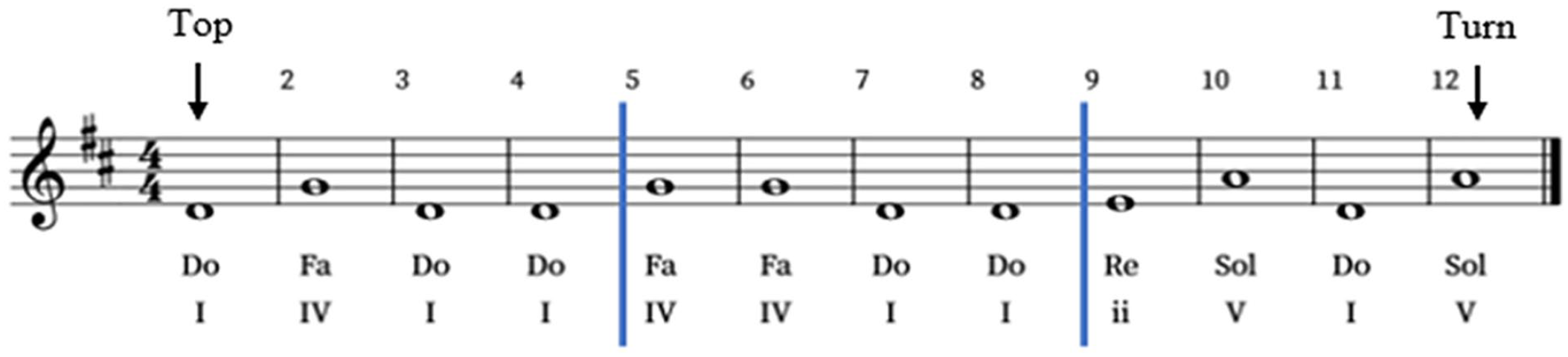
Blues Progression Root Notes in D.
Teachers can also explore the concept of chords and their roots within the context of the 12-bar blues. Jamey Aebersold’s (1988) book Blues in All Keys provides a “backing track” with piano, bass, and drums playing a slow, repeated blues progression over which students can practice. Students sing or play each chord’s root note with one whole note per measure of music using movable Do solfege to help solidify their sense of the key (see Figure 5 where each four-measure section is delineated with blue bar lines). This helps musicians develop their ear for the progression while following along and lays the groundwork for more advanced chord progressions in the future. If teachers have access to a jazz combo of any level, it is wonderful for students to be able to learn alongside a live jazz groove instead of playing with a recording.
Older students can now perform more complex harmonic content. Once comfortable with the roots of each measure, students can perform the full major or minor triad in each bar (see the first four bars of the progression represented in Figure 6). The ii triad in measure nine allows for musical contrast with the sound of a minor chord versus the other major ones. Advanced students can then progress to singing or playing the first five notes of the major or minor scale associated with each bar. Figure 7 shows Measures 9–12 of the progression in this style. These techniques again lay the foundation for further work on improvisation with more complex chord progressions where different scales are used in each measure.

Measures 1–4 of the Blues Progression With Notated Triads.

Measures 9–12 of the Blues Progression With the First Five Notes of Each Associated Scale Notated.
Step 3: Improvise
Now that students have learned the Blues Scales and are comfortable with the 12-bar blues harmonic progression, they are ready to put the two together and truly improvise. As this is often the most frightening step in improvisation—the initial foray—ask students to begin improvising rhythms by choosing only one note from the blues scale on which to sing or play. Encourage each musician to think of the variety of rhythms (and silences) they might employ with only one pitch and then model this creativity by trading patterns with them.
“Trading” twos, fours, or eights (or any even number of measures) is a technique by which two jazz musicians have an improvisatory “discussion.” The first improviser will sing or play for two bars, for example—often posing a musical “question”—and the second improviser will follow for another two bars in an answer. In the beginning, the teacher can be the first improviser and a student volunteer the second. Instructors can encourage the student’s improvisational ability by controlling the level of difficulty and new ideas presented with the “question.” After the class is more comfortable, a student can begin the improvisational exchange and the teacher can answer, progressing to two students exchanging improvisational ideas themselves without the instructor improvising at all.
There are so many musical concepts that students are exploring by trading lengths of improvisation. First, they are learning about musical phrases—the natural question and answer sequence presented in many musical forms. Students also learn advanced listening skills and work to respond in kind to the “questioning” improviser. Initially, pairs of students can be tempted to have two completely separate conversations. Encouraging them to listen and respond to the other’s “query,” with small modifications but the same basic musical ideas, hones their ears, and musical thought processes.
Once the class is comfortable improvising with one note, more pitches from the blues scale can be added, with an eventual progression to the entire set. Trading now naturally increases in complexity, and students can expand to trading four or eight measures as appropriate. In this intermediate stage educators can encourage students to explore longer notes, the different possibilities for the rhythmic placement and length of silence, and repeated rhythmic and melodic patterns.
Jazz musicians often gain inspiration from other artists and preexistent melodies can present fresh improvisational ideas. The entire class can learn the sample melodies presented by Jamey Aebersold (1988) as a part of his book Blues in All Keys that are suitable for any voice or instrument range. Recordings are also a rich source of improvisational learning. Blues tunes like “Route 66” or the “St. Louis Blues” have been recorded multiple times by any number of famous jazz musicians that can serve as models at this stage and as improvisational skills progress.
Step 4: Exploration
As students’ skills grow, more advanced musical concepts become available to them. One of the most important hallmarks of jazz is syncopation, an advanced rhythmic concept for most students. Students will see and hear syncopated melodies in the models presented above, so they can begin to practice and incorporate it into their own creative work. One technique for helping students feel syncopation is to throw a small ball (approximately the size of a tennis ball) on a nearby hard surface (like the floor) on the downbeat and catch it on the upbeat syncopated entrance. Whether imaginary or using an actual ball, this technique allows students to strongly feel the beat to which they must react for crisp syncopation.
Teachers can now also return to the timbral effects introduced when learning the blues scale and add more advanced effects to allow further work with pitch, rhythm, and articulation. A good list of timbral effects, their notation, and performance directions can be found in the work of Richard Sussman and Michael Abene’s (2010) Jazz Composition and Arranging in the Digital Age (pp. 151–152). This text also mentions a new timbral effect commonly heard in both instrumental and vocal jazz: the “ghost note.” This is a pitch that is barely heard and expressed vocally as a hummed “n” sound (notated with an “x” notehead in Figure 8).
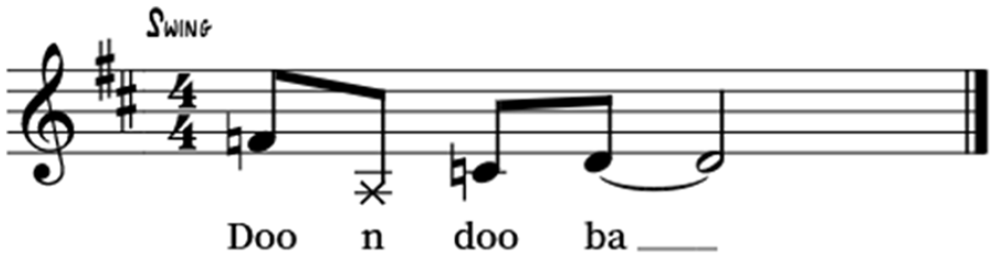
A Ghost Note.
Besides adding rhythmic and timbral effects, more advanced students can also begin to experiment with pitches outside of the blues scale. Passing tones can be used to quickly move between notes of the scale, allowing students more continuous musical thought. Using the blues harmonic progression, the full scale of each root note can be explored on the appropriate measures, setting the stage for improvising outside of the blues harmonic progression in other jazz standards. Jamey Aebersold is a prominent jazz educator whose series of books, like How to Play Jazz and Improvise (1992), Nothin’ but Blues (2015), Minor Blues in All Keys (1999b), and Millennium Blues (1999a), also come with “backing track” CDs. These texts provide an expanded repertoire of progressions in any key and a variety of styles, sample melodies, and further guidance on performing the blues.
Finally, this stage in jazz improvisation allows teachers to return to, and expand upon, the concepts of both scat syllables (for vocalists) and jazz articulation. Sample recordings from jazz vocalists are likely to include scat syllables and may provide an enhanced reference for improvisational singers. The above referenced list by Sussman and Abene also includes common jazz articulations, specifying how they are notated and performed. Both the teacher and students should feel safe to explore these advanced techniques knowing that any sound they do not like can provide a springboard leading to successful performance.
Step 5: Performance
One way to showcase this creative improvisatory work is by performing a completed blues piece in front of an audience. Blues repertoire exists at all skill levels, from unison or two-part music appropriate for elementary school students, to more advanced high school repertoire (Williams, 2021). Jazz uses a performer-centered aesthetic, which means that conductors and performers are encouraged to take creative license with the score. If a fully-notated piece does not have specific improvisatory choruses, feel free to add your own by repeating any 12-bar blues progression in the score without its notated melody part(s) as many times as you like to accommodate improvisation. If students are not comfortable improvising an entire blues chorus by themselves, they can trade twos or fours in a concert. Students can also improvise collectively. This style is one exhibited in early, New Orleans jazz with a trumpet playing a centrally pitched melody, a clarinet on high obbligato, and a trombone performing a lower harmony that students can imitate. Not only do students learn a new improvisational language, but they can also perform with increased confidence since no individual is improvising alone.
Combo instruments are also a typical addition to accompanied vocal jazz. If possible, a live jazz combo of piano, bass, and drums can add to any performance and the blues presents basic patterns for beginning instrumentalists. This might offer an opportunity for vocalists to collaborate with the local band, even with beginning students. Barred instruments can also create the 12-bar blues pattern without needing any written notation. The players can simply provide the roots (see Figure 5) or triads (see Figure 6; depending on skill level) of the progression while other students perform a preexistent melody and/or improvise above it.
New Experiences
Jazz improvisation allows advancement in a multitude of skills for students in any general music classroom while creating music in the moment. Improvisation presents the opportunity to grow in all elements of musicianship: melodic and harmonic skills, rhythmic confidence, aural skills, phrasing, and articulation. Personal advancement can be assessed as well, with students gaining skills in leadership, teamwork, self-confidence, and independence. Benefits are notable for the teacher while leading improvisatory exchanges. These new skills can then be performed live for an audience, demonstrating the creating strand of the national standards for administrators and the community. While the above elements are important, teaching jazz improvisation through the blues scale and progression most notably allows everyone to enjoy the experience of being creative within a safe context from which all musicians can grow!
Footnotes
Declaration of Conflicting Interests
The author(s) declared no potential conflicts of interest with respect to the research, authorship, and/or publication of this article.
Funding
The author(s) received no financial support for the research, authorship, and/or publication of this article.
