




Abstract
This article analyses a wartime feminist publication, Zhenskaia Pravda (Women's Truth), founded by the Feminist Anti-War Resistance shortly after Russia's full-scale invasion of Ukraine in 2022. We examine the publication as an activist do-it-yourself newspaper and a contemporary version of Soviet samizdat. We explore how, in its 41 issues, it speaks to the intended Russian female readers and, we suggest, invites them to take part in anti-war action. We show how Zhenskaia Pravda puts forward three main types of activist ‘selves’ to which readers can relate: a decolonial activist self, a dissident self and an everyday heroine self. By uncovering these selves, we expose conflicting representations of gender, coloniality and popular feminism, and suggest that Zhenskaia Pravda strategically combines these elements. We argue that it employs a flexible distribution format and ambiguous messaging to speak to diverse Russian audiences and to encourage anti-war resistance.
Zhenskaia Pravda (ZhP) was a newspaper created by Feminist Anti-War Resistance (FAR) movement activists shortly after Russia's full-scale invasion of Ukraine in 2022. Its aim was to distribute critical knowledge relating to the ongoing war to Russian citizens, and especially ordinary Russian women, as suggested by its title, ‘Women's Truth’. ZhP was published online in digital format, and could be printed by anyone as an analogue product to be distributed locally in various parts of Russia. During the first months following its inception, ZhP was issued as often as three times a month and disseminated via FAR's Telegram channel. Its last issue was published in 2024, shortly after FAR was designated an ‘undesirable organization’ by the Russian Ministry of Justice (OVD info, 2024). Following this, FAR activists removed the link to the ZhP archive from their online repository, allegedly so as not to incriminate and endanger themselves or any members of the community accessing ZhP there. However, links to the archive can still be found elsewhere online, illustrating the necessity for a wartime publication to be simultaneously hidden from public view and available as counter-media.
ZhP is designed to resemble a conventional regional newspaper in format, size and style when printed off (see Figure 1; see Perheentupa et al., Forthcoming 2026). Its appearance can be seen as an editorial tactic to subvert possible state surveillance. It is also strategically designed to safely reach certain audiences without putting off readers who might find radical content objectionable or dangerous (Perheentupa et al., Forthcoming 2026). Interestingly, ZhP makes no reference to feminism due to its highly ambivalent connotations in post-Soviet society (Miazhevich, 2025b). Nevertheless, ZhP's issues are often thematic, focusing, for example, on women's rights, abortion, gendered violence, or mobilization and how to avoid it.
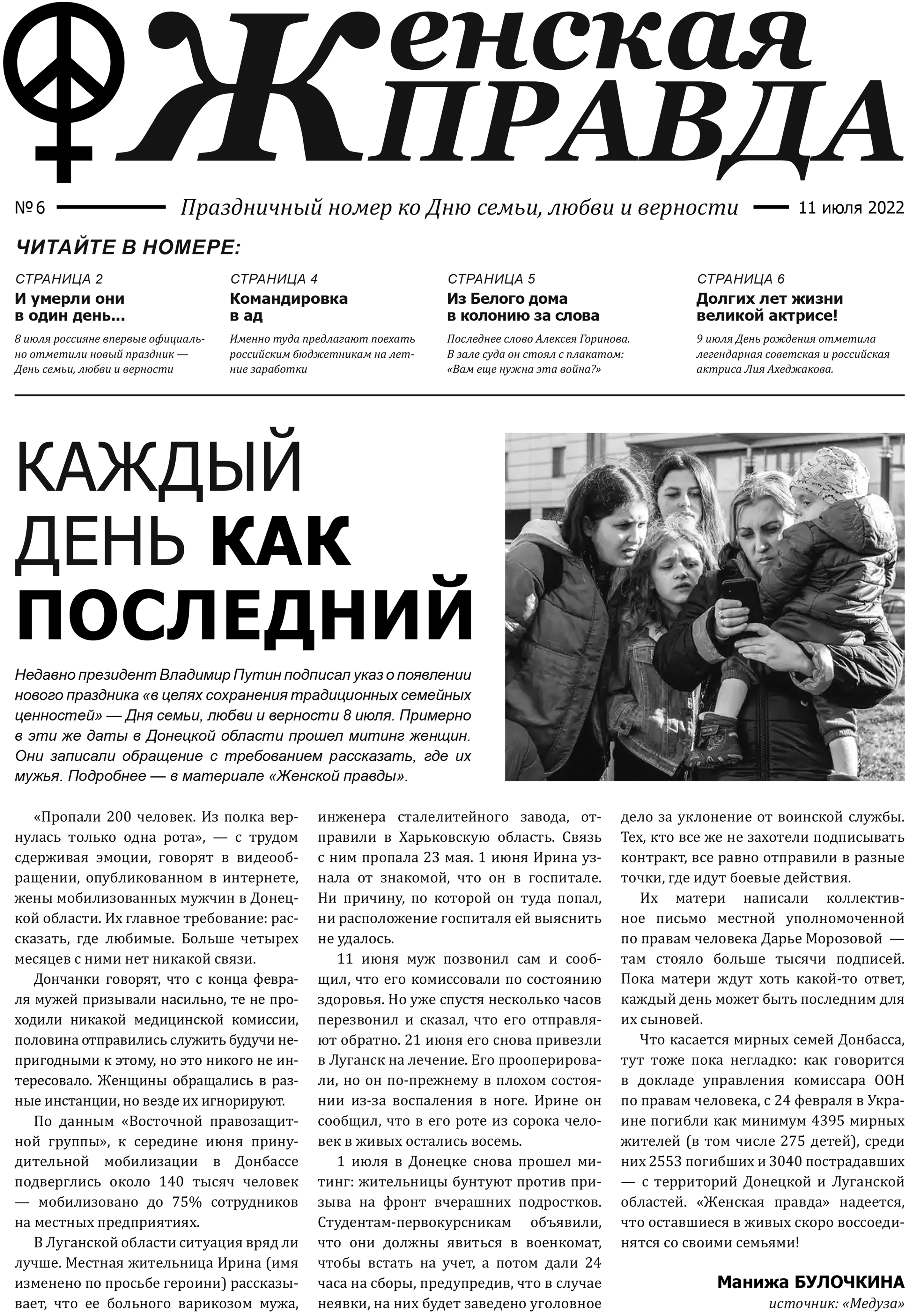
The cover of issue 6 of Zhenskaia Pravda illustrates the way Zhenskaia Pravda resembles a regional newspaper rather than an openly feminist activist publication. The main article is titled ‘Everyday is like the last one’.
In this article, we examine ZhP as a contemporary version of Soviet samizdat (see Komaromi, 2022). Samizdat, a self-made analogue publication, was produced ‘underground’ under Soviet censorship to distribute alternative and forbidden knowledge (Komaromi, 2022; see also Glanc, 2018). ZhP functions within a contemporary hybrid mediascape that combines traditional and online media platforms, and thus represents a revamped version of samizdat. Our focus here is on tracing how ZhP reaches out to a diverse Russian audience in a wartime authoritarian context with its intensified post-2022 media censorship. More specifically, we ask (i) what type of anti-war action and related selves are constructed in ZhP, and how do they relate to the samizdat tradition and contemporary feminist sensibilities, (ii) how does the wartime Russian context of censorship affect the editorial choices of the publication's activist editors, and (iii) what does this say of the ways in which do-it-yourself (DIY) activist publications and activists must manoeuvre in repressive contexts?
We argue that ZhP and its contents invite readers to take anti-war action by (1) raising awareness, (2) advocating anti-war action and (3) suggesting solo action due to the challenging wartime context. We explore these suggested dimensions through three DIY activist selves to which ZhP speaks, namely the Soviet dissident, decolonial activist and everyday heroine selves. These selves and subjectivities are both emerging and recycled. First, in drawing on the Soviet samizdat tradition, ZhP editors revive the ‘
By identifying suggested DIY anti-war actions and the three selves, we illustrate how ZhP's editors draw flexibly on elements of Soviet alternative cultural history as well as contemporary feminist and activist media sensibilities, such as intersectionality, decoloniality and the economy of visibility. Our investigation of these selves highlights the challenging editorial terrain, as ZhP's editors engage in somewhat ambivalent and inconsistent communication by bringing together essentialist, anti-essentialist, decolonial and at times even racist elements. Moreover, they contradictorily simultaneously suggest camouflaged and highly visible anti-war actions. This ambivalence, we argue, is partly strategic, as the editors’ aim is to deliver critical anti-war messages to a wide public of differently positioned women, and to engage them in anti-war action, while simultaneously keeping everyone safe. These strategies of ambivalence and flexibility can be treated as a manifestation of activism in a repressive context.
In this article, we start by placing ZhP within Russia's wartime media ecology. We then position it in relation to the Soviet samizdat and especially feminist samizdat tradition, while suggesting that ZhP combines elements from both Soviet alternative cultural history and contemporary popular feminist, intersectional and decolonial sensibilities. This is followed by our analysis of the three identified DIY activist selves and their inherent paradoxes.
ZhP and the changing Russian wartime media sphere
Feminist Anti-War Resistance (FAR) activism takes place both within and outside Russia. However, Zhenskaia Pravda (ZhP) was targeted mainly at ordinary Russians residing in the country. It was just one of FAR's numerous initiatives. ZhP's editors comprised activists and volunteers from a relatively independent cell within the horizontal FAR network. For safety reasons, the production team behind ZhP was decentralized and anonymous, as they operated in a context of wartime censorship and repression. Whilst no reliable distribution statistics are available, interviews with FAR activists 1 show that ZhP is deemed by FAR activists to have been one of the movement's successes. FAR see their publishing activity as countering the state propaganda and ‘information siege’ (infoblokada) by providing fact-based information regarding the war and its consequences for the public.
To understand ZhP as part of wartime information activism, one needs to account for the transformation of Russian media prior to and post February 2022. Previously, Russia was an ‘information autocracy’ (Guriev and Treisman, 2022) with a focus on media manipulation, influencing both domestic and international audiences via information dissemination, and gradually evolving control over the state and alternative media (Miazhevich, 2022). From the start of Russia's full-scale invasion of Ukraine in 2022, the Russian media sphere was marked by a rapidly increased censorship, stricter control over the trans/national information flows (e.g. the term ‘war’ is prohibited, and Western-based platforms Facebook and Instagram banned) and mainstreaming of an ‘us vs them’ narrative in the state media (Hutchings et al., 2024). Propaganda is not only disseminated through news content but also implemented as ‘agitainment’, that is, propaganda content packaged as entertainment (Tolz and Teper, 2018) typical of state TV, which is still popular among a significant part of the Russian population. Despite these measures, the porous online sphere allows for some resistance to the state-dominated information field.
As Perheentupa et al. demonstrate (forthcoming, 2026), ZhP's production team is aware of this transformed Russian media landscape, as its content mimics the state narratives and its packaging borrows, among other things, from a familiar print media format of a ‘regional newspaper’ (raionka), as well as newer formats based on digital media. Its title, ‘Zhenskaia Pravda’, translates as ‘Women's Truth’ and plays on similarity to the Soviet newspaper Pravda, a well-known state propaganda outlet. By visually mimicking a conventional ‘raionka’ set-up, ZhP avoids, at least in its analogue format, publicly declaring itself to be a product of counterculture, thus reaching out to older and ordinary Russian audiences beyond activist groups and feminist circles (see Perheentupa et al., Forthcoming 2026). This strategy echoes the path of covert rather than overt forms of activism chosen by activists even before the full-scale invasion due to the harsh socio-political settings (Perheentupa, 2022; Olimpieva, 2024).
To navigate an increasingly repressive authoritarian wartime context, ZhP's editors must, among other things, avoid certain terminology, such as the term ‘war’, using the word ‘Tragedy’ as a euphemism, and advocate mundane everyday resistance such as formal complaints procedures against mobilizations rather than more radical protest actions. This shows how activists need to take increasingly cautious measures to protect themselves as well as other individuals engaged in anti-war activities.
Although ZhP does not feature in FAR's centralized repository, it can be accessed via other platforms 2 and Telegram. The rhizomatic nature of digital media allows for such DIY-produced objects to exist in an increasingly restricted mediascape. ZhP issues might thus be overlooked (e.g. a crude filtering might not pick up on a PDF file) or seem harmless, as ZhP does not use terms that might potentially ‘flag up’ issues. Furthermore, issues previously communicated to other members or volunteers might then have been re-mediated further, constituting an ‘instant’ individual archive. Even if the ‘institutionalized’ archive of ZhP is made unavailable, it remains a ‘living’ archive elsewhere. Thus, the ZhP collection endures over time due to decentralized printing and the multitude of online ‘shelving’ archiving tactics.
ZhP as a revamped version of Soviet samizdat
ZhP is a revamped version of the Soviet samizdat format, flexibly combining contemporary elements such as digital production and popular feminist sensibilities with the analogue and underground ethos of the historical underground publication tradition and related ‘alternative culture’ references. The Soviet samizdat tradition is an important frame of reference for FAR activists, as they label ZhP an ‘anti-war samizdat newspaper’ (antivoennaia samizdat gazeta) on their Telegram channel. However, ZhP's analogue version, which anyone can print from an online source, does not openly refer to the samizdat tradition. This suggests that intended readers 3 of the paper version (ordinary Russian women) are assumed to represent a different group from digital readers (i.e. potential activists), and this assumption leads to different messaging for these two partially differing audiences.
The DIY ethos is typical of samizdat, as well as the western feminist zine tradition (Reynolds, 2020; Vasiakina et al., 2020), which also offers an important point of reference to ZhP as a contemporary popular activist media format. The terms ‘sam’ and ‘izdat’ refer to the self and publishing. Typical of samizdat, the FAR activist community takes the roles of producing, editing and distributing ZhP itself. Like its historical predecessors, ZhP is also produced to offer alternative readings and views to its intended readership, potentially stimulating their political imagination in a context of limited access to information other than state propaganda.
During Soviet times, samizdats were distributed from hand to hand (iz ruk v ruki), or from kitchen to kitchen, to provide information forbidden by the Soviet state. The term samizdat refers to the versatile range of low-tech, self-published print products circulating among Soviet dissidents in either handwritten or (more often) self-typed format (Glanc, 2018; Komaromi, 2022). Political samizdat, which became prominent only in the last decades of the Soviet Union, included pamphlets, news bulletins and recordings of political prisoners’ court hearings (Komaromi, 2022; Oushakine, 2001).
In referencing ZhP as a samizdat, FAR activists refer to an understanding of samizdat as a cultural and material resource that took root in a totalitarian environment lacking political rights and freedom of expression and with strict limitations on free circulation of information (Glanc, 2018). At the same time, FAR is repurposing samizdat in a new, fundamentally different way from the late Soviet print culture in the context of digital media, which is by default a decentralizing system of communication. ZhP seems to flexibly take the best of both analogue and digital worlds to enable swift and safe distribution to various audiences living in different parts of the Russian Federation. Moreover, ZhP draws from both Soviet dissident and feminist traditions, but combines them with contemporary feminist sensibilities, such as intersectionality, decoloniality and popular feminism, albeit often in a paradoxical manner.
Indeed, feminism and the samizdat tradition share a history. The first feminist samizdat was published in 1979, when a group of dissident women came together to make a samizdat entitled Woman and Russia, which later, having ended up in the hands of the Soviet secret service, led to the deportation of its creators in 1980 (Ruthchild, 1983; Vasiakina et al., 2020). This feminist almanac assumed the role of widening the worldview of its readers, Soviet women, and giving voice to different women around the Soviet Union. The format and content of Woman and Russia was unrestricted, and consisted of poetry, essay, texts on philosophical and socio-political topics, short stories, letters, and an interview about prison. Key themes included motherhood and childhood, centering on the female experience. The main emphasis, however, was on creative self-realization (Nizhnik, 2020: 36). Following their deportation, the authors of Woman and Russia split owing to differing approaches to feminism, and began to publish two separate samizdat: Woman and Earth and Maria. While Maria focused on discovering the Russian feminine essence in dialogue with religious aspects, Woman and Earth turned towards a more Western form of feminism (Ruthchild, 1983: 7; Smirno, 2020: 47–8).
While creative self-realization, typical of the feminist samizdat tradition, appears important in the context of ZhP, it takes new forms. Mimicking a traditional newspaper, ZhP's creativity lies in subversive messaging, such as inviting the audience to evoke the Soviet tactic of ‘reading between the lines’. It lies also in mundane factual reporting (factual dissent), which can dispel the dominant state narrative or list possible interventions without being obvious or propagandistic about them. Moreover, as our analysis will show, both a more essentialist reading of gender and counter-essentialist ideas of gender are present in ZhP, just like they were articulated by Soviet feminists, also causing their split.
In addition to capitalizing on the samizdat legacy, ZhP also draws inspiration from contemporary feminist sensibilities. The present-day samizdat can be seen as increasingly turning from ‘resistive texts’ to adopting dominant media discourses (e.g. Kempson, 2015, Tong, 2020) or, as we show, blending together elements of both worlds. While challenging hegemonic patriarchal norms, it also increasingly becomes a popular feminist product that reinforces individualistic empowerment and encourages engagement with visibility to become a recognized Self (see Banet-Weiser et al., 2019; Gill, 2007). Popular feminism, as defined by Banet-Weiser (2018: 11–16), focuses on media expression and circulation, and is defined by visibility, which ‘has to be in constant state of growth’. Such logic, it has been pointed out, threatens to depoliticize feminist efforts, although we suggest that it is deployed strategically by ZhP's editors.
Finally, individual empowerment as the central logic of popular feminism, enabled by the neoliberal capitalist context and digital media affordances, is predominantly concerned with white and heterosexual women in privileged positions (Banet-Weiser, 2018). By using specific aspects of intersectionality, ZhP challenges the normative assumptions of popular feminism and constructs a decolonial narrative, giving voice to previously underrepresented and now wartime-exploited ethnicities. However, as our analysis shows, ZhP's strategy here is partial and ambivalent.
Countering propaganda and introducing the decolonial activist self
The key task of ZhP, we suggest, is to produce a counter-narrative to Russian state propaganda and to provide readers with alternative information about the ongoing war. Activism often takes place around production and distribution of alternative viewpoints. However, such information activism and awareness-raising are dangerous in the wartime mediascape.
ZhP foregrounds two types of subjectivities regarding counter-narratives and their possible recipients. The first is an active figure who seeks knowledge, based on which they may take anti-war action, and the second is a passive ‘zombie’ type who consumes state propaganda and does not question the official ‘truth’. Humour is deployed as a tactic to talk about this latter, ignorant and indifferent figure. For instance, a joke (issue 6, last page) describes that ‘A son calls mother, saying that he has been taken to the war, to which the mother replies: “It cannot be, as they just reported on television that I only have a daughter”’. This joke picks on the excessive nature of Russian state propaganda to the extent that one might deny the existence of a son – if one chooses the path of ignorance and indoctrination.
An article entitled ‘The freeing of Bucha-one year on’ (issue 23, page 3), in turn, features a woman who has survived the atrocities in Bucha, Ukraine. She urges readers not to become zombies: ‘I do not believe that those Russians, who have turned into zombies due to the propaganda, will change. But I do believe that you – who form one percent – are the future of your country. Imagine the struggle (…) here, and this struggle is being fought with blood and pain… And the fact that you exist, that you are also fighting, is very important.’ Such direct address is a typical editorial tactic in ZhP, used to persuade the reader into becoming someone who is aware of the atrocities conducted by the Russian army, and thus dissenting against the regime.
One strategy to activate readers’ awareness is to speak to their sense of fairness by providing information on economic and legal issues. For example, an article ‘The price of priorities’ (issue 22, page 5) remarks that: ‘Every day of the Tragedy costs us dearly in every sense. Even in the most mundane sense: in a year our authorities spent more than one hundred billion dollars (that's about 8.6 trillion rubles). And what could have been done if they had invested this money in improving our own lives?’ This article appeals to both the political imagination and rationality of the reader, highlighting the state's skewed priorities in spending taxpayers’ money rather than improving the everyday lives of Russians.
Whereas ZhP can be seen as debunking state propaganda, in some instances, the authors themselves fabricate knowledge. This becomes evident, in particular, through the fictional names and ironic identities of the articles’ authors, which, on closer reading, reveal a story of their own. Authors’ names like ‘White Rose’, ‘Maria Flower’, ‘Manizha Bun’ and ‘Sofiia Pineapple’ appear more like characters in fairytales than names of actual journalists. It anonymizes and protects the paper's activist editors, and simultaneously adds an imaginative layer to ZhP's counter-narrative. In fact, by using provocative fairytale-like names, the ZhP editors seem to engage in counterpropaganda and play with the category of propaganda to make it more visible to the intended reader (also analyzed in Perheentupa et al., Forthcoming 2026). Indeed, even the title, Women's Truth, implies that truths may vary, and one must then choose one's own. This is one of the elements illustrating the creative play in which the editors engage, but also reflecting the necessity to keep safe in Russia's censored mediascape.
Another tactic of ZhP is to talk about the current war indirectly through history and earlier wars, such as the Great Patriotic War (WWII) and its legacy, and how, for example, the Soviet Union often disregarded its citizens and their best interests while celebrating war victories (e.g. issue 25, page 5). At the same time, insights into the actions of (often female) historical figures offer a resource on types of available action. Perhaps the most radical example is provided by Sof’ja Perovskaia, who took part in the assassination of Tsar Alexander II in 1879 (issue 26, page 6) and was part of the People's Will (Narodnaia Volia), a movement that aimed to take power to the ordinary people and democratize Russia, although through extreme measures. However, most examples are more recent and chosen from the Soviet period. For example, in many instances ZhP recirculates the figure of the Soviet dissident, also known as the creator of historical samizdat, a subjectivity we explore more closely in the next section.
In addition to the dissident figure, another key identity suggested on the pages of ZhP is what we call a ‘decolonial activist self’. This self of a DIY activist is concerned about the war but also displays an awareness of Russian coloniality and related othering, as in the following quote (issue 21, page 4) signed by a group of women living in the Russian Federation but representing various ethnicities: We are women from different Republics of the Russian Federation. We face not only various forms of gender oppression, but also racial discrimination and xenophobia. Many of us have been deprived of the opportunity to study and preserve our culture and language due to pressure from the Russian authorities and the uncompromising policy of Russification. (…) Our cultures and ourselves are presented as different, alien, but we are the same people whose ancestors lived on their lands thousands of years ago, before the beginning of Russia's expansion.
The decolonial approach combines an anti-war perspective with a critique of xenophobia in Russia, highlighting how different ethnic groups have been historically discriminated against in Russia. In another instance (issue 20, page 7), a founder of the NGO ‘Buryats against the war’ talks about fighting war propaganda, but also xenophobia and how national minorities are treated in Russia, thus bringing into the limelight Russia's colonial legacies and how they are continued in the context of the current war: We are against the war against Ukraine. We are for the residents of Buryatia to be able to find a decent job in the Republic and not go there because of poverty to kill other people under contract. They are thrown as ‘cannon fodder’ because the state does not feel sorry for them. When war crimes become known, like in Bucha, then the Buryats are again blamed, because they are ‘savages’. We will fight the xenophobia that permeates Russian society.
This article exposes double standards in the treatment of national minorities and replication of these inequalities on the front lines, where Buryats are overrepresented as soldiers who must die for the cause of a titular nation that has discriminated against them for centuries. Several other articles (e.g. issue 20, page 7) likewise portray Chechen, Tuvian and other female ethnic individuals taking anti-war action, and often combine their messages about war with a decolonial sensibility. According to Madina Tlostanova (2012: 133), decoloniality is about actively dismantling the colonial matrix of power and binary logic of modernity/coloniality, and hierarchies and world orders based on western thinking and epistemics. Tlostanova (2012: 136) shows how Russia itself has embodied a special place in the colonial world order, as it has, while appropriating western orientalism, itself been orientalized and mythified by the western world.
Decolonial perspectives have emerged as part of feminist and other anti-war protests in Russia following the annexation of Crimea in 2014, although not all anti-war protests acknowledge such issues (Bygnes, 2025; Rossman et al., 2024). Moreover, decoloniality is sometimes used to emphasize Russia's otherness in relation to the West, thus ignoring its own role as a colonizer (Solovey, 2023). However, Russian feminists have increasingly recognized the power dynamics of Russia as an empire, an awareness that has been manifested in their activism (Rossman et al., 2024: 148–9).
While FAR itself is known for having a decolonial activist branch that engages critically with issues of coloniality, ZhP's approach to coloniality follows a different and more ambivalent logic. On the one hand, it often takes the perspective of ethnic minorities, thus applying an anti-colonial frame to its war-related counter-narrative. ZhP has published special issues in Buryat (October 18, 2023) and Tuvin languages (December 1, 2022), in order to focus on these perspectives in particular, thus giving voice to and carving out space for marginalized ethnic groups in Russia in their own language. On the other hand, the reporting highlights sustained coloniality, as a special issue on Belarus is written in Russian rather than Belarusian language. Furthermore, certain reflections on intersectionality are still conducted by white women and partially from an imperial centre's perspective, for example, in the form of racist jokes. In this case Buryats’ facial appearance, which differs from Slavic features, becomes the pun of the anecdote (see issue 4, last page). Indeed, while there clearly is a decolonial activist self-frame in ZhP, it is one of contradiction and is marked by a certain lack of reflexivity by the editorial team. We contend that this ambiguity reflects the diversity of the editors and their views, as some may be more aware of issues of decoloniality than others. However, it also relates to strategic interweaving of different views to ‘talk to’ a diverse domestic audience.
Encouraging life-protecting action and recirculating the dissident(ka)
In addition to raising awareness, ZhP strives to persuade readers to take anti-war action. These forms of action vary on a scale from ‘small’ acts, such as signing petitions or expressing support for those under house arrest or jailed for their anti-war action, to more substantial contentious actions, such as volunteering on the Ukraine border or street activism. Even if ZhP's readers cannot or do not want to engage in this range of actions, they can become DIY-activists through simple (although risky) acts of distributing ZhP, by first printing it out and then distributing it to mailboxes in their own regions.
To illustrate ZhP's coverage within this theme, we start with an article in issue 20 (page 6) that introduces the story of Svetlana from St Petersburg. Having previously worked as head of a health centre, Svetlana now devotes her life to helping refugees from Ukraine. Svetlana's example introduces the reader to manageable ways of advancing peace and being on the side of ‘good’. In many cases, the articles are written in the first person, which creates a sense of intimacy and dialogue between readers and the article's main characters. Such features reflect the Woman and Russia feminist samizdat tradition by bringing forth views on different female lives across the country.
While zooming in on different and ethnically diverse women across the Russian Federation and portraying the variety of anti-war activities in which they engage, ZhP often ends up emphasizing their role as life protectors. The article ‘Choice according to the heart’ (issue 20, page 3) suggests that one can protect life in different ways: ‘Some work as doctors, others in the Ministry of Emergency Situations. And one Russian woman from a small Russian city saved people's lives by being… a drone operator. She anonymously told “Zhenskaya Pravda” how it happened’. Paradoxically, these specialists may be not only saving lives, but also inflicting damage and causing loss (drone operators), but this is not reflected in the article (issue 20, page 3).
In suggesting different types of anti-war action, ZhP also recirculates the historical figure of the Soviet dissident. Indeed, the ‘Soviet dissident figure’ inspires readers to distribute ZhP in a fashion similar to how Soviet dissidents distributed underground publications from hand to hand under Soviet censorship (Komaromi, 2022). This informs the past–present continuum constituting a vital part of ZhP's DIY activist efforts. The reader can relate to the Soviet dissident culture through various stories of historical dissident figures covered by ZhP. These include, for example, ‘The grandmother of Russian democracy’, a story about Marina Sal’e, an activist and leader of democratic organizations and movements in the 1990s who investigated corruption schemes and was exiled as a result (issue 39, page 6). Another prominent example is a story about Soviet lawyer and dissident Elena Bonner (A. Sakharov's wife, issue 31, page 5).
However, curiously, in introducing the dissident figure as an inspiration for anti-war action, ZhP ends up re-circulating traditional gender roles. For instance, the final issue 41 (front-page article ‘Fighting to get old together’ continued on pages 4–5) is dedicated to opposition leader Vladimir Kara-Murza, featuring an extensive interview with his wife Evgeniia Kara-Murza. Contrary to the examples above, this article resorts to a highly patriarchal gender representation of a modern Russian dissident family, as Evgeniia says that she will ‘continue Volodya's work and will do it for as long as necessary’ (i.e. until his release, which occurred in a prisoner swap in summer 2024), and thus presents herself as a ‘support’ and ‘substitute’ for the leading male opposition figure. She also adopts a very traditional role in envisioning their retirement: ‘I imagine pictures of him being a grandfather, writing his memories, smoking a pipe, and I will be next to him knitting socks for my grandchildren. This is my ideal in 30–40 years.’ Such articles evoke not only the dissident tradition, but also the essentialist gendered implications of this tradition (see Lipovetsky, 2013). The wife here is portrayed as standing by her husband's side without claiming any active political role. In the case of Julia Naval’naia, this ‘traditional’ background role (issue 37) changed when Alexey Navalny died in prison camp: Julia became the protector of his legacy and commenced her political engagement. Such portrayals outline a variety of forms and experiences of activism, and (for a certain readership) signal that women should only play a full role in dissidence and become dissidentka (the ka end to dissident refers to female dissidents in Russia) if their spouses are no longer able to do so.
Indeed, the examples above suggest that ZhP's relationship to gender, like its relationship to coloniality, is ambivalent and at times paradoxical. While FAR itself criticizes essentialist gender ideas, ZhP has its own logic, which also engages with the popularity of maternalism among ordinary Russian women who might oppose the war but still relate to traditional gender roles. In relation to this, Gradskova (2023: 7) observes how maternalism has been deployed by the Russian state as one form of preparation for the current war. This maternalism has highlighted the centrality of the family in society and has made many women support traditional values with their patriotic and nationalist components (Gradskova, 2023). Thus, while the anti-war movement in Russia has a feminine face, among those opposing it are both women engaged with more essentialist views on gender, and those with more subversive approaches (Kuteleva, 2025: 142). In this way, ZhP is simultaneously doing and undoing gender, just like the women engaging in anti-war action interviewed by Kuteleva (2025: 130).
Celebrating everyday heroines who take anti-war action alone
Our analysis brings us to the last set of subjectivities, which informed the title of our article. A front-cover article (issue 27) about 26-year-old Viktoria is emblematic of war-related DIY activism in an authoritarian setting. The title ‘One is not a warrior at the battlefield’ (‘Odna v pole ne voin’) refers to a well-known Russian saying with one exception. It substitutes a male for female gender, thus reversing traditional gender roles. Viktoria participates in a single-woman anti-war picket on the streets of her hometown. Single-person pickets are the most prevalent form of street protest in contemporary Russia, as organizing larger protests is forbidden by law. However, the focus on a single-person-picket turns the activist into a lonely, atomized protester, rather than someone expressing contention collectively. As if to highlight the lonely task of being an anti-war activist in contemporary Russia, many ZhP articles feature individuals acting against the regime. Paradoxically, this (a)lone action aligns with the popular feminist logic of media attention focusing on individual (empowered) women rather than engaging women in a collective struggle to drive social change (Banet-Weiser, 2018). However, we argue that ZhP engages with popular feminist elements partially as a strategy related to the wartime media ecology.
In order to amplify its anti-war messaging, ZhP frequently resorts to a popular feminist sensibility by narrating the cases of individual activists’ pickets and demonstrations. Occasionally, it draws on popular feminist sensibility with the help of celebrity figures. An emblematic case here is cult pop singer Alla Pugacheva, who has publicly expressed her anti-war positionality. Interestingly, several ZhP issues (issue 20, page 8; issue 39, page 6; issue 16, pages 2, 4; issue 11, page 6) refer to Pugacheva on various occasions. ZhP uses her celebrity role not only to bring facts about the war to its readers, but also to convey its anti-war stance using Pugacheva's socio-cultural leverage, as the singer and her songs are well-known and appreciated. Thereby ZhP strives to capitalize on the figure of celebrity as an incarnation of ‘moral authority’ for many Russians (Miazhevich, 2025a). This concerns especially the more mature demographic group of above 40 years old, for whom Pugacheva represents a beloved cult figure who now also acts as mediator of anti-war public sentiment.
For example, an article ‘Do not joke with Prima Donna!’ discusses Pugacheva's anti-war positionality. The style of the article mimics the ‘light style’ of popular tabloid media and women's magazines by talking about ‘our Alla’, while at the same time addressing a contentious issue of dissent. The article reports on how Pugacheva made an Instagram statement asking to be labelled ‘a foreign agent’ like her husband, popular comedian Maksim Galkin. Moreover, her standpoint is further celebrated by documenting how Pugacheva responded to online criticism following that statement: ‘What a blessing that I am hated by those people whom I have always been unable to stand. If they liked me, it would mean that I sang and lived in vain’ (issue 20, page 8). This quote is followed by ZhP's assertive praise of Pugacheva's optionality and womanhood, acknowledging that Pugacheva is not afraid of being disliked due to her political views: ‘This is what she is like – our woman, who not only sings, but is also ready to take a hit’ (issue 20, page 8).
Nevertheless, ZhP ensures that ordinary women can also feel like and indeed become celebrity-like heroines if they take anti-war action or challenge state propaganda. An article using the Soviet shaming label ‘Enemies of the people’ in its title (issue 16, pages 4–5) brings various figures – both celebrities and ordinary women – together by highlighting their personal stories of resistance. Other specific cases include a mother of many children (‘Penalty for courage’, issue 40, page 5), and Lena and her daughter Varia (‘Family values: How parents and their children are persecuted’, issue 23, page 5), who is only 11 years old but had to deal with the police for her dissenting views on patriotic teaching in schools. Such articles send a message of how ordinary people, too, can become heroines if they are courageous and take anti-war action. However, it appears that such actions are more valuable if they are more visible. ZhP itself offers a platform for this by making some acts or activists more visible than others. A similar logic of activists becoming celebrities through digital and social media visibility was detected in Russian feminist activism prior to the full-scale invasion (Perheentupa, 2022; Zhaivoronok, 2025). This resonates with the wider trend of visibility increasingly becoming a key resource in digital popular feminism (Banet-Weiser, 2018; Ratilainen et al., 2026).
The way in which ZhP often pays attention to selected celebrities or heroines illustrates how it engages with the economy of visibility (Banet-Weiser, 2018). Here, we argue that the highly individualized and profit-driven celebrity culture is deployed by ZhP in order to inform unpaid activism and (eventually) collective resistance. The editors are aware of the tension between popular feminist engagements and their aim to raise awareness and anti-war action. We suggest that here popular feminism becomes a strategy to convince individual readers to take (potentially collective) anti-war action. Such agitainment to anti-war actions can also be observed in dialogue with the content of Russian state war propaganda packaged as entertainment (Tolz and Teper, 2018), the difference being that although ZhP draws from popular entertainment, it combines it with the suggestion to resist and counter-act. This is also echoed in how popular feminist elements are combined with critical views and commentaries, rather than aiming to please everyone, as the case of Pugacheva shows (cf. Miazhevich, 2025a; Ratilainen et al., 2026) . Indeed, such emotions run counter to the positive and non-confrontational tones mostly connected with popular feminism (Banet-Weiser, 2018: 15). ZhP plays with elements of popular feminism, but without totally giving in to its trivializing sensibility. This illustrates how popular feminist elements can be used creatively to alternative ends in the repressive wartime context: not to de-politicize, but to camouflage and enable anti-war resistance.
Moreover, despite ZhP's emphasis on individuals, there is an implied layer of collective unity beyond this apparent focus on individuals. For instance, an entry on picketing makes readers aware of the collective dimension, as behind the picketing individual is always a larger group of people who share the anti-war position. In the case of Viktoria (above), readers are told that she soon realized that people passing her by were expressing their support for her action, some even crying. She herself points out how she wants to provide an example for others of the possibility of speaking up and doing at least something, thus bringing about the possibility of a wider resisting collective. Another article (issue 22, page 2) portrays Nikita, living in Udmurtia, who invites an anti-war-inclined passer-by to hug him. This momentarily forms a group of two people, and if the hugs are many, grows into a wider group, even if just to hug.
However, while ZhP stimulates the political imagination of those living in wartime Russia by illustrating the many ways in which one can still express an anti-war positionality, its own imagination stops short of gazing beyond the global logic of popular feminism, which increasingly forces activists to strive above all for mediated visibility. This is paradoxical in the wartime context, where anonymity is at the same time necessary for safety.
Conclusion: blending paradoxical elements and the limits of DIY activism
In this article, we have argued that ZhP articulates three types of activist self-frames to which their readers can relate: the decolonial activist self, the dissident self and the everyday heroine self. By portraying such activist self-frames, ZhP informs and encourages readers’ engagement in anti-war action. The DIY nature of this activism presupposes that intended readers – ordinary women living in Russia – are likely to take anti-war action alone, based on knowledge and tips provided by ZhP. More specifically, ZhP invites DIY anti-war activism by (1) awareness raising, (2) suggesting different forms of anti-war action and (3) reminding readers that they should take action individually, as this is the safest form of action in authoritarian wartime Russia.
As we have shown, ZhP's messages are often paradoxical and ambivalent. First, while some articles entail a decolonial reading of the current war, other news entries may demonstrate less critical practices or even sustained coloniality. Second, ZhP's progressive views on gender co-exist with essentialist ideas, especially in connection with the Soviet figure of dissident(ka). Finally, while ZhP engages in anonymous production for safety reasons, it celebrates visibility by focusing on public figures like Alla Pugacheva and implying that anyone can become an everyday heroine by engaging in visible anti-war action. The publication does not reflect on the potential risks of such visibility, and tends to frame it along the lines of entrepreneurial agency, echoing popular feminism.
We argue that ZhP's strategy of combining apparently paradoxical elements aims to speak to a wider readership within the Russian war media ecology. Such engagement may, at least to some extent, be seen as a decolonial gesture. The outlet acknowledges the co-existence of binaries and conflicting decolonial views (Tlostanova, 2012), although its articulation of such views is somewhat incoherent, as our analysis demonstrates. Indeed, ZhP ‘celebrates complexity and multifacetedness’ of female anti-war positionalities (Kuteleva, 2025). This may also relate to the likelihood that the ZhP editorship comprises individuals from very different positions and backgrounds.
ZhP's inconsistent engagement with essentialist gender ideas echoes the Soviet feminist tradition and its split based on differing interpretations of womanhood and feminism. The publication foregrounds creative self-expression, like its predecessors the feminist samizdat editors, by flexibly combining historical and contemporary elements. Indeed, the current repressive wartime context warrants a particular focus on creativity. Here, ZhP's playful approaches mean that the texts are multilayered, with several possible ‘readings’ depending on readers’ competences. Creativity is also seen in the amalgamation of different cultural sources and media formats, including the novel combination of digital and analogue elements.
This hybrid format evokes a set of tensions between the samizdat tradition of private, secretive and analogue production, and the online version available digitally within a capitalist attention economy privileging visibility and speed. How ZhP repurposes samizdat within the hybrid mediascape and the repressive national context is riddled with tensions: the format still holds on to anonymity and secrecy connected with the repressive and authoritarian context, while simultaneously engaging with the economy of visibility (Banet-Weiser, 2018). The sam – ‘self’ in Russian – refers here not only to the independent DIY makers but also to the readers, who are invited to distribute the publication as well as taking other anti-war action in a highly challenging context.
Although we have argued that ZhP's engagement with celebrity and popular feminism are strategic, the publication cannot entirely escape the depoliticizing logic of popular feminist engagements. It fluctuates between reproducing political imaginaries grounded in the logic of media visibility and more radical examples of alternative imaginaries, drawing, among other things, from the Russian history of feminist resistance. Moreover, ZhP as a wartime media product itself seems to embody the paradox of contemporary anti-war activism, having to be simultaneously anonymous for safety but also striving for visibility at all costs. ZhP's content therefore highlights the vulnerability of the DIY activist and the ambivalence of engaging in such resistance in the first place, lacking support structures other than the virtual FAR collective. It demonstrates that all activists in Russia are, de facto, alone, and if something happens, they must deal with the consequences by themselves. This loneliness in connection with resistance means that, to some extent, all activists in present-day Russia are in fact DIY activists.
Footnotes
Acknowledgement
We wish to thank other members of the project ‘Mediated Feminism(s) in Contemporary Russia (FEMCORUS 2021–25)’, funded by the Research Council of Finland (Grant No. 341436). Moreover, we wish to thank the anonymous reviewers for their great comments, which helped us finalize the article and improve it significantly.

Funding
This article was written with the support of two Research Council of Finland grants: Grant Numbers 341436 and 363129.
Declaration of conflicting interests
The authors declared no potential conflicts of interest with respect to the research, authorship, and/or publication of this article.