



Abstract
South Korea demonstrated its ability to respond effectively with rapid policy measures and implementation in the early stages of the pandemic. However, at the end of second year of the pandemic, South Korea reached a peak in its number of daily new cases. Why didn’t South Korea maintain the initial successful performance? To answer the question, this study examined South Korea's pandemic response process through Complex Adaptive Systems (CAS), focusing on actors’ behavior according to the phase transition. We found that the South Korean government failed to interact with the rapidly evolving public due to the different evolving pace. Dissonance between the government and the public resulted in distrust, fatigue, and resistance to the government's policy among people. From the case study of South Korea, this study emphasizes that not only individual governments, but also the international community, should anticipate and interact with the rapidly evolving public to prepare for the pandemic and post-pandemic era.
Coronavirus disease (COVID-19) revealed the global lack of preparedness for mitigating the effects of a global pandemic. Because it has brought multi-layered effects on society, there is a limitation to the ability to control the pandemic only with national health policy. The impact of the disease has ripple effects in various fields such as economic, cultural, and security throughout the whole society. 1 Accordingly, the government has been called to provide a rapid reaction to the pandemic by devising effective policy actions and timely decision-making. Nevertheless, uncertainty of the pandemic, such as the unprecedented rapid spread that appeared in transnational society, the emergence of variant viruses, and the vaccine development, acted as a great barrier to the government's timely policy decision and implementation.
Despite the uncertainty of the pandemic, South Korea has demonstrated its ability to respond effectively with rapid measures and policy implementation in the early stages of COVID-19.2–4 South Korea had shown a rapid containment strategy by maintaining the level of the infected individuals at 0.02 percent in the initial stage. 5 Previous studies found that South Korea's effective initial response was achieved through the 3 T (test-trace-treat) strategy, epidemiologic field investigations through information communication technology, multiple public health measures, and public trust and participation.2–4,6,7
The mixture of socio-political governance and scientific and technological governance is considered a big success of South Korea's response to the pandemic. 8 However, in April 2022, South Korea recorded the highest number of daily new cases in the world. While existing studies mostly focused on the analysis of effective strategy and measures in the initial stage,6,7,9–11 we raised a question why the initial performance did not sustain during the two-year pandemic period. To explain the collaboration of policy, science, and society and the cause of the sudden change in South Korea's pandemic management, this study examined South Korea's pandemic response process through Complex Adaptive Systems (CAS). The CAS is especially a helpful tool to examine complex interactions of actors to respond to a social problem as an interactive framework. There has been a growing understanding that public health systems are embedded in CAS.12,13 Because a pandemic response is known to highly depend on an initial stage of social system, feedback loops, and interactions of actors, 14 the CAS especially provides useful guidance to understand the situation under the pandemic, where uncertainty increases and complex interactions exist.
This study, through the framework of CAS, focuses on changes in the interaction of actors, their adaptations, and evolving process according to phase transitions during the COVID-19 era. We found that the South Korean government failed to interact with the public when the phase transition with pandemic occurred. While the public promptly absorbed information from outside and evolved into the next phase, the government was a step behind by repeating previous successful measures. In the meantime, people's distrust and fatigue against the government's measures have been amplified. An abrupt change such as the pandemic brings a different transition and evolving process for each actor. This study disclosed that South Korea's pandemic policy had limitations in responding organically to evolving circumstances and actors due to lack of the government's evolving and adaptive strategy in the mid- and long-term perspective. However, this is not only a problem that the South Korean government encounters. Through the case of South Korea, we suggest that not only the individual government, but also the international community, should understand the pandemic response with the CAS framework so that we can prepare for the post-pandemic era. It is crucial for the authorities to expect and coordinate with rapidly evolving people and global circumstances.
Complex Adaptive Systems as Theoretical Framework
CAS and Health System
This article analyzes South Korea's response to the pandemic through the lens of a CAS. CAS theory is an analytical approach within the physical and natural sciences that has only recently begun to be applied to social and health research. It is rooted in the assumption that there are nonlinear or unpredictable types of systematic change. 13 CAS theory considers systems to be comprised of many interacting components, which generate significant changes that can occur across inter-connected political, social, economic, and technical systems in unexpected ways. 12 The public health system is not designed for simple health care service delivery but is conceptualized as a complex social system that involves multiple actors and components.12,15–17 Recent studies show a growing recognition that public health systems are embedded in CAS.12,13,17,18 Health systems that respond to various challenges such as infectious disease and noncommunicable disease are complex, as they are constrained by various socio-cultural contexts.
Phase Transition in CAS
CAS theory does not view a system as an unchanged or fixed device, but an evolving process. This is because interacting components have the ability to self-organize and adapt the system in response to their experiences. 12 Thus, when applying CAS theory, it is important to trace how the intrinsic features of a CAS emerged in the evolutionary process.
In the CAS theory, phase transition is one of the key concepts.13,19,20 It results in a shift of a path after a critical juncture in the context of path dependency. Although the critical juncture is widely understood as an abrupt shock, such as a war or natural disaster, Streeck and Thelen 21 introduced that gradual changes could also bring a phase transition. In either case, a phase transition reconstructs role of actors and strongly influences the way of interaction even if the transitioning process could be different. A phase transition induces and is induced by changes in connectivity of networks of randomly interacting variables. 22 The transition entails “a multitude of interactions in and between constellations”. 23 CAS stresses that actors evolve through feedback loops that reinforce a particular pattern in nonlinear way. In a society, they involve interactions among independent agents, relevant systems, and internal and external environments. However, during and after a transition, they are evolving through interacting with each other and entering into the next phase. By doing so, the whole society experiences profound changes in functioning.
However, the phase transition cannot occur simultaneously in all dimensions of society. Especially when the transition is abrupt and rapid from the external shock, actors may learn and adapt to the transition at different speeds. With an abrupt shock, actors may be given different amounts of information in a short period and have different levels of understanding. This difference affects the actors’ transitioning and evolving process in a nonlinear way. The more the shock is radical, the more likely that society will go through more severe conflict among actors. The conflict, oftentimes, may cause a failure of the system.
Phase Transition with Pandemic
The emergence of COVID-19 as a pandemic brought the whole society to a standstill due to its interconnected nature as a CAS. A pandemic can be understood as an exogenous shock leading to system change as well as behavior changes of actors. Not only in theory but also in reality, the pandemic causes a phase transition by showing how a sudden change can destabilize the system that entails various actors and their interactions. 14 With the transition, as heightened uncertainty and volatility existed, the way of interactions among agents would be reset and re-organized with system shifts. In turn, the pandemic caused a wide range of consequences from threatening an individual's health condition to the collapse of the social safety net.
Under the emergence of a pandemic, the government, in theory, needs to adapt to the new phase and adjust its policy by interacting with changing environments, relevant organizations, and the public. Uncertainties created by the pandemic require the government to reset health- and society-side policies for infection control and to construct a system to encourage health behavior. In the meantime, since all agents are independent and intelligent in the CAS, 13 other agents, such as the public, also absorb information and modify their behavior accordingly.
However, given the abrupt and rapid nature of a pandemic, the actors, including the public and the government, have different levels of risk perception. Especially with the free and quick flows of information under globalization, different ways of reacting to the pandemic can be exaggerated among actors in the transitioning process. Therefore, during the pandemic, the government should consider each actor's different stage of transitioning and evolving. Abraham 24 emphasized that the government should align the public understanding with the scientific view and maintain trust amid the outbreak. It is crucial for the government to evolve by itself as well as to interact with the public timely and appropriately to encourage behavior changes to reduce the risk. Because the CAS experiencing phase transitions may become either chaotic or orderly, 25 the way of interaction among actors will be the key to manage the pandemic.
This study adopts CAS to examine South Korea's pandemic response experience. In particular, by tracing the timing and sequencing of phase transition, this study focuses on the interaction changes of actors, their adaptation, and evolving process. The passage of time in the pandemic era and the phase transitions are both crucial elements in explaining the development and outcomes of the policy process and the way policy systems evolve. Therefore, this study reviews the process of policy implementation by analyzing the interaction between the actors—the government and the people—and their evolving process at the phase transition in the pandemic era.
Methods
With reference to the theoretical framework of the CAS, this study conducted a case study. Based on the real-world question of why the initial performance did not sustain during the two-year pandemic period in South Korea, we focused on the government's strategy and measures. A case study is an attempt to understand how a case unfolds in specific situations based on interest in a certain phenomenon, 26 and deals with events that occur in reality. 27 It also focuses on the context. The case should be distinguished from other events, and it changes over time. This study aims to examine how the relationship between the government and citizens changes over time in the important event of the unprecedented pandemic with COVID-19.
To this end, we intend to use the CAS as a theoretical framework to explain changes in the relationship between government and citizens. The case study based on the CAS framework has limitations in that, when multiple cases are covered, the unique complexity emphasized by CAS and fine details constituting it can be omitted. Therefore, this study focuses on a single case in South Korea and used newspaper articles, government publications, and regular public briefings from January 2020 to May 2022 for analyzing data.
Phase Transition During the Pandemic in South Korea
First Phase Transition: Pandemic
The South Korean government confirmed its first imported COVID-19 infection from China on January 19, 2020. Until March 13, 2020, the number of newly confirmed cases of COVID-19 was within a range of between 100 and 300 per day. Although the number rapidly increased in late March due to massive infections in various public facilities, the outbreak was contained with less draconian measures in South Korea.28,29 The South Korean government launched rapid activation of the national response protocol. The government implemented public health strategies learning from previous outbreaks, such as MERS and SARS, including extensive screening through public health care clinics, transparent data sharing, and aggressive epidemiological investigation on movement and contact tracing. 29 In the early stage of the pandemic, South Korea was considered vulnerable to the pandemic as it was located geographically close to China. Nevertheless, the government's decisive and swift response led to the public's proactive cooperation. As a result, South Korea achieved a low crude mortality rate, as presented in Figure 1.
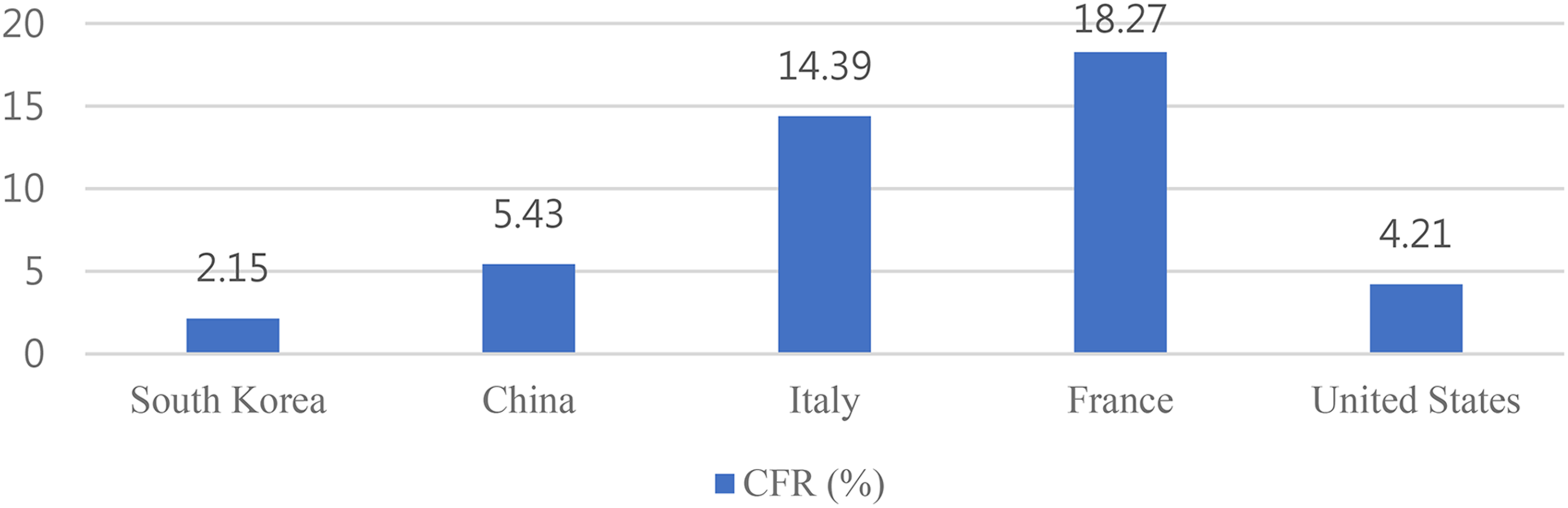
Crude fatality rate as of July 6, 2020. Source: WHO COVID-19 Dashboard (2022) https://covid19.who.int/.
Although the South Korean government did not impose stringent restrictive measures such as lockdowns, it gave the public confidence in its pandemic policy by showing a lower number of positive cases and mortality rates than other countries. Based on the trust built with the government, the public had expectations that the pandemic would be controlled soon if they complied with the government measures. However, the wave of infections was repeated over the whole year of 2020 due to various social factors such as travels, social gatherings, and religious activities. Accordingly, the policy of the South Korean government alternated between mitigated restrictions and repressive measures and, in turn, caused confusion to the public. The government's transparent announcements through regular briefings formed trust in the quarantine policy, but it delivered the message that this would be a turning point, raising expectations of easing the quarantine policy soon. However, as the same message was repeated every week, people expressed fatigue and distrust. Although the public's hasty optimism about the end of the pandemic was formed based on the initial quarantine policy, the repeated crisis warnings turned optimism into greater disappointment and made people feel tired. In addition, as the spread of COVID-19 was accelerated all over the world, people started to have reservations about the government's measures.
Second Phase Transition: Vaccine Development
In the early stage of the pandemic, the government's role primarily focused on tracking and testing COVID-19. As vaccines had been under development, they quickly became the cornerstone of the management of the pandemic. Since November 2020, the COVID-19 vaccine has been released and approved by numerous countries. In doing so, a new phase of the pandemic has emerged. In this period when the vaccine was about to become available, South Korean people were feeling tired of prolonged social distancing and frequently changing measures for a year and becoming immune to the dangers of the pandemic. Moreover, there was an increasing number of protests and backlash against the government in some industries due to business restrictions. The public started to express frustration and dissatisfaction with restricted social and economic activities.
In the meantime, the South Korean government did not announce a solid plan to secure and start vaccination for the entire population of a country until June 2021, even after some countries, such as the United States, Britain, and Israel, began the vaccination. The government only started vaccinating medical staff in February 2021 and expanded vaccinations to the public a month later. However, vaccinations had to be suspended due to a lack of vaccine supply in May. As such, public concerns reached a peak during the first half of 2021. The vaccine delay combined with quarantine rules and social regulations sparked a strong backlash and undermined confidence in the government.
After securing the vaccine, South Korea achieved its initial goal of inoculating over 70 percent of the population earlier than scheduled. 30 Since the government announced a plan to phase out restrictions starting November 2021, the expectation of returning to normal life was increased among the public. With the high expectation, people were getting vaccines actively and rapidly by cooperating with the government's guidelines. On November 1, 2021, the authority officially declared that the country was ready to shift to “living with COVID-19.” Returning to normal life in various sectors immediately followed; consumer confidence rose, and companies and stores reopened. However, as variants emerged, the “living with COVID-19” stalled a month later and another vaccine shot was strongly recommended. Although the government argued that the country aimed for herd immunity, distrust in the government and its policy has been growing. During the pandemic, the government drew the public's cooperation by announcing an optimistic outlook that COVID-19 would be controlled according to government measures each time, but after that, a situation completely different from the forecast unfolded, making the people even more discouraged.
Three Lessons Learned from/to Complex Adaptive Systems Theory
As the health system is considered a CAS, the phase transition caused by the critical juncture results in a radical change in the operation of the system. In particular, critical junctures such as pandemics affect not only the health system but also other aspects of society, and, at the same time, the roles and interactive ways of related actors are re-created/re-organized. COVID-19 was an unprecedented pandemic, affecting not only the health sector but also the overall society, including the economy, security, and welfare sectors. As a critical juncture, it brought a phase transition around the world. Therefore, in the transitioning stage, each actor is self-organizing and evolving by themselves through a feedback loop. In the following, we analyze how the public and the government differently evolved and, in turn, the feedback loop between them did not adequately occur.
Rapidly Evolving People: From Health Service Consumers to Social Actors
The CAS theory emphasizes the process of an actor's adaption and evolution. An actor's evolution is caused by interaction with other actors and environmental factors and affects the very interaction with them in the next stage. That is, through an actor's evolution, the way of interacting with the actor is evolved.
In South Korea's experience, South Korean people have shown proactive and swift adaption and evolution from external information. In CAS, an actor's characteristics and interests are not consistent but constantly changing and self-organizing according to the external environment. Thanks to advanced communication technology, the worldwide impact of the pandemic makes people actively communicate with the world. People no longer rely only on their government's announcements. They observe another country's experience, analyze statistics, and assess various measures. For the first half of 2020, the South Korean people showed a high level of confidence in government measures and practiced the government-led guidelines without a doubt. However, they watched a huge number of positive cases and crude fatality rates in foreign countries. Although South Korea responded well to the pandemic compared to these countries, as South Korean people realized that the pandemic would be prolonged and not easily controlled by the government, they started preparing to respond to the long-term impact. As such, they evolved from health service consumers merely paying attention to avoid infection to social and economic actors expecting the government's support to be back to normal life.
South Korean people's rapid evolving process was enabled by globally featured environments. Due to the inherently globalized nature of the pandemic, the interaction of the public was not limited to its own government but also encompassed the world through a globally connected communication channel. This is not only a lesson learned from CAS's explanation of complex interaction and self-adaption but also a new feature of the globalized environment to be added to CAS. In a global event or policy, the active and rapid evolution of an actor from external factors needs to be stressed. South Korean people showed more prompt responses to the pandemic than their government. As a result, the different speeds of evolution between the government and the people became the beginning of the conflict between the two. It shows that the environment that CAS should consider in the globalization era is getting wider and more diverse.
Government Failing to Phase Transition
During the pandemic era, unlike the public, the South Korean government failed to recognize and respond to phase transition—pandemic declaration and vaccine development—as the health system was not considered the CAS. First, South Korea's previous experience with MERS and SARS provided path dependence to implement policies and regulations related to the COVID-19 response. This outbreak experience acted as a feedback loop and contributed to an effective initial response when COVID-19 first broke out. Even when the World Health Organization (WHO) declared COVID-19 a pandemic on March 11, 2020, the South Korean government's COVID-19 response policy remained at the level of an outbreak, not a pandemic, based on previous experiences and thus failed to transition the phase to the pandemic. Despite the WHO's declaration of a pandemic, the South Korean government maintained its COVID-19 response policy and message to the public based on the two previous outbreaks. Due to the nature of the pandemic, it is difficult to end it within a short period of time until a vaccine is fully developed. Nevertheless, the government repeatedly and continuously delivered a message that strong quarantine measures could control the virus. South Korea's COVID-19 measures were effectively working in a short period of time but when a phase transition to the pandemic occurred that was long-term, transnational, and complex, several problems were exposed in the policy and response strategy. The South Korean government, which failed in the phase transition, stayed with the previous experience and did not evolve. It overlooked the possibility of self-organization and evolution of other actors through their own feedback loop.
Second, with the development of a vaccine, the pandemic faced another transition from a wide-open epidemic era to a counteractable epidemic era. However, the South Korean government's pandemic policy shift was not made in a timely manner in accordance with the vaccine development. Given that developing and securing vaccines should be included in each government's capability to respond to the pandemic, the South Korean government showed the inability to do so because it did not prioritize the vaccine policy. After securing the vaccine, it was notified that the quarantine policy would be relaxed when the vaccination rate reached a certain level. Despite achieving the target vaccination rate, the South Korean government did not relax some restrictions as promised and maintained the existing quarantine policy. Such a change in the government's position occurred in response to changes in the external environment, such as the emergence of a new variant virus in Omicron. However, changes in the external environment surrounding the pandemic were repeated. Although the changes were predictable from other countries’ experiences, the government failed to prepare for them.
In brief, from the beginning of the pandemic to the time when the vaccination rate reached the target level, the government adhered to the same level of quarantine policy, and this attitude caused conflicts with other stakeholders. Unlike the people, the South Korean government lacked awareness of the pandemic from the perspective of CAS. The lack of awareness acted as a limit for the phase transition to occur in a timely manner.
Dissonance in Actors
The different evolving paces of the government and the people eventually turned out to be an interaction problem between the two actors. In the early stage of the pandemic, the South Korean government and people worked well together to control the impact of the virus spread for the first few months until people went through the phase transition earlier than the government did. When the first COVID-19 case was confirmed, the government swiftly responded to it and showed a successful containment strategy, maintaining the level of infected individuals at 0.02 percent of the population. The government’s swift reaction established credibility and the people complied with the government guidelines. In turn, the interaction between the government and the people took place smoothly. Even when the infection rate became higher in the early days of the pandemic, it was controlled within one or two weeks. Therefore, people strongly supported the government's measures and even encouraged each other to cooperate with the government.
However, while the people absorbing information from outside were moving on to the pandemic stage, the government still stayed at the early stage, arguing that the virus could be controlled with a government quarantine policy. Meanwhile, the government implemented measures and one-sided interactions that produced short-term quarantine effects. However, the rapidly evolving people who accepted the external environment realized that such a measurement was not effective in the long term. As a result, the people showed distrust in government policy and an imbalance in interaction with the government appeared. In addition, although the vaccine was essential for pandemic control, the South Korean government failed to secure vaccines in a timely manner due to excessive confidence in its quarantine policy and misjudgment of priorities. In the meantime, the public showed strong distrust of the government's policy, arguing that vaccines should be the top priority for pandemic control. This imbalance appeared repeatedly throughout the pandemic, and the conflict between the public and the government has gradually intensified throughout the quarantine policy and vaccine-securing process.
The problem of interaction between the government and the people came from different understandings of the pandemic and its influence. The government maintained its policy focusing only on the health sector while people quickly accepted the pandemic as a part of their lives and set their own interests in consideration of their social and economic impact. Looking at the South Korean government's policies and the public's responses to the pandemic, the feedback loop for the aftermath of the pandemic was formed differently for each actor, indicating that each actor evolved differently. The government maintained an interaction that had a short-term effect in responding to the pandemic whereas people started preparing to live with the long-term impact of the pandemic. Due to this different perspective and practice, the interaction between them was dissonant. In the end, such a conflict inevitably led to distrust in government policies and became an obstacle to effective policy implementation.
Discussion
This article examined South Korea's response to COVID-19 through the CAS framework, focusing on actors’ behavior according to the phase transition. It emphasized that an abrupt change such as the pandemic might bring a different transition and evolving process for each actor. When an actor adopts new information and adapts to a new environment, interactions involving the actor can be changed in different ways. Under the abrupt shock, this difference can be exaggerated due to the sudden and rapid change in a short period of time. By emphasizing the interactions among various actors, CAS analyzes social phenomena that are not explained by linear relationships or causal mechanisms. Especially with the abrupt change to the system, the CAS stresses actors’ different perception of risk and its influence on the system, which can bring a standstill or failure.
South Korea was considered a successful case in the control of COVID-19.6,7,29,31 However, as the world enters Year Three of the pandemic, South Korea recorded the highest number of daily new cases in April 2022. This is the result of two main actors’ different ways of adaptation to the phase transition caused by the pandemic. While the public promptly accepted the new phase and adjusted perception and behavior, the government was reluctant to enter the new phase. This disparity resulted in people's growing doubts about the government's policy and measures in the past three years.
The results have two implications for infectious disease control policy for governments and international society. First, a government needs to anticipate and respond to the quickly evolving public. Advanced technology and communications enabled people to easily access external information and promptly adapt to a new environment. The public no longer relies only on its own government's lead and limited information, especially in a global event. Facing COVID-19, the South Korean people quickly transitioned to the pandemic phase when the government was still staying in the outbreak phase. Because the South Korean government learned how to react to infectious diseases from previous experiences, such as SARS or MERS, the authority believed that the COVID-19 outbreak could be managed by the government's control in the health sector. However, COVID-19 turned out to be an unprecedented pandemic with an impact on the whole society. After South Korean people realized the impact of the pandemic earlier than the government through rapidly increasing cases and different measures in foreign countries, they started to question and resist government measures ignoring economic and social impacts even when South Korea showed a relatively low number of cases and fatalities. Given that people have been going through phase transitions faster than the government, the government should expect that the public can exit from the pandemic phase at any moment due to external environments. Failure of matching the phase transition among actors causes policy failures, conflict, and distrust in society. If the government once again fails in the transition to the next recovery phase, the failure may cause a massive impact on society because the next phase would be directly linked to people's normal lives. To prepare for the next stage, the government needs to promptly digest transnational information and interact with reliable suggestions to the public.
Second, the current pandemic raises a question about international cooperation in response to the transnational issue. Especially when it comes to vaccine supply and distribution during the pandemic, global efforts were highly limited. CAS stresses the importance of relevant actors and argues that their dyadic and multi-layered interactions can make changes. From the perspective of CAS, global issues, such as the pandemic, include international and transnational actors as well as domestic actors. Thus, their cooperation is the key to responding to the issue. Nevertheless, as soon as the vaccine was released, some countries preempted the vaccine through individual contracts with pharmaceutical companies based on national capabilities. Numerous countries, including South Korea, could not secure vaccines in a timely manner and did not even know when they could do it partly. This is because they waited for international cooperation, relying on the international organizations such as COVAX, and partly because they were not financially and technically capable of developing the vaccine. The lack of globally cooperative efforts can delay the end of the pandemic in the short term. The aftermath of the pandemic affects not only the economic and social problems of each country, but also limits trade, production, and movement between countries and affects the lives of people around the world. A pandemic cannot end only in individual countries. From the perspective of CAS, the actors of a pandemic are not simply set for individual countries, but all countries are connected as actors of the pandemic. In the longer term, it will cause conflicts among actors and in turn damage the trust.
Now the whole world is about to shift a phase from the pandemic to the post-pandemic. South Korea's experience tells us that it is essential to cooperate and coordinate to respond to the global crisis for various actors in a broader sense.
Footnotes
Declaration of Conflicting Interests
The author(s) declared no potential conflicts of interest with respect to the research, authorship, and/or publication of this article.
Funding
The author(s) received no financial support for the research, authorship, and/or publication of this article.
