



Abstract
Currently the socioeconomic gradient of obesity it is not well understood in the urban population in Latin American. This study reviewed the literature assessing associations between pre-obesity, obesity, and socioeconomic position (SEP) in adults living in urban areas in Latin American countries. PubMed and SciELO databases were used. Data extraction was conducted using the Preferred Reporting Items for Systematic Reviews and Meta-Analyses (PRISMA) guidelines. We extracted data on the association between SEP (e.g., education, income), pre-obesity (body mass index [BMI] ≥ 25 and < 30 kg/m2) and obesity (BMI ≥ 30 kg/m2). Relative differences between low and high SEP groups were assessed and defined a priori as significant at p < 0.05. Thirty-one studies met our inclusion criteria and most were conducted in Brazil and Mexico (22 and 3 studies, respectively). One study presented nonsignificant associations. Forty-seven percent of associations between education or income and pre-obesity were negative. Regarding obesity, 80 percent were negative and 20 percent positive. Most negative associations were found in women while in men they varied depending on the indicator used. Pre-obesity and obesity by SEP did not follow the same pattern, revealing a reversal of the obesity social gradient by SEP, especially for women in Latin America, highlighting the need for articulated policies that target structural and agentic interventions.
Latin America is undergoing a rapid urbanization process that increases health inequities and leads to greater morbidity and mortality gaps between socioeconomic position (SEP) groups.1,2 Urbanization is associated with the adoption of unhealthy behaviors such as sedentary lifestyles and diets rich in ultra-processed food, sugars, and saturated fats content.2,3 Prior research suggests that such unhealthy behaviors are first adopted by high SEP individuals, 4 leading to a higher risk of pre-obesity and obesity. Afterwards, a reversal of the social gradient may occur, with obesity rates increasing faster among low SEP groups.5,6
Entangling this scenario, the dominant construction of obesity leads to ineffective governmental food policies and focus on interventions in which individuals are seen to have specific behaviors and deficiencies that could be solved by educational actions. 7
SEP differences in obesity rates remain largely unknown in Latin American countries. Obesity rates between the countries differ 8 as a result of differences in economic growth in the region. 5 Previous evidence has suggested a gross national product per capita of US$2,500 as a threshold level at which obesity prevalence shifts towards the poor. 5 In Mexico and Brazil, rates were first higher among those with high SEP but have now shifted to low SEP. 9 Such shifts may be due to several reasons, including urbanization, supermarket expansion, working outside of the home, adoption of westernized diets, access to fruit and vegetables, and cash transfers.3,10,11
With these factors in mind, it is urgent to recognize that the approach to obesity management that relies on individual-level interventions, based on the assumption that people have choices and are completely free to make their choices, is overwhelmingly simplistic. Countering obesity cannot be achieved without support of public policies that target broad social and environmental determinants, involving multiple solutions that provide an environment that supports individuals in their communities and cities. 12
About the scientific evidence on the theme, currently it is not well understood to what extent obesity differs by SEP within urban areas in Latin America, as the majority of the previous studies have focused on national health surveys, not showing results in urban areas only. 11 Also, there is a paucity of research assessing pre-obesity rates by SEP in the region, considering that pre-obesity individuals have a lower risk of comorbidities than those with obesity. 13 Therefore, this review aims to synthesize the evidence on the direction of the associations between socioeconomic position, pre-obesity and obesity in Latin American adults living in urban areas.
Materials and Methods
We followed the Preferred Reporting Items for Systematic Reviews and Meta-Analyses (PRISMA) guidelines for systematic reviews and the Population, Intervention, Comparison, Outcome, Study (PICOS) framework (see Table 1). We included peer-reviewed cross-sectional and cohort studies assessing the association between SEP, pre-obesity, and obesity in Latin American countries. We did not restrict results based on date of publication. We included articles published in English, Spanish, and Portuguese. We excluded conference proceedings and gray literature, as well as studies conducted among pregnant women, outside Latin America, that were not population-based (e.g., military populations), qualitative studies, and studies without explicit body mass index (BMI) cutoffs (i.e., underweight, normal weight, pre-obesity, and obesity; see Supplementary Figure 1).
PICOS Framework Followed for the Inclusion of Studies.

We identified eligible studies by scanning titles and abstracts before reviewing the full text. PubMed and SciELO databases were used to identify studies (see Supplementary Table 1). We reviewed reference lists of included studies and those sent by regional experts working in research related to SEP and weight. We conducted searches from July 2017 until May 2023. Two authors separately reviewed all potential studies to be included. We resolved disagreements by discussion between both authors and, when no agreement was reached, a third author made the final decision.
Pre-obesity (or overweight; BMI ≥ 25 and < 30 kg/m2) and obesity (BMI ≥ 30 kg/m2) were the two main outcomes to assess the influence of SEP on weight. We included excess weight (BMI ≥ 25 kg/m2) as a secondary outcome. We included studies having at least one individual SEP indicator, such as education and income, with two or more categories for comparison. We considered the definitions of low and high SEP categories used in each article. We also considered the definitions of urban areas used in each article including city, state capital and federal district, metropolitan region, or a predefined urban area.
We extracted information from each study on country, survey year, sample size, age, BMI (pre-obesity, obesity, or excess weight), SEP indicator, and cohort (see Supplementary Table 2). We also extracted relative differences between high and low SEP groups when already provided in each study and were calculated using either logistic, Poisson regression, or log-log models. In the absence of such values, we assessed relative differences using the following formula, as previously published 14 :
[(Value for high SEP – value for low SEP) ÷ value for high SEP] x 100, where the values in the formula are extracted from each manuscript, being the nature of the values for SEP—for example, percentages, prevalence ratios, or odds ratios.
We considered an association as negative when low SEP individuals had a higher pre-obesity or obesity prevalence and as positive when high SEP individuals had a higher prevalence. We considered differences between high and low SEP groups as significant if defined as such in each study (p < 0.05). We included more than one association per study if they included more than one SEP indicator.
We assessed study quality with the 22-item Strengthening the Reporting of Observational Studies in Epidemiology checklist (STROBE;. 15 The minimum score was 0 and the maximum was 22. Study quality was ranked as high (score of,16–22 intermediate (score of8–15 or low (score of 0–7; see Supplementary Table 2). Two authors separately ranked each study. We resolved disagreements by discussion between both authors and, when no agreement was reached, a third author made the final decision.
Results
We identified 31 studies that met the inclusion criteria, most of which were conducted in Brazil (n = 22, 70.9%; 3, 16–35, 23 and the remaining (n = 9, 29.0%) in Mexico24–26 Chile,27,28 Argentina,29,30 Peru, 31 and Colombia 32 ; see Supplementary Table 2). Most assessed associations between an indicator of SEP and obesity (n = 24), though six did include pre-obesity as an outcome and some examined other BMI cutoffs (i.e., weight ≥ 25 or 27 kg/m2) (see Supplementary Table 2). Nearly all studies used education as an SEP indicator and 21 used income. We assessed most studies as being of high quality; only three were intermediate quality, typically because they did not clearly describe the presence of missing values and reported only bivariate analyses (e.g. ANOVA, weighted percentages, chi-2).
Five studies in Brazil and one in Colombia assessed associations between individual SEP and pre-obesity (see Table 2). Two studies that pooled results between men and women observed a positive association between education and pre-obesity. However, in the four studies that stratified results by gender, education was positively associated with pre-obesity among men and negatively associated with pre-obesity among women.
Association of Socioeconomic Indicators with pre-Obesity (BMI ≥ 25 and < 30).
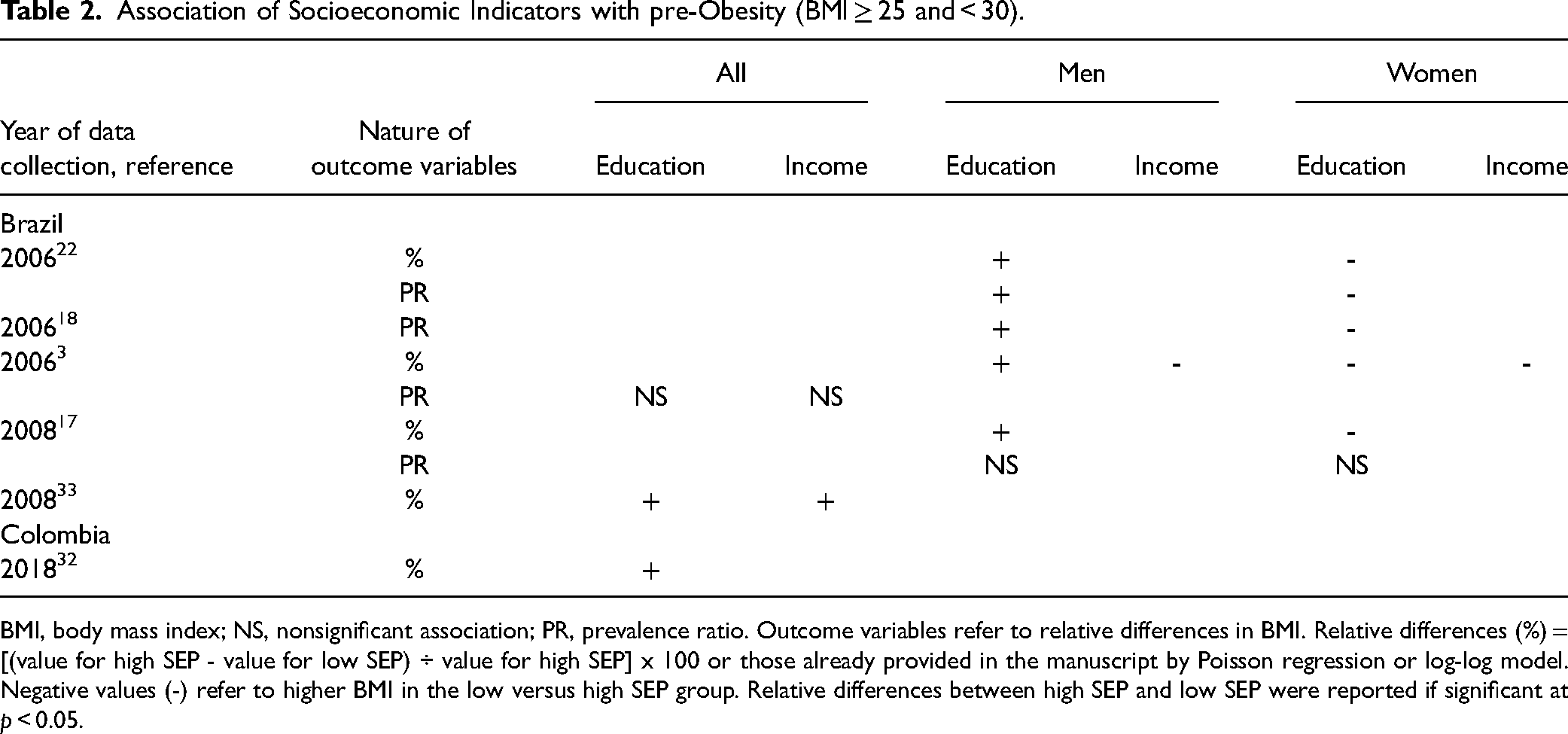
BMI, body mass index; NS, nonsignificant association; PR, prevalence ratio. Outcome variables refer to relative differences in BMI. Relative differences (%) = [(value for high SEP - value for low SEP) ÷ value for high SEP] x 100 or those already provided in the manuscript by Poisson regression or log-log model. Negative values (-) refer to higher BMI in the low versus high SEP group. Relative differences between high SEP and low SEP were reported if significant at p < 0.05.
Twenty-four studies evaluated the associations between individual SEP and obesity (see Table 3), including studies in Argentina (n = 2, 6%), Brazil (n = 16, 52%), Chile (n = 2, 6%), Mexico (n = 3, 10%), Colombia (n = 1, 3.2%) (see Table 3). Broadly, studies observed a negative association between education and obesity among women and in studies that pooled results across genders. However, findings were much more heterogeneous for gender-stratified studies among men and with respect to the relationship between income and obesity. In men, the observed association between education and obesity was negative in eight studies but positive in two, and the association between income and obesity was negative in three studies but positive in five. Among women, income was negatively associated with obesity in eight studies, positively associated in two studies, and no association was observed in five studies.
Association of Socioeconomic Indicators with Obesity (BMI ≥ 30).
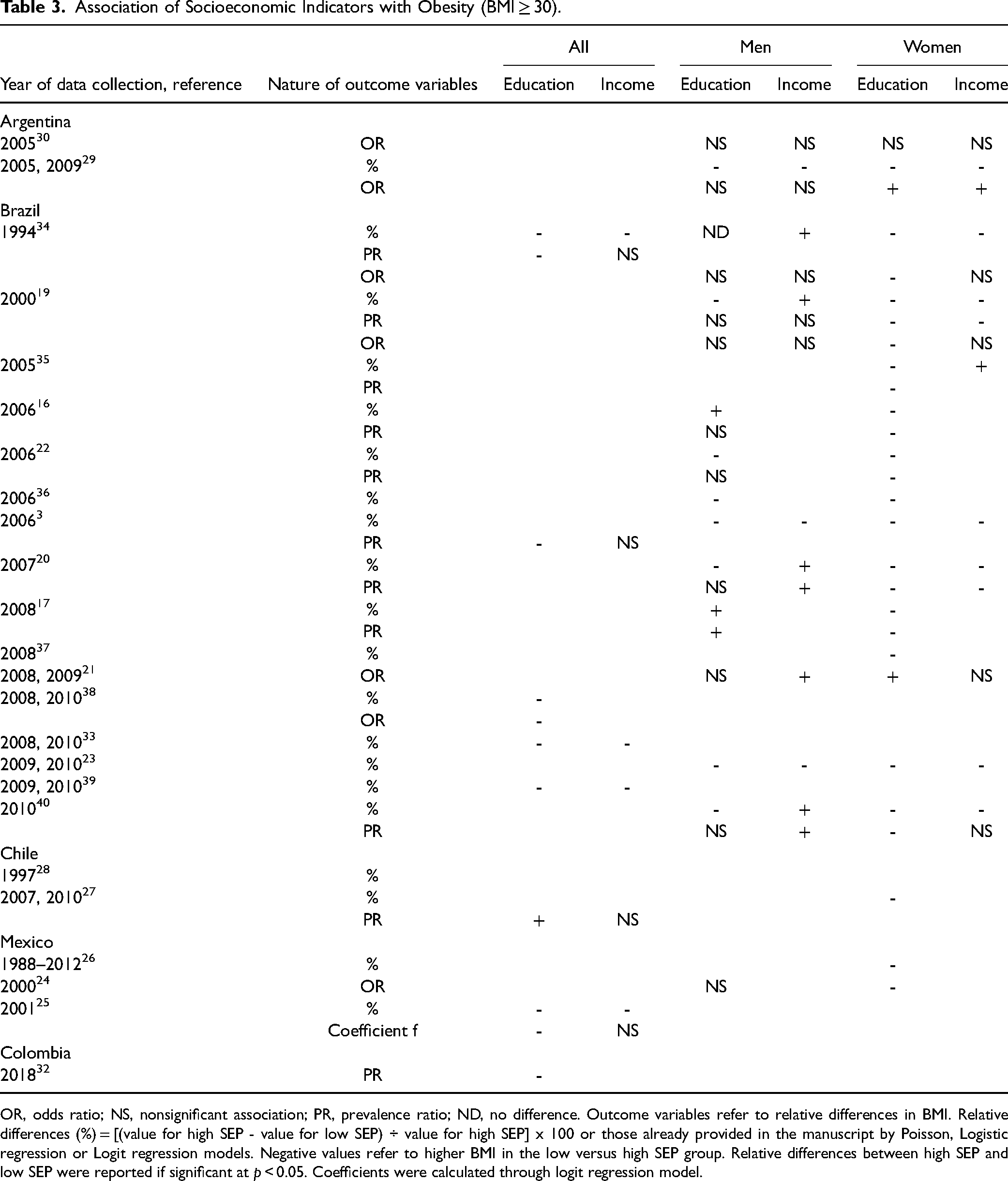
OR, odds ratio; NS, nonsignificant association; PR, prevalence ratio; ND, no difference. Outcome variables refer to relative differences in BMI. Relative differences (%) = [(value for high SEP - value for low SEP) ÷ value for high SEP] x 100 or those already provided in the manuscript by Poisson, Logistic regression or Logit regression models. Negative values refer to higher BMI in the low versus high SEP group. Relative differences between high SEP and low SEP were reported if significant at p < 0.05. Coefficients were calculated through logit regression model.
Few studies assessed the association between individual SEP and excess weight and were conducted in Brazil (n = 6, 19%), and Peru (n = 1, 3%) (see Supplementary Table 3). In both sexes, education was positively associated with excess weight in one study, but negatively associated in four studies. In men, two studies showed opposite results on the association between education and excess weight. Nonetheless, the association was positive for income in the same studies. In women, education was negatively associated with excess weight in three studies while income was negatively associated with excess weight in two.
Eight studies assessed the association between BMI and occupation or other SEP indicators.3,16,24,25,27,28,34,40 The direction of associations did not show a clear pattern. For example, in men, occupation was positively associated with obesity in one study 3 while it was negatively associated in another study. 16 Also, the association between obesity and the Bronfman scale or number of home assets became nonsignificant after adjustment. 27
Discussion
The aim of our study was to summarize available evidence on the socioeconomic patterning of pre-obesity and obesity in Latin America countries. Our findings showed that education was the most frequently used SEP indicator followed by income. A clear relationship was seen for women, where most studies showed a negative association between SEP and BMI, while results in men revealed mainly positive associations for pre-obesity; mixed results were found for obesity. No clear pattern was found between BMI and other SEP indicators (i.e., social class, asset ownership, wealth, Bronfman scale, Graffar scale, or multi-deprivation index), especially due to a lack of evidence. Our results corroborate the existence of inequalities between pre-obesity and obesity and different SEP indicators in Latin American countries and highlight the need for intervention strategies.
The association of SEP with pre-obesity was mainly positive for men and negative for women. Our results for men showing a positive association, that is, an increase in BMI associated with an increase in SEP, are in agreement with Jones-Smith and colleagues, 6 who confirmed that in 27 different countries, high SEP groups have higher BMI, followed by the rest of the social strata. 41 As all associations between SEP and pre-obesity were found in studies conducted in Brazil, our study highlights the need for implementing policies to reduce weight inequalities in urban areas in other Latin American countries (i.e., the next ones to undergo the reversal of social gradients). 30 Our results also confirm the occurrence of the reversal in women first, 21 reflecting the impact of pre-obesity in low versus high SEP women. 42 Such findings highlight the need for individual (i.e., agentic interventions) and environmental changes (i.e., structural interventions) to prevent obesity and related chronic illnesses from striking one of the most vulnerable populations in the region: low SEP women.
It is also worth noting that pre-obesity and obesity by SEP did not follow the same pattern, implying that they may follow different social mechanisms. In a review conducted in the beginning of the 2000s, 43 a total of 1,914 primarily cross-sectional associations between obesity and SEP were analyzed. Results found an increasing proportion of positive associations and a decreasing of negative associations as one moved from high income countries to low- and middle-income countries. 43 Another study has previously reported differences between the social patterning of pre-obesity and obesity in Australian adults, 44 measuring SEP by socioeconomic disadvantage and residential areas. Overall, there were higher odds of obesity in poor areas, while there were lower odds of pre-obesity in men in those areas. The relation between SEP and obesity is not simple and should be contextualized considering the perspective that involves multiple pathways operating at several different levels, involving a range of modifying factors and mechanisms. 45 Further research on the effect of area-level SEP indicators on the social patterning of pre-obesity in the Latin American region is warranted.
As for obesity, the reverse gradient in women found in the present study may also be related to a socioeconomic gradient in diet. The social patterning of diet is also reversing with the progression of the nutritional transition. In addition to lower access to healthy foods in low SEP neighborhoods, obesogenic environments provide higher access to ultra-processed foods (which are becoming more available and with lower prices). Such changes selectively affect poor people who are more constrained in their choices. In this sense, another study has reported that in low- and middle-income countries, people of low SEP tend to adopt unhealthier dietary patterns, which are, in turn, related to weight gain. 14 Another important factor is the socioeconomic gradient in physical activity in Latin America. In a randomized controlled trial conducted in eight Latin American countries, results showed that physical activity graded positively with SEP, although overall, women were more sedentary than men. 46
Interventions and policies aimed to decrease socioeconomic differences in obesity in urban populations may target the prevention of weight gain, the promotion of weight loss, 27 and environmental factors. 38 As unhealthy dietary patterns and sedentariness worsen with urbanization, 47 public health policies to prevent obesity must be adapted to the Latin American context. Further studies may inquire about the economic development of Latin American countries (the shift from agricultural to industrial occupations) and the physical activity by SEP.
As previously reported in middle-income countries, 9 the association of SEP and obesity was mainly negative in women and mixed in men, where rates appeared to be higher among those with low versus high SEP, depending on the indicator used. More recently in Latin America, 48 a multi-country study revealed a negative association between education and obesity in women and a positive one in men, although results do not focus on urban areas only.
Our results confirm a difference in the social patterning of BMI by sex which might be explained by socially constructed body weight norms 43 ; different physical activity and alcohol consumption levels than men; responses to early-life nutrition and weight gain during pregnancy; higher psychosocial risk as low SEP women have a higher risk of depression; and women often remain responsible for food purchase and preparation, among others. 42 Also, differences in the social patterning by sex have been described before for hypertension and diabetes in urban Latin America.49,50 As obesity is a risk factor for other noncommunicable diseases, our results corroborate the hypothesis of an increased risk for chronic diseases in people with low SEP, especially women. 30
Education and income-based obesity gradients usually followed the same direction in urban areas in women, but not in men. Differences between using different SEP indicators may be due to each indicator measuring a different aspect of the social dimension, and it is important to note that they cannot be used interchangeably.51,52 Also, differences between education and income as SEP indicators in associations with obesity risk have been reported before, for example, in a study using data from the National Health and Nutrition Examination Survey, where associations differ by sex and race/Hispanic origin. 53
Our results finding a clear negative association between SEP and obesity in women differ from a previous review conducted of low- to middle-income countries, 43 where a positive association was most likely reported between income and obesity. However, the studies included in our review were published more recently and confirm the occurrence of the gradient reversal in the Latin American region. To avoid an underestimation of the overall effect of SEP on obesity, available evidence on other SEP indicators was also summarized. However, the direction of associations between other SEP indicators and obesity did not show a clear pattern, mainly due to a lack of evidence and the small number of associations found. Also, the association between SEP and excess weight followed the same pattern as with obesity.
The correlation between obesity and SEP can be explained by the complex relationship between city features and health outcomes through the interrelated synergistic effects of the environment with individual-, household-, and area-level SEP. For instance, families with low SEP living in poor areas may have high access to ultra-processed foods, low access to fresh and healthy foods (food deserts), less access to facilities that promote physical activity, and have fewer opportunities for safe mobility. 54 Hence, some policy examples include the regulation of ultra-processed food marketing, trans fatty acids, and the price of food,55,56 access to healthy food stores and restaurants, 38 infrastructure (i.e., sports facilities and transportation56,57; and a focus on urban slums. 42 Citywide interventions to counter the burden of obesity must be implemented in hand with assuring better living conditions. 54 In addition, sex-specific solutions may be necessary and a combination of structural and agentic interventions may be used to reduce inequalities in weight. 12
Our systematic review includes several limitations. First, included studies that had different measures of income (e.g., individual, per capita and/or family income) combined individual and household level measures. However, evidence on SEP and BMI in Latin America is scarce and we were able to provide a summary of the direction of associations. Second, we were not able to conduct a meta-analysis due to high heterogeneity, as measures were not standard and we were not able to compare across countries. Third, almost half of the studies included self-reported measures of BMI and previous evidence has shown self-reported weight and height may affect the prevalence of reported BMI. However, we measured differences in BMI between SEP groups. Fourth, other aspects such as ethnicity (i.e., indigenous, mixed ethnicity) may play a role in the prevalence of overweight and obesity in Latin American countries, as seen, for example, in the United States where American Indians and Alaska Natives have a higher risk than non-Hispanic, white adolescents. However, ethnicity information was not available in the included studies. Finally, our study is limited to the analysis of individual characteristics, and we suggest multilevel analyses to explore how the social gradients are influenced by contextual effects. We also recommend studies to be conducted in urban areas in countries with the lowest human development index in the region where the reversal might not have occurred yet. Our study also revealed the need to produce evidence in uncovered countries, where no or few studies were found, and the need to deepen the comparison of the evidence by time periods to better understand how the social gradient reversal in the Latin American region evolutes as the countries develop.
Conclusion
Pre-obesity and obesity by SEP did not follow the same pattern in Latin America countries, implying that they may follow different social mechanisms. However, a clear relationship was seen for education and income-based BMI gradients and women, revealing that low SEP women in Latin America countries have higher BMI levels compared to more advantaged women. Our findings suggest the existence of inequalities in pre-obesity and obesity and a reversal of the obesity social gradient in urban areas, occurring in women first. The results highlight the urgency for combining articulated government plans that target both structural (i.e., public policies that provide access to healthy food especially in poor neighborhoods, marketing control and unhealthy food price regulations) and agentic interventions to narrow social and gender inequalities in obesity.
Supplemental Material
sj-docx-1-joh-10.1177_27551938241238677 - Supplemental material for Socioeconomic Position, Pre-Obesity and Obesity in Latin American Cities: A Systematic Review
Supplemental material, sj-docx-1-joh-10.1177_27551938241238677 for Socioeconomic Position, Pre-Obesity and Obesity in Latin American Cities: A Systematic Review by Mariana Carvalho de Menezes, Ana C. Duran, Brent Langellier, Carolina Pérez-Ferrer, Joaquin Barnoya and Ana-Lucia Mayén in International Journal of Social Determinants of Health and Health Services
Footnotes
Acknowledgements

Author Contributions
MCM contributed to study design, helped summarize findings into tables and contributed to manuscript content and intellectual content. ACD, BL and CP contributed especially to the intellectual content. JB contributed to the study design the intellectual content and format of the manuscript. ALM contributed to the study design, summarized the findings into tables, contributed to manuscript drafting and intellectual content. All authors read and commented on the drafts and approved of the final version.
Data Sharing Statement
Declaration of Conflicting Interests
The authors declared no potential conflicts of interest with respect to the research, authorship, and/or publication of this article.
Funding
The Salud Urbana en América Latina (SALURBAL)/ Urban Health in Latin America project is funded by the Wellcome Trust [205177/Z/16/Z]
Wellcome Trust DBT India Alliance, (grant number 205177/Z/16/Z).
Supplemental Material
Supplemental material for this article is available online.
Author Biographies
References
Supplementary Material
Please find the following supplemental material available below.
For Open Access articles published under a Creative Commons License, all supplemental material carries the same license as the article it is associated with.
For non-Open Access articles published, all supplemental material carries a non-exclusive license, and permission requests for re-use of supplemental material or any part of supplemental material shall be sent directly to the copyright owner as specified in the copyright notice associated with the article.
