



Abstract
Aim
This study aimed to determine the validity and reliability of the Indonesian version of the Eating and Drinking Ability Classification System (EDACS) in children with cerebral palsy.
Method
The EDACS was translated and culturally adapted into Bahasa Indonesia using the FACIT (Functional Assessment of Chronic Illness Therapy) translation methodology, aligning with established international cross-cultural adaptation guidelines such as. Content validity was confirmed through expert review and cognitive debriefing interviews. Inter-rater reliability (κ) was assessed across three pairings: Speech Therapists (STs), Physical Medicine and Rehabilitation (PM&R) Residents, and cross-professionally.
Results
A total of 30 children with cerebral palsy (range 3–16 years) were classified. Inter-rater reliability showed very strong agreement among STs (κ level = 0.871; κ assistance = 1.000). Strong agreement was found among Residents (κ level = 0.703; κ assistance = 0.788), with the highest disagreement reaching 2 levels on EDACS Level I classifications. Cross-professional agreement was very strong (κ level = 0.828; κ assistance = 0.895).
Conclusion
The Indonesian EDACS is confirmed to be valid and reliable for clinical use. The demonstrated strong to very strong cross-professional reliability supports its consistent use as an effective, multidisciplinary communication tool for STs and PM&R Residents.
Introduction
Cerebral palsy (CP) is a group of permanent disorders affecting motor development and posture that lead to activity limitations, caused by non-progressive disturbances occurring in the immature brain of a fetus or infant. As a chronic and lifelong condition, CP requires standardized classification and long-term multidisciplinary management (Sellers, Pennington, et al., 2014; van Hulst, 2019). The prevalence of CP is estimated to be 2 to 2.5 per 1,000 live births globally (Patel et al., 2024). Children with cerebral palsy also have lifelong limitations in movement and coordination. These limitations vary greatly in degree from person to person and affect different aspects of bodily function (Wahyuni, 2023). Children with CP commonly experience feeding and drinking difficulties due to oromotor dysfunction, neurological deficit, systemic conditions or complex medical conditions, which can lead to reduced caloric intake, prolonged feeding times, and increased risk of aspiration (Tschirren et al., 2018; Wahyu, 2014). These feeding and swallowing issues significantly affect growth, nutritional status, and overall quality of life of the children and their families, a topic widely addressed in recent literature (Wahyu, 2014; Mouilly et al., 2022) The prevalence of eating and drinking difficulties in children with Cerebral Palsy is difficult to determine and varies between 27% and 85% (Tschirren et al., 2018).
The main components of a clinical assessment of a child’s feeding and swallowing skills are a thorough history, pre-feeding evaluation, observation during feeding, or trial feeding. If aspiration is suspected or at risk, additional swallowing assessment tools such as videofluoroscopic swallow study (VFSS) and flexible endoscopic evaluation of swallowing (FEES) are needed (Skalsky, 2015).
A valid and reliable system is needed to classify the daily functional aspects of children with cerebral palsy. Multiple classifications such as the Gross Motor Function Classification System (GMFCS), Manual Ability Classification System (MACS), and Communication Function Classification System (CFCS) are widely used to assess functional abilities in children with CP. However, these systems do not adequately capture feeding and drinking abilities (Bell et al., 2019; Sellers et al., 2014).
To address this gap, Sellers et al. developed the Eating and Drinking Ability Classification System (EDACS), a five-level ordinal scale that categorizes safety and efficiency of eating and drinking, as well as the level of assistance required. The EDACS is typically assigned by a healthcare professional (such as a speech therapist or occupational therapist) based on observations during mealtime or systematic food/drink trials and input from caregivers/parents.
The EDACS uses five distinct levels of ability: • Level I: Eats and drinks safely and efficiently. • Level II: Eats and drinks safely, but with reduced efficiency. • Level III: Eats and drinks with some safety and efficiency limitations. • Level IV: Eats and drinks with significant safety or efficiency limitations. • Level V: Unable to eat or drink safely.
Assistance levels related to the ability to bring food and drink to the mouth are described by three ordinal levels: Independent, Requires Assistance, and Totally Dependent. EDACS enables clinicians and caregivers to make informed decisions regarding nutritional support and feeding strategies. Despite its widespread use internationally, no standardized Indonesian version existed until now (Paulson & Vargus-Adams, 2017; Sellers et al., 2019; Sellers, Mandy, et al., 2014; Wilson et al., 2010).
Methods
Study Design and Participant
This study included patients with cerebral palsy in outclinic ward of Dr. Cipto Mangunkusumo Hospital (RSCM) in Jakarta. Participants were selected through consecutive sampling from the available population between 2021 and 2023, meeting the following inclusion criteria: cerebral palsy, aged 3–18 years, male or female, whose parents allowed them to be included in the study and have filled out the informed consent. The exclusion criteria were the parents’ inability to cooperate during the study and the participant’s status as “currently unwell.” This status was defined as having an acute illness (e.g., a communicable disease) that could temporarily affect eating and drinking abilities, specifically including respiratory infection, fever, or gastrointestinal distress, or any condition posing an infectious risk to other patients. Participants were classified according to age, sex, and type of CP. Each participant was assessed using the EDACS classification. Each step was documented with a video camera in order to be re-assessed by the inter-rater.
To ensure methodological clarity, the translation and cross-cultural adaptation of EDACS into Bahasa Indonesia was performed following the structured methodology described by Eremenco et al. (2005), known as the Functional Assessment of Chronic Illness Therapy (FACIT) translation methodology. This methodology is conceptually aligned with internationally accepted cross-cultural adaptation frameworks (e.g., Beaton et al., 2000; Cruchinho et al., 2024; Huang & Wong, 2014; Wild et al., 2005), incorporating forward translation, reconciliation, backward translation, expert multidisciplinary review, cognitive debriefing interviews, iterative revision, and finalization. In accordance with EDACS developer requirements, the original version of EDACS was retained; therefore, content equivalence was evaluated through expert review and cognitive debriefing rather than item redevelopment. These are standard approaches for measuring conceptual equivalence when the original instrument structure is preserved (Beaton et al., 2000; Cruchinho et al., 2024; Huang & Wong, 2014; Wild et al., 2005).
This study used Strengthening the Reporting of Observational Studies in Epidemiology (STROBE; von Elm et al., 2007) cross-sectional reporting guidelines.
Stage 1: Translation
In the forward translation step, two independent native Indonesian translators generated separate versions of EDACS: Translator 1 was a medical doctor familiar with EDACS terminology, and Translator 2 was a certified professional English–Indonesian translator with no clinical background. The reconciliation step was conducted by a pediatric rehabilitation medicine specialist experienced with EDACS, who compared both forward translations and combined them into a single reconciled version. The back translation was carried out by a native English speaker with no prior involvement in EDACS and who was blinded to the original instrument. The expert review stage consisted of a bilingual expert panel (physiatrist, pediatric speech therapist, and language translation specialist) and included direct review from the original EDACS developers to evaluate conceptual, semantic, and cultural equivalence. Cognitive debriefing interviews were then performed with five parents of children with cerebral palsy to assess clarity, comprehensibility, and cultural appropriateness of the translated items. Revisions were made iteratively until no further discrepancies were identified.
The procedural steps of this translation and adaptation process are summarized as follows: - Using FACIT method of translation, researcher asked permission to the original writers and publisher of EDACS via electronic mail. - Forward translation was conducted by a medical doctor in PM&R department and a certified English translator who is a native Indonesian speaker and understands the concept of EDACS. - It was then further reconciliated with an expert familiar with EDACS who was not involved in the initial translation. - Backward translation was later performed by a native English speaker who also fluent in Indonesian and had no prior involvement in the translation process and only provided access to the reconciled version. - Quality control: The back-translated version is reviewed by an expert team, including the original EDACS developers and the research supervisors. - Independent review by four bilingual reviewers to provide objective feedback, including physiatrist, to review all versions of the translation, forward translations, the reconciled version, and any notes from the translation process. - Expert and Developer Review (Establishing Content Validity and Conceptual Equivalence): The back-translated version was reviewed by an expert team, including the original EDACS developers and the research supervisors. An independent review by four bilingual reviewers (including a medical doctor) was conducted to provide objective feedback, ensuring content validity, face validity, and conceptual equivalence across all versions. This rigorous review confirmed that the translated items comprehensively covered the original EDACS construct and were culturally appropriate, thus satisfying the requirements for content validity. - Cognitive Debriefing and Finalization: A pilot test of the translated version (pre-test translation) was conducted to detect any incorrect or reversed meanings that may have resulted from the translation process. This pilot test was conducted by the research team using a qualitative method involving five respondents. The test utilized retrospective debriefing interviews or cognitive debriefing interviews to assess the respondents’ comprehension of the translated questionnaire items. Any incorrect or reversed meanings identified during these interviews were documented and incorporated as revisions in the finalization stage of the Indonesian version of EDACS. The Indonesian version of EDACS was then finalized, documenting the linguistic development and conceptual understanding achieved during the translation process, culminating in the finalized Indonesian version of EDACS. - A qualitative method involving five respondents was completed to test the translation using retrospective debriefing interviews or cognitive debriefing interviews, to assess their comprehension of the translated questionnaire items. - Inter-rater reliability was measured using Cohen’s Kappa to evaluate the consistency among raters regarding the classification items of EDACS. - The pre-test results were incorporated into the translation process. If any items scoring below the acceptable reliability threshold, were subject to revisions and subsequent retesting. - Lastly, a final report was compiled, documenting the linguistic development, conceptual understanding, and challenges encountered during the translation process, culminating in the finalized Indonesian version of EDACS.
Stage 2: Validity and Reliability Test
The researcher obtained ethical clearance and conducted brief training on the EDACS guidelines and the procedures for using the Indonesian version of the EDACS guidelines and algorithm for residents (raters) and pediatric speech therapists (raters). Each rater classified the eating and drinking ability using the Indonesian version of the EDACS guidelines and algorithm. The final level was assigned based on a structured decision-making process involving assessing two domains: the safety and efficiency of eating and drinking (Levels I-V) and the level of assistance required to bring food to the mouth (Independent, Requires Assistance, Totally Dependent). The rater followed the EDACS decision tree to systematically evaluate observed factors such as mouth movements, coordination between breathing and swallowing, food loss from the mouth, and the required food textures during the single-meal observation. The most severe limitation determines the final EDACS level. For instance, a child who eats efficiently but is deemed unsafe (e.g., due to silent aspiration risk) would be classified at a higher, more compromised level (e.g., Level IV or V) regardless of their efficiency. The EDACS algorithm refers to a structured decision-making tool or flow chart provided by the EDACS developers that guides the rater through a sequence of questions to arrive at the child’s final EDACS level (I-V) and Assistance Level (Independent, Requires Assistance, Totally Dependent).
The researcher explained EDACS to the research subjects’ legal guardian, as well as the risks and benefits of participating in the study, Guardians then provided written, informed consent.
The researcher also provided education to parents who signed the informed consent form about aspiration symptoms and prevention of aspiration in children with cerebral palsy, and later conducted a trial practice of the algorithm using recorded video footage for the raters.
Observation of eating and drinking was conducted via video recordings by raters, consisting of two speech therapists (referred to as TW1 and TW2) and two residents in the PM&R Specialist Training Program (referred to as PPDS1 and PPDS2), and classified the eating and drinking ability using the Indonesian version of the EDACS guidelines and algorithm.
Only inter-rater reliability was assessed in this study. The reliability testing involved comparing three distinct pairs of raters: (1) Between Speech Therapists (TW1 vs. TW2), (2) Between PM&R residents (PPDS1 vs. PPDS2), and (3) Cross-Professionally (TW1 vs. PPDS1). All assessments were conducted based on the same video recording of the child’s feeding session, thus eliminating differences in the environment or the child’s performance. To ensure assessment independence, each rater classified the video independently, and all classifications were completed within a two-week period. No intra-rater reliability assessment was performed due to the absence of cognitive data required for a stable intra-rater measure. Furthermore, the classifications used for analysis were solely based on the video observations, with no direct, non-video assessments performed by the raters themselves. All data were collected and subsequently analyzed statistically.
Observational Video Recording
Parents were instructed to bring food with textures the child typically eats, as well as the child’s eating utensils. The video was recorded once, during the child's regular mealtime, in a well-lit room, using 50–75 cm camera distance, and stable video. The video was recorded from the front of the child to capture the face, oral cavity, and upper body while eating. The caregiver’s position while feeding did not block the child from view while the child was seated. Positional modifications were permitted to support the child’s eating and drinking ability. Recordings were collected directly by the research assistant (a medical doctor), at the Pediatric Outpatient Clinic of the Department of Physical Medicine and Rehabilitation. Videos were recorded from the beginning of the eating process until the child finished. Meal duration was recorded. Other data, such as food texture and relevant medical history, were noted in the research status form.
Ethical Statement
This study was approved by The Committee of Medical Research Ethics from Universitas Indonesia (KET-1173/UN2.F1/ETIK/PPM.00.02/2021), and Dr. Cipto Mangunkusumo Hospital Board Research Ethics Committee (LB.02.03/2.6.2/0008/2022). Verbal and written informed consent was obtained from all participants. This study was conducted in accordance with the principles of the Declaration of Helsinki.
Results
Characteristic of Study Samples (N = 30)
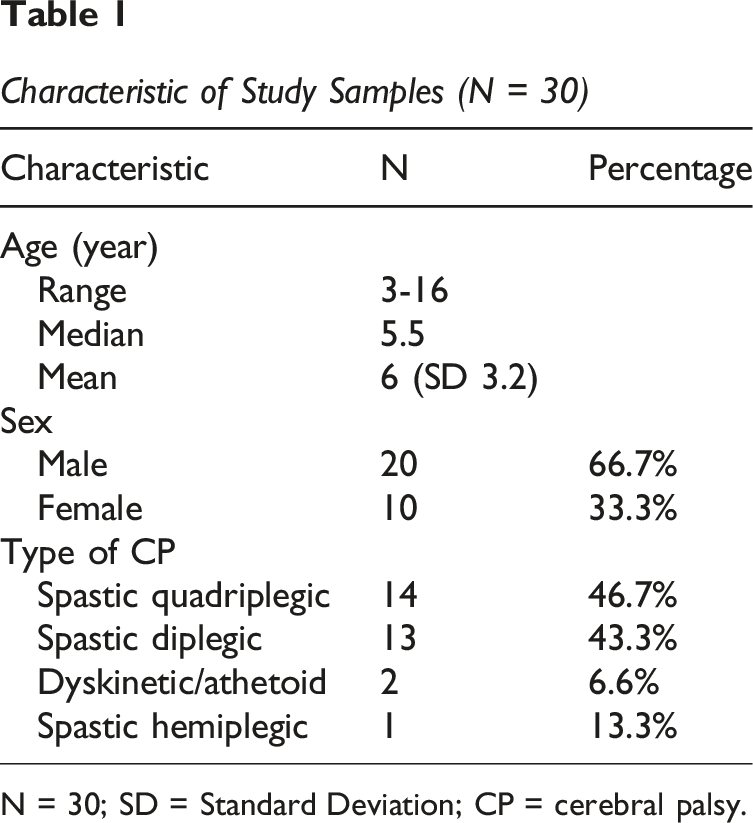
N = 30; SD = Standard Deviation; CP = cerebral palsy.
Distribution of EDACS and Assistance Level in CP

EDACS = Eating and Drinking Ability Classification System; CP = cerebral palsy; TW1 = Speech Therapist 1; PPDS 1 = Resident 1.
Translation
Following discussions between the first and second authors, the following modifications were made to the Bahasa Indonesian translation of EDACS: (1) Medical terminology was simplified to ensure that EDACS could be easily understood by parents, caregivers, and individuals without a healthcare background. (2) Translating the types and descriptions of food textures and fluid consistencies posed a specific challenge due to cultural differences in cooking and eating practices. As a result, we conducted a cross-cultural adaptation of food-related content. For instance, substituting “halva and tahini” with “dodol, sagoo or ketan.” (3) Due to the more limited vocabulary, certain terms on the Level I-V ability scale needed to be explained in full sentences to convey the intended meaning as defined by the EDACS developers. For example, the phrase “Can risks of aspiration be managed to eliminate harm to the individual” was harmonized and translated as “Apakah risiko aspirasi dapat dikelola melalui eliminasi hal yang membahayakan bagi individu.”
The classifications provided by Speech Therapist 1 (TW1) and Resident 1 (PPDS1) are reported in Table 2 to illustrate the distribution of eating and drinking abilities within the study cohort (N = 30) and provide context for the reliability analysis.
Content Validation
The cross-cultural adaptation process followed the FACIT translation methodology. After forward translation, reconciliation, backward translation, review by the original EDACS developers, and quality control, the Indonesian version of EDACS was finalized. The translation incorporated necessary cross-cultural adaptations, such as substituting local Indonesian foods (“dodol, sagoo or ketan”) for culturally specific examples in the original scale.
The Indonesian version of EDACS was then finalized, and proceeded to the reliability test using Kappa coefficient. Reliability was considered poor if < 0.40, fair if 0.41–0.60, moderate if 0.61–0.80, and very strong if 0.81–1.00. The inter-rater reliability analysis for the Indonesian EDACS demonstrated overall very strong agreement across professions. The Kappa coefficients for the three distinct professional pairings are as follows: • Agreement between Speech Therapists (TW1 and TW2): The Kappa value for EDACS level was 0.871 (very strong agreement), and for level of assistance was 1.000 (perfect agreement). Disagreement between TW1 and TW2 was minimal, with only one shift by one level. • Agreement between PRM Residents (PPDS1 and PPDS2): The Kappa value for EDACS level was 0.703 (strong agreement), and for level of assistance was 0.788 (strong agreement). Disagreement between PPDS1 and PPDS2 raters was higher, reaching up to 2 levels on EDACS Level I classifications. • Cross-Professional Agreement (TW1 and PPDS1): The Kappa value for EDACS level was 0.828 (very strong agreement), and for level of assistance was 0.895 (very strong agreement).
Kappa Inter-Rater Between Raters for EDACS Level and Assistance Level

EDACS: Eating and Drinking Ability Classification System; TW1 and TW2: Speech Therapist Raters; PPDS1 and PPDS2: Physical and Rehabilitation Medicine Resident Raters; κ: Kappa coefficient (Measure of Agreement); SE: Asymptotic Standard Error. The probability that the agreement occurred by chance (p < 0.001 indicates statistical significance).
The inter-rater Kappa coefficient among PPDS raters for EDACS levels was 0.703 (strong), and the inter-rater value for the level of assistance was 0.788 (strong).
The Kappa coefficient value between speech therapy raters and PPDS for the EDACS level was 0.828 (very strong), and the inter-rater value for the mentoring level was 0.895 (very strong). Disagreement in EDACS classification was minimal among Speech Therapist raters (TW1 and TW2), with only a single shift by one level observed. Conversely, disagreement was higher among the PM&R Resident raters (PPDS1 and PPDS2). This was most notable for EDACS Level I classifications, where scoring differences between the residents reached up to 2 levels.
Discussion
This study successfully determined the validity and reliability of the Indonesian version of the Eating and Drinking Ability Classification System (EDACS) in children with cerebral palsy. The study achieved a high level of agreement, demonstrating that the translated and culturally adapted scale is a reliable tool for use by healthcare professionals in Indonesia. Specifically, we found very strong inter-rater reliability between speech therapists (κ = 0.871 to 1.000) and very strong cross-professional agreement between speech therapists and residents (κ = 0.828 to 0.895) in classifying functional eating and drinking abilities.
Inter-Rater Reliability
Inter-Rater Agreement Between Speech Therapists
The results of the inter-rater reliability of speech therapists for the EDACS level showed very strong agreement with a Kappa coefficient of 0.871. This value is higher than the first study which showed a level of agreement between speech therapist raters in determining the EDACS level (κ = 0.72) (Benfer et al., 2017; Chiu et al., 2022; Sellers, Mandy, et al., 2014; Tschirren et al., 2018). At almost every level, raters agreed on the EDACS level. There was disagreement between raters but only shifted by one level. Regarding the level of assistance, in this study, both raters were in full agreement with a Kappa coefficient of 1.00. This is higher than the original study, with a strong level of agreement between speech therapist raters (κ = 0.80). The closeness of the agreement between speech therapists in many previous studies has shown a higher closeness of agreement compared to the closeness of the agreement between speech therapists and raters from different backgrounds, for example, parents, teachers, or occupational therapists (Tschirren et al., 2018). The high level of agreement between speech therapists may be because speech therapists typically have a good understanding of eating and drinking difficulties in individuals with Cerebral Palsy. In addition, assessors who are more familiar with individuals with Cerebral Palsy will classify the level of EDACS and the level of child support better than speech therapists who are less familiar (Sellers, Pennington, et al., 2014).
Inter-Rater Agreement of Residents
The inter-rater agreement value of residents in assessing EDACS level and level of assistance is strong (κ = 0.703 and κ = 0.788). Although strong, these agreement values are still lower than those of the speech therapist raters (κ = 0.871). This difference may be due to the residents being less familiar with the patients compared to the speech therapists. During their pediatric rotation, residents typically manage patients with various medical backgrounds, not only individuals with Cerebral Palsy. This is different from speech therapists, who regularly provide therapy to individuals with Cerebral Palsy and have many years of experience in the field of speech therapy.
In addition, the use of a single-time video recording limited the variety of food textures brought by families, so the raters could only assess the individual’s performance at that specific time. There was a disagreement of up to 2 levels between PPDS1 and PPDS2 on EDACS level I, which may have been caused by the raters’ difficulty in determining the texture of the food and clearly observing the child’s mouth movements while chewing. PPDS raters had limited information regarding the child’s eating and drinking abilities, as it was based on only one video observation. This limitation was also found in a recent study by Sellers et al. in developing the mini EDACS, where raters ultimately had to use assumptions to determine EDACS classification levels due to the limitations of video recordings (Benfer et al., 2017).
Nevertheless, the inter-rater agreement among speech therapists in this study was higher than that found in other studies using video recordings. Experience in the field of pediatric speech therapy and other factors such as the frequency of subject observation appear to influence the strength of inter-rater agreement. In this study, Resident 1, who had completed the pediatric rotation, and Resident 2, who had not yet completed the rotation, served as the raters. Resident 1 had more frequent interactions with children with Cerebral Palsy compared to PPDS2. In the original study, one of the raters who provided assessments was the one more familiar with the child than the other rater (Sellers, Mandy, et al., 2014).
Inter-Rater Agreement Between Speech Therapists and Residents
The strength of inter-rater agreement between the speech therapist and the residents for EDACS level and assistance level was very strong (κ = 0.828 and κ = 0.895). The selection of raters in this study differed from the original study, which assessed agreement between speech therapists and parents. The discovery of a very strong agreement level between professionals of different backgrounds supports the notion that EDACS can be easily understood across professions, aligning with its intended purpose as a communication tool between professionals regarding the eating and drinking abilities of individuals with Cerebral Palsy (Adams, 2009).
In the Indonesian context, this scale is intended to be used by experienced health professionals, including Speech Language Pathologists/Speech Therapists (SLPs) and Physical Medicine and Rehabilitation (PM&R) Residents/Medical Doctors in rotation. While SLPs exhibited slightly higher agreement (κ = 0.871) compared to residents (κ = 0.703), the strong agreement among residents and the very strong cross-professional agreement demonstrate that the scale is reliable even for medical professionals who may be less familiar with the patients. Therefore, we recommend EDACS as a reliable classification and communication tool for both specialists (SLPs, PM&R specialists) and PM&R residents in training, provided they receive adequate training on the EDACS guidelines and algorithm.
Several domains are considered in the assessment, including mouth movements, coordination between breathing and swallowing, food or liquid escaping from the mouth, techniques used during eating or drinking, and the texture and consistency of food and liquids the child can safely manage. In some settings, children may not be given food textures or liquid consistencies that demonstrate higher levels of skill. For instance, in this study, parents were asked to bring the foods their children typically eat daily. As a result, the child might not display their ability to eat food textures that require more effort to chew. Consequently, raters would choose an EDACS level based on the child’s observed limitations at that moment.
Differences in EDACS level categorization between speech therapist raters and PPDS raters in this study were mainly due to judgments about food textures and liquids that may increase the risk of aspiration and choking, as well as the child’s ability to move food across the mouth. The speech therapist raters had previously interacted with some of the study participants and were thus familiar with their eating abilities. This is similar to the findings of a previous study, where speech therapist raters noted that inter-rater disagreement on EDACS levels stemmed from differences in judging food textures and liquids that could raise the risk of choking and aspiration (Sellers, Mandy, et al., 2014).
Tschirren et al. also found a very strong level of agreement between speech therapist raters (κ = 0.94) and between speech therapists and parents (κ = 0.82). The lower agreement value between speech therapists and parents may be due to the therapists being unable to observe the child eating foods that need to be bitten forcefully and require effort to chew, since the observations took place in clinical settings where such textures were not provided (Tschirren et al., 2018).
The assessment of the eating and drinking abilities of individuals with cerebral palsy in this study was conducted only once in an outpatient clinic setting. The texture of the food provided matched what was typically eaten at home (Kerem Günel et al., 2020). Additional information about the individual’s food texture is included in the study report and can be accessed by the rater if needed to assist in determining the EDACS classification. This differs from previous studies, which assessed the children at two mealtimes: a main meal and a snack, consisting of four different food textures (puree, pieces of food, chewable food, and liquids) (Benfer et al., 2017; van Hulst, 2019).
The characteristics of the study cohort in the current study align with previous regional studies on Cerebral Palsy prevalence and characteristics. For instance, previous research conducted at the Dr. Cipto Mangunkusumo Hospital (RSCM) reported a higher proportion of males than females, with severe spastic Cerebral Palsy being the dominant type. This local data found that 51% of subjects were classified as Gross Motor Function Classification System (GMFCS) level V and 33% as level IV. Furthermore, the reported prevalence of dysphagia in CP patients at RSCM was 57%, predominantly due to oropharyngeal dysphagia. This clinical background highlights the high local need for standardized classification tools like the EDACS within Indonesian rehabilitation settings (Faiza, 2021).
It is important for professionals, when classifying EDACS levels, to emphasize the need to ask both parents about the child’s eating and drinking abilities at home, to gain a complete picture of the child’s functional eating and drinking performance in their everyday environment.
Limitation
The classification of EDACS in this study was conducted through video recordings, taken during a single mealtime, using food textures that the child usually eats at home. A limitation of using video recordings is that raters cannot fully observe the child’s overall eating and drinking abilities. What is agreed upon by the raters is limited to the information provided in the video. Across several videos used in this study, insufficient information was found regarding the child’s ability to manage food textures within the oral cavity.
A further limitation of this study is the omission of intra-rater reliability testing. This was not performed due to the lack of available follow-up cognitive data, which is necessary to ensure the stability of the classification between two assessments by the same rater (T1 and T2).
The researcher documented all information provided by parents, including meal duration, food textures the child could eat, and drinking skills using a cup and straw. However, what was described by the parents sometimes did not match the observations from the video recordings.
The video recordings in this study were taken at the Pediatric Rehabilitation outpatient clinic, so environmental factors and the timing of the recordings may have influenced the eating and drinking performance of the children with cerebral palsy. Furthermore, participants’ intellectual function was not systematically collected and reported, which may have influenced eating and drinking abilities and thus represents an unexamined potential confound in this study.
Conclusion
The Indonesian version of EDACS is valid and reliable for classifying the eating and drinking abilities of children with cerebral palsy when used by experienced health professionals.
Footnotes
Acknowledgement
The authors of this manuscript express their thanks to all students, supervisors, and teachers at Department of Physical and Rehabilitation Faculty of Medicine Universitas Indonesia, Cipto Mangunkusumo Hospital (RSCM).

Funding
The authors received no financial support for the research, authorship, and/or publication of this article.
Declaration of Conflicting Interests
The authors declared no potential conflicts of interest with respect to the research, authorship, and/or publication of this article.