



Abstract
Background:
Predicting aneurysm occlusion outcomes on follow-up is challenging, especially in niche neurosurgical scenarios with limited data. The Woven EndoBridge (WEB) is an endovascular device specifically used for wide-neck cerebral bifurcation aneurysms. This study aims to use synthetic data generation to improve the multiclass classification of 6-month aneurysm occlusion grades.
Methods:
A preprocessed dataset (n = 78) of the clinical, procedural, and morphometric aneurysm and WEB parameters across three institutions was fed into a conditional Generative Adversarial Network (cGAN) to generate the augmented dataset (n = 1000). The augmented dataset was validated using similarity and divergence metrics and distance-to-closest-record to ensure fidelity and privacy integrity. Two machine learning classifiers—Random Forest (RF) and XGBoost (XGB)—were trained on four dataset configurations: original data (cross-validation), oversampled original data (cross-validation), cGAN-augmented data, and oversampled cGAN data. We recorded the area under the receiver operative characteristic curve (AUC) and precision-recall analyses; a selected model was used for model-agnostic explainable artificial intelligence (AI) analysis.
Results:
The cGAN-augmented dataset generalized to the original with minimal overfitting or divergence. Models trained on the cGAN data outperformed those using on the cross-validated original or oversampled data, with XGB achieving the highest performance (AUC: 0.62–0.91, avg. 0.78), maintaining discriminative power for rare occlusion grades. Larger neck volumes and WEB resizing lead to unfavorable outcomes. Counterfactual analysis showed poorer outcomes with WEB underfilling, and diminished returns and aneurysm remnant risk beyond 15%.
Conclusions:
Synthetic data generation can be useful with small dataset limitations in neurosurgery. The cGAN-augmented dataset improved the discriminative performance of the classifiers across all occlusion grades and provided more granularity. The model-agnostic analysis identified small aneurysm neck volumes as a key determinant of better occlusion grade, which could be optimized with higher WEB volumes.
Introduction
Harnessing data-driven approaches is key to advancing precision medicine in neurosurgery, although progress is often limited by small data regimes, the challenge of modeling rare clinical events, and heterogeneity across patient populations and procedural techniques. Endovascular therapy is one such area with keen interest in personalized treatment planning. A prominent example is the Woven EndoBridge (WEB; Terumo Neuro, Aliso Viejo, CA), an endovascular device designed to treat wide-neck cerebral aneurysms (typically defined as a neck width of ≥4 mm or a dome-to-neck ratio of <2). 1 Unlike stent-assisted coiling, which requires stent placement across the aneurysm neck followed by coiling, or the Pipeline Embolization Device (PED), which redirects blood flow through parent vessel reconstruction, the WEB is deployed entirely within the aneurysm sac to promote aneurysm thrombosis. 1 Receiving FDA approval in 2018, the WEB device has an established safety profile; regardless, the device’s efficacy in achieving complete occlusion and adequate occlusion varies across patient populations and the literature, ranging from 78% to 90%.2–6 The heterogeneity of treatment outcomes with the WEB device, usually assessed by the degree of aneurysm occlusion on follow-up imaging, can generally be attributed to multiple factors in aneurysm morphology, device selection and sizing, procedural outcomes (e.g., need for device resizing, adjunctive stenting, or device abandonment), and patient factors.7,8
Grading systems, such as the Simple Measurement of Aneurysm Residual after Treatment (SMART) scale, have been developed to predict aneurysm occlusion at follow-up or standardize aneurysm evolution after various endovascular approaches; the SMART scale, for example, can be applied immediately after deployment during the venous phase of angiography, although such grading systems struggle with discriminative capability in validation studies. 9 For this reason, machine learning algorithms have been applied to predict outcomes after various endovascular treatments, although data scarcity and other factors limit their scope. 10 Most studies to date have used binary classification frameworks to predict treatment success versus failure in different therapies, such as the PED, endovascular coiling, and surgical clipping. Although many have built accurate models, with several achieving an area under the curve (AUC) between 0.71 and 0.97, they all oversimplify aneurysm outcomes by dichotomizing them into success and failure. This prevents the models from capturing intermediate occlusion states (e.g., partial thrombosis, neck remnant, recurrent filling) that are important for determining follow-up and retreatment strategies.10,11
A multiclass classification (MC) strategy is more clinically relevant for predicting specific occlusion rates during follow-up, as it accounts for heterogeneity in aneurysm healing based on treatment modality. Developing robust MC pipelines for aneurysm occlusion prediction is challenging due to the need for larger datasets to avoid overfitting, particularly for rare outcomes like delayed recanalization. 12 However, most studies rely on small, single-center datasets with incomplete follow-up, which can distort predictions. 13 Expanding datasets in the real world is hindered by regulatory constraints and may still miss rare events. 14
Synthetic data generation can address this bottleneck by artificially expanding the size of clinical data and health records. Generative Adversarial Networks (GANs) are one such data augmentation technique that learn complex data distributions through adversarial learning. They consist of a generator creating synthetic data and a discriminator evaluating its authenticity. While traditionally used to enhance imaging, GANs can help with tabular data as well. Unlike traditional oversampling techniques, which increase the risk of overfitting, the goal of synthetic data generation through GANs is to introduce new, non-identical records that preserve the structure of the original data. 15 As neural networks, GANs can especially preserve minority class variability, which is often oversimplified with simpler methods such as SMOTE that rely on linear interpolation. 16
In this study, we develop an MC algorithm that predicts aneurysm occlusion grades at the 6-month follow-up for patients treated with a WEB device. We implement a specialized GAN to help address the challenges of multiclass aneurysm occlusion prediction and use model-agnostic feature analysis to understand how various variables relate to treatment outcomes.
Methods
A workflow is depicted in Figure 1. All analyses were done using Python 3.12.0 (Python Software Foundation) using standard packages available through Anaconda.
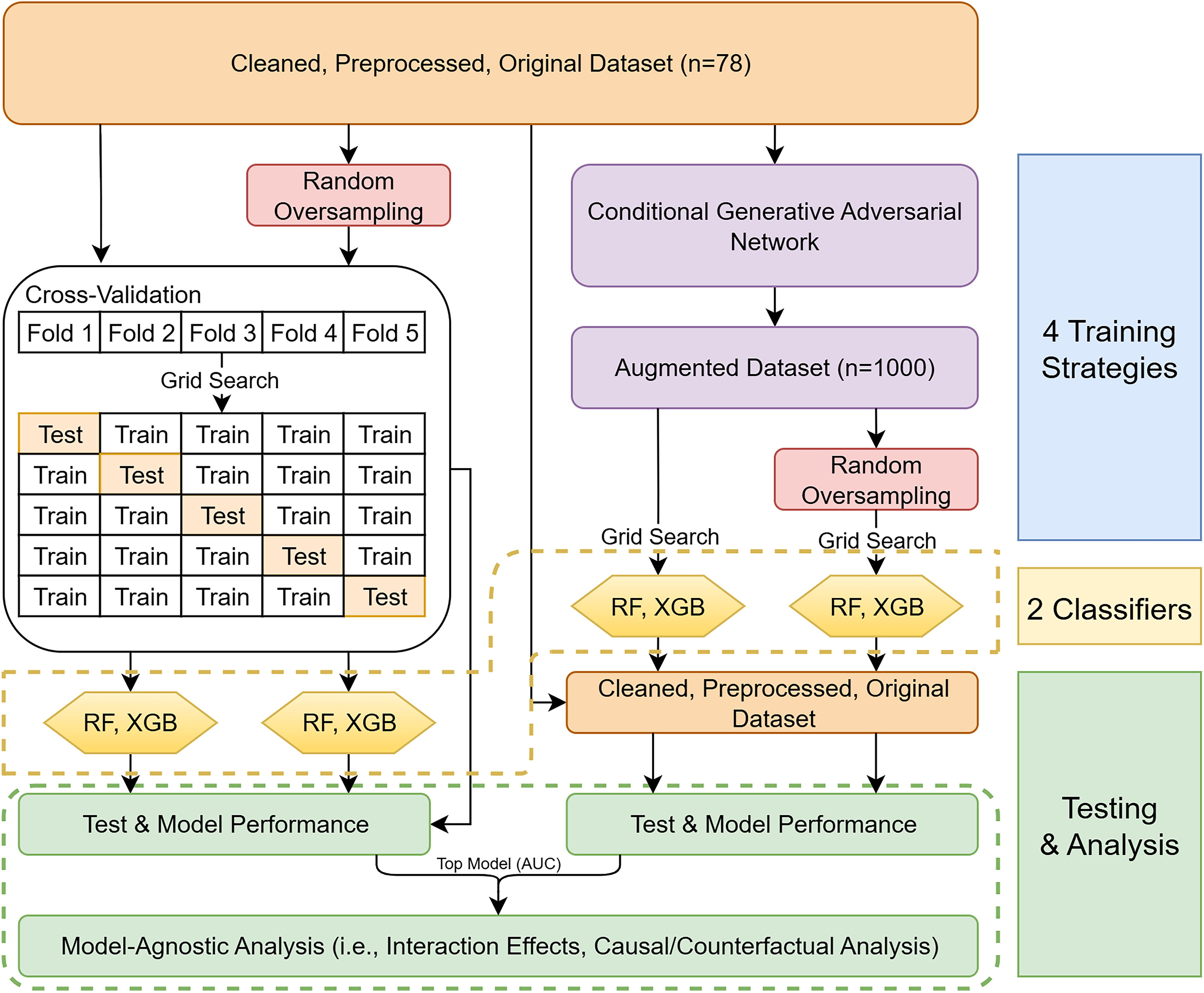
Workflow for generating and analyzing occlusion prediction models. RF, Random Forest, XGB, XGBoost, AUC, area under the curve.
Data collection and feature engineering
The original dataset was collected retrospectively and included clinical and procedural features of patients treated with the WEB device for cerebral aneurysms, such as patient demographics, aneurysm morphometry, device details, and occlusion rates across different time periods for three separate institutions. Any variable (including the target variable) with >70% missing data were excluded. Continuous and ordinal features were scaled with min–max scaling, and missing values were imputed using column-wise means for continuous variables. WEB device details included single-layer/single-layer sphere type and the final WEB volume. Procedural details included if re-sizing was required, stenting, intraoperative rupture, WEB abandonment, and if the procedure was related to ischemic stroke. Aneurysm details included its location (which was dichotomized into anterior and posterior locations), rupture, and morphometry such as height, width, 3D volume, orthogonal neck width dimensions, and maximum aneurysm diameter in any dimension. The final target variable was the 6-month occlusion grade (“6_mo_occ”), which followed the Bicêtre Occlusion Scale Score (BOSS): complete occlusion (0), opacification of the proximal recess of the WEB (1), neck remnant (2), residual flow inside WEB (3), and aneurysm remnant (4). The BOSS grade stratifies angiographic aneurysm occlusion status upon follow-up imaging. To allow for GAN training, the features and target variable—together totaling 19 variables—were separated into binary, ordinal, and continuous categories (Table 1).
Summary of Features Available for Synthetic Data Generation
SL devices are typically for elongated aneurysms based on morphology.
Mm, millimeters; BOSS, Bicêtre Occlusion Scale Score; WEB, Woven EndoBridge.
Generative adversarial network
Only the data that collected the target variable were used as the train set (n = 78). We used a conditional GAN (cGAN) to generate an augmented training dataset that preserves feature relationships without overfitting. The architecture (Fig. 2) includes two neural networks working against each other: a conditional generator and discriminator. The generator combines binary condition vectors with latent noise to produce synthetic data, which are evaluated against real data by the discriminator. The cGAN was trained in batches of 16 over 5000 epochs using a hinge loss function with gradient penalty for stability.

Architecture of the conditional Generative Adversarial Network (cGAN). The generator creates new, synthetic data samples by combining random noise (latent noise) and specific aneurysm-related features (e.g., binary variables). The discriminator acts as a quality checker and compares the generated data with real data from the original dataset to decide whether each sample is “real” or “fake.” Over time, the generator improves its ability to create realistic synthetic data that closely resembles the original dataset, yielding a much larger yet statistically similar augmented dataset.
To validate the synthetic data, the Kolmogorov–Smirnov test and Jensen–Shannon Divergence (JSD) analysis were used for continuous features and the target variable, while binary features were validated through frequency comparisons. To evaluate privacy preservation, we used Euclidean distance as a distance-to-closest-record metric, comparing synthetic-to-nearest-real-neighbor distances to real-to-real distances, in order to determine whether synthetically generated cases could potentially identify individual patients. 2D kernel density estimation (KDE) plots were also used to visualize distributions of original and synthetic data projected into the first two principal components using principal component analysis (PCA).
Predicting 6-Month occlusion
Tree-based models, particularly Random Forest (RF) and XGBoost (XGB), were used for the MC of the target variable, which had five ordinal classes based on BOSS. We selected RF and XGB, tree-based ensembles, as our classifiers given their strong performance on structured clinical data and compatibility with explainable AI methods. 17 Eighteen training features, including demographic variables, aneurysm morphometry, and procedural details, were used to predict the target variable. To assess the impact of cGAN data augmentation, we trained and tested RF and XGB classifiers under four conditions (Fig. 1). For the first condition, RF and XGB classifiers were trained on the original dataset using 5-fold cross-validation (CV). For the second condition, random oversampling was applied to balance the target variable distribution (positive control). These first two conditions yielded baseline models, as they were trained only on original data. For the third condition, we trained the RF and XGB classifiers on the large synthetic dataset (n = 1000) and tested them on the original dataset. For the fourth condition, random sampling was also applied to the target variable distribution in the synthetic dataset before training the two classifiers.
In total, we implemented eight models (two classifiers × four training strategies). Grid search was used for hyperparameter tuning. Accuracy, precision, F1 score, and AUC for each occlusion grade were obtained for model performance. We used global model-agnostic methods to interpret the top-performing model (highest AUC), where feature interactions were quantified using the H-statistic and partial dependence plots. Causal analyses were used to evaluate the causal impact of procedural variables on occlusion grades and the implications of filling the WEB to the aneurysm dome. Specifically, the causal treatment effects were analyzed as a function of the WAVe ratio, defined as the deployed (final) WEB device volume divided by the aneurysm 3D volume. 8 The continuous quantity serves as a proxy for intrasaccular filling and was used to evaluate its influence on occlusion outcomes.
Results
The cGAN generated 1000 samples that generalized appropriately to the original dataset, as seen in Figure 3: the 2D KDE plot illustrates strong overlap of the two datasets with slight divergences in the periphery. The distribution of the BOSS grade (target) in the augmented dataset aligned closely with the original (KS statistic 0.05, p > 0.98). Most continuous features, such as age, maximum aneurysm diameter and 3D volume, and final WEB volume, showed no significant differences in distribution (KS statistic < 0.10, p > 0.5). Aneurysm width and neck dimension had slightly higher KS statistics, but the distributions nevertheless had no significant difference (p > 0.15). The JSD confirmed these findings, with values under 0.35 for all continuous features, suggesting minimal differences. Binary features were also consistent between the original and augmented datasets. The privacy analysis showed that while the minimum distance-to-closest-record (1.93) was lower than the minimum real-to-real distance (3.53), the median and overall distribution showed that most synthetic samples remained sufficiently distant from original records. Therefore, there was no memorization; the 1000 synthetic cases did not include any real patient records from the original dataset, although some isolated samples may be flagged for privacy.

Comparison of original and synthetic data.
Figure 4 compares AUC values across different training approaches for predicting aneurysm grades and includes the RF and XGB classifiers. Both classifiers had the poorest average and class-specific AUCs under the baseline CV condition, although the performance slightly improved when oversampling. The discriminative power for both models improved across all grades when trained on the cGAN-augmented dataset, where adding oversampling had a negligible effect.
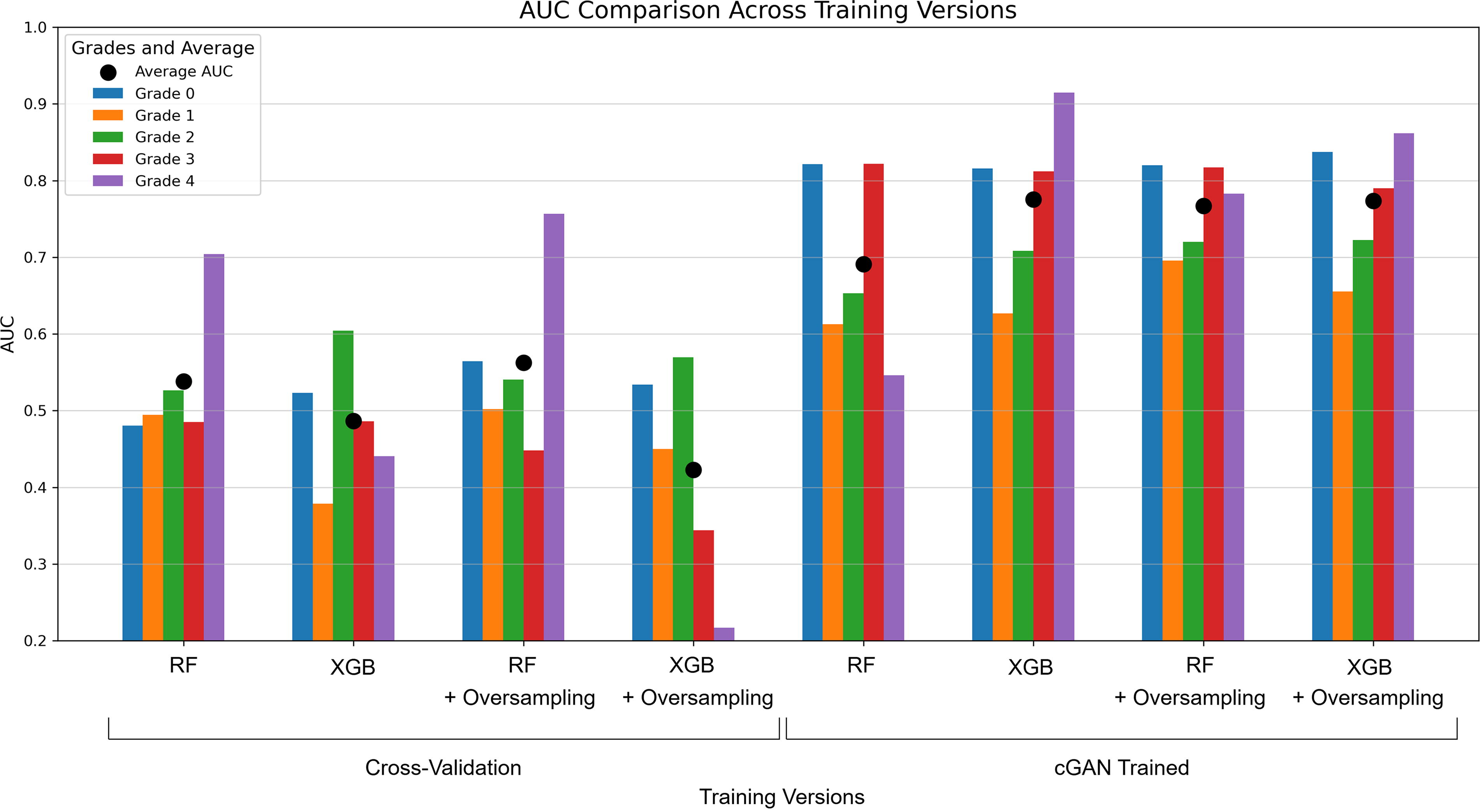
Area under the curve (AUC) comparison of RF and XGB classifiers across four training strategies: cross-validation (CV) on original dataset, CV + oversampling on original dataset, cGAN-augmented training, cGAN-augmented training + oversampling.
Table 2 tabulates the performance metrics for the RF and XGB models trained on the cGAN synthetic dataset (no oversampling) and tested on the original dataset. XGB had better overall discriminative capability over RF based on AUC, although there were noteworthy differences in model performance in learning specific aneurysm occlusion grades. Both models learned grades 0 and 3, with AUC values above 0.81 for both, although RF did much poorer compared with XGB in predicting grade 4 (0.55 vs. 0.91, respectively). However, RF maintained a slightly better overall balance in classification learning than XG. Regardless, the class-wise breakdown showed that XGB was more sensitive to minority classes, such as Grade 1 and 2.
Test AUC, Precision, Recall, and F1-Score of Random Forest and XGBoost Algorithms (Trained on cGAN Data) Across Each Aneurysm Occlusion Grade and Averaged
Average values for precision, recall, and F1-score are weighted averages. AUC, area under the curve.
As XGB was more robust compared with RF, it was used as the base model for the model-agnostic feature analysis. The greatest interaction effect across the input variables was between aneurysm average neck width and final WEB volume (H-statistic: 0.236). Their joint effect on the predicted probability of each aneurysm occlusion grade is depicted in Figure 5. Smaller aneurysm neck widths increased the probability for complete occlusion (grade 0) regardless of the WEB size, although this drops significantly as the neck width increases beyond 3.5 mm. In such cases, WEB volumes larger than 200 mm3 reduce the likelihood for residual flow inside the WEB (grade 3) or aneurysm remnants (grade 4).
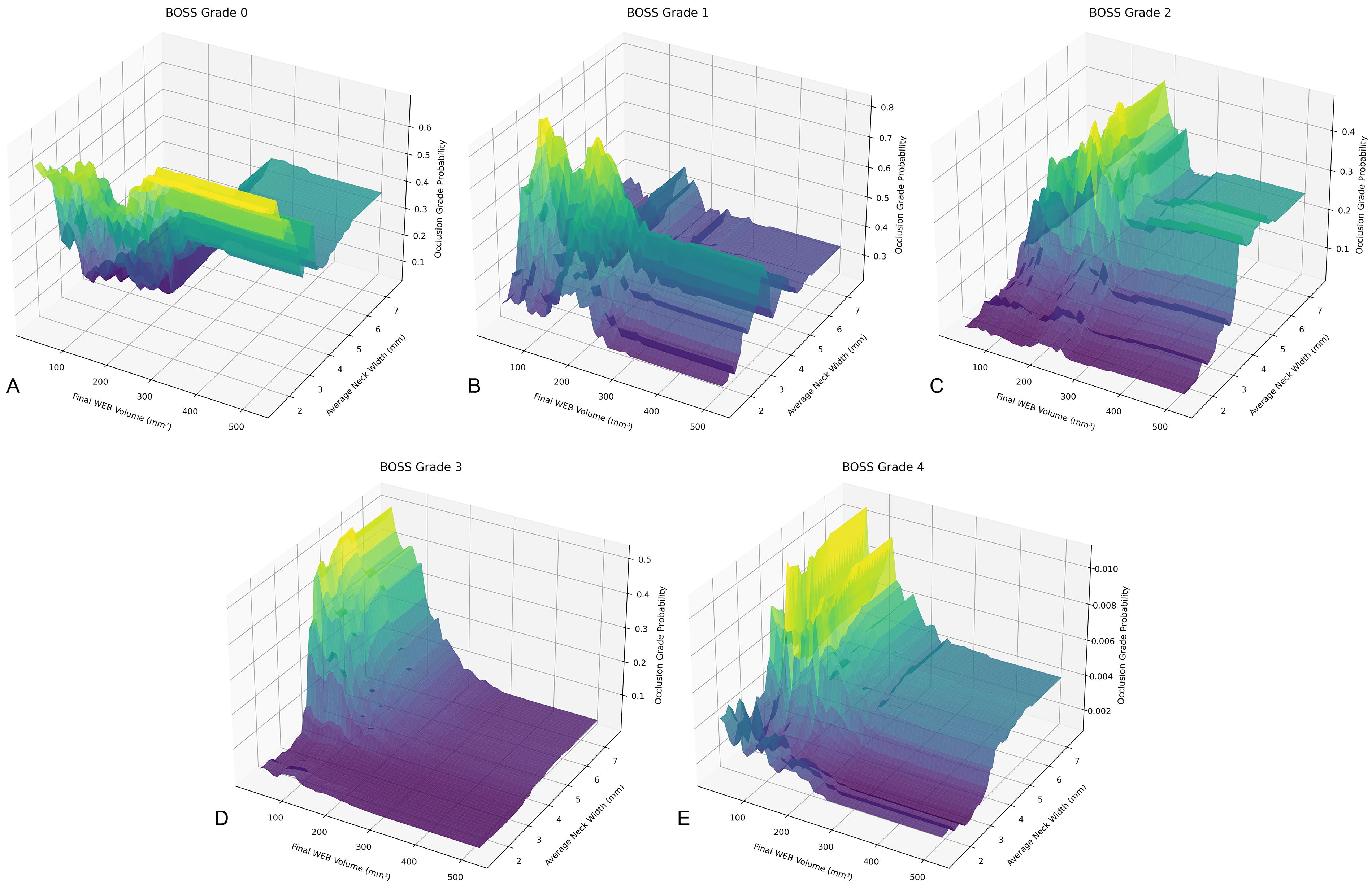
Interaction effects between final Woven EndoBridge (WEB) volume and average neck width on occlusion grade prediction by XGBoost.
The results of causal and counterfactual analyses of procedural features and WEB filling are depicted in Figures 6 and 7, respectively. In Figure 7, the marginal treatment effect analysis suggested diminishing returns in average occlusion probability beyond a 15% overfill of final WEB volume relative to aneurysm volume (WAVe = 1.15).
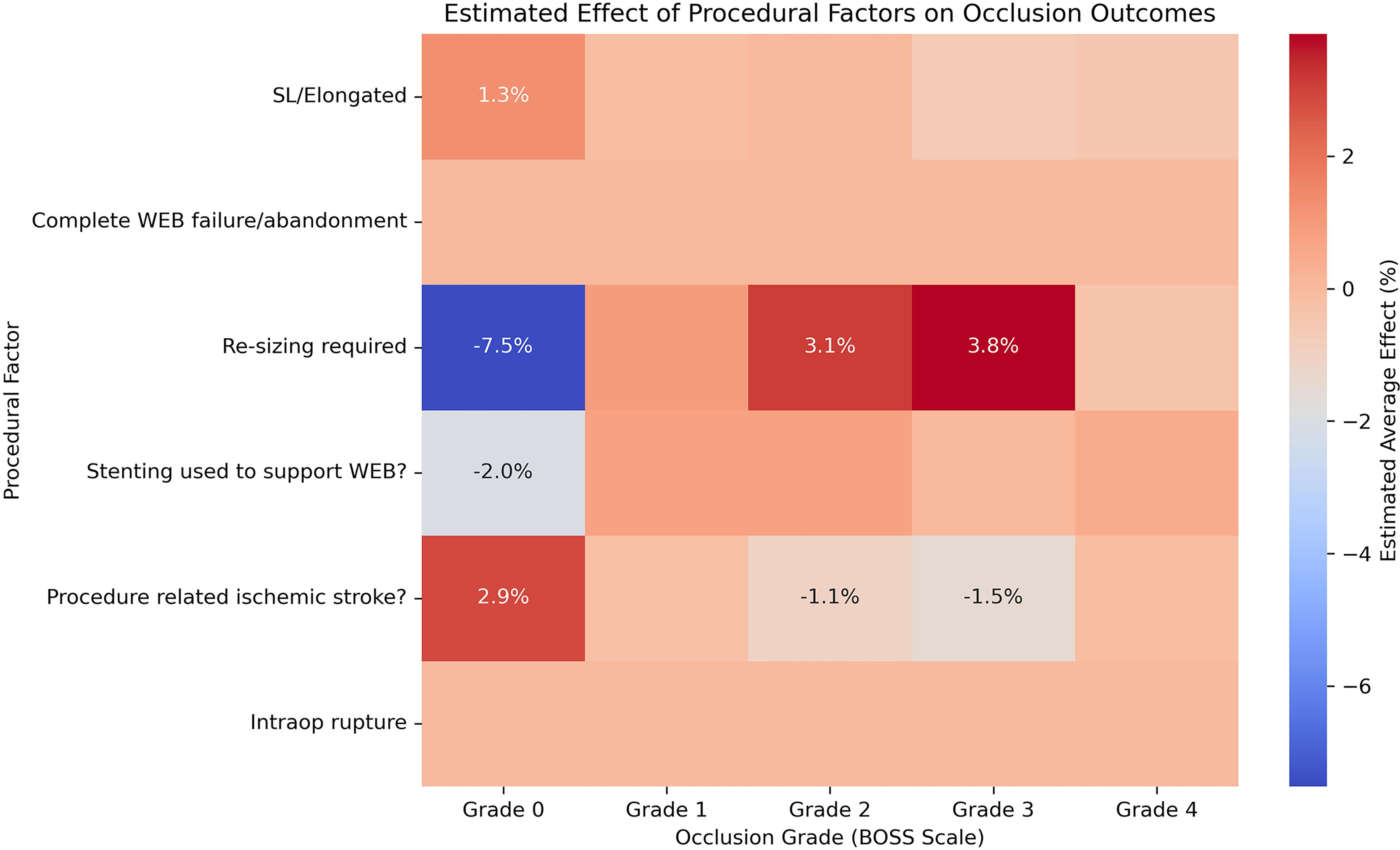
Heatmap of average treatment effect of procedural features on occlusion grades. Red shades mean positive causal effect (higher predicted probability), while blue means negative causal effects (lower predicted probability). Each cell represents the ATE value (threshold: 0.01), quantifying the impact of a procedural feature on the probability of a specific occlusion grade (e.g., 0.05 = 5% increase). Requiring WEB re-sizing lowered the probability of complete occlusion (Grade 0) by 7.5% but increased the likelihood of grades 2 and 3. Procedure-related ischemic stroke was associated with a 2.9% higher probability of achieving complete occlusion (grade 0).
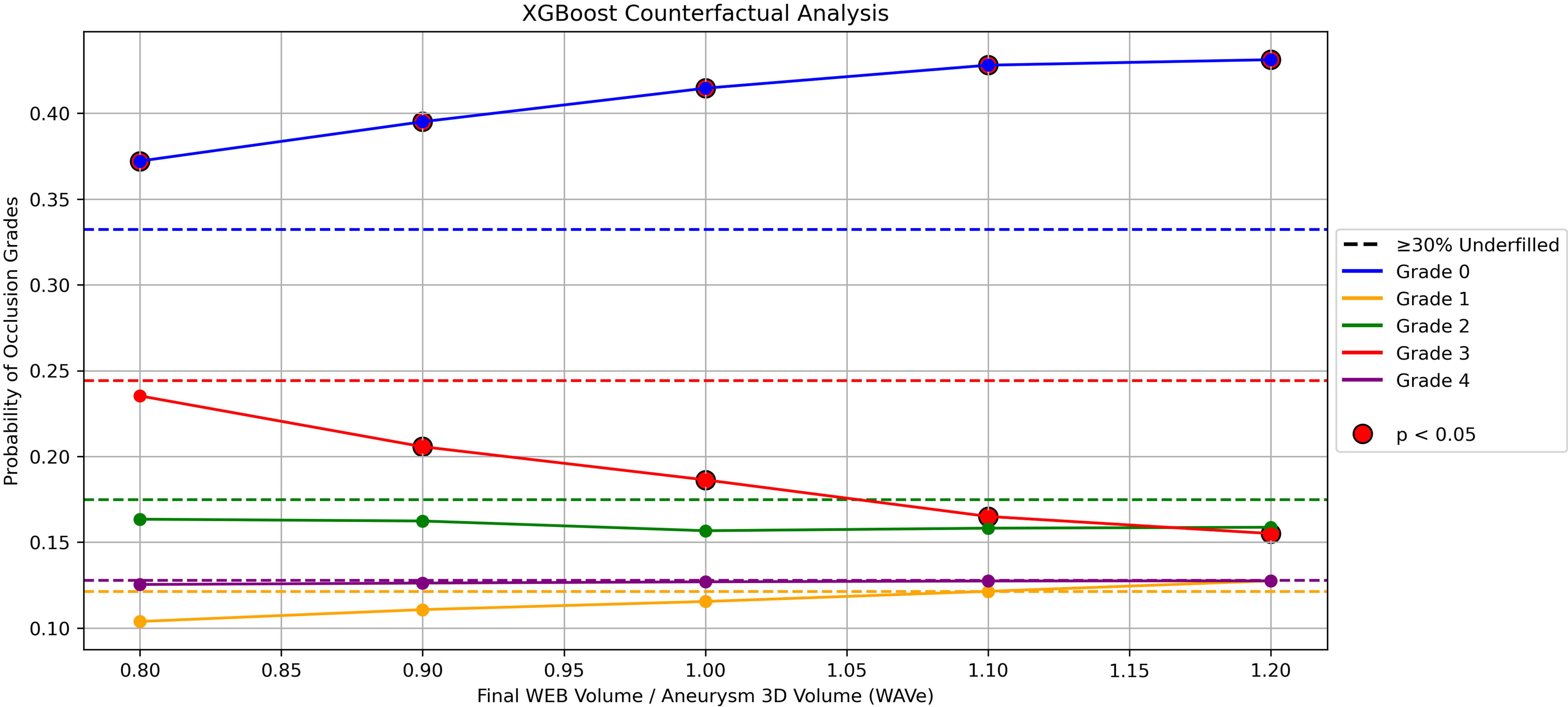
XGBoost counterfactual analysis of WEB filling. Dashed lines represent average probabilities in cases of ≥30% volume gap from the aneurysm dome. Solid lines represent average counterfactual estimates of occlusion probabilities for the same cases if the WEB filled from 80% to 120% relative to aneurysm volume (i.e., iWAVe ratio 0.80–1.20). Highlighted data points represent p < 0.05 by paired t-test. Increasing WEB volume relative to aneurysm size improved completed occlusion (grade 0) and reduced residual flow (grade 3), while probabilities for neck remnant (grade 2) and aneurysm remnant (grade 4) remained stable.
Discussion
This study demonstrates the use of synthetic data generation through GANs to improve the multiclass prediction of aneurysm occlusion outcomes after WEB embolization. GANs provide a reliable solution for data augmentation, enhancing the granularity of modeling clinical relationships and improving predictive analytics—especially in small or rare data regimes. XGB trained on the cGAN-augmented dataset demonstrated the best overall discriminative power and was ultimately used to interpret factors influencing WEB aneurysm occlusion. Specifically, the models suggest that aneurysm occlusion rates improve when aneurysm necks are smaller (especially when <3mm), although for larger aneurysm necks, occlusion rates can be slightly improved with larger WEB volumes and also when there is a ∼15% overfill of WEB volume relative to aneurysm volume (WAVe = 1.15).
The average neck width had the strongest influence on the XGB model based on the permutation feature importance, with its most significant interaction effect observed in the final WEB volume regardless of the final WEB volume chosen. However, as neck width reached 4 mm, the selection of the WEB volume had a greater effect on BOSS probabilities, with medium-to-large WEB volumes (200–300 mm³) slightly mitigating the model probability of residual flow; a WEB volume under 200 mm3 appeared to drive probabilities for proximal recess opacification or neck remnant. For larger neck widths >6 mm, smaller WEB volumes (<200 mm³) increased the probability of residual flow or aneurysm remnant. Regardless, increasing the WEB volume from 300 mm³ to 500 mm³ showed no meaningful improvement in outcome probabilities for large neck widths. The model insights agree with past analyses on the aneurysm neck, particularly the findings by Nawka et al., which describe that the WEB’s relationship with the aneurysm neck is the most relevant to determining 6-month occlusion outcomes. 18 Larger neck widths inherently deal with more occlusion challenges; although WEB devices should not be undersized in such cases, oversizing beyond 300 mm³ plateaus outcomes. 19
The causal analysis of procedural factors showed that WEB resizing caused a reduction in total aneurysm occlusion probabilities while resulting in more unfavorable outcomes. Pressman et al. (2024) similarly highlighted that incorporating volumetric measurements can minimize the need for resizing, and optimizing the WAVe ratio may further reduce the risk of unfavorable outcomes. 8
Poor model learning in clinically actionable categories, such as grades 0, 3, and 4, would result in a higher clinical risk, as these categories can shape decisions such as retreatment, escalation, or follow-up imaging. Fortunately, both models were able to effectively learn patterns for BOSS grades 0, 3, and 4, while they struggled in intermediate grades, especially grade 1. Notably, XGB demonstrated remarkably stronger performance than RF in predicting BOSS grade 4 (AUC: 0.914 vs. 0.546), likely due to its iterative error optimization that makes it more suitable in imbalanced data. 20 Regardless, although the AUC reflects strong rank-order discrimination, improving class-specific precision and recall (sensitivity) is necessary before reliable use. While the current model is not ready for clinical deployment, it has a promising framework that could be improved through additional modalities, such as imaging or time-series hemodynamic data. Future work could use multimodal approaches to integrate radiomic features from angiographic imaging with computational fluid dynamics (CFD) simulations that model patient-specific hemodynamics impacting aneurysm healing. 21
GANs offer a practical alternative by generating synthetic, HIPAA-compliant data to enhance machine learning model training.22,23 However, synthetic data in neurosurgery present some considerations around their use. The fidelity of synthetic data is a spectrum, requiring a balance between being too similar to the original data (risking redundancy and privacy violations) and diverging too much (resulting in a loss of real-world relevance). Effective synthetic data should be able to generalize well to unseen real-world data without memorizing the training set. The techniques we used to validate our cGAN-generated data, such as the KS test, divergence analyses, and KDE plot, ensure that the synthetic data matches the statistical distributions inherent to the original data, without data redundancy or memorization. Regardless, synthetic data only inherit the relationships and biases in their training environment, which might not capture the complexity of real-world relationships. In other words, until machine learning achieves a point of singularity, effective synthetic data generation is contingent on the quality of the training data.
While synthetic data generation can be a solution to privacy restraints with data sharing in neurosurgery, issues like overfitting, regression to the mean, and data memorization of the training set can themselves become a source of data leakage. Fortunately, in addition to using conditional GANs as we did, Differential Privacy techniques can be integrated into GAN workflows as a safeguard. 22 Transparency with the exact data generation techniques used, along with their evaluation approach, is equally important. The U.S. FDA’s AI/ML-Based Software as a Medical Device Action Plan does not contain provisions to oversee synthetic data. 24 A standardized approach to synthetic data generation is necessary to prevent inconsistencies in how it is evaluated, shared, and applied.
This study is the first of its kind to use data augmentation to build a multiclass prediction system of aneurysm occlusion after endovascular therapy. Model validation on an external dataset to assess generalizability across populations would be the next step. However, this study is limited by its focus on a single treatment strategy. In addition, the training set did not use multimodal data, such as radiomics or hemodynamic features, and its synthetic nature may limit its generalizability to other real-world datasets. While synthetic data augmentation improved class representation, the GAN was trained on the full dataset before generation, which may offer an unfair advantage when compared to baseline models trained from 5-fold cross-validation, where each fold is trained on only four-fifths of the data. Finally, the reliance on a single follow-up period also limits the scope, especially in capturing delayed recanalization events that may occur beyond 6 months and are typically underrepresented in existing prediction models; a future study can use recurrent neural networks to treat the follow-up as a continuum.
Conclusions
In this study, we demonstrate the potential of synthetic data generation in neurosurgery by using GANs for a MC model predicting specific aneurysm occlusion outcomes after WEB embolization. The XGB model, which was trained on a cGAN-augmented dataset over 10-fold larger than the original dataset, has strong predictive accuracy across all occlusion grades, especially in underrepresented outcomes. The model-agnostic analysis identified small aneurysm neck widths as a key determinant of better occlusion grade. It also identified that if neck widths are larger, occlusion grading was most improved with higher WEB volumes. Future studies can integrate multimodal data, such as auto-segmented imaging, and build clinical decision support systems.
Footnotes
Authors’ Contributions
S.B.: Conceptualization, methodology, software, validation, formal analysis, data curation, writing—original Draft, visualization. E.P., J.H.W., A.A.B., G.J.R., S.S., J.V.-J., T.S., P.Y., J.M.D., A.H.S., E.I.L., W.R.G., and M.M.: Conceptualization, methodology, validation, data curation, writing—review and editing. K.V.: Conceptualization, methodology, validation, data curation, writing—review and editing, supervision, project administration.
Institutional Review Board Approval Statement
This study was approved by the USF-TGH Office of Clinical Research Institutional Review Board (IRB) (Authorization number: 003508).
Code Availability Statement
Code and synthetic data can be accessed on GitHub: https://github.com/shrinitbabel/WEB-GAN-occlusion-prediction. Interactive: 
Data Availability Statement
Raw data will be available from the corresponding author upon request.
Author Disclosure Statement
The authors have no relevant disclosures.
Funding Information
This research received no external funding.