




Abstract
A sense of belonging in higher education is widely recognised as critical for student well-being, retention, and academic success. Foundation programmes play a key role in widening access and may enhance belonging for students transitioning to degree-level study, yet there is limited understanding of how belonging is experienced within these programmes and how pedagogical practices can support its development. To increase knowledge in this area this research explored how ‘sense of belonging’ is described and experienced by foundation programme students. Thirteen students enrolled on the Batchelor of Science in Health Sciences with Foundation at a UK university between 2020–2025, took part in focus groups and interviews. Data were analysed using thematic analysis. Three main themes were drawn from the data (1) stigma; (2) uncertainty, and (3) facilitators to belonging. While foundation courses provide essential access routes to higher education, the associated stigma and uncertainty reported can initially weaken students’ identity and sense of belonging. Through strong social support networks and efforts to maximise integration beyond the scope of the programme universities can foster a more inclusive and welcoming environment for those on alternative entry pathways.
Introduction
The concept of belonging in higher education often refers to a sense of connection, inclusion, and identification that students and faculty feel within an academic community (Allen et al., 2024; Blake et al., 2022; Wilson et al., 2015; Winter & Chapleo, 2017). The WonkHE/Pearson report (Blake et al., 2022) proposes that the concept of belonging is shaped by four interlinked components: connection, inclusion, support and autonomy. Belonging encompasses both social and academic dimensions, contributing to students’ overall well-being, academic success and choice of university (Wilson et al., 2015; Winter & Chapleo, 2017). Sense of belonging is enhanced by peer support and opportunities to interact with others (Allen et al., 2021; Hamm & Faircloth, 2005; Thornberg et al., 2022). The university environment affords these opportunities and fosters a sense of connection through on-campus teaching, activities, and events. However, as Gravett & Ajjawi (2022) highlight, physical spaces are not neutral. They do not always provide a positive experience and have been reported to contribute to exclusion and vulnerability. This can be particularly salient for students from under-represented or non-traditional backgrounds for whom higher education spaces may feel unfamiliar or exclusionary (Gravett & Ajjawi 2022).
Understanding ‘sense of belonging’ is a clear focus for universities as the impact on student wellbeing, retention and student outcomes is recognised (Crawford et al. 2024; Masika & Jones 2016; Pedler et al., 2022). Universities are identifying ways to improve belonging and enhance the student experience through robust data collection and analysis and fostering a culture of belonging has become a ‘strategic necessity’ as universities address increasing pressures to attract and retain students in a highly competitive sector (Morgan, 2024). Morgan (2024) suggests that embracing an inclusive pedagogy can empower the learning process. For example, the structure of teaching sessions can work to enhance connections between students, especially when the use of group work, interactive sessions, and small group teaching are utilised (Allen et al., 2021, 2024; Hamm & Faircloth, 2005). Furthermore, opportunities for both peer and teacher feedback have been indicated to help with confidence development and contribute to a sense of connection and support (Blake et al., 2022). The substantial review by Allen et al., (2024) also cites a range of inclusive practices such as such as using students’ names, maintaining instructor presence, responding to student needs and incorporating varied lived experiences to make course content more relatable.
Foundation courses are a significant resource in widening access to university by making it accessible to students who may not meet traditional entry requirements. This includes mature students, those from under-represented or disadvantaged backgrounds, international students, or learners whose previous qualifications are not directly aligned with their chosen degree. In doing so they promote greater equity, inclusion and social mobility (Freeman, 2024). They are designed to bridge the gap between prior education and university-led study by focusing on preparing students to enter their degree with a strong academic skill set as well as building confidence, study habits and social skills that mean they are better prepared for university life (Sanders & Daly, 2013; Webber 2023). These programmes can introduce students to university teaching styles, assessment methods, digital learning platforms, and academic culture. Many offer vocational options and allow students to explore a subject area before committing to a full degree, making students more informed about their career pathway and reducing drop-out rates (Simm et al., 2011).
Emerging evidence suggests that foundation years contribute to sense of belonging for students who continue to degree level studies (Law & Sheen, 2024), with one comparative study by O’Sullivan et al. (2019) showing students from disadvantaged backgrounds reported a greater sense of belonging and academic confidence attributed to the relationships they developed during their foundation year. Anecdotally, students report developing friendships and support networks, and gaining increased confidence in academic study during the foundation year. Yet to date the dominant focus of belonging research in Higher Education has been on experiences of students at university more broadly, rather than specifically foundation students (Crawford et al., 2024; Masika & Jones, 2016; Pedler et al., 2022; Wilson et al., 2015). There is limited understanding of how belonging is experienced by students who are or have participated in foundation programmes, what this sense of belonging might mean for them in terms of their foundation year and for their integration into university more broadly, or how inclusive pedagogical practices can enhance sense of belonging for these students. This gap in knowledge constrains efforts to design effective strategies that promote belonging and improve student outcomes for this group.
This paper is based on the experiences of students who studied on the Batchelor of Science (BSc) in Health Sciences with Foundation at the University of Nottingham between 2020 and 2025 (this included students on the foundation programme at the time of the research and those who had completed foundation and moved to their chosen degree programme). The course attracts an average of 30 student registrations each academic year. The foundation year is designed to support students who do not meet the usual university entry tariff and to equip students with the foundational knowledge and skills to prepare them for degree level study with professional registration for Nursing, Midwifery, Physiotherapy and Sport Rehabilitation. It provides a year to develop the academic, social and professional skills for successful degree completion and effective clinical practice as required by Professional, Statutory and Regulatory Bodies (PSRBs). To progress from foundation to BSc study, students must achieve a minimum grade of 60% across foundation year modules and successfully interview for their preferred degree programme.
Research Purpose
This research aimed to develop understanding of what belonging means to foundation students at the University of Nottingham on the BSc in Health Sciences with Foundation and explore how the development of belonging can be supported, and inclusive pedagogy be enhanced. It was guided by five research questions:
What does belonging mean to students? What role do students think the foundation course plays in their sense of belonging at university? How might the foundation course have supported/or not this sense of belonging? What else could be done as part of the foundation course to enhance belonging? What impact does this have for them moving through their degree pathway?
Methodology and Methods
The study employed a constructive interpretivist approach utilising a qualitative exploratory design (Rubin & Rubin, 2005; Tanlaka & Aryal 2025). This approach emphasises understanding how individuals create meaning through their interactions and experiences within specific contexts. Interpretivism assumes that reality is not fixed nor objective but is constructed through interactions, experiences, and contexts (Bazeley, 2021; Rubin & Rubin, 2005). This aligns with the study's focus on exploring variations in understanding and the practical implications of these interpretations. By adopting this lens, the study was able to capture the complexity of student perspectives, uncover underlying values and assumptions, and provide nuanced insights into the shared meanings of belonging (Rubin & Rubin, 2005).
Focus groups and interviews were used to generate data (Mason, 1996). Focus groups are used to gather diverse perspectives, experiences, and insights from participants to better understand complex educational issues (Vaughn et al. 1996). Constructionism recognises that, during focus groups, participants and the researcher work together to co-construct an understanding of the topic under study (Bazeley, 2021). It is important to be cognisant of group dynamics and power relations, but the group setting allows participants to engage with each other and for the researcher to identify areas of consensus (Krueger & Casey, 2000).
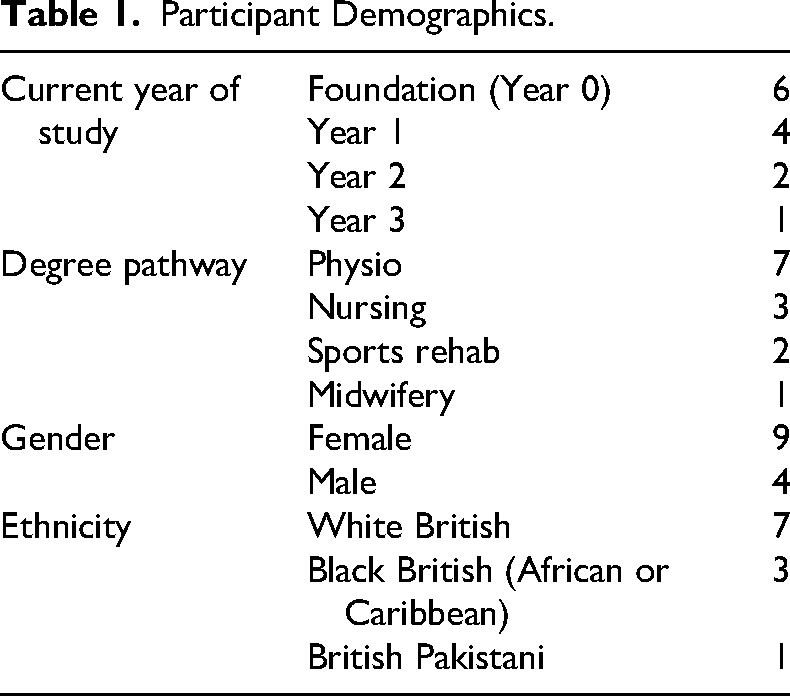
A total of 13 students participated in the study. Twelve in three focus groups (group 1 n = 7, group 2 n = 3, and group 3 online n = 2) and one individual online interview. Participants were asked to note their degree pathway, their year of study and how they identify in terms of gender and ethnicity, see Table 1 for participant demographics.
Participant Demographics.
Written consent was provided by all participants either via email or hard copy. Group rules regarding respect and confidentiality were discussed and agreed prior to the start of the focus group. Permission to audio record with a digital device or via the video platform (MS Teams©) was also agreed. An interview topic guide was used [see supplementary information], but this was flexible and tailored for each focus group, and the individual interview. At the start of each focus group and the interview, students were invited to share what ‘belonging’ meant to them, without reference to any specific setting or context. This served both as an introductory exercise and as an opportunity for participants to collaboratively establish a shared understanding of the terminology. By learning participants’ understanding of the term belonging, the researcher was also able to align their perspective with that of the participants.
The interview and focus groups were between 19–50 min in length and took place in February and March 2025. Following each, EW made summary notes and spent time reflecting to improve questioning and identify potential areas of further investigation (Bazeley, 2021). Transcription was undertaking using Microsoft Word automated transcription and those conducted online were automatically transcribed in the online platform (MS Teams©).
The main ethical concern was to recognise and acknowledge was the power imbalance between student participants and EW as a member of teaching staff on the foundation programme and the principal researcher, particularly for the current students part way through the programme. As such, potential participants were approached by other teaching staff, to reduce the risk of coercion and enhance anonymity prior to participation. All participants were assured that their participation was voluntary and would not impact assessments outcomes or disadvantage their studies. It was important to recognise the limits of anonymity and confidentiality when utilising focus groups, as although participants were asked to keep group discussions private, this could not be guaranteed. Additionally, anonymity was not fully assured since other involved students knew they had participated. In contrast, individual interviews offered greater confidentiality and anonymity. The identities of the students were only known to EW and all data were anonymised prior to sharing with the wider team.
Findings
As part of the analysis a word cloud was generated to visually represent the breadth of terms and concepts identified when participants were asked specifically about what ‘belonging’ meant to them. Participants listed 29 descriptors that they considered to be part of ‘belonging’. Repeated or similar responses were then grouped and a word cloud created to illustrate the more frequently used terms (larger font) and the breadth of responses given (see Figure 1).
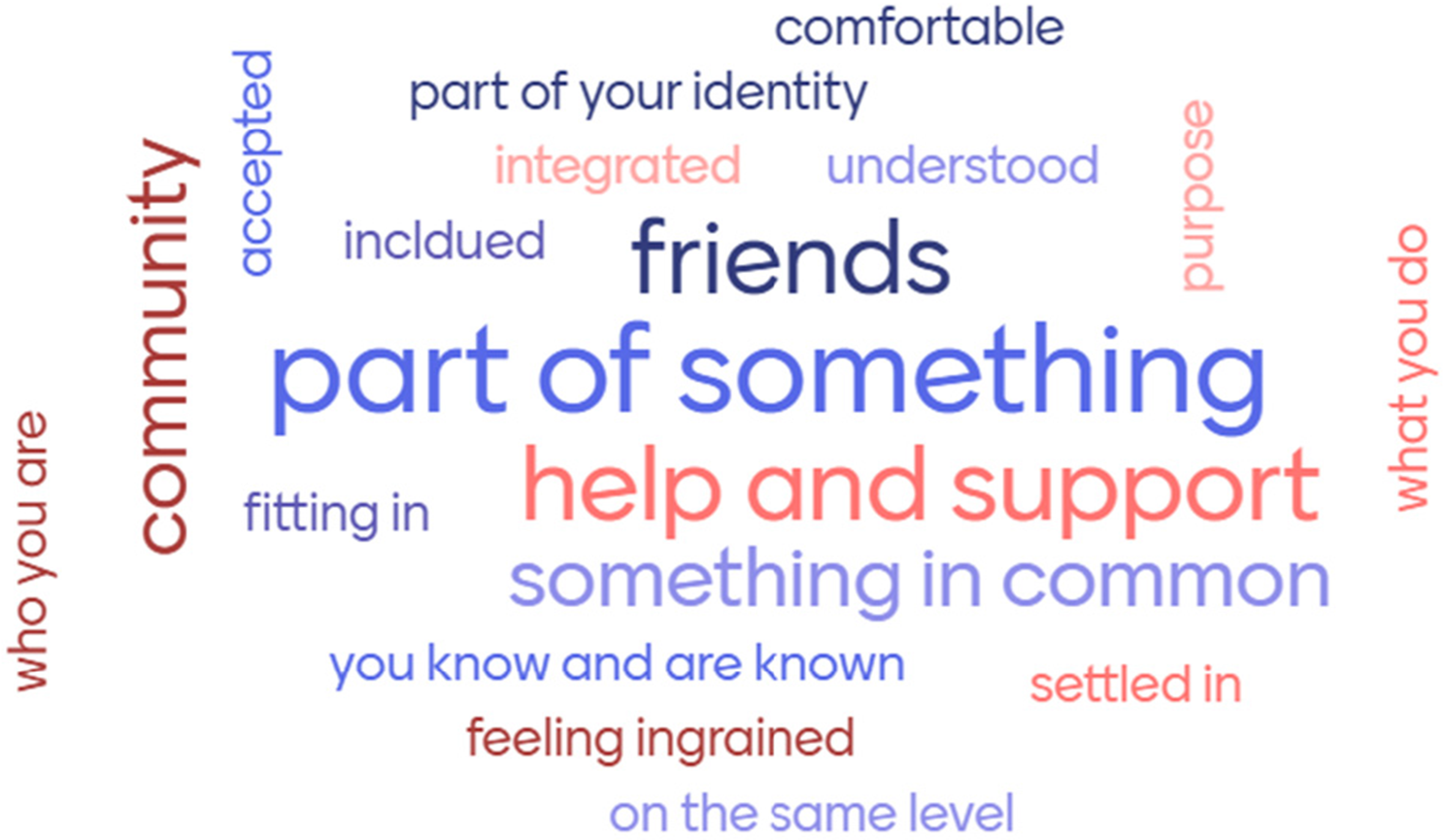
What belonging means – word cloud.
The thematic analysis of the group and interview data identified complex stories and integrated themes beyond the scope of this paper. The focus here is on the three consistent qualitative themes and their significance for pedagogical development of foundation programmes: (1) stigma; (2) uncertainty, and (3) facilitators to belonging.
Stigma
All participants acknowledged and recognised some element of stigma surrounding undertaking the foundation programme. This stigma is described as both implicit and internally negotiated, shaping how students understand themselves and anticipate or interpret interactions with others. Many reported finding other ways to respond to questions about their course or reported to ‘dodge’ the question.
P1: I feel like there's a bit of a stigma around foundation courses though, because like you're not good enough to be at uni[versity]
P3: I'll tend to dodge saying it's a foundation. (Focus Group 1) [it's just] immaturity of other people, but I think it's the nature of stigma around doing a foundation year, of how it's seen as, or what we have done. We didn't get the sixth form grades needed, and stuff like that. So I think the feeling of not belonging is due to …that. (Focus group 2)
Uncertainty
Coupled with the perceived stigma, participants also highlighted the innate uncertainty associated with the foundation year and the significant impact this had for ‘settling in’, joining clubs and making friendships. The recognition that they would need to still apply for their chosen degree, resubmit to the UK Universities and Colleges Admissions Service (UCAS) for alternative options, undertake an interview and achieve a 60% grade on the course to progress to their BSc programme created great uncertainty, and by association, impacted negatively on identity and sense of belonging at university. Well, maybe not jump too far ahead because I may not be here next year, so I feel like the belonging is kind of, it's just very uncertain because you're not too sure if you're gonna be [here for] the next couple of years. (Focus Group 2) I didn't join any societies I didn't like, really get to know [place] as a city because, I personally felt insecure and felt that I wasn't gonna make it. …I don't want to feel sad leaving all these people behind, but I still made friends and things, but I was kind of like, oh, guys, by the way, I might not be here next year, so I didn't get a house with them because I didn't think I was going to stay. And now in first year I've joined like societies, and I've become more integrated. (Focus Group 3) Especially for housing because, obviously everyone starts to like get houses and stuff, and then you're having to hold back on it because you don't know 100% if you're going to get in. (Focus group 3) When you knew you were on the course and then you kind of feel that you can settle in a bit more. … I guess you know where you're going to be for three years. There's that sense of stability. You're able to build connections within the class because you know that those may end up being long lasting. I think I felt more confident. (Interview)
Facilitators to Belonging
When asked about physical spaces across campuses, all participants agreed there were no places they felt they did not belong. Some highlighted specific places they felt a particular sense of belonging, including the gym and sports facilities, certain libraries and social clubs. Sport and social clubs and societies were considered crucial ways to enhance sense of belonging in their area of interest, but also at university as a whole. Physiotherapy and Sports Rehabilitation students noted the efforts made by their society to increase recruitment of foundation students and include them in social activities. This was alongside making and maintaining friends from the foundation course and gaining wider friendship groups as they progressed on their chosen programmes. I integrated myself into like the sports community as well. That's what I did. And I felt like that really helped me actually feel, my place at the uni[versity], like committing myself. (Focus group 2) Speaker 1: Societies are fun. Speaker 3: They don't judge you for being a foundation year. Yeah. They really because they're just happy to have more people. We both do [course] Netball. … because it's quite a small society as well. Like, everyone gets to know each other. (Focus Group 1) we're not sure if we're going on to the course, but I feel like obviously in first year for Physio we get like 1/2-day observation in the field. I think that'll be really good for foundations years to like, solidify what you want to do because when I was in foundation, I didn't know if I wanted to go into sports rehab or actually physio, but that's something like that would give me like insight into what a physio does and maybe confirm that I want to do physio instead of sports rehab. (Focus group 3) However, I will say the foundation here for me personally has made me feel I belong in the sense that, so I have a learning difficulty, and in the sixth form, there wasn't that much support for me, but here, in the foundation year, there is so much support on offer for me, and I remember I have conversations with [the course lead]. She would just keep on checking on me to ask me if I'm OK and if I do need extra support or is there resources she can give to me to help with my [work]. (Focus group 2)
Discussion
Sense of belonging was explored with 13 students who were undertaking or had undertaken a foundation year. They identified 29 descriptors they associated with the concept. Primarily describing ‘belonging’ as being ‘part of something’. As definitions of belonging have lacked ‘conceptual clarity and consistency’ in the literature (Allen et al. 2021:89) it was important for participants to generate their own mutual understanding of the term for the purposes of the discussions.
A key challenge for students in this study was the stigma associated with the foundation year. Goffman defines stigma as an attribute that ‘taints’ or ‘discredits’ someone, this is socially constructed and dependent on what society defines as ‘normal’ or ‘acceptable’ (Goffman 1963). Participants expressed concerns that the foundation programme was viewed as a ‘lesser’ entry route, leading some to avoid disclosing their course. Shaw et al. (2019) identified similar feelings in America students transitioning from community colleges to university courses. Those from community college backgrounds reported feeling ‘not good enough’ to be at university. The students in this study employed a range of the management techniques highlighted by Goffman's work; by hiding or minimising the visibility of their affiliation to the foundation course (‘passing’ or ‘covering’) or seeking support from others in the same situation (‘group affiliation’) (1963). In line with Simm et al.'s work, this stigma created feelings of exclusion and self-doubt, reducing students’ confidence in their place at university (Simm et al., 2011). As such foundation courses play a complex role in shaping students’ sense of belonging (O’Sullivan et al., 2019). While they provide a crucial pathway into higher education, they also present unique challenges that can hinder students’ ability to fully integrate into university life (Sanders & Daly, 2013; Webber, 2023).
As students in this study highlighted, uncertainty surrounding progression contributed to a weaker sense of belonging. Unlike direct-entry students, participants faced the prospect of reapplying for their chosen degree, meeting progression requirements, and adjusting to potential future changes. This lack of stability made it difficult for them to fully engage in student life, as they were unsure whether they would remain at the university beyond their foundation year. The impact of this uncertainty extended to social integration, with students finding it harder to form lasting friendships and participate in extracurricular activities. Once their degree course was confirmed students were able to embrace a range of ways to integrate within the university (Sanders & Daly, 2013).
Despite these challenges, foundation courses also introduce facilitators to belonging such as opportunities for social engagement, participation in sports, and student societies, providing students with spaces where they feel included (Allen et al., 2021). Friendships formed during the foundation year can continue into later degree programmes, helping students transition into university life. Additionally, efforts by foundation staff to integrate students through structured group work, peer networking and academic support can enhance their sense of connection to the wider university community and build confidence in their abilities (Thornberg et al., 2022; Tierney & Slack, 2005). Social Identity Theory can be utilised to underpin the development of foundation programmes and reduce uncertainty by encouraging students to identify as a group (Tajfel and Turner 1979). Studies suggest that social identity, and identification with group membership and group norms can promote collective resilience (Drury et al., 2019). Such shared experiences and perspectives can instil a feeling of connection and enhanced sense of belonging. However, studies also suggest that social identity, social group membership and identification with being part of particular groups can also have negative effects, including potential to trigger feelings of being unworthy, incapable, and unsupported (Wakefield et al., 2019). This schism between group membership, identification and adoption of group norms as both potentially helpful, and potentially problematic has been called the ‘social cure’ and the ‘social curse’ (Wakefield et al., 2019). Such nuanced dynamics of group membership are evident in the findings, with students reporting that identifying as foundation students enabled support and helped foster a sense of belonging but also could risk potentially feeling stigmatised and uncertain. Because group membership and active identification with a group can have this dual quality, it has been proposed that membership and identification with multiple groups may have a protective effect on wellbeing (Iyer et al., 2009). To overcome this potential dual quality of group identification, students could be encouraged to seek to integrate identification as a foundation student into their personal sense of self, to reconcile old and new identities, alongside active encouragement to develop affinities with multiple group memberships (such as foundation students being encouraged to connect with university societies representing students enrolled on the BSc degrees, e.g., the Physiotherapy and Sport Rehabilitation Association society (SUPRA)) (Ahn & Davis 2020; Masika & Jones 2016).
These findings provide significant insight into the complexities of belonging when undertaking a foundation course. By illuminating the student's experiences of perceived stigma, and uncertainty it provides a better understanding of the challenges and varied experiences faced in transitioning into a university environment with this pre-degree identity. This provides opportunity for improving integration support, including clear expectations and routes to success, as well as encouraging engagement with social groups to enhance belonging. As Simm et al. (2011) note the capacity for foundation students to belong in the university environment influences their academic performance, as well as their retention and completion rates (Morgan, 2024; Pedler et al., 2022). Capper and McVitty (2022) report that “students’ self-assessed mental health was most consistently and dramatically associated with their sense of belonging across all the different dimensions” of their UK-wide survey. While this does not tell us if mental health is influenced by sense of belonging or vice versa, we support the recommendation that mental health, wellbeing, equity, and inclusion efforts are integrated. Approaching these elements together will foster a stronger sense of belonging.
This study extends current literature on belonging in higher education by focusing on the experiences of foundation year students, a group often overlooked despite their unique challenges. It specifically highlights how belonging is shaped by alternative entry routes and progression requirements. While previous research has emphasised the importance of belonging for retention and wellbeing, our findings highlight two distinctive barriers, stigma and uncertainty. While stigma has been discussed in other contexts, this study shows how perceptions of being on a “lesser” pathway and uncertainty about progression significantly undermine belonging for students entering through alternative pathways (Shaw et al., 2019). In addition, the study identifies practical facilitators, including inclusive pedagogical practices such as group work and small class teaching, and opportunities for social integration through societies and sports clubs (Crawford et al. 2024; Masika & Jones 2016). This practical insight extends theoretical discussions into actionable recommendations for educators. By applying Social Identity Theory (Tajfel and Turner 1979), we offer a nuanced interpretation of how group membership can both support and hinder belonging, illustrating the dual potential of identity as a ‘social cure’ and ‘social curse’ (Wakefield et al., 2019). These insights contribute to the development of targeted strategies to enhance belonging within foundation programmes, reinforcing its strategic importance for widening participation and improving student outcomes (Allen et al. 2024; Morgan, 2024).
Limitations
The research benefited from the inclusion of a range of students from across all years, current and post-foundation. This was a small-scale project within a set time frame. A key limitation is the reach and spread of participants. The majority of participants were students on or planning to access the physiotherapy degree programme. While proportionally this reflected the spread of students on the foundation course, it would have been preferable to include more students from other courses, especially post-foundation years to understand if they have different perspectives or experiences.
Those less confident to share their experiences may not have taken part in the research. Likewise, while care was taken to actively involve all those in the groups, some may not have felt comfortable sharing some aspects of their experiences in this context. Although individual interviews were offered as an alternative way to participate, further research would benefit from providing different options for data collection to minimise these effects. While the flexibility of the design was of benefit to study participation it should be recognised that different forms of data collection may have impact for the nature of the data collected, however we do not feel this has affected the credibility of the data.
Implications for Teaching Practice
A direct implication for the foundation team at the [University] has been to initiate small group semi-structured discussions with students during the first term and towards the end of the foundation year. These allow exploration of student experiences of belonging, enable co-creation of strategies to maximise belonging and provide further opportunity to engage with peer support beyond the focus of the course. It is expected this will foster a stronger sense of cohesion over time, encouraging students to return and share their experiences as part of our ongoing peer mentoring initiatives. This sharing of experiences has the potential to support and embolden students who are struggling with their sense of belonging (Shaw et al. 2019).
Further efforts to enhance peer mentoring programme are also being implemented. Feedback from students from across the school suggests mentors often find it difficult to build connections with their mentees through online communication alone. Student Experience Co-ordinators hope to help mentees better engage with the programme by increasing visibility and creating opportunities for peer mentors to be present in relevant teaching sessions. They are inviting staff to consider whether the presence of a peer mentor might add value to teaching sessions, such as to provide a brief introduction or be more involved in a specific activity.
Opportunities such as these could be adapted to suit a range of foundation level programmes at any university. This research has identified several broader implications for teaching practice. It is evident from both the literature and this research that group work plays a vital role in effective pedagogy, helping students form strong connections with one another and we would emphasise its importance within foundation-level teaching. Directing students toward social and sports clubs is another valuable way to help them engage and integrate more fully with university life and enhance their sense of belonging beyond their foundation programme. Recognising and embracing that foundation programmes have an integral education role that promotes access and prepares students academically and personally is vital for long-term success in higher education. Further research focused on the links between mental health and belonging for foundation students would be an important development, and an essential means for understanding student support.
Conclusion
While foundation courses provide essential access routes to higher education, the associated stigma and uncertainty reported can initially weaken students’ identity and sense of belonging. However, through strong social support networks and efforts to maximise integration beyond the scope of the programme, universities can foster a more inclusive and welcoming environment for those on alternative entry pathways.
Supplemental Material
sj-docx-1-bel-10.1177_30290805261454153 - Supplemental material for Experiencing and Enhancing ‘Sense of Belonging’ in Foundation Year Programmes: Student Perspectives
Supplemental material, sj-docx-1-bel-10.1177_30290805261454153 for Experiencing and Enhancing ‘Sense of Belonging’ in Foundation Year Programmes: Student Perspectives by Eleanor Wilson, Matthew Horrocks, Lesley Halliday, Zoe Tilley, Ruben Sezen and Samantha Ravenall in Belonging
Footnotes
Acknowledgements
We thank all the students who so willingly gave their time and shared their experiences. We also thank the Student Experience Co-Ordinator's for sharing their plans to improve the peer mentoring programme in the school.

Ethics Considerations and Informed Consent
Ethical approval was granted by the University of Nottingham Education Department in line with the British Education Research Association (BERA) guidelines as part of EW's Postgraduate Certificated in Higher Education (PGCHE) (Ethics Ref: EDUC4265_UNUK_FYR1_24-25_2).
Author Contribution(s)
Funding
EW's PGCHE was funded by the University of Nottingham.
Declaration of Conflicting Interests
The authors declared no potential conflicts of interest with respect to the research, authorship, and/or publication of this article.
Data Availability Statement
The data generated and analysed during the study are not publicly available. Data sharing was not included in the ethical approval as the study involves personal accounts of student's experiences. Sufficiently anonymised parts of the data are available from the corresponding author on reasonable request.
Supplemental Material
Supplemental material for this article is available online.
References
Supplementary Material
Please find the following supplemental material available below.
For Open Access articles published under a Creative Commons License, all supplemental material carries the same license as the article it is associated with.
For non-Open Access articles published, all supplemental material carries a non-exclusive license, and permission requests for re-use of supplemental material or any part of supplemental material shall be sent directly to the copyright owner as specified in the copyright notice associated with the article.
