




Abstract
Using qualitative data from a longitudinal, mixed-methods case study, this study examined (a) students’ perceptions of the relationship of self-efficacy and sense of belonging and (b) belonging-related elements of learning environments that influence self-efficacy in engineering. Findings show the co-constituted nature of self-efficacy (SE) and sense of belonging (SB) within engineering learning environments. Students perceive SE as critical for SB in engineering, while belonging-infused learning environments provide infrastructure for SE to develop. Implications include the need to conceptualize SE as a component of SB in academic contexts as well as pedagogical strategies that promote SB.
Keywords
Introduction
Large scale quantitative research confirms the importance of self-efficacy (SE) and sense of belonging (SB) for student success and retention in higher education (e.g., Hausmann et al., 2007; Marra et al., 2009; Mattanah et al., 2012; Walton & Cohen, 2007; Walton & Cohen, 2011). Those constructs have proven to be especially important in engineering. For example, in a sample of 2,253 first-year engineering students, Graven et al. (2025) found that sense of belonging and self-efficacy were two of the strongest non-cognitive variables predicting engineering course performance two years later. Furthermore, in engineering fields, where women and students of color are often underrepresented (Trapani & Hale, 2019), students have shared experiences of differential self-efficacy (Marra et al., 2009) and sense of belonging (McGee, 2016) tied to identity. Scholars suggest SE may be lower for students not because of cognitive capacity but because of differential belongingness features of learning environments, such as relationships, inclusivity, and support (Foor et al., 2007; McGee, 2020; Park et al., 2020). Fostering learning environments that cue both SE and SB, therefore, is critical for supporting equitable student learning, inclusion, and retention both broadly in higher education and specifically in engineering.
At the same time, SE and SB have often been studied as joint independent variables supporting other outcomes (Aelenei et al., 2019; Apriceno et al., 2020, Graham et al., 2023), though evidence suggests that SE and SB are related. Graven et al. (2024) found SE and SB (in both college and engineering) were significantly, positively correlated for over 3600 first-year engineering students. At the same time, less scholarship examines how SE and SB work together in learning environments, especially from students’ perceptions.
In our own five-year study of belonging in engineering, students reflected on the connections between SE and SB in their academic experiences (Buckley, 2025; Buckley et al., 2021; Buckley et al., 2023; Buckley et al., 2025; Tretter et al., 2025). Mia noted in her first year that when she was “struggling” in class, she would question herself, “Oh, do I belong? Do I belong? Do I belong?” Driven by self-doubt, she asked the instructor to put her in a class group with women where she would potentially avoid “being treated like I'm stupid or like I'm dumb.” In her reflections, Mia alluded to the ways in which her academic SB could hinder belonging, but also noted her strategy to engage a form of social belonging—having supportive peers, especially of similar identity—as a protective factor for self-efficacy. In other words, SE and sense of SB were intermingled in her academic experiences.
This study, therefore, seeks to examine in depth the understudied relationship of SE and SB in engineering, asking the following research question: How do students understand the relationship of self-efficacy (SE) and sense of belonging (SB) in engineering learning environments? Results from the study can inform critical components of learning environments broadly but especially in engineering where almost 50% of students leave before graduating, suggesting need to examine factors that may support persistence, such as SE and SB. Further, simultaneous dynamics in engineering of (a) complex cognitive content and low grades that may not accurately represent one's capability (cueing limited SE) (Geisinger & Raman, 2013) alongside (b) a traditionally White, masculine field (cueing limited SB) (McGee, 2016), suggest the need to examine ways the two inform one another especially in engineering—a field which some argue is critical for the global infrastructure of society (Geisinger & Raman, 2013). This study, therefore, examining the interrelationship of SE and SB, provides evidence of ways to foster learning environments that cue both SE and SB, supporting equitable student learning and retention in engineering and beyond.
Theoretical Frameworks
The concepts of SE and SB grounded the study. Bandura (1997) defined SE as “beliefs in one's capabilities to organize and execute the courses of action required to produce given attainments” (p. 3). While the work of SE delineates four well-researched areas of mastery experiences (performing a task), vicarious experiences (observing others in performing a task), verbal persuasion from others, and physiological and affective states (physical/emotional experiences related to task performance) (Bandura, 1997, p. 77), aspects of our data did not fit neatly into the pre-existing categories. Therefore, in coding, we allowed for emergent rather than a priori coding related to experiences where students described beliefs in their abilities. The discussion provides further explanation of ways in which data extend notions of SE beyond the traditional post-positivist delineations.
Similarly, the concept of SB, often defined as feeling valued, connected, and supported within environments (Strayhorn, 2019), informed study design. In this study, we examine academic belonging—a sense of belonging to or within a specific academic domain—specifically in engineering, a broad context that has many sub-contexts (e.g., engineering peers, disciplinary specialties, classrooms, and internships) (Buckley et al., 2023; Strayhorn, 2024). Therefore, in analysis, we identified SB through students’ discussion of their perceptions of feeling valued, connected and supported in engineering contexts. We employed the concepts jointly to examine how students described the relationships between their sense of support or connection in engineering alongside their beliefs in their engineering abilities.
Literature Review
Before describing the study, we examine literature on both SB and SE, especially in engineering, describing ways in which this study contributes to scholarship in both areas.
SB and SE: Separate Constructs in STEM and Engineering
Scholars have well-examined the role of SB in engineering, with findings suggesting that limited SB is related to decreased student performance (Weaver et al., 2016) and varies across identities, with minoritized students finding less SB in the discipline (Foor et al., 2007; Geisinger & Raman, 2013; McGee, 2020; Tate & Linn, 2005; Williams et al., 2026). Factors, such as positive peer interactions and positive climate contribute to SB in engineering (Buckley et al., 2023), as do cultures and practices of growth mindset (which cue intelligence as malleable) (Williams et al., 2021). In addition, identity-based STEM organizations can support SB for students who may be minoritized and question their SE (Rodgriguez & Blaney, 2021). At the same time, factors such as discrimination (Park et al., 2020), climate (Tate & Linn, 2005; Williams et al., 2026), and structural barriers (Foor et al., 2007) all can diminish SB. In addition, limited representation of minoritized faculty in engineering, especially women of color (Main et al., 2023), may limit minoritized students from seeing themselves in the discipline and completing a degree (Main et al., 2020). Overall, SB is well documented as a critical component of equitable student experience, leading to our examination of its role in this study.
Similarly, SE, often seen as critical in engineering contexts (Mamaril et al., 2016; Marra et al., 2009; Ponton et al., 2001), can differ by identity, including student age (Erb & Drysdale, 2017), race (Litzler et al., 2014), and gender (Chen et al., 2023; Hutchison et al., 2013; Marra et al., 2009; Nolte et al., 2021), among others (Concannon & Barrow, 2009); such studies suggest the importance of socio-cultural factors (like SB) for a student's belief in their abilities. Studying over 1,000 first year engineering students at one institution, Hutchison et al. (2013) suggested many factors matter for SE in engineering especially a student's drive, abilities, and mastery experiences through coursework; in another study of over 600 students at one institution, students reported mastery experiences (e.g., tests, homework, internships) as the most important influence on SE (Chen et al., 2023). Nolte et al. (2021), in a pre-post assessment, showed that practica (a type of mastery experience) increased SE more than traditional exams for first year students, especially women.
With a strong focus on mastery-related educational experiences, such as engineering exposure and skill building, many of the aforementioned studies importantly focus on tasks or methods of assessment for SE in engineering but not on broader socio-cultural features of learning environments, such as ways in which the environments cue belongingness. Findings from Andrews et al. (2021), suggest, however the importance of considering belongingness in addition to mastery experiences; in their study, students participating in university makerspaces experienced significant gains in both SE and SB in the makerspace, but gendered SE gaps remained and students reported only small gains in SB to engineering. Further, internships and industry partnerships offering such mastery experiences may have negative climate for marginalized students, such as women of color, limiting student SB (Williams et al., 2026). Scholarship suggests, therefore, the potentially limited role of hands-on learning environments for supporting SB in engineering, especially across students’ identities.
Combining SE and SB in STEM and Engineering
An examination of the relationship of SE and SB, therefore, seems critical given evidence suggests mastery experiences do not automatically or equally support SE (Andrews et al., 2021; Hirshfield & Chachra, 2019). Additional research indirectly suggests differential belonginess factors may influence student SE, such as early mentorship supporting SE (Apriceno et al., 2020) and perceptions of department climate tied to SE for women engineering students (Rincon & George-Jackson, 2016). Other studies describe inequities in student experiences related to SE, such as students’ differential access to college-preparatory courses in high school (Leung et al., 2020), discriminatory features of academic programs (McGee, 2016; Park et al., 2020), and work hours for working-class students limiting their access to available times for faculty support (Foor et al., 2007).
Further studies imply the importance not just of mastery experiences but also SB-related elements in learning environments in which such practice occurs. For example, in a study of 654 students, Chen et al. (2023) found that social and emotional experiences were important for SE in engineering. Similarly, Hutchison et al. (2013) found that connection in teams contributed to student SE in engineering. Aelenei et al. (2019), giving hypothetical scenarios of courses and asking students to respond, noted decreased SB in women across many disciplines when success was described as self-enhancement versus self-transcendence and evidence; evidence from their work suggested that SB influenced students’ SE. Collectively, these studies underscore the potential critical role of nurturing SB to support SE and academic success, demonstrating its broad applicability and significant impact across diverse student populations.
This study seeks to extend existing scholarship, therefore, by directly examining how SB and SE are interrelated in student experience. Findings from the study can guide the creation of focused interventions and pedagogy to support equitable academic experience and performance.
Methodology and Methods
This study adopts longitudinal qualitative research (LQR) methodology (Neale, 2021) given its “explanatory power” on “factors that shape lives” (p. 345), and is a part of a five-year project examining SB in engineering at one institution in the United States (Buckley et al., 2021; Buckley et al., 2024; Buckley et al., 2025; Tretter et al., 2025). We use the process of “abductive reasoning,” “zigzag[ing] back and forth between theoretical knowledge . . . and rich, situated data,” often associated with LQR (Neale, 2021, p. 270). Specifically, findings from phase 1 data (Buckley et al., 2023) informed adoption of the construct of SE because of its importance in students’ experiences, which then informed creation of phase 2 interview questions and the research question for this study.
Data Collection
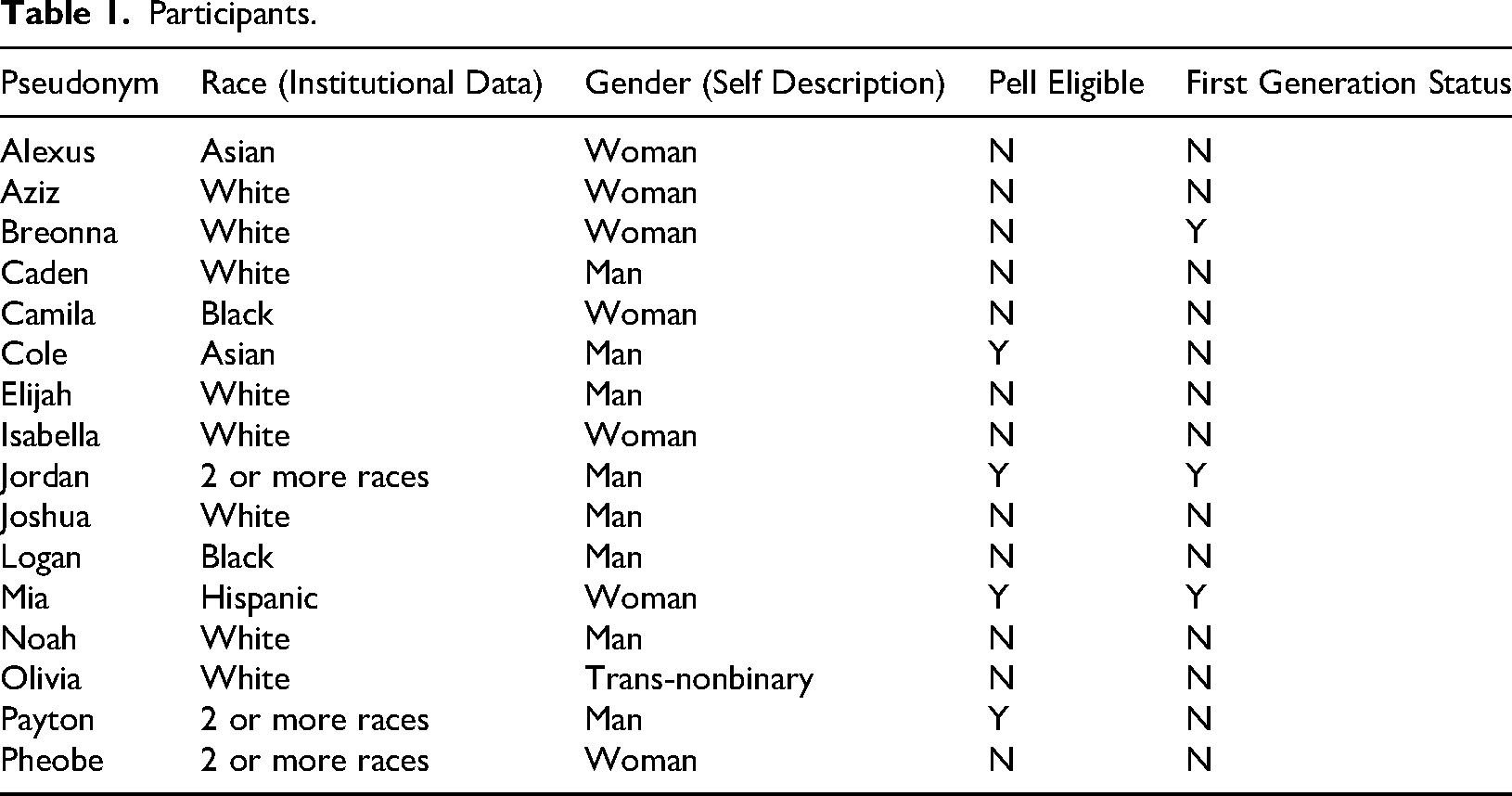
The site for the study was a research-intensive institution in the Southeastern United States with a strong engineering program. In phase 1 of the project (fall 2020), all first year engineering students (∼22% women and 24% students of color) were invited to participate in focus groups. We continually sampled for diversification across race, gender, social class, and first generation student status given the importance of those identities for SB and SE in engineering, with 28 students ultimately participating across 7 focus groups, each earning a $100 gift card (Buckley et al., 2023). For phase 2 (spring 2023), all 28 students from phase 1 were invited to participate in individual semi-structured interviews; 16 students volunteered and earned a $75 gift card for participation (7 women, 8 men, 1 non-binary student, 9 white students, and 7 students of color) (see Table 1). Data for this study drew primarily from phase 2 data. While focus groups were purposeful in phase 1 as ways to invite student discussion on learning environments across course experiences, interviews in phase 2 allowed for in-depth consideration of student experiences of belonging and efficacy across time and context. Interviews allow for examination of students’ “subjective experiences” and how they “make meaning” of their lives and experiences, making them well-suited for the study (Neale, 2021, p. 171); they were designed as semi-structured conversations, with structured questions alongside unstructured opportunity to explore students’ experiences to meet the need for questions “to be sufficiently open to enable participants to reflect on the meaning and significance of their own experiences” (Neale, 2021, p 171).
Participants.
Throughout the study we provided descriptions of belonging for students when asking about belonging to help support the process of “jointly construct(ing) and reconstruct(ing) meanings and knowledge as the interaction unfolds” (Neale, 2021, p. 172); for example, before asking specifically about belonging in phase 2, we shared, “A sense of belonging can change over time and in different contexts and refers to your sense of fitting in or feeling valued in engineering.” Structured questions in the interview concerned students experiences in engineering across three years, especially related to SB and SE, which were developed collectively as a team in a pre-interview process, with interaction among authors, the research question, prior data and focus group questions, and the interview protocol to build questions that would elicit “interesting and engaging” and relevant information (Glesne, 2011, p. 113). Example questions included, “Broadly, how would you describe your developing sense of belonging within engineering over the last few years?” Because phase 1 data showed students perceived performance and efficacy as primary indicators of belonging (Buckley et al., 2023), we asked students’ to reflect specifically on linkages between the two in phase 2 after asking open-ended questions about SB. Asking, for example, “How does your belief in your abilities relate to your feelings of belonging in engineering?” With interview responses continually revealing relevant meaning-making and reflection on SE and SB, they sufficiently allowed for revelation of the students’ own perception of the key constructs in the study.
Data Analysis
The first three authors were primary analysts, engaging in a four-part analysis process. First, they reviewed three student transcripts and collectively discussed interpretations to build a (continually evolving) codebook. Second, they reviewed separate transcripts, assigning incident-by-incident descriptive codes (Saldaña, 2009) in Dedoose data management software, crafting coding memos, and meeting regularly to discuss coding decisions and questions. In an emergent coding process, attuning to students’ descriptions, they coded for the research question. Third, upon coding completion, they holistically reviewed quotes within each code to synthesize common themes within codes. Finally, the entire team narrowed to key findings presented in this study.
Positionality
We also attuned to our positionality, which Secules et al. (2021) identify within six key areas of research, of which we highlight two: research topic and relation to participants. The full research team included two faculty in education (science education and higher education), two faculty in engineering fundamentals, and two graduate students in education. First, as educators we approach this study directly because of our interests in understanding and leading academic experiences to support equitable student learning; we value the role of belonging, which admittedly informs our work, while we also recognized students themselves may hold differing salience for belonging in engineering (Buckley et al., 2025). Thus, we worked to remain close to participants’ perceptions through our analytical coding and discussion. Second, we recognize that interviewers’ identities intersect with power dynamics, potentially informing what and how students reveal their experiences; for example, students who shared identities with the interviewers may have been more comfortable sharing difficult experiences. Interviewers for phase 2 included one White woman faculty member and one White woman graduate student; therefore, we sought to develop rapport and listen openly, journaled about the data collection process, and purposefully describe our identities. We intentionally ensured interviewers were from education versus engineering, to set a tone of exploration rather than student evaluation.
Findings
Findings highlight that ways in which students describe (a) SB in engineering is dependent on SE, yet (b) belonging-related elements in the learning environment also serve as infrastructure for SE.
Sense of Belonging in Engineering as Dependent on Self-Efficacy
Engineering students often perceived their SB as dependent upon their abilities and performance. For example, Breonna, reflecting on her relationship of abilities in engineering to SB, said “I think it's the whole thing. If I felt like I couldn’t do it, I simply wouldn’t.” While she spoke about many elements that supported SB, SE felt especially critical in her academic context. Similarly, Mia noted the importance of abilities for SB: For me, belonging is being able to hold your own, … having the abilities, . . . having knowledge of what the tech industry is and being able to apply everything you’ve learned, being able to apply the things you’ve studied.
Sense of Belonging in Engineering as Infrastructure for Self-Efficacy
In fact, students described several belonging-related elements that influenced their SE. Experiences of the presence and/or lack of support from and connection with faculty, pedagogy, and peers all were elements that influenced SE, illuminating the critical importance of connection and support—not simply isolated content mastery—for students’ growing belief in their abilities in engineering.
Belonging Cued by Faculty Connection and Support Influences Self-Efficacy
Interactions with faculty could both support and diminish a student's SE. Positive interactions included support for students, such as care and being available outside of class. Aziz shared simply, “It helps to know that professors care.” She reflected that in engineering, often “the course is hard but [faculty] want you to do well, and so they’ll go out of their way to make sure you do well.” Camila remembered a class where learning felt like “a lot of pushing through roadblocks.” Yet, she recalled the commitment of the faculty member to her learning, I probably stayed after class for like an hour one day trying to work out the problem with the professor, just really trying to figure out the issue. I think that's …one of the times that it felt like it was the right place to be.
Several students were also encouraged by faculty reassuring them that mistakes were expected. For example, Olivia stated, “That's part of what's been really helpful here, is that [professors have] been like, ‘Hey, getting things wrong isn't a failure. You're allowed to and expected to get things wrong.’” Faculty associating being wrong with an “expected” part of engineering cued Olivia's SB because of (rather than in spite of) her mistakes, allowing for growth in SE when her abilities were not dependent on perfect performance. Similarly, Jordan recalled a professor telling him “If you see a bad grade, don’t fret. It's just part of it. You’re not the only one struggling.” He recalled similar “wise words” from a professor who shared with him the mindset that, “It's not about your flight plan. It's about the plane landing,” reassuring him to focus on the journey of learning rather than individual courses or tasks. Similarly, Phoebe said “I've had a few professors, even if I didn't do well in their class, they've tried to encourage me and be like, ‘No, no, keep going.’” Students described not just the content of feedback but also the way faculty shared it—namely helping students appropriately frame grades as only one metric and inviting mistakes—built students SE through the way they embodied and cued SB. When faculty cued imperfection as critical for SB, students were able to build rather than doubt their abilities.
At the same time, students described situations where their SE was diminished due to interactions with professors. Aziz described ways in which she felt a limited connection with faculty in those classes when they felt unavailable. She shared, “I feel like [some faculty are] here because they are researching . . . and they're just—‘I’m here, I'm gonna teach a lecture and I'm gonna leave,’” cuing they did not “care.” Camila shared intimidation around asking a faculty member questions about an internship mostly rooted in her performance, “I didn’t feel very worthy to ask . . . because he’d seen my grades, he’d seen how I performed.” Some students described identity dynamics, especially limited gender and racial diversity in engineering faculty. Phoebe noted faculty who were men “didn’t try at all (to foster belonging)… a lot of them I cannot relate to;” while she still succeeded in learning and found SE, she was “wary of faculty” because of gender dynamics. Similarly, Mia reflected not having many “significant relationships with any professors” and feeling “disconnected” in the first few years especially because of limited relationship with others who shared her identity. What helped her overcome that distance from faculty was attending a women's technology conference; she shared hearing from other individuals that have similar feelings to me about pursuing my degree and when they were in college and how far they’ve made it, it's reassuring for me because I do have–you know, I’m first generation. My mom's an immigrant. She doesn’t speak English. I have a lot of family members in jail. Growing up in poverty, it's kind of hard for you to see something further . . . Now I feel better, ‘cause I’m seeing how big the tech industry can be, how many women are in it, how many women are joining it. It's making me feel more confident in my place.
Belonging Cued by Pedagogical Connection and Support Influences Self-Efficacy
Students also described ways in which course content, instructional strategies, and course environments could evoke or neglect support and connection, which then influenced their SE. Camila described course instruction, which cued for SB, as igniting her SE: The way he approached problem solving encouraged me in the way I approach problem solving, and it doesn't seem like as big of a deal. He puts such an emphasis on group work and teamwork that it makes it feel like, even if I can't figure it out myself in the real world, I will have a team of engineers that I can ask for help. That was also encouraging.
On the other hand, learning environments could also dampen SB and SE. Camila discussed difficulty asking questions in online spaces when “lectures were recorded” and curriculum seemed unaligned with learning, diminishing her SE. Sometimes she felt faculty “prescrib[ed] the wrong work” or work that seemed out of alignment with learning: [A quiz] never seemed to be anything like what we had been doing in class, or what we had been doing in class wasn't enough. He would teach us things but didn't give examples, so we didn't know exactly how to apply what we've been learning ‘cause we hadn't seen him show that before. It's really tough especially when you’re in calculus classes and . . . you have a final lecture, and then you have to understand the content, finish the homework by Sunday, so you can take the quiz that's due Sunday and then, review on Monday and then take the exam on Tuesday, and then the process just repeats that. It's so much fast-paced that sometimes I just think about dropping it altogether.
Some students further described isolating instructional strategies detracting from SE. Aziz reflected on the way instructional strategies were critical for SE: Something about the sitting and the lecturing math content and the conceptual side of it just did not click for me at all. Whereas the more interactive courses, … you're doing more problems in class, you're doing more collaborative work, that made a huge difference in my learning.
Belonging Cued by Peer Connection and Support Influences Self Efficacy
Findings about the importance of collaborative instructional strategies relate to findings showing broadly (e.g., beyond specific course pedagogy) the importance of interactions with peers for SE. Payton emphasized the connection between SB and SE, “finding somewhere [in] this engineering community where you kind of fit in … it just kind of gives you confidence.” Isabella added, “We would get together and study, this little group of us, and then we would see our grades start to rise the more we collaborated.” She added, “If I was just doing this degree and all of my friends were not doing engineering, I would feel really, like this is really hard.” Joshua mentioned the value of group projects: “the camaraderie, having a support system with all the people helping you. You're not just by yourself doing it. If you have a question, you can turn to your partners, and they help me out with this thing.” Finding support and connection within informal peer groups around academics (SB), therefore, was an environment that facilitated students’ SE.
Students’ experiences working with and serving as peer mentors also contributed to their SE. Cole noted the value of an older peer mentor, who “helped me to understand what type of teaching style the professor [had] and what kind of course content and how much time requirement that the class demands; it prepared me for the classes and the semester coming up.” Connection with a near peer around academics helped shore Cole's SE. Further, several students mentioned how mentoring others brought a sense of connection, which fueled their confidence. Caden stated, “I generally feel like I’m a quite valuable member of each team I’m a part of, which has … been very helpful in making me feel like I have value.” Similarly, Isabella described the feeling when she was hired to become a tutor for other engineering students that she “must be doing something right” despite feeling “not confident in [her] ability in academics like she used to.” Helping others built a sense of deepened connection to the community (SB), which fueled students’ realization of their capabilities.
When struggling to understand content, several students noted how valuable it was for their own SE to hear that other students were also struggling. For example, Isabella said, Being able to talk to my peers this semester in engineering classes has been also really helpful ‘cause I really was like, ‘Okay, they’re struggling too. It's not just me,’ and it helps me feel like I’m where I’m supposed to be.”
As a first-generation college student, Cole emphasized the value of joining groups of students with similar identities. I joined [a group on campus], and that also provided me with more connection to people who are like me. I’ve met a lot of other refugees, other immigrants, other low-income, other first-generation students, so all of those identities provide me a support from other students who are like me. We’re all experiencing college together, we help each other out and provide some type of encouragement to each other when we are in need. I’m always thinking, “Okay, are they looking down on me? Are they judging?” I get really nervous… I would make a coding error or if I didn’t understand something. Then, they would have to keep explaining, explaining, explain. Then, I just got–I just felt very intimidated.
Thus, SB through shared identity with peers, many who struggled similarly given climate, provided a foundation for students’ “confidence.” Overall, the infrastructure of SB built among peers (learning alongside others, realizing shared difficulties, having similar identities) provided an environment in which student SE could grow.
At the same time, some elements of peer interactions could also reduce SE. Payton reflected on the lack of peer interaction in online classes during COVID where “if you're struggling, you're kind of thinking, “Oh, can I do this or not? Am I good enough?” Whereas, “if you're in the [physical] classroom, you can [see] other people are struggling and it's more of a normal situation. You're not isolated and having those thoughts to yourself where you don't think you're good enough.” Many students also described the ways in which peer comparison, anxiety about others’ perceptions, and negative experience of competition influenced their SE. For example, Phoebe said “Well, I put in the same amount of hours, and this person's this far ahead, and I still don't understand what's going on.” Jordan added, “when you hear a lot [of] people say a lot of these classes are easy, and you’re struggling in it . . . is this really for me, engineering?” Many women also described a masculine-dominated environment impacting their experiences of SB negatively. In her third year, as noted above, Mia described the gendered climate jointly impacting her SB and SE: “It's very intimidating for me. I still do find myself uncomfortable in really male-dominant spaces, even though I’m trying to pursue a computer-science degree.” Being one of few women fueled her self-doubt in the field, despite success in academics. Negative experiences with peers showcase the ways in which feeling limited connection, support, or value undermined SE; negative or isolating interactions with peers heightened perceptions of the need for academic perfection to belong, which threatened SE. Such dynamics revealed that SB can protect against threats to SE, such as struggle, perfection, and comparison.
Discussion
Overall, this study offers two key areas of findings. First, students perceive their SB—feelings of connection, support, and being valued—as tightly connected to if not dependent on their SE—or beliefs in their abilities—in engineering. Second, students described ways in which SB—specifically support and connection experienced through faculty, pedagogy, and peers—provided infrastructure for SE, influencing it positively and negatively. Collectively, findings show SE and SB are co-constituted in learning. Echoing others’ work (Rueda & Lowe Swift, 2023), our findings show SE is critical for students feeling they belong in academic environments, where some ability to understand the academic material is critical. At the same time, students described growth in SE most often when they experienced belonging-infused environments, where support, connection, and being valued provided infrastructure for learning, imperfection, and self-belief. Identity also played a role, with students describing the importance of having faculty and peers with similar identities. Seeing few people of like identities contributed to students questioning their SE, while finding mentors (usually outside of faculty in this study) and peers of similar identities then allowed for greater confidence and reassurance. When learning-environments were reduced to simple content transactions, with few cues for SB, SE was threatened, especially when few had shared identities with students. Importantly, students found SB in many ways, such as with faculty, in peer groups, or in supportive pedagogical structures—echoing other work suggesting the many ways to conceive of and navigate SB (Ajjawi, 2023).
In sum, findings suggest that SB offers a critical supportive infrastructure from which students can build SE, serving as a protective factor especially in a demanding and sometimes-competitive academic environment. Environments—not simply one's academic merit or academic capacity—can cue abilities; in fact, findings suggest SB can normalize academic imperfection, allowing for SE to grow even when students struggle academically. Figure 1 showcases holistic findings, where environmental elements lead to SB, which influences SE; SE, in turn, reinforces SB. Next, we review key findings before offering implications.
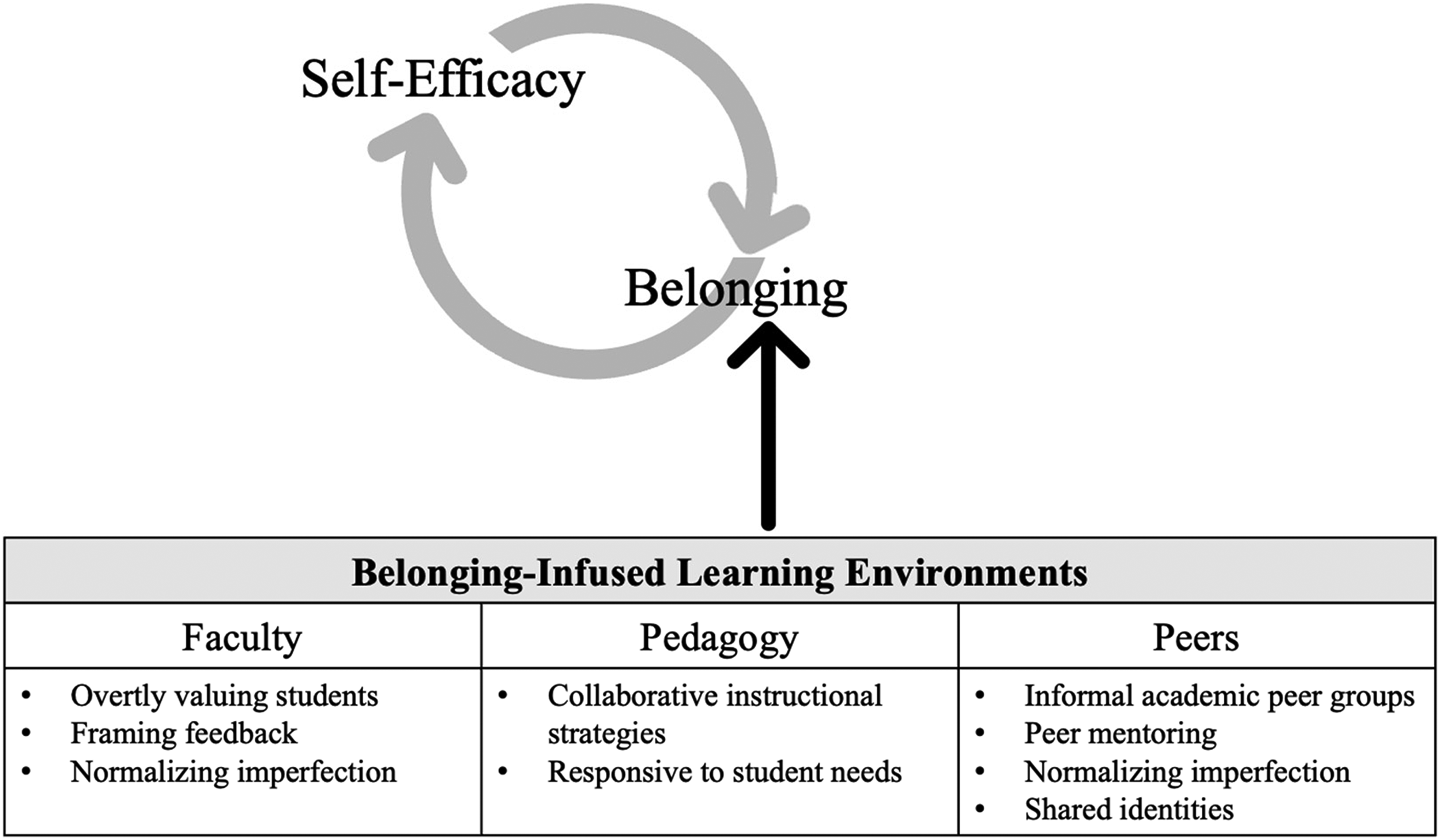
Belonging-Infused learning environments supporting the co-constitution of sense of belonging and self efficacy.
Student Perception of Belonging as Dependent on Self-Efficacy
The findings showing students’ perceptions of the dependence of SB on SE suggest the need to consider carefully the ways in which students receive messages about performance and ability, especially early in an academic pathway. Given learning is a developmental journey that often entails one's improving competence and performance over a long period of time (Buckley, 2025), early messages that undercut one's perception of SE could then make students question their SB in an academic context, underestimate their capability, and potentially hinder their persistence. In addition, students’ perceptions of the ways SB is dependent on SE suggests the critical importance of building equitable, belonging-infused learning environments to support SE, especially given the underrepresentation of women and students of color in engineering (Trapani & Hale, 2019). Lower feelings of SB among underrepresented students may continually foster inequitable persistence and perceptions of SE.
Belonging-Centered Environments as Infrastructure for Self-Efficacy
Findings showing that belonging-infused learning environments are critical not only for students’ feelings of inclusion but also their SE in engineering echo research showing the importance of social dynamics for SE for women (Chen et al., 2023) and students of color especially (Byars-Winston & Rogers, 2019; Gainor & Lent, 1998; Usher & Pajares, 2008). The meaningful role of faculty connection and support fostering SE aligns with prior research (Kim & Lundberg, 2016), suggesting the important but sometimes indirect relationship of the role of faculty on student experience and cognitive outcomes. Critical to such findings is that while traditional SE sources, such as direct verbal persuasion or mastery experiences (Bandura, 1997), were a part of faculty behaviors that fostered SE, they were not fully explanatory of the learning dynamic; faculty engaged in broader work of building learning environments as infrastructures of SB that then contributed to SE. Namely, their supportive manner of giving feedback, not just the feedback itself, and the overt welcome of failure and trying again were critical SB elements that bolstered SE. Much like Artez-Vega et al. (2023) noted the important role for faculty of building trust with students when working toward equity-minded teaching, our findings suggest the importance of relational course components alongside mastery experiences for students. In addition, students′ experiences show the ways in which being able to engage with mentors and peers with similar identities allowed for SE, rather than self-doubt, to flourish. Findings suggest that content transaction alone does not necessarily foster SE, but connection with and among diverse faculty and students—communities of learning—build SB, providing infrastructure for SE.
Infrastructure for SB through pedagogy included collaborative learning opportunities and teaching practices that adapted to student feedback. On the other hand, when students felt uncertain about their learning, methods of teaching, and methods of assessment, they felt unsupported and unconnected (i.e., limited SB), which also hindered their SE. Yet again, findings extend sources of SE beyond traditional notions of successful completion of tasks or verbal persuasion (Bandura, 1997), showing the importance of belonging-infused pedagogy for engendering SE.
Finally, shared experiences of struggle, seeing others of similar identity, and working together to learn were peer dynamics that fostered SE. Alternatively, worry about others’ perceptions, comparing oneself to others, and gendered dynamics of exclusion could hinder SE. While students’ descriptions of peer dynamics influencing SE included traditional SE notions of vicarious experiences with others (Bandura, 1997), findings suggest positive collaboration and normalizing imperfection—not just comparison or observation—within a learning community where they found SB bolstered SE. Similarly negative collaboration (e.g., gendered exclusion) could hinder SE.
In sum, while certainly separate constructs, SB and SE were critical for one another. Belonging-infused learning environments supported SE, just as students identified SE as critical for SB engineering. Findings provide empirical support for building diverse, constructivist learning environments (Parson & Ozaki, 2020), rich in offering collaboration and support as a vehicle for SE. In addition, belongingness features were protective factors against other threats to SE (such as Jordan's “bad grade” or Isabella struggling in a class), suggesting the possibilities of cueing for SB across student experience to both bolster SE and protect against threats to SE that might be common in a sometimes-competitive, academically demanding discipline.
Implications
The study holds implications for practice, research, and theoretical limitations.
Practice
Implications include supporting SB not only through positive social and environmental dynamics, but also in the ways in which students receive messages about their SE. For example, educators might consider how to adapt growth mindset (Dweck, 2006; Yeager & Dweck, 2020) strategies when giving feedback to students; such strategies not only assume students’ capabilities but cue an educator's assumption that students belong and can continuing learning in the community. Ideas might include recognizing or grading student effort (e.g., problem solving versus answers alone), providing specific feedback toward improvement (beyond correct/incorrect), asking students to reflect on ways in which their SE is growing (Buckley, 2025), and welcoming failures to support future attempts. Such examples mirror effective practices for equity-minded assessment (Artez-Vega et al., 2023).
Further, the importance of support and connection with faculty, pedagogy, and peers for SE suggest the need to build belonging-infused learning environments to foster SE; isolation, fast learning pace, perfectionism, and limited pedagogical support were problematic for students’ SE. Thus, institutions might build curricula that foster collaborative learning and time to learn and correct mistakes with others. Institutions might also offer incentives (e.g., course release, funded work) for faculty to build learning-oriented relationships with students in and outside the classroom in opportunities ranging from undergraduate research opportunities, study hours, or community-engaged learning. Teaching and learning centers might offer training for faculty on findings such as those in this paper, showcasing why SB may boost both SE and academic performance, providing opportunities for faculty to workshop and brainstorm practices within and across distinct disciplines. Such centers might also offer learning communities where faculty collaboratively assess SB in classrooms to then adapt or maintain practices that support SB (e.g., Student Experience Project, 2021). Course evaluations might include SB-related questions to both incentivize and reward faculty that support student SB.
Further, to support pedagogical initiatives, educators could build and use environmental rubrics that help instructors identify and measure pedagogical features that infuse SB. Institutions could facilitate systematic, faculty peer review, with collaborative faculty support for building belonging-infused environments. Finally, to support positive peer dynamics, simply using active, collaborative instructional strategies in the classroom can be a start (Major et al., 2021). Such strategies allow for students to learn from one another whether in formal or informal groups, which students in this study identified was supportive of their SE. At the same time, limited reflection on such collaboration could gloss over potential negative interactions; thus, group work might be accompanied by metacognitive assignments (Major et al., 2021), inviting students to reflect on the learning process holistically. Courses where collaboration is integral might also embed team-building curriculum, helping students understand, recognize, and develop skills to support team work, such as emotional intelligence or perspective taking. Many campuses already offer a host of such co-curricular opportunities—all of which may build skills that can translate into students’ positive interactions in the classroom.
Research
Implications for research also exist. Given SE is a critical element of academic SB, where a student may not continue on an academic pathway if their grades do not promote continued success, continued research might examine the complications of the relationship with SE and SB. Such work could examine psychologically healthy ways to support students’ navigating the relationship of SE and SB and ways to support student resilience through self-doubt.
SB as infrastructure for SE also holds implications for research. First, continued research could expand empirical understandings of how and when SB elements support SE, answering questions such as when SB may be most critical for SE and learning. Further, given findings such as those from Marra et al. (2009), which suggested women grew in SE in engineering overtime while also experiencing a decreased sense of inclusion, critical scholarship might consider if fostering SB-related elements of SE assumes assimilation into environments; such work might suggest radical reconsideration of SB, offering new, creative, and liberatory ways of building learning environments.
Theoretical Implications
Finally, this study provides theoretical insight into the constructs of both SB and SE. The findings support the need to further build the conceptualization of competence as a critical element of academic SB that differs from other belongingness areas (e.g., campus or peer belonging). In addition, the study illuminates constructivist dynamics of SE and sources of SE that might be co-constructed alongside learners. Continued theoretical work and scholarship could consider the extent to which belonging-infused learning environments support, compliment, or perhaps undergird Bandura's (1997) four traditional sources of SE.
Limitations
Finally, this study has limitations, of which we highlight two. First, all participants volunteered twice to be a part of the study; throughout the project, we discussed the resilience of participants, which may correspond with their willingness to volunteer to discuss their, at times, difficult experiences, such as bad grades, problematic faculty, and feelings of not belonging. At the same time, we found rich diversity in participants’ perceptions of study constructs, suggesting the value of the findings in showcasing diverse experiences of SE and SB. Further research could consider experiences of students who did not persist in engineering. Second, while the study attunes to identity broadly, additional research using a specific framework of intersectionality (Jones & Abes, 2013) could show with more nuance the roles of varied intersecting oppressions within the environment that act upon SE and SB.
Conclusion
This study offers in-depth consideration of the relationship of SB and SE in engineering, showing especially their co-constituted nature in students’ experiences. While students perceived SE as a critical component of academic SB, they also described that belonging-infused learning environments—beyond content transactions or student academic merit—provided infrastructure supporting student SE. Implications include vast, creative strategies for building learning environments, and suggestions for research to continue exploring the role of SE in SB, especially in academic and/or performance-oriented environments, to support facilitation of equitable learning environments that are critical for society.
Footnotes

Author Contribution(s)
Funding
The authors disclosed receipt of the following financial support for the research, authorship, and/or publication of this article: This work was supported by the Division of Undergraduate Education, (grant number DUE2037605).
Declaration of Conflicting Interests
The authors declared no potential conflicts of interest with respect to the research, authorship, and/or publication of this article.