




Abstract
Eliza Hamilton Dunlop (1796–1880) and Charles Harpur (1813–1867) were two of the most important Romantic poets of colonial New South Wales. In this article, I consider their engagement with Indigenous Australian languages. In “Native Song” (1848), Dunlop provides a transcription and translation of verse composed by her informant Wulatji (fl. 1840s), a local poet. In The Kangaroo Hunt (c. 1844), Harpur enriches his description of Australian landscapes with a dozen words learned from Darkinyung, Gamilaraay, Wonnarua, and Wiradjuri informants. I contrast Dunlop’s universalist approach to Indigenous language with Harpur’s particularist approach and contextualize their poetry in British philosophy of language. Dunlop and Harpur use Indigenous names to present Australia as a land steeped in poetry. This recognition of Indigenous names introduces contradictions into their poetry, which readers today can use to deconstruct the colonial poetics of naming.
Keywords
Introduction: The colonial poetics of naming
To occupy Australia, its European invaders had to name it. This was not merely a matter of naming places, though that of course was crucial. They also needed to name the things that made the places. They needed to name the trees that dropped their autumn bark, the deer-like creatures that hopped on two legs, the fires that ripped through crackling scrubland. They needed to name the fickle weather, the whirling dust, the intermittent streams. They needed to name hundreds of parrots and pigeons and snakes and dragons. They needed to name the people whose land they occupied. To occupy Australia, the invaders had to “conquer space”. With a touch of the namer’s wand, they sought to convert a strange land “into a familiar world of routes and places” (Tuan, 1977: 83).
Of course the land was already familiar to, already named by, the Indigenous peoples who have occupied it since the beginning.
The Romantic poets of the early occupation also saw naming as one of their key roles. According to Charles Harpur (1813–1867), the poet can wield the “might of song” to give “Glad meanings” to the land (2019, h209–ff). 1 But the “might of song” is hard to wield in the colonial context. In Harpur’s own poems, the poetry of naming is marred by violence and stupidity, and his places seldom have “glad meanings”. In poems such as “The Creek of the Four Graves” (1845), “The Beautiful Squatter” (1845), “The Glen of the Whiteman’s Grave” (1846), and “Ned Connor” (1846), names become by-words for rape and murder.
Eliza Hamilton Dunlop (1796–1880) also sought to imbue the land with meaning, but in her case the poet’s power was compromised by the cultural inferiority of the colonist. In her poem “The Mulla, or Wollombi Creek, New South Wales” (1849), she questions her own naming power. The poem describes a creek behind Dunlop’s home in Wollombi (see Figure 1), which she had named “Mulla”, after a creek in her native Ireland. The original Mulla features in Edmund Spenser’s Colin Clouts Come Home Again (1595) and “Cantos Of Mutability” (1609). Dunlop compares herself unfavourably to her Elizabethan forebear: Deep, silent water — water dark and still, Bowered in the desert, lonely lot is thine! For thee, no courtly Bard essays his skill At thy cool font inspired — “sweet Mulla mine.” (Dunlop, 2021: 198)
Does she have Spenser’s “skill” in naming? Can she render the creek less “lonely”? Can she turn this “desert” into a human place? How can she, the distant colonial, match the “courtly” Spenser? Wafer (2021: 165) suggests that Dunlop may have seen an analogy between herself and Spenser: both lived in exile, Spenser from England to Ireland, Dunlop from Ireland to Australia. But Dunlop must also have seen the analogy’s darker side. Spenser was a colonizer, who argued in a famous pamphlet that Dunlop’s own people, the Irish, were descended from blood-drinking Scythians. He supported the brutal rule of his patron, the Lord Deputy Arthur Grey (Mccabe, 2001). How did Dunlop reconcile Spenser’s brutal depiction of the Irish occupation in Book V of The Faerie Queene (1590–96) with the Australian occupation of which she was a part? And of course, as she recognizes in the title of her poem, the creek she is naming is not a “lonely” or nameless “desert”, but a named place of human occupation: Wollombi.
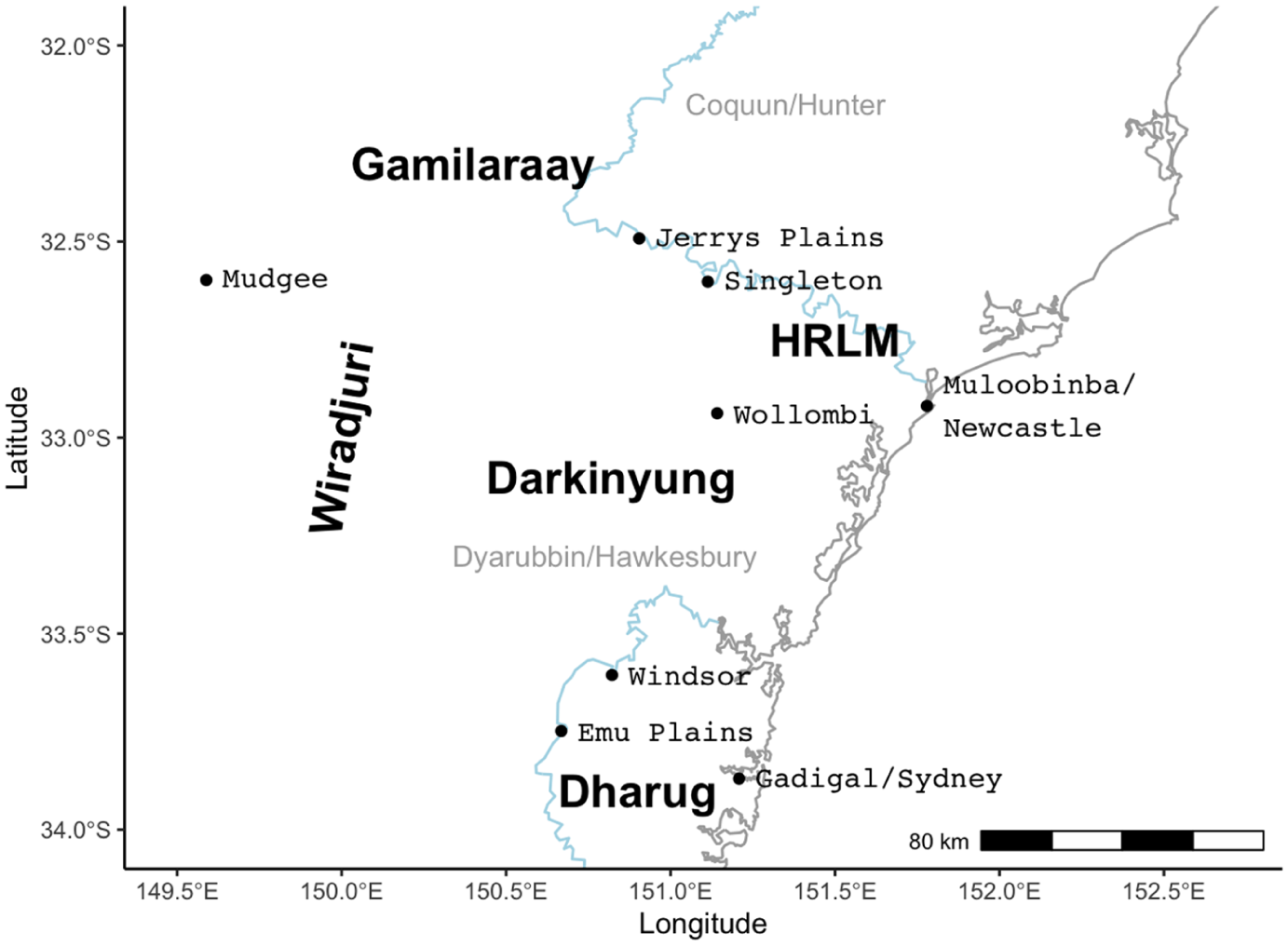
The rivers Dyarubbin and Coquun in the 1840s, indicating languages and settlements relevant to Harpur and Dunlop.
More than violence or the cultural cringe, it was the namedness of the land that undermined the colonial poetics of naming. How could the poet name the already named? In this article, I consider how Harpur and Dunlop grappled with this contradiction. In The Kangaroo Hunt (c. 1843, rev. 1860s), Harpur incorporates a dozen Indigenous names into the text of his poem, and in a series of footnotes reflects on the poetic merits of settler and Indigenous names — generally finding in favour of the originals. In “Native Song” (Wulatji, 1848), Dunlop provides a transcription and translation of original poetry by her informant Wulatji (fl. 1840s), who composed in what is now known as the Hunter River-Lake Macquarie Language (HRLM), varieties of which are spoken by Awabakal, Kuringai, Wonnarua, and possibly also Gweagal people (see Wafer, 2017; Lissarrague, 2006: 6–7). As I hope to show, the key value of these two poems is their contradictoriness. They vividly dramatize the contradictions of colonial naming.
Because of their contradictions, these poems are especially apt for the style of deconstructive criticism advocated by Indigenous scholars such as Peter Minter and Evelyn Araluen. Through their contradictions, these poems can help the critic “[break] apart Settler strategies of sublimating Aboriginal presence into Western terms of reference and control” (Araluen, 2022: 195). When settler poets such as Harpur and Dunlop ventriloquize Indigenous voices, argues Minter, they create a “demarcation” between the pollution of colonial violence and the purifying ritual of the poem. Minter’s example is Dunlop’s “Aboriginal Mother” (1841), written in the voice of the one adult survivor of the Myall Creek massacre. In the poem, the mother laments the polluted “fields of blood” left by the massacre. She imagines that the pure soul of her dead husband has flown to heaven, to complain directly to the “Christian God”. Although such poems have obvious humanitarian intentions, they ultimately protect the colonial project, by containing the Indigenous person in familiar moral categories (Minter, 2021). Indigenous scholars such as Minter and Araluen have helped critics to see how colonial poets contain Indigenous people in their poetry. Harpur and Dunlop can also help us to see this containment more clearly, by exposing their own contradictions.
Not all colonial poets expose their own contradictions as Harpur and Dunlop do. Before considering their naming-strategies in detail, it is worth surveying some other naming strategies employed by Romantic settler-poets. One strategy is to dismiss or ignore Indigenous names. In “Botany-Bay Flowers” (1819), Barron Field (1786–1846) contrasts the botanist’s way of naming flowers with the poet’s, and laments that in Australia, the poets are outnumbered by the botanists and their “bar’brous Latin”: Still fewer (perhaps none) of all these Flowers Have been by Poet sung. Poets are few, And Botanists are many, and good cheap. (Field 1823: 5)
Field simply neglects to mention any Indigenous names or namers. Emily “Australie” Manning (1845–1890) dismisses Indigenous names more robustly in “From the Clyde to Braidwood” (1877): — no legend old Adds softening beauty to the Buddawong Peak, Or near home-ranges with too barbarous names. (Manning, 1877: 43)
In this case, Indigenous names exist, but are “barbarous”, and are not linked to any “legend” that incorporates them into a wider structure of value. Field and Manning typify the terra nullis tradition in Australian poetry, whose premise is that Indigenous people either do not exist or lack “civilization” (T. H. Ford and Clemens, 2023). In this strategy, the settler-poet tries to contain the Indigenous person by situating them in a scale of values. Indigenous names are at the bottom of the scale, or drop off it altogether.
A second strategy is to place Indigenous names in the past. This was a favoured strategy of Harpur and Dunlop’s American contemporaries, William Cullen Bryant (1794–1878) and Walt Whitman (1819–1892). In “The Prairies” (1833), Bryant describes a “boundless and beautiful” landscape, “For which the speech of England has no name” (Bryant, 1892: 49). The Indigenous inhabitants who once had named it have left: The red man, too, Has left the blooming wilds he ranged so long, And nearer to the Rocky Mountains, sought A wilder hunting-ground. (1892: 52)
Presumably the Indigenous inhabitants have “left” due to colonization, but Bryant prefers to see their departure in cosmic terms: “Races” of people “arise” and “perish, as the quickening breath of God | Fills them, or is withdrawn”. When people “perish”, their names perish with them. Whitman performs a variation on this theme in “Starting from Paumanok” (1860). He suggests that when Indigenous peoples “depart”, they leave their names behind: The red aborigines, Leaving natural breaths, sounds of rain and winds, calls as of birds and animals in the wood, syllabled to use for names, Okonee, Koosa, Ottawa, Monongahela, Sauk, Natchez, Chattahoochee, Kaqueta, Oronoco, Wabash, Miami, Sagniaw, Chippewa, Oshkosh, Walla-Walla, Leaving such to the States they melt, they depart, charging the water and the land with names. (Whitman, 1982: 186)
Whitman’s view, like Bryant’s, is cosmic. It is simply a fact that Indigenous Americans are “leaving”. In this strategy, the settler-poet tries to contain the Indigenous person in history. Indigenous names are past names, that remain for white people to either remember or forget.
A third strategy is simply to appropriate Indigenous names without acknowledgement. The most famous instance of this in Australian literature is “Waltzing Matilda” (1895), by A. B. “Banjo” Paterson (1864–1941): Oh there once was a swagman camped in the billabong, Under the shade of a coolibah tree, And he sang as he looked at the old billy boiling, Who’ll come a’ Waltzing Matilda with me (Paterson and MacPherson, 1895: 1)
In Paterson’s poetic diction, white slang terms like “swagman” (tramp) and “billy” (pail) nestle comfortably beside Indigenous words from multiple languages such as bilaban (waterhole; Wiradjuri) and gulaba (a species of eucalypt; Gamilaraay/Yuwaaliyay). In Paterson’s disquieting vision, Indigenous Australians are metaphorically replaced by a white nomad, the swagman. The swagman wanders freely over the pastures of a local “squatter” (grazier), takes a sheep as food, commits suicide when caught, and imbues the land with enduring meaning by haunting the billabong as a ghost. In this strategy, the settler-poet seeks to absorb Indigenous names into settler discourse, as part of a broader effort to assert a “native” identity in their verse (see Rudy, 2017: chap. 4).
These three naming strategies are eschewed by Dunlop and Harpur in “Native Song” and The Kangaroo Hunt respectively. In these poems, Dunlop and Harpur acknowledge the continued presence of Indigenous people in Australian society and praise Indigenous language and poetry for its force and beauty. When they incorporate Indigenous names into their verse, they acknowledge the Indigeneity of those names. It is certainly the case that Harpur and Dunlop seek to contain Indigenous people in their poetry. They were colonists. Their identity was premised on the appropriation of Indigenous land. But they acknowledge Indigenous people so explicitly in their poetry that they fail to “sublimate” them, to use Araluen’s term once more. In this failure of sublimation lies the chief interest of their poetry. Their poems are explicit acts of translation. When they translate or borrow words from Indigenous languages, they acknowledge their informants, if only imperfectly, and draw attention to the problem of rendering Indigenous languages in English. When should an Indigenous word be translated by an English equivalent, and when should the word itself be borrowed into English? In the case of multiple words, or multiple Indigenous languages, which is the correct word in the context? Harpur and Dunlop answer these questions less confidently than other colonial Romantics, drawing attention to problems that other colonists more brazenly conceal.
Dunlop and Harpur mainly translate languages of the Hunter Valley, north of Gadigal/Sydney: Darkinyung, spoken in the highlands to the South; Gamilaraay, spoken in the upper reaches to the West; and HRLM, spoken across the lowlands to the East (Figure 1). Dunlop lived in Wollombi, Harpur in Jerrys Plains. The valley is named for the Hunter River, which is known to its Indigneous inhabitants as Coquun. 2 Although Europeans had been present in the valley since the turn of the century, in the 1820s there was a land rush that triggered the Wonnarua, Gamilaraay, and Wiradjuri to launch a war of resistance (Connor, 2000: chap. 4; Dunn, 2020: chap. 8). By the 1840s, warfare had subsided. Aboriginal people were employed in significant numbers in agricultural and domestic work. There were still convict labourers, but the valley was losing its character as a penal settlement, and towns such as Singleton and Wollombi were becoming more integrated into the colony’s growing capitalist economy and bourgeois society.
“Native Song” and The Kangaroo Hunt form part of the valley’s integration into bourgeois society. Dunlop and Harpur translate Indigenous words as part of a broader effort to civilize and edify colonial readers, by creating a distinctively local poetry. To compare their translational practices, I have identified the origin of each Indigenous word in Harpur’s The Kangaroo Hunt and in Dunlop’s translation of Wulatji’s poetry, using published dictionaries and notes generously provided by Jim Wafer. In Section 1 and Section 2, I present these word-lists, arguing that Dunlop’s approach to translation is universalist, while Harpur’s is particularist. In Section 3, I provide an intellectual context for their translation practices, by situating them in Anglophone debates about the nature of language. While both poems have attracted scholarly attention, this article presents the first literary analysis of Harpur and Dunlop’s use of Indigenous names in their English verse. Prior research has established the accuracy of Dunlop’s translation (Wafer, 2017) and considered its political charge (O’Leary, 2004). Meanwhile scholars have studied The Kangaroo Hunt for its scientific learning (Dixon, 1980), post-Wordsworthian poetics (Ackland, 2002), and place in the cultural history of kangaroo hunting (Gelder and Weaver, 2020). After decades of language revitalization and linguistic research, it is now possible to assess the literary merit of these poems as translations. Let us begin with Dunlop.
Eliza Hamilton Dunlop: Universalism
Eliza Hamilton Dunlop arrived in Australia from Ireland in 1838. She lived initially in Emu Plains, moving to Wollombi in 1839, where she remained for 40 years (Johnston and Webby, 2021). In Wollombi, or thereabouts, Dunlop befriended Wulatji. Wulatji was a well-known poet, whose humourous “gibes” and “song and dance” performances were highly appreciated by Indigenous people throughout the region, according to the local missionary and linguist Lancelot Threlkeld (qtd. in Wafer, 2017: 200). Dunlop learned Wulatji’s tongue and published her transcription and translation of his poetry in the Sydney Morning Herald in 1848 (Wulatji, 1848). She also adapted the poem for Isaac Nathan’s song collection, The Southern Euphrosyne (Dunlop and Wulatji, 1848).
Dunlop reveals her translation theory in the published preface to Wulatji’s poetry: There is a god of Poesy, Wallatu, who composes music, and who, without temple, shrine, or statue, is as universally acknowledged as if his oracles were breathed by Belus or Osiris: he comes in dreams, and transports the individual to some sunny hill, where he is inspired with the supernatural gift. (Wulatji, 1848)
According to Wafer (2017, 201), Dunlop’s description of Indigenous dream-writing is probably accurate. What is interesting for our purposes is her comparison of the dream-deity, “Wullatu”, to Belus and Osiris, and her suppression of her informant’s name. For it is known that “Wullatu” (or “Wulatji” in modern orthography) was also the name of the individual person whose poetry she transcribed (O’Leary, 2004: 91).
When she compares Wulatji (the god) to Belus and Osiris, she implies that Wulatji (the person) is proponent of a universal human practice. The “oracles” of Wulatji (the god) are “universally acknowledged” by the people of the Hunter Valley, just as the oracles of Belus were universally acknowledged by the Celts of Ireland, or the oracles of Osiris by the Egyptians of the Middle Kingdom. Human beings everywhere acknowledge oracles, and Indigenous Australians are no different. This theory opens the first contradiction in Dunlop’s translation, the contradiction between Wulatji (the god) who exemplifies a universal human impulse, and Wulatji (the person), the unmentioned vector of this impulse.
At first the comparison to Belus and Osiris may seem to place Indigenous people in the past. But if we read Dunlop’s preface in the context of her other writings, we can see that this is not the case: Since morning stars first sang in prayerful praise, Since Adam’s hymns resounded over space, Or Sinai’s hill trembled in glory’s blaze; Immortal song hath had acknowledged place. (Dunlop, 1872: ll. 1–4)
For Dunlop, “song” is a universal feature of human nature. In the opening lines of “Poesy”, she hears song in three places:
in nature: the “morning stars”,
in oral tradition: “Adam’s hymns”, and
in written literature: “On Sinai’s hill”, where Moses received the tablets of the law.
In all these places, the same force of “song” is heard. At all times, too, this “song” is heard, for it is “Immortal”. Poetry is an “Essence inherent of the sentient mind” (Dunlop, 1872: l. 5). Her translation of Wulatji’s poetry is rooted in the belief that poetry is a universal practice. All poetry, whether ancient, modern, Hebrew, Celtic, Egyptian, English, or Wonnarua, expresses the same human impulse. It must therefore be true that all poetry can be understood — and translated.
Dunlop’s belief in the universality of song had deep ethical and intellectual roots. She was a “sentimentalist”, whose poetry teaches that “the emotional experiences of others are similar to our own” (Rudy, 2021: 91). Her poetry is internationalist and polyglossic, incorporating languages and peoples from across the British Empire (Wu, 2021: 60; Johnston and Webby, 2021: 9; Wafer, 2021: 158–59). This belief in the universality of feeling perhaps explains why she does not name Wulatji (the person). She does not intend to bring a particular human individual to attention. Her aim is general. She provides a sample of Indigenous verse to prove to her white readers that Indigenous people are fully human. Her aim to sample Indigenous speech is implicit in the titles she gave her translation: “Native Poetry” in the newspaper version, and “Pialla Wollombi” (“the language of Wollombi”) in the adapted version for Isaac Nathan. She provides a specimen of “poetry” or pialla, illustrating Indigenous culture, rather than a particular “poem” or utterance by a given person.
It is in this context that we should understand her transcription and translation of Wulatji’s poetry. The transcription is short enough to quote in full: Nung-Ngnun Nge a runba wonung bulkirra umbilinto bulwarra; Pital burra kultan wirripang Nung-Ngnun Nge a runba turrama berrambo, burra kilkoa: Kurri wi, raratoa yella walliko, Yulo Moane, woinya, birung poro bulliko. Nung-Ngnun Nge a runba kan wullung, Makoro, Mip-pa-rai, kekul, Nge a runba
I have italicized words that Dunlop includes in her translation of the poem, and printed words in boldface which she translates by other Indigenous words. These correspondences are summarized in Table 1, which lists all of the Indigenous words that Dunlop includes in the translation of Wulatji’s poem.
Indigenous vocabulary in Dunlop’s translation of Wulatji.
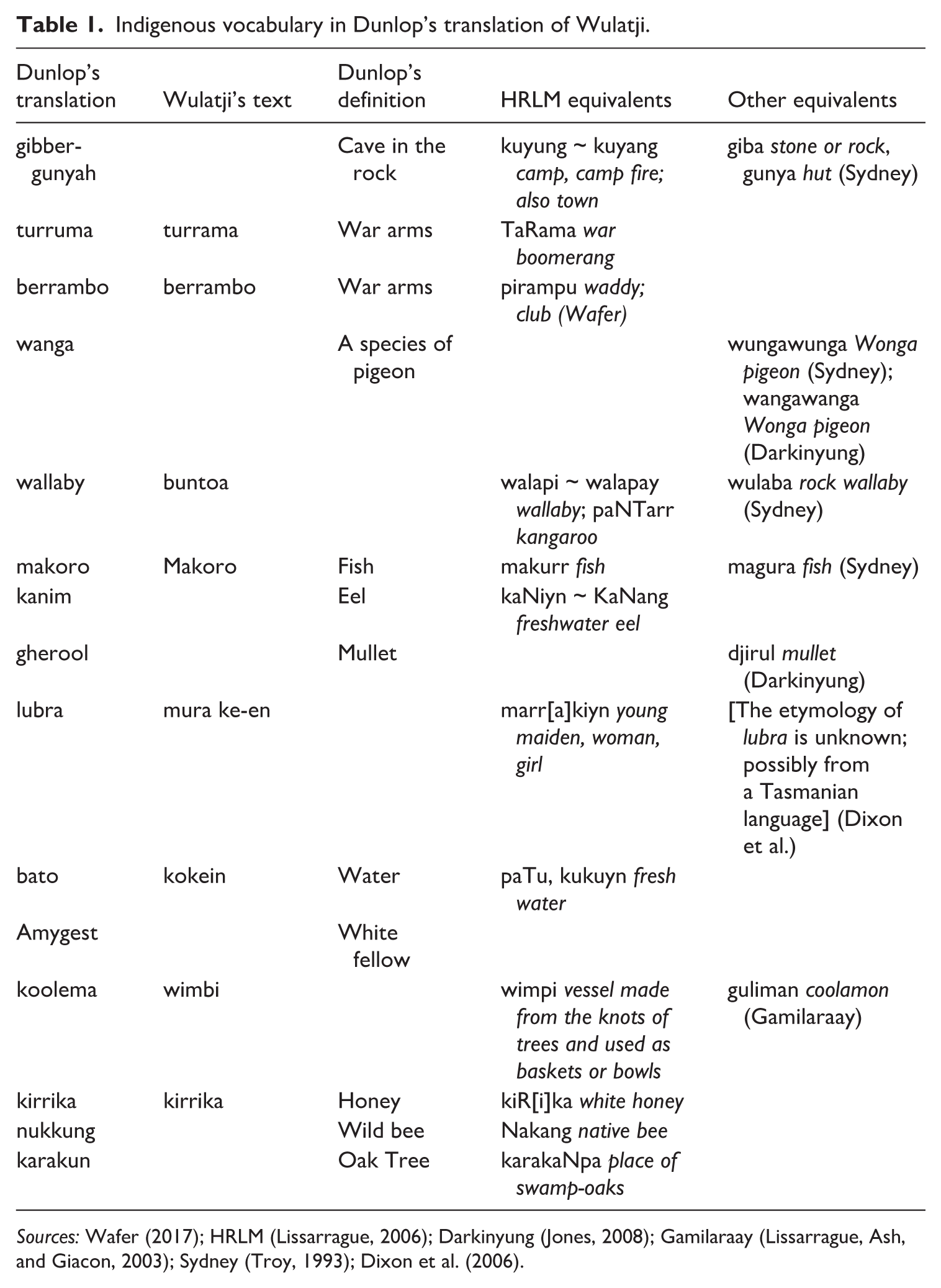
Sources: Wafer (2017); HRLM (Lissarrague, 2006); Darkinyung (Jones, 2008); Gamilaraay (Lissarrague, Ash, and Giacon, 2003); Sydney (Troy, 1993); Dixon et al. (2006).
Before considering her translation, however, it is worth considering the structure of the transcribed text. Dunlop presents this “Native Poetry” as three separate poems, each with the heading “Nung-Ngnun” (nannguyn, song). In a manuscript version, she labels the three sections “Song 1”, “Song 2”, and “Song 3” (Dunlop, 1871: image 60; printed in Dunlop, 2021: 194). 3 As we will see, Dunlop combines and reorders Wulatji’s verse in her translation, converting it into a single poem of three stanzas. This is her first effort of translation: to convert Wulatji’s separate verses into a singular poem that would be understood by her readers. In the manuscript version of the poem, she notes that Indigenous songs are short and “often repeated in a variety of cadence” (2021: 194). This, needless to say, was not a typical style of publication or performance in Romantic literary culture. When she translates this kind of cyclic song into a linear Romantic lyric, she opens the second contradiction in her text: the contradiction between the three “Nung-Ngnun”s in the transcription, and the singular poem in the translation.
The translation itself is a remarkable text, when considered in its original publication context. It was original poetry by an Indigenous person, published in a prominent settler newspaper, which ringingly asserted that the lands and waters and living creatures were “Ours” (“Nge a runba”/ngayaranpa): Our home is the gibber-gunyah, Where hill joins hill on high; Where the turruma and berrambo, Like sleeping serpents lie; And the rushing of wings, as the wangas pass, Sweeps the wallaby’s print from the glistening grass. Ours are the makoro gliding, Deep in the shady pool; For our spear is sure, and the prey secure… Kanin, or the bright gherool. Our lubras sleep by the bato clear, That the Amygest’s track hath never been near. Ours is the koolema flowing With precious kirrika stored; For fleet the foot, and keen the eye, That seeks the nukkung’s hoard; And the glances are bright, and the footsteps are free, When we dance in the shade of the karakon tree.
There are many remarkable features of this translation, but for our purposes, the most important aspect is its vocabulary (Table 1). Dunlop includes 15 Indigenous words in her translation. Five of these had already been incorporated into Australian English by 1848: “gibber-gunyah”, “wallaby”, “wanga”, “lubra”, and probably “koolema” (Dixon et al., 2006). She nonetheless includes two of these familar words — “gibber-gunyah” and “wanga” — in the poem’s Glossary. The other ten words probably appear here in English verse for the first time, and probably all originate in Wulatji’s speech (“gherool” and “Amygest” being the difficult cases).
This opens a third contradiction in Dunlop’s text: the contradiction between Wulatji’s speech and the Indigenous speech that she presents in her translation. In just four cases, Dunlop incorporates a word from Wulatji’s text into her translation: “turruma”, “berrambo”, “makoro”, and “kirrika”. In the other 11 cases, she either inserts a new word into the poem (e.g. “wanga”, “nukkung”) or translates one of Wulatji’s words by a different Indigenous word (e.g. “kokein” → “bato”, “wimbi” → “koolema”). Her translation ultimately incorporates vocabulary from at least three or four Australian languages, but in neither the text nor the Glossary does she indicate which languages they are.
What are we to make of these contradictions? In her attempt to universalize Wulatji’s poetry, Dunlop dissolves him into his people, blends his verses together, and mixes his language with many others. Her translation is an act of diffusion in the sense of both softening and spreading. She softens Wulatji’s poetry, making it more diffuse; and she seeks to “diffuse liberty”, as Mary Wollstonecraft (1994: 104) would put it, by spreading sympathy for Wulatji’s people among the public. A telling example of this double-diffusion occurs in line 5 of the translation. Wulatji’s original verse features a warlike eaglehawk (“wirripang”/wiripang). Dunlop replaces it with a “wanga”, an especially plump and gentle ground-dwelling pigeon.
Dunlop’s diffusive translation was politically canny. She presents Wulatji’s poetry in a form that would be familiar to her readers: as a “Relique” or popular ballad. Through her translation, she converts Wulatji’s poetry into an Indigenous Australian version of Thomas Percy’s Reliques of Ancient English Poetry (1765) or Walter Scott’s Minstrelsy of the Scottish Border (1802). Dunlop uses a verse-form appropriate for a popular ballad. The metre is loosely accentual, and alternates between 3- and 4-beat lines (334344). The stanzas use traditional ballad-rhyme in the first four lines, rhyming on the second and fourth lines, and terminate elegantly with tetrameter couplets. Seen in this light, the translation implicitly portrays Indigenous Australians as a nation, with a common language, deep historical roots, and flourishing literature, who love and celebrate their “home”, and who are “free” in their native lands. This apparently anticolonial aim is tempered by Dunlop’s own role in this nationalization. She is the scholar who collects, transcribes, translates, and publishes this national tradition. It is her name that appears on the final product. This is the ultimate contradiction of her enterprise: the deep aesthetic contradiction between Dunlop, the sophisticated Romantic poet who is individually responsible for her poetry, and the anonymous Wulatji, the folk-poet or “bard” whose verses are universal. 4
This is certainly an act of “sublimation”, which accomodates Wulatji to a settler system of understanding. But Dunlop herself provided the materials to undo this sublimation. She named Wulatji indirectly in her preface, enabling his later identification; and she provided an accurate transcription that laid bare her process of translation. It is also significant that she never glossed the words in her transcription. Along with her diffuse, universalist translation, she presented settler readers with a hard, unreadable nugget of Wulatji’s particular words. Today Wulatji can speak for himself. Charles Harpur’s informants, unfortunately, cannot be identified by name.
Charles Harpur: Particularism
A thousand bright particulars are given, And they outshine the very stars of heaven! (“Ideality”, h185b)
Charles Harpur was a “currency lad”, or child of convict parents, born in Windsor in 1813. He moved to the banks of Coquun sometime before 1842 (Normington-Rawling, 1962: 79). Dating The Kangaroo Hunt is difficult, because like many of Harpur’s poems it exists in multiple manuscript versions (Eggert, 2016). The earliest evidence for the poem is an excerpt published in the Weekly Register in 1843, by which time Harpur was in Jerrys Plains (Harpur, 1843). All the surviving complete versions of the poem, however, date to the 1860s, when Harpur was living far to the south in Eurobodalla. Although Harpur revised the poem continually, The Kangaroo Hunt retains its character as a poem of the 1840s, extolling the beauties of the “loud Nepean”, “old Hawkesbury”, and “rapid Hunter” rivers where Harpur spent his youth and early adulthood (h209-bf). The Indigenous vocabulary of the poem is consistent with this dating.
Harpur’s poetics are starkly different to Dunlop’s. Harpur’s poetry is rocky rather than diffuse and The Kangaroo Hunt is no exception. Harpur’s poem comprises five texts: the main text is a verse epic in six books, describing an idealized kangaroo hunt in a mountainous landscape; the second text is a preface, explaining Harpur’s theory of poetry; the third text comprises Harpur’s voluminous notes, which critique, expand, and explain the epic; included in these notes are the fourth and fifth texts, namely two additional poems that describe Australian bushland in the “flash” language of the convicts (and one of these poems itself has a note!). Dunlop’s poem also contains multiple texts: the preface, glossary, transcription, and translation. But where Dunlop seeks to diffuse these texts into a harmonious whole, producing implicit contradictions, Harpur allows the different texts of his poem to pull against one another. The Kangaroo Hunt contradicts itself explicitly.
Harpur draws attention to the particularity of Indigenous speech. Unlike Dunlop, who blends Indigenous languages together without alerting the reader to this fact, Harpur frequently notes the multiplicity of Indigenous languages: “almost every tribe of Blacks has a different set of names for our indiginous animals” (h209-cf, n. g). In particular, he distinguishes between the language spoken in the “Hawksbury Mountains” and the language(s) spoken in “the Hunter” or “some parts of the interior” (h209-df, n. j; h209-gf, n. g). The vocabulary of the poem would suggest the language of the “Hawksbury Mountains” is Darkinyung while the language of “the Hunter” is a mixture of Wonnarua (HRLM), Gamilaraay, and Wiradjuri (Table 2). From Harpur’s vague references to “the Hunter” and “the interior”, it is hard to judge how well he grasped the multilingualism of Jerrys Plains. Jerrys Plains lies near the border of Wonnarua and Gamilaraay country, and in this period, Wiradjuri speakers of the so-called “Mudgee tribe” were frequent visitors to the region (Lissarrague, 2006: 12–13; Dunn, 2020: 82, 140–41). Whether knowingly or not, Harpur learned words in all their languages.
Indigenous vocabulary in The Kangaroo Hunt.
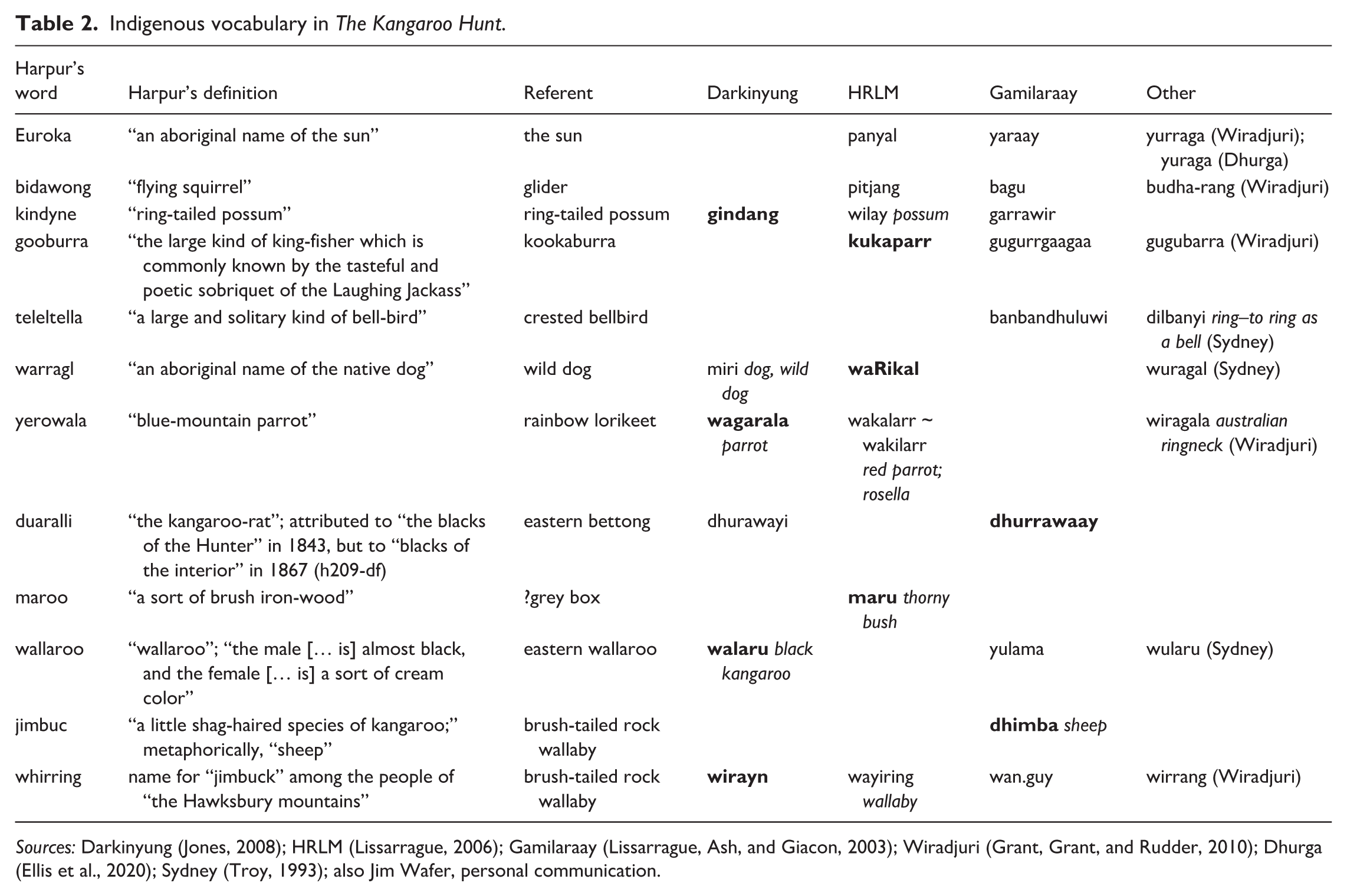
Sources: Darkinyung (Jones, 2008); HRLM (Lissarrague, 2006); Gamilaraay (Lissarrague, Ash, and Giacon, 2003); Wiradjuri (Grant, Grant, and Rudder, 2010); Dhurga (Ellis et al., 2020); Sydney (Troy, 1993); also Jim Wafer, personal communication
Here opens the main contradiction in Harpur’s poem, between the poem and its notes. In the notes, Harpur describes a country of many distinct peoples, who have named everything in the landscape. In the poem itself, Harpur uses epic conventions to try and imagine a new, unified nation of settlers, and wields the “might of song” (h209-ff) to name the land and its inhabitants. Despite his employment of Indigenous names, Harpur refers to the land as “nameless” twice in his epic (h209-cf, h209-df), and in the poem’s opening, he invokes “Australia’s yet unchristened Muse” (h209-bf). Harpur’s epic presupposes a nameless land, which the young poet can fill with “glad meanings” (h209-ff). Like Whitman, Harpur tries to sing a new nation into being, but his song is troubled by the prior existence of other nations.
He undercuts his epic task in his notes, and in the epic itself. The invocation to “Australia’s yet unchristened Muse” is a key example. Harpur’s epic in fact begins with two invocations. Before Harpur introduces the “muse”, he invokes another figure, “Euroka”. In his note to the word, he explains: b Euroka is an aboriginal name of the sun. It is at once euphonious and robust, and has therefore a certain sounding adequacy as a vocable, and thence somewhat of ideal unison with the golden progression and godlike port of that paramount luminary. (h209-bf)
In this note, Harpur acknowledges the poetic power of Indigenous names. The word “Euroka” itself exhibits an “ideal unison” with what it denotes: the sun. The “Ideal” is the central concept of Harpur’s literary theory. In the preface to the Kangaroo Hunt, Harpur argues that memories and perceptions are “idealised” when worked up into poetry (h209-af), and he muses on the nature of “ideality” frequently in the notes (e.g. h209-cf: n. i; h209-df: n. g; h209-ff: n. d). In a public lecture of 1859, Harpur clarifies the relationship between “ideality” and the language of poetry: Poetry — the harmonised expression in language of an exquisite perception of the beautiful, is the territory of the poet; the Poetic — the ideal expanse in which Poetry lives and moves, is the dominion of the Muse herself. (Harpur, 1859: 2)
In Harpur’s theory, ideality pre-exists the poet. The poet can recover this ideality through “exquisite perception” and “harmonised language”. In his note to “Euroka”, Harpur implies that Indigenous speakers have perceived the sun exquisitely and harmonized their language to it. Harpur can understand the word “Euroka”, and appreciate its “euphony” and “robustness”, because he too is a poet who perceives exquisitely and expresses himself harmoniously.
Harpur’s theory of translation is therefore different to Dunlop’s. Lurking behind his argument is the European tradition of “mimeology”, the theory that the sounds of words reflect their sense (Genette, 1976). This is an objective theory. Words denote objects. A good word for an object will somehow mimic the object itself. In this case, the sun is “robust”, and so is “Euroka”, thus word and object are in “ideal unison”. Since Harpur and his Aboriginal informants are both looking at the same sun and hearing the same sounds in the word “Euroka”, Harpur can translate — or rather, import — this word effectively into English. We have seen that Dunlop’s theory is psychological. Poetry is the expression of human feeling, and since human feelings are universal, she can recapture this poetry in her translation. In Dunlop’s subjectivist, universalist theory, the word “wimbi” may be translated by “koolema”, or “kokein” by “bato”, as the expression of feeling requires (Table 1). In Harpur’s objectivist, particularist theory, by contrast, the correct translation for “Euroka” can only be the very word “Euroka” itself.
After introducing “Euroka”, Harpur describes the “life-essential influence” of the sun for seventeen lines, before then invoking the muse: While thus Euroka riseth red, Up, even to the kingly head Of some proud eminence, we climb, Where high amid the crags sublime, Australia’s yet unchristened Muse, A wandering Spirit of beauty rare, Loves oft to gem her streaming hair With heaven’s selectest dews, And scarf her bosom bright and bare With a robe of Morning richest hues; Giving the while to all objects there, All sounds, — the water drip just heard — The hum of insect — voice of bird, — To every echo and every air A poetry unfelt elsewhere. (h209-bf)
In this context the word “unchristened” is destabilized. Its literal meaning is obvious: the muse is unnamed, and Harpur, the inaugural poet of settler Australia’s new national tradition, will make the muse his own. In the poem’s closing lines, he uses a different metaphor to similar effect: the muse of Australia is a “virgin” whom he has learned to “woo” (h209-gf). But looking closer, it becomes apparent that Harpur is not the first to know the muse. She gives “poetry” to “all objects”. This poetry can be “felt”. And it must surely have been “felt” by the people who gave the sun the poetic name “Euroka”. Perhaps the use is “unchristened” only because she is yet to be named by and for Christians.
The destabilization of colonial naming occurs again in Part II of the poem. In the final verse-paragraph, Harpur describes a flurry of birds, who screech and sing in response to the kangaroo-hunters’ shouts. One of these birds is the “Teleltella”, or crested bellbird (h209-cf). Harpur again makes a “mimeological” argument for the poetic power of the name: “the teleltella has several notes, sounding, altogether, exactly its name” (h209-cf, n. m). A few lines later, however, he again evokes the namelessness of the colonial landscape: The while innumerous nameless fowl Fluttering forth from tree to tree, Or dodging along the bushy ground In nimble clusters, clamor round:
Not only are the birds “nameless”, but they are “innumerous” and clamorous. In these lines the colonial landscape appears to be dissolving into a chaotic wilderness untouched by people. In the note to the word “nameless”, however, Harpur gives a different meaning to the passage: p Nameless, or having names that would “stick in the soft muse’s gullet”, as Byron somewhere writeth of Russian patronymics. Never were God’s creatures named — or rather nick-named — after a more barbarous fashion than were our native birds by the first comers.
In this instance, “nameless” means badly named. Harpur surveys a number of colonial bird-names in this note, condemning all but one for their barbarity. To illustrate the badness of colonial names, Harpur provides a short poem in convict slang. Here is one stanza: Beautiful change hath inspired the creation! And bobtails and cocktails sing sweet in the briar; In the gum-tree the gorger pours forth his oration, And below in the wattle the bald-headed friar.
He presents this stanza as blatantly self-contradictory. The stanza attempts to describe the “Beautiful change” of sunrise, but this beauty is undercut by the barbarousness of convict speech. For Harpur it is self-evident that names like “bobtail”, “cocktail”, “gorger”, and “bald-headed friar” are names without a shred of “ideality”.
Throughout The Kangaroo Hunt, Harpur relies on the namelessness of the landscape to justify his poem. He is naming the land and the things in it to inaugurate a new nation. But this namelessness is undermined by the presence of both Indigenous and convict names everywhere he looks. When he fails to find an existing name for something, he admits that this may be down to his own ignorance (h209-bf, n. d). In his discussion of names, Harpur grapples with his “firstness”, as a colonial poet in the early decades of settlement. As Mead (1990) has shown, Harpur often problematizes firstness in his poems. In this case, Harpur questions his position as the first namer of things, by drawing attention to the existing names of “nameless” creatures and the “unchristened” muse who idealizes them.
Harpur’s critique of colonial names opens a broader question. Why are colonial names bad, and Indigenous names good? Harpur criticizes his fellow settlers for being only “loosely observant” of even “the commonest natural appearances” (h209-ef, n. b). The settlers not only fail to name things properly, but haplessly mismanage the land. When they try to clear sparse woodland for grazing or cropping, it regrows as thick forest (h209-cf). Wherever they go, they drive beautiful birds to “extinction”. By contrast, when Indigenous people were the “lords of the soil”, they preserved avian biodiversity by hunting goannas and preventing them from stealing the birds’ eggs (h209-df, n. e). In the notes to his poem, Harpur represents Indigenous people as wise naturalists, whose perceptiveness allows them to know and name the things of nature.
Harpur represents Indigenous people in a different way in the epic itself. In Part V, Harpur describes a battle between white settlers and their Indigenous opponents in graphic terms. In so doing, he gothicizes the Indigenous warriors (see Van Toorn, 1992): When whooping forth in fell array, Dark savages, like demons dread, Amongst the backward dwellings spread Dire rapine, death, and sore dismay! Till, like a lion in his wrath, He met them on their wasteful path, A beardless War God in the way! (h209-ff)
The “He” in the second-last line is Ossian, one of the white kangaroo-hunters, whom Harpur lionizes as the natural leader of their “warrior band”. Although these lines are upsetting to read today, they can be understood in the context of Harpur’s epic conventions, and the prevarications of the colonial authorities. Harpur represents Ossian and his Indigenous opponents as belligerents of a “War”, and imagines the war from the perspective of frightened settlers in their “backward dwellings” (h209-ff). This is consistent with the conventions of martial epic. It also refutes the official position of the colonial authorities, who declared that since the Indigenous inhabitants of the colony were British subjects, they could not be at war with the Crown (Connor, 2000: loc. 1293). For Harpur, war was a brutal and terrifying fact of life in the early colony. This brutal fact is the ultimate contradiction in his attempt at translation.
The Kangaroo Hunt is more obviously colonialist than Dunlop’s translation of Wulatji, but it is also more obviously self-contradictory. Dunlop universalizes Wulatji’s plight, presenting his people as a nation in European terms. Harpur particularizes, obsessively analysing particular words, places, events, and people, and explaining his own procedure for idealizing them in verse. These different approaches lead to two different presentations of Indigenous language. Dunlop presents Indigenous languages as syntactic and literary. Wulatji’s language flows, into itself and other languages, and although his poetry has not before been written down, it has the same historical depth and classical character as English literature as soon as it is published. Harpur presents Indigenous languages as verbal and oral. He presents language as a collection of words, each one of which has the potential to achieve the “ideal unison” required for poetry (h209-bf). This “ideal unison” requires no history or tradition — it need not stretch back to Osiris or the Sinai for its justification. Each word is spoken by somebody somewhere, and its ideality arises from the exquisite perception and harmonious expression of the speaker. Thus Harpur acknowledges the Indigenous “poetic”, although he does not acknowledge any individual Indigenous poets or poems.
Colonial naming and the nature of words
In this final section, I situate Harpur and Dunlop’s translation-practices in a wider intellectual context. Despite their differences, Harpur and Dunlop have a point in common, which must be explained. Both translate Indigenous words with a freedom which is hard to accept today. Harpur asserts that he can judge the poetry of a word simply by hearing it. Dunlop confidently reshapes Wulatji’s poetry into a bardic ballad, and asserts that his verse is simply an example of a universal human practice, “Poesy”. We have become used to the idea that translation is extremely difficult, if not actually impossible. How can Harpur and Dunlop find it so easy?
The question is especially pertinent, because modern translation theory has its roots in the Romantic period. According to Steiner (1975: 78), the Romantic nationalists and comparative philologists of the early nineteenth century were the first who introduced a “sense of locale” into Western theories of language (see also Foucault, 2002: chap. 4). Romantic philologists such as Johann Gottfried Herder (1744–1803) argued persuasively that language is freighted with culture, and that languages cannot be separated from the peoples who speak them. This theory of language imposes a heavy burden on the translator: You must first enter the spirit of a nation in order to empathize completely with even one of its thoughts or deeds. You must discover a characterizing word through which you can understand everything in depth. Otherwise, you simply read a word. (Herder, 1993: 38–39)
In Herder’s terms, both Dunlop and Harpur “simply read a word”. Dunlop certainly evokes “the spirit of a nation” in her translation from Wulatji, but since she mixes so many foreign languages and literary conventions into her translation, it is not a “deep” translation by Herder’s standard. Harpur departs even more sharply from Herder’s view. He considers Indigenous words in isolation, judging them solely by how well sound accords with sense. Neither poet shares with Herder the idea that language is culturally dense. Accordingly their translation practices seem extraordinarily free by the standards of modern translation theory.
This freedom with Indigenous language may reflect Harpur and Dunlop’s colonial attitudes, but it also accords with the prevailing theory of language in the British world. In Britain, the ideas of Herder and the comparative philologists spread slowly, despite the important contribution to comparative philology of William Jones, a Welshman (Aarsleff, 1967). The most influential British theorist of language was John Horne Tooke (1736–1812), who promoted a radical version of the empiricist theory of language. Like other empiricists, Horne Tooke (1805: vol. 1, p. 18) begins with the proposition that “Words are the signs of things”. A word is simply an arbitrary sequence of sounds that denotes some object in the world. This raises an obvious problem: what objects are denoted by words like an, wherefore, and of? In the popular and frequently reprinted Epea Pteroenta. Or, the Diversions of Purley (1786, 1802), Horne Tooke devoted hundreds of pages to proving that abstract words like of could be derived from concrete words that denote objects known to sensation. Horne Tooke’s ideas were later promulgated by British utilitarians such as Jeremy Bentham (1843), who in turn influenced prominent Victorian poets including Browning and Tennyson (Cooper, 2006: 642–43).
In this intellectual context, Dunlop and Harpur’s translational choices make more sense. Dunlop can translate the word “wimbi” by the word “koolema”, because both words denote a bowl-like object of human manufacture. Harpur can judge “Euroka” or “duaralli” to be appropriate words for their objects, because he can hear the words, and perceive their objects, using the same human sense-organs as his Indigenous informants.
It is not surprising that Dunlop and Harpur should have been empiricists. Dunlop was well-versed in British empiricism, having read David Hume by the age of 12 (Hansord, 2021: 76). Harpur’s education is less well attested, but he was strongly influenced by Percy Shelley, whose early debt to empiricism is well known. In any case, empiricism was convenient for the colonists. Empiricism gave Dunlop the freedom to reshape Wulatji’s poetry into a politically effective form and Harpur the freedom to fashion a new Australian English that incorporated the poetic perceptions of Indigenous Australians.
Australia remains a settler-colonial state and has not answered the questions raised by Dunlop and Harpur’s contradictory poetry. Dual-naming and renaming are increasingly common. The erstwhile water rat (hydromys chrysogaster) is now officially the rakali. Australia’s capital cities have widely accepted Indigenous names, as do regional centres such as Muloobinba/Newcastle. But colonial attitudes remain strong. When Fraser Island officially reverted to its original name, K’Gari, the reversion sparked a year-long “edit war” on Wikipedia, as some editors fought to retain the more familiar colonial name for the popular tourist destination (H. Ford et al., 2024). The colonial poetics of naming remain controversial.
Harpur’s Kangaroo Hunt and Dunlop’s translation of Wulatji remain valuable today primarily for their contradictions. Harpur deconstructed the concepts of named and nameless even as he tried to assert the right to name. Dunlop sublimated Wulatji to a Western ideal of literary nationalism, but through her skilled transcription of his words, provided the tools to deconstruct her own translation. Harpur and Dunlop’s deconstruction of colonial naming remains resonant today, as Australians continue to debate the ongoing effects of settler colonialism.
The final value of Wulatji’s poetry is, of course, the poetry itself. As a settler with little knowledge of Wulatji’s culture, I cannot evaluate, but only admire his crystalline verses. 5
Footnotes
Acknowledgements
I live on the unceded lands of the Darug and Gundungurra peoples, and work on the unceded lands of the Wurundjuri Woiwurrung people of the Kulin nation. I acknowledge their sovereignty over these lands, and the sovereignty of the Indigenous peoples discussed in this article. I am grateful also to Jim Wafer and Grace Karskens for sharing their unpublished notes on Harpur’s Kangaroo Hunt. I also thank Lynda Ng, Rachael Weaver, Ken Gelder, Marc Mierowsky, and the two anonymous reviewers for their comments on the manuscript.

Funding
The author received no financial support for the research, authorship, and/or publication of this article.
Declaration of conflicting interests
The author declared no potential conflicts of interest with respect to the research, authorship, and/or publication of this article.