




Abstract
Aim
This narrative literature review aimed to evaluate thermoplastic materials used in orthodontic aligners and their influence on mechanical properties and clinical performance.
Materials and Methods
A literature search was conducted in PubMed and Google Scholar between November 1, 2023, and January 31, 2024, including studies published from 2015 to 2023. The search combined keywords related to “aligners,” “plastic,” and “mechanical properties.” Study selection, eligibility assessment, and data extraction were performed independently by two reviewers. Supplemental materials include the full search strategy and a structured data extraction table.
Results
From 197 identified records, 22 studies were included. The primary materials analyzed were polyethylene terephthalate glycol, thermoplastic polyurethane, and polycarbonate. Variations in material composition, thickness, thermoforming processes, and intraoral aging significantly influenced mechanical behavior, including stress relaxation, force delivery, and dimensional stability.
Conclusions
Intraoral aging, material properties, and clinical use patterns significantly affect aligner performance. Materials with improved resistance to stress relaxation and degradation may enhance treatment predictability. However, due to limited high-quality clinical evidence, further studies are required to establish definitive clinical guidelines.
Keywords
Introduction
Clear aligners have revolutionized orthodontic treatment, representing a significant advancement driven by digital workflows and patient demand for aesthetic and removable appliances.1, 2 Compared to conventional fixed appliances, aligners offer advantages such as improved comfort, oral hygiene, and aesthetic acceptability, contributing to their increasing use among both adults and adolescents.3–5
The introduction of Invisalign® by Align Technology in 1998 marked a major milestone, enabling digitally planned orthodontic treatment with improved predictability.6, 7 Since then, advances in material science and manufacturing processes have led to the development of various thermoplastic polymers, including polyethylene terephthalate glycol (PET-G), thermoplastic polyurethane (TPU), and polycarbonate (PC).8–10 These materials differ in their mechanical behavior, including flexibility, stress relaxation, and resistance to intraoral degradation, which directly influence treatment effectiveness. 11
Modified PET-G refers to PET-G-based materials that have undergone structural or chemical modifications (such as multilayer configurations or additive incorporation) to enhance mechanical properties and resistance to intraoral aging. However, variability in proprietary formulations and manufacturing techniques complicates direct comparison across studies. 12
Recent systematic evidence comparing clear aligners with fixed appliances provides important clinical context for interpreting laboratory findings. Studies suggest that aligners are effective for mild to moderate malocclusions, although limitations remain in complex cases requiring greater biomechanical control.13–16 These findings highlight the importance of integrating material properties with clinical outcomes.
Despite increasing clinical adoption, the relationship between thermoplastic material properties, intraoral aging, and treatment predictability remains incompletely understood. Therefore, this narrative review aims to evaluate thermoplastic materials used in orthodontic aligners, focusing on mechanical properties, intraoral aging, and their clinical implications.
Material and Methods
This narrative review followed the PRISMA 2020 recommendations. 17 The protocol was registered in the Open Science Framework (OSF.IO/5V2HG). Although registration occurred after completion of the literature search, it accurately reflects the methodology applied, with no post hoc modifications.
A literature search was conducted in PubMed and Google Scholar between November 1, 2023, and January 31, 2024, including studies published from January 2015 to December 2023. The search strategy combined keywords related to “aligners,” “plastic,” and “mechanical properties,” and is fully detailed in Supplemental File 1. A limitation of this review is the inclusion of only two databases, which may have excluded studies indexed in Scopus, Web of Science, and Embase. However, this limitation was mitigated by manual screening of reference lists and inclusion of gray literature.
Eligibility criteria included in vitro, in vivo, and ex vivo studies evaluating the mechanical properties of thermoplastic materials used in orthodontic aligners and their potential clinical implications. Review articles, opinion papers, and studies lacking mechanical analysis were excluded.
Although the initial search was conducted by a single researcher, study selection, eligibility assessment, and data extraction were independently performed by two reviewers. Disagreements were resolved through discussion and consensus. Inter-reviewer agreement statistics were not calculated, representing a methodological limitation.
Dimensional accuracy of printed models may influence aligner fit and performance. In this context, studies comparing fused deposition modeling (FDM) and digital light processing (DLP) demonstrate that manufacturing techniques can affect thermoforming outcomes. 18
As this study is a literature review, no ethical approval was required. All included studies were assumed to comply with ethical standards.
Narrative Literature Review
Materials Influence on Force Consistency
Treatment with clear aligners is typically complemented by accessories such as attachments, elastics, and mini-implant devices. 3 However, understanding the properties of plastics is essential to extenuating limitations in fabrication materials. 14 Studies have demonstrated that the viscoelastic nature of plastics in the oral environment often results in either excessive force on teeth,19, 20 causing discomfort, or insufficient force, leading to inadequate tooth movement. The mechanical properties of aligners are evaluated based on their activation state and subsequent intraoral aging,12, 17 and the impact of these changes on orthodontic treatment effectiveness is discussed.
Aligners are manufactured from various thermoplastic polymers, with the most common materials being PET-G, TPU, and PC.13, 21 Clear aligners have different thicknesses, ranging from 0.75 to 1.2 mm, 21 thus, both thickness and activation significantly influence orthodontic force values. The force exerted by thermoplastic appliances depends on activation amount, material type, thickness, and thermoforming process.
PET-G is a clear amorphous copolymer of polyethylene terephthalate (PET), known for low hygroscopicity and ease of manufacture.20, 22, 23 TPU,13, 20 highly abrasion-resistant and elastic, exhibits high shear strength and good transparency due to its two-phase microstructure with hard and soft segments, terminal oriented perpendicularly to applied stresses, enabling extensive deformation. 20 Conversely, PC is a robust material with high impact resistance but low resistance scores.19, 24
Clear aligners experience varying mechanical stresses during their use, which can be categorized into short-term and long-term deformation stresses. 18 Short-term stresses occur immediately upon insertion of the aligner, as the material adapts to the initial force exerted against the teeth to initiate movement. 15 This phase can be categorized by higher force peaks and transient deformation as the aligner material adjusts to the oral environment and the geometry of the dentition. 25 In contrast, long-term stresses refer to sustained forces that develop over prolonged contact with the teeth. 16 These stresses are influenced by factors such as material relaxation, creep behavior, and the gradual reduction in force as the aligner adjusts to the shifting tooth positions. 24
The findings indicate that intermittent force causes less damage than constant force, displaying a direct correlation between thickness and resultant stress delivered. 26 Further research is secured to explore the effects of constant force on tooth movement by simulating intraoral conditions and investigating the influence of immersion time and activation on orthodontic force values. The precision of thin-film pressure chip sensors in measuring contact surface force between aligners has been acknowledged, 1 precepting future studies to simulate stress-strain and relaxation properties of clear aligners in oral cavity environments.
Understanding the interplay between these two types of stresses (short and long-term) is crucial for optimizing aligner design, ensuring effective treatment and predictable tooth movement, while minimizing material deformation and patient discomfort.
Mechanical Behavior of Aligners
In-office aligners undergo thermoforming to be produced,12, 27 wherein the polymer is heated and stretched under tension. This process aligns polymer chains, enhancing material strength and stiffness. 28 Clinically, the oral cavity attempts fluid absorption, and it can vary aligner dimensions, compromising the fit of the patient’s arch. 22 Combined with changes in thermoplastic mechanical properties, 26 this can lead to unpredictable orthodontic force application and potential treatment efficacy loss. 18
An optimal force system is crucial for obtaining an appropriate biological response in the periodontal ligament, 29 where bone remodeling and resorption processes take place over 7–14 days with use of aligners, revealing the time needed for the periodontal ligament repair and regeneration thereupon tooth displacement.14, 30 Considering the force variation of aligners composed of different materials, including conventional PET-G and modified PET-G immersed in artificial saliva, a previous study 26 evaluated force measurements over 0, 3, 7, 10, and 14 days. Force values of both types of aligners decreased progressively over time compared to the control group (0 days of artificial saliva immersion). Each plastic material exhibited a distinct stress relaxation curve during the analyzed period, leading to a decrease in aligner force beyond time, which may compromise the efficiency of tooth movement during the prescribed aligner wear period per day when its position in the oral cavity is in full contact with saliva.
When comparing aligners based on composition, force measurements in clear modified PET-G aligners were higher than those in conventional PET-G aligners. 6 Following immersion in saliva, both types exhibited decreased force values. Still, modified PET-G aligners showed a slower decrease compared to conventional PET-G aligners under oral cavity conditions.
Positioned in the mouth, aligners face a challenging environment characterized by intermittent loads, both short-term (during insertion) and long-term (continuous contact with the teeth being moved, which opposes movement) loads. 31 Deformation reduces the load applied by the aligner upon insertion, and the degree of reduction and its impact on performance depends on the magnitude of the applied load and the properties of the material used. 10 The deformation of thermoplastics induces variations in aligner behavior, influencing pressure and consequently tooth movement. 15 Comparing other studies in the literature with laboratory experiments proves challenging due to varying protocols, and even slight differences in testing apparatus can output significantly different results. 11
Ideally, orthodontists must consider these factors when planning treatment protocols and prescribing movement synergisms 9 ; the mechanical properties of the polymers comprising aligners should enable the prediction of their behavior in clinical use and contribute to treatment effectiveness.23, 32 Clear aligners should maintain consistent forces throughout their use to facilitate physiological tooth movement. 24 However, achieving this consistency stand challenges in clinical practice, and advanced materials, such as direct-printed aligners, are being performed to alternately individualize plastic by shape memory characteristics. 27
Impact of Aging and Activation
Albertini et al. 21 illustrated that the single-layer aligner group (TPU and PET-G) exhibited highly similar mechanical properties, particularly in terms of deformation and stiffness, with increasing values compared to the double-layer aligners (PET-G/TPU and PC/TPU). Conversely, the double-layer group displayed distinct measurements from each other, even though significantly lower than those of the single-layer aligners. Moreover, appliances with greater hardness are anticipated to demonstrate superior wear resistance, thereby ensuring consistent clinical application of tooth movement. Prior studies8, 11, 22 have noted that PET-G materials exhibit higher wear resistance compared to polypropylene materials, although a similar comparison with PU-based materials is lacking.
Intraoral aging reduces residual stress across all materials over time, contributing to the deterioration of their clinical properties. 29 Mechanotherapy is directly influenced by the material’s viscoelasticity over time, 33 potentially exacerbated by fluid absorption. 30 Notably, these materials absorb water over time and expand hygroscopically. 28 A higher modulus of elasticity is desirable, allowing aligners to strain consistent forces despite their slim dimensions, thereby minimizing deformation and improving applied orthodontic forces.16, 21 The implications of this degradation on tooth movement remain unclear; literature suggests that the efficiency of movement efficiency should enclose both mechanical properties and molecular composition of commonly used materials. 31
Given that Invisalign® is exclusively manufactured and delivered as an orthodontic appliance, acquiring large specimens for testing remains impractical. 2 In contrast, in-office clear aligners offer a distinct advantage in terms of accessibility. Clinicians can easily fabricate new samples or adjust existing ones using 3D printing and thermoforming technologies, allowing for rapid prototyping and testing. 32
Hardness measurements typically involve evaluating applied force against indentation depth during loading–unloading cycles. 30 The flexibility of manufacturing in-office clear aligners in this manner facilitates comprehensive material analysis, including hardness and aging studies 29 compared to outsourced aligners, such as Invisalign®. Furthermore, a clearer understanding of their properties and the effects of aging could lead to more precise sequencing of tooth movement, 12 especially as certain polymer compositions remain undisclosed. In-office systems eliminate the dependency on proprietary manufacturing processes and undisclosed polymer compositions, providing greater control over treatment planning and customization.
Results
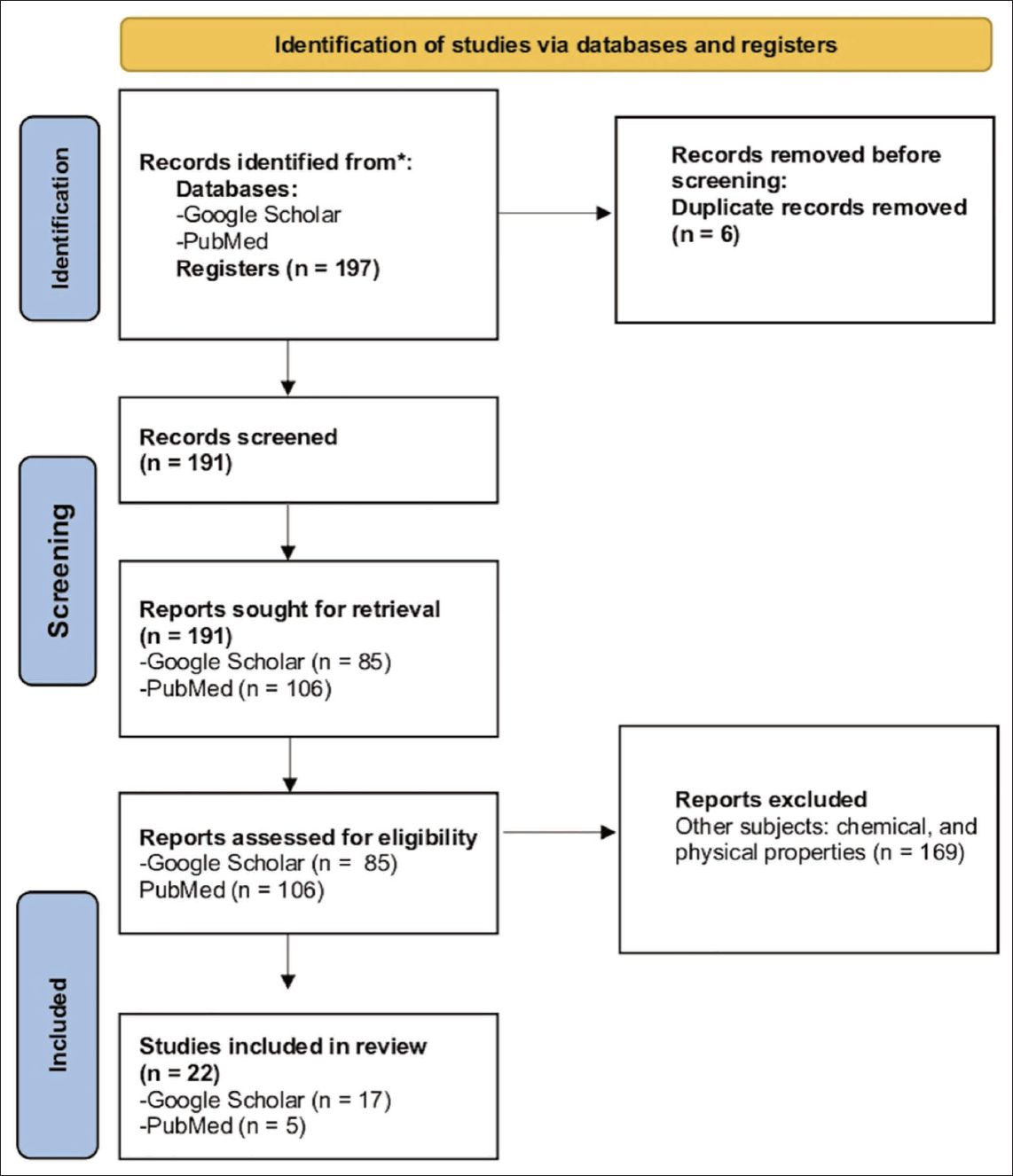
A total of 197 records were identified through database searching, of which 22 studies met the inclusion criteria after duplicate removal and eligibility assessment (Figure 1 and Supplemental File 2). The included studies comprised predominantly in vitro investigations, with a limited number of in vivo and ex vivo studies, reflecting the current predominance of laboratory-based evidence in this field. At the full-text stage, 169 studies were excluded for the following reasons: lack of relevance to orthodontic aligners (n = 52), absence of mechanical property evaluation (n = 61), exclusive analysis of chemical composition (n = 28), and ineligible study design, such as reviews or opinion articles (n = 28).
PRISMA Flowchart 35 of the Study Selection Process. The Diagram Illustrates the Number of Records Identified Through Database Searching, Screened, Assessed for Eligibility, and Included in the Final Analysis. Reasons for Exclusion at the Full-text Stage Included Lack of Evaluation of Mechanical Properties, Absence of Focus on Orthodontic Aligners, Exclusive Assessment of Chemical Composition, and Ineligible Study Design.
The analyzed thermoplastic materials primarily included PET-G, TPU, and PC, as well as modified or multilayered variants of these polymers. Reported aligner thickness ranged from 0.75 to 1.2 mm. When specified, thickness values were distinguished between nominal (manufacturer-reported) and post-thermoforming measurements, as thermoforming processes may significantly alter final material dimensions and mechanical behavior.
Across the included studies, mechanical properties such as stress relaxation, viscoelasticity, force delivery, and dimensional stability were evaluated using different experimental setups. Considerable heterogeneity was observed in testing protocols, including variations in thermoforming conditions, aging simulations (e.g., artificial saliva immersion, thermocycling), and measurement techniques. This variability limited direct quantitative comparison between studies.
A consistent finding across studies was the progressive reduction in force delivery over time, particularly under simulated intraoral conditions. Force decay was commonly reported within 7–14 days, corresponding to clinically relevant aligner wear intervals.19, 25, 34 This reduction was attributed to stress relaxation, material creep, and water absorption, all of which contribute to the degradation of mechanical performance.
Differences between materials were also identified. TPU generally demonstrated superior elasticity, higher resistance to deformation, and slower force decay compared to PET-G materials. Conversely, PET-G materials showed advantages in manufacturability, transparency, and cost-effectiveness, although they were more susceptible to mechanical degradation under intraoral conditions. PC materials exhibited high impact resistance but less favorable flexibility characteristics.
In addition, multilayer or modified materials showed variable performance depending on composition and structure, with some studies reporting improved resistance to stress relaxation and enhanced force consistency. Manufacturing techniques, including thermoforming and direct 3D printing, were also shown to influence mechanical behavior, particularly through their effects on polymer chain orientation and dimensional accuracy.
To facilitate comparison across heterogeneous methodologies, a structured data extraction table summarizing study characteristics and main findings has been provided as supplemental material (Supplemental File 3). A simplified level-of-evidence assessment was performed for all included studies based on study design. In vitro and review studies were classified as low-level evidence, while in vivo studies were considered moderate-level evidence. This classification is presented in Supplemental File 3 to enhance transparency and support interpretation of the findings.
Discussion
This review highlights the critical role of thermoplastic materials in determining the mechanical performance and clinical effectiveness of orthodontic aligners. However, significant heterogeneity across studies limits direct comparison, particularly due to differences in experimental setups, test rigs, and measurement units. Therefore, direct numerical comparisons of force values should be interpreted with caution unless methodologies are standardized and directly comparable. Although two reviewers independently evaluated the included studies, inter-reviewer agreement statistics were not calculated, representing a methodological limitation. Future systematic reviews should include quantitative measures of agreement to enhance transparency and methodological rigor.
Laboratory findings must be interpreted within a clinical framework. For example, force decay observed over 7–14 days supports clinical recommendations for regular aligner replacement and strict adherence to wear protocols. Similarly, stress relaxation and material deformation may reduce treatment predictability, suggesting the need for optimized staging strategies and the use of auxiliaries such as attachments or elastics to enhance force control. Recent systematic reviews and randomized clinical trials have provided important insights into the clinical effectiveness of aligners. Evidence suggests that aligners are effective in mild to moderate malocclusions but may be less predictable in complex cases requiring precise root control or significant occlusal corrections.13–16, 21, 35 Although several included studies evaluated intraoral aging through artificial saliva immersion, the complex interaction between saliva composition, temperature variation, pH fluctuations, and the oral microbiological environment was not comprehensively analyzed. These factors may accelerate material degradation, alter surface morphology, and compromise mechanical properties over time. Therefore, future studies should aim to replicate the multifactorial oral environment more accurately to better predict the long-term clinical performance of orthodontic aligners.
Systematic reviews of clinical outcomes indicate variable effectiveness of aligners in complex cases, underscoring the need to relate material properties to realistic clinical endpoints. 21 Manufacturing pathways also influence clinical outcomes, as randomized clinical data indicate that in-house aligner systems may differ from outsourced systems due to variations in fabrication protocols and material processing. 33 In addition, the oral environment plays a crucial role in material degradation, as factors such as saliva composition, temperature variation, pH fluctuations, and microbiological activity may accelerate degradation and alter mechanical properties over time.25, 34
This review did not include cost-effectiveness analyses or structured clinical decision-making frameworks for material selection. From a clinical perspective, material choice should balance mechanical performance, patient-specific needs, and economic considerations. For instance, while TPU exhibits superior mechanical properties, PET-G may offer a more cost-effective alternative. Future studies should incorporate health economics and decision-analysis models to guide evidence-based material selection in orthodontic practice.
Recent high-quality clinical evidence, including randomized controlled trials and systematic reviews, has provided important insights into the effectiveness of clear aligners compared to fixed appliances. Current findings suggest that aligners may achieve comparable outcomes in mild to moderate malocclusions, while fixed appliances tend to demonstrate superior control in more complex cases, particularly those requiring extractions or significant occlusal corrections.36, 37 Additionally, systematic reviews indicate that although aligners may offer advantages such as reduced treatment time and improved patient-reported outcomes, the overall quality of evidence remains limited and heterogeneous.38, 39 Furthermore, emerging clinical data highlight that both treatment modality and manufacturing approach (e.g., in-house versus outsourced systems) can influence treatment efficiency and final occlusal outcomes. These findings reinforce the importance of integrating laboratory-based material properties with robust clinical evidence when interpreting aligner performance and making evidence-based treatment decisions.
Despite these advances, this review has limitations, including restriction to two databases, absence of formal risk-of-bias assessment, and lack of inter-reviewer agreement statistics. While current evidence is predominantly derived from in vitro studies, clinically relevant conclusions can still be drawn, although high-quality randomized clinical trials are needed to establish definitive guidelines. This review did not stratify findings according to aligner brand, material generation, or manufacturing technique (e.g., thermoforming versus direct 3D printing), which represents a relevant limitation. Variations in polymer composition, proprietary material formulations, and fabrication methods may significantly influence mechanical properties such as stress relaxation, force delivery, and aging behavior. Future investigations should incorporate subgroup analyses to better elucidate the impact of these variables on clinical performance. Patient-related factors such as compliance, occlusal forces, parafunctional habits (e.g., bruxism), and aligner wear time were not systematically analyzed in this review, despite their well-established influence on treatment outcomes. The effectiveness of aligner therapy is highly dependent on consistent use (approximately 20–22 h/day), and deviations from recommended protocols may compromise force delivery and predictability of tooth movement. Future clinical studies should integrate behavioral and biomechanical patient variables into outcome analyses.
Taken together, the studies by Jaber et al.40–42 provide complementary evidence linking manufacturing processes, material properties, and clinical outcomes in aligner therapy. Dimensional accuracy of 3D-printed models, particularly when comparing FDM and DLP techniques, has been shown to influence thermoforming outcomes and, consequently, the fit and mechanical behavior of aligners. In addition, randomized clinical data indicate that in-house aligner systems can achieve clinically acceptable results, although differences in treatment efficiency may exist when compared to conventional fixed appliances. Furthermore, systematic reviews of clinical outcomes suggest that the effectiveness of aligners in complex malocclusions remains variable, reinforcing the need to relate laboratory-derived material properties to realistic clinical endpoints. Collectively, these findings highlight that aligner performance is multifactorial, depending not only on material characteristics but also on manufacturing protocols and case complexity, underscoring the importance of integrating experimental and clinical evidence in orthodontic treatment planning.
Recent bibliometric analyses have highlighted the rapid evolution and growing scientific interest in orthodontic aligner research. A network and bibliometric analysis of 50 pivotal articles 43 demonstrated increasing trends in material innovation, biomechanics, and digital workflows, reinforcing the relevance of continuous investigation into aligner materials and their clinical implications. This supports the need for ongoing updates in evidence synthesis as new technologies emerge.
While current evidence remains limited by heterogeneity and a predominance of in vitro studies, important clinical implications can be drawn. Materials with greater resistance to intraoral aging and lower stress relaxation rates appear to provide more consistent force delivery, potentially improving treatment predictability. Clinicians should prioritize materials with demonstrated mechanical stability, consider patient compliance, and account for intraoral environmental factors when selecting aligner systems. Nevertheless, high-quality clinical trials are still required to establish definitive clinical guidelines.
Conclusion
Within the limitations of the available evidence, this review highlights that the mechanical properties of thermoplastic materials play a fundamental role in the clinical performance of clear aligners. Factors such as material composition, thickness, thermoforming processes, and intraoral aging significantly influence force delivery, stress relaxation, and overall treatment predictability.
Materials with greater resistance to intraoral degradation and lower stress relaxation rates appear to provide more consistent force application over time, which may enhance the efficiency and predictability of orthodontic tooth movement. However, these material-dependent effects must be interpreted alongside clinical variables, including patient compliance, occlusal forces, and oral environmental conditions.
Current evidence remains limited by methodological heterogeneity and a predominance of in vitro studies. Therefore, although clinically relevant implications can be inferred, definitive clinical recommendations should be made with caution. Future research should prioritize well-designed randomized clinical trials and standardized testing protocols to establish evidence-based guidelines for material selection and aligner therapy optimization.
Footnotes
Authors’ Contributions
Viana ALFSR: Obtained funding, Registered protocol, Data curation, Investigation methodology, Software, Formal analysis, Validation, Visualization, Writing – original draft, Writing – review & editing.
Barreto LSC: Conceptualization, Obtained funding, Registered protocol, Data curation, Investigation methodology, Software, Formal analysis, Validation, Visualization, Writing – original draft, Writing – review & editing.
Barreto BCT: Resources, Validation, Methodology, Formal analysis, Writing – original draft, Writing – review & editing.
Marassi C: Resources, Validation, Methodology, Formal analysis, Writing – original draft, Writing – review & editing.
Vásquez GAM: Resources, Validation, Methodology, Formal analysis, Writing – original draft, Writing – review & editing.
Elias CN: Investigation, Resources, Supervision, Validation, Methodology, Formal analysis, Project administration, Writing – original draft, Writing – review & editing.
Nojima LI: Investigation, Resources, Supervision, Validation, Methodology, Formal analysis, Project administration, Writing – original draft, Writing – review & editing.
Nojima MCG: Conceptualization, Obtained funding, Data curation, Investigation, Resources, Supervision, Validation, Methodology, Formal analysis, Project administration, Writing – original draft, Writing – review & editing.
Data Availability Statement
Not applicable.
Declaration of Conflicting Interests
The authors declared no potential conflicts of interest with respect to the research, authorship, and/or publication of this article.
Ethical Approval Institutional Statement
Not applicable.
Funding
The authors disclosed receipt of the following financial support for the research, authorship, and/or publication of this article: This study was financed in part by the Coordenação de Aperfeiçoamento de Pessoal de Nível Superior – Brasil (CAPES) – Finance Code 001.
Informed Consent
Not applicable.
OSF Registration
Barreto LSC, Viana ALFSR, Marassi C, Vásquez GAM, Elias CN, Nojima LI, and Nojima MCG. Evolution and Impact of Orthodontic Aligners: Materials and Mechanical Properties. OSF. 2024 June 20.
Supplemental Material

References
Supplementary Material
Please find the following supplemental material available below.
For Open Access articles published under a Creative Commons License, all supplemental material carries the same license as the article it is associated with.
For non-Open Access articles published, all supplemental material carries a non-exclusive license, and permission requests for re-use of supplemental material or any part of supplemental material shall be sent directly to the copyright owner as specified in the copyright notice associated with the article.
