



Abstract
In the urgent context of climate change, embodied carbon data has become critical to the decarbonization of the built environment. This research examines the integration of embodied carbon assessment into urban design practice, with a focus on early-stage design. Based on a 3-month practice-based case study in a Dutch architecture office, the study identifies persistent challenges in applying Life-Cycle Assessment (LCA) at the urban scale, including the definition of system boundaries, reconciliation of heterogeneous levels of detail, and communication of data omissions. The findings reveal abductive reasoning, visualization, and tacit knowledge enable designers to transform fluid design artefacts into workable protocols—what is here defined as designerly ways of decarbonizing. The study redefines early-stage design as an operational category for carbon assessment and demonstrates the codification of tacit knowledge in data-enabled tools, advancing understanding of design processes in the low-carbon transition.
Keywords
Introduction
Background context
The European Union has positioned decarbonization of the built environment as a central pillar in its policy and legislation, addressing climate change pressing issues (Oberthür and Homeyer, 2023). Historically, efforts in reducing carbon emissions focused on key emission sectors, such as construction, responsible for 37% of global emissions (Economidou et al., 2020; UNEP, 2021). For instance, the 2000 energy efficiency action plan led to the Energy Performance of Buildings Directive (EPBD) in 2022 and set a minimum performance standard in building operations. These measures reveal an emphasis on operational carbon reductions for buildings, pushing architects and urbanists to embrace the design of energy efficiency measures such as enhanced insulation, renewable energy integration, and high-performance building envelopes. Stricter energy codes, technological advancements in building performance, and cleaner power grids are helping operational emissions diminish. Meanwhile, the significance of embodied carbon—emissions associated with material extraction, production, transportation construction, and end-of-life disposal—gains attention to achieve the European Green Deal’s target of carbon neutrality by 2050.
Emerging EU frameworks such as Level(s) (2021) acknowledge the shift toward integrating embodied carbon data in the design processes, by introducing a methodology for whole-life carbon assessment. Level(s) provides a methodology for measuring Global Warming Potential (GWP), commonly known as whole-life carbon, throughout a building’s life cycle. While countries like The Netherlands (DGBC, 2021; RVO, 2017), France (FrenchPlans, 2022), and Germany (DGNB, 2023) have already introduced regulations to limit embodied carbon in new buildings, widespread implementation across the EU remains limited (One Click, 2022).
For architects and urban designers, the transition toward built environment decarbonization presents a methodological and practical challenge: integrate embodied carbon considerations throughout the design process, not only at the end—when most decisions are fixed—but at early-stage design. That is when materials, structural systems, and urban form are still fluid and have the largest potential impact on carbon reduction (Beltran et al., 2018; Rauland and Newman, 2015; Zarate et al., 2024). While rules-of-thumb, carbon guidelines, and early benchmarks have begun shaping low-carbon architectural intuition—facilitating early-stage integration—the same clarity is largely absent in urban design, where the assessment system expands to include networks, infrastructures, and landscape, in addition to heterogeneous building types.
Urban projects introduce additional complexity: fragmented data, uneven levels of detail (LoD) across design components, and the need to reconcile multiple disciplinary inputs. In this evolving policy and design context, embodied carbon becomes not only a technical metric but a design driver, demanding new workflows, tools, and cognitive strategies. Carbon data integration at early-stage urban design, thus, represents a critical yet under-examined instrument for decarbonization of the built environment, where the potential for decarbonization is high but methodological clarity is low.
Research problem
Despite the emergence of heuristics that support architects in making low-carbon decisions early in the design process, urban design projects still lack the methodological instinct needed to guide decarbonization at similarly formative stages. This problem is important because design processes in architecture and urban design play a central role in shaping the carbon footprint of buildings (Figure 1). Design Processes are currently facing a great pressure to support efforts in decarbonizing the built environment (Dos Santos Gervasio and Dimova, 2018). For example, conscious material selection (i.e., favoring locally sourced materials or even timber structures over concrete and steel) can reduce embodied carbon emissions (Davies et al., 2018); passive lighting and ventilation can help reduce energy consumption and emissions, with heating and air conditioning (Beltran et al., 2018); and designing for deconstruction and re-assembly of structures help reduce end-of-life impacts (Dos Santos Gervasio and Dimova, 2018; Tingley et al., 2018). The central role of the design process for decarbonization of the built environment. Illustration by the author, inspired by scheme on Dos Santos Gervasio and Dimova’s Model for Life-Cycle Assessment (LCA) of buildings, 2018.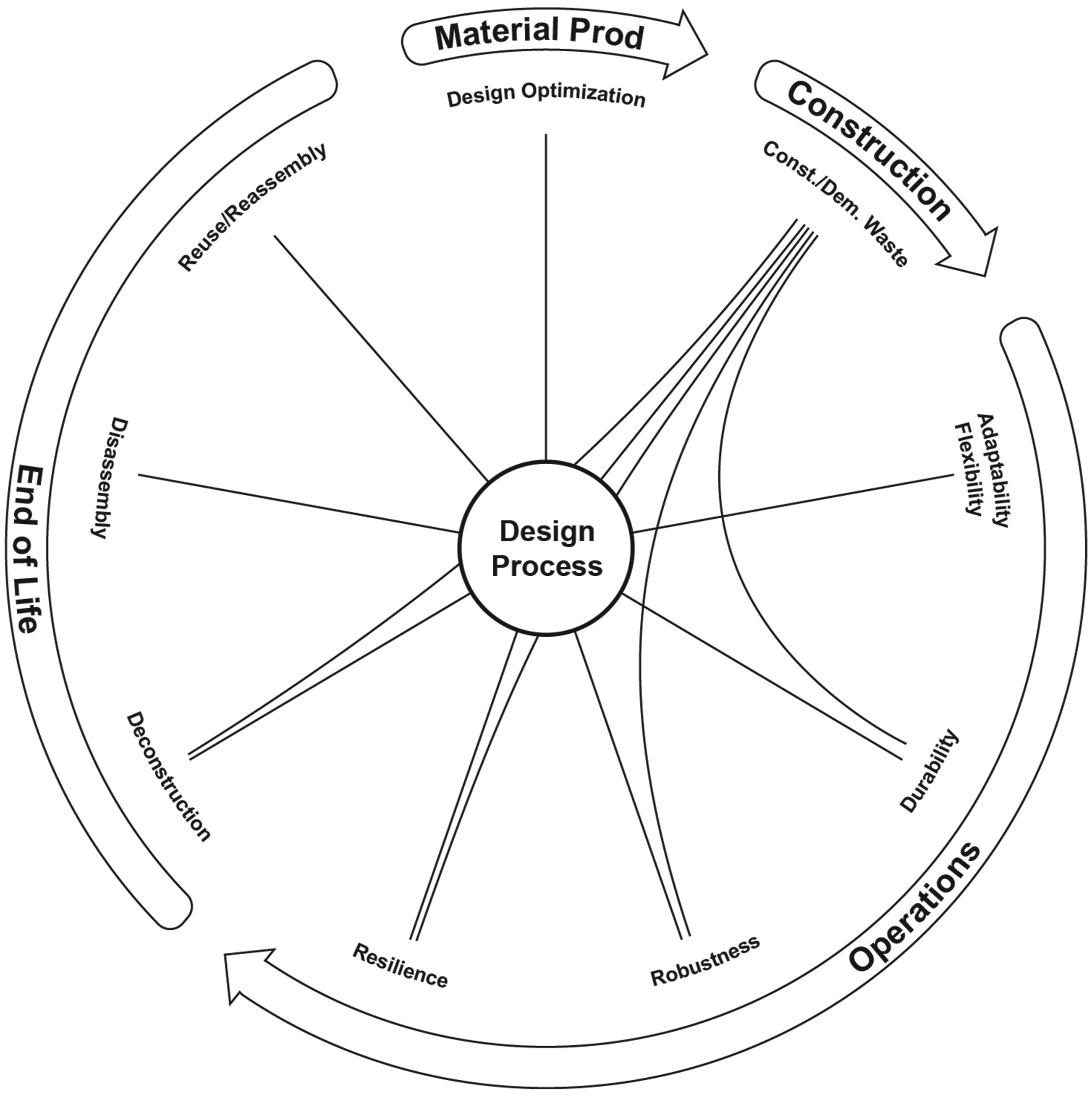
Life-cycle assessment (LCA) is positioned as a key methodological basis for environmental assessment in the construction sector (Moisio et al., 2024). LCA can be incorporated in the design process to quantify environmental impact across a building’s lifespan. LCA aids in the accountability of embodied and operational carbon emissions in buildings, by following standardized methods (CEN, 2024; EN 15804, 2019; NMD, 2022). The structure of the process of assessment described in EN 15978 (for buildings), is paired with the required information related to each step (Figure 2). LCA considers the building as a product constituted of parts and elements, each made of certain materials, where each material has its own GWP, a carbon factor in Kg CO2 equivalent (Gibbons and Orr, 2020; Netherlands, 2020). Process of assessment, adapted from EN 15978. In gray, the observed moments structuring the findings of this paper. Illustration by the author.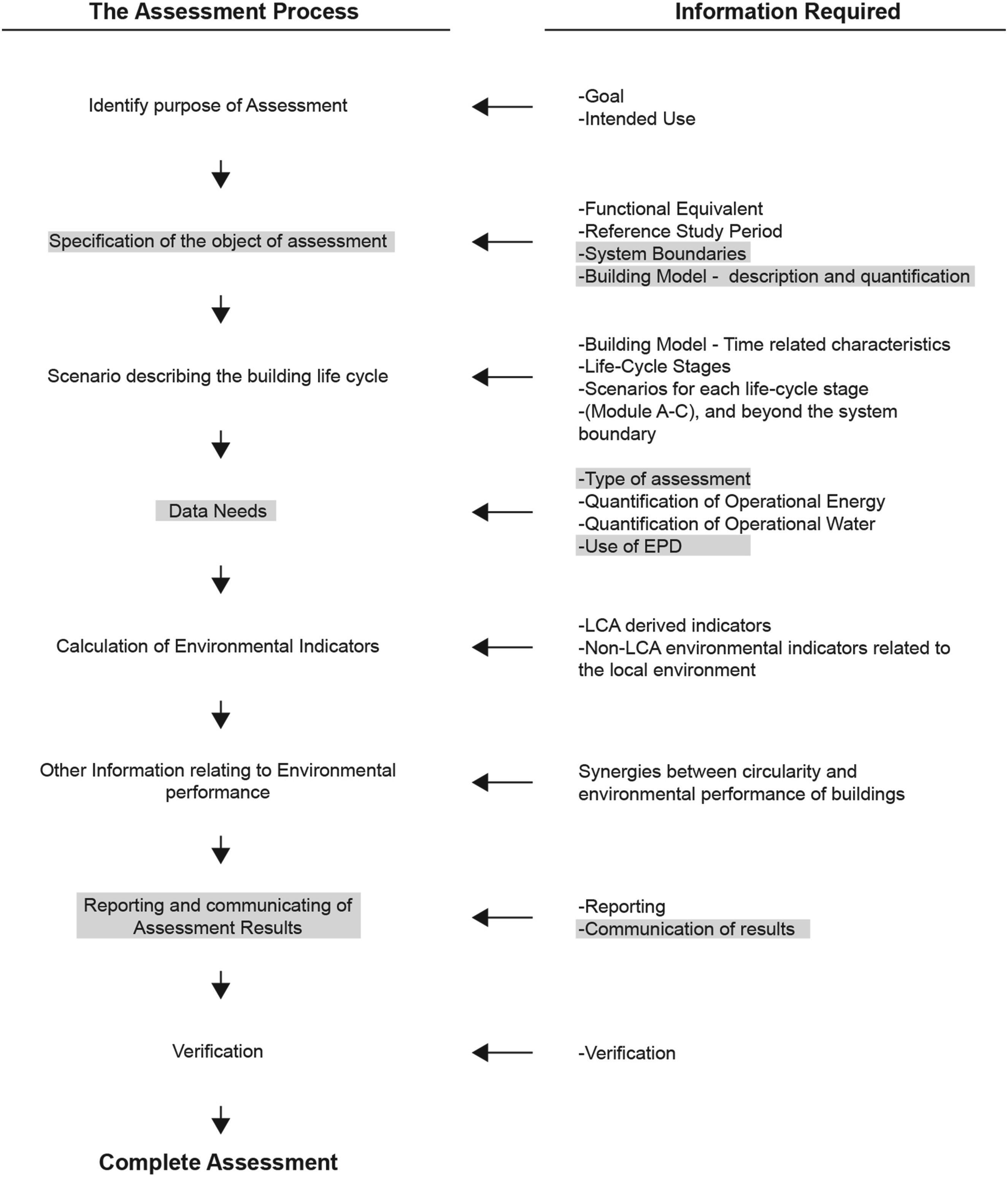
The reference study-period of the building is divided into “modules”: Product Stage (Modules A1−A3), Construction Stage (Modules A4−A5), Operation Stage (Modules B1−B7), End-of-Life Stage (Modules C1−C4), and Recycling (Module D) (Dos Santos Gervasio and Dimova, 2018). EU countries like the Netherlands have pioneered carbon benchmarks, or “budgets,” in building codes, especially considering the embodied carbon from Product Stage (A1−A3) (RVO, 2017; NMD, 2021). Studies show that the Product Stage has the most embodied carbon impact (Dos Santos Gervasio and Dimova, 2018; Gibbons and Orr, 2020), as the production of typical construction materials such as concrete and steel consume large amounts of energy and emit gases from chemical reactions (Bandera, 2024). In buildings, superstructure (including all vertical load-bearing elements, i.e., columns and walls) represent the greatest carbon footprint of a building, contributing with 61% of the total impact, followed by the substructure, with 32%, representing the preparatory works that are needed in the terrain for the construction of the building, the foundations, and all auxiliary materials such as waterproofing membranes (Dos Santos Gervasio et al., 2018). Identifying major embodied carbon impacts within the design of a building allows architects to understand the effectiveness of specific design strategies in carbon reductions.
Knowing the share of carbon impact in given parts of a building or how some materials are more impactful than others can guide design toward more conscious decisions. Together with generic data on buildings, for instance the impact per building typology, allows for the use of “rules-of-thumb” by designers at early design stages. In that stage, a low level of granularity of the assessment is acceptable in the design process (CEN, 2024). That understanding enables architects to consolidate an intuition that, in practice, comes before any quantitative assessment (MVRDV NEXT, 2023).
A challenge for Urban LCA implementation is that there lacks a standard definition on what is “early-stage design” for carbon assessment. In practice, it is understood as a moment when accurate project data and external expertise are not yet available (Dos Santos Gervasio and Dimova, 2018). Architects, particularly Dutch practitioners, are developing easy-to-get “carbon guidelines” or “carbon-based design” precedents (Cityförster, 2025; LEVS, 2022; Sobota et al., 2022; MVRDV NEXT, 2023), that contribute to “informed decision-making” at early-stage design. They contain recommendations such as “avoid building underground,” and “reduce structural weight,” which are straight forward good practices applicable to virtually all buildings.
The problem is that while architects begin to build a strong intuition when it comes to low-carbon building design, less in known when it comes to precinct-scale projects, typical in urban design practice. LCA applications in urban design become significantly more complex due to the interconnected nature of urban systems, data uncertainties, and the augmented need for interdisciplinary collaboration in the project’s workflow. Dealing with more than just a building, urban design projects demand adjusted LCA system boundaries including urban components not commonly assessed in building LCA. Even when only including modules from Product and Construction (A1−A5), the expanded system framework includes more than buildings, but also transportation infrastructure composed by road surfaces, sidewalks, bike lanes, parking; and landscape infrastructure, composed by lawns, paved public spaces, water bodies (Kayaçetin and Tanyer, 2019; Oettinger, 2023). They may also include service infrastructure such as manholes, pipes for sewerage, water and energy, and wires (Herfray et al., 2011)—components which material GWP values are not always available in open, accredited material databases. Urban LCA studies often exclude relevant components due to insufficient data availability, reflecting on incomplete assessments (Moisio et al., 2024). These and other challenges demand solutions that are characterized by hands-on, iterative and creative. They form new ways to perform the assessment and manage and communicate carbon impact results of the whole system.
Despite Urban LCA studies demonstrate how precinct-level carbon accounting can be performed, they remain primarily focused on reporting numerical carbon outcomes—comparing scenarios, quantifying embodied impacts, or ranking design alternatives. What these studies seldom reveal are the practical processes that make such assessments possible: how system boundaries were negotiated, how missing or uneven data was handled, or how diverse design components were translated into assessable models. These methodological and practical issues underscore the absence of a shared instinct for urban design decarbonization, leaving early-stage urban design without the intuitive guidance that has begun to emerge at the building level.
Knowledge gap and research relevance
Studies of Urban LCA applications focus on quantifying impacts at the precinct scale but rarely address the practice-based processes through which embodied carbon assessments are carried out, in real design settings. Urban LCA studies often neglect discussing practical challenges faced by designers, overlooking the situated, iterative, and designerly work that enables embodied carbon data to inform and shape early-stage design workflows.
The lack of standardization or documentation on the design process behind Urban LCA implementation creates a persistent “black box.” Such hidden processes prevent architects and urbanists to form collective epistemes that bridge investigation and projection, analysis and design (Avermaete, 2021; Banham, 1990). Addressing this gap is essential to create an enhanced cohesion between theory and practice, enabling carbon assessments to be influential in formative design phases. This relevance is reinforced by Lloyd’s recent editorial call to focus design research on the practice of designing and to document new forms of practice as they emerge (Lloyd, 2025).
Research aim
Rather than advancing new metrics or technical validation, this paper aims to foreground the designerly reasoning and workflows through which embodied carbon data becomes actionable in early-stage urban design. To better understand the integration of data-enabled design in the practice of designing in the built environment, this paper focuses in examining a tangible urban design project that integrates embodied carbon assessment from the very start, under development in an architecture office. The study unveils design thinking solutions that make possible the fulfillment of LCA steps in early-stage design. In doing so, it advances the understanding of Design Processes in the context of the low-carbon transition.
Research question
This paper responds to the research question “How do Architects and Urbanists integrate embodied carbon data into early-stage urban design processes to support the decarbonization of the built environment?”. A 3-month research-by-design case study at a Dutch architecture office provides empirical insights into methodological adaptations, data challenges, and interdisciplinary collaboration, ultimately informing practical frameworks for low-carbon urban design.
Literature review
LCA at “early-stage design”: A practice-based definition
In EN 15978, “early design stage” can be interpreted as the time of assessment that encompasses strategic definition, preliminary studies and concept design (CEN, 2024). This is a stage with a low level of granularity of the building model, and in which the minimum requirements of data quality in line with EN 15941 is the lowest, admitting rough estimates when product-specific data is unavailable. However, there are several definitions for the design process, some reflecting the project phases commonly utilized in design theory, some more practical, related to the architecture industry.
In the history of design research, which arguably sees design as a form of science, the notion of “design process” has evolved, linked to traditional theories of design methods (Cross, 2007; Rowe and Chung, 2023). In the groundbreaking Conference on Design Methods, in the early 1960s, Christopher Jones introduces a rather linear approach in “Method of Systematic Design,” consisting of three stages: (1) Analysis, where performance indicators are defined together with the first ideas and design proposals, (2) Synthesis, where solutions are investigated, and (3) Evaluation (Jones and Thornley, 1963). Broadbent and Ward’s 1967 “Design Methods in Architecture” argues that the design process is not linear; it is an iterative exercise that requires continuous refinement based on performance assessments, stakeholder input, and emerging constraints. “The whole process of design will consist of many levels, progressing from very general considerations at the start, through to specific details as the project nears completion” p. 129 (Broadbent and Ward, 1969). In 1968, Bruce Archer’s dissertation “The Structure of the Design Process” proposes design as a third way of knowing, distinct from sciences and humanities, which encompasses feedback loops embracing intuition and cognition, although presenting a rather sequential model of the design process (Rowe and Chung, 2023). In 1980, Bryan Lawson’s first edition of “How Designers Think” divides the design process into four phases: assimilation, general study, development, and communication. He notes that these phases of “decision sequence” are not strictly sequential and proposes a more honest cyclical representation (Lawson, 2005). Among these theories, “early-stage design” can be interpreted as a moment of conceptual definition, in which the designer experiments through 2D drawings and 3D models with a considerable level of abstraction, with plenty liberty to choose materials and subsystems (Eekhout, 2008).
Design phases in different practical plans of work. In gray, the “early-stage design,” as referred in this paper.
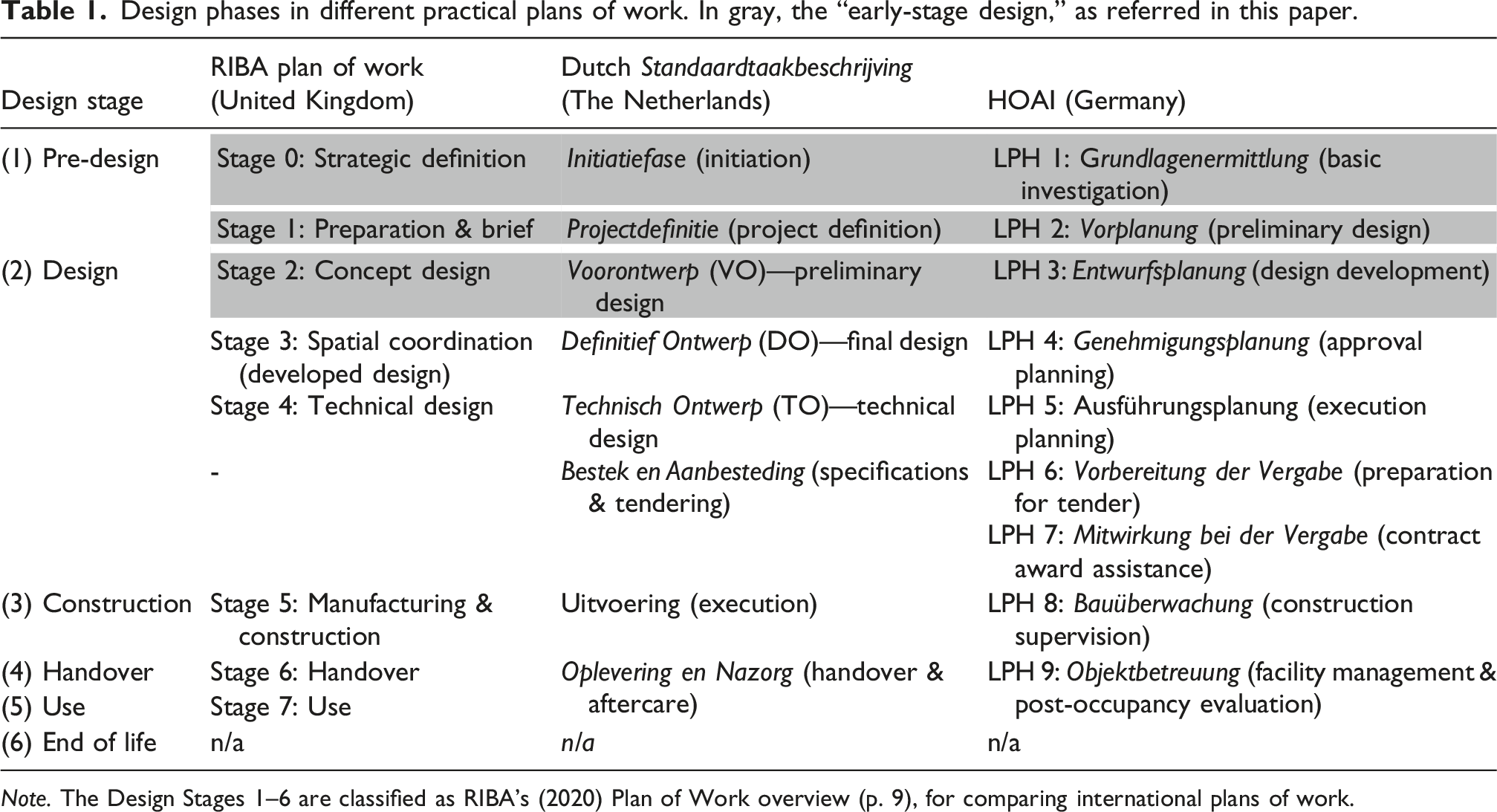
Note. The Design Stages 1–6 are classified as RIBA’s (2020) Plan of Work overview (p. 9), for comparing international plans of work.
Considering the theories on design methods and the practical plans of work, this paper defines the “early-stage design,” as the moment up to the first stage of “2. Design” (see Table 1).
Urban LCA studies: Defining system boundaries, components, and benchmarks
Research adapting building LCA to urban design consistently expands the system boundary beyond individual buildings to include infrastructure, landscape, and, in some cases, energy and mobility systems. Key studies by Kayaçetin and Tanyer (2019), Herfray et al. (2011), Moisio et al. (2024), and Oettinger (2023) provide methodological precedents and benchmark values that inform how embodied carbon can be quantified at neighborhood or precinct level.
Kayaçetin and Tanyer (2019) analyze three realized residential developments in Turkey, explicitly disaggregating embodied carbon contributions across buildings, structural landscape, and transportation infrastructure. They find that buildings account for roughly two-thirds of neighborhood-scale embodied emissions, with infrastructure contributing the remaining third. They offer one of the clearest benchmark breakdowns available for Urban LCA (Kayaçetin and Tanyer, 2019). The study demonstrates how carbon data can support comparative urban design decisions, yet it relies on complete post-design datasets and material quantification, offering limited insight into how such distributions might be approximated under early-stage uncertainty.
Herfray et al. (2011) further extend system boundaries by incorporating buildings, open spaces, networks, district heating, and external flows such as water and waste within an 80-year life-cycle framework. The authors identify harmonization of functional units as a prerequisite for comparing urban morphologies, operationalized through model adjustments to population, density, and open-space ratios. However, the study is an example of a recurring “black box” in Urban LCA literature: key assumptions—particularly regarding the allocation of shared infrastructure and service impacts—are acknowledged but not operationally explained (Herfray et al., 2011). This reduces transparency regarding the specific challenges involved in constructing the assessment itself, including data sourcing, population compatibilization, model harmonization, and the creation of datasets that are both realistic and sufficiently controlled for comparison. Such opacity limits applicability in early design phases, where system boundaries and programmatic assumptions remain fluid.
Moisio et al. (2024) investigate the transferability of building LCA methods to urban design through a Finnish densification case comparing refurbishment and new construction. By extending the system boundary to include streets, earthworks, and district-heating connections, the study proposes a way urban components can be formally integrated, extending building-based LCA frameworks (Moisio et al., 2024). Yet the reliance on fully specified BIM-based models anchors the analysis in advanced design stages, prioritizing numerical precision over adaptability to incomplete or evolving design information. Methodological decisions remain largely implicit, reinforcing a calculation-driven rather than process-oriented approach.
Oettinger (2023) departs from post-design assessments by proposing a designer-facing, parametric workflow for early-stage urban carbon estimation. Based on a hypothetical urban model, developed within a master’s thesis conducted in collaboration with Danish practitioners, the work emphasizes replicability and practical implementation. Using Rhino and Grasshopper, supported by tools such as Ladybug, the “Urban Decarb” method operationalizes system-boundary selection by focusing on buildings and open spaces (subdivided into hardscape and landscape) while intentionally excluding mobility and network systems due to data uncertainty. Although this workflow enables rapid scenario testing and transparent benchmark-style comparisons, results remain contingent on modeling conventions, assumed lifespans, regulatory datasets, and a uniform LoD that does not reflect real-world early-stage conditions.
Across these studies, Urban LCA research informs which components to include within expanded system boundaries, and their relative embodied carbon contributions. Yet, they offer limited insight into how such assessments are operationalized under early-stage design conditions. Reliance on complete or homogenized datasets enables numerical comparison but obscures the assumptions, reasoning, and workarounds required when data are partial, heterogeneous, or evolving.
Designerly ways of decarbonizing
If early-stage Urban LCA depends on navigating incomplete data, provisional boundaries, and evolving design intentions, then understanding its effectiveness requires attention to the designerly ways of knowing that underpin the process. Rather than treating LCA as a purely analytical method, this section situates carbon assessment within design theory, framing it as a heuristic, practice-based activity shaped by tacit knowledge, iteration, and visual reasoning.
In 1982, Nigel Cross’ “Designerly Ways of Knowing” proposes that design embodies processes that tackle ill-defined problems (also known as “wicked” problems), where the designer does not have access to all the necessary information (and data) to solve them (Cross, 1982). With solution-focused thinking, designers create solutions through making and doing. They translate abstract requirements into tangible objects, using visual and material codes, and engage in iterative problem-solving, where the design process informs and reshapes the problem itself. The designer uses non-verbal cognition, such as sketches, diagrams and prototypes to explore possibilities. In 2006, Cross poses that design cognition is an essential aspect of human intelligence (Cross, 2006), not exclusive to design professionals, but a skill that is magnified by professional expertise.
In 1987, Peter Rowe’s “Design thinking” concept brings designerly cognition beyond the design discipline, making it an approach to innovation (Dorst, 2011; Rowe and Chung, 2023). Rowe comments on approaches to design by architects and urban designers as one, where these designers apply intuition, or “a priori knowledge” associated with their professional design education and experience to “shed more tractable and soluble light” to solve problems. Valuing heuristic form of reasoning, “tacit knowledge” accounts the type of knowledge or learning that cannot be quantified or codified (Schrijver, 2021)—this is a key concept in understanding design thinking, representing the unstated and difficult-to-articulate aspects of a designer’s skills and understanding. Tacit knowledge (Avermaete, 2021; Schrijver, 2021) is an experiential perspective that arises from skill, bridging the gap between theoretic principles and practical performance.
In 2016, Peter Lloyd’s “From Design Methods to Future-Focused Thinking: 50 years of design research” commemorates 50 years of the Design Research Society (DRS), and reflects on the evolution of design research (Lloyd, 2017). While he points out that understanding design process and the nature of design knowledge are a recurrent theme on design research, there has been a recent shift into a more systemic view of design, placing it within a network of activities and technologies. That perspective persists, and appears in the 2024 DRS (2024), under the theme “Data as design knowledge” posing that the increasing availability of data, driven by networked artifacts, cultural digitalization, and artificial intelligence, is causing a shift in design practices (Christoforetti and Witt, 2024). Data brings designers to operate beyond the boundaries of their traditional disciplinary expertise, especially when used to support design investigations to address complex challenges of the world demanding interdisciplinary insights, such as climate change and the urge to decarbonize the built environment. Therefore, data, such as carbon data, influences and supports design processes, backing each iteration with traceable evidence and aiding in achieve certifiable final outputs.
In exchange, embedding LCA methods to integrate embodied carbon in urban design processes demands a designerly approach of its own. The concepts of designerly ways of knowing, design thinking, and tacit knowledge provide a comprehensive understanding of “problem solving” through an iterative and structured workflow that balances scientific knowledge, professional expertise, and creative intuition.
The integration of carbon data into the design process exemplifies a shift—where quantitative environmental metrics inform heuristic design workflows, and vice versa. This shift challenges designers to operate beyond disciplinary boundaries, embedding standardized, data-enabled approaches into creative practice while bringing the experiential, exploratory, iterative reasoning essential to design into scientific, rigorous procedures. This paper specifically addresses the intersection of data-enabled decision-making and designerly ways of knowing within the pursuit of low-carbon built environments.
Methods
Case-study research design
This study adopted a practice-based, single-case-study methodology to examine how embodied carbon data can be integrated into early-stage urban design. The case study served as the central research frame, within which multiple qualitative and empirical methods were combined. This approach allows close observation of design decision-making under real project constraints and responds to the lack of process-oriented accounts in Urban LCA literature.
The research was conducted over 3 months (June–August 2022) within the professional setting of a European architecture and urban design firm, followed by post-processing and analysis in an academic environment. Methods included a targeted literature review that informed the analytical framing. Research data was gathered through autoethnography, empirical design experimentation, and triangulated through semi-structured interviews for expert validation. The Results section was structured using the LCA steps described in Figure 2, which function as an organizing framework for the empirical analysis rather than as findings in themselves.
Case-study description
The case study examined a 265,000 m2 precinct-scale Research and Development campus in Germany, at preliminary design stage (LPH2). The project included 12 buildings, landscape areas, and mobility infrastructure within a walkable 500 m radius. Design development was distributed across multiple teams, resulting in heterogeneous LoD across buildings and urban components. This condition made the project particularly suitable for studying early-stage embodied carbon integration under fragmented and evolving data conditions.
The selection of this project as a case study was based on its urban character, design phase, and interdisciplinary complexity. The case study examined a 265,000-square-meter Research and Development campus (the “R&D campus”) in Germany, developed by a Dutch Architectural and Urban Design firm with expertise in computational design and sustainability (MVRDV). The campus masterplan includes 12 buildings in its first construction phase, alongside landscape and mobility infrastructure. The concept comprised of a compact mixed-use development, organized within a 500 m radius area, allowing a walkable distance between the programmatic elements: offices, laboratories, business incubator, housing, daycare, restaurant, mobility hub, data center, and communication center (Figure 3). The case-study project: a precinct-scale Research and Development Campus in Germany, a project by MVRDV. Illustration by the author.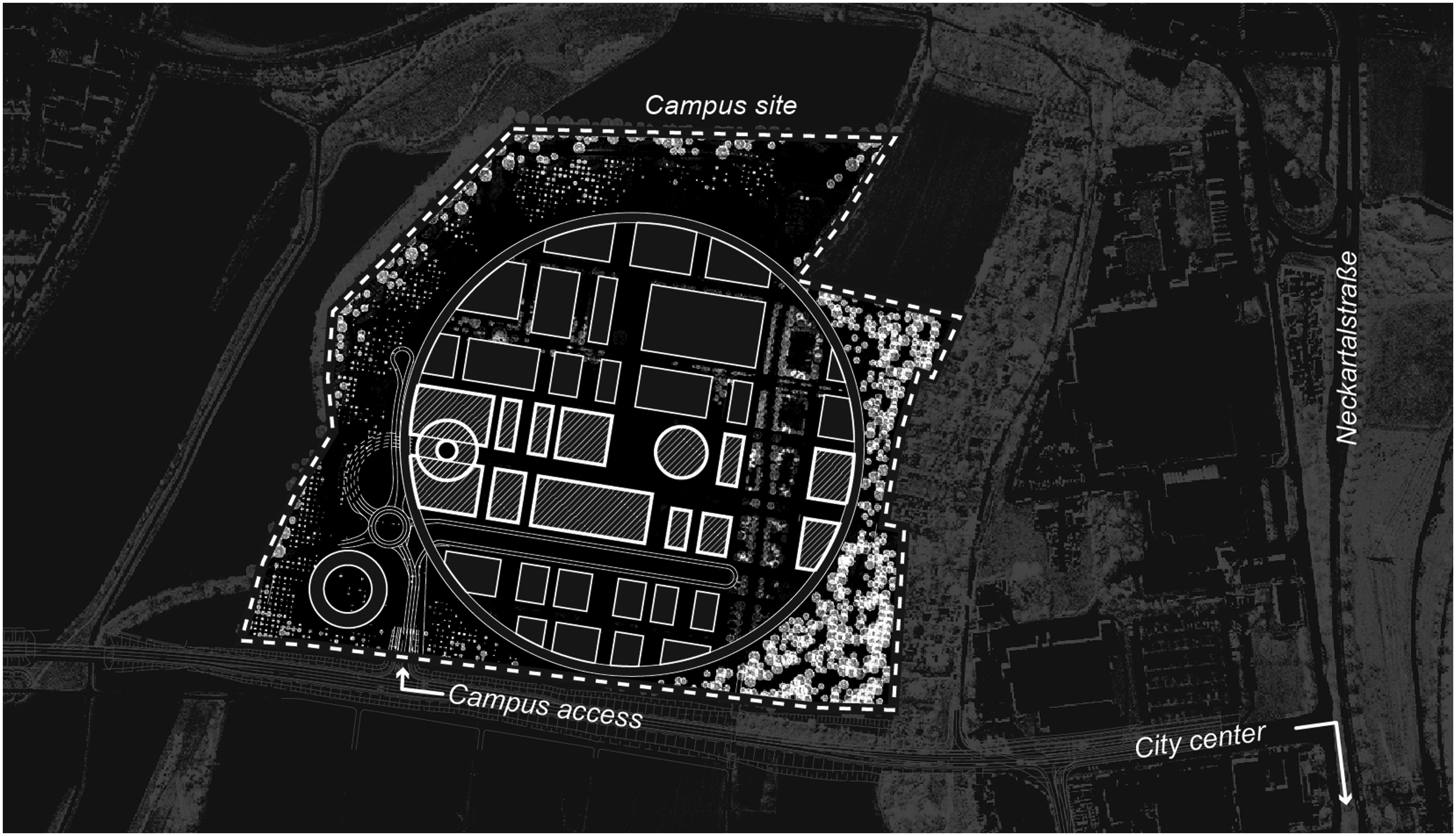
The project was divided in subsystems, where teams of designers worked separately in each building and urban components. Although this research presents a static “snapshot” of a specific design stage (LPH2), each of the teams had their own pace—some dealing with more conceptual and abstract LoD, while others progressed to more defined designs.
Commissioned by a consortium of municipal and private actors, the project aimed to establish a leading innovation hub for technology and artificial intelligence. The client’s explicit sustainability requirements made embodied carbon assessment a critical aspect of design development. To address this demand, the Tech/Climate team centralized all project parts and assessed the performance of the project in its integrity. Circa 60 designers were involved in this process as part of the core team working at the architecture firm, supported by several other consultants in landscape, mobility, sustainability and structural engineering, biodiversity, placemaking, noise control, fire protection, and representation through the making of physical models and photography (Figure 4). Actors involved in the decision making and design process of the case study of the project. Illustration by the author.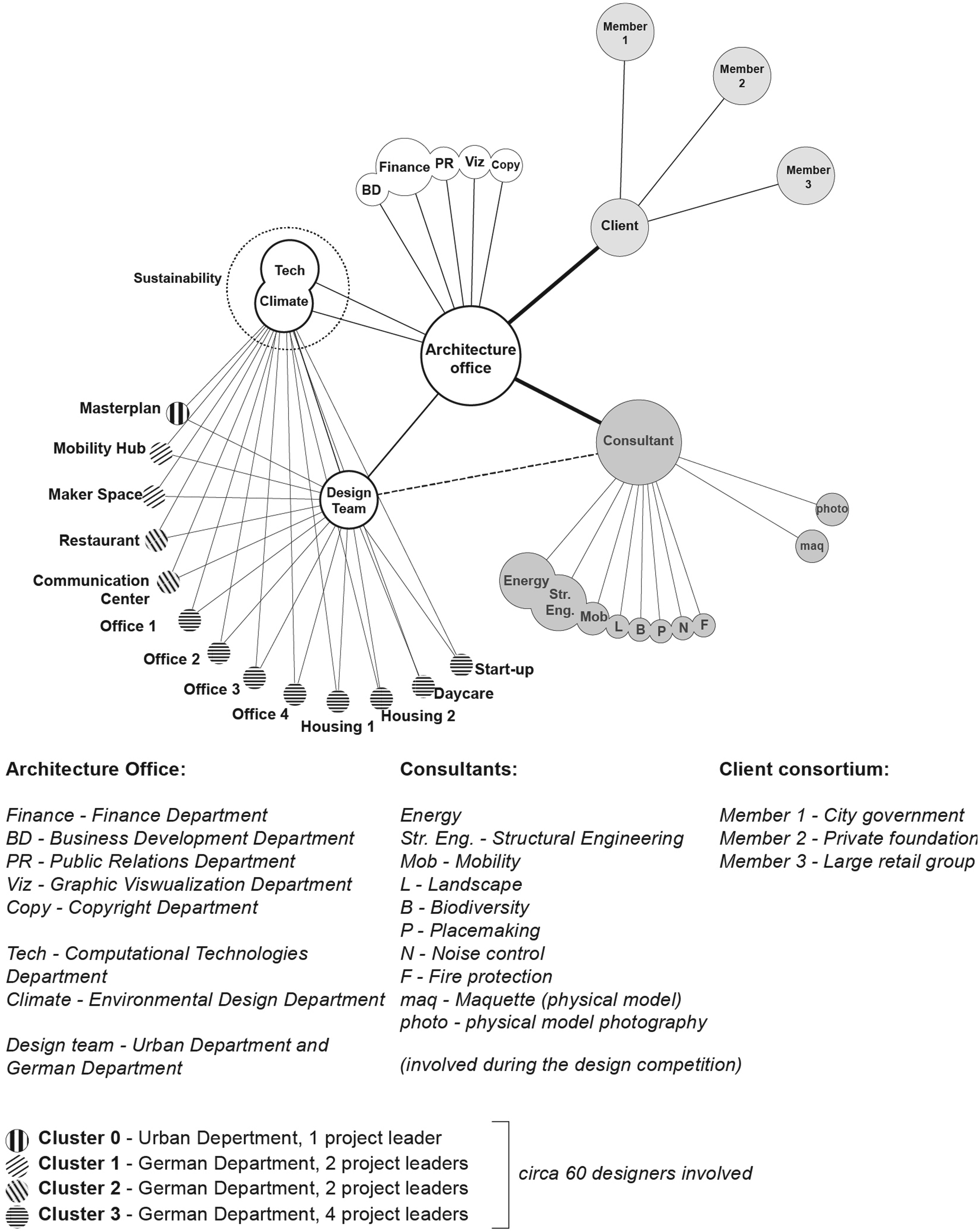
Research data collection
Autoethnographic data. The first author explored professional and methodological challenges through hands-on participation in modeling, data harmonization, and carbon assessment tasks. Acting simultaneously as designer and researcher, the author documented assumptions, data gaps, modeling decisions, and iterative adaptations. This perspective acknowledged the researcher as both subject and observer, using introspection to generate insights (“learn by doing”) that contributed to broader theoretical discussions on data-enabled design for decarbonization. Research data (Table 2) consisted of several design artefacts, interviews and collaborative exchanges and a questionnaire. Research data inventory and analytical procedures. This inventory makes explicit how the research used heterogeneous design artefacts to systematically translate them into a coherent early-stage urban carbon assessment model.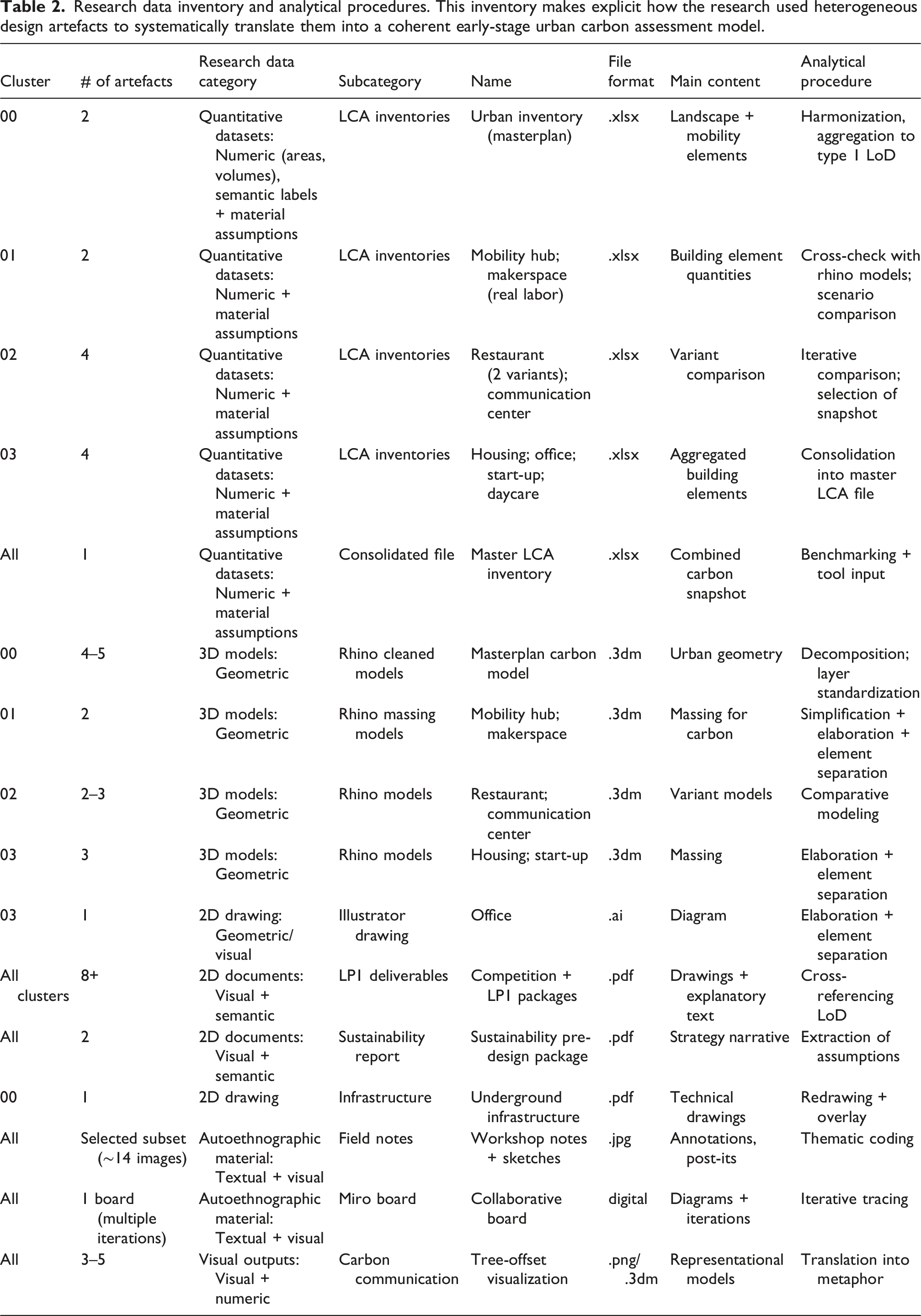
Design artefacts and datasets. Research data included 2D drawings, 3D models (Rhino, Revit, Illustrator), PDF project documentation, and qualitative testimonies from design teams. The dataset comprised approximately fifteen Excel-based LCA inventories (distributed across Clusters 0–3 and later consolidated into one master file), around 20 Rhino models (including cleaned massing models, duplicated carbon models, and variant studies), 12 LP1 and sustainability PDF deliverables, one collaborative Miro board with multiple iterative diagrams, and a selected subset of 14 photographs documenting annotated sketches and workshop exchanges (Table 2). Across data types, the analytical strategies (further described in results) consisted of harmonization of project data across different artefacts, decomposition and reconstruction of 3D models, comparison of design option iterations along design evolution, and abstraction (through simplification or standardization) toward a consistent Type 1 quantification level. Design data from multiple software environments were translated and harmonized in Rhino, while Microsoft Excel was used to structure quantities and calculate embodied carbon using an internally developed assessment tool (CarbonSpace). Originally conceived for buildings, the tool was extended to precinct scale using ÖKOBAUDAT, adopting range-based material values (A1–A5 or whole life cycle). Climate Positive Design was used as a supplementary material data source when landscape and infrastructure data was missing. These artefacts documented how incomplete and heterogeneous design information was translated into assessable carbon data.
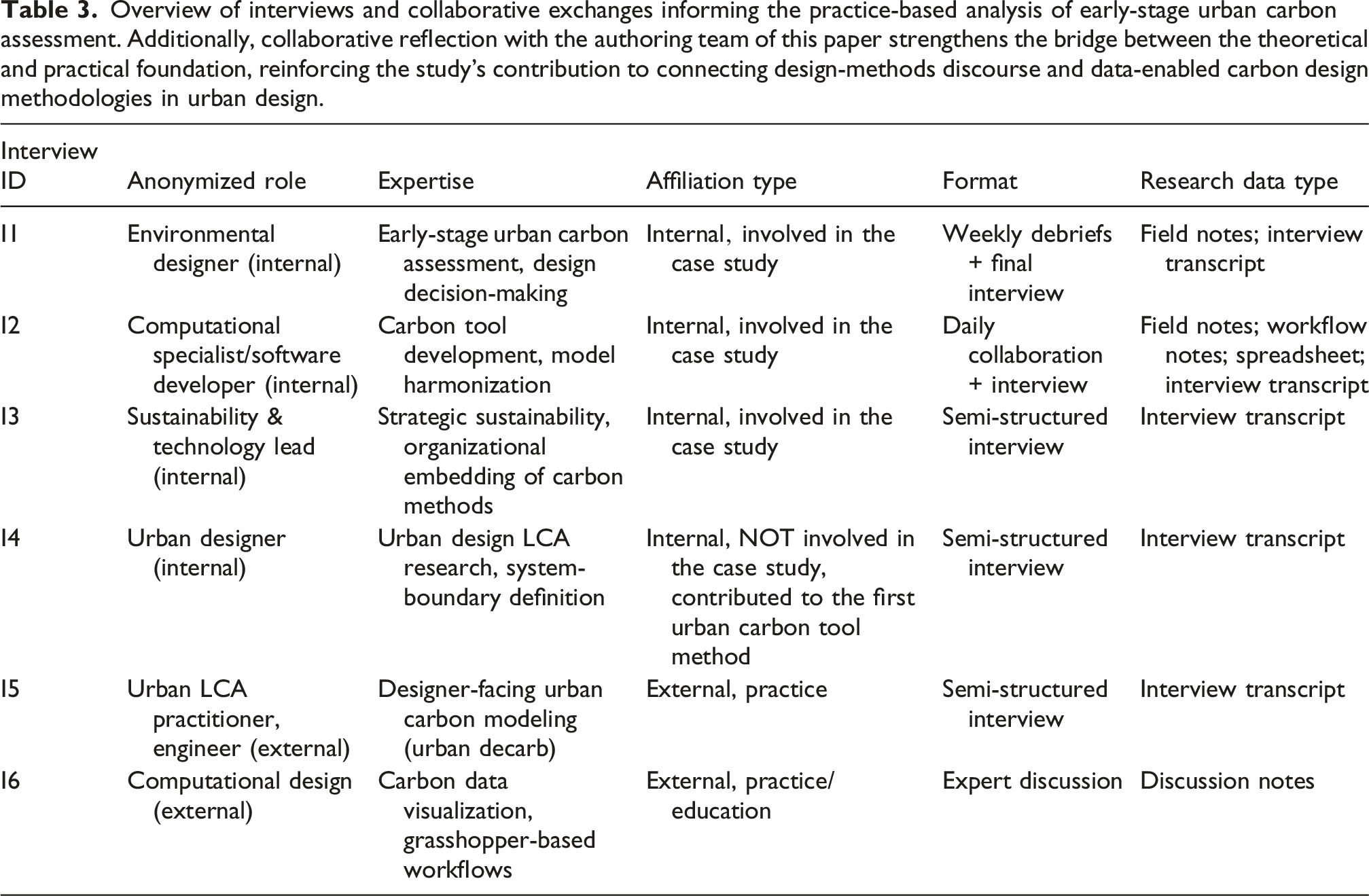
Overview of interviews and collaborative exchanges informing the practice-based analysis of early-stage urban carbon assessment. Additionally, collaborative reflection with the authoring team of this paper strengthens the bridge between the theoretical and practical foundation, reinforcing the study’s contribution to connecting design-methods discourse and data-enabled carbon design methodologies in urban design.
Questionnaire. A short questionnaire was distributed to all 13 project leaders to document awareness, perceived workflow integration, and perceived decision-making influence of embodied carbon assessment across early design phases. Results indicated high awareness of embodied carbon among project leaders but limited direct use of carbon tools, highlighting a gap between perceived relevance and hands-on integration in design workflows (Figure 5). Selected results from the project-wide questionnaire distributed to 13 project leaders, illustrating prior experience with carbon assessment tools, self-reported awareness of embodied carbon in material choices, and perceived integration of carbon estimation within design workflows. The responses reveal high awareness but limited direct tool use, indicating a gap between perceived relevance and hands-on integration in early-stage design practice.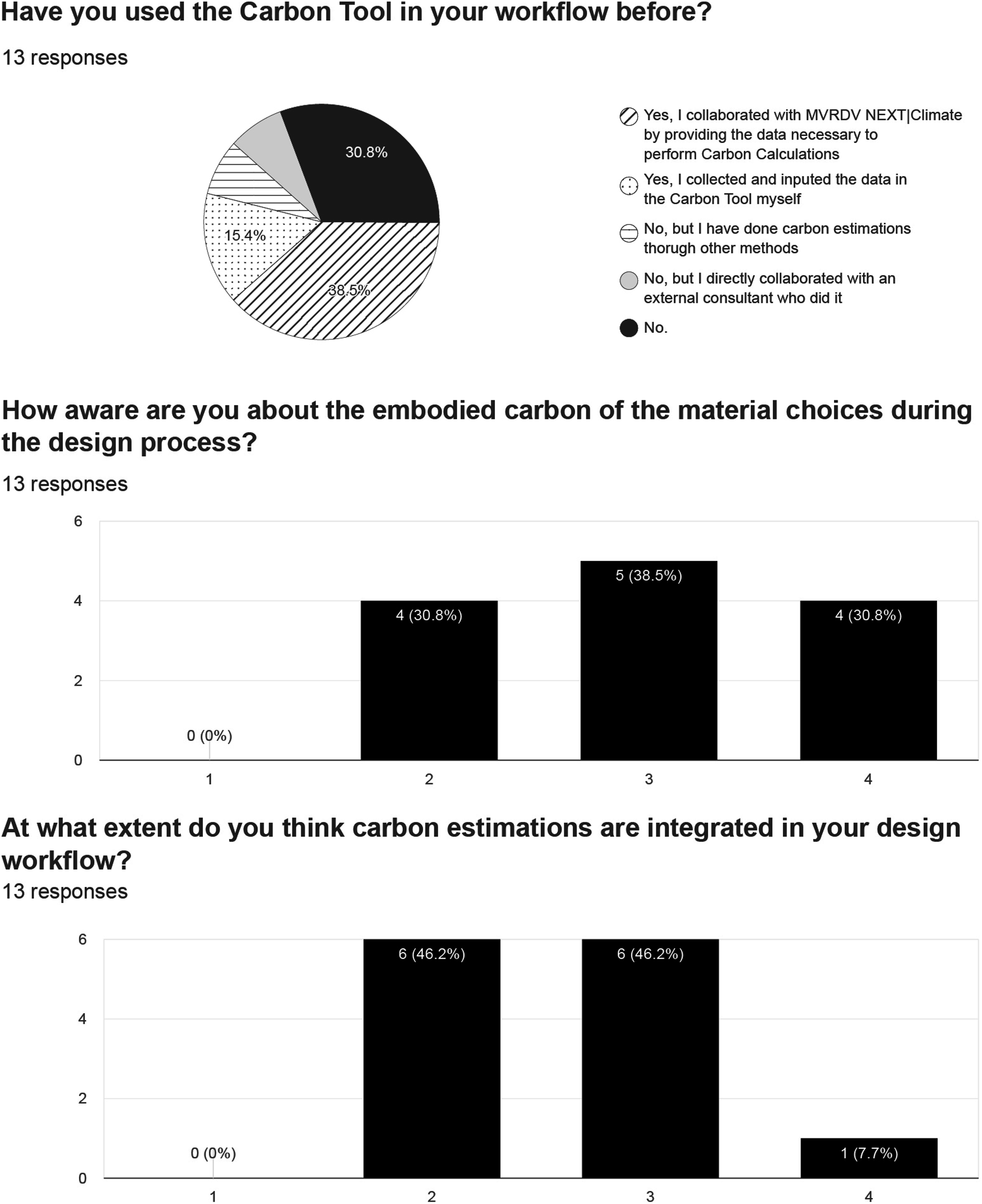
Results
Considering there is no standard for life-cycle assessment specific to the scope and goal of assessment for urban design, this paper uses the structure of the process of assessment described in EN 15978 (for buildings). Using that as a reference to organize the findings on this paper, three “steps” are described in detail: specifying the object of assessment, meeting data needs and communicating results. They are used to portray ill-defined challenges in the adaptation of LCA to urban design, in which designers adopt a “designerly way of knowing” to come around them and integrate embodied carbon data in early-stage design. In this case, that approach by design means using methods and values beyond the traditional scientific or humanities way to frame the problem, generate ideas to address it and prototype and test the solution.
Specifying the object of assessment
EN 15978 proposes to start specifying the object of assessment by clarifying the curtilage of the site within which whole elements, new or existing, will be assessed over the life cycle of the main object of assessment. The specification of the object of assessment also includes defining the Functional Equivalent, including descriptions of (building) type, pattern of use (i.e., occupancy), and estimated service life, explaining assumptions, scenarios and sources of information used to supply data when not readily available. The system boundary refers to the combined physical, temporal and functional terms of the object of assessment, aiming to avoid double counting by delineating which are considered in the focused assessment (modules A1−A3 or “product stage” or A4−A5 “construction stage,” and so on). The building model for performance assessment represents the object under observations as complete and realistic as possible, describing its parts, construction elements, and the components in terms of type and quantity. The model allows consistency and appropriate levels of granularity of information, in line with the status progress in the design process. Although described in a straightforward way, specifying the object of assessment is not such an objective task in practice, when it comes to early-stage design of an urban design project. Some of these specifications are in fact ill-defined problems that require design thinking to resolve.
Defining the curtilage of the site (the physical term of the system’s boundary)
The campus can be seen as a single object of assessment composed by parts that fall within the curtilage of the property cadastral border (dashed line “campus site,” in Figure 3). Despite this clear “site” definition, for the urban project, there is not a clear or typical definition of the spatial subdivisions within the site: at this design stage, there is no cadastral subdivision of “building plots.” Interviewees I2 and I4 independently confirm that, at early design stages, defining spatial subdivisions for assessment is not driven by existing administrative boundary definition or standards, but must be actively constructed by designers to avoid double counting and enable comparison across project parts. Furthermore, this project adopts a “flexible parcellation” approach, in which the area of land attached to and serving the building can extend or shrink on demand (Figure 6). That is a problem to the integration of embodied carbon assessment in the design process, because it does not allow for a clear spatial division between the objects within the main site, which is crucial to avoid double counting. Flexible parcellation challenges the definition of a building site. Illustration by the author, based on diagram by the MVRDV, 2022.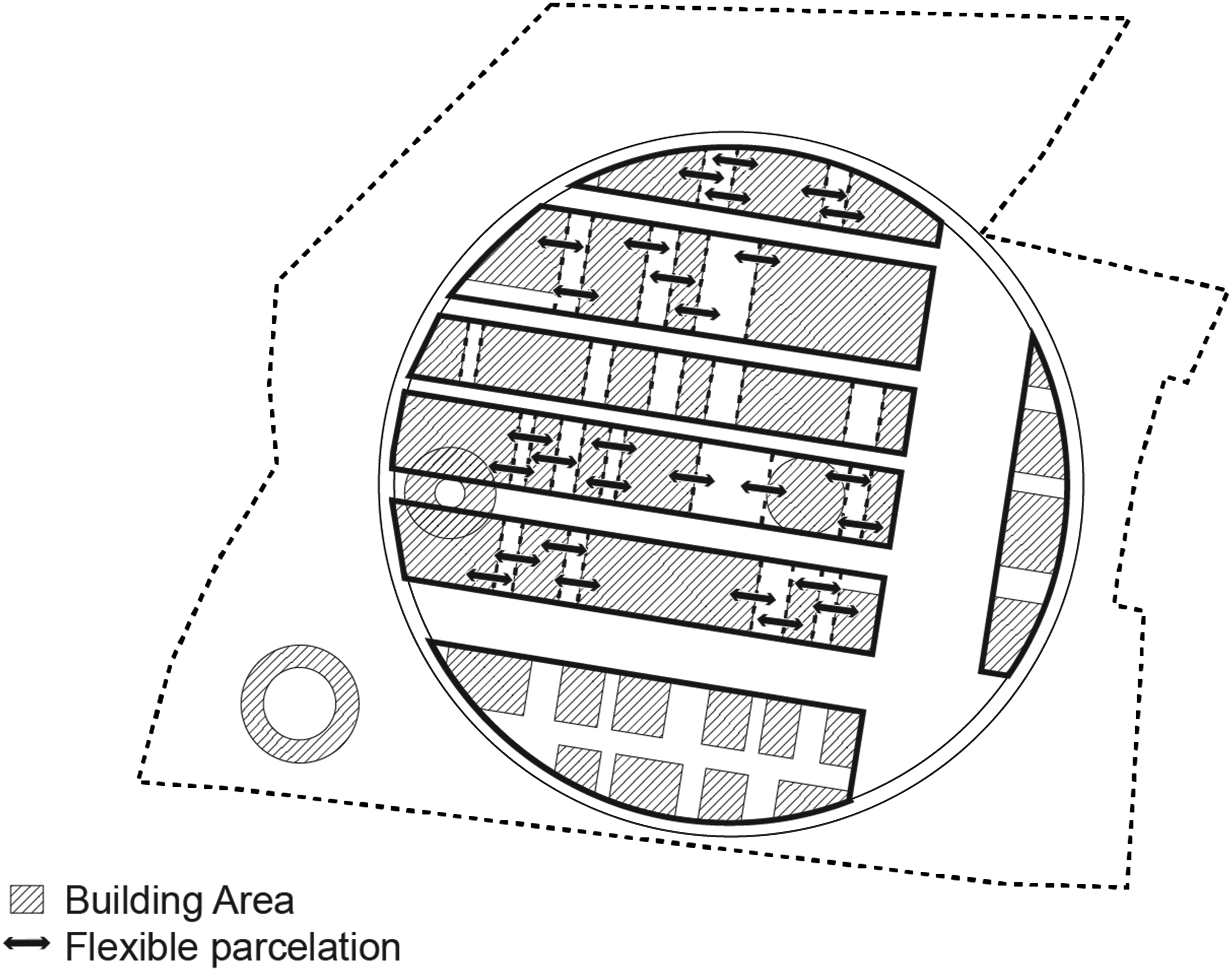
According to the standard for buildings, objects in the site can include but are not limited to: building foundations, parking areas, landscape areas, pavements and roadways for access or movement around site, boundary fencing according to legal ownership, networks and equipment of energy, water and mobility; and excludes permanent construction outside the curtilage site such as infrastructure for energy, water, waste and transportation. Without a reference standard for urban developments, the designers had to create a tailor-made spatial subdivision for assessment of the campus, in which the buildings are individual objects with no “building site” beyond the building area, and the landscape and transportation elements are considered separately (Figure 7). The common functional equivalent to aggregate the estimated embodied carbon is KgCO2eq./m2, for the modules A1−A5. Spatial boundary subdivision for urban design LCA assessment. Illustration by the author.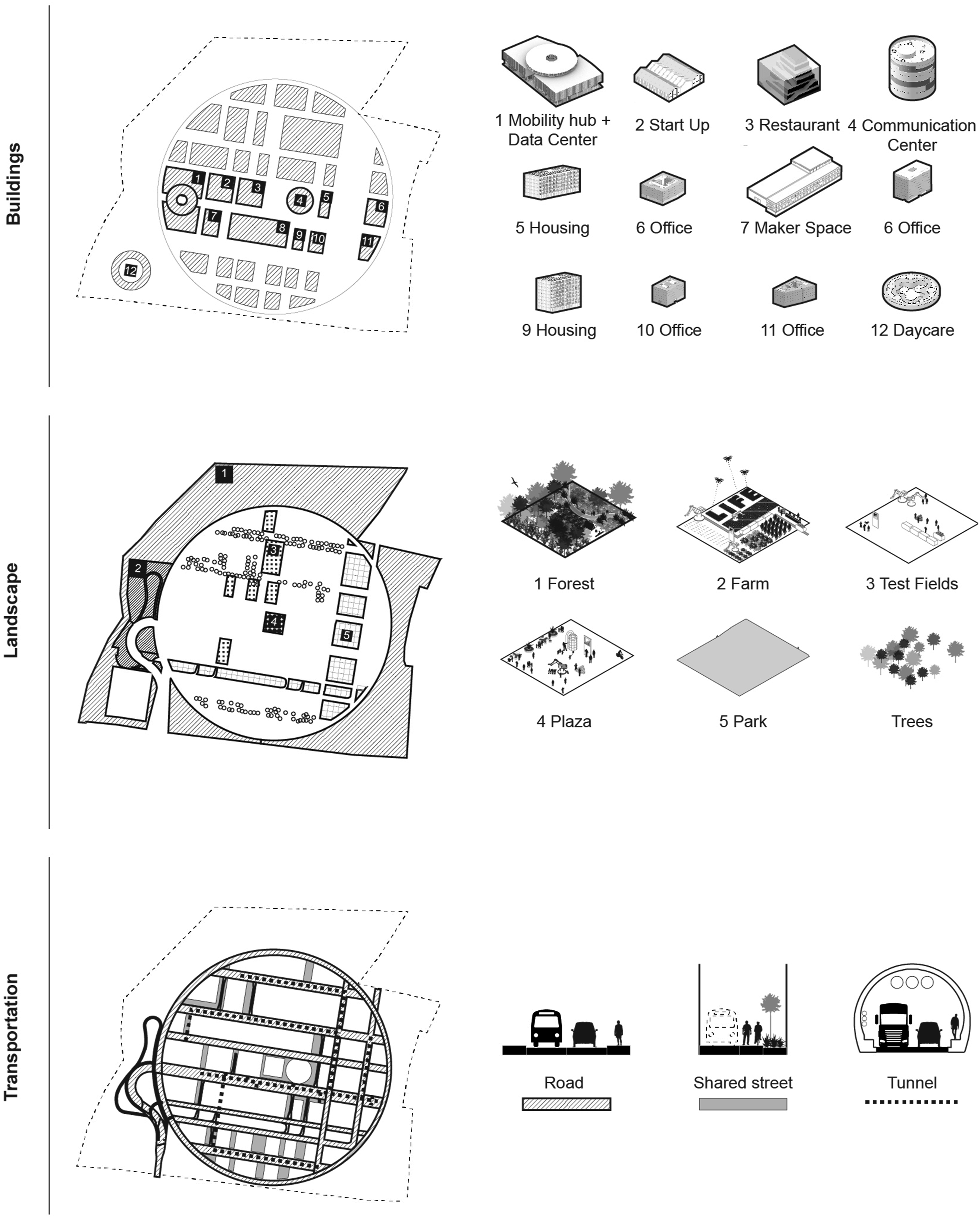
This solution-focused problem-solving approach happens quickly, without engaging in more scientific but time-consuming analytics (Cross, 2006), that is investigating several options of “building plot” division. While such a scientific investigation would certainly create a more accurate probabilistic approach based on statistical averages, there is no demand for this level of accuracy at this stage of design and of the assessment. Addressing this problem through design enables the assessment process to progress in a timely manner and at a level that is sufficient at this stage.
Describing and quantifying the building model
The building model, as per EN 15978, should describe construction elements and components in detail; specify material quantities and types for each part of the building; maintain consistency and granularity of the represented elements, appropriate to the stage of design development; and ensure comparability across different buildings and projects by following standardized classification methods. In theory, this process should align with the design stage’s progress, allowing embodied carbon assessments to integrate smoothly into decision-making. Ideally, by the early-stage design, projects should already contain sufficient geometric and material specifications to allow low-accuracy carbon quantifications. However, when applied in practice—particularly in urban projects like this campus—the EN 15978 approach encounters significant challenges.
In the campus project, which progressed from basic investigation to preliminary design (LPH1 to LPH2) following a competition win, the design team faced heterogeneous LoD across the urban system, and the need to design a consistent building model inventory. Unlike an isolated building project, an urban design development consists of multiple buildings at different levels of design maturity. While some buildings—particularly those with simple forms and conventional typologies (i.e., maker space)—were progressing fast and could already be modeled in Revit, others (i.e., restaurant, communication center, four office buildings) remained highly conceptual, in Rhino or simply diagrams in Adobe Illustrator (Figure 8). The offices, for example, were represented only as 2D diagrams or Illustrator sketches, with no defined geometry, construction system, or material composition. For the files either in high or low of detail (LoD), there was no common modeling template with consistent layer organization to categorize components, and every model was organized in its own way. This disparity in design progress creates a problem to apply a uniform approach to describing and quantifying the building model. Interviewees I1, I4, and I5 all confirm the finding that heterogeneous LoD across buildings are an intrinsic condition of early-stage urban projects, making manual harmonization and selective simplification unavoidable when attempting precinct-scale carbon assessment. Inconsistency in the LoD of the different building models, as well as inconsistent organization of elements in project layers. On the right, the resolution by the authoring researcher, setting a target LoD for the models for assessment, and proposed project layer organization. Illustration by the author.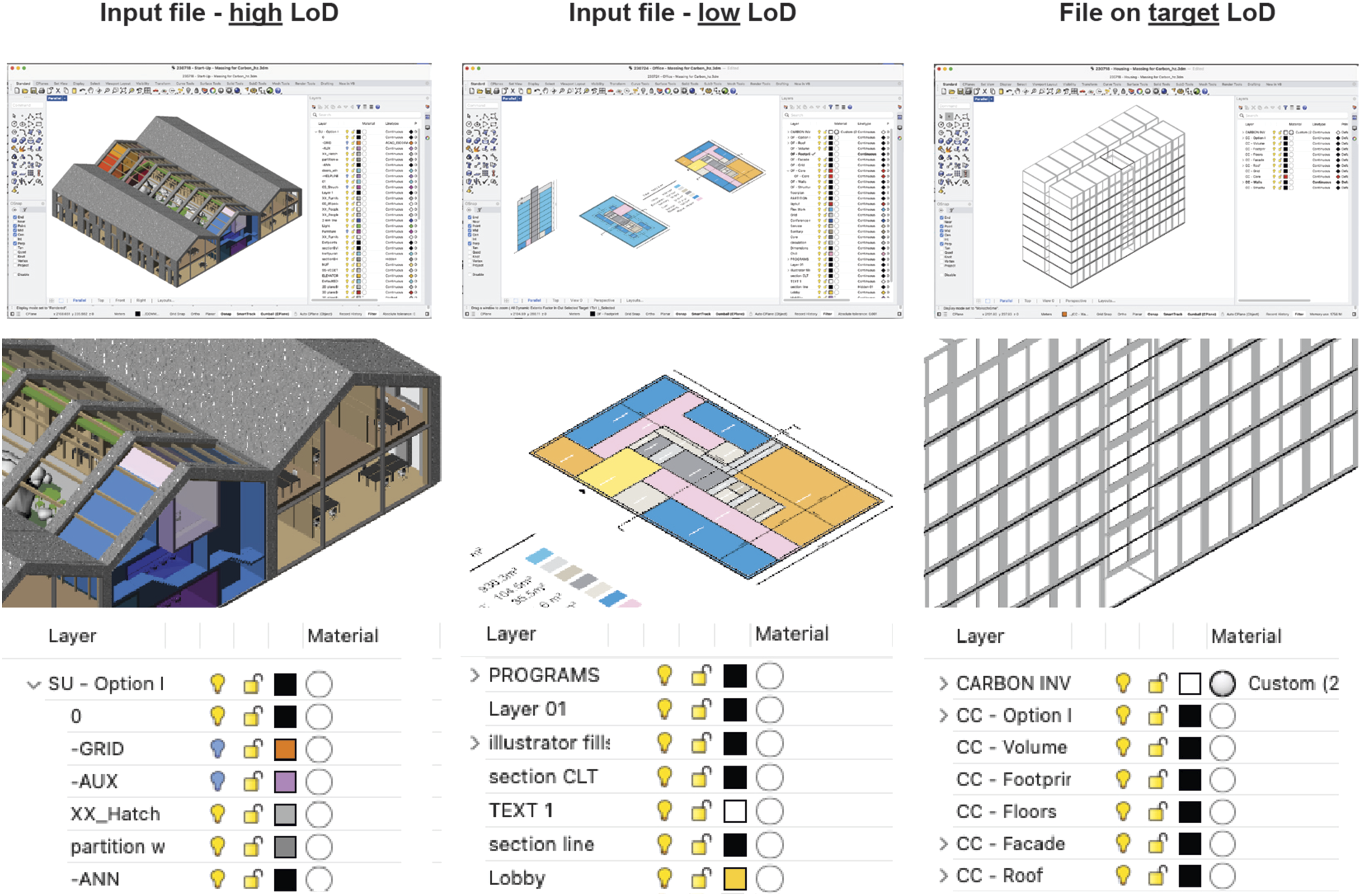
To address the need for a consistent inventory, the designer created a new inventorization approach for carbon quantification that fit the ongoing, evolving design process. That inventory demanded enriching the input of building models with oral input from 13 project-leaders. In those sessions, the researcher could better understand the designer workflow, how to find more information in other project documentation, and show the designers the LoD desired for the LCA building model. That meant having to bring all building models to Rhino and remodel them one by one, adding spatial detail to the ones that were mere diagrams and simplifying the ones that were too detailed (Figure 9). That also required reorganizing the file into project layers suitable for the carbon assessment and then breaking the model apart in non-overlapping elements for the assessment. This process was repeated for the elements in landscape and transportation. This inventorization method made use of designerly solutions, developing the understanding of the problem at the same time as experimenting potential solutions (Cross, 2006). Processing and remodeling the information from several sources to achieve a consistent LCA model. Illustration by the author.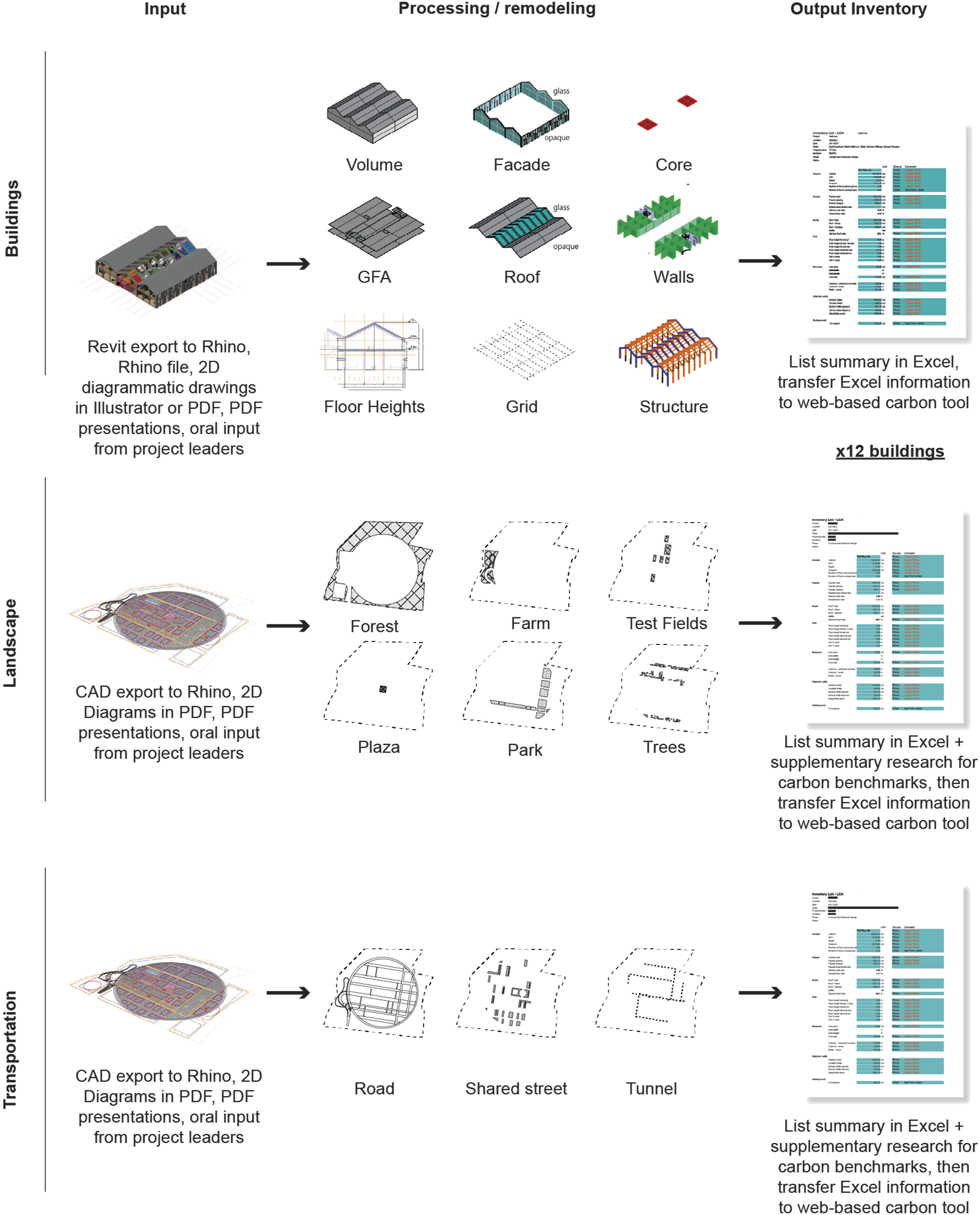
Meeting data needs
The data needs of the carbon assessment increase as the design process progresses. EN 15978 recognizes that at concept design stage, quantification of materials from the object of assessment is based on a limited amount of information, classifying this low-level accuracy as “Type 1—Concept Design Quantification” data. At this level, EN 15978 allows for the use of aggregated LCA data at the element level, rather than analyzing each specific material or component separately. The Standard also allows broad assumptions and the use of benchmark values to estimate the carbon impact of rough architectural models is acceptable. The standard also classifies Type 2—Building Permit Quantification, Type 3—Detailed Design Quantification, and Type 4, the highest accuracy, As-built Quantification.
These data accuracy levels per design stage do not correspond to the German workplan. In this practical case, German LPH2 can correspond to “concept” design, while only LPH6 applies to building permitting, leaving LP3-4-5 without a corresponding description for acceptable datatype. This gap complicates accuracy expectations in intermediate phases, hindering real-world implementation. It limits designers’ ability to communicate transparently with clients and consultants and challenges managing assessment consistency across large teams—critical for integrating embodied carbon LCA into urban design.
Assuming “Type 1 data quantification” as the requirement for this stage of design, it becomes an abstract requirement that needs to be translated to a concrete object—the urban model. Allowing to aggregate LCA data at building element level would require having enough design definition, at this stage of design, to describe the spatial and material composition of the common building elements: foundations, columns, beams, slabs (structural elements); walls, windows, roofs, facades (building envelope); non-load-bearing walls, doors (internal partitions); flooring, ceiling systems (finishes); HVAC, plumbing, electrical systems (building systems). If this logic is extended to the landscape elements, Type 1 data would require enough definition to describe: public plazas, street furniture, retaining walls, drainage and stormwater systems (hardscape); lawns, greenspaces, meadows, forests, trees (soft scape); and underground infrastructure. Similarly, specifying transportation elements would require definition on cars, buses, bicycles, e-scoters, micromobility, logistics trucks, urban air mobility (vehicles); public transportation stops/stations, parking structure, electric charging stations, landing pads (transport facilities); roads, cycle paths, sidewalks, tunnels (transport infrastructure). At this stage of the design process, none of the buildings, landscape and transportation elements being assessed are defined at this LoD.
To achieve an aggregation level analogue to Type 1, the researcher set up a template in Rhino, to enable the collection of the data from various sources into the design software environment, pushing for the spatial translation of data. This “spatial translation” includes reporting on material definitions or tacit knowledge from designers that were yet undocumented. This approach allowed to systematically collect data and scan across all elements (building, landscape and transportation), interpret the data according to the target LoD, and pack them into one proposed template that allows matching, classifying and comparing their parts at a concise level of data aggregation (Figure 10). The resulting level for data aggregation for buildings includes information on building footprint area, building volume, height, number of floors, number of floors below ground, floor height, GFA, façade area, facade glass area, façade opaque area, roof area, roof glass area, roof opaque area, core area, core wall area, partition walls, structure grid, columns, and beams. This requires “metaphoric appreciation” skills (Cross, 2006), meaning the back-and-forth translation from abstract requirements to concrete objects. Template setting in the design software to collect and compatibilize Type 1 data. Illustration by the author.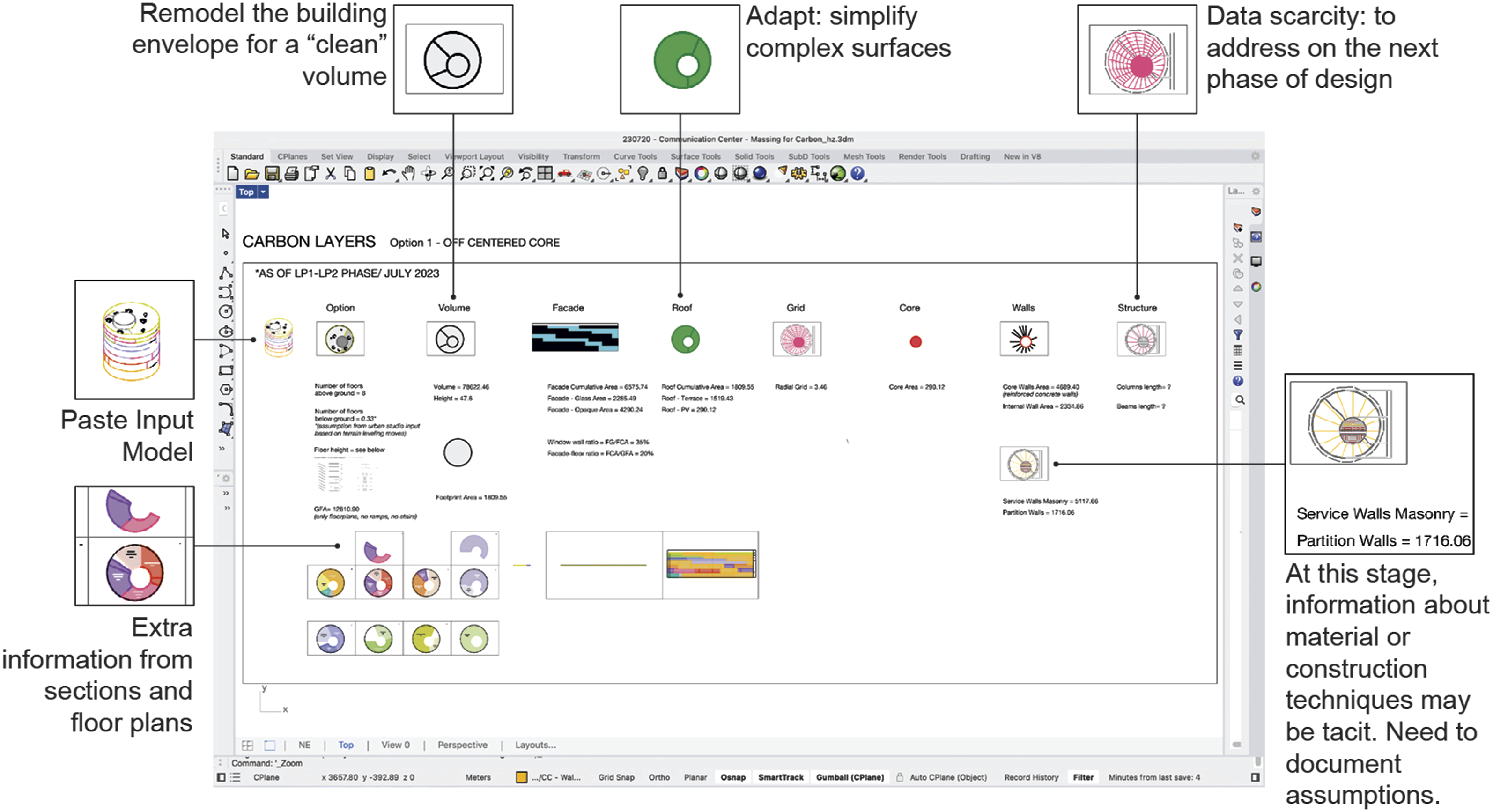
Upon testing this strategy across the design teams, 7 out of the 12 buildings still did not present enough information to fill in the data on “structure.” This is due to this moment in the design process (early-stage design), in which the involvements of consultants had been paused, and expert advice was not fully available. Integrating carbon assessment in the project deliverables demanded new contracts between the parties involved. New agreements were defined for the responsibilities of carbon accounting, carbon data sharing and a new scope of work for architects and partnering contributors. Meanwhile, the project proceeded without consultants to provide “a priori knowledge” on building structure. Therefore, structure grid, columns and beams were removed from the assessment at this point. For designers to clearly communicate this omission to the client and contributors of the project, they used visual codes, the architects created a diagrammatic scheme to explain “when to measure what” in terms of the quantification of embodied carbon for this project, related to the stage in the design process (Figure 11). Describing this level of accuracy is crucial to have a transparent communication with the client and the internal design team. A visual code to communicate “when to measure what” and respective levels of accuracy, facilitating communication between various actors. Illustration by the authors. Interviewees I1 and I3 highlight that standard workflows do not align with how urban design projects are staffed, timed, and contracted, requiring new scopes of work, responsibilities, and agreements to integrate carbon assessment throughout the entire design process.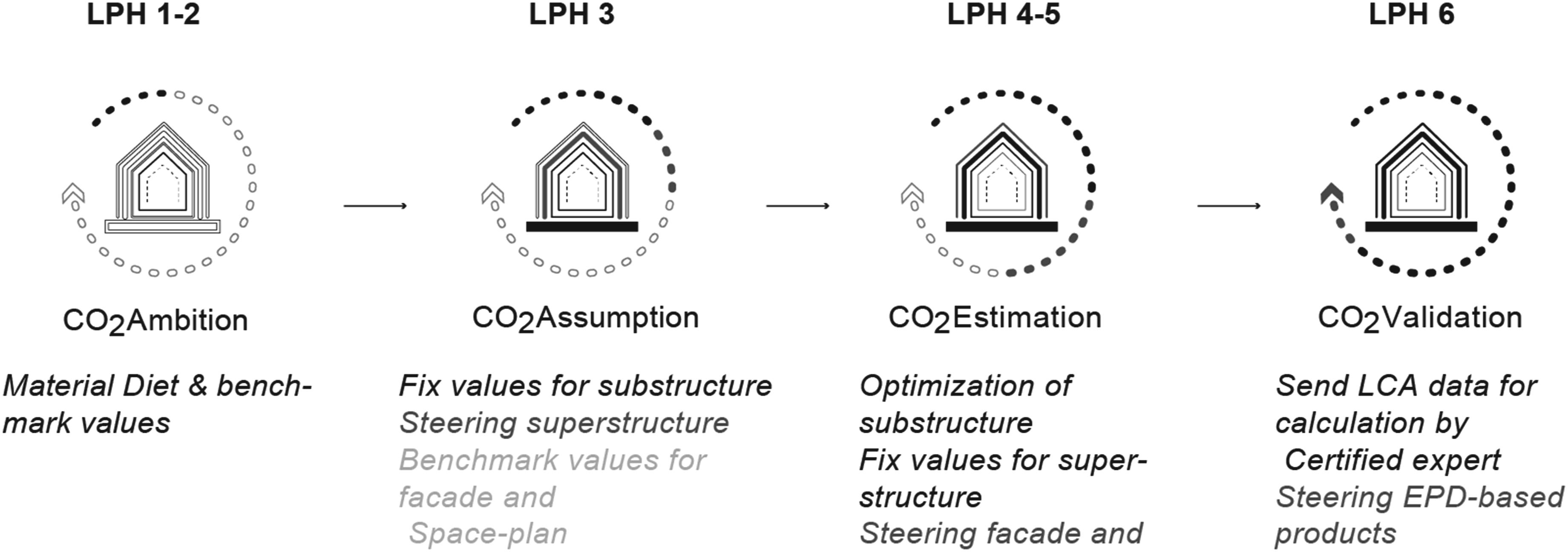
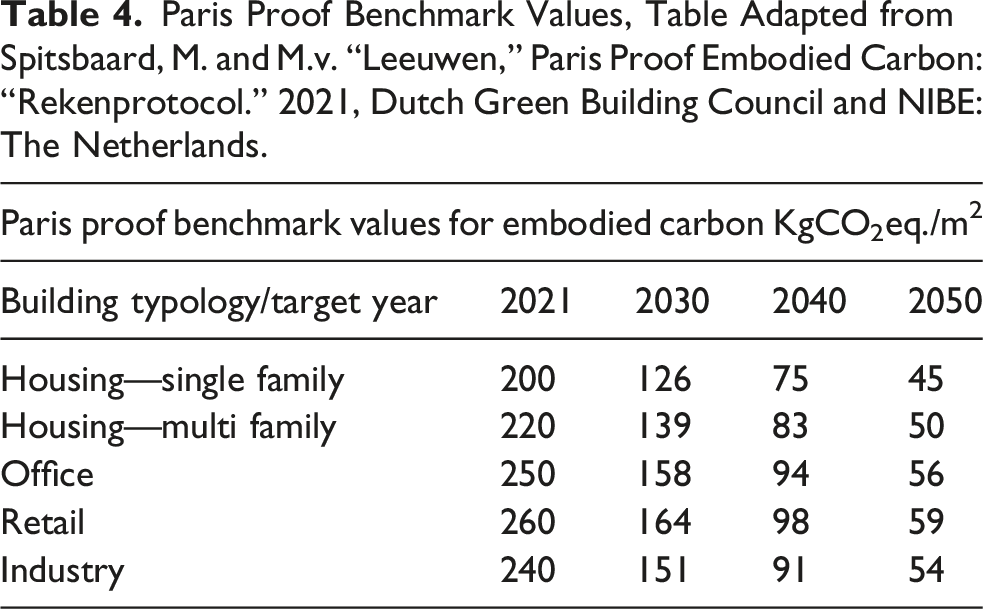
Another ill-defined problem in meeting data needs regards the lack of carbon benchmarks as a reference. Expert consultants may play a role in bringing in benchmark values from case-studies, as the mobility consultants did during the competition phase. However, at the moment this research was being conducted, consultant collaboration was at pause, due contract negotiations. Part of it were administrative discussions on how to integrate the responsibilities for carbon assessments into the contracts—a new scope of work in the architecture industry, changing the way it relates to complementary disciplines. Arranging for carbon assessments to be a part of the design scope rarely happens in such a holistic way at early-stage design, requiring much negotiation to bring clarity on the sphere of influence of each collaborator, a consensus on calculation methods, and a suitable way of exchanging of carbon data between the disciplines.
Paris Proof Benchmark Values, Table Adapted from Spitsbaard, M. and M.v. “Leeuwen,” Paris Proof Embodied Carbon: “Rekenprotocol.” 2021, Dutch Green Building Council and NIBE: The Netherlands.
To support the data needs, the architecture firm in this case study uses a web-based dashboard where designers log LCA data (at the LoD described above), chose from a curated material database (an iterative process), and generate numeric and visual results. CarbonSpace is an internal tool developed in Java and HTML to assess embodied carbon in buildings—this project marked its first application to urban design. It operates through two methods: a clear-box approach, based on target benchmarks, and a black-box approach, using post-design assessment. The tool integrates Ökobaudat (2000), pre-selecting commonly used materials for this practice. When benchmarks are unavailable, designers conduct additional research, attaching sources and documenting assumptions through note-taking. The results can be visualized in the format of graphs, for one object at a time—a systemic overview for multiple objects is not yet available. Through automation, data conversion, modular boundary selection, and visualization (Figure 12), the tool also fosters a digital archive from the companies’ assessed objects. This archive that evolves over time, supporting data-driven, carbon-based decisions by creating their own internal database to extract benchmarks. While CarbonSpace automates data processing, it relies on designers’ tacit knowledge to interpret results and translate them into meaningful design decisions—that is, instead of just tweaking numeric input or material choices, the designer can interpret that a given structure is always burdensome and propose to not include them at all (as in the case of underground structures or tunnels). CarbonSpace—a web-based carbon tool that also functions as a digital archive of the carbon assessments across various projects in the company. This tool supports the documentation of the designers’ tacit knowledge through allowing input notes, annotations on assumptions and uploading references as annexes.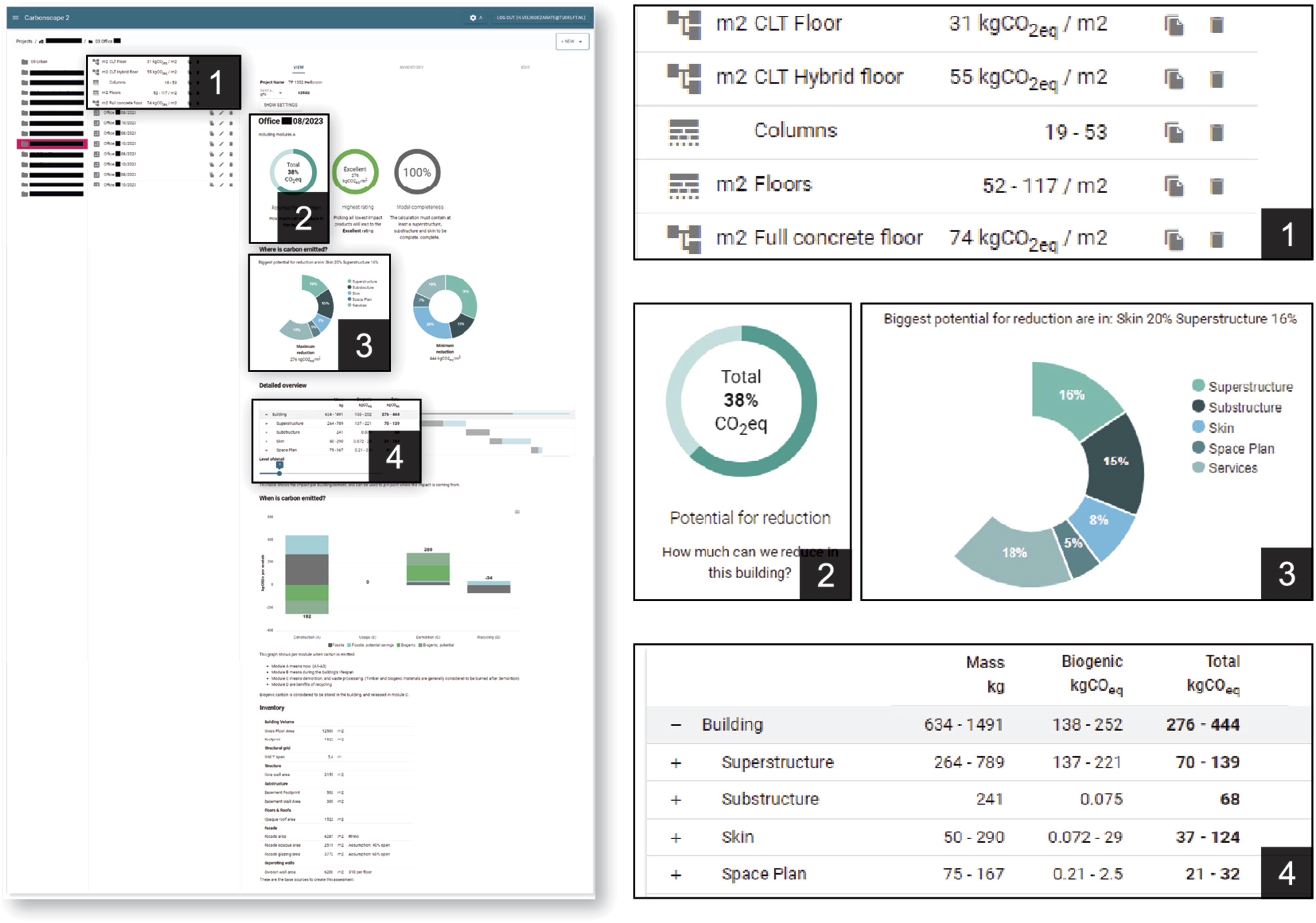
Communicating the LCA results
According to EN 15978, the communication of environmental assessment results must adhere to a structured and transparent framework. Results must be clearly reported per life cycle modules, and simplified communication is permitted (such as focusing on selected indicators or presentations using graphs), but any supplementary information or assumptions must be disclosed in annexes to ensure transparency and verifiability. However, unlike purely quantitative disciplines, where the numeric carbon data alone may suffice, low-carbon urban design necessitates the translation of these impacts’ numbers into comprehensible information and actionable insights. For example, if a non-LCA-expert is informed that a given building within an urban system has an impact of 250 KgCO2eq./m2, it is likely that does not mean much to them. In fact, a questionnaire with 12 project leaders (about 10 years of experience) in this campus project revealed that, at the time of this research, only 2 of them had actively dealt with the numeric carbon calculation using the office’s carbon tool. While 4 of them considered themselves highly aware about the impact of embodied carbon in the design process, 4 considered themselves not so familiar with it. Having a dedicated climate team to deal with numeric calculations for embodied carbon alleviates the pressure for designers to further develop this carbon expertise but increases the demand for effective communication strategies that balance analytical rigor with easy-to-get analogies and visualizations.
Communicating LCA results presents an ill-defined problem to the urban designer, as it extends beyond mathematical reporting, striving to influence decision-making in design at a systemic level. More than stating a numeric result, designers must communicate, at a glance, what does that impact mean, and based on that awareness, drive informed choices toward lower-carbon solutions. For instance, in this practical study, an inquiry coming from the client required clarity on whether the proposed landscape elements could offset the embodied carbon of the collection of buildings (not including other landscape and transportation impacts). Rather than relying solely on abstract carbon metrics (KgCO2/m2), the team sought to make the data tangible and intuitive by translating carbon impact into the number of trees required to sequester the same amount of CO2. To visually and spatially communicate the scale of embodied carbon emissions from the buildings, designers proposed a way of representing the required planting area for the number of trees needed to sequestrate an equivalent quantity of carbon.
This structured approach to LCA communication heavily integrates visualization methods, making use of sketches, mental boards, digital modeling and scripting, and story-telling strategies to achieve clarity (Figure 13). At first, the designer developing this method used hand-sketching as a cognitive tool to process the thought process, findings and explore representation strategies. This informal yet essential step facilitates conceptual clarity, enabling the designer to externalize a mental imagery of the aspired visualization—circle-packing arrangement of 50-year-old beech trees, a common species in Germany, to determine the required planting area. Reference values for CO2 sequestration per tree and tree crown area were derived from the 2017 Carbon Inventory, the most recent data on CO2 storage in trees, by the Federal Ministry of Food and Agriculture in Germany. Upon this background research, digital platforms such as Miro enhance collaborative refinement, serving as a digital whiteboard for team discussions. Within this digital white board environment, the designer can structure preliminary insights, that is, compensating for the carbon impact requires planting 30,000 trees. This collaborative platform facilitates iterative adjustments based on feedback from teammates, improving both the accuracy and accessibility of the visual representation. Development of the tree-based visualization used to communicate embodied carbon impacts at precinct scale. The figure shows notes, analogue and digital sketches produced during a collaborative design session with a team-member collaborator, at MVRDV. This exercise informs the visual metaphor, followed by digital refinement and application in the story-telling slide-deck developed by the climate team. The visualization translates abstract carbon quantities into a spatial and comparative representation to support early-stage design discussion and client communication. Illustration by the author.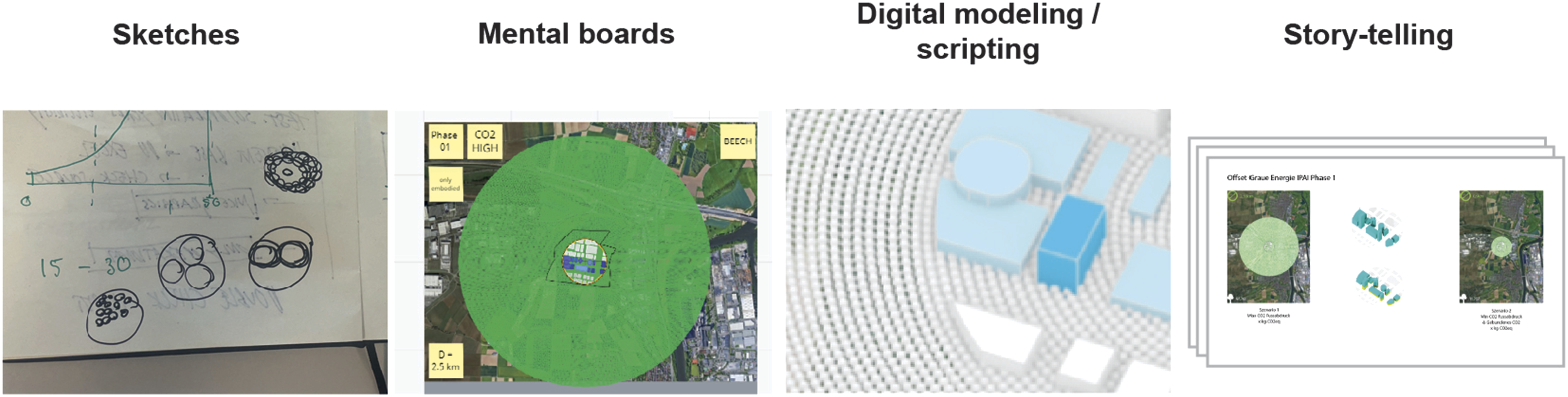
The circle-packing model (over)simplifies actual land requirements, as it does not account for ecological spacing needs for light and roots. This “idealized” assumption, however, allows a more striking visualization when this idea is modeled at scale in Rhinoceros and Grasshopper. The resulting visual comparison revealed a striking insight: the area required to plant enough trees to offset the project’s embodied carbon exceeds the physical site itself, even under idealized assumptions. Interviewees I1 and I6 further validate that comparative and visual carbon representations—rather than absolute numeric values—are most effective in steering early-stage design discussions and client decision-making.
Discussion
Lessons learned for the field of design
This research advances understanding of design process, design thinking and designerly ways of knowing by examining their tangible role in the integration of embodied carbon data within urban design practice. The study moves beyond the traditional, abstract theorization of Cross, Rowe, and Dorst, showing how their prevailing assumptions are demonstrated in LCA research.
Redefining early-stage design
Theorists have long described design as an iterative and cyclical process but are often imprecise about what constitutes “early-stage design.” This study shows that such definition is not just conceptual—it is operationally necessary for integrating Life-Cycle Assessment into practice, when implementing guidelines such as the EN 15978 standard. To perform embodied carbon assessment, practitioners must establish what counts as “early-stage” in terms of LoD and acceptable data accuracy. Therefore, this research proposes a practice-based definition, grounded in carbon assessment requirements, therefore bridging abstract models of design process and concrete dees of sustainability-oriented practices.
Mismatch between early-stage design processes and post-design carbon assessment frameworks
While much Urban LCA literature assumes complete, consistent data models developed at advanced design stages, early-stage urban projects are typically organized through parallel workflows, in which buildings, landscape, and mobility systems are developed simultaneously by different teams and at uneven LoD. In such conditions, carbon assessment becomes less a matter of calculation accuracy and more a managerial challenge of coordinating partial information, aligning assumptions, and sequencing evaluation moments. This reframes early-stage embodied carbon assessment as a project management task—one that requires deliberate structuring of responsibilities, timing, and decision gateways to support design exploration rather than the traditional after-design LCA.
Tacit knowledge can be, at an extent, codified in data-enabled tools
Challenging Schrijver’s premise that tacit knowledge is non-codifiable and cannot be written as a rule, here, tacit insights (i.e., assumptions about structural systems, undocumented material choices) are documented in databases, visual codes, and digital archives. Designers are not just applying tacit knowledge but systematically embedding it into evolving computational tools that document and store assumptions, references, and benchmarks. This new form of archive creates a hybrid “data-tacit” episteme.
Lessons for bringing life-cycle assessment into urban design practice
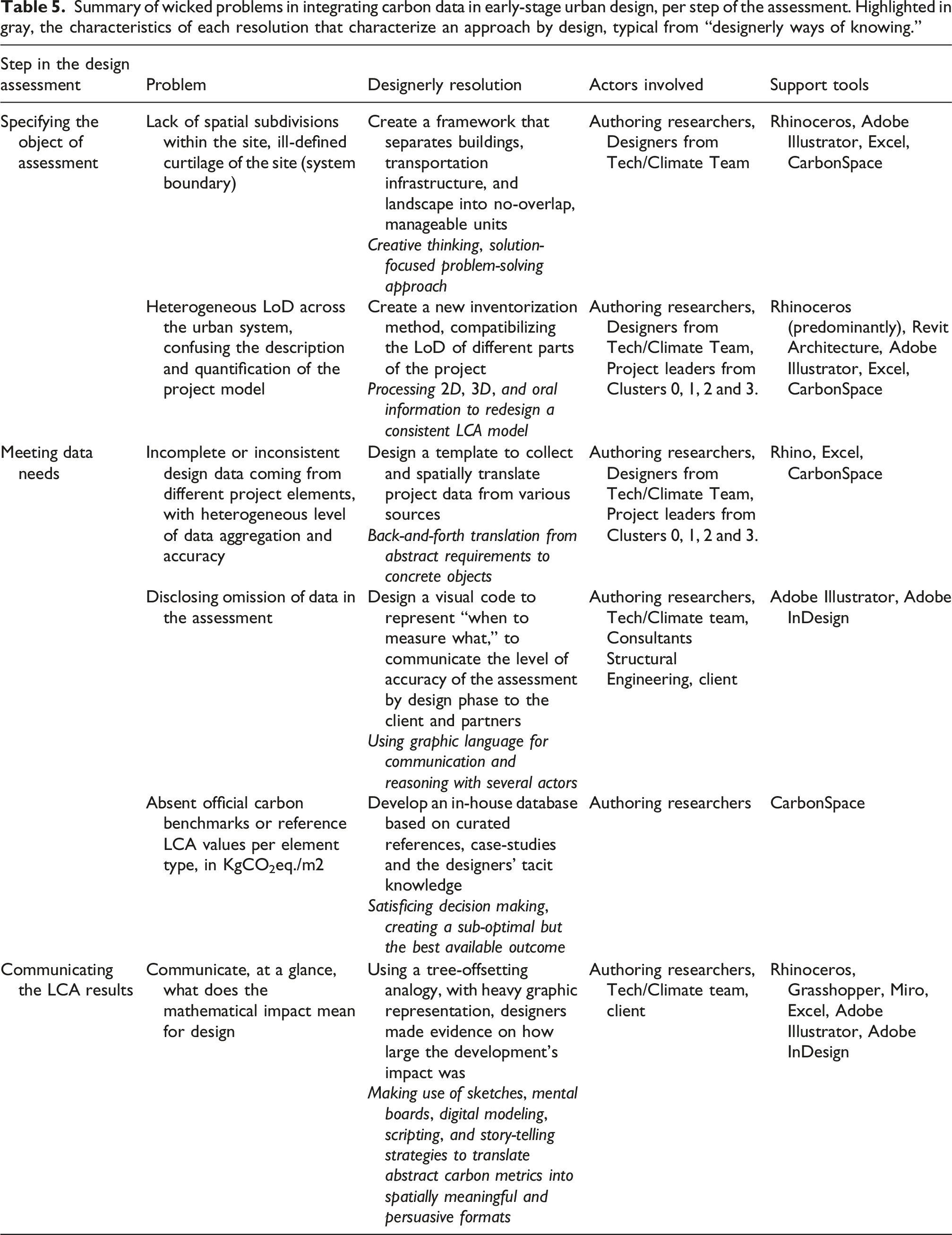
Summary of wicked problems in integrating carbon data in early-stage urban design, per step of the assessment. Highlighted in gray, the characteristics of each resolution that characterize an approach by design, typical from “designerly ways of knowing.”
Lessons for a potential new standard for urban design LCA
The case study reveals specific gaps between the standardized building protocols and urban design realities, offering recommendations for improvement in LCA methodology and usability.
Enhance LCA scalability from building application into urban design application. While EN 15978 acknowledges the existence of non-building objects within the building site, it should further explain how to account for them. This can enhance scalability when the building site is at precinct scale. Urban Design LCA would benefit of examples or references with predefined categorizations of landscape and transportation elements and components. Designers can benefit from a more thorough methodological description of typical data requirements for infrastructure, open space, and mobility systems, similar to the one for buildings. Better align the standard classification systems with practical design workflows. Creating more precise definitions of early-stage design or “conceptual design,” by referring to the national Plans of Work. Introducing the possibility of using flexible data templates, with a designerly data aggregation strategy for Type 1 data, can help designers navigate data scarcity while still enabling meaningful, comparative, and actionable carbon assessments in the early-stage design. Provide a communication annex or toolkit. Communicating results to non-experts is as essential as communicating results to a governing body conceding a building permit, especially because they are involved in early-stage design decision-making. Defining new ways of communicating embodied carbon impact can contribute to an improved understanding of results and more informed design decision-making. Use digital twins as an interface between design practice and standards. In the same way that Building Information Modelling (BIM) has become a pragmatic intermediary between design practice and standardized building LCA, this study recommends positioning urban digital twins as an analogous mediating framework for urban design LCA. BIM-based LCA operates through incremental models and evolving LoD rather than complete representations; similarly, urban digital twins should be understood as purpose-driven abstractions, not exact mirrors of reality (Stoter et al., 2021). The designer-facing carbon workflows developed here function as partial, carbon-focused urban twins, supporting early-stage decision-making under uncertainty. Given persistent challenges of data availability and interoperability (Lei et al., 2023), standards such as EN 15978 could benefit from explicitly recognizing incremental, multi-LOD digital twins as legitimate interfaces between urban design practice and carbon accounting.
By aligning standards more closely with the actual conditions of architectural and urban design practice, EN can support broader adoption of carbon accounting and empower designers to take meaningful, timely action toward climate goals.
Risks
The communication approach in this case study emphasizes the role of data visualization in shaping perceptions and guiding sustainable choices. It questions well-known literature such as “How to Lie with Statistics” (Huff, 1954), which adopts a skeptic positioning on data visualization methods, as it can create misleading impressions. For climate-oriented design, the data visualization illustrated in this case study, portrayed through heavy graphic design methods, risks “greenwashing” (Belitardo, 2023) if not used with good intentions. Nonetheless, it is essential to use data visualizations to convey an easy-to-grasp message and advocate for carbon reduction, in the urgent context of climate change. This positioning is closer to the take on “How to Lie with Maps,” where Monmonier describes “white lies”—when its not only easy to “lie,” but essential. “To effectively portray the complex, three-dimensional world on a flat surface, a map must distort reality.” The choice of symbols and graphic representation involve simplification and abstraction, to help convey a given message (Pickle and Monmonier, 1997). Borrowing from this notion, the circle-packing tree visualization method underscores the ethical responsibility of design professionals to use visualization as an advocacy tool. Rather than manipulating data for marketing or commercial reasons, the objective remains to present embodied carbon findings in a manner that underscores urgency to decarbonize. This way, designers and clients can grasp the implications of design choices, thereby promote low-carbon design alternatives and encourage the adoption of more sustainable strategies in early-stage design.
Limitations
Conducted within a Dutch architectural office and focused on a German case, the study reflects a European-centric regulatory and design context. Findings are shaped by the availability of open data, expert teams, and internal tools, which may not be accessible in other regions. The single-case, empirical nature of the research calls for further comparative studies across diverse geographic, cultural, and typological settings to validate and extend its conclusions. Nonetheless, the research offers a replicable framework and methodological insights that are foundational for future interdisciplinary efforts to embed carbon data in design practice.
Conclusion
This study demonstrates that designerly ways of knowing support data-enabled urban design practices to move toward the low-carbon transition, here defined as “designerly ways of decarbonizing.” The contribution of this research is two-fold.
For the field of Design, it advances understanding of design processes by showing how designers creatively resolve systemic gaps in Life-Cycle Assessment (LCA), when adapting the guidelines from standard EN 15978, meant for buildings, into the urban design scope. By situating carbon assessment within the fluid and iterative nature of master planning, this case examines how spatial reasoning, visualization, and tacit judgment interact with standardized LCA procedures. Examples include creating spatial subdivisions to define system boundaries, developing innovative inventorization methods to reconcile heterogeneous levels of detail, and creating visual codes to communicate data omissions. These strategies show that abductive reasoning, visualization, and tacit knowledge translate fluid design artefacts into workable protocols. The research also redefines early-stage design as an operational category aligned with carbon assessment, bridging theory and practice. This study evidences reliance on specialized expertise and demonstrates that tacit knowledge can be codified into evolving digital data-enabled tools.
For the field of LCA, the study offers a taxonomy of challenges in following the standard EN 15978 at the urban level and proposes refinements: improved scalability from building to precinct, better alignment between classification systems and design workflows, and a communication annex to engage non-experts. The study reveals methodological limitations that hider the integration of carbon data in the design process, specifically at early-stage design, when it’s the most influential in reducing carbon emissions. By foregrounding process rather than metric validation, the paper positions design practice as a critical platform of methodological innovation, enabling carbon data to meaningfully inform early-stage decisions where its impact on emission reduction is greatest.
As a continuation of this body of knowledge, Delft University of Technology is currently developing CARB-HUB: Climate-Adaptive Resilient and Balanced Mobility Hubs, a NWO research and design project that develops innovative methods, tools, and stakeholder game to integrate carbon data into architectural and urban design processes. It brings together academics, practitioners, and mobility stakeholders to co-create low-carbon solutions for station and station-area redevelopment. This paper paves the way for this and other initiatives supporting the transition to carbon-neutral construction and urbanization, proposing “designerly ways of decarbonizing” to make carbon data interpretable and useable for non-experts, strengthening design decision-making in early-stage practice.
Footnotes
Acknowledgments
This research counts with the invaluable contribution of researchers and practitioners, who shared their time, knowledge, data and tools in support of this research: Sanne van der Burgh, Inger Kammeraat, Luisa Correa de Oliveira, Moritz Rossdeutscher.

Ethical considerations
This research follows the Human Research Ethics guidelines and Data Management guidelines from Delft University of Technology, having obtained a written informed consent from the contributing human participants and consent from the contributing architecture office for developing, processing, archiving, and publishing the research material.
Author contributions
Funding
The authors disclosed receipt of the following financial support for the research, authorship, and/or publication of this article: This work was supported by Delft University of Technology (TU Delft), under the funding for the PhD Project entitled “Data-Supported Design for Transport Nodes and Sustainable Urbanization,” by PhD Candidate Halina Veloso e Zárate, as part of the Dean’s Themes of 2020/2021.
Declaration of conflicting interests
The authors declared no potential conflicts of interest with respect to the research, authorship, and/or publication of this article.
Data Availability Statement
Data will be made available upon request.
Declaration of generative AI and AI-assisted technologies in the writing process
During the preparation of this work the authors used the Artificial Intelligence tools ChatGPT, Grammarly, and Notebook LM to streamline writing and improve readability and language of the work. These tools are not employed to replace key authoring tasks, such as producing scientific insights, conclusions or recommendations. After using this tool/service, the authors reviewed and edited the content as needed and take full responsibility for the content of the publication.