




Abstract
The purpose of this exploratory study was to measure music educators’ (N = 9) self-perceptions of their use of interpersonal skills. Participants rated themselves on 32 statements included on the “My Use of Interpersonal Skills Inventory” in pre- and posttest formats. Participants participated in a 4-week period of weekly practice, class discussions, and self-reflections focused on interpersonal skills. A Wilcoxon signed-rank test was applied and revealed an overall significant difference (z = −2.81, p < .01) in participants’ self-perceptions of their use of interpersonal skills. Self-perceptions of improved skills were reported in 20 out of 32 areas including a statistically significant (p < .05) increase of ratings for seven interpersonal skill behaviors.
Keywords
The positive outcomes, in terms of gains in the professional setting, have been well documented in education, where training teachers in counseling and interpersonal skills appears to be related to substantial gains for the students in schools. (Sirin, Hall, Hall, & Restorick, p. 377)
In the United States, the lack of training on teachers’ use of interpersonal skills has had a negative effect on the ability to formulate and implement new relationships, programs, and policies that accompany reform efforts, including site-based decision making, peer coaching, and mentoring (Price, 1991). Teachers reported that they received a limited amount of training in the processes of communication (Jellinek, 1990). Training resources such as Burley-Allen’s Listening: The Forgotten Skill (1982) are available; however, educational training in basic communication skills is also lacking in the business sector. Findings from Bryant’s (1987) survey described in Quality Circles: New Management Strategies for Schools indicated that 45% of a manager’s work time was spent on listening, 30% on talking, 15% on writing, and 10% on reading. Findings from reports on training received in these areas (reading = 60%, writing = 30%, talking = 10%, listening = 0%) revealed a vast discrepancy between amount of time spent listening and the training received.
Roles that teachers fill within societies continue to evolve; therefore, there is a constant need to revise and update teacher-training curricula. In addition to leading students through the acquisition of academic objectives, teachers are also expected to support students’ learning by fostering a safe (physical, social, and emotional) learning environment. A study from Japan (Itsuno, 1993) raised the question of how teachers could foster the healthy minds of students and enhance interpersonal communication. Itsuno (1993) argued that teacher-training curriculums needed to be reevaluated in order to support not only the academic but also the emotional needs of students. This investigation identified potential reasons for elementary and secondary students’ refusal to attend school: family life, school life, and physical, physiological, and social factors. These implications encourage school officials to reexamine the school guidance system and implore teacher-training institutions to educate future teachers in counseling and interpersonal skills. In an effort to minimize the factor of “school life” as it contributes to students’ avoidance of attending school, teachers are encouraged to improve their use of interpersonal skills in order to become more effective as teachers and to be able to offer their students more emotional support.
Teachers’ use of interpersonal skills can contribute to their overall effectiveness as an educator. In a survey of preservice teachers’ perceptions on characteristics of effective teachers (Minor, Onwuegbuzie, Witcher, & James, 2002), seven themes relating to effective teaching were identified. The highest-ranking category reported by preservice teachers was that teachers needed to be “student centered.” These results supported previous research findings (Witcher, Onwuegbuzie, & Minor, 2001) where the “student centeredness” category received the most support by respondents. Qualitative responses of student-centered themes (“supportive,” “patient,” “trustworthy,” “impartial,” “honest,” and being a “good communicator”) paralleled themes of interpersonal skills examined in a previous study (Sirin et al., 1995). In response to the reported training deficiencies in communication or use of interpersonal skills, it appears that teachers, administrators, and leaders from other professions need to seek out additional training to further develop these skills in order to become more effective within their respective professions.
The interaction among teachers and students as they contribute to overall teacher effectiveness has been the focus of many research investigations. An investigation by Madsen and Duke (1991) examined interactions between beginning teachers and nonmusic major students and the role of teacher feedback in overall success students’. Implications from this study suggested that teacher reinforcement or feedback used in sequential patterns of instruction (teacher presentation, student response, and teacher reinforcement) could help foster a greater level of communication between the teacher and student in addition to raising students’ success rate. Research studies by Becker, Englemann, and Thomas (1971), Rosenshine (1979), and Brophy (1986) indicated that sequential patterns of instruction improved overall teacher effectiveness, student behavior and attitude, and task performance in the nonmusic classroom.
Bowers (1997) studied the use of teacher feedback in sequential instruction with elementary school students who were enrolled in music lessons with elementary education majors. The findings from this investigation supported earlier research on the relationship of sequential patterns of instruction to overall teacher effectiveness. According to a study conducted more than 20 years ago (Yarbrough & Price, 1989), many practicing music educators were not integrating positive interpersonal skills and teacher feedback in this manner during their daily teaching routine. Since that time, a number of studies have focused on the effectiveness of sequential patterns of instruction (Bowers, 1997; Duke & Davis, 2006; S. Howard, 2006; Taylor, 2006), which suggests that more music teachers may now be implementing this technique while leading students through the learning process.
Teachers can also use counseling skills in the classroom setting. Hanna, Gerber, and Wizer’s (1998) research found the need for teachers to incorporate counseling skills into the classroom. Characteristics that described counseling skills in their philosophical study paralleled that of interpersonal skills (being empathetic, trusting, supportive, patient, helping the other person feel safe). Haselswerdt and Lenhardt (2003) conducted a qualitative study, which revealed that high school students’ most prominent concern about the school climate was feeling a lack of respect from many adult teachers. These student frustrations stemmed from reported teacher behaviors that included interrupting, not actively listening, and a lack of empathy. Implications from this study suggested that educators needed more training in effective communication and interpersonal skills in order to improve relationships with students.
Communication is a process in which information is transmitted by one person and received by another. Adler’s book How to Speak: Flow to Listen (1997) identified the basic components of face-to-face communication to consist of a speaker, listener, statement, mode of expression, and response. As humans, our approach to interaction can promote a positive feeling of support or a negative feeling of defensiveness in the other person (Gibb, 1978). Price (1991) identified attributes of speakers and listeners that affect their verbal communication: values, attitudes, culture, social class, education, experience, and knowledge. His article suggested that in order to enhance positive interactions among teachers and students, teachers must first establish a foundation of respect and trust by actively listening to students’ concerns. G. S. Howard, Nance, and Meyers (1987) described the teaching process as one that involves the implementation of fundamental aspects of counseling or interpersonal skills.
Egan’s (1977) communication and counseling model suggested that teachers use “you–me” talk as a form of feedback to their students to help elevate levels of students’ confidence on academic tasks and as individuals. In the more recent past, Holmes (2005) described this counseling technique as follows: “This, to me, is a humanistic way of working with clients—trying to understand how they feel within their frame of reference, and with what Egan calls the proper degree of tentativeness, instead of imposing things” (p. 127). Interpersonal skills involved with “you–me” talk included being empathetic, listening carefully to the feelings expressed by the student, and responding appropriately.
Researchers within the counseling and teaching professions have investigated the extent to which educators applied interpersonal skills that were introduced in counseling skills training courses. In The Skilled Helper, Egan (1990) suggested that teachers’ use of interpersonal skills could be improved through specific exercises designed to heighten awareness of their interpersonal style. A more recent text based on the Egan model, Counseling Skills for Teachers (Kottler & Kottler, 2007), provides similar exercises along with making connections between the counseling and teaching professions.
Sirin et al. (1995) designed a 32-item self-report inventory to measure the implementation of learned interpersonal skills in course members’ personal and professional interactions. The development of this 5-point Likert-type scale, the “My Use of Interpersonal Skills Inventory” (MUISI) was based on professional writings in the counseling profession (Hargie, 1986; Ivey & Authier, 1978), discussions among counseling professionals, and the Egan (1990) model, the most commonly used approach in general professional counselor training. Following item analysis and three applications of the inventory, the MUISI (Sirin et al., 1995) was defined as “an internally consistent instrument, with a good level of reliability and reasonable indications of validity” (p. 377). Researchers from that study encourage other investigators to administer the inventory in future studies as the implementation of the MUISI generated significant results in the research process.
Additional investigations that evaluate teachers’ application of interpersonal skills discussed in teacher-training courses are needed. The texts previously described represent a small sample of teacher resources that focus on the improvement of interpersonal skills, yet there is a lack of research focusing on teachers’ use of counseling skills in the classroom. Further research in the development and use of educators’ interpersonal skills is warranted. The purpose of this exploratory study was to measure nine music educators’ self-perceptions of their use of interpersonal skills and to examine to what degree these perceptions would change as a result of weekly practice, class discussions, and self-reflection.
Specific research questions addressed were the following: (a) What interpersonal skills will be self-reported as strengths by participating music educators? (b) What interpersonal skills will be self-reported as areas of weakness by participating music educators? (c) Will music educators’ reported self-perceptions of interpersonal skills change during the duration of the study with weekly practice and reflection? (d) Which interpersonal skill(s) will be reported most prominently in participating music educators’ weekly reflection journals?
Method
Teachers for this exploratory study included three male and six female music educators who were enrolled in a graduate-level music education course at a comprehensive university located in the Midwest region of the United States. At the time of the investigation, each had completed at least 1 year of contractual music teaching experience and were currently in the teaching field or enrolled as a full-time graduate music education major.
The nine teachers were asked to respond to 32 statements using a Likert-type scale (1 = weak; 5 = excellent) on the MUISI (Sirin et al., 1995) in both pre- and post-inventory formats within the context of the course (see Table 1). After the completion of the pre-inventory, they were instructed to read the first two chapters from Counseling Skills for Teachers (Kottler & Kottler, 2007) during the first 2 weeks of the treatment period. Teachers also submitted a series of weekly, typed reflections describing a communication or interaction with another individual, focused on a theme of their choice from the assigned reading or a selected interpersonal skill listed in the MUISI. During four weekly class meetings, they shared personal reflections in a class discussion format and in partner activities. Discussions and practice activities were designed to reinforce concepts and techniques outlined in the MUISI and the text (Kottler & Kottler, 2007): attending (the act of being present), listening (the act of hearing attentively), nonverbal responses (i.e., head nods, eye contact, facial expressions, and body posture), verbal encouragers (i.e., “uh-huh,” “I see,” and “go on”), and reflecting feelings (verbal acknowledgement that demonstrates and understanding of what is heard). At the end of the 4-week period, each teacher completed the MUISI as the post-inventory for this study.
Pre- and Post-Inventory Results of the “My Use of Interpersonal Skills Inventory” (MUISI).
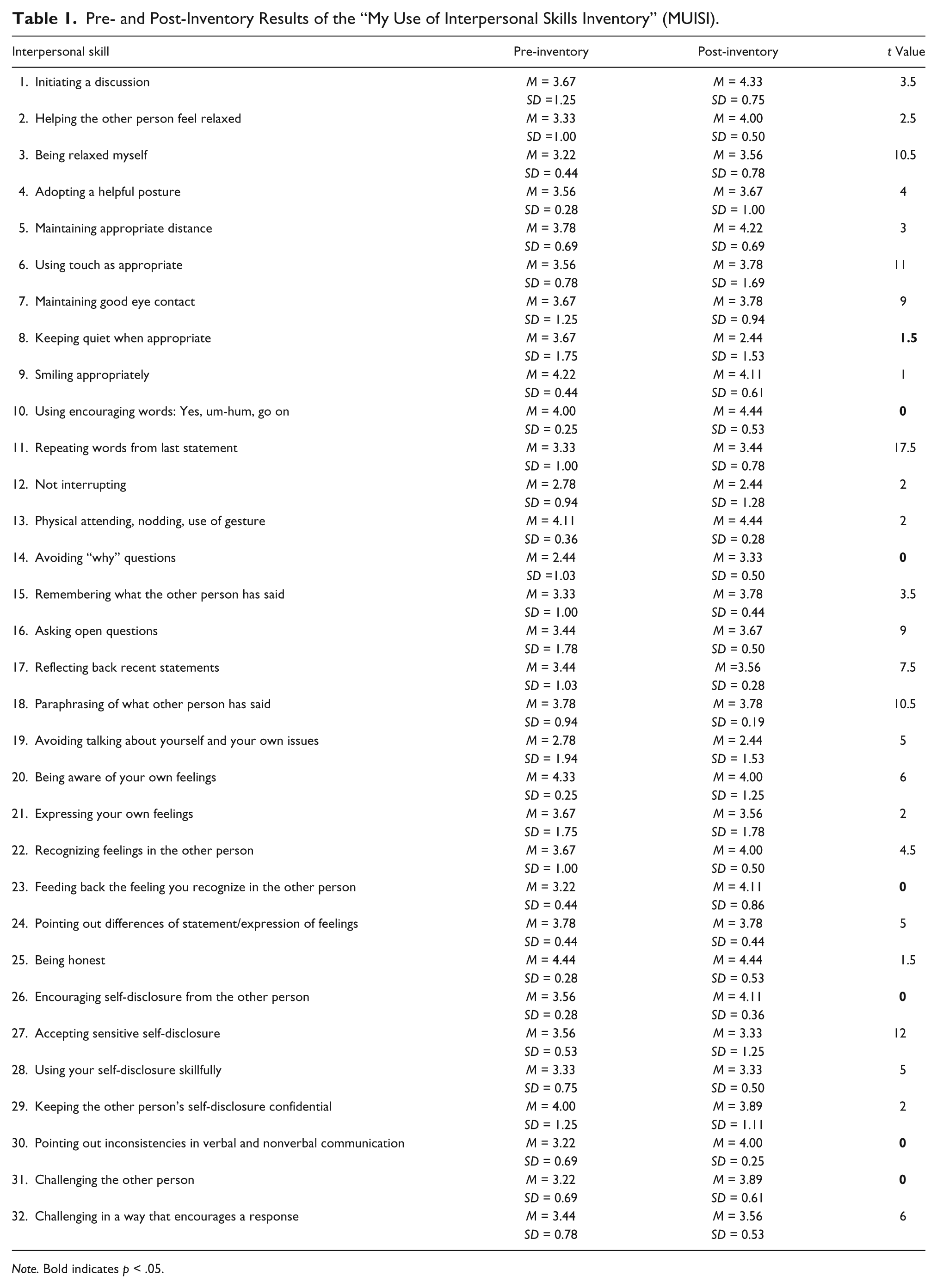
Note. Bold indicates p < .05.
Results
Participants’ responses to the pre- and post-inventory MUISI were tabulated and used to compare perceptions of their use of interpersonal skills using a 5-point Likert-type scale (1 = weak; 5 = excellent). Mean scores were calculated for each inventory item and a nonparametric test was selected for statistical analyses because of the small sample size (N = 9). Mean scores were ranked for each item and the Wilcoxon signed-rank test was applied, which revealed a significant difference (z = .0025, p < .01) in participants’ perceptions of their overall use of interpersonal skills. Participants reported self-perceived improvements in 20 out of 32 criteria listed on the MUISI (see Table 1 for mean scores and t values); however, a significant difference (p < .05) was only identified for ratings of seven interpersonal skill behaviors: “keeping quiet when appropriate,” “using encouraging words: yes, um-hum, go on,” “avoiding ‘why’ questions,” “feeding back the feeling you recognize in the other person,” “encouraging self-disclosure from the other person,” “pointing out inconsistencies in verbal and nonverbal communication,” and “challenging the other person.”
In the pretest inventory, the five strongest (mean score ≥ 4.00) self-reported interpersonal skills included “smiling appropriately,” “using encouraging words: yes, um-hum, go on,” “physical attending: nodding, use of gesture,” “being aware of your own feelings,” “being honest,” and “keeping the other person’s self-disclosure confidential.” Three statements were rated as being the weakest self-reported interpersonal skills: “not interrupting,” “avoiding ‘why’ questions,” and “avoiding talking about yourself and your own issues.”
At the end of the 4-week exploratory study, music educators completed the post-inventory and responses revealed 12 self-reported interpersonal skills perceived as areas of strength with a mean score greater than or equal to 4.00 on each. Five of the six perceived strength areas in the pre-inventory were also identified in the post-inventory: “smiling appropriately,” “using encouraging words: yes, um-hum, go on,” “physical attending: nodding, use of gesture,” “being aware of your own feelings,” and “being honest.” Seven additional interpersonal skills were also identified as areas of strength: “initiating a discussion,” “helping the other person feel relaxed,” “maintaining an appropriate distance,” “recognizing feelings in the other person,” “feeding back the feeling you recognize in the other person,” “encouraging self-disclosure from the other person,” and “pointing out inconsistencies in verbal and nonverbal communication.”
Although 20 of 32 interpersonal skills received increased self-reported ratings at the end of the study, participants identified eight interpersonal skills that weakened during the 4-week reflection: “keeping quiet when appropriate,” “smiling appropriately,” “not interrupting,” and “avoiding talking about yourself and your own issues,” “being aware of your own feelings,” “expressing your own feelings,” “accepting sensitive self-disclosure,” and “keeping the other person’s self-disclosure confidential.”
Discussion
The findings from this exploratory study indicate that it is possible for individuals to improve upon interpersonal skills over time with practice and self-reflection. Each participant reported some self-perceived improvement during the 4-week period. The present study found statistically significant differences (p < .05) for 7 of the 32 interpersonal skills listed on the MUISI and a positive change found in 21% of interpersonal skills. The teachers’ self-perceived improvement on their use of interpersonal skills supports findings from previous research, wherein Burns (1992) found that student teachers who had undergone less than 15 hours of personal growth work, including interpersonal skills, performed significantly better on teaching practice than their contemporaries. Implications from this exploratory investigation suggest that individuals or teacher-training institutions that emphasize the development of interpersonal skills, even with limited exposure, may enhance this aspect of overall teacher effectiveness.
Individuals’ self-perceptions of interpersonal skills may be affected by outside factors including, but not limited to, stress level, external criticism versus praise, school situations, and family circumstances. Participants may have perceived an improvement in their use of interpersonal skills solely by completing the pre-inventory and focusing their attention on the criteria listed in the MUISI. It is possible that the results from the pre- and post-inventories could have produced different outcomes because of these other confounding variables. This exploratory study provides limited but interesting insights into the perceptions of these music educators. See’s (1988) investigation identified a significant improvement in students’ perceptions of classroom climate with teachers who had completed a 30-hour counseling skills course. Future researchers are encouraged to collect data on participants’ use of interpersonal skills from the perspectives of others (i.e., students, peers, administrators, family members).
The written journal reflections revealed that some teachers perceived their use of interpersonal skills as being more effective at the start of the treatment period than what was later described following self-reflection at the end of the 4 weeks. Although some interpersonal skills were rated higher during the post-inventory, other criteria received lower mean scores by the respondents. Some teachers reported having an inflated sense of their implementation of interpersonal skills, which may indicate that they may not have been pressured by classroom norms to modify behavior, but instead may have gained a greater self-awareness of their abilities through self-observation. It is possible that, prior to this study, teachers were unaware of what possessing interpersonal skills in the classroom meant or they were not cognizant of the importance of gaining and using interpersonal skills as related to student outcomes.
Although the self-reflection charted during this study provided some interesting insights for these music educators, a longer period of time for growth and behavior change is needed for continued reflection. It could be argued that any perceived improvement in skills could be regarded as having value to the individual, regardless of statistically significance findings. Future studies that encompass a longer period of time may offer participants an opportunity for additional implementation, practice, and improvement of interpersonal skills. Additional studies could expand to a more multifaceted approach to the development of interpersonal skills. Other insights could be gathered from student interviews, observations, and perceptions on the teacher’s implementation of interpersonal skills in the classroom. Participants could also submit video-recordings or researcher observations of teachers’ use of interpersonal skills in the music classroom to provide more information.
Teachers are encouraged to seek out texts that provide more information on the effective use of interpersonal skills (Egan, 1977, 1990; Kottler & Kottler, 2007) and reflect on their interactions with students, parents, colleagues, and community members. Music educators may also gain further insight on their communication with students by video recording rehearsals or class lessons followed by thoughtful self-assessment. Although formal training led by a counseling expert or faculty member may provide music educators with a more systematic model and feedback, teachers may choose to participate in practice exercises in a less formal setting to refine their interpersonal skills.
Future research on counseling or interpersonal skills with preservice music teachers may help identify areas of focus and help guide their development as undergraduate students prior to entering the teaching force. Educators have more contact time with students during the school day than a traditional guidance counselor. To better support the needs of students, teachers must more effectively implement interpersonal skills in to their teaching routine. Faculty members involved with preservice teachers are encouraged to seek out ways to discuss and measure professional dispositions using an in-depth list of interpersonal skills associated with effective teaching.
Footnotes
Declaration of Conflicting Interests
The author declared no potential conflicts of interest with respect to the research, authorship, and/or publication of this article.
Funding
The author received no financial support for the research, authorship, and/or publication of this article.