




Abstract
The purpose of this study was to examine preservice music educators’ attitudes toward popular music in the music classroom. On a survey instrument designed by the investigators, participants (N = 82) rated (a) the effectiveness of popular music in addressing the National Standards for Music Education, (b) the appropriateness of popular music in various age-groups and music classroom settings, (c) their overall attitudes toward the use of popular music in the classroom, and (d) their perceived preparation to teach popular music based on their preservice coursework. Results suggest that the participants find popular music to be more appropriate for older students than for younger students and appropriate only in certain classroom settings. Attitudes toward popular music varied within the sample, and participants responded that their preservice training to teach popular music was minimal.
The role of popular music in the classroom has been one of the most contentious areas of practice in music education since the middle of the 20th century. Educators have periodically called for the need for popular music in the music classroom, but it has yet to gain widespread acceptance. One of the strongest calls for popular music in classroom settings occurred at the 1967 Tanglewood Symposium. As stated in the Tanglewood Declaration, students should have experiences in the music classroom with “music of all periods, styles, forms and cultures . . ., including current popular teenage music and avant-garde music, American folk music, and the music of other cultures” (Choate, 1968, p. 139).
Since Tanglewood, much has been written about the role of popular music in music classrooms in practitioner publications. These writings have discussed the value of popular music in music classes (e.g., MacCluskey, 1979; O’Brien, 1982; Woody, 2007) and how popular music can be effectively taught in music classes (e.g., Cutietta & Brennan, 1991; MacCluskey, 1969; Vulliamy & Lee, 1982). Research articles have also been published on the use of popular music in the curriculum since that time, and these have been summarized in two reviews (Isbell, 2007; Pembrook, 1990).
Variously referred to as youth music (Mark, 1994), rock music (Fowler, 1970; MacCluskey, 1969), and pop music (MacCluskey, 1979; O’Brien, 1982), popular music is a complex descriptor that holds different meanings for different people. As a result, defining the term popular music is problematic, and authors have expressed disagreement on how this term can be adequately limited to a singular definition (Bowman, 2004). Rodriguez (2004) defines popular music based on three common features, including its (a) consumption (measured by ranking systems such as Top 40 radio stations or Billboard charts), (b) presentation in certain media that are indicators of its popularity (e.g., movie soundtracks, sheet music, etc.), and (c) alignment with a socially desirable group. Others (Frith, 1996; Toynbee, 2000) describe popular music based on how it differs from folk or art music. Humphreys (2004) describes popular music as any music that is intended for mass audience appeal, but he claims that this method is troublesome because it presumes that listeners can interpret the intention of the composers, performers, and producers. Davis and Blair (2011) offer a broader, more inclusive definition of popular music from a sociocultural perspective. They describe popular music as “a social construct influenced historically and culturally while also developing and transforming over time” (Davis & Blair, 2011, p. 127).
The Appropriateness of Popular Music in the Classroom
Voices of Assent
Since Tanglewood, music educators have engaged in lively discourse on whether popular music should be used in school music programs. Many educators and researchers have written favorably about the uses of popular music in the classroom, citing a variety of benefits. First, it is widely reported that popular music is the preferred genre of many students (e.g., Boyle, Hosterman, & Ramsey, 1981; Finnäs, 1989; LeBlanc, 1979; North, Hargreaves, & O’Neill, 2000; Rentz, 1994). Some scholars (Davis & Blair, 2011; Hebert & Campbell, 2000) also assert that the use of popular music can affect how students understand social experiences.
Many support the inclusion of popular music in the classroom because it can help students achieve desirable learning outcomes. Ponick (2000) advocates for the use of popular music in the classroom because it can be used with other styles to address the National Standards for Music Education. For example, experiences with popular music in the schools provide opportunities for students to compose, improvise, and arrange music (Green, 2002; Hebert & Campbell, 2000). Others contend that popular music can be used effectively to teach students the elements of music and performance techniques, and these techniques can then be transferred to other musical styles (Mann, 1995; O’Brien, 1982; Pembrook, 1991). Allsup (2003) maintains that through popular music study, students will have opportunities to enhance their creativity and promote self-expression. Additionally, an oft-ignored benefit of popular music study is that imitative learning practices, which are commonly used in popular music learning, can improve students’ aural musicianship (Green, 2002; Woody, 2007).
Some authors perceive a disconnect between in-school and out-of-school music experiences (Hargreaves, Comber, & Colley, 1995; Isbell, 2007; Lamont, Hargreaves, Marshall, & Tarrant, 2003), and this need for relevant musical experiences provides one of the most compelling arguments for including popular music in the classroom. Woody (2007) also defends popular music on the basis that its inclusion in school music programs can encourage and prepare students for a lifetime of participatory music making.
Voices of Dissent
While some music educators favor the use of popular music, others have expressed skepticism on the appropriateness of popular music in the classroom. Three years after the Tanglewood Symposium, Fowler (1970) iterated several commonly stated arguments against the use of rock and other forms of youth music in the classroom, including the following: (a) rock is aesthetically inferior to more traditional genres, especially art music; (b) rock is morally damaging to students; and (c) instructional time should not be spent teaching the vernacular culture. Hebert and Campbell (2000) critically reviewed these three arguments and appended three others: (a) preservice music teachers in the United States often receive inadequate training in popular music, (b) popular music can foster defiant or rebellious behavior among students, and (c) popular music curricula are difficult to find in the United States.
Mark (1994) expressed uncertainty about whether popular music should be given equal footing with other genres in the classroom. He introduced three primary concerns about the appropriateness of popular music in the music classroom. His first concern relates to instructional content. If schools are supposed to teach what is not usually learned outside school, should popular music be included as a content area? Students are surrounded by popular music in their daily lives and, as a result, he claims they receive ample exposure to popular music away from school. As his second concern, Mark expresses doubt on whether the resources of time and money should be spent on popular music in the classroom. Finally, Mark questions whether popular music, which is sometimes considered to have a shorter life span than other musical genres, should be used in a classroom setting if the goal is to educate students for a lifetime.
Another reason that some are skeptical of using popular music in the classroom is the shallow way in which it is sometimes integrated into the curriculum. The clearest example of this is the “bait-and-switch” technique whereby the teacher uses a popular music selection only to grab the students’ attention before changing focus to a more traditional genre of school music (Cutietta, 1991). As a related concern, Woody (2007) points out that popular music is not always treated with the same authenticity as that which is expressed in other genres.
Bringing Popular Music Into the Classroom Through Informal Learning Practices
The methods of skill acquisition for popular music are conspicuously different from that of the traditional school rehearsal model (Woody, 2007). A flexible, informal approach is generally considered to be requisite for learning popular music, and some suggest that this approach offers a great deal of pedagogical promise for formal music education models as well (Davis & Blair, 2011; Green, 2002). Some informal learning practices common with popular music learning that are not often found in formal music education settings include the following:
Performers (i.e., students) often have autonomy in terms of musical choice (Allsup, 2003; Davis & Blair; 2011; Green, 2002).
Performers listen to recordings frequently (Woody, 2007) and copy musical ideas by ear as a primary learning mechanism (Green, 2002).
The role of musical notation is diminished (Dunbar-Hall & Wemyss, 2000; Green, 2004), and notation often occurs after the music is learned, composed, or arranged.
Creative processes such as composition, improvisation, and arranging are often integrated throughout the learning process (Boespflug, 2004; Green, 2002).
Musical material used in practice sessions usually includes learning new songs, tunes, or licks that the performers have heard, rather than scales, arpeggios, and other out-of-context technique exercises (Woody, 2007).
Learning often occurs through collaboration with peers in small groups, like cooperative learning environments (Allsup, 2003; Boespflug, 2004; Green, 2002; Woody, 2007).
Performers often watch and imitate behaviors modeled by their peers (Green, 2002).
Performers are more intrinsically motivated throughout the learning process (Woody, 2007).
Popular music instruction requires the teacher to take a nontraditional role as a guide or facilitator, rather than as an autocrat or dictator (Allsup, 2011; Boespflug, 2004).
Woody (2007) emphasizes the significant role that these informal learning practices could have when transferred to formal music education settings: “. . . the way vernacular musicians learn may be more in line with the nature of music and the nature of learning altogether, as compared to some traditional methods of formal music education” (p. 34). Allsup’s (2003, 2011) classroom garage band model is an exemplar of the use of informal learning practices within a formal educational context. It embraces collaborative and student-centered music learning processes, which can be used in many music classroom settings.
As noted above, educators and researchers have described both the benefits and encumbrances of the use of popular music in the classroom, yet little has been done to investigate preservice music teachers’ attitudes on this issue. In an effort to address this need, the purpose of this study was to examine preservice music teachers’ attitudes toward popular music in the music classroom by addressing the following specific research questions:
How do preservice teachers rate the effectiveness of popular music as a tool to address the National Standards for Music Education?
Which age groups do preservice teachers rate as appropriate for using popular music in music classroom settings?
Which formal music classroom settings (e.g., orchestra, general music class, piano class, etc.) do preservice music teachers rate as appropriate for including popular music?
Do instrumentalists and vocalists report different attitudes toward popular music in the classroom?
How do preservice music teachers rate their undergraduate preparation for teaching popular music?
Method
Participants
Participants (N = 82) in this study were music education students at a large Southern university. They were sampled from choral, general, and instrumental music methods classes and freshman aural skills classes, which were required for music education majors at the university. The mean age of the participants was 20.39 years. Participants represented all student classifications, including freshmen (14.6%), sophomores (36.6%), juniors (28.1%), seniors (18.3%), and graduate students (2.4%). The graduate students who were included in this sample were pursuing a master’s degree in music education with teaching licensure, as they had neither a bachelor’s degree in music education nor a teaching certificate. As such, they were enrolled in undergraduate methods courses to fulfill their preservice teacher certification requirements.
The sample was composed of 51.2% females and 48.8% males. In terms of musical background, 75.6% reported a primary instrumental background, while 24.4% reported a primary vocal background. Participants in this sample reported varied teaching interests. The majority of the sample (56.8%) reported that they would most prefer to teach in a band setting. The remainder of the sample reported that they would most prefer to teach in a choir setting (25.9%), general music setting (11.1%), or orchestra setting (6.2%).
Survey Instrument
A survey instrument, designed by the investigators, was used to measure participants’ attitudes toward popular music in various music classroom settings. The construction of the survey was informed by the review of prior research used in the present study. The study procedures were explained to participants, and 82 surveys were distributed. All the participants provided informed consent to participate and completed the survey. In the first section of the survey, participants supplied demographic data and information about their prior musical experiences. In the second section of the survey, participants rated the effectiveness of popular music as a teaching tool to address each of the National Standards for Music Education using a 5-point rating scale between 1 (very ineffective) and 5 (very effective). In the third and fourth sections of the survey, participants rated the appropriateness of the use of popular music within specific age groups and classroom settings, respectively. These sections used a 5-point rating scale between 1 (very inappropriate) and 5 (very appropriate).
In the next section of the survey, participants rated their agreement with 16 attitude statements concerning the use of popular music in the classroom (e.g., “Popular music is culturally relevant to students’ lives” or “Popular music study improves students’ aural musicianship”) using a 5-point rating scale between 1 (strongly disagree) and 5 (strongly agree). To reduce acquiescence response effects, seven of the items were negatively worded and reverse scored (e.g., “Instructional time should not be spent on popular music.”). The positively and negatively worded items were assigned to a random order for this section of the survey.
In the final section, participants provided the number of undergraduate courses that they have taken that included teaching skills specific to popular music. Then, they rated how prepared they feel to teach popular music, based on their undergraduate coursework. This item used a 5-point rating scale between 1 (very unprepared) and 5 (very prepared). Three open-ended questions concluded the questionnaire (“What reasons would make you more likely to use popular music in the music classroom?”; “What reasons would make you less likely to use popular music in the music classroom?”; “Is there anything else that you would like to share about popular music in the classroom?”).
Results
Perceived Effectiveness of Popular Music in the Classroom
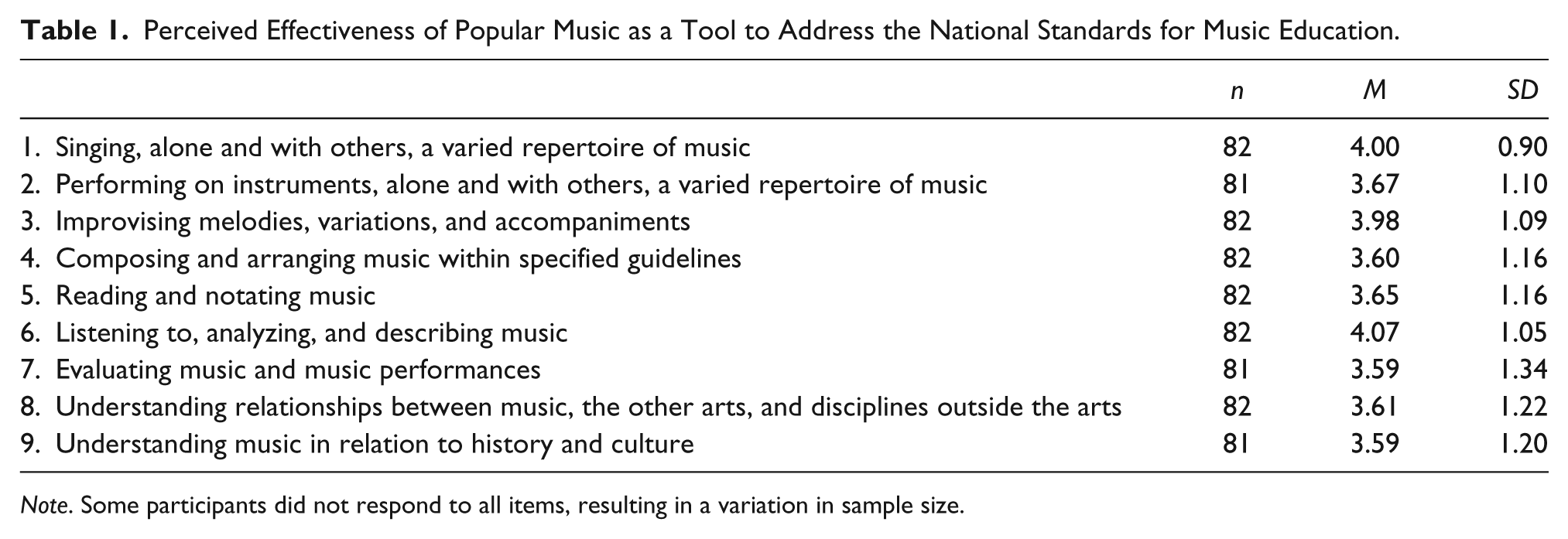
The first research question concerned preservice music teachers’ perceived effectiveness of popular music in addressing the National Standards for Music Education. Descriptive analyses of the data indicate that participants generally rate popular music to be an effective tool for addressing these standards. Mean responses were highest for Standard 6, listening (M = 4.07, SD = 1.05), and Standard 1, singing (M = 4.00, SD = 0.90). Lowest mean responses were for Standard 7, evaluating music and musical performances (M = 3.59, SD = 1.34), and Standard 9, understanding music in relation to history and culture (M = 3.59, SD = 1.20). Data describing participants’ responses to each of the standards are summarized in Table 1.
Perceived Effectiveness of Popular Music as a Tool to Address the National Standards for Music Education.
Note. Some participants did not respond to all items, resulting in a variation in sample size.
Perceived Appropriateness of Popular Music in the Classroom
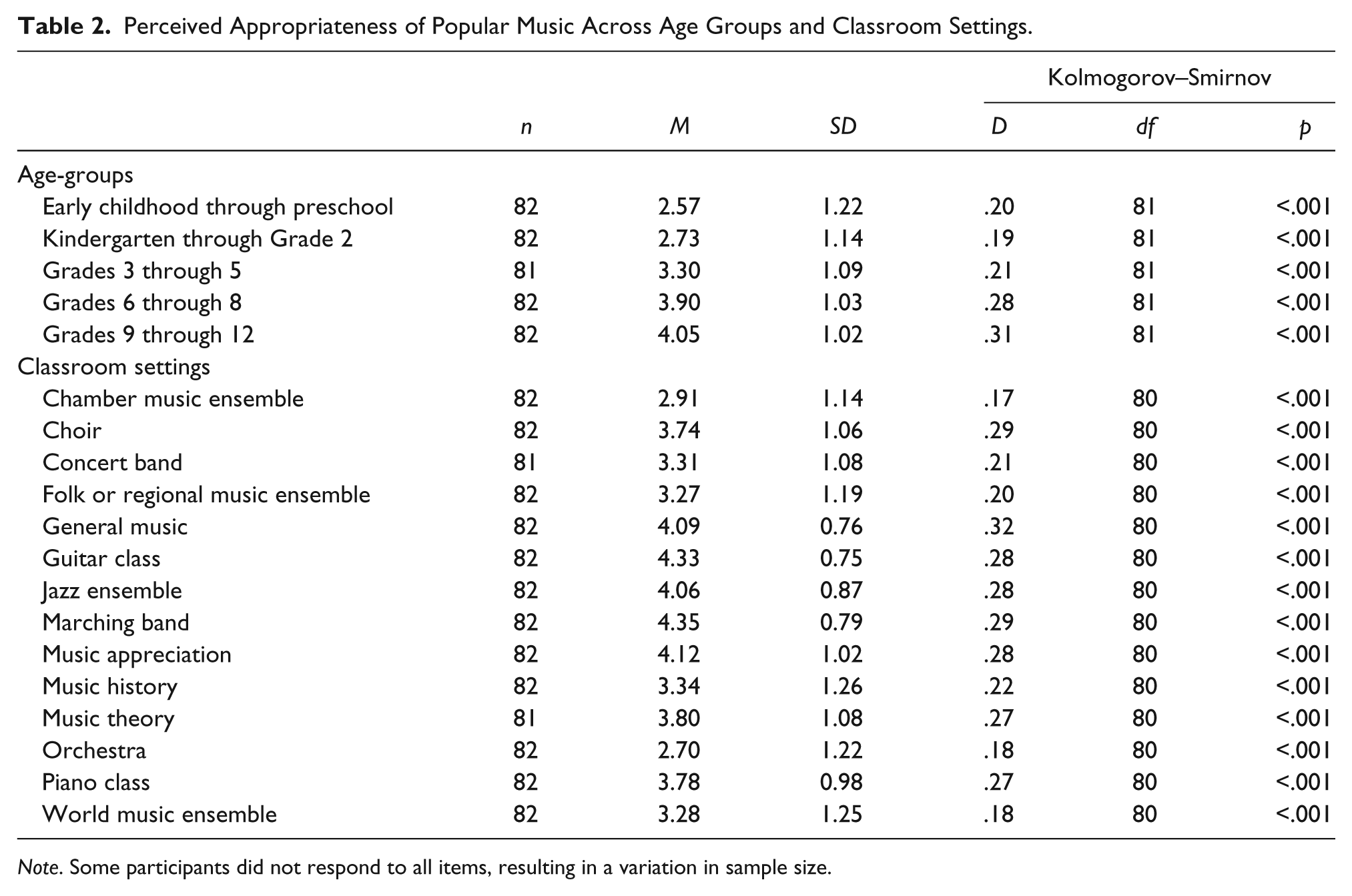
The second research question focused on perceived appropriateness of popular music in the classroom based on student age. Participants rated popular music to be more appropriate for older age groups than for younger age groups. Descriptive statistics for each age group were conducted first. Mean ratings were lowest for the “Early childhood through preschool” age group (M = 2.57, SD = 1.22) and highest for the “Grades 9 through 12” age-group (M = 4.05, SD = 1.02). As shown in Table 2, a noticeable pattern emerged in the participants’ responses. With each increasing age group, mean ratings increased, while variability decreased.
Perceived Appropriateness of Popular Music Across Age Groups and Classroom Settings.
Note. Some participants did not respond to all items, resulting in a variation in sample size.
In response to the third research question, which investigated appropriateness based on classroom setting, participants’ appropriateness ratings varied among different classroom settings. Mean appropriateness ratings were highest for marching band (M = 4.35, SD = 0.79) and guitar class (M = 4.33, SD = 0.75), whereas mean ratings were lowest for orchestra (M = 2.70, SD = 1.22) and chamber music ensemble (M = 2.91, SD = 1.14). Prior to examining the differences in appropriateness ratings among different age groups and classroom settings, responses were tested for normality. Results of a Kolmogorov–Smirnov test indicate that responses to all the age-groups and classroom settings significantly deviated from the normal distribution (p < .001). Table 2 outlines the results of the descriptive analyses and the normality tests for various age-groups and classroom settings.
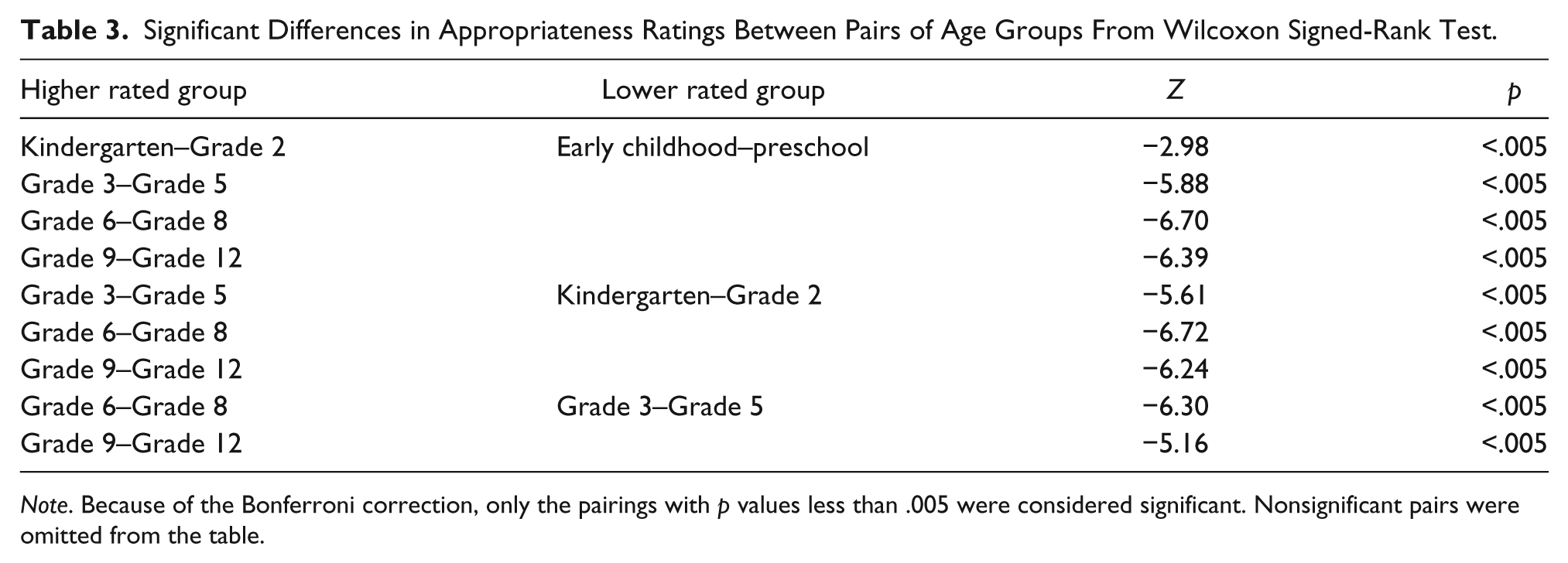
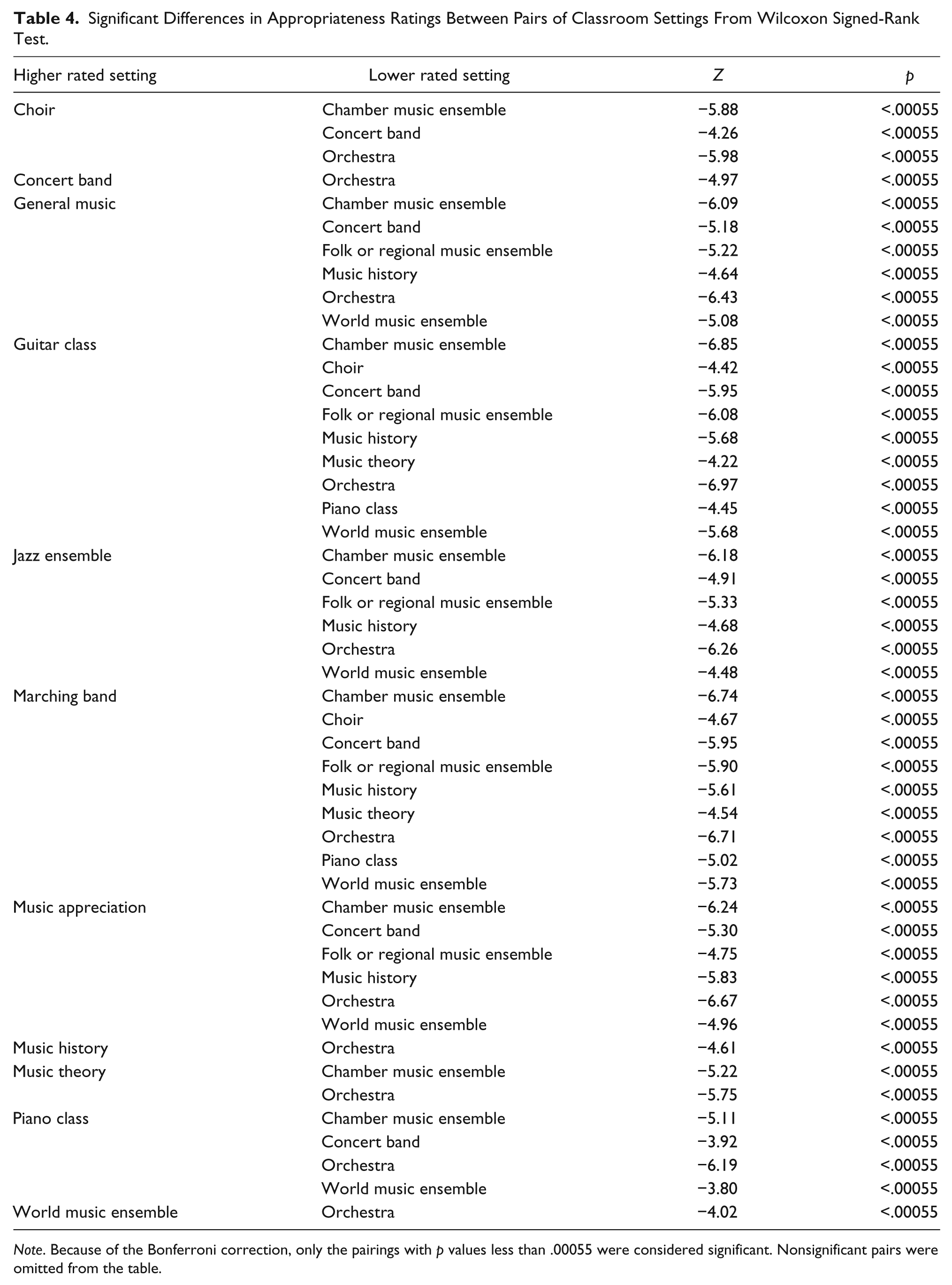
Because the collected data did not meet the assumption of normality, a nonparametric Wilcoxon signed-rank test was used to compare participants’ responses between pairs of age groups and between pairs of classroom settings. Because this test involved multiple pairwise comparisons of age groups and classroom settings, a Bonferroni correction was used to control for inflated familywise error rates. Significant differences were found between participants’ appropriateness ratings on 9 of the 10 age-group pairs and between 48 of the 91 pairs of classroom settings. These differences are summarized in Tables 3 and 4.
Significant Differences in Appropriateness Ratings Between Pairs of Age Groups From Wilcoxon Signed-Rank Test.
Note. Because of the Bonferroni correction, only the pairings with p values less than .005 were considered significant. Nonsignificant pairs were omitted from the table.
Significant Differences in Appropriateness Ratings Between Pairs of Classroom Settings From Wilcoxon Signed-Rank Test.
Note. Because of the Bonferroni correction, only the pairings with p values less than .00055 were considered significant. Nonsignificant pairs were omitted from the table.
Attitudes Toward Popular Music in the Classroom
The fourth research question was concerned with the participants’ attitudes toward popular music in the music classroom, specifically the differences in attitudes between instrumentalists and vocalists. Responses to the 16 attitude statements were added to calculate each participant’s overall attitude score. The negatively worded items were included in the calculation with a reverse-keyed response (i.e., a response of 1 was calculated as 5). As an overall sample, the participants’ attitude scores displayed variability (M = 60.05, SD = 8.44). Between instrumentalists (M = 59.68, SD = 8.95) and vocalists (M = 61.16, SD = 6.74), however, results from an independent samples t test indicate no significant differences in attitude toward popular music in the classroom, t(74) = −.657, p = .513. Results from further exploratory data analyses demonstrated no significant differences between gender groups, between student classifications, or between preferred teaching setting groups.
Preparation for Teaching Popular Music in the Classroom
Participants reported that their preparation to teach popular music in their undergraduate coursework was minimal. The majority of participants (86.3%) responded that they had either zero or one class that included teaching skills specific to popular music in their undergraduate coursework. Because of response error, one participant’s score was excluded from the above percentage.
Participants also rated how prepared they feel to teach popular music on a scale from 1 (very unprepared) to 5 (very prepared), based on their undergraduate coursework. Results suggest that the majority of the respondents felt unprepared (M = 2.63, SD = 1.05). It is interesting to note that no participants selected response choice 5 (very prepared) on this item; all participants selected choices 1 through 4. Though the majority of the participants stated that they had completed zero or one class that included training in popular music pedagogy, a disproportionately large portion (26.8%) of the sample selected response choice 4 (prepared).
All participants freely responded to at least one of the open-ended items, and 96% of the sample responded to at least two of the open-ended items. Responses to these three items were analyzed for common themes and classified into one of two categories—themes that support the use of popular music in the classroom and themes that oppose the use of popular music in the classroom. The four most prominent themes that supported popular music in the classroom included the following: (a) popular music as a powerful motivational tool, (b) students’ familiarity with popular music, (c) easy transfer of music content to other genres, and (d) students’ preference for popular music. The four most prominent themes that opposed popular music in the classroom included the following: (a) inappropriate language or thematic content, (b) perceived lack of depth or complexity, (c) risk of offending parents, teachers, administrators, or community members, and (d) poor quality arrangements for ensembles.
Discussion
The responses of the preservice music teachers who participated in this study highlight the complicated nature of the matter of popular music in the classroom. Generally, the sample indicated that popular music can be used to effectively address the National Standards for Music Education, but their responses suggest that they view popular music as more appropriate for older students than for younger students. They also responded that popular music was more appropriate for some types of music classrooms than for others. These responses did not differ as a function of musical background; both instrumentalists and vocalists rated the appropriateness of popular music similarly. In terms of overall attitude toward popular music in the classroom, participants responded with some variability. Results show that some of the participants strongly supported the use of popular music in the classroom, while others opposed its use in the classroom.
These differing attitudes can be examined in light of participants’ responses to the three open-ended questions at the end of the survey. Common themes that emerged in response to these items can provide a tentative explanation of why some students reported positive attitudes toward popular music in the classroom while others reported negative attitudes, though this explanation is only provisional.
Supporting the use of popular music in the classroom, the theme that emerged with the greatest frequency was that popular music can be used as a powerful motivational tool, one that can grab students’ attention, maintain students’ interest, and increase students’ involvement in classroom procedures. In fact, one participant claimed, “I strongly, strongly believe a ton more students would stay involved w/music if popular music was at least somewhat incorporated into teaching. Everyone listens to music!” Consistent with findings from prior research (e.g., LeBlanc, 1979; North, Hargreaves, & O’Neill, 2000), many participants also cited students’ preference for popular music as a reason that would make them more likely to use popular music in their classrooms. Additionally, students’ familiarity with popular music and the ease of transfer to other musical genres were reported as common themes that support the use of popular music in the classroom. One participant summarized,
Kids really love it. To teach certain musical elements, popular music works really well because you don’t have to orient them to the music first. They already know it, or can very easily learn and then go and build on it.
In addition to supportive statements, a number of comments opposing the use of popular music in the classroom were also reported by participants. These comments generally fell into four themes: (a) the presence of inappropriate thematic content (such as profanity, sexual imagery, and violent or vulgar themes), (b) a perceived inferior musical quality in comparison to other genres, (c) a perceived inappropriateness for advanced musicians, and (d) a perceived inappropriateness for performance-based ensembles. With regard to the potential presence of inappropriate content, one participant stated, “Impressionable young minds don’t need exposure,” while another participant concurred, “Modern music is swiftly losing integrity. . . . I don’t feel comfortable playing music about ‘making love in this club’ to 3rd graders.” Participants who responded that popular music is an inferior genre in terms of quality noted a perceived lack of depth and complexity, and they claimed that listening to popular music required little cognitive investment from students. One participant described popular music as “not as in depth . . . popular music = cut & paste,” while another participant described it as “the complete degradation of mental faculties.”
Others claimed that popular music study was inappropriate for advanced musicians and for classrooms in which ensemble performance was the primary goal. One participant explained that popular music would only be appropriate “if I was teaching the non–‘music major’ type students, like those in the lowest level choirs, music appreciation, or guitar class.” Another participant explained that popular music is “easier in general music classes than in some proper [italics added] ensembles,” and another participant explained that “it’s no comparison to music we play as band students.” These statements call attention to an important issue; should music education be elite or egalitarian in purpose? In other words, should music programs be designed for only the most talented students, or should they be accessible to all, regardless of ability level? The responses provided in the current investigation raise an interesting question for future study.
The benefits of informal pedagogies have been discussed in research and practitioner publications, but results from this study support an earlier claim (Hebert & Campbell, 2000) that preservice teacher training is lacking in the area of popular music pedagogy. Indeed, the majority of the participants in this study responded that their undergraduate coursework has offered minimal preparation in the area of popular music pedagogy. Their responses suggest that they generally find popular music to be an effective instructional tool in the music classroom, yet their responses indicate negligible preservice training in this area. No participants responded that they felt very prepared to teach popular music, and much of the sample indicated that they felt unprepared. One participant explained that popular music was absent throughout his or her preservice preparation: “No one talks about [popular music] here . . . kinda sucks.” Another participant continued: “Popular music, when correctly chosen, can have as much musical importance as a Beethoven symphony. . . . I think XXXX should prepare us to teach and perform all musical styles, not just classical.”
The disproportionately large portion of the sample that responded that they felt prepared to teach popular music was an unexpected outcome of the study. If 86.3% of the sample responded that they have had between zero and one class that included popular music teaching skills, then how are these preservice teachers acquiring the skills and dispositions to make them feel prepared to teach popular music? Though the answer to this question is beyond the scope of this investigation, it can be speculated that these skills could have been obtained in various formal or informal ways—from experience in ensembles, from recreational listening experiences, from observing peers, or from observing models in the media.
Some limitations of this study should be considered when interpreting its findings. First, the participants in this sample were preservice music teachers at one university, so the applicability of these findings to other universities and geographical locations is unknown. Second, results of this study are subject to response biases that are common with self-report measures, such as acquiescence and social desirability. Although certain measures were taken to reduce these bias effects (e.g., assurance of confidentiality, presenting attitude items in both the affirmative and negative direction, etc.), they could have affected the results of the study.
Further research should consider the above limitations as well as other promising directions in this area of study. Studies comparing preservice teachers’ attitudes toward popular music with those of novice and expert teachers are needed. Additionally, future descriptive studies should also examine the types of popular music genres that preservice teachers rate as appropriate for use in different age groups and classroom settings. Future investigations should also examine the sources from which practicing music teachers received training to teach popular music, noting especially whether these skills were acquired in preservice coursework or in more informal settings (e.g., from experience in ensembles, from friends, from singing karaoke, from religious practice, from listening to a variety of musical styles, from social media experiences, etc.).
Footnotes
Declaration of Conflicting Interests
The author(s) declared no potential conflicts of interest with respect to the research, authorship, and/or publication of this article.
Funding
The author(s) received no financial support for the research, authorship, and/or publication of this article.