



Abstract
Many institutions provide an undergraduate experience that can lead to professional certification to teach music. Each institution provides a unique socialization experience in the music teaching profession. In this literature review, studies are presented that provide information on the decision to become a music teacher, the early socialization of music teachers, the culture within schools of music, and models of music teacher identity.
The high school student wishing to pursue a career as a music teacher can choose from a wide variety of approaches toward achieving certification to teach music in the United States. There are over 1,300 institutions in this country that offer programs leading to licensure to become teachers (Darling-Hammond, 2000), 630 of which are accredited members of the National Association of Schools of Music (2011). Within this list of schools there exists a great deal of variety concerning size and campus culture but due to accreditation constraints, degree requirements and curricula are less diverse. Following a general overview of music teacher preparation programs, this review of literature is intended to provide insight into the manner in which young musicians decide to pursue careers in music education, the culture of schools of music, and the ways in which preservice music teachers develop an occupational identity by learning the skills and habits of a professional music educator.
Music Teacher Preparation Programs: A National Perspective
Degrees that lead to professional certification to teach music include Bachelor of Music Education, Bachelor of Music in Music Education, Bachelor of Science in Music Education, and Bachelor of Arts in Music Education (National Association of Schools of Music, 2011). Within these degrees, curricula generally adhere to the following guidelines: studies in music, including basic musicianship and performance normally comprise at least 50% of the total program; general studies, 30% to 35%; and professional education, 15% to 20%. Professional education is defined as those courses normally offered by the education unit which deal with philosophical and social foundations of education, educational psychology, special education, and the history of education. Some have argued that, since credits accumulated in music content and performance-centered courses typically outweigh music education course requirements and that most rewards are typically assigned to student abilities as an artist (i.e., scholarships, accolades, applause) and there are fewer rewards for teaching-related activities, the typical School of Music favors the establishment of an artist identity over a teacher identity (Scheib, 2006a). The culture of music schools in higher education will be discussed in more detail later in this article.
Every year the number of music teachers entering the workforce increases. According to the Higher Education Arts Data Services analysis, in 1990 there were 2,875 music education bachelor degrees awarded. In 2000, that number increased to 3,674. The most recent report indicates that 4,494 music education bachelor degrees were awarded from July 1, 2011 through June 30, 2012. The United States Bureau of Labor Statistics indicates that employment of kindergarten, elementary, middle, and secondary school teachers is expected to grow by 13% between 2008 and 2018, while employment of musicians, singers, and related workers is expected to grow 8% during the 2008–2018 decade, as fast as the average for all occupations (http://www.bls.gov/home.htm). Music teacher shortages were reported in half of the United States for 2010–2011 and 2011–2012. The following states did not report a shortage of music teachers during those 2 years: Alaska, Arkansas, Florida, Hawaii, Illinois, Indiana, Kansas, Kentucky, Maine, Maryland, Massachusetts, Michigan, Minnesota, Mississippi, New Jersey, New York (exception New York City), Ohio, Oregon, Pennsylvania, Rhode Island, Tennessee, Texas, Utah, Washington, and West Virginia.
The extent to which teacher education programs affect the professional development of undergraduate students and prepare them to teach remains unclear and continues to be a central component to a great deal of contemporary research (i.e., Austin, Isbell, & Russell, 2012; Ballantyne & Packer, 2004; Isbell, 2008; McClellan, 2011). It may still be the case as Clark and Marker (1975) remark that “the critical variance in teacher education programs among institutions is more a function of overall variance by institutional types than a systematic variation attributable to the professional training itself” (p. 58).
Wilson, Floden, and Ferrini-Mundy (2001) point out, “the challenges in improving teacher education programs and practices in the US are enormous, and a qualified teaching force is an unquestionable necessity” (p. 3). If music teacher educators wish to improve their preparation programs, the process by which preservice music teachers acquire the norms and understandings of the music teaching profession, occupational socialization, needs to be closely examined. In order to provide a context to this socialization of music education to undergraduate students, it seems appropriate to understand the reasons why young musicians choose to become music educators.
The Decision to Become a Music Teacher
When the early career decisions of general education teachers are examined it appears that the decisions are not typically based on a strong connection with the content area, but rather are more focused on personal and/or social reasons (Clinton, 1997). This is not the case however, when music teachers are asked of their reasons for pursuing a career in education. For them altruistic reasons like “making a difference” are present but they are less common than are reasons specifically linked to the subject of music. For music educators, a passion for making music is the top reason for pursuing a career as a music educator (Hellman, 2008). Indeed, the decision to pursue a career in music typically occurs much earlier than the decision to pursue a career in music education (Isbell, 2008). It is interesting to note however, that in a study consisting only of string players, Gillespie and Hamann (1999) asked participants specifically to select factors influencing the decision to major in strings/orchestra music education, the majority chose “liked teaching as a profession, rewarding work”; this was followed by “enjoyment and love of music.”
In a survey of 152 undergraduate music education students at four institutions in the United States, Hellman (2008) found that students decided to pursue a career in music education for a variety of reasons. A love for music was the most common response for wanting to obtain a school music teaching position, cited by 42 students. This was followed by the desire to share music (n = 22), and influence, help succeed, and make a difference in their lives (n = 17). Other reasons included enjoyable job, love for people, influenced by a former teacher, importance of music education, and career fit.
Findings from a study by Bergee, Coffman, Demorest, Humphreys, and Thornton (2001) also support the notion that a strong connection to the subject matter, the pure joy of making music, and the desire to work with other people are primary reasons for choosing to become a music educator. Some also indicate that they wish to teach music because it serves as a logical alternative to a performance career (Roberts, 1993). Reasons cited for not wanting to pursue a career in music education included: the desire to work in another area of music, lack of confidence in teaching skills, anticipation of low pay and/or job instability, anticipation of a large work load accompanied by stress, consideration of a career field other than teaching, dislike of children or adolescents, and preference to do something else (Hellman, 2008).
The Early Socialization of Music Teachers
Socialization is the process by which an individual acquires the beliefs, values, skills, and resources needed to live and participate in society (Handel, 2006; Musolf, 2009). Although many psychologists and sociologists acknowledge that socialization is a lifelong process, separate periods of socialization have been delineated to help better understand the shift in influence occurring when children move to adolescence and begin to consider the possibility of new roles in society. The early period of socialization, extending from preschool through high school is commonly referred to as primary socialization. Secondary socialization occurs when people enter the workforce or enroll in higher education and begin to adopt the roles and responsibilities of a smaller or more specialized group within the larger culture (Wallace & Wolf, 1999). According to the Oxford Dictionary of Sociology (Marshall, 1994), occupational socialization is a more specific term that refers to the manner in which a person learns the attitudes and behaviors necessary to recognize sustainable competence within a context of employment. For music teachers, this socialization begins when they are first enrolled in school as children.
The majority of music education research supports the notion that the effects of primary socialization linger into college and have an impact on the development of identity (Campbell, 1999; Dolloff, 1999; Ferguson, 2003; Prescesky, 1997; Woodford, 2002). High school music teachers, private studio teachers, and family are the “significant others” most commonly cited as being the strongest influence during the primary socialization (Dolloff, 1999; Isbell, 2008; Prescesky, 1997; Woodford, 2002). These studies are typically conducted after the fact with participant recollection being the source of data. Nevertheless, there exists agreement across a diverse set of studies that music education students enter their preparation programs with strong preconceived notions of what and how to teach music.
Prescesky (1997) examined music education students’ perceptions of themselves as musicians and as educators at Acadia University, a liberal arts college in Nova Scotia. Participants in her study were asked to reflect on the manner in which childhood experiences, teacher role models, teaching experiences, and significant people or experiences influenced their perceptions of themselves as musicians and educators. Prescesky learned that the participants’ perception of their “selves” was rooted in childhood memories and significant role models. Participants who adopted a “self-as-performer” view encountered conflict between their identities as musician and as educator, while participants who constructed images of “self-as-participant” had a more balanced view between their roles as musician and teacher.
Dolloff (1999) suggested that music education faculty do not often consider prior knowledge of students when they develop curricula for university methods courses. Instead, faculty typically show a preference for building new competencies, skills, or formal knowledge about teaching. Her research has focused on “describing a variety of means of uncovering and analyzing personal images as a component of formal study in music education” (p. 191).
In 2008, Isbell conceptualized primary socialization as participant decisions to enter the music and music education fields, influential people and experiences prior to enrollment in preservice teacher education programs. In his study, results showed that parents, school music teachers, and private music teachers are the major influences associated with primary socialization. Parents are pivotal in generating initial interest in music activity during childhood, but partner with school music teachers in sustaining music participation during adolescence. School music teachers appear to be pivotal in both initiating and sustaining interest in music teaching as a career. (p. 168)
As the undergraduate years progress, do music education students begin to think of music teaching and music making as separate skills or as closely interrelated activities? Research findings are not clear. Bernard (2004) examined how six elementary general music teachers spoke about their music making and their music teaching, and determined that the participants characterized their music making and music teaching not only as two distinct roles that they take on in their professional lives but also as a single approach that they take to two activities.
Socialization of Music Teachers: The Culture of the School of Music
Roberts (1991a, 1991b, 1993) has examined the socialization of music education majors and has found evidence that he believes reflects a culture surrounding music schools that inhibits or negatively influences music teacher identity development. According to his qualitative findings, music education majors felt stigmatized by being labeled as teachers and struggled within a Faculty of Music culture that awards social status on the basis of musicianship rather than teaching expertise. This in turn contributes to difficulty and stress associated with the development of identity as a music teacher.
Contrasting the work that depicts music school socialization (particularly as it relates to aspiring music teachers) in rather unconstructive terms, other researchers have concluded that the impact of music school culture on occupational identity construction may be more positive than theorized. In a national sample of music education students at 30 institutions in the United States, participants in a study by Isbell (2008) used a 7-point scale (1 = extremely negative influence, 4 = no influence, 7 = extremely positive influence) to rate the level of influence that particular people and experiences had on the decision to continue pursuing a degree in music education. Specifically, the most influential people were parents, school music teachers, and private lesson instructors. Performing in ensembles and interacting with other music education students were the most influential experiences during the undergraduate years. Interestingly, the most influential people were those individuals who began interacting with participants prior to undergraduate study; their influence was stronger than any individuals encountered during the college years.
Believing that there may exist cultural differences among music schools, which have some bearing on the social interactions among undergraduate music majors, Austin et al. (2012) investigated secondary socialization and occupational identity among 454 music majors enrolled in one of three music schools in the United States. In their investigation, they found evidence that the ratio of music education students to other music majors may influence the undergraduate socialization experience. Students attending the school which has a preponderance of undergraduate majors in music performance, few students pursuing a dual degree in performance and education, and a culture where performance and education are often juxtaposed reported less positive music classroom influence, and weaker teacher and conductor/composer identities than students at the school where the number of music education and performance majors is relatively balanced, the dual degree in performance and education is quite popular, and performance skills are considered a vital part of teacher preparation.
In an attempt to articulate the internal relationships of the groups of people within schools/departments of music, Nettl (1995) suggested that there exists a culture consisting of social hierarchies organized vertically with administrators, faculty/teachers, and students as well as horizontally with some roles being more or less central to the mission of the school of music. Within these hierarchies there exist specific sets of principles of organization governing the relationships among the groups. The specific roles of each group (performers, music education students, conductors, faculty, administration) may be imprecisely defined, but they serve to establish class structures and social boundaries within the building, within which are struggles for dominance between, for example, education and performance majors. Furthermore, some believe that in a typical school of music, the pursuit of a major in performance, the personal associations students have with private teachers, the placement in top performing ensembles and attainment of high chairs within these ensembles, awards and scholarship based on performance, all contribute hierarchy that favors performance majors above students from other majors (Bouij, 2004; Roberts, 1993).
There is general agreement across several diverse studies (i.e., Austin et al., 2012; Bouij, 1998; Roberts, 1991a) that the socialization processes is driven, in large part, by the music school performance culture. Furthermore, these studies indicate that the culture affects the socialization of music education students due, in part, to pressures to compete for social status within the institutional hierarchy. Whether these pressures are explicit or implicit, they appear to influence the manner in which preservice music teachers consider their occupational identity.
Preservice music teachers consider performance related activities to be of the utmost importance and applied faculty members have been cited as the primary role models during the undergraduate years (Isbell, 2008; Roberts, 1990). Pelligrino (2009) has provided a review of literature documenting the tension existing between the performer and teacher identities among preservice music teachers and provides further evidence for a privileged performer identity within the music school setting.
Participants in Roberts’s (1991a) study attended one of five Canadian institutions; Bouij (1998) investigated music students in Sweden. Austin et al. (2012) collected data from three American schools that differed in geographic location, total undergraduate enrolment in music, type of music degree programs offered, and the ratio of music performance majors to music education majors. The culture at music schools is indeed a complex phenomenon, one that likely cannot be fully understood or generalized due to the extreme variability among schools.
When the findings described above are considered along with those of researchers who have examined the ways music teachers consider what they do for a living, the impact that socialization has on occupational identity becomes clearer. Several researchers (Arostegui, 2004; Bouij, 1998; Froehlich & L’Roy, 1985; Mark, 1998; Roberts, 1991a; Woodford, 2002). have concluded that preservice and in-service music educators alike view themselves first as a performer and second as a music teacher. The connection between socialization and the construction/development of identity among preservice music teachers continues to be an area of interest in contemporary music education research.
Models of Music Teacher Identity
The relationship between socialization and identity is a close one. As mentioned earlier, occupational socialization is the manner in which individuals learn the norms and expectations of a given profession. As individuals practice embedding these actions and behaviors into their own lives, they are informed by their own self-perceptions as well as their perceptions of how others are responding to them. Through this “symbolic interactionist” interpretation, their identity as a music educator emerges and is developed.
A basic tenet of symbolic interactionism is that humans place meaning on the actions (gestures) of others, and this meaning informs future behavior (Blumer, 1969; McCall & Simmons, 2009). According to a symbolic interaction perspective, individuals inherently seek to understand why other people act in certain ways, and based on this understanding they may or may not align their own actions with a particular role or identity. A person’s sense of “self” and their sense of “other(s)” is a primary consideration when one interprets occupational identity using this theoretical framework.
Brewer (2009) used an interactionist framework to investigate the conceptions of effective music teaching held by five preservice music educators enrolled in the same undergraduate program and the influence of these conceptions on the participants’ developing teacher role-identities. Using a multiple case study design, Brewer collected data from 2 years of observing five preservice music teachers. He determined that the symbolic interactionist framework was an effective method of examining the highly individualized role identities that emerged. According to Brewer, conceptions of effective music teaching can be categorized into three groupings: personal skills and qualities, teaching skills and knowledge, and musical skills and knowledge.
Similarly, Paise (2010) also examined the role identity development of a small group (N = 6) of beginning music teachers. Data from observations, interviews, and e-mail communication were used to inspect what each of these beginning music teachers discussed when they described themselves in the role of music teacher. According to Paise, the participants’ role identities changed from the period prior to student teaching to the time after their student teaching. Musical selves, instructional selves, professional selves, and ideological selves were the four components of identity that emerged from the qualitative analyses.
After investigating 578 music education undergraduates, Isbell (2008) suggested that preservice music teachers’ understandings of self/other as a musician functioned somewhat differently than did the understandings of self/other as a teacher. In his study, factor analysis revealed musician perceptions of self/other as a single construct while the teacher self/other perceptions were distinctly separate understandings that were not influenced in the same manner. A replication of this study (Austin et al., 2012) with a smaller population however, did not provide similar findings.
Paul (1998) used symbolic interactionism to interpret Carper’s identity theory to examine the effect of a peer teaching laboratory experience on the occupational role development of undergraduate music majors and concluded that the peer teaching episodes were successful in helping students develop from a teacher-centered perspective to one that was more focused on students. Other people who have used symbolic interactionism to investigate identity among preservice music teachers include Froehlich and L’Roy (1985), Roberts (2000), and Wolfgang (1990).
Bouij (1998, 2004) found that Swedish music student teachers struggled to build a musical role-identity. He believed that students adopt role-identities that differ not only in terms of the traditional musician versus teacher distinction but also in terms of how broadly or narrowly one defines the goals associated with making or teaching music. His theory of identity among preservice music teachers is based on his investigation of Swedish music education students and is depicted above (see Figure 1, Bouij model).
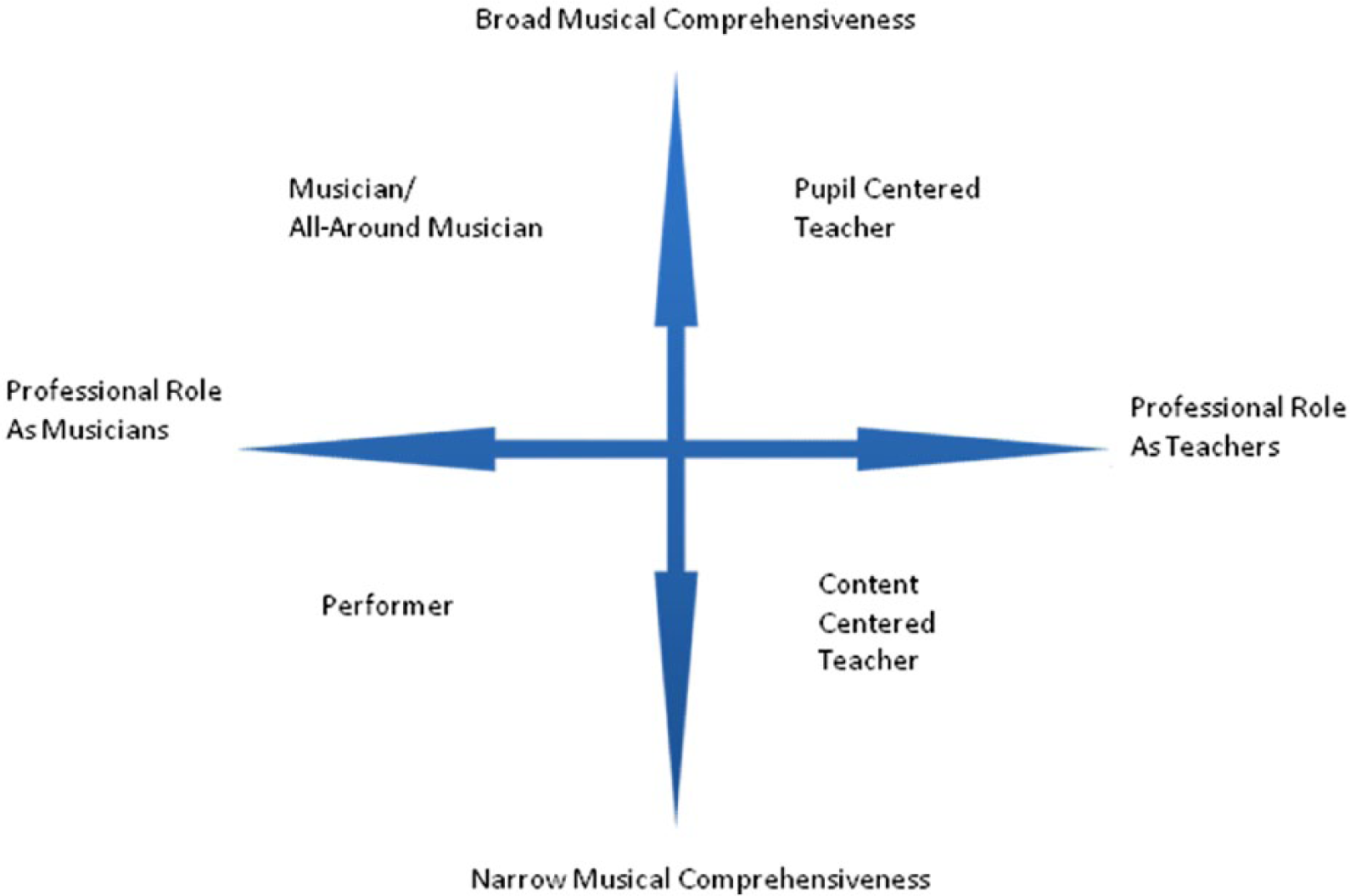
Salient role identities during music education (Bouij, 2004).
As a reinterpretation of the Bouij model in terms of the hierarchical importance placed on the performer identity, Scheib (2007) created a status hierarchy of role identities (see Figure 2, Scheib adaptation model).
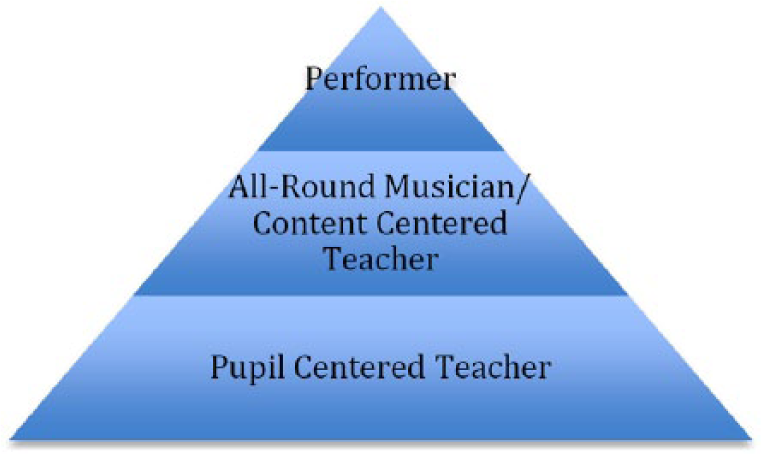
Status hierarchy of role identities (Scheib, 2004 adapted from Bouij).
Research exists that details the identity stress associated with careers in music education (Scheib, 2006b). Indeed, studies have shown school music to be among the most stressful occupations in teaching (Hodge, Jupp, & Taylor, 1994). Studies that focus on the stresses associated with in-service music teachers are beyond the scope of this article. It is logical to assume however, that some of these stressors and conflicts associated with teaching music may emerge during the undergraduate preparation period and influence the socialization and occupational identity development of future music teachers.
Conclusion
Socialization and occupational identity research in music education continues to be an active area of investigation. The findings presented above indicate that young people who decide to become music teachers typically make a commitment to performing music early in life and the influence from role models and performance experiences prior to college remain strong into and during the undergraduate preparation years (Dolloff, 1999; Isbell, 2008; Prescesky, 1997; Woodford, 2002). This finding alone can help explain some of the challenges associated with socializing preservice music educators. Increasing the challenge further perhaps are social and institutional pressures in schools of music. At the onset of secondary socialization, a culture emphasizing and rewarding performance over other skills, including teaching, appears to complicate the occupational identity shift to professional educator. This interpretation arises from contrasting studies and types of data such as Roberts, (1991b), Austin et al. (2012), and Nettl (1995). It is not surprising then, that the extent to which preservice teachers experience an identity shift from musician to music educator is at the heart of socialization inquiry.
The strength of commitment to a music educator identity comes into clearer focus when readers encounter the model established by Bouij (1998). The model is useful because it acknowledges the socialized roles not only as musicians and teachers but also in terms of comprehensiveness (narrow to broad). It has already been explained that music education students arrive to campus with a strong identity as musicians. This is not surprising due to the limited opportunities to “try on” a teacher identity. Nevertheless, if one is to assume that a task of music education faculty is to broaden musical comprehensiveness then the Bouij model can help visually represent the shift in socialized identity from performer to pupil centered teacher.
As Scheib (2006b) and Pelligrino (2009) have pointed out, music education students and teachers experience a significant amount of career stress. Scheib reminds readers of the many extra-musical responsibilities of a music educator that can cause stress. Could it be that attempts by music education faculty to influence the identity shift from performer to music teacher are interpreted by some music education students as a challenge to move away from their strongly held musician identity, rather than as a deepening of this identity to a more nuanced and sophisticated one with components of both performer and educator (including nonteaching related roles and responsibilities)? More research on the psychological stresses associated with occupational identity shifts in preservice music education would need to be conducted to uncover possible answers to this complicated question. Symbolic interaction appears to be a useful lens through which to examine this component of music teacher socialization.
Currently, the music teacher socialization Area of Strategic Planning and Action within the Society for Music Teacher Education lists 62 members. This active group has posted literature reviews and is presently attempting to identify appropriate indicators of a socialized music teacher at the transition point from preservice to in-service teaching (http://smte.us/aspas/music-teacher-socialization/). At the time of the writing of this article, members of this group are working on a project intended to generate a resource collection of activities and approaches employed in undergraduate curricula and during novice teacher mentoring that are intended to address occupational identity and to better understanding how undergraduates transition from self-concerns, to teaching concerns, to concerns about students (Haston, Isbell, Rabier, & Teachout, 2013).
Before appropriate or effective socialization approaches can be determined, a very complicated question concerning the professional role of public school music teachers must be answered. What are the professional expectations and challenges facing contemporary music educators? Calls for reform, close scrutiny of the role of public school, recommendations to close the gap between school music and societal music, and the rapidly changing political and economic climates make socialization a moving target that is very difficult to keep pace. Furthermore, it is clear that effective music teaching in one setting may appear and be interpreted very differently in one setting than in another. There is likely not one ideal model of music teacher that is best equipped to meet the needs of 21st-century students. Continued research is needed that not only examines the manner in which music teachers consider their lives as musicians and music teachers but also investigates how these complex understandings can inform the contemporary demands of an evolving music education profession.
As music education undergraduate curricula are scrutinized and updated, music education graduates should emerge from their programs prepared to be agents of change—or at the minimum, people able to acknowledge the need for and adapt to change—so that they may be prepared to grasp this moving target. The skills, understandings, and dispositions of a person who is ready to enter a work force with the desire and capability of moving the profession forward should be at the heart of the discussion about the socialization of music teachers. Will future music programs look and sound like those of the 1950s? How will they be different? Will the recurring calls for reform be realized on a national level? Will school music programs begin to attract a more diverse population of young musicians?
If future music teachers are going to graduate with the ability to finally realize a truly comprehensive music education—one that connects societal music with school music and promotes the study and making of music by all (the present mission statement by NAfME), then the socialization experiences which influence music education students during the undergraduate preparation programs must continue to be closely examined. To avoid becoming extinct or completely disconnected, public school music education programs—and those who prepare future music teachers—must incorporate significant and meaningful music making experiences relevant to diverse populations. These experiences should more closely reflect the many ways music is made outside of the traditional large ensembles. If this becomes the case on a broad level, music teachers in the 21st century will begin to be socialized to a profession that meets all the musical needs of K–12 students.
Footnotes
Declaration of Conflicting Interests
The author(s) declared no potential conflicts of interest with respect to the research, authorship, and/or publication of this article.
Funding
The author(s) received no financial support for the research, authorship, and/or publication of this article.
References
Supplementary Material
Please find the following supplemental material available below.
For Open Access articles published under a Creative Commons License, all supplemental material carries the same license as the article it is associated with.
For non-Open Access articles published, all supplemental material carries a non-exclusive license, and permission requests for re-use of supplemental material or any part of supplemental material shall be sent directly to the copyright owner as specified in the copyright notice associated with the article.
