



Abstract
The purpose of this study was to examine undergraduate conductors’ and conducting teachers’ perceptions about basic conducting efficacy. At the beginning and end of the semester, undergraduate students (N = 19) enrolled in a basic conducting course (a) were surveyed about the importance of certain skills necessary for being an effective conductor and (b) viewed and rated their first videotaped conducting episode. Results indicated very few significant differences in participants’ ratings of important conducting skills or their own self-evaluation of nonverbal conducting skills. In addition, university conducting teachers (N = 9) evaluated videos of 10 conductors (five who had participated in the basic conducting course and five nonconductors who had not) who led a university concert band in an identical 1-minute excerpt of band music. No significant differences were found between the basic conductors’ and the nonconductors’ nonverbal conducting behaviors. Implications for conducting teachers, undergraduate conducting students, and preservice teachers are discussed.
Keywords
During their undergraduate preparation, music education students are required to take many different courses that are designed to help them succeed as teachers. Aural training, rhythmic dictation, music theory, and music history are but just a few of the important music fundamentals that undergraduates learn. After having already completed several courses dedicated to these topics, students eventually enroll in basic conducting—a course that prompts students to synthesize much of their previously completed course work. Given the regularity with which music teachers conduct, basic conducting represents one of the most essential courses for prospective educators in the entire undergraduate curriculum (National Association of Schools of Music, 2012).
Perhaps the chief component of the basic conducting course is undergraduates’ physical skill development. Musicians and observers have indicated that nonverbal conducting behaviors such as expressiveness of gesture (House, 1998; Morrison, Price, Geiger, & Cornacchio, 2009; Napoles, 2013; Price, Morrison, & Mann, 2011), eye contact (Byo & Austin, 1994; Harden, 2000), and facial expression (Silvey, 2013; VanWeelden, 2002) are important behaviors for conductors to demonstrate. These skills also are frequently addressed in prominent undergraduate conducting texts (Green & Gibson, 2004; Hunsberger & Ernst, 1992; Labuta, 2010), making them the focus of many conducting pedagogues’ instruction. The perceived importance of the aforementioned nonverbal skills indicates the need for undergraduates to quickly learn and exhibit these nonverbal behaviors in their own conducting.
Researchers have explored the connection among conducting effectiveness, ensemble members’ attention, and performance achievement. Conductors who demonstrate behaviors such as frequent eye contact, rapid pacing, modulation of voice, and varied nonverbal conducting behaviors have been found to possess high levels of teacher intensity or conductor magnitude (Madsen, 1989; Waymire, 2011; Whitaker, 2011; Yarbrough, 1975). These factors positively influenced participants’ perceptions of conductors who demonstrated these characteristics versus those who did not. Researchers have also found that teacher intensity can be taught to and demonstrated by novice conductors. Students who received training sessions in high and low teacher intensity behaviors were able to demonstrate them successfully, and these behaviors could be recognized by outside observers (Madsen, Standley, & Cassidy, 1989). Furthermore, after watching videotaped high and low intensity examples and practicing them outside of conducting class, undergraduate conductors could exhibit both intensity conducting behaviors (Byo, 1990). These findings support the idea that young conductors are capable of learning and demonstrating a wide array of nonverbal behavior that can help lead to effective conducting.
Investigators have examined the efficacy of various preparation methodologies on undergraduate conductors’ nonverbal skill development. Running (2008) investigated the effects of theatre-based movement exercises on undergraduate conductors’ expressiveness and attitudes about conducting. Although he found no significant differences between the treatment and control groups, both traditional and theatre-based preparation proved helpful to the conductors. In a similar study, nonconductors who took an exploratory basic conducting course designed to increase their nonverbal communication skills—often in unconventional ways (e.g., learning to lead an ensemble with only the face)—were rated similarly in these areas to students who were enrolled in a traditional conducting course (Porter, 2000). Undergraduate conductors who were taught imagery and expressive conducting exercises outside of class were rated higher than those receiving no such treatment (Orzolek, 2002). Perhaps one of the most important conclusions from these studies is that nontraditional exercises may not hinder the development of the skills that are typically learned in basic conducting courses. Rather, in some cases, these nontraditional exercises can strengthen the development of conducting skills.
Several studies have reported conducting instructors’ beliefs about how undergraduate conducting courses should be structured (Boardman, 2000; Romines, 2003; Zirkman, 1984). The consensus among most conducting instructors has been that substantial podium time and conducting experiences are necessary components of all conducting courses, so that undergraduate conductors are afforded multiple opportunities to practice and develop their podium skills in live ensemble settings. However, much less information has been documented from the student perspective. In a national survey of undergraduate students who had taken a basic conducting course, undergraduates believed they were more prepared to demonstrate appropriate posture, conducting patterns, and eye contact than facial expressions and left hand independence (Silvey, 2011). A recent multiple case study of three undergraduate conductors revealed these students’ uncertainty about issues of leadership, score study, and podium time (Silvey & Major, 2014). There is still much to be learned from further investigation, particularly of how a basic conducting course assists in shaping undergraduates’ beliefs about the importance of conducting, how students might gauge their development during this valuable course, and whether progress in developing nonverbal conducting skills is evident to outside observers.
The purpose of this study was to examine undergraduate conductors’ and conducting teachers’ perceptions about basic conducting efficacy. We compared basic conducting students’ perceptions about (a) the skills and behaviors necessary for successful conductors and (b) their self-evaluation of nonverbal skills as a result of participation in a beginning conducting course. In addition, we sought to (c) determine if conducting teachers charged with instructing undergraduate basic conducting courses could distinguish between conducting performances of selected students who had taken a basic conducting course versus those who had not.
Method
Participants
Basic Conductors
Undergraduate music students (N = 19) enrolled in a basic conducting and score reading course at a large Midwestern university volunteered to participate in this study. Participants read and signed an institutional review board informed consent form per university requirements. The project began with 20 student conductors, but one participant dropped the course during the fifth week of the semester. Participants (male, n = 11; female, n = 8) were at various stages of an undergraduate music degree program (sophomore, n = 11; junior, n = 5; senior, n = 3) and had declared either a vocal (n = 8) or instrumental focus (n = 11). Thirteen participants were enrolled in the music education program, three were music performance majors, and one each had declared a major in music history, music performance/musicology, and music/anthropology. Successful completion (B average or higher) of introductory music theory served as the prerequisite for enrollment in the course. Experience in other music theory, music history, or aural training classes varied among participants. Prior conducting experience ranged from conducting a high school marching band, to occasionally directing a church choir, to none at all.
The basic conducting course was taught by one of the researchers who was assisted by two graduate wind-conducting students, each with several years of public school teaching experience. The course took place over a 16-week semester, with three 50-minute class meetings per week. Basic Conducting Techniques (Labuta, 2010) was used as the primary text for the course. The text included descriptions of basic conducting skills such as gesture, cuing, eye contact, and patterns with the aid of diagrams, photos, and music excerpts for conducting practice. The instructor provided supplemental materials for class use (e.g., conducting pedagogy articles, excerpts from other conducting textbooks, additional choral and instrumental music examples). Students regularly conducted during class, both individually (leading the lab ensemble) and as a group (class exercises). Six formal conducting exams were administered during the course, with each including a (a) formal assessment, using a researcher-designed rubric, (b) self-assessment by the student with the same rubric, and (c) written self-reflection of the student’s conducting performance. Although the primary focus of the course was on students developing and refining their nonverbal conducting skills, students also completed assignments on score study and score marking, instrument transpositions, music terminology, and score analysis.
Nonconductors
First-year music majors (n = 5), who we referred to as nonconductors, also participated in this study. These participants were not enrolled in the basic conducting course, reported no previous conducting experience, and were invited at random from the population of all first-year music majors enrolled at the university where the study took place. After agreeing to participate in the study, nonconductor participants also read and signed informed consent forms.
Near the end of the semester, we briefly instructed the nonconductors on basic conducting skills. Both investigators met with the nonconductors for a 1-hour training session. In an effort to control for any instructional differences, the researcher who instructed the basic conducting course taught and demonstrated basic conducting skills (e.g., posture, baton grip, starting and stopping the ensemble, 4/4 pattern execution, releases) that we believed were necessary for successfully leading the university concert band in a selected music excerpt. Similar to the basic conducting course, participants demonstrated these skills in groups and individually with help from both investigators.
Expert Conducting Evaluators
University faculty (n = 9) charged with teaching an undergraduate basic conducting course at similar public institutions served as expert evaluators for this study. They reported an average of 12.30 years (SD = 11.10) basic conducting teaching experience. All evaluators viewed and rated a group of 10 student conductors using the same researcher-designed rubric that was employed with the basic conducting class.
Measurement Tools
Conducting Attributes Survey
A pretest–posttest design was employed to determine if the experiences gained during a basic conducting course would affect undergraduate music students’ perceptions of basic conducting skills and behaviors. Survey items were adapted from previous research involving experienced teachers’ and conducting instructors’ reports of important teaching and conducting skills (Battisti, 2007; Haldeman, 2001; Manfredo, 2008; Teachout, 1997) and were divided into three sections: interpersonal skills (9 items), musical skills (10 items), and physical skills (5 items). Participants responded to each of the 24 items using a 10-point Likert-type scale anchored by 0 (not important) and 10 (very important). See Table 1 for the complete list of survey items.
Means and Standard Deviations for Beginning Conductors’ Perceived Importance of Basic Conducting Attributes (N = 19).
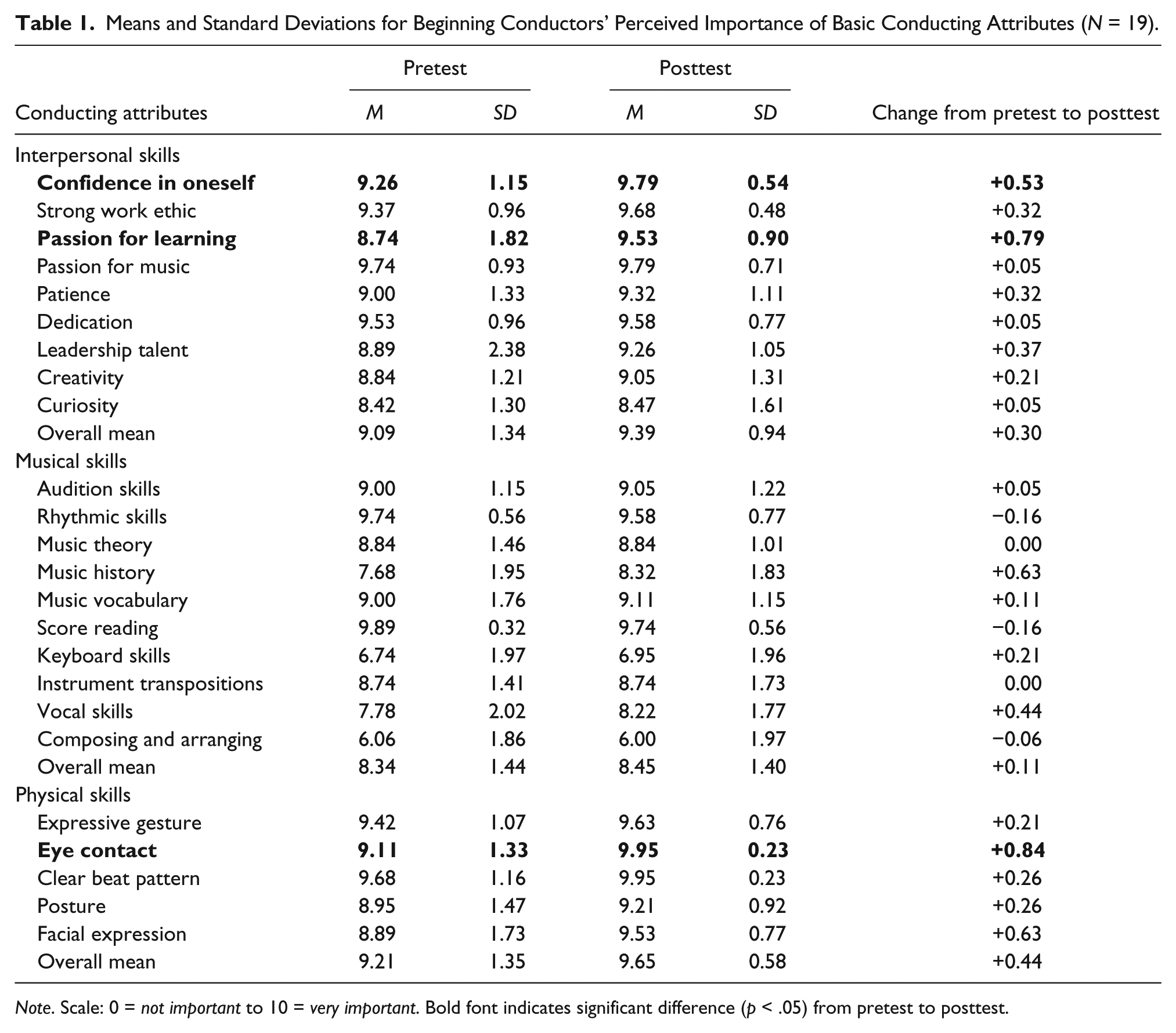
Note. Scale: 0 = not important to 10 = very important. Bold font indicates significant difference (p < .05) from pretest to posttest.
Conducting Evaluation Rubric
Both the basic conductors and expert conducting teachers used a researcher-designed rubric to rate conducting efficacy. The rubric—anchored from 1 (lowest) to 5 (highest)—was adapted from the textbook used during the basic conducting course (Labuta, 2010) and previous research involving novice conductors (Bergee, 1992; Byo & Austin, 1994). The following seven categories were evaluated by participants: (a) confidence/poise, (b) preparatory position, (c) baton grip/hand shape, (d) pattern, (e) horizontal/vertical planes, (f) release, and (g) gesture. Each rating in the rubric included a description of the level of proficiency for the designated category. For example, the description of a three rating for the execution of preparatory position read, “Good eye contact, somewhat clear establishment of beat plane, tempo and style are only somewhat appropriate, breath is not effective.”
Video Recorded Conducting Examples
Basic Conducting Videotaping Session
All conducting participants’ first, live ensemble conducting experience of the semester (held during the second week of classes) was videotaped. Each participant conducted one of the three randomly assigned music excerpts chosen from Chapter 2 of Basic Conducting Techniques (Labuta, 2010). These 1-minute music excerpts were chosen to illustrate participants’ nonverbal conducting skills, including execution of patterns in two, three, and four, preparatory beats, and release gestures. Students in the basic conducting class served as the performing ensemble. Participants’ videos were focused entirely on their upper torso and were recorded with a Kodak Zi8 video camera.
Conductor and Nonconductor Videotaping Session
Ten undergraduate music students were videotaped while conducting a 1-minute music excerpt with a university concert band, using the same equipment as in the previously described recording session. Five of these student conductors were selected randomly from all study participants enrolled in the basic conducting class (i.e., basic conductors). The remaining five participants were the nonconductors.
Each of the 10 participants received a printed score excerpt of mm. 1–16 of Kentucky 1800 by Clare Grundman, 1 week prior to the videotaping session. This piece had been identified as Grade 2 (out of 6) difficulty in the Teaching Music Through Performance in Band series (Miles, 1997). We chose this excerpt primarily because it would allow these conductors the opportunity to demonstrate simple, basic conducting skills such as preparatory gesture, pattern in 4/4 time, and release. In addition, the piece presented no technical difficulty to the musicians and had already been rehearsed and recently performed by the ensemble. We then held the previously described 1-hour training session for the nonconductors. Since the basic conductors had completed nearly one semester in the beginning conducting course, they received no further training. All conductors were instructed to prepare for the performance using whatever methods they deemed appropriate (e.g., score study, listening to recordings, practicing gestures). The recording session took place the following week during the regularly scheduled rehearsal time of the university concert band. After a brief warm-up and tuning exercise, each participant led the ensemble in the excerpt (conductor order was randomly chosen).
Procedure
Conducting Attributes Survey
During the initial class meeting, participants enrolled in the basic conducting course completed the researcher-designed questionnaire concerning their perceived importance of conductor attributes. The same questionnaire was then distributed on the last day of class after all participants had completed the basic conducting course. By using a pretest–posttest design, we hoped to determine how these students’ perceptions of conducting attributes might change after a semester of conducting study.
Basic Conductors’ Self-Evaluations
Within 1 week following the in-class videotaping session, participants completed a self-evaluation of their conducting performance using the researcher-designed conducting rubric. Video files were uploaded to a shared Internet folder from which each student could individually retrieve, download, and view his/her own video. At the conclusion of the semester-long course, participants rated the same video a second time, using the identical scoring rubric. By having participants evaluate the same video, we hoped to elucidate how ratings about their own conducting efficacy may have changed over time.
Conducting Teachers’ Video Evaluations
We presented the compiled performances of Kentucky 1800 to the expert conducting teachers (N = 9) through an Internet-based survey tool (Qualtrics, 2013). The 10, approximately 1-minute conducting videos were uploaded into iMovie 9.0.7 and randomly ordered. A 15-minute movie file (featuring 20-second title cards between each video with the words “please respond”) was created and uploaded for subsequent evaluation. All expert conducting teachers viewed and rated each of the 10 participants using the researcher-designed conducting rubric. In addition, participants were asked to indicate on their evaluation form (by checking a box) whether or not they believed the conductor had previously completed a course in basic conducting.
Results
Conducting Attributes Survey
We analyzed students’ pretest and posttest survey ratings to determine if participation in a basic conducting course influenced their perceptions of basic conducting attributes—interpersonal, musical, and physical skills related to conducting. Results indicated a significant difference for Confidence, F(1, 18) = 5.66, p < .05, partial η2 = .24 and Passion for Learning, F(1, 18) = 7.31, p < .05, partial η2 = .29. We found no significant differences for the remaining seven interpersonal skills; however, mean ratings increased from pretest to posttest for each of the nine variables. See Table 1 for a complete list of means and standard deviations for each item in the conducting attributes survey. No significant differences were found for beginning conductors’ perceived importance of the 10 musical skills. Of the five physical skills listed in the survey, a significant difference was found only in the ratings for Eye Contact, F(1, 18) = 7.95, p < .05, partial η2 = .31.
Student Evaluation of Their Own Conducting Videos
A repeated measures analysis of variance, with one within-subjects factor (pretest–posttest) was used to determine the effect of participation in a basic conducting course on participants’ self-evaluation of nonverbal skills. Results from the analysis of student self-evaluations indicated a significant difference for Executing a Release Gesture, F(1, 16) = 5.31, p < .05, partial η2 = .25. No other significant differences were found for the remaining nonverbal behaviors (Beat Pattern, Gesture, Confidence and Poise, Baton Grip and Hand Shape, Preparatory Beats, and Horizontal/Vertical Planes). Table 2 displays the means and standard deviations for each nonverbal behavior listed in the evaluation rubric.
Means and Standard Deviations for Beginning Conductors’ Self-Evaluation of Nonverbal Skills (N = 17).
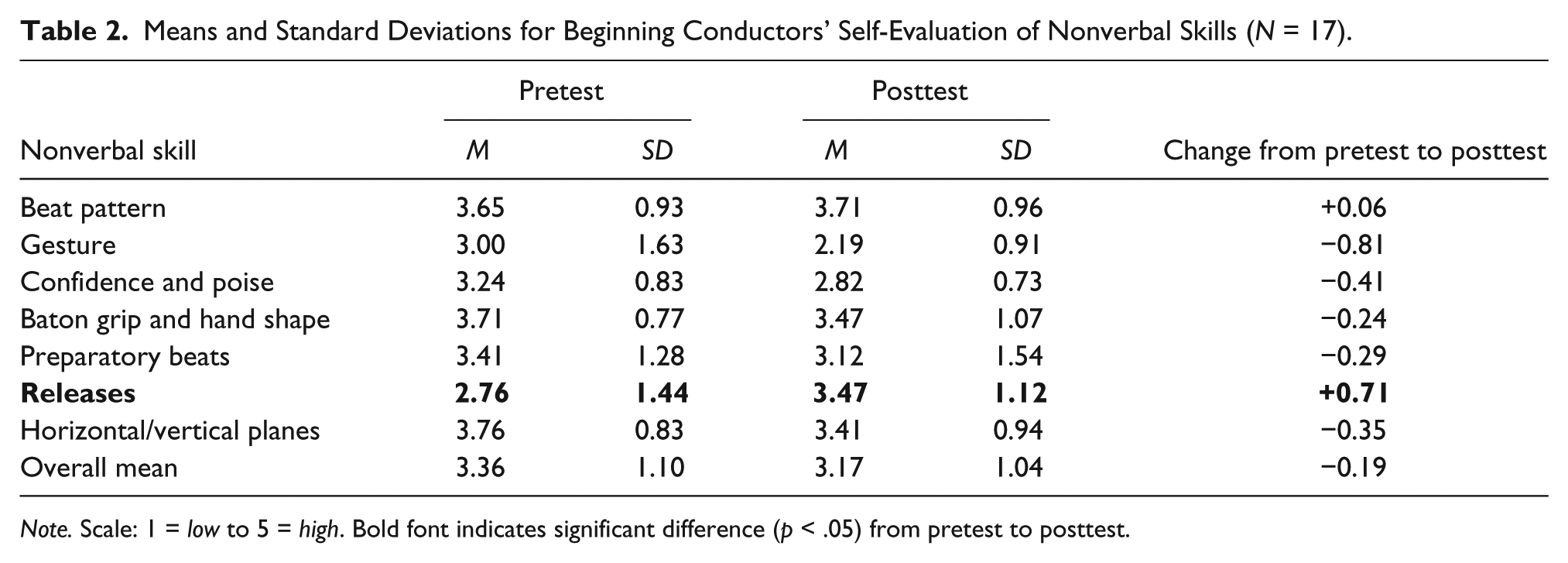
Note. Scale: 1 = low to 5 = high. Bold font indicates significant difference (p < .05) from pretest to posttest.
Conducting Teachers’ Evaluations
When rating basic conductors and nonconductors’ conducting performances, university conducting teachers (N = 9) used the same rubric that the undergraduate conducting students used for their self-evaluation. Conducting teachers were unaware of participants’ experimental assignments. A series of one-way analysis of variance tests were used to compare conducting teachers’ ratings of basic conductors’ and nonconductors’ nonverbal behaviors. An alpha level of .01 was used to attempt to control for the increased chance of Type I error that results from multiple comparisons.
No significant differences between experimental conditions were found for any of the seven nonverbal conducting behaviors. A majority of conducting teachers correctly identified four out of five basic conductors (80% accuracy) as having taken a basic conducting course; they incorrectly identified three out of five nonconductors (40% accuracy) as having taken the same course. Means and standard deviations for conducting teachers’ ratings of the seven nonverbal conducting skills are listed in Table 3.
Means and Standard Deviations for Expert Conducting Teachers’ Evaluation of Beginning Conductors’ and Nonconductors’ Nonverbal Skills.
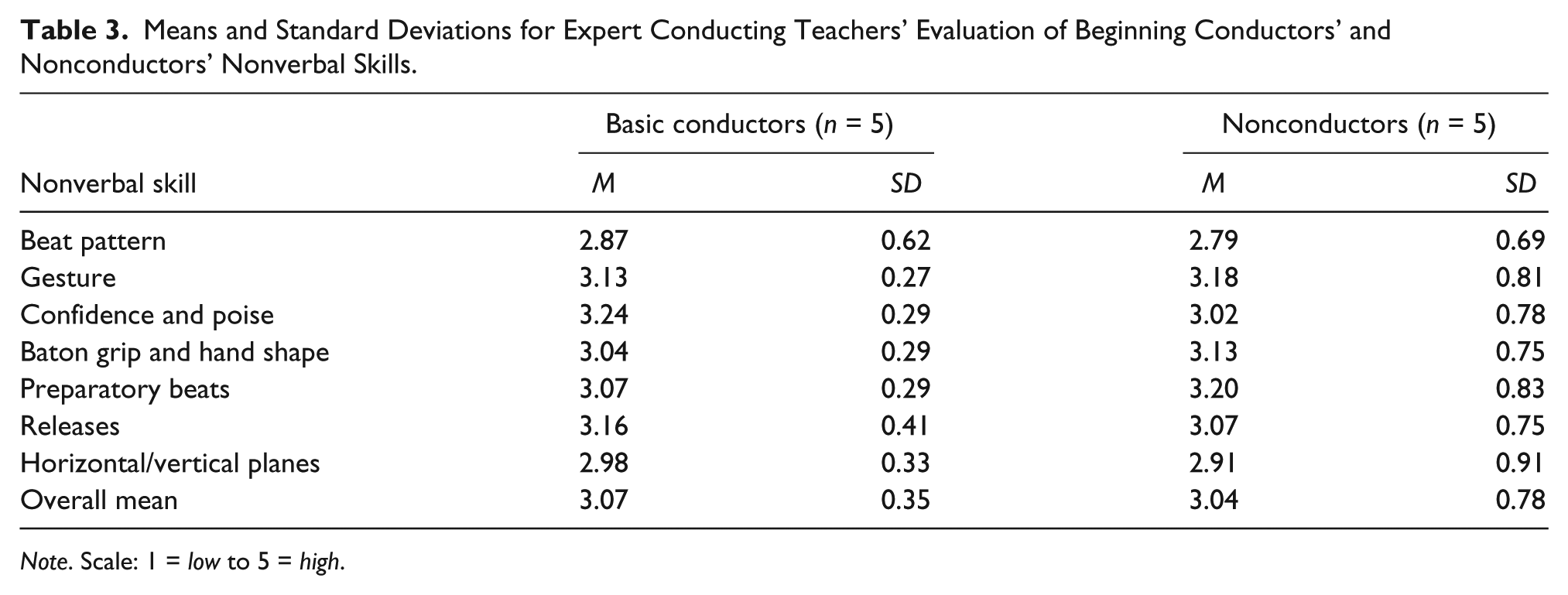
Note. Scale: 1 = low to 5 = high.
Discussion
In this study, we investigated the development of undergraduate basic conducting students’ perceptions about (a) the skills and behaviors necessary for successful conductors and (b) their self-evaluation of nonverbal conducting skills after participation in a beginning conducting course. Although significant differences in perceptions of conducting attributes were found only for Confidence, Passion for Learning, and Eye Contact, participants’ overall mean ratings increased from pretest to posttest in 23 out of 25 attributes. The simplest explanation of this finding relates to participants’ realization—through the experience of the course—that a multitude of attributes (e.g., interpersonal, musical, and physical) play a complex and important role in determining overall conducting success. Even though this awareness seems predictable, it would appear essential toward effecting change in novice conductors’ attitudes and conducting behaviors. Overall, students’ highest rated conducting attributes involved physical skills rather than interpersonal and musical skills. This result may be attributed to the fact that many beginning conducting teachers and textbooks focus more on the physical/nonverbal skills associated with successful conducting than other desired attributes (Boardman, 2000; Carlton, 2003). It is important to acknowledge that, although we modeled our survey items from these previous reports, we did not estimate the validity and reliability of these survey items so there may be embedded error in our students’ responses, thus making the results not generalizable to other settings.
Because students enrolled in the basic conducting course were given the opportunity to practice these skills in an authentic-context learning (ACL) environment (Katz & Raths, 1982), it appears that conducting a live ensemble may have increased their understanding of the complexities inherent in leading an ensemble. Similar results were found for the correlation of ACL activities on teacher effectiveness in undergraduate instrumental music student teachers (Haston & Russell, 2012; Paul et al., 2001). Conducting teachers may want to consider providing beginning conducting students with multiple opportunities to apply their skills in front of a live ensemble, but not just during class meetings. Finding and making available conducting experiences of all types (e.g., chamber music, community groups, studio ensembles) might be included as an integral part of the undergraduate conducting experience.
After evaluating their first videotaped conducting episodes a second time at the end of the semester, participants’ mean ratings in several nonverbal skill categories (Gesture, Confidence and Poise, and Preparatory Beats) declined. We speculate that students became more critical of their conducting performance after a semester of coursework that included instructor-mandated self-evaluation and self-reflection. This teaching method represents the cyclical process of reflective thinking that has been defined as action–reflection–action (Eyler, Giles, & Schmiede, 1996). The change in students’ self-evaluation of their initial performances might be largely attributed to the inclusion of reflective practice, therefore reinforcing the importance of self-reflection in improving nonverbal conducting skills (Johnson & Fredrickson, 1995; Yarbrough, 1987; Yarbrough, Wapnick, & Kelly, 1979). Although the reflective process may have affected students’ self-awareness, the written reflection assignments were not used as data sources in this study. Future researchers might investigate how different types of guided reflection (e.g., journals, video analysis, guided prompts, verbal discussions) affect the improvement of beginning conductors’ basic skills to determine the most effective methods for cultivating nonverbal conducting effectiveness.
Another component of this study was to determine if conducting teachers charged with instructing undergraduate basic conducting courses could distinguish between conducting performances of those students who had taken a basic conducting course versus those who had not. No significant differences were found between conducting teachers’ ratings of basic conductors’ and nonconductors’ nonverbal conducting behaviors. Conducting teachers rated all of the participants’ seven nonverbal conducting skills similarly (average ratings were clustered around 3.0 on a 5-point scale for each item), regardless of the participants’ experimental assignment. That evaluators with several years of basic conducting teaching experience could not distinguish between those students who received only 1 hour of intensive preparation versus an entire semester of coursework is fascinating. One explanation is that the brevity of the excerpt may have created a ceiling effect, making the ability to detect any meaningful differences between the basic and nonconductors difficult. However, this idea appears tenuous because the majority of evaluators inaccurately identified three out of the five nonconductors as having taken a basic conducting course. It may also be that nonconductor participants randomly selected in this phase of the study were similar in their basic conducting skills to those conductors who had taken the course, even considering the inequity in previous instruction that preceded the experimental intervention.
The findings of this study should not be viewed as grounds to disparage the nature of basic conducting instruction or the preparation these students received throughout the semester. The difficulty in teaching, sequencing instruction, and evaluating novice conductors’ skills has been well established (Chapman, 2008; Haldeman, 2001; Manfredo, 2008). The fact that conducting teachers had difficulty distinguishing between basic conductors and nonconductors may provide an important impetus to consider the content and sequencing of skills in basic conducting courses, and perhaps more importantly, what are the key skills that separate expert from novice conductors (e.g., expressivity, knowledge of the score, motivation, confidence, focus on the ensemble). Developing conducting courses that focus on these important concepts might better prepare preservice teachers to conduct and rehearse large ensembles.
Implications for Music Educators and Conducting Instructors
Increased and more diverse opportunities to conduct and apply knowledge of basic conducting skills may promote improved performance in beginning conductors. Conducting instructors may want to consider incorporating more ACL experiences earlier in undergraduate conductors’ coursework (e.g., lab ensembles, field work with cooperating teachers, bringing guest ensembles to campus). Making students wait until upper-level field experiences or the student teaching internship to gain meaningful conducting experiences might not offer the best opportunity to promote the transfer of conducting skills to the ensemble setting. Moreover, a guided application of these skills by university professors (who have knowledge of the undergraduate curriculum) may prove more impactful than relying on a public school cooperating teacher to emphasize these important connections. Conducting instructors could possibly consider the timing and supervision of ACL in the teacher preparation program to best facilitate novices’ ensemble conducting skills.
Public school ensemble directors might also consider allowing students to conduct (either collectively while seated at their chairs or individually in front of the group) during their ensemble rehearsals. As a component of the comprehensive musicianship approach to teaching music through ensemble performance (Labuta, 2000; Moore, 2003), younger musicians would have the opportunity to apply conducting technique to current performance literature in the ensemble setting. Learning how to conduct patterns, keep time, and shape the music through expressive gesture might enhance students’ understanding of the music that is being rehearsed.
Participants’ survey responses suggest that beginning conductors focus mostly on physical and interpersonal skills necessary for effective conducting. Although most beginning conducting textbooks do discuss the application of music skills (e.g., score study, transposition, score reading/keyboard skills) to the art of conducting and rehearsing, the majority of beginning conducting instruction appears to focus more heavily on the physical skills necessary for leading an ensemble. Beginning conducting teachers may want to consider incorporating more course activities that encourage students to think critically about the application of fundamental music skills (e.g., music theory, music history) to conducting. While this likely will remain an objective in subsequent conducting and rehearsal technique courses, integrating these musical concepts earlier on in the conducting curriculum would afford students more opportunities to apply theoretical and historical knowledge to their conducting practice. Furthermore, because music theory and history skills are important components of K–12 students’ comprehensive music education (Consortium of National Arts Education Associations, 1994), making preservice students synthesize these skills during their undergraduate preparation will hopefully lead them to transfer these concepts into their own rehearsal halls once they enter the field.
We acknowledge several limitations when considering the findings from this study. Our investigation was a one-group design that focused on one small class of beginning conductors, at one large Midwestern university, with one instructor; therefore, causation may be called into question and broad generalizations should not be made. Also, because multiple statistical comparisons were made in this study, it is possible that our results may contain false positives, further inhibiting our ability to generalize these results. Furthermore, we did not ascertain the frequency or duration of our participants’ conducting practice throughout the semester—data that might have proven helpful in describing the ratings of certain conducting attributes. Future investigators might consider replicating this study with other basic conducting classes to gain an increased understanding of the impact that a basic conducting course has on students’ performance, self-evaluation, and perceptions of important conducting attributes. Similarly, comparing the effects of differing conducting pedagogies (e.g., philosophy, skill focus, class activities, ACL experiences) may illuminate the most effective methods for teaching a basic conducting class. The desire to improve novice conductors’ experiences during the basic conducting course, and their subsequent ability to successfully conduct and rehearse ensembles once they become inservice teachers, will hopefully lead to continued examination of these important topics.
Footnotes
Declaration of Conflicting Interests
The author(s) declared no potential conflicts of interest with respect to the research, authorship, and/or publication of this article.
Funding
The author(s) received no financial support for the research, authorship, and/or publication of this article.