




Abstract
Classroom management is a common concern for teachers. Music teachers in particular experience unique behavior challenges because of large class sizes, uncommon pacing requirements, and performance-based outcomes. Positive behavior support is an evidence-based framework for preventing or eliminating challenging behaviors by teaching and reinforcing appropriate social skills. Class-Wide Function-Related Intervention Teams (CW-FIT), a specific positive behavior support intervention involving social skills instruction, positive reinforcement, and group contingencies, has proven effective in elementary schools but has not been evaluated specifically in music classrooms. The present study sought to investigate the effectiveness of CW-FIT in increasing on-task behavior and teacher praise-to-reprimand ratios in a sixth-grade music classroom. A single-subject reversal (ABAB) design was used. Results indicated that student on-task behavior increased when CW-FIT was implemented. Teacher praise-to-reprimand ratios also improved. Results suggest the teacher and the students found CW-FIT valuable and enjoyable. Study limitations and implications are addressed.
Keywords
Classroom management is a significant and common concern of school teachers and consists of three core components: (a) maximized allocation of time for instruction, (b) arrangement of instructional activities to promote student engagement and achievement, and (c) proactive behavior management strategies (Sugai & Horner, 2002). Many have reported feeling underprepared in effective classroom management practices; lack of these skills has been cited as a reason teachers leave the profession (McIntosh, Brown, & Borgmeier, 2008). Teachers’ most frequent requests for help have involved their struggles with student behavior and classroom management problems (Rose & Gallup, 2005). This is not surprising, as general education students can exhibit problem behavior as extreme and disruptive as that of students with emotional disorders (Landrum & Tankersley, 1999; Liaupsin, Jolivette, & Scott, 2004).
Time spent managing misbehavior has been found to reduce teaching time and learning engagement, affecting all students in the classroom (Griffiths, Sharkey, & Furlong, 2009; Mitchem, Young, West, & Benyo, 2001). Persistent misbehavior of only a few students can create a negative environment that impedes student learning (Epstein, Atkins, Cullinan, Kutash, & Weaver, 2008). Problem behavior paired with educational disengagement has been found to significantly affect referral to special education and school dropout (Jimerson, Reschly, & Hess, 2008). These challenges may be especially daunting if teachers have little or no expertise in managing students’ problem behavior. Many schools have limited resources to intervene with classroom behavioral difficulties; thus many general education teachers may not have the support they need for effective classroom management (Adelman & Taylor, 2005). Music educators can also struggle with classroom behavior problems (Nutter, 2000). To address this issue, we explored whether the difficulties specific to elementary music classrooms could be decreased through a particular research-based classroom management system.
Behavior Management in Music Education Classrooms
Music teachers have indicated that some of their greatest stressors result from student apathy and lack of motivation (Gordon, 2002). Music teachers experience different challenges from core subject teachers due to larger classes, different pacing requirements, and constant on-task focus demands. Larger classes have greater potential for misbehavior. Student outcomes in music classrooms are often collectivistic (i.e., the success of one student affects the overall music performance of the class). The public nature of classroom outcomes (e.g., concerts, festivals) can create additional stress for music teachers (Gordon, 2001), and that stress may become a self-fulfilling prophecy. Costello (2005) found a positive correlation between choral ensemble teachers’ perceptions of their classroom management abilities and their performance ratings in music festivals. Teachers who felt they had stronger management abilities scored better in performances. Discouraged music teachers were generally dissatisfied with their training as teacher candidates and their professional development related to classroom management (Costello, 2005).
Brigham, Brigham, and Renfro (1994) provided several recommendations for effective music classroom management. First, acceptable classroom behavior should be related to the outcome of the class; therefore, students in a music class should be expected to behave in ways that lead to the production of music. Second, effective music teachers should prepare a curriculum that is relevant and engaging. Third, teacher enthusiasm is important in motivating students to learn. Fourth, social skills instruction that involves modeling, description, prompting, and reinforcement can also be effective. Finally, individual and group contingencies can be helpful.
Kassner (1996) similarly suggested that music teachers can increase on-task behavior by having students work as groups to earn reinforcers. Both elementary and secondary students respond well to such cooperative learning strategies. Attention signals can also contribute constructively to classroom management, especially if teachers use them with positive reinforcement. Such positive approaches to classroom management are considered best practice, but unfortunately reactive (punishing) approaches are often used in dealing with students with challenging behaviors (Benedict, Horner, & Squires, 2007).
Positive Behavior Support
One way music educators can incorporate effective behavior management strategies is by using positive behavior support (PBS) in their classrooms. PBS is an evidence-based framework for preventing or eliminating challenging behaviors by teaching and reinforcing appropriate social skills (Cohn, 2001). The core components of PBS are (a) fostering students’ positive relationships and interactions with peers and adults, (b) defining and teaching clear behavioral expectations during instruction time, and (c) providing students feedback on their use of appropriate social skills throughout the school day (Benedict et al., 2007).
Music classrooms can be an ideal place to teach social skills because they are often interactive and sometimes emotive; students work with partners, share instruments, and imitate rhythms of others (Jacobi, 2012). Many social skills are foundational for successful music performance. Both planned and spontaneous learning opportunities are important in teaching desired social skills. Jacobi recommended incorporating two to three social skills into games and songs already designed to achieve music goals. The teacher should model these social skills and point them out when they occur in the classroom. Teaching social skills may be particularly effective when connected to a classroom reinforcement system (Young, Caldarella, Richardson, & Young, 2012).
Caldarella, Christensen, Young, and Densley (2011) noted that praise is a critical part of PBS. As teachers use frequent, contingent, and specific praise, student behavior can improve. Praise has been recommended as a way to encourage students and contribute to improved teacher–student relationships (Gable, Hester, Rock, & Hughes, 2009). A teacher can tailor praise to one of four purposes: (a) to show recognition, (b) to encourage, (c) to describe what is occurring, or (d) to evaluate performance. Bartholomew (1993) found that effective music teachers used specific praise and avoided using absolutes such as always or never when providing feedback. Dunn (1997) showed that teachers’ verbal and facial feedback, including praise, resulted in more positive student attitudes and higher music performance ratings. Despite research that has supported praise as an effective means of improving behavior, Yarbrough and Price (1989) reported that experienced music teachers tended to deliver disapproving comments more often (and more specifically) than they delivered praise. This suggests that further training on ways to incorporate praise would be helpful.
The use of group contingencies, another PBS strategy for managing student behavior, involves placing students in groups that cooperate to behave appropriately and earn points to exchange for a group reward (Kerr & Nelson, 2006). Group contingencies can generate positive peer influence to help students avoid their challenging behaviors as well as motivate appropriate behavior (Ling, Hawkins, & Weber, 2011). Group contingencies have been found to reduce disruptive classroom behaviors and improve classroom learning environments (Ling & Barnett, 2013; Wright & McCurdy, 2012).
Unfortunately, many teachers struggle with consistently implementing PBS in their classrooms despite the established efficacy of such practices. Reinke, Herman, and Stormont (2013) investigated elementary teachers’ use of PBS classroom behavior management strategies and found that while most teachers had posted positively stated classroom rules, their use of frequent praise and avoidance of reprimands were much less common. An approach focused on improving PBS implementation in elementary school classrooms is known as Class-Wide Function-Related Intervention Teams (CW-FIT; Wills et al., 2010).
Class-Wide Function-Related Intervention Teams
CW-FIT is a classroom management strategy that incorporates social skills instruction, group contingencies, praise, points, and group rewards (Wills et al., 2010). Teachers choose social skills or specific rules to implement in the classroom and explicitly teach them to the students through repetition, role-plays, and discussions. Three common social skills are taught and posted in the classroom: “Follow directions the first time,” “Get the teacher’s attention correctly,” and “Ignore inappropriate behavior.” Teachers can choose other specific target behaviors to teach based on classroom needs.
The class is organized into groups or teams, according to teacher preference. During regular classroom instruction, the teacher praises and awards points to groups of students who are exhibiting the social skills and participating appropriately in class lessons. At the end of the lesson, the groups that have exceeded a predetermined point goal receive a reward that is simple, feasible for the teacher, and reinforcing for the students. It can be tangible (e.g., stickers, positive notes) or nontangible (e.g., simple games, dance time) and should not take very long. A second tier of CW-FIT, which includes the use of self-management charts and help cards, can be implemented on individual students with behavior struggles. A third tier, using a functional assessment for students who still do not respond favorably to the second tier intervention, can also be adopted. Neither Tier 2 nor Tier 3 interventions were used in the present study.
Previous studies of CW-FIT in elementary school classrooms have shown that it leads to greater student engagement, more teacher praise/fewer teacher reprimands, and fewer disruptions. Kamps et al. (2011) investigated CW-FIT in six elementary classrooms (kindergarten through fifth grade) across three different schools. On-task behavior significantly increased and disruptive behavior significantly decreased following implementation. Teacher praise rates increased, while reprimand rates decreased. Caldarella, Williams, Hansen, and Wills (2015) implemented CW-FIT in five kindergarten through second-grade classrooms. Results were similar to the study of Kamps et al. (2011); praise-to-reprimand ratios and student on-task behavior significantly increased, while student disruptive behaviors significantly decreased. Similar results were found in a large 4-year study by Kamps et al. (2015) in which CW-FIT was implemented across 86 elementary school classrooms. Additionally, teachers and students have found CW-FIT to be socially valid (Caldarella et al., 2015; Kamps et al., 2015). However, to date, no CW-FIT studies have been conducted in music classrooms.
Study Purpose
Favorable results in elementary schools suggest that CW-FIT may be helpful in elementary music classrooms. The purpose of the current study was to investigate the effects of CW-FIT implemented in such a classroom by addressing four specific research questions:
Method
Setting and Participants
This study took place in a Title I elementary school in Utah with a total student population of 518: 54.83% male, 45.17% female; 54.60% Hispanic, 35.30% Caucasian, and 10.10% other ethnicities. Approximately 87% of the students were considered economically disadvantaged. Participants were 22 sixth-grade students and a female teacher in one music class. The music teacher was Caucasian, in her late 30s, with 14 years of teaching experience. She had a master’s degree, a music certification, and a gifted and talented certification. The class of sixth-grade students included 11 boys and 11 girls (72.73% Hispanic, 22.73% Caucasian, and 4.54% Asian). The classroom teacher employed the Kodály approach to teaching (Mason, 2012). The music class, which lasted 60 minutes, was held once a week on Wednesday afternoons.
Prior to the implementation of CW-FIT (during baseline), the teacher reported using praise, a motivation system, and consequences such as alternative assignments. Her posted classroom rules included “Follow Directions Quickly,” “Raise Your Hand,” “Be Kind,” and “Make Smart Choices.” The rules were taught through repetition and reviewed throughout the school year. Specific rules were reviewed as problems arose.
Design and Analysis
A single-subject, reversal (ABAB, i.e., baseline and treatment stages are alternated) design was chosen to evaluate the impact of CW-FIT in the music classroom, as it is the most straightforward and powerful within-subject design for demonstrating functional relationships between environmental changes and corresponding changes in behavior (Cooper, Heron, & Heward, 2007). The first baseline phase (A) consisted of seven observation sessions from October through December, followed by CW-FIT implementation (B) over four sessions in January and February, followed by removal of the intervention (A) for three sessions in March, and finally reintroduction of CW-FIT (B) for the last five observations in April and May. After baseline, phase changes occurred when a stable trend in classroom behavior change was evident, as typical in ABAB designs (see Cooper et al., 2007). Descriptive statistics (means, standard deviations) were calculated across baseline/reversal phases compared to CW-FIT intervention phases to compare the impact of the intervention across phases.
Intervention Procedures
School district approval and institutional review board clearance were first obtained for the research protocol. The teacher completed a consent form following a school recruitment meeting. Consent forms were sent to parents of all students in the classroom. All research staff were trained in ethical and responsible research conduct via the university’s institutional review board office and were supervised by the first and second authors.
The intervention was the implementation of CW-FIT. The teacher attended a 1-hour training session conducted by the researchers, which included an explanation of the rationale behind CW-FIT, video clips of instructors using the intervention, and opportunities to practice. During training, the teacher was advised that students who continued to misbehave during CW-FIT, and thus “ruin it” for their team, could be placed on their own team for a few class periods to understand the impact of their behavior. As part of training, research staff also supported the teacher as she began implementing CW-FIT in the classroom by answering her questions as they arose and offering feedback to her.
When first implementing the intervention, the teacher introduced one social skill per class period. Along with the three CW-FIT skills mentioned previously, the teacher chose to add “classroom participation” and “playing instruments.” The social skills were introduced by explicitly defining the steps in the behavior, discussing the importance of the skill, and role-playing the expected behavior. After the skills were introduced, the teacher briefly reviewed them with the students at the beginning of each class. Social skills posters were displayed in the room where the teacher and students could reference them as needed.
Students were grouped into six teams based on their classroom seating arrangement, as done in other CW-FIT studies. During instruction, a timer beeped approximately every 3 to 5 minutes; at each beep the teacher praised and awarded points to those teams that were following the expected social skills. At the end of the class period points were tallied and the teams that had reached a predetermined goal received the group reward (typically short video clips from the Internet, treats, and games).
Measures
Student group on-task behavior as well as teacher praise and reprimand rates were measured during 20-minute observation sessions via paper-and-pencil methods. The groups’ on-task behavior (defined as working appropriately on an assigned or approved activity) was recorded using a time sampling procedure during which an observer scanned each student group every 30 seconds. If the entire group was on task, one observer recorded a plus for that group; if any group member was off-task, the observer recorded a minus. To calculate scores, the number of pluses was totaled for each group and divided by the total number of observed increments. Group scores were combined and converted into a percentage of on-task behavior for the whole class. Teacher praise (verbal statements indicating approval of behavior rather than just acknowledging a correct response) and reprimands (verbal statements commenting negatively about behavior) were also recorded on the top portion of the group on-task observation sheet, using a frequency count, and summed.
To ensure consistency of observations, interobserver agreement was collected for 47.37% of the classroom observation sessions during which a second observer was present and recorded data simultaneously with the primary observer. Reliability (percentage of agreement between the two observers) for group on-task behaviors and teacher treatment fidelity was calculated by dividing the number of agreements by the total number of agreements plus disagreements. The average interobserver agreement was 95.19% for group on-task behaviors.
A 17-item treatment fidelity form was completed during each observation period evaluating the fidelity of CW-FIT implementation (e.g., reviewing social skills at beginning of lesson, posting daily point goal, awarding points and praise) and scored dichotomously as “yes” or “no.” Those items scored “yes” were also given a quality rating from 1 (low) to 3 (high). For the purpose of this study, fidelity was defined as a minimum of 80% “yes” scores on the treatment fidelity form, as levels of 80% or higher are considered acceptable (Kamps et al., 2011). The average interobserver agreement was 100% for treatment fidelity observations of CW-FIT implementation and 97.74% for the quality ratings, suggesting high reliability of the observations.
Social validity was assessed with the teacher and 90.91% of the students at the end of the study using a questionnaire. The teacher form included questions about the acceptability of the procedural components, ease of implementation, feasibility of self-management, and perceptions of effectiveness. The student social validity questionnaire included three open-ended questions and two yes/no questions, assessing what they liked or did not like about CW-FIT and whether they would recommend it to peers.
Results
Treatment Fidelity
Fidelity on the CW-FIT procedures in the music classroom averaged 89.80%; intervention fidelity levels of 80% or higher are considered acceptable (Kamps et al., 2011). Occasionally the teacher missed reviewing the social skills at the beginning of class, tallying points at the end of the class, or referencing the skills when reprimanding. The teacher posted the social skills, posted the daily goal, and used specific praise. When the timer sounded, the teacher praised students for use of skills and awarded points accordingly. Toward the end of the year, students still earned points but were not praised as often.
Impact on Teacher and Student Behavior
During baseline, the teacher’s praise-to-reprimand ratio in the classroom was 1.65. After intervention, the praise-to-reprimand ratio increased significantly to 4.50. During reversal, the ratio dropped to 3.50 praise-to-reprimand statements. When CW-FIT was reintroduced, the ratio dropped to 2.15.
The class group on-task behavior during baseline averaged 51.70% (37.50%–71.00%). During the CW-FIT intervention, the class average increased to 83.07% on task (80.18%–87.50%). The class average decreased to 64.52% (56.67%–68.47%) when CW-FIT was removed, but it increased to 79.20% (59.17%–87.50%) when the intervention was reintroduced. See Figure 1 for group on-task percentages per session.
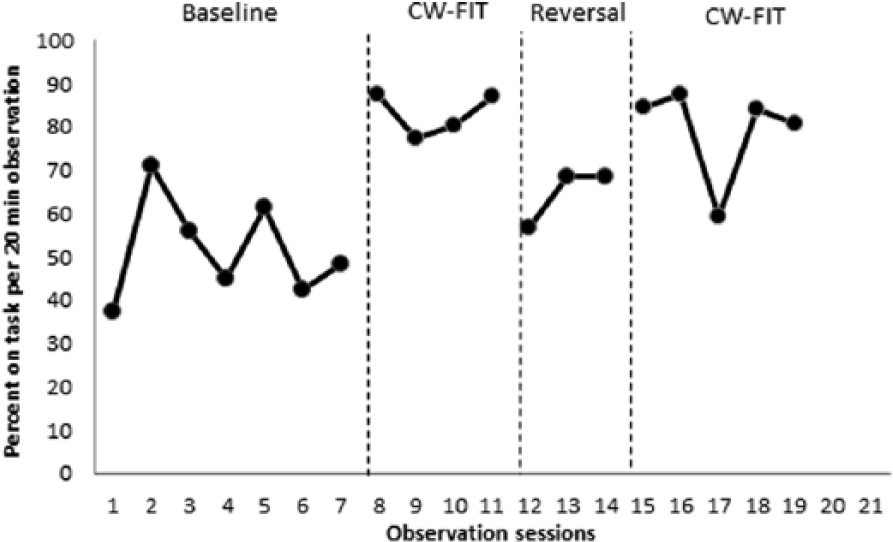
Classroom group on-task behavior across phases.
Social Validity
Results of the social validity survey indicated that the music teacher was very satisfied with CW-FIT. She reported that the program was easy to learn and implement in the classroom. She noted that the use of teams and points was helpful in improving students’ behaviors. She also reported that students were more focused and engaged when CW-FIT was implemented.
Results also showed that 90.00% of the class reported liking CW-FIT. In fact, 100% of the class thought other students should get to use CW-FIT in their classrooms. The majority of students reported liking the rewards and appreciating that CW-FIT helped the class be quiet, stay focused, and act better. While one student reported not liking some aspects of CW-FIT (i.e., the class goals and points), that student still responded that other students should get to use CW-FIT “because it could be easier for teachers and more fun for students because of the award.” While 80.00% of the students did not see anything wrong with CW-FIT, some reported they did not like the beeping of the timer or having a team member prevent the team from earning a point.
Discussion
The purpose of the present study was to examine the effectiveness of CW-FIT, a PBS classroom management strategy involving the use of social skills instruction, group contingencies, positive reinforcement, and praise, in an elementary school music classroom. Previous studies have shown that the use of CW-FIT in elementary school classrooms has led to increased student on-task behavior and higher teacher praise-to-reprimand ratios (Caldarella et al., 2015; Kamps et al., 2011; Wills et al., 2010), though this has not been previously studied in music classrooms. The results discussed below are specific to the one classroom studied but provide value as the first study of CW-FIT in a music classroom.
Results indicated that the music teacher was able to implement CW-FIT with high fidelity and quality. This high fidelity is consistent with prior CW-FIT studies in other elementary schools (Caldarella et al., 2015; Kamps et al., 2015). Implementation of CW-FIT has generally resulted in increased ratios of teacher praise to reprimand, an important contribution since teacher praise has been shown to lead to improved performance and student attitudes (Dunn, 1997). CW-FIT can improve music classroom management, since praise can lead to better teacher–student relationships and increased student engagement (Gable et al., 2009). It was surprising in the present study that the praise-to-reprimand ratio was somewhat lower after CW-FIT was reintroduced. The reasons for this lower ratio were unclear; it conflicts with results of past CW-FIT studies. It may be that the teacher found the more frequent use of praise less necessary as student behavior improved as a result of learning and using the social skills and working for group points and rewards.
Implementation of CW-FIT also increased levels of student group on-task classroom behavior. On-task behavior percentages were relatively low during baseline. Once CW-FIT was introduced, on-task behavior increased over 30% above the baseline rate. During the reversal phase, on-task rates dropped, although not to as low as baseline levels. With the reintroduction of CW-FIT, levels increased once again. These results are consistent with those of previous CW-FIT studies (Caldarella et al., 2015; Kamps et al., 2015). Increasing student on-task behavior is vital, as disruptive behavior can lead to less instruction time (Mitchem et al., 2001).
Social validity results suggested that both the music teacher and her students viewed CW-FIT favorably. The teacher commented that sixth grade is a challenging year for students in terms of their social development. She had taught music to students who throughout their elementary years had actively participated in class but in sixth grade had become more reserved. She felt that when she added the Classroom Participation skill poster, the students attempted to participate like they had in previous years. The teacher reported, “Those signs really provide a forum to discuss specific behaviors in a positive manner,” suggesting her increased confidence in behavior management. This was similar to results of Hedden (2015), who found that music teachers’ confidence can be increased through direct training on effective classroom management practices.
Limitations and Implications
Some limitations to the present study need to be considered. This study was limited to one music classroom comprising 1 teacher and 22 students. Future studies could benefit from including more participants and different age groups, possibly employing a group research design. The somewhat lower teacher praise-to-reprimand ratio when CW-FIT was reintroduced (following reversal) was a limitation. Future studies could investigate whether this effect would be found again in other music classrooms. We also did not measure the effect of this classroom management program on the quality or degree of learning in the music classroom as others have suggested (Hedden, 2015), though this is an area that warrants further exploration.
In the present study, CW-FIT was shown to be effective in increasing on-task behavior and decreasing disruptive behavior of elementary school music students. The core components of CW-FIT (social skill instruction, praise, and group contingencies) fit well with recommendations in the literature about effective classroom management during music instruction (Brigham et al., 1994; Kassner, 1996). Since group contingencies can help students become more aware of how their behavior affects others (Poduska et al., 2007), interventions such as CW-FIT can help music students in their peer relationships and social skills development.
Classroom management is a learned behavior (Hedden, 2015) that needs to be taught and practiced as part of preservice and in-service music teacher training. This study suggests that teacher behavior can be positively influenced with the implementation of CW-FIT; music teachers can be trained to teach social skills, implement a group contingency, award points, and increase praise—all of which in turn lead to increased student on-task behavior. Although replications are needed to confirm effectiveness of the program, this study suggests promising results for the implementation of CW-FIT in other elementary school music classrooms.
Footnotes
Authors’ Note
The opinions presented in this article are those of the authors, and no endorsement by the agency is intended or implied.
Declaration of Conflicting Interests
The author(s) declared no potential conflicts of interest with respect to the research, authorship, and/or publication of this article.
Funding
The author(s) disclosed receipt of the following financial support for the research, authorship, and/or publication of this article: The research reported in this article was supported in part by a grant from the Institute of Education Sciences and the U.S. Department of Education (R324A120344) awarded to the University of Kansas.