



Abstract
We analyzed the article types, participants, and topics represented in Update articles published between 1989 and 2017 (N = 379), beginning when MENC (now NAfME) took over publication of the journal. Quantitative research articles (46.42%) and literature reviews (28.84%) accounted for the largest portion of articles published. The percentage of qualitative research articles published has increased over time, while the percentage of historical articles and essays has decreased. Journal authors investigated a large variety of topics (N = 68), with teaching methods and techniques (7.14%) and teaching students with exceptionalities (4.51%) representing the most frequent article topics. Authors most frequently recruited public school personnel, special populations, and college/university students as participants. These data provide insights into the article types, participants, and topics of interest in research designed to inform in-service music teachers, provide guidance for authors seeking publication venues, and help students and researchers know where to find various types of articles and topics.
The journal Update: Applications of Research in Music Education has a mission that is unique among peer-reviewed music education research journals in the United States, namely, to bring “research in music teaching and learning close to everyday practice to help teachers apply research in their music classrooms and rehearsal halls,” and to do this “without research terminology or jargon” (NAfME, n.d.-a). Unlike other research journals in the field, Update’s editorial board includes positions that are allocated for “clinicians,” with those positions equal in number to positions designated for researchers. The journal also is distinguished from other U.S. research journals by specifying the publication of “reviews of the literature” as part of its Aims and Scope (NAfME, n.d.-a). Update has been described as having a “significant impact on the music education profession” based on an analysis of citations appearing in references lists of articles published in six national U.S. journals (Hamann & Lucas, 1998, pp. 408–409). Although content analyses of other music education research journals have been completed and published since the mid-1980s, there has been no comprehensive content analysis of Update. Based on the factors noted previously, which demonstrate the journal’s uniqueness and importance, we believed that a content analysis of Update may illuminate various characteristics of the journal, as well as identify trends over time in research related to music teaching practices.
The systematic approach to understanding music education research in the United States via journal content analyses dates back to Yarbrough’s 1984 content analysis of the Journal of Research in Music Education (JRME). Yarbrough published updates to that article in 1996 and again in 2002, encompassing the contents of the first 50 years of the journal (Yarbrough, 1996, 2002). The primary data reported in those two analyses included the percentage of articles based on dissertations and theses, research methodologies employed, topics studied, and research participants investigated. Authors have undertaken analyses of other aspects of JRME contents as well, including characteristics of the research subject samples (Draves, Cruse, Mills, & Sweet, 2008; Ebie, 2002; Kratus, 1992), analysis of the qualitative articles published including methods and foundational sources used (Joubert, 2017; Lane, 2011), investigation of the theoretical frameworks and academic fields of knowledge represented (Miksza & Johnson, 2012), and analysis of the methodologies represented by articles accepted or not accepted for publication in the journal (Sims, Lordo, & Phelps, 2016). The findings on the methodologies used by JRME authors have consistently indicated that the percentage of quantitative research has greatly exceeded that of qualitative research, although the gap has been closing over the years, and that historical and philosophical articles have made up a small percentage of the JRME research articles, a percentage diminishing over time. The analyses of characteristics of research participants have demonstrated that college-level students have remained the most frequently studied group throughout all time periods investigated.
The Journal of Music Teacher Education is also a NAfME research publication for which there are published content analyses. Similar to the studies of JRME articles, authors of these studies investigated the methodologies and topics of the articles published (Killian, 2016; Killian, Liu, & Reid, 2013; Nichols, 2013). Although the JRME publishes only quantitative, qualitative, historical, and philosophical research articles, the JMTE publishes a wider variety of manuscripts such as interest articles and book reviews, so article type was a variable of interest to the JMTE content analysis authors. The authors used different categorization systems related to types of articles, thus conclusions about these categories are difficult to represent. However, in all three articles about the JMTE, the authors reported that quantitative research reports considerably outnumbered qualitative research reports. All were also in agreement that the most frequent topics of the articles published were related to teacher education curriculum and techniques, which is not surprising, given the focus of the journal.
Because Update is the only NAfME research publication that has yet to be studied systematically, we believed that a content analysis of this journal may provide a more complete view of the body of research published by this major professional organization. Thus, the purpose of the present study was to conduct a 29-year content analysis of all published articles in Update from the time the journal became an official publication of MENC (now NAfME). 1 Given that Update authors are focused on helping practitioners understand and apply research findings in their classrooms, an analysis of the contents of this journal should provide insights into the types of research and topics that have been undertaken with in-service teachers in mind. This knowledge could be useful to researchers, and to teachers and/or students in undergraduate and graduate courses who search for articles representing certain methodologies, topics, or participants. These data also could help authors understand what is likely to be published in Update, so they can decide if a potential submission is appropriate. The identification of trends over time, and comparison of those with extant content analyses of other music education journals, may allow gaps in areas of research to be identified, and help provide insights into any changing interests in the profession.
We designed this study using categories for analysis that would permit us to draw comparisons with the findings of content analyses that have been completed for the other two NAfME research journals. Thus, the following research questions guided our investigation:
Method
We began our analysis with the first Update issue that was available for subscription under the auspices of MENC, the 1989 Fall-Winter issue, to facilitate comparisons with the content analyses of other MENC/NAfME research journals. We concluded with the most current issue at the time we began our analysis, November 2017. Similar to other authors’ decisions concerning recent content analyses in music education journals (Killian et al., 2013; Nichols, 2013), we chose to analyze only peer-reviewed manuscripts that were found in the journal. Thus, nonrefereed journal contents were excluded from our analysis, such as comments from the editor, instructions to contributors, and announcements. From 1989 (Volume 8, Issue 1) through 2017 (Volume 36, Issue 1), we identified 379 articles that met our criteria. 2 From 1989 to 2015 (Volumes 7–34), two issues were published in each volume, with an average of 6.47 articles and 49.65 pages per issue. Starting with Volume 35, each issue had 8 articles with 67.50 pages per issue.
To answer the research questions, we gathered data related to each article’s type, participants, and topic(s). To code by type, we began with a list of categories and subcategories that had been used in content analyses of other music education journals (Killian et al., 2013; Lane, 2011; Nichols, 2013; Sims et al., 2016; Yarbrough, 1984). Literature reviews, essays, and annotated bibliographies were each considered article types, in addition to the more traditional research types such as qualitative, quantitative, and historical. We categorized an article according to how it was identified by the author, but if that was not stated explicitly, we determined the category based on the description in the article. We operationally defined an essay as an article in which the author used selected research to meet stated objectives or support specific arguments. Examples from earlier volumes included writings about music savants, the nature of collaboration in music education, and curricular reform in choral music education. We defined a literature review as an article that provided a systematic analysis of the body of literature related to a defined topic.
To determine the characteristics of the participants in those studies that reported findings of either quantitative or qualitative research, we searched the abstract and/or Method section of each article. We again started from an a priori list of categories based on those used in the content analysis literature (Draves et al., 2008; Ebie, 2002; Kratus, 1992) and adjusted this list as necessary to accurately represent participant characteristics. This procedure resulted in data reflecting participants’ age/school level, music teaching level and content area, members of the public who were not affiliated with schools or colleges, special populations such as gender-specific or students at risk, and miscellaneous media such as concert programs when they served as the unit of analysis. If a study employed more than one participant group, each applicable category was coded and counted.
We generated a list of potential article topics initially from prior research (Yarbrough, 1984), the most extensive list available in the literature reviewed, and we added that to the list as necessary. We used the title, keywords, abstract, and/or article to determine the topic. The dependent variable(s) and/or data used for analysis were especially helpful in guiding the topic decision. Articles could be assigned up to three topic codes if they aligned clearly with multiple categories. After all articles had been coded, we worked to shorten the list of 80 initial topic codes by combining categories to the extent possible, especially to eliminate as many one-entry categories as we could, to shorten the list for ease of interpretation (e.g., musician health as a topic of 7 articles and vocal health as a topic of 1 article are listed in one category: musician health/vocal health with a count of 8). We made decisions to combine topics by considering reasonable and logical possibilities, and then referring back using the abstracts and if necessary, the articles, to determine whether combining the topics represented the articles appropriately. We did our best to adequately and reliably represent the article topics. This resulted in a final list with a total of 68 topics.
We began by coding each article based on the title and abstract, but where those did not provide sufficient information, we read the applicable parts of the full articles. The team coded article type, participants, and topic simultaneously when viewing each article. To establish reliability of our coding system, the primary author randomly selected 20% (n = 76) of the articles that appeared in the journal and distributed those to the three other authors. All four authors independently examined those articles to determine the codes for each. We then met and discussed our initial coding and resolved any discrepancies until consensus was reached and we were confident with our coding process (Denzin & Lincoln, 2005). We divided the remaining 303 articles randomly among the four authors. As we coded these articles, we noted any articles for which we had questions or concerns about correct identification in any of the categories. We met again as a group to discuss these, and determined our final codes by consensus.
Results
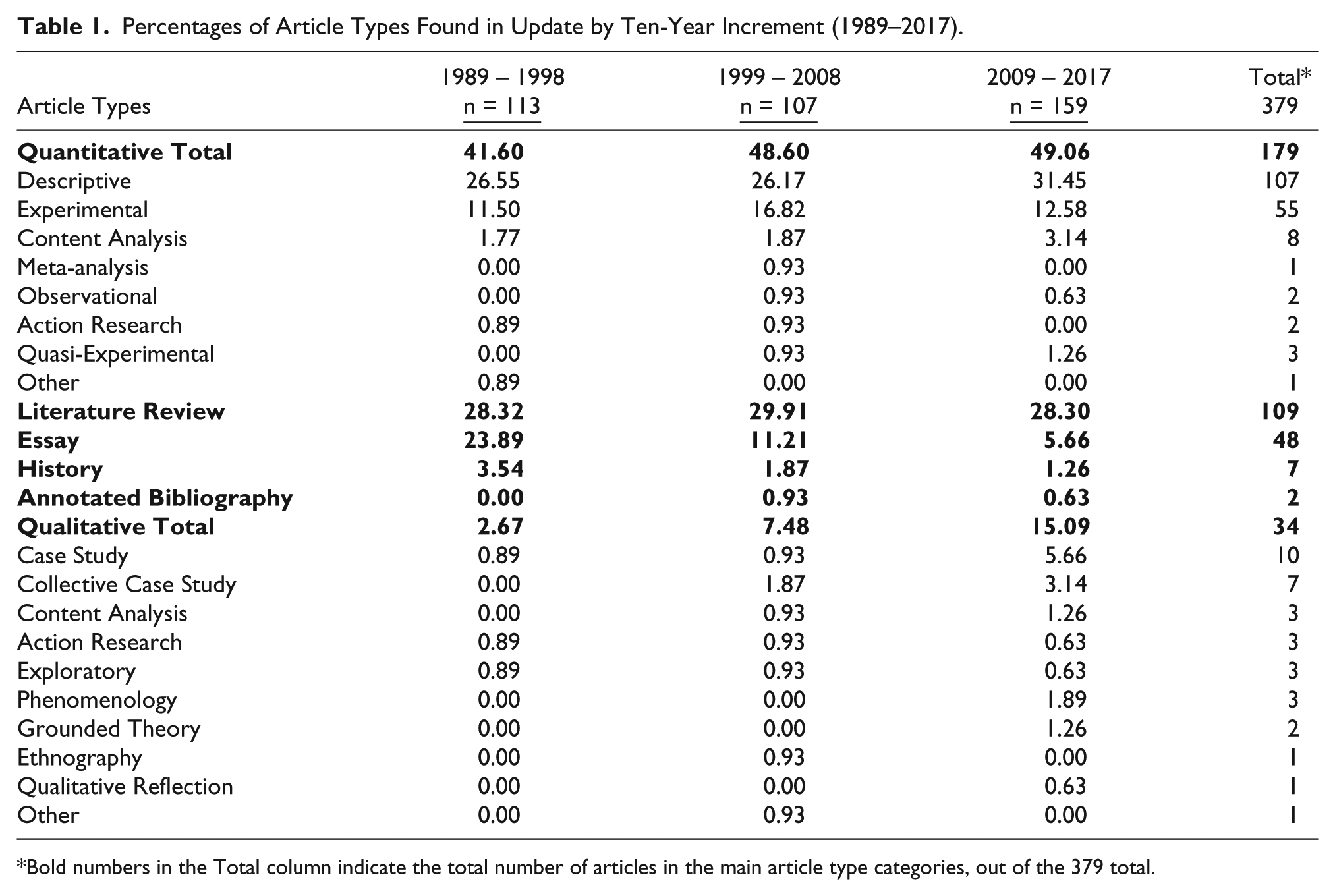
The first research question was “What are the article types represented by the articles published, and have these changed over time?” After reviewing each of the 379 manuscripts, we identified six primary types of articles, with subcategories for several of these (see Table 1). In order from most frequent to least frequent, the categories included quantitative research (n = 179, 46.42%), literature review (n = 109, 28.84%), essay (n = 48, 13.58%), qualitative research (n = 34, 8.41%), historical research (n = 7, 2.22%), and annotated bibliography (n = 2, 0.52%). Although the quantitative category as a whole represented the largest percentage of articles, within that, the descriptive research subcategory accounted for the single greatest percentage of articles (28.05%) as compared with every other main category (except literature review) and all other subcategories.
Percentages of Article Types Found in Update by Ten-Year Increment (1989–2017).
Bold numbers in the Total column indicate the total number of articles in the main article type categories, out of the 379 total.
To investigate whether article types had changed over time, we calculated percentages by 10-year increments (i.e., 1989–1998, 1999–2008, 2009–2017). Overall, there was an increase in the percentage of quantitative articles by decade that was accompanied by a similar decrease in essays. Almost a quarter of the articles that appeared in Update from 1989 to 1998 were essays in which authors used research findings to report on or bolster pedagogical techniques on topics such as music and stress reduction, multicultural music, increasing aesthetic sensitivity, and effective music teacher characteristics. Qualitative articles appeared in more frequent proportions by decade, with case studies and collective case studies contributing the most to that increase. The percentage of literature reviews across decades was remarkably consistent. Annotated bibliographies and articles featuring historical methodologies accounted for approximately 2% of all articles from 1989 to 2017. Complete results by article type and decade are found in Table 1.
To determine “Who served as the participants in the quantitative and qualitative studies published?” (our second research question), we identified nine participant categories, some of which included subcategories. There was a total of 213 quantitative and qualitative studies, but because a number of those reported data for more than one category of participants, there were 358 participant codings in total. The participants who were studied the most frequently were public school personnel (n = 117, 32.68%), followed by individuals from special populations (n = 64, 17.88%), college/university students (n = 62, 17.32%), and secondary school children (n = 40, 11.17%). Participant categories and corresponding frequency counts are displayed in Table 2.
Frequencies of Participant Categories Found in Update Research Articles (1989–2017).
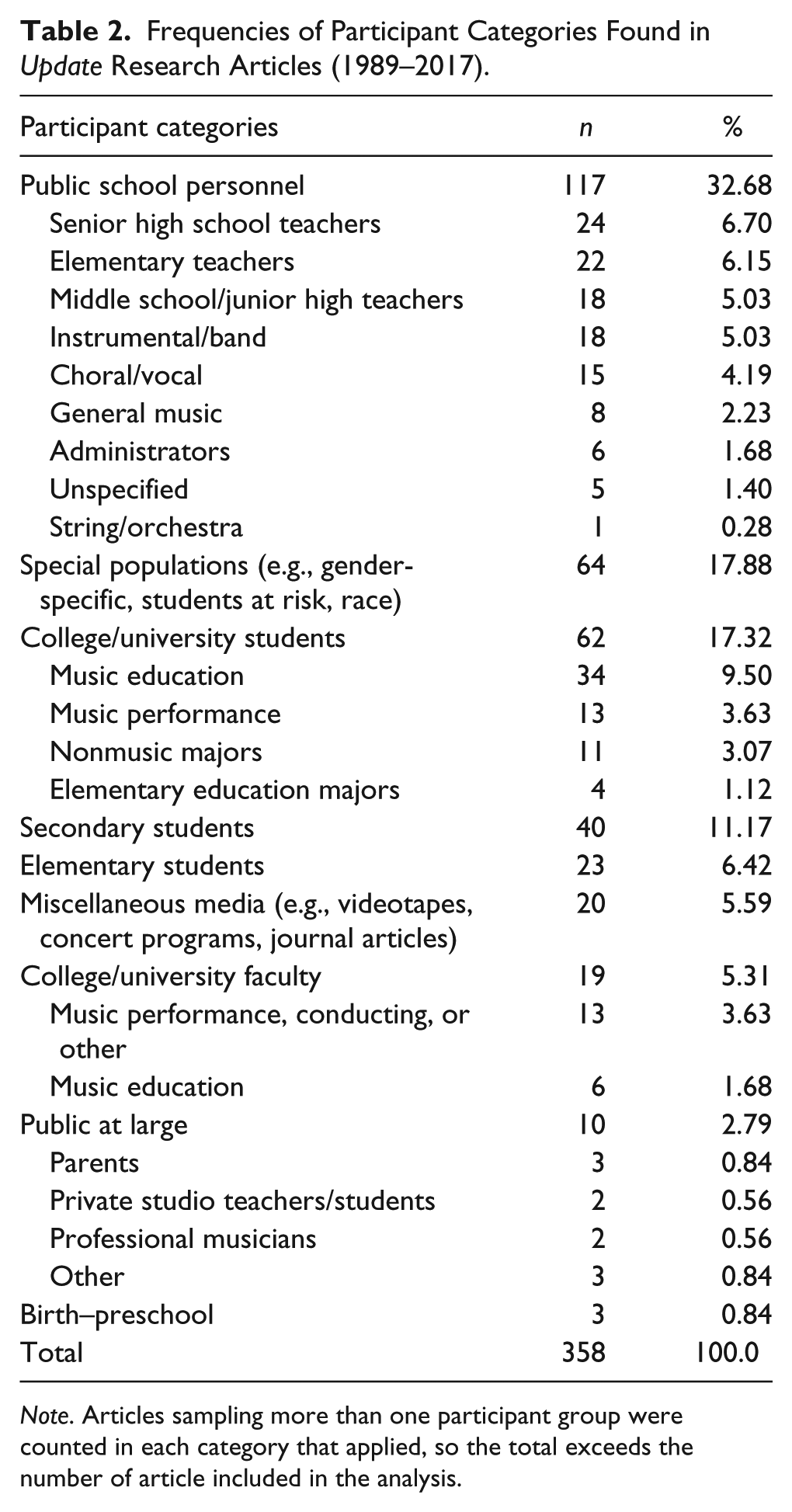
Note. Articles sampling more than one participant group were counted in each category that applied, so the total exceeds the number of article included in the analysis.
To answer the third research question, we analyzed the topics addressed in the articles. Because up to three topics were assigned to any one of the 379 articles, there was a total of 532 topic codes generated. The most frequent article topic, Teaching Methods and Techniques, was addressed in 38 (7.14%) of the articles. This was followed in frequency by Teaching Students With Exceptionalities (n = 24; 4.51%), Singing (n = 22; 4.14%), and Curriculum Issues/Study/Implementation (n = 19; 3.57%). Only two other categories were found to represent greater than 3% of the total topics identified: Sight-Reading/Ear Training/Music Theory and World/Multicultural Music, each with 16 (3.01%). These top five categories accounted for a little over 25% of the topics identified, with the remaining 75% distributed among 63 categories, including from 1 article (.19%) to 15 (2.82%) articles. Frequencies and percentages of article topics are found in Table 3.
Frequencies and Percentage of Article Topics Found in Update Articles (1989–2017).
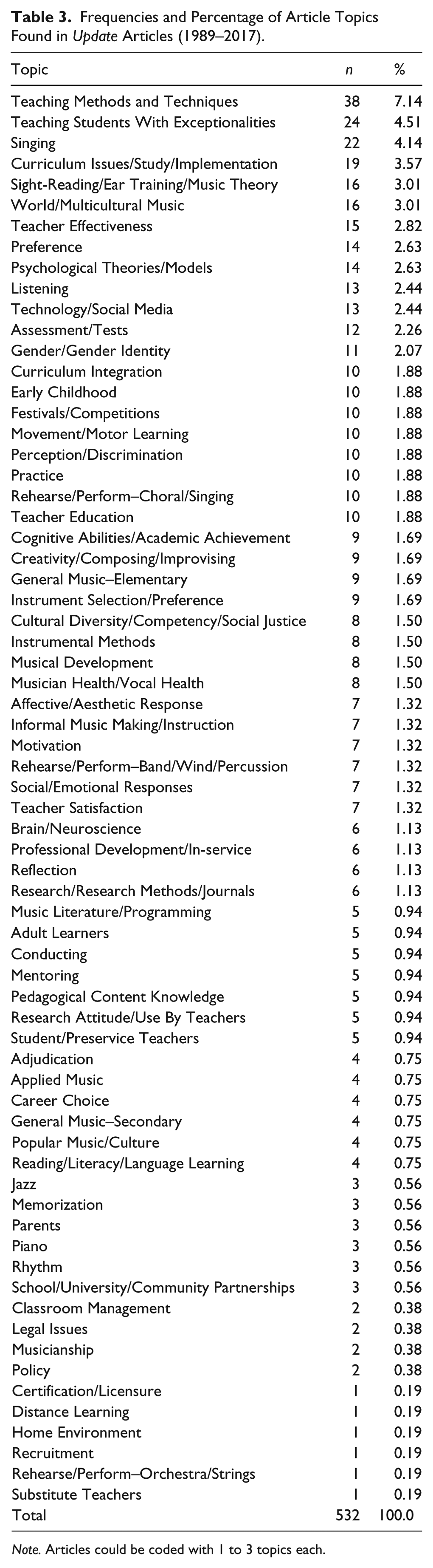
Note. Articles could be coded with 1 to 3 topics each.
Discussion
When examining the article types and research methodologies employed in the articles that appeared in Update, there were many similarities with other authors’ previous content analyses. In his Editor’s column, Byo (1998) described a reasonably comparable distribution of categories in Update articles published from 1989 to 1998 as we found for the equivalent time period. He indicated that the articles represented “reviews of literature (48%), descriptive studies (37%), experimental studies (13%), and historical research (2%)” (p. 2). Byo noted that “these percentages illuminate the fact that Update provides a home for articles that both synthesize and apply research” (p. 2). This seems to have continued over the ensuing decades, with the proportions of published literature reviews and essays that synthesize research remaining relatively balanced over the decades with the proportion of quantitative and qualitative articles that apply research.
Of particular interest was the increased number of qualitative articles appearing in Update, a finding that is consistent with other music education research journals, namely, JRME (Lane, 2011; Sims et al., 2016; Yarbrough, 2002), JMTE (Killian et al., 2013; Nichols, 2013), and the Bulletin of the Council for Research in Music Education (Lane, 2011). The reasons for more qualitative articles could be due to (a) authors’ growing comfort in using these methodologies based upon preparation received during their graduate coursework, (b) editorial board members’ increasing methodological diversity and acceptance of nonquantitative research paradigms, or (c) a larger percentage of qualitative manuscripts being submitted by authors. As qualitative methodologies became more accepted in music education research, they may have been viewed by authors and/or editorial committees to be a good fit with Update’s mission of communicating research to teachers using minimal research jargon, given that qualitative research relies on more descriptive narrative and storytelling as compared with the statistical analysis employed in quantitative methodologies, and thus may be easier to read for individuals not familiar with statistics. The increased use of varying research methodologies within music education research should be viewed positively, as the readership of these journals benefits from seeing how research can be designed and executed from different perspectives.
The frequency of types of participants used in the studies that we examined was somewhat different than previous content analyses of other music education journals. The most sampled participants according to our analysis were public school personnel (32.68%), followed by individuals from special populations (17.88%), and college/university students (17.32%). Yarbrough (1996) found that college (34.77%) and elementary (27.60%) students were the most frequently sampled participants in experimental studies in JRME articles from 1984 to 1995. Similarly, Ebie (2002) identified college/university populations (34.1%) as being the most sampled participants in JRME articles from 1953 to 2002. He reported that elementary school populations were sampled the second-most (21.0%), followed by secondary school (19.1%), which included middle school, junior high, and high school students. However, there are some similarities between our results and Ebie’s, especially that high school, elementary, and middle school teachers represented the most sampled levels among public school personnel, and that instrumental/band teachers were the most sampled public school teachers by subject area. Perhaps the larger proportions of adult and college student participants in more recent years, as compared with school-aged children, reflects greater challenges of obtaining school district and parental consent for minors to participate in research studies. Given that both Update and the JRME share goals of addressing music teaching and learning, figuring out why the teaching aspect may be overrepresented and finding ways to encourage a greater proportion of studies about student learning might be productive endeavors for future researchers.
Considering that Update’s mission is to help teachers transfer research findings into the rehearsal hall and music classroom, it seems appropriate that the most sampled population in our study was public school personnel. Although band, choir, and general music personnel were sampled more than seven times each in the 117 articles that featured public school personnel as participants, string/orchestra personnel were specifically sampled only once. Likewise, Ebie (2002) reported that few public school string personnel served as participants in JRME studies. Additionally, in the current study, we identified only one article with a topic that focused on strings. Although fundamental teaching techniques may transfer within instrumental settings, each one likely presents unique challenges. Asking journal editors and editorial board members to encourage authors to submit manuscripts that include topics pertinent to string education would prove useful for string teachers who could be helped by connecting research findings with pedagogical best practices most directly related to their teaching area.
The breadth of topics addressed by Update authors reflects a diversity of issues related to music teaching and learning. Viewed broadly, these include various aspects such as pedagogical strategies, teacher behaviors and characteristics, curricular decisions and implications, learner characteristics, and developmental, psychological, and physiological principles applied to learning and instruction. In a content analysis of the JMTE, Killian (2016) also described the “immense variety exhibited among the articles” (p. 10). Music education researchers appear to have a wide range of interests and specialties. Although from one perspective, the profession might benefit from a more focused and coordinated research agenda (Reimer, 2008), the variety of research topics allows for music educators to find information in Update that will meet their particular interests and needs. An analysis of research questions posed by in-service music teachers as part of their graduate research coursework indicated that “the abundance of research questions centered around teaching and learning, with additional attention to curriculum/budget, psychological factors, cognition, preference, and social/developmental factors” (Flowers, Gallant, & Single, 1995, p. 28). The contents of Update appear to be consistent with needs expressed by these teachers.
There is one aspect of the articles appearing in Update that differs substantially in comparison with the articles published in the JRME. In a content analysis of the theoretical frameworks employed by JRME authors from 1979 to 2009, Miksza and Johnson (2012) reported that 32% of the 726 studies included reference to a theoretical framework related to the research problem being investigated. Although we thought it would be interesting to include similar data in our content analysis for the sake of comparison, and coded articles using the categories identified by Miksza and Johnson, we found that so few authors specified a theoretical framework (14 articles, less than 4%) that any further analysis of this category was not warranted. Perhaps there is a perception that the practice-based research desired by Update is generally incompatible with, or does not require, an identifiable theoretical framework. This may provide one aspect of differentiation from the other NAfME research journals.
Given the diverse categories of research participants studied and large range of topics addressed, music educators of all levels, of all specialties, and with varied interests should be able to find relevant contents in this journal. Researchers who wish to publish literature reviews or essays related to almost any aspect of music teaching and learning in a NAfME-based refereed research journal will find that this is a valuable outlet for their work, given that those types of articles represent a substantial proportion of articles published in Update and that they are not published at all in the JRME (NAfME, n.d.-b). Authors of quantitative and qualitative research examining participants at all levels and representing virtually any topic related to music teaching and learning should also find this to be a good publication venue. Based on our analysis, it is reasonable to conclude that Update is fulfilling its unique mission, by publishing both research findings and research-based articles that encompass a broad range of subject matter, ultimately providing many opportunities for “teachers to apply the results of research readily in music classrooms and rehearsal halls” (NAfME, n.d.-c).
Footnotes
Declaration of Conflicting Interests
The author(s) declared no potential conflicts of interest with respect to the research, authorship, and/or publication of this article.
Funding
The author(s) received no financial support for the research, authorship, and/or publication of this article.
