




Abstract
I surveyed inservice instrumental music educators (N = 96) to determine their comfort level for teaching and performing on secondary band instruments. Research questions included the following: (a) How comfortable do inservice music educators feel teaching and performing on secondary instruments? (b) Does grade level affect educators’ comfort levels? (c) Does the educators’ primary instrument family relate to their perceived comfort level for teaching and playing on secondary instruments? and (d) Does the format of instrument classes during preparation programs influence educators’ comfort for teaching and playing secondary instruments? Participants reported moderate comfort on most instruments, with brass being most comfortable. Participants indicating woodwind as a primary instrument reported an overall higher comfort level for teaching and performing on brass instruments, whereas low comfort levels on double reeds. High school educators felt least comfortable teaching and performing on secondary instruments. Participants who took Split-Families and Semester-Families preservice classes felt more comfortable performing on secondary instruments versus those who took Individual-Instrument courses.
An important outcome of instrumental music teacher preparation programs is teaching students to perform and teach secondary instruments. To that end, instrument methods and techniques courses serve as a crucial aspect of the preservice music education curriculum. According to the National Association of Schools of Music (2021), undergraduate instrumental music education majors should possess a “knowledge of and performing ability on wind, string, and percussion instruments sufficient to teach beginning students effectively in groups” (p. 122). Common preservice course structures include the following: (a) Split-Family courses where students take high brass and low brass courses, learning multiple instruments per semester, (b) Individual-Instrument courses where students focus a half or full semester of study on one instrument, and (c) Semester-Family courses where students take a semester of all of the brass or woodwind instruments (Austin, 2006; Wagoner & Juchniewicz, 2017). Additionally, secondary instrument course instructors have to decide what information to include for each instrument. Powell et al. (2018) noted that facilitating the development of pedagogical knowledge and skill on secondary instruments is one of the most challenging tasks for preservice instrumental music teacher educators.
One primary use of secondary instruments for an educator is through modeling, particularly for beginning students. Millican and Forrester (2019) defined modeling music concepts as an act in which “the teacher demonstrates music concepts with their instrument or voice” (p. 89). These core practices should (a) occur with high frequency in teaching, (b) over time, be enacted and possibly mastered by novice teachers in classrooms representing varying disciplines and context, (c) allow novice teachers to learn more about students and teaching, and (d) preserve the integrity to improve student achievement through research-based practices (Grossman et al., 2009, p. 277).
A variety of literature exists about the perception of both preservice and inservice music educators concerning secondary instrument courses and their instructors (e.g., Conway, 2002; Davis, 2006; Teachout, 1997). Teachout (1997) and Davis (2006) surveyed preservice and inservice music educators on what skills and behaviors are important to successful music teaching. Both authors noted that knowledge of and proficiency on secondary instruments ranked near the bottom quarter of the skills and behaviors necessary for music teaching. Cooperating teachers surveyed by MacLeod and Walter (2011) ranked band and orchestra student teachers’ preparation on secondary instruments 11th and 12th, respectively, out of 12 music skills. A majority of surveyed college and high school band directors ranked “technique courses” seventh of 11 in regard to their developmental effectiveness (Jennings, 1988). In addition, first-year teachers listed their instrument methods courses as one of the least valuable aspects of the program due to course inconsistencies (Conway, 2002).
Conversely, student teachers observed by Hourigan and Scheib (2009) placed the knowledge of brass and woodwind fingerings and other secondary instrument knowledge at the top of their priority list. Stegall et al. (1978) found that omitting secondary instrument competencies from music teacher education curriculum would harm the profession. Novice band directors surveyed by Denis (2019) considered secondary instrument technique courses to be of great practical importance. The type of instructor (e.g., music education faculty, music education graduate student, performance faculty, performance graduate student) and amount of teaching experience they possess play important factors in students’ success and motivation (Conway et al., 2007; Russell, 2007). The variety of course structure and type or quality of instructor may be why such mixed findings exist concerning the perceived importance of secondary instrument courses.
Researchers have explored various models of content knowledge delivery in secondary instrument courses. Hunter et al. (2010) described a partnership between a university’s secondary instrument courses and a local PreK–8 elementary school. Preservice students taught 30- to 45-minute individual instrument lessons on an instrument they studied in their secondary instrument course. Weaver (2010) described a model for secondary instrument technique courses which balanced performance and pedagogy skills.
Course structures and instructors not only influence the perception and comfort of educators, but their identities do as well. Researchers have investigated the identities and comfort levels of both preservice and inservice music teachers (e.g., Bucura, 2019; Kim, 2018; Parker & Powell, 2014; Powell et al., 2018). Parker and Powell (2014) examined students’ identity when taking methods courses outside their area of focus. Several students indicated increased comfort and preparation in teaching outside their focus area due to these additional courses. Powell et al. (2018) studied the relationship between primary instrument background and secondary instrument teaching effectiveness. Preservice students with brass and woodwind primary instrument backgrounds taught more effectively in secondary instrument classes than those with string, percussion, or voice backgrounds. The authors attributed these findings to students’ comfort levels on their primary instrument transferring to teaching secondary instruments. Pineau (1982, as cited in Kim, 2018) defined comfort as a state of well-being that is different depending on each person and their situation. Kim (2018) found that choir directors with instrumental backgrounds who had taken choral methods reported significantly higher comfort than those who did not. Negative experiences could lead to a lack of comfort and negative perception of their abilities. Lowered perceptions could lead to lower competency. Bucura (2019) noted that poor self-efficacy could stifle musicianship. Collectively, these studies indicate the importance of providing preservice teachers with content knowledge and music ability, but also confidence in their identity as a music educator.
Music educators spend years honing skills on their primary instrument. However, compared with the variety of secondary instruments required for modeling, educators likely spend less time playing their primary instrument while serving as an instrumental music educator. Educators may spend the remaining instructional time teaching and playing on secondary instruments they learned briefly in their preparation program. Although researchers found that performing on secondary instruments is important (Conway et al., 2007; Davis, 2006; Denis, 2019; Teachout, 1997), little research exists on how inservice educators feel performing and teaching these instruments. The purpose of this study was to document inservice instrumental music educators’ (N = 96) comfort level for teaching and performing on secondary wind and percussion instruments. The following research questions guided this study: (a) How comfortable do inservice music educators feel teaching and performing on secondary instruments? (b) Does grade level affect educators’ comfort levels? (c) Does the educators’ primary instrument family relate to their perceived comfort-level teaching and playing on secondary instruments? and (d) Does the format of instrument classes during preparation programs influence educators’ comfort for teaching and playing secondary instruments?
Method
To gain insight into as many inservice educators as possible, regardless of location (Creswell & Creswell, 2018), I chose a survey research design. Authors of extant literature on instrumental methods and secondary instrument classes have implemented the use of survey methodologies (Legette, 2013; Kim, 2018; Stegall et al., 1978). Although some of these studies do not directly address measuring perceptions of teachers, it exists in the literature. Examples include Legette (2013), who used a Likert-type scale to explore the perceptions of music teachers concerning their preservice training, and Kim (2018) who used a 7-point Likert-type scale to measure participants’ comfort-level teaching various choral teaching skills.
Survey Construction
The researcher-created, IRB-approved questionnaire consisted of three parts and 72 items. My research questions and preexisting literature (Kim, 2018; Legette, 2013) guided the creation of the questionnaire items. Section 1 contained 34 items concerning participants’ perceived comfort levels for performing on secondary instruments. Participants indicated their performance comfort level on a scale of 1 (cannot perform on the instrument with good tone quality and technique) to 5 (can perform college-appropriate music with good tone quality and technique). The points in-between corresponded to performing with good tone quality and technique at the beginning band, middle school, and high school band levels, respectively. I listed the following instruments: flute, oboe, bassoon, clarinet, saxophone, French horn, trumpet, trombone, euphonium/baritone, tuba, snare drum, mallets, bass drum, timpani, and drumset. I chose these instruments as they were cited as the most commonly offered instruments (Wagoner & Juchniewicz, 2017). After indicating their comfort level for performing each instrument, participants used a checkbox to select the single instrument they felt most and least comfortable performing on from the same list, with the exception of percussion instruments, which I combined into one category. (I grouped percussion instruments as one category because percussionists are traditionally required to perform on all of the instruments listed previously.) Participants then used an additional 6-point rating scale to indicate how they believed their preparation program prepared them to perform on each instrument. Participants indicated their comfort level from 1 (unacceptable) to 5 (excellent) with an additional sixth choice allowing participants to indicate if they did not take the instrument during their preparation program coursework.
I structured Section 2 of the questionnaire similarly to Section 1. Participants indicated their comfort level for teaching secondary instruments on a scale of 1 (no reasonable comfort) to 5 (extremely comfortable teaching). The 34 items in Section 2 mirrored those in Section 1 with the exception of the word teaching replacing performing.
Section 3 contained eight demographic items, including participants’ teaching status, courses they currently taught, years of service, primary instrument(s), and any additional instruments on which they possessed a high level of ability. Additional items included the U.S. state where they completed their music education preparation program and one open-ended question in which they described the format of the instrument technique courses taken during their preparation program. Because the research questions pertained to participants’ comfort level for performing on and teaching secondary instruments, I removed all rating scale data pertaining to a participants’ primary instrument.
Once constructed, the questionnaire was pilot-tested for clarity. I distributed the questionnaire to 10 music education graduate students with previous teaching experience and two university music education faculty. Based on input from the pilot test, I changed several questions to make the wording clearer. In the open-ended question, there was a discrepancy in whether respondents described their instrumental methods or instrument technique courses. I adjusted the wording to include the phrase “instrument technique course” and a description to prevent further confusion and redistributed it to the same group again. Those who pilot-tested the questionnaire deemed it valid and indicated a completion time of approximately 15 minutes. I conducted a Cronbach’s alpha test to measure the reliability of the quantitative items within the survey instrument. Results indicated strong reliability (α = .92).
Data Collection
I sent a recruitment post to the Facebook Band Directors Group to invite participants. This closed-membership group represented an ideal sampling based on years of teaching experience, geographic region, and the variety of ensemble size and skill levels taught (Rickels & Brewer, 2017; Silvey et al., 2020). In my recruitment post, I indicated that participants needed to be inservice instrumental music educators and included a question in which participants identified their current status (e.g., inservice educator, retired educator, preservice student, other). I used this question to filter out any submissions other than those by inservice educators. I posted the questionnaire to the group page once a week for 4 weeks. I never posted the questionnaire on the same day or time as a previous post. After 4 weeks of data collection, I closed the questionnaire and deleted any post containing the link.
Participants
One hundred respondents completed the questionnaire. After eliminating responses from anyone who indicated they were not an inservice educator, 96 useable responses remained. These educators completed their preparation programs in 33 states throughout the United States. Participants’ teaching experience ranged from 0 to 5 years (n = 31, 32.29%), 5 to 10 years (n = 23, 23.96%), 10 to 15 years (n = 13, 13.54%), and 15 or more years (n = 29, 30.21%). As cited in previous literature, Facebook’s privacy restrictions make it impossible to determine a response rate (Rickels & Brewer, 2017; Silvey et al., 2020). Of the 96 participants, 53 taught high school in some capacity. However, 43 of the participants taught a combination of elementary school or middle school.
Data Analysis
I grouped participants into several different categories to answer each research question. To answer the research question concerning grade level influencing participants’ comfort levels, I grouped participants based on whether they taught high school. I based this decision on the assumption that high school teachers program more difficult music than educators who solely teach elementary or middle school instrumental ensembles.
Concerning primary instrument family, I grouped participants based on the instrument family associated with their primary instrument. Several participants indicated having more than one primary instrument. As these multiple primaries aid in forming their perception of the remaining instruments, I included these participants in all instrument families indicated by their responses. Due to this, the sample size for this analysis was 106 rather than the original 96. Of the 106 participants, 48 indicated woodwind as a primary instrument, whereas 45 indicated brass as a primary, and 13 participants indicated a primary instrument other than a brass or woodwind instrument. As done previously (Powell et al., 2018), I decided to combine the 13 participants with a primary instrument other than brass or woodwind into a singular group. I labeled this group as “Non-Winds/Brass.”
I grouped participants for analysis based on their responses to the open-ended question concerning their preparation program instrument technique courses to answer the research question concerning preparation program structure. The responses from the participants aligned similarly to Austin (2006). Therefore, I classified the groups as follows: (a) Split-Families (e.g., high brass, low brass), (b) Semester-Families (e.g., brass class, woodwind class), and (c) Individual-Instrument classes (e.g., trumpet class, clarinet class). Five participants misinterpreted the question and described their current teaching schedule rather than the instrument technique course. As it was impossible to place them correctly into one of the three categories, I removed those five participants from this part of the analysis. Therefore, the sample size for this analysis was 91 rather than the original 96. I cross-referenced the preparation program classifications by seeking input from a music education colleague to ensure that I placed participants within the correct group. This person had a background in music education and was able to give objective insight. I then shared the preparation program classification list and instructions on how to group each participant. I calculated interrater reliability using Cohen’s Kappa. As reliability for the program classifications proved to be strong (k = .83), I made no changes to my classifications.
I calculated mean scores to determine each participant’s comfort level for playing all instruments and the overall comfort level for each instrument family and ran the appropriate statistical tests as necessary. Prior to data analysis, I checked the assumptions of normality (Russell, 2018) to determine if I should run a parametric or nonparametric test. Using the rating scale anchors from Section 1, I calculated percentages to determine how many participants felt they could play secondary instruments at the level they teach.
Results
Comfort for Teaching and Performing on Secondary Instruments
All participants (N = 96) reported highest comfort in both performing and teaching brass instruments, followed by percussion and woodwinds. Instrument comfort means in performance were near 3, on a scale of 1 (lowest) to 5 (highest), with the exception of drumset (M = 2.35, SD = 1.06), oboe (M = 2.08, SD = 0.91), and bassoon (M = 1.78, SD = 0.99). The means for teaching comfort for a majority of instruments were higher than 3.5, with the exception of drumset (M = 2.74, SD = 1.17), oboe (M = 2.86, SD = 1.13), and bassoon (M = 2.46, SD = 1.14). In the online supplemental Table A, I present results for each instrument and all instrument families.
Participants (44.79%, n = 43) ranked the bassoon as the instrument they were least comfortable performing. Twenty-one participants (21.86%) ranked the oboe as least comfortable. Almost half of the participants (47.92%, n = 46) indicated that they believed they could not perform on the bassoon with good tone and technique.
Approximately 81% of the 96 participants (n = 78) selected their primary instrument as the instrument they were the most comfortable teaching. Four participants indicated an instrument outside of their primary instrument family. Similar to performing, 45.83% of participants (n = 44) ranked the bassoon as the instrument they were least comfortable teaching. Oboe ranked second, with 22.92% of participants (n = 22) ranking it as the least comfortable. Half of participants (n = 48) stated they had no comfort or below average comfort-level teaching the bassoon.
Relationship Between Grade Level Taught and Comfort for Teaching Secondary Instruments
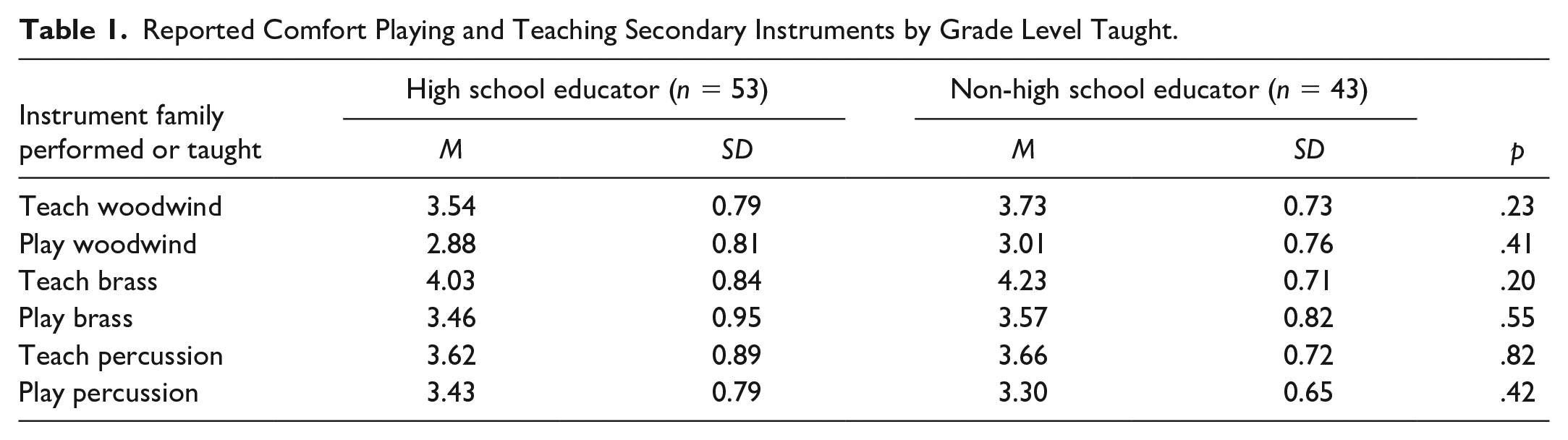
High school teachers (n = 53) reported they felt most comfortable playing brass (M = 3.46, SD = 0.95) instruments, followed by percussion (M = 3.43, SD = 0.79) and woodwind (M = 2.88, SD = 0.81) instruments. Similarly, they reported being more comfortable teaching brass (M = 4.03, SD = 0.84) instruments than percussion (M = 3.61, SD = 0.89) and woodwind instruments (M = 3.54, SD = 0.78). Educators who did not teach high school (n = 43) reported highest comfort for playing brass (M = 3.57, SD = 0.82) instruments, followed by percussion (M = 3.30, SD = 0.69) and woodwind (M = 3.01, SD = 0.76) instruments. With regard to teaching, non-high school teachers reported highest comfort for teaching brass (M = 4.23, SD = 0.71) instruments, followed by woodwind (M = 3.73, SD = 0.73) and percussion (M = 3.66, SD = 0.72) instruments.
To determine if differences existed between the two groups of educators, I compared the groups by using an independent-samples t test. Results indicated no significant difference between the playing and teaching comforts of educators who teach at the high school level and educators who do not teach at the high school (see Table 1).
Reported Comfort Playing and Teaching Secondary Instruments by Grade Level Taught.
Out of the non-high school teachers (n = 43), a majority believed they could play secondary instruments at a middle school level with the exception of oboe (35%, n = 15), bassoon (15%, n = 6), and drumset (46.5%, n = 20), whereas a majority of high school teachers (n = 53) believed they could only play the saxophone, trumpet, euphonium, mallets, bass drum, and timpani at a high school level. With the exception of high school teachers’ lack of comfort for teaching bassoon, the remainder of participants indicated at least an average comfort level for teaching all secondary instruments. Furthermore, with the exception of oboe, bassoon, and drumset, a majority of all participants indicated an above-average comfort level for teaching secondary instruments. Online supplemental Table B depicts the percentage of participants who believed they could perform at the level they teach for all instruments listed.
Relationship Between Primary Instrument Family and Comfort for Secondary Instruments
Woodwind players (n = 48) reported higher comfort levels playing percussion (M = 3.23, SD = 0.78) than brass (M = 3.02, SD = 0.74) and woodwind (M = 2.86, SD = 0.73) instruments. Brass players (n = 45) reported their highest comfort levels playing brass instruments (M = 3.81, SD = 0.77), followed by percussion (M = 3.37, SD = 0.61) and woodwind (M = 3.56, SD = 0.56), respectively. Educators in the non-wind/brass group (n = 13) reported higher comfort levels playing percussion (M = 3.62, SD = 0.78) than brass (M = 3.17, SD = 0.95) and woodwind (M = 2.61, SD = 0.97) instruments. Woodwind players reported higher comfort levels teaching brass (M = 3.80, SD = 0.87) instruments than percussion (M = 3.57, SD = 0.76) and woodwind (M = 3.54, SD = 0.83) instruments. Similarly, brass players reported highest comfort levels teaching brass (M = 4.27, SD = 0.76) instruments, followed by percussion (M = 3.56, SD = 0.77) and woodwind (M = 3.37, SD = 0.69). Educators in the non-wind/brass group reported higher comfort levels for teaching percussion (M = 3.78, SD = 0.91) than brass (M = 3.70, SD = 0.60) and woodwind (M = 3.31, SD = 1.04) instruments.
Kruskal-Wallis H test revealed statistically significant differences for playing (χ2 = 19.70, p < .001) and teaching (χ2 = 10.41, p < .001) brass instruments. Post hoc Mann-Whitney U analyses showed that brass players (n = 45, mean rank = 59.26) indicated higher comfort playing brass instrument compared with the woodwind players (n = 47, mean rank = 34.80; U = 454.50, p < .001, r = −.46). Furthermore, brass players (n = 45, mean rank = 54.76) indicated higher comfort teaching brass instruments compared with the woodwind (n = 48, mean rank = 39.73; U = 731.00, p < .001, r = −.28) group. The brass players (n = 45, mean rank = 32.68) also indicated higher comfort teaching brass instruments compared with the non-wind/brass (n = 13, mean rank = 18.50; U = 149.50, p < .001, r = −.35) group. A subsequent dependent-samples t test between the groups revealed woodwind players’ higher comfort levels for playing and teaching brass over woodwinds to be significant (p < .001).
Relationship Between Preparation Program Structure and Comfort for Secondary Instruments
Participants in the Semester-Families group (n = 47) reported highest comfort playing percussion (M = 3.34, SD = 0.61), followed by brass (M = 3.28, SD = 0.84) and woodwind (M = 2.58, SD = 0.63). Participants in the Split-Families group (n = 35) reported higher comfort playing brass (M = 3.59, SD = 0.85) instruments than percussion (M = 3.34, SD = 0.77) and woodwind (M = 2.82, SD = 0.69) instruments. Educators who indicated taking Individual-Instrument classes (n = 9) indicated higher comfort playing percussion (M = 3.18, SD = 0.54), followed by brass (M = 3.18, SD = 0.82) and woodwind (M = 2.58, SD = 1.10).
Concerning teaching comfort, participants in the Semester-Families group reported highest comfort with brass (M = 3.89, SD = 0.88) instruments, followed by percussion (M = 3.57, SD = 1.14) and woodwind (M = 3.18, SD = 0.82). Educators in the Split-Families group reported higher comfort teaching brass (M = 4.27, SD = 0.78) instruments than woodwind (M = 3.77, SD = 0.67) and percussion (M = 3.66, SD = 0.81) instruments. Those who took Individual-Instrument classes indicated higher comfort teaching brass (M = 4.02, SD = 0.63), followed by woodwind (M = 3.64, SD = 0.73) and percussion (M = 3.33, SD = 0.65). To determine if any significant differences existed in the playing and teaching means scores for the three groups, I employed a Kruskal-Wallis H test. Results indicated no significant difference between groups.
When asked about their secondary instrument performance preparation, those in the Semester-Families group reported being most prepared to play percussion (M = 3.50, SD = 1.15), followed by brass (M = 3.39, SD = 0.88) and woodwind (M = 3.22, SD = 0.85) instruments. Educators in the Split-Families group reported being most prepared to play percussion (M = 3.60, SD = 1.21) instruments, followed by woodwind (M = 3.49, SD = 0.70) and brass (M = 3.33, SD = 1.05) instruments. Those who took Individual-Instrument classes indicated highest preparation playing woodwind (M = 3.70, SD = 1.08), followed by brass (M = 3.60, SD = 1.02) and percussion (M = 2.50, SD = 1.64).
Concerning their preparation teaching secondary instruments, those in the Semester-Families group reported being most prepared to teach brass (M = 3.45, SD = 0.94), followed by percussion (M = 3.38, SD = 1.11) and woodwind (M = 3.27, SD = 0.92) instruments. Educators in the Split-Families group reported being most prepared to teach percussion (M = 3.60, SD = 1.00) instruments, followed by woodwind (M = 3.59, SD = 0.84) and brass (M = 3.59, SD = 0.94) instruments. Those who took Individual-Instrument classes indicated highest preparation teaching brass (M = 3.93, SD = 1.11) instruments, followed by woodwind (M = 3.91, SD = 0.98) and percussion (M = 3.00, SD = 1.60) instruments. To determine if a relationship existed between the playing and teaching comforts of participants with their indicated preparation to play and teach secondary instruments, I conducted a Spearman correlation analysis (Table 2). I found statistically significant strong positive correlations with both the Semester-Family and Split-Family groups comfort playing woodwinds and their preparation to play woodwinds. A significant moderate positive correlation existed in the Semester-Family groups comfort teaching woodwinds and their preparation to teach woodwinds. A significant moderate positive correlation existed in the Split-Family groups comfort teaching brass instruments and their preparation to teach brass instruments.
The Relationship Between Educators’ Comfort Playing and Teaching Secondary Instruments to their Perceived Preparedness Based on their Preparation Program.
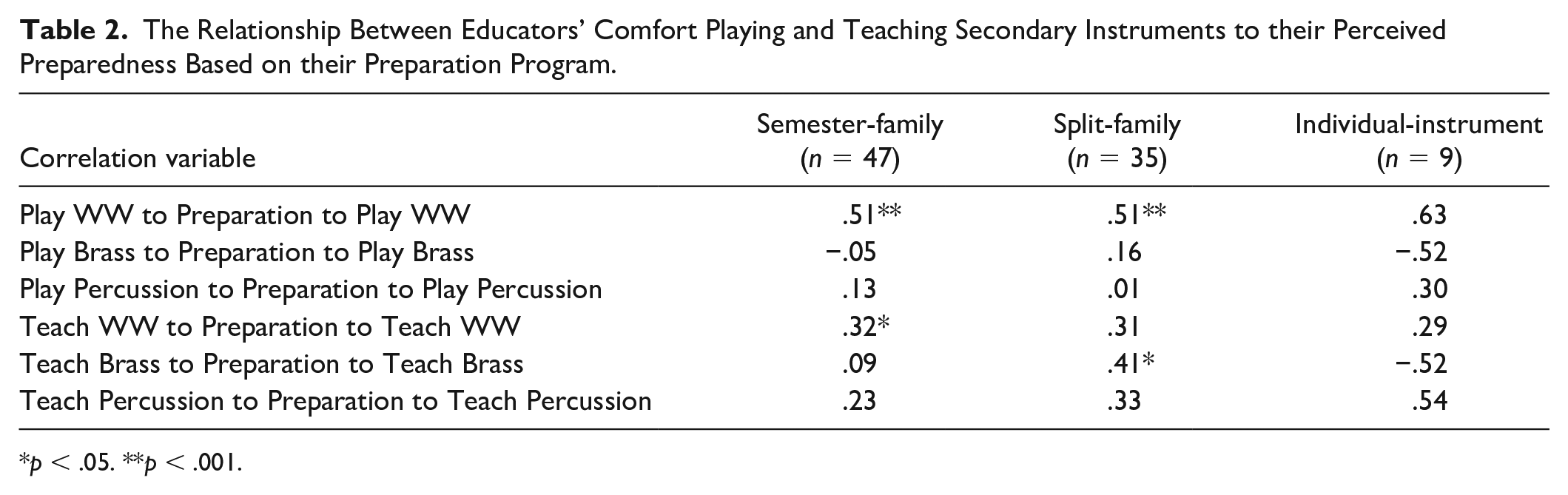
p < .05. **p < .001.
Discussion
Overall, participants indicated higher comfort levels for teaching and performing brass instruments than woodwinds, regardless of primary instrument. There are many variables to consider when examining the intricacies of playing reed instruments in addition to differences in fingerings. These variables are especially true when making comparisons with brass instruments. Embouchures for brass instruments are more similar than those in the woodwind family. Woodwind fingerings do not follow the same principles as brass instruments such as the trumpet and euphonium. The homogeneous nature of brass instruments could be why all participants—not just woodwind players—felt most comfortable performing and teaching brass instruments. Perhaps the most consistent trend that emerged during analysis was that inservice educators indicated little comfort for performing or teaching double reeds, particularly the bassoon. Participants’ comfort level on bassoon was consistently lower than every other instrument, regardless of participant groupings.
High school educators felt less comfortable playing and teaching brass and woodwind instruments than elementary and middle school educators. It is worth considering the likelihood that those who teach beginners may play these secondary instruments more frequently than high school teacher who feel more vulnerable modeling secondary instruments for more advanced students. Another cause may be educators’ low self-efficacy. Educators who feel that they cannot perform these instruments as well as their primary or have had previous negative experiences with a particular instrument may experience an altered perception of how well they are playing and teaching these instruments. This negative perception may lower self-efficacy and could stifle musicianship (Bucura, 2019).
One finding of this study was that woodwind players indicated being more comfortable performing and teaching brass instruments than woodwind instruments. In general, a lack of participants’ exposure to double reeds, particularly the bassoon, lowered comfort levels. Compared with the findings of Powell et al. (2018), higher means for teaching brass instruments may be from the aforementioned greater transferability between them compared with the difference in woodwind instruments.
Overall, participants in the Individual-Instrument class group reported a variety of mean scores. As a group, they consistently ranked lowest in the performing categories, but higher than the Semester-Families group in teaching. Most participants stated their program adequately prepared them in one category but did not prepare them in the other. Participants indicated that graduate students taught most of these Individual-Instrument courses. Graduate students who teach these instrument technique courses may not necessarily have a teaching background and often lack the teaching experience required to teach these courses (Conway et al., 2007). Preparation programs may consider offering technique instruction courses to graduate student instructors. Additionally, preparation programs should consider having graduate student instructors who are majoring in performance serve who could focus their instruction on performance rather than pedagogy and graduate music education students with teaching experience focus on pedagogy.
By nature of the course structure and typical length, Individual-Instrument and Split-Families courses grant participants more time to develop both pedagogical and performance skills on each instrument (Austin, 2006; Wagoner & Juchniewicz, 2017). Students often play more instruments in Split-Families courses. This balance in playing and teaching was evident in the current study with participants in the Split-Families group comfort levels being higher in both teaching and playing secondary instruments than the other groups. This finding aligns with Weaver’s (2010) report that students with a more balanced approach of pedagogy and performance, as well as those who have prolonged exposure to many instruments, felt more prepared when they were hired.
Conclusion and Suggestions for Future Research
The findings of this study may help music teacher educators evaluate their curricula to determine if they are adequately preparing their students to teach instrumental music, particularly if their programs are preparing their students adequately on double reeds. Music teacher educators may also use these findings to determine which of the program structures analyzed in this study their programs belong and if their current preservice students and alumni feel prepared to teach and play secondary instruments. Changing the culture and perceived importance of these courses is crucial. Russell (2007) recommends that faculty, staff, and student leaders must emphasize the importance of secondary instrument technique courses to younger students. Music teacher educators may consider adding peer teaching into their programs as a means of practical application of the information acquired in secondary instrument classes (Austin, 2006; Conway et al., 2007; Weaver, 2010).
If schedules permit, music teacher educators may consider implementing a model similar to the one described by Weaver (2010) in which the brass and woodwind methods students meet 4 times a week for 50 minutes. Two times per week, students receive a lecture/demonstration focused on pedagogy. The other 2 days allow students to participate in a performance lab to focus on executive skills. This type of model can help develop both the performance and pedagogical aspects of methods courses.
Inservice music educators can use the findings of this study to reflect on their comfort level for teaching and performing secondary instruments. Inservice educators should consider devoting time every week and throughout the year to improving comfort for teaching in areas that are deemed difficult. Increasing pedagogical knowledge and performance ability can become a form of professional development for instrumental music educators. Inservice educators should reflect and determine their satisfaction with playing and teaching these instruments. Additional practice may be necessary if satisfaction is low. In addition, inservice educators may also consider taking lessons from a music education major at a local university. Taking lessons from a university student might improve their performance abilities and will give future music educators valuable teaching experience. Educators may also consider playing a secondary instrument in an ensemble where they would be less stressed such as a community band. Community bands provide an important outlet by focusing on play/fun, social support, stress reduction, and the joy of making music (Coffman & Adamek, 2001; Jutras, 2011; Mantie, 2012; Rohwer, 2016).
A question on secondary instrument performance rises from this study: Do inservice educators need to perform at the ability level they teach? For some, their ability to teach an instrument without modeling at a particular level may be enough. However, some educators may realize a need for improvement for their students’ sake. Future research should explore whether instrumental music educators feel the need to be able to play all instruments at the level in which they teach.
Although the participants in this study represented preparation programs from 33 states throughout the United States, a bigger sample size would add generalizability to the study. Distributing the questionnaire through state and local music educator associations may yield more responses and allow the researcher to determine response rates (Rickels & Brewer, 2017; Silvey et al., 2020). Additionally, by using a survey featuring convenience sampling, only educators with strong feelings toward secondary instrument use may have participated in the study. Distributing the questionnaire in other ways may result in a wider variety of experiences and reported comfort levels concerning secondary instruments. An additional limitation may include not allowing participants to choose an individual percussion instrument when selecting the instruments that were most and least comfortable. Future researchers may consider permitting participants to indicate specifically which instruments they are most and least comfortable performing and teaching. Furthermore, researchers might explore how much time educators spend playing secondary instruments. Knowing the actual time spent playing secondaries may add insight into their comfort level. Future research should allow inservice educators the opportunity to describe their teaching assignments in more detail. Also, it is possible that several of the participants in this study only directed ensembles or taught lessons that aligned with their primary instrument family. Giving participants an option to describe preparation program size and the type of institution (e.g., bachelor-only vs. graduate schools) may give additional insight so that faculty who teach in preparation programs can compare findings. An examination of current preservice music education students’ comfort level and preparation for teaching secondary instruments could guide the curriculum of music education preparation programs.
For our students to truly succeed in our classrooms, educators need to be confident in their knowledge and abilities. If there is an area in which an educator lacks confidence, it is not too late for them to enhance their abilities and knowledge and heighten confidence. As inservice educators, we are lifelong learners ourselves and should continue to grow alongside our students.
Supplemental Material
sj-docx-1-upd-10.1177_8755123321995953 – Supplemental material for Inservice Music Educators’ Perceived Comfort for Teaching and Performing on Secondary Band Instruments
Supplemental material, sj-docx-1-upd-10.1177_8755123321995953 for Inservice Music Educators’ Perceived Comfort for Teaching and Performing on Secondary Band Instruments by Alvin F. Simpson in Update: Applications of Research in Music Education
Supplemental Material
sj-docx-2-upd-10.1177_8755123321995953 – Supplemental material for Inservice Music Educators’ Perceived Comfort for Teaching and Performing on Secondary Band Instruments
Supplemental material, sj-docx-2-upd-10.1177_8755123321995953 for Inservice Music Educators’ Perceived Comfort for Teaching and Performing on Secondary Band Instruments by Alvin F. Simpson in Update: Applications of Research in Music Education
Footnotes
Declaration of Conflicting Interests
The author declared no potential conflicts of interest with respect to the research, authorship, and/or publication of this article.
Funding
The author received no financial support for the research, authorship, and/or publication of this article.

Supplemental Material
Supplemental material for this article is available online.
References
Supplementary Material
Please find the following supplemental material available below.
For Open Access articles published under a Creative Commons License, all supplemental material carries the same license as the article it is associated with.
For non-Open Access articles published, all supplemental material carries a non-exclusive license, and permission requests for re-use of supplemental material or any part of supplemental material shall be sent directly to the copyright owner as specified in the copyright notice associated with the article.
