



Abstract
There is a trend of combining agile and traditional project management practices for technology-based product and service development in the search for more agility. Although there are, in the literature, hybrid models that propose combinations of traditional and agile approaches, there are no studies that discuss the impact of the adoption of this approach in organizations in practice. Consequently, guidance on the selection of the most appropriate project management approach has remained largely theoretical, rather than based on companies’ experiences. The objective of this research is to analyze how organizations that develop technology-based products and services apply hybrid approaches to project management, their characteristics, advantages, and disadvantages, conducting a literature review and multiple case studies as research methods. Results reveal that hybrid approaches to project management are currently fundamental for companies in order to deal with distinct organizational cultures, specific processes, customer contractual requirements, and project specificities. This study also led to a consolidated list of the characteristics of hybrid approaches to project management.
Keywords
Introduction
Problems concerning the adoption of project management approaches in the context of software development have been debated by practitioners and researchers since the 1980s (Boehm, 1984, 1988; Brooks, 1987; Heninger, 1980; Royce, 1970). The project life cycle is always predefined (An et al., 2019). The search for solutions has resulted in the creation of development process models for the software industry (Software Engineering Institute, 2010), as well as the wide dissemination of management guides, such as A Guide to the Project Management Body of Knowledge (PMBOK ® Guide) – Sixth Edition (Project Management Institute [PMI], 2017) and Prince2 (OCG, 2009) for this industry. The purpose of these guides was to improve current development process and ensure control and some degree of predictability about projects.
However, in spite of these efforts, the complexity of software development activities and the rapid changes that have taken place in organizations since the 1990s (Cooper & Sommer, 2016) have led to scenarios where projects are constantly altering in scope. These, then, result in large reworks and potentially high risks and costs, which may, further, lead to the projects failing and/or organizations facing financial losses and reputation damages (Beck & Andres, 2004; Boehm, 2000, 2002; Highsmith & Cockburn, 2001).
At the end of the 1990s, the search for solutions to these problems led to the emergence of practices that became known as agile (Agile Manifesto, 2001). This set of practices proposes the elimination of the management bureaucracy of software development projects in order to promote “agility” to deal with contemporary challenges. Agile approaches are well known in the context of the software development industry, especially in their project management approaches, referenced in the literature as agile approaches to project management (Baskerville et al., 2011; Dikert et al., 2016; Serrador & Pinto, 2015).
Today, innovative projects require greater agility in the design and development phases to respond to the demands of the market (Ardito et al., 2014; Baskerville et al., 2011; Conforto et al., 2014; Schön et al., 2015), and agile management approaches are broadly used in developing products and services projects because these approaches could improve speed in product development and, therefore, are recommended for radical innovation development projects (Ardito et al., 2014; Baskerville et al., 2011; Conforto et al., 2014; Cooper & Sommer, 2016; Schön et al., 2015).
However, today’s organizations need to balance the specific characteristics of their environments and their projects with the need for greater agility to respond to the demands of innovation. Therefore, some organizations choose to combine elements of traditional and agile approaches to project management to create a method capable of addressing their needs (Robins, 2016).
The combination of both approaches is referenced in the literature as hybrid approaches to project management (Amaral et al., 2011; Conforto & Amaral, 2016; Hayata & Han, 2011; Robins, 2016). The combination of traditional and agile approaches to management is considered by some authors as incompatible, because team structures and management styles follow opposite logics and principles (Cockburn, 2000; Galal-Edeen et al., 2007; Nerur et al., 2005; Vinekar et al., 2006). However, authors including Boehm and Turner (2005) argue that the combination of approaches is possible. Indeed, the practice is even recommended in certain situations, such as when there is a need to minimize unnecessary or low-value functions, or to obtain faster development. On the other hand, it is not recommended when organizations need to obtain long-term goals or a higher degree of documentation and scope control.
In the literature, authors have presented hybrid management models that combine the techniques and processes of both approaches, traditional and agile (Amaral et al., 2011; Binfire, 2016; Cohn, 2005; Conforto & Amaral, 2010, 2016; Hayata & Han, 2011). However, these are prescriptive theory-based models, and little has been done to answer how hybrid projects are truly more successful. Considering the existing literature, actual case studies should lead to a better understanding of hybrid management approaches, and, from the resulting information, it should be possible to indicate ineffective practices, which can then be stopped (Boehm & Turner, 2005). At the moment, a miscellany of techniques and processes makes it difficult to identify and to qualify the hybrid approaches that are currently applied in practice. This is because project management theory does not provide tools and methods to evaluate the best approach without first identifying the project characteristics and practices (Sauser et al., 2009). In this context, managers from organizations face three main challenges in the adoption of hybrid approaches: the conflicts of process, business, and people. These are challenges for hybrid approaches to project management that can be overcome according to Boehm and Turner (2005).
However, how organizations adopt and explore hybrid approaches to project management in their contexts to overcome these barriers is still not clear. For this reason, it is relevant to analyze the characteristics of hybrid approaches to project management in organizations that are developing innovative products and services and to investigate how the approach is applied in practice.
The objectives of this study are to understand the adoption of hybrid approaches to project management in organizations, developing a landscape framework involving organizations, actors, contexts, activities, and practices, aiming to identify the advantages and disadvantages of this approach in Brazilian organizations. From this, the aim is to develop a list of the characteristics of hybrid approaches to project management.
To this end, two case studies were conducted in Brazilian companies and three case studies were conducted in multinationals operating in Brazil that develop technology-based products and services. Data were collected via semistructured interviews, documentation analysis, and face-to-face observation performed in the companies’ environments, aiming to answer the questions: What are the characteristics of hybrid approaches to project management? How are the organizations adopting hybrid approaches to project management? What are the advantages and disadvantages of hybrid approaches to project management adoption in Brazilian organizations?
This article is structured in six sections. The first section describes the research context, importance, objectives, and methodology. The second section details the main characteristics of hybrid approaches to project management from the literature and the theoretical framework used to structure this study. The methodology is provided in the third section. In the fourth section, details of the companies selected for the case studies are given. The fifth section presents and discusses the results of the research. The sixth and final section presents the conclusions, with research contributions, limitations, and possible future studies.
Systematic Literature Review
To identify the current state of the art concerning hybrid approaches to project management research, a systematic literature review (SLR) was conducted. An SLR explores the evolution of knowledge about a subject by analyzing, gathering, and synthesizing information (Dorn et al., 2016; Lappi et al., 2018); applying complementary methods such as bibliometric, networks, and content analysis; and allowing the analysis of the current literature and showing connections among different research areas (Reis et al., 2019; Weissbrodt & Giauque, 2017). The analyzed articles were extracted from ISI—Web of Science (WoS) and from Scopus databases, as these include the largest number of articles that are peer reviewed before publication, in a wide variety of recognized academic journals. The development of an SLR includes the identification, analysis, and synthesis of evidence obtained from relevant studies of a research area (Irshad et al., 2018) and results in the construction of databases for future research (Dikici et al., 2018; Maier et al., 2014). Specifically, for this article, this SLR demonstrated the most relevant models and approaches described in the specialized literature. Figure 1 illustrates the process adopted in the SLR.
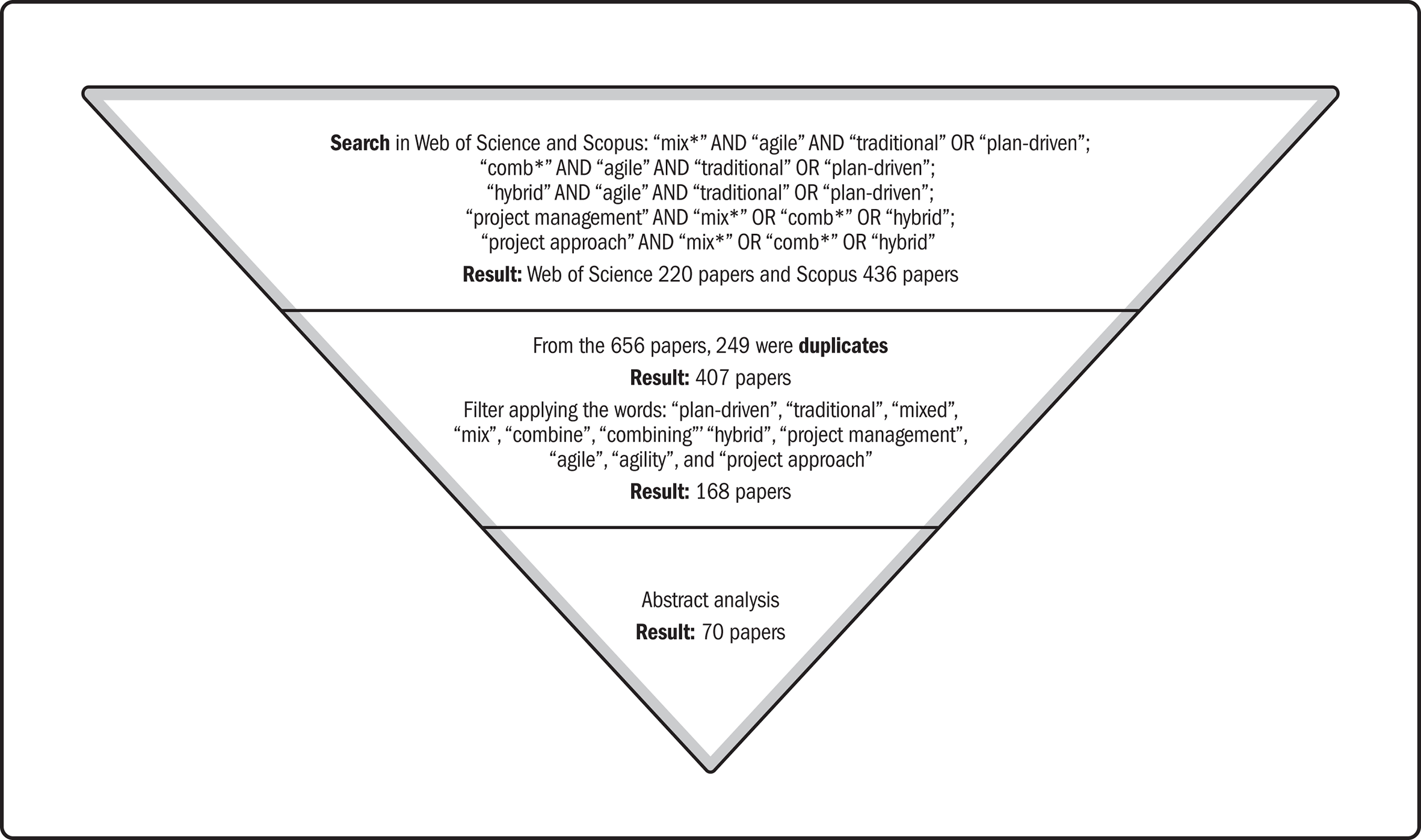
Systematic literature review process.
The first article on the subject was published in 2005 by Karlström and Runeson (2005), and there had been a continuous growth in the number of publications until 2019. The most relevant period is between 2015 and 2019 and comprehends 51% of the articles. Considering the total of 70 identified studies, 26 have been published in journals (37.14%), 43 of these works have been published in proceedings of conferences (61.43%), and only one work was published in the format of review. This fact shows that research concerning hybridity is relatively recent in the academic community.
Figure 2 presents the keyword network, built with VOSviewer software (Van Eck & Waltman, 2010). It is possible to observe the predominance of software development keywords, evinced by the “software design” central nodes, indicating that hybrid approaches to project management are more often related to software development contexts. The lower right cluster indicates that some studies relate hybrid management to innovation models, such as stage gate (Cooper, 2008). Thus, the analysis of the sample indicates two main perspectives of hybridism in the literature: studies with a focus on software development projects and studies with a focus on innovation projects.
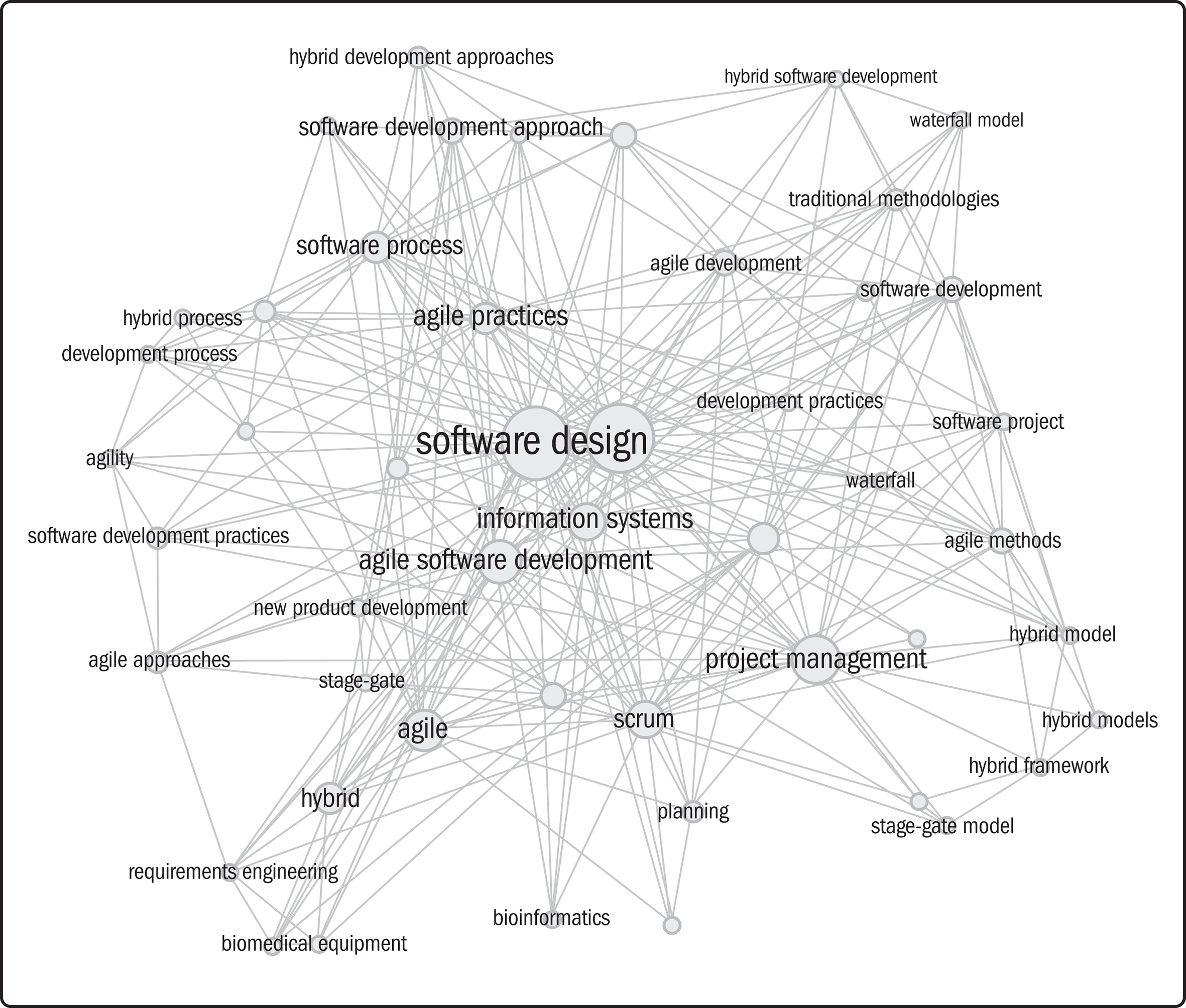
Cluster of keywords (VOSviewer).
Figure 3 highlights the keyword “hybrid” and its direct connections. It is possible to observe a direct relation with the keywords “requirements-engineering” and “biomedical-equipment,” illustrating the application of hybrid management models in specific software development contexts, such as the development of critical systems and medical equipment. This evidence indicates that some sectors present specific needs for project management that can be resolved with hybrid approaches to project management (Dingsøyr et al., 2018; Drechsler & Breth, 2019; Niederman et al., 2018).
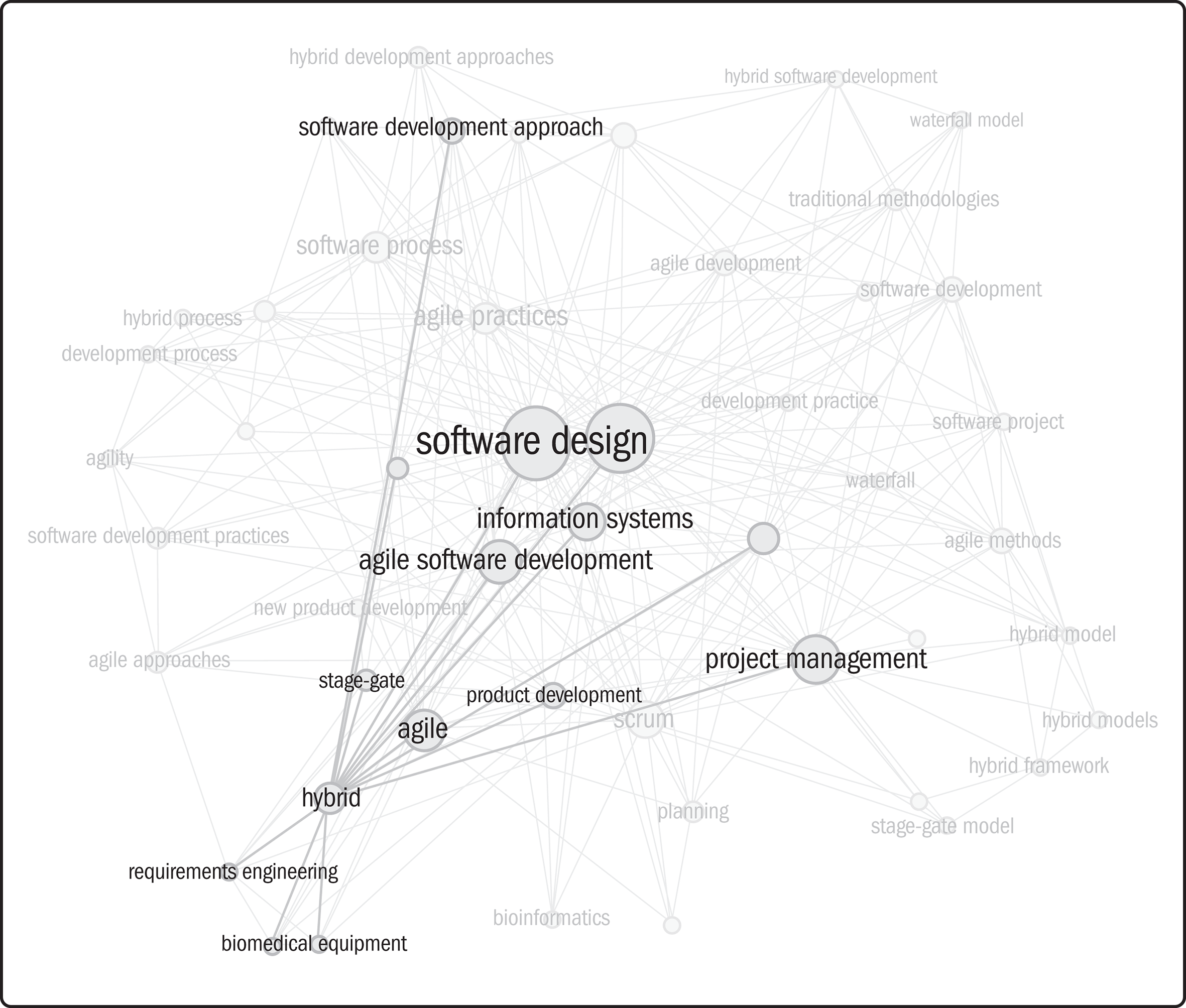
Cluster of keywords (hybrid; SOSviewer).
The titles and abstracts network presented in Figure 4 illustrate the relationship between the keywords “hybrid model” and “large organizations,” indicating that hybridism can be an approach for solving trade-offs in project management at large organizations. Thus, hybridity is a way to resolve the issue of scalability of agile approaches to project management in certain contexts, as advocated by Amaral et al. (2011). Moreover, Figure 4 also shows the combination among distinct project development perspectives, including stage gate, agile approaches to project management, and traditional project management approaches, reinforcing hybridity as a multifaceted phenomenon, with no single definition.
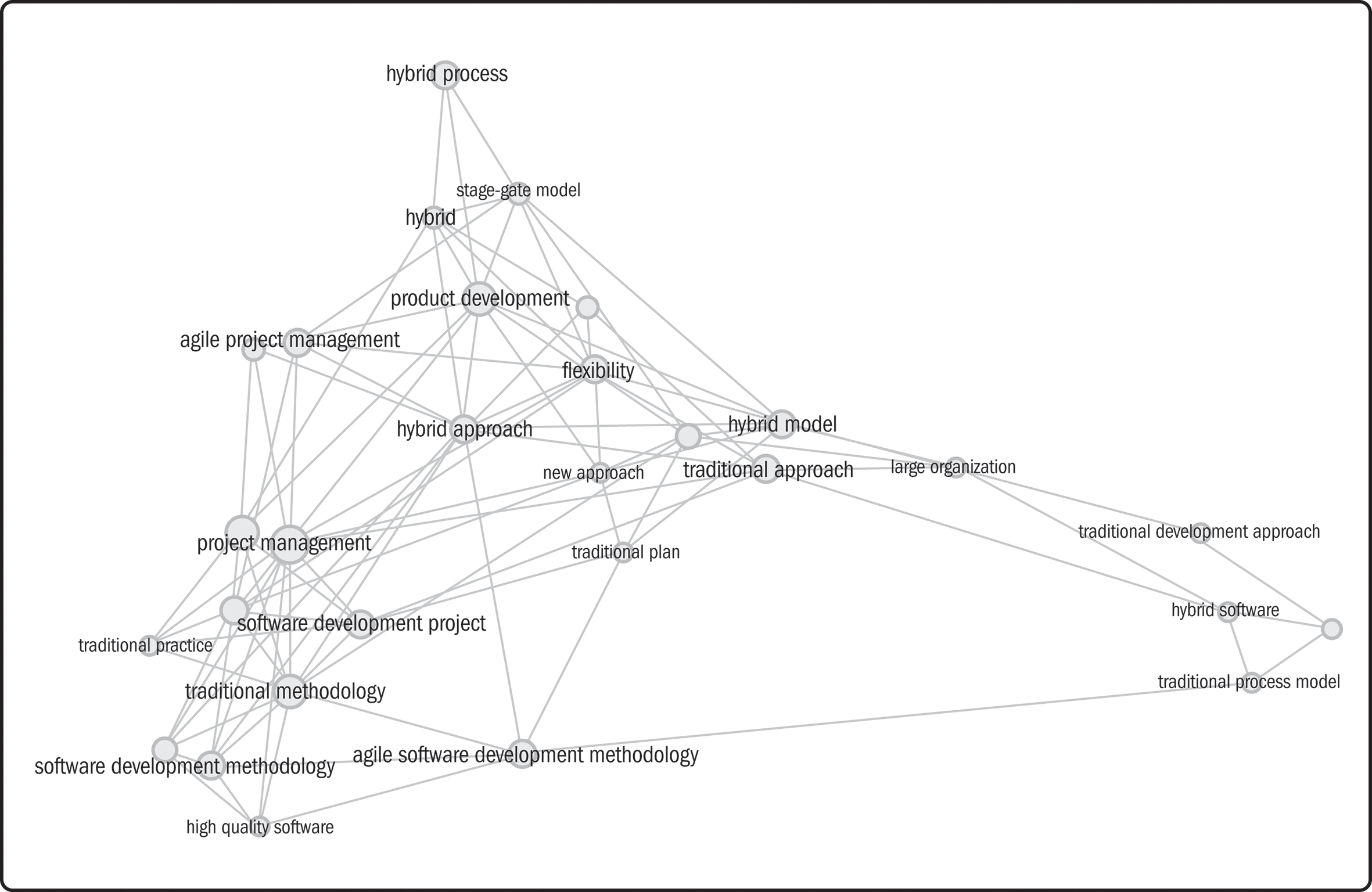
Cluster of terms: Titles and abstracts (SOSviewer).
Table 1 summarizes the characteristics of project management approaches identified in the literature, organized to show the fundamental differences between agile, traditional, and hybrid approaches, with the aim of classifying and identifying different project management approaches. It is relevant to note that there are several possibilities for hybrid approaches to project management, so Table 1 aims to synthetize some of the relevant tendencies and contributions identified in the literature concerning this theme. This procedure was inspired by Dezdar and Sulaiman (2009) and Leech and Onwuegbuzie (2007), who applied content analysis of the literature to propose a taxonomy to classify their main subjects of interest, evincing the relevance of this kind of approach for synthesizing knowledge from different research areas.
Characteristics of Project Management Approaches

Considering the results obtained with the SLR, it was possible to consolidate the fundamental characteristics of hybrid models in a single framework, as presented in Table 1. However, it is important to emphasize that the descriptions of the characteristics of hybrid management were compiled from the correlation of the characteristics of traditional and agile approaches shown in the literature. Thus, the framework was applied as a foundation to identify and to qualify methodologies and processes studied in the field case studies.
When observing the characteristics highlighted in Table 1, it is possible to note that in the various works found in the literature, traditional and agile approaches are rarely adopted in a purist way; that is, all project management approaches end up undergoing changes and adaptations, according to the needs of the environment, even if, in the case of agile, some authors emphasize that the practices must be implemented without modification to promote a cultural transformation of organizations (Cooper & Sommer, 2016; Schwaber, 2004; Schwaber & Sutherland, 2016).
On the other hand, hybridity is a natural phenomenon when adopting some style of project management, because there is an intrinsic need to adapt to the needs of the environment, in which the combination of practices and processes of the agile and traditional approaches is a way of dealing with the trade-off between the need for agility and project control (Conforto & Amaral, 2010; McCaffery et al., 2008; Rong et al., 2010; Torrecilla-Salinas et al., 2015).
In this way, the hybrid approach to project management is based on the premise of adapting the approach to the context specificities. Adaptations can be made considering the use of rapid prototyping techniques (Boehm & Turner, 2005), such as Kanban, work breakdown structures (WBSs), roadmaps, formal documentation, and even specific processes and techniques for the development of products and services. However, this is still an emerging research theme and not enough studies have been undertaken yet on the success factors of making adaptations or on teams’ abilities and skills in hybrid approaches to project management (Unterkalmsteiner et al., 2015), and so, as of yet, there is not enough information about the best ways to act and to achieve successful measures when making adaptations to project management. Success depends greatly on organizations’ capabilities to manage their daily routines effectively, harmonizing quantitative and qualitative requirements and stakeholders’ expectations. For these organizations, the emphasis should be in learning fast what is relevant and real, what works, and for whom it works (Unterkalmsteiner et al., 2015).
Literature presents models and practices of hybrid approaches, such as the concept created by Cohn (2009), the “waterfall up front” and “waterfall at end,” which aims to integrate traditional and agile management. From this concept, Hayata and Han (2011) propose a management model that combines elements of traditional and agile approaches for software development projects. In this model, the traditional approach is applied to the project at initial and final phases, where, according to the authors, there is greater need for planning in this context. Then, the agile approach is applied to the development, implementation and testing phases, where the need for agility is greater, as shown in Figure 5.
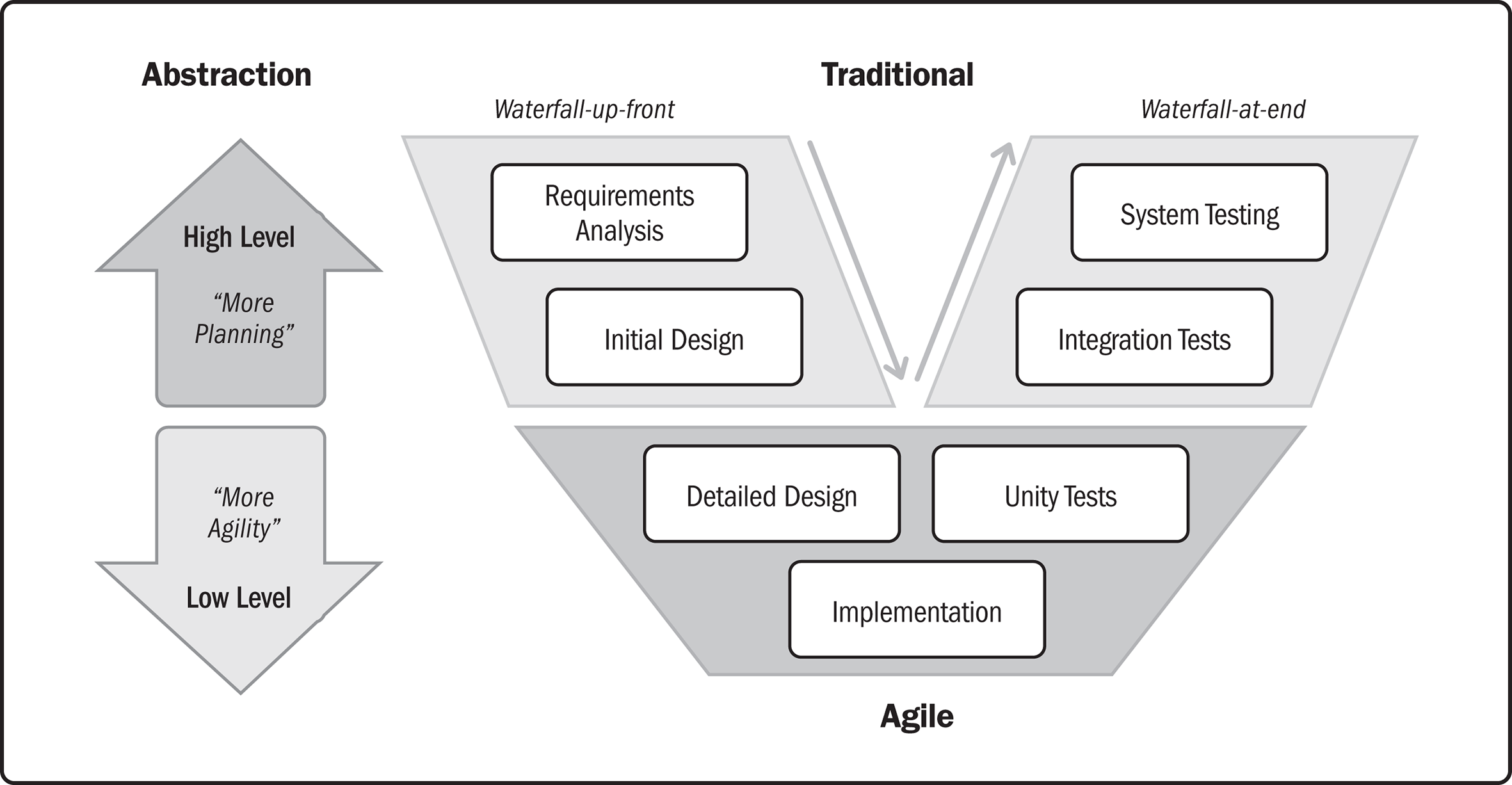
Hybrid model for software project management (adapted from Hayata & Han, 2011).
Another relevant model, also based on Cohn’s concept (2009), is proposed by Binfire (2016). In this model, traditional approaches, such as formal documentation, detailed requirement specifications, milestones, and WBSs are used for projects’ initial and final phases, as presented in Figure 6.
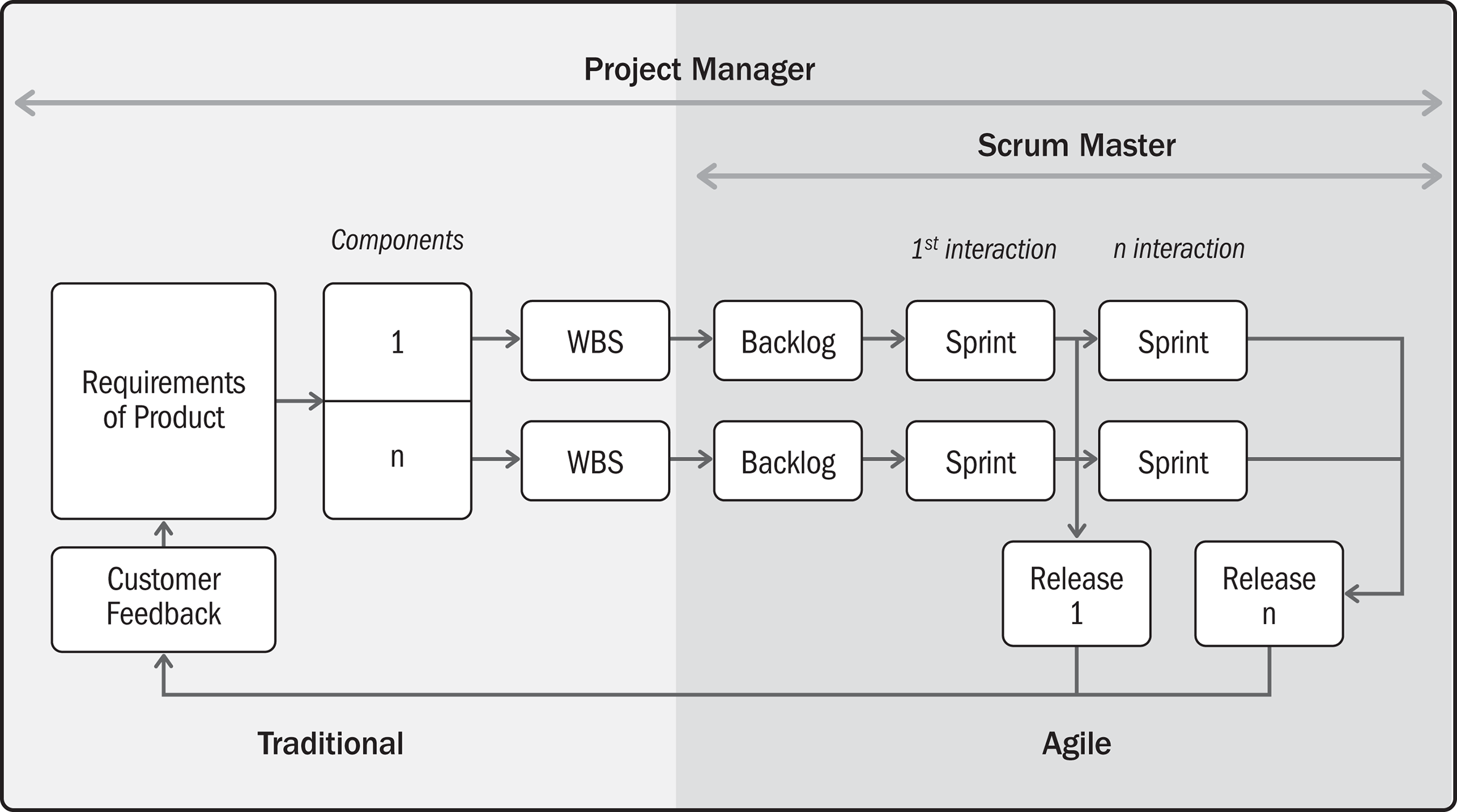
Hybrid approaches to project management (adapted from Binfire, 2016).
The model proposed by Binfire (2016) also presents an interesting management structure, in which management roles are divided into three: the project manager, based on the role described in traditional approaches; the scrum master; and the product owner, both of which are roles described in agile approach frameworks and, more specifically, in the Scrum framework. Here, there is only one project manager, who is primarily responsible for the project, as well as a single product owner for every project. On the other hand, there may be several scrum masters and also several development teams and delivery strategies, which will be organized based on the needs and complexities of the project in question. It is worth noting that each scrum master is responsible for the results and deliveries performed by the iterations and responds hierarchically to the project manager.
Another important hybrid model is proposed by Amaral et al. (2011). It is a model to scale agile management to large projects and is focused mainly on product development but it can be applied to any category of high complexity project. The model combines processes, techniques, and practices of traditional and agile approaches, such as personas, product backlog, and the concept of iterative development, which are techniques widely disseminated by agile approaches, and the use of robust documentation and precise planning and control, which are common techniques of the traditional approach, for projects’ initial and final phases (see Figure 7).
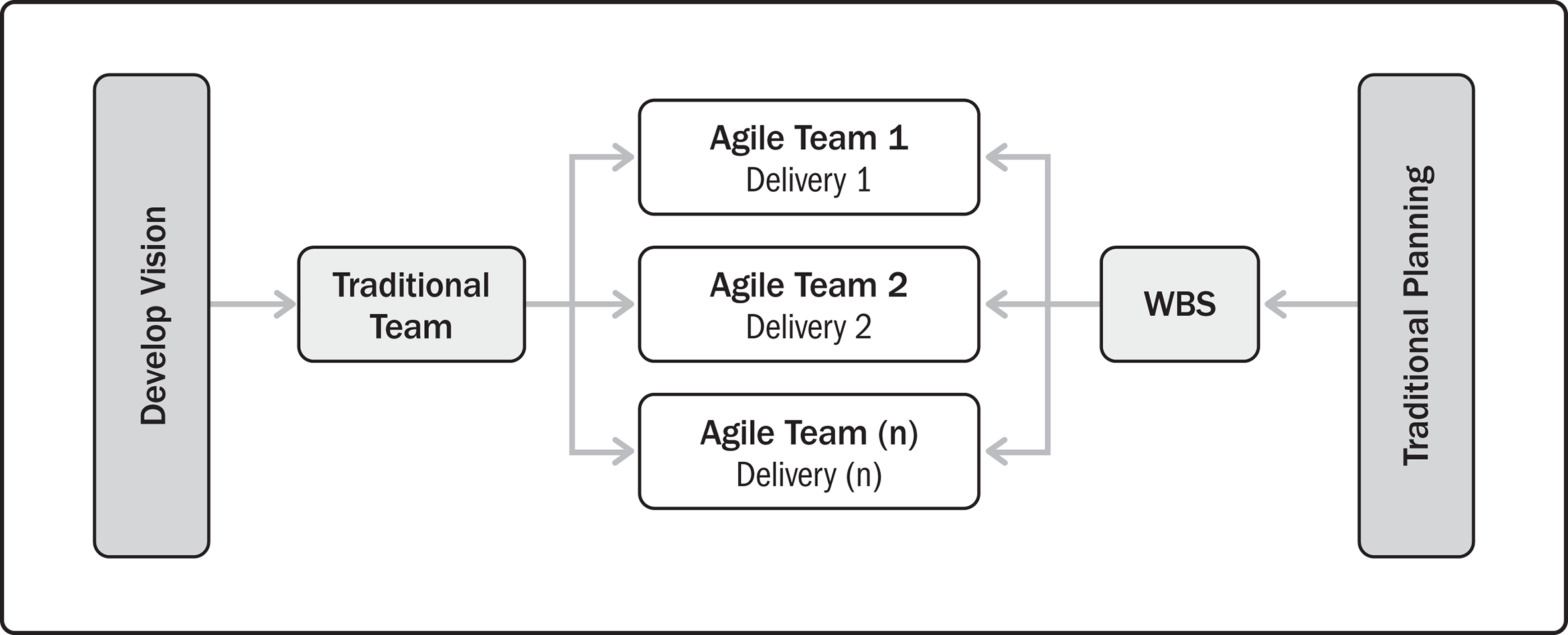
Model of hybrid approaches to project management for large and complex projects (adapted from Amaral et al., 2011).
In this model, agile planning is as a microplanning of the whole development. One advantage of this approach is that agile practices are more adaptive and allow a faster response when customers’ requirements change, being more vibrant, dynamic, and flexible (Cooper & Sommer, 2016; Verburg et al., 2013). Its main disadvantage is that it is not robust enough to support the whole product development process (Cooper & Sommer, 2016).
The presented SLR identified three main perspectives related to the fundamentals of hybrid approaches to project management. Network analysis illustrated the main contexts in which hybrid management is applied (e.g., innovative software projects for the development of complex systems, such as medical equipment in large organizations, in which the management of system requirements must accommodate varying considerations from different stakeholders, but cost and time constraints must be maintained). The main research themes concerning hybrid management are planning horizon, that is, time perspectives involved in the traditional and in the agile phases; project planning, including techniques and methods that are applied in each phase; activity details, that is, how project objectives are deployed into sequences of activities; project scope, considering how objectives are formulated in each development iteration; scope conformance, that is, how the adherence between the results obtained in each iteration and the general objectives are verified; control and monitoring, including artifacts that are generated to evince the evolution of the project; and finally, management style, that is, how the project manager acts to ensure that the project occurs according to scope, on time, and considering the available budget. Finally, the analysis of the hybrid models from the literature allowed the visualization of the connections between traditional activities and agile activities in hybrid projects, the first connected to the broader project planning and aligned with the different stakeholders and their specific governance systems, and the agile phase, with greater focus on improving productivity considering the available development teams, usually working in parallel, with sufficient vision of the objectives of a specific iteration but without vision of the whole project and, thus, strengthening the position of the project manager in relation to the achievement of overall project results.
Method
The purpose of this research is to reveal the characteristics of hybrid approaches to project management from a literature review and to analyze project management practices using case studies. From investigating how organizations apply this type of approach in their specific contexts, both its advantages and disadvantages are discerned. This kind of study requires the observation of the phenomenon in its context, in real-life routines (Eisenhardt, 1989; Voss et al., 2002; Yan & Yin, 2006).
Considering that theory-building research usually combines multiple data collection methods (Eisenhardt, 1989), this article combines multiple case studies in an exploratory way. This method is applied in exploratory research (Dingsøyr et al., 2018; Liu et al., 2019; Midler et al., 2019; Momeni & Martinsuo, 2019), starting with the formulation of the research question related to the emerging phenomenon in order to build knowledge capable of contributing to the academic discourse (Müller & Klein, 2019). Cooper and Sommer (2016) investigated publications that described cases of agile applications and highlighted studies with multiple case studies, a relevant method because multiple case studies allow cross-case analyses and the triangulation of obtained evidence, making it possible to look beyond impressions and to obtain evidence considering multiple perspectives, improving the levels of analysis, providing substantial foundations for hypotheses and constructs, and enhancing confidence (Eisenhardt, 1989).
Since the application of hybrid approaches to project management is recent from the academic point of view, the study conducted exploratory multiple case studies in an attempt to build first contributions to better understand the context and to add value to its application, benefits from exploratory case studies that were advocated by McEvoy et al. (2019). The research was exploratory and the multiple case studies contributed to analyze how organizations that develop technology-based products and services apply hybrid approaches to project management, a phenomenon that lacks academic research (Boehm & Turner, 2005).
The research planning was divided into five phases, as presented in Figure 8.
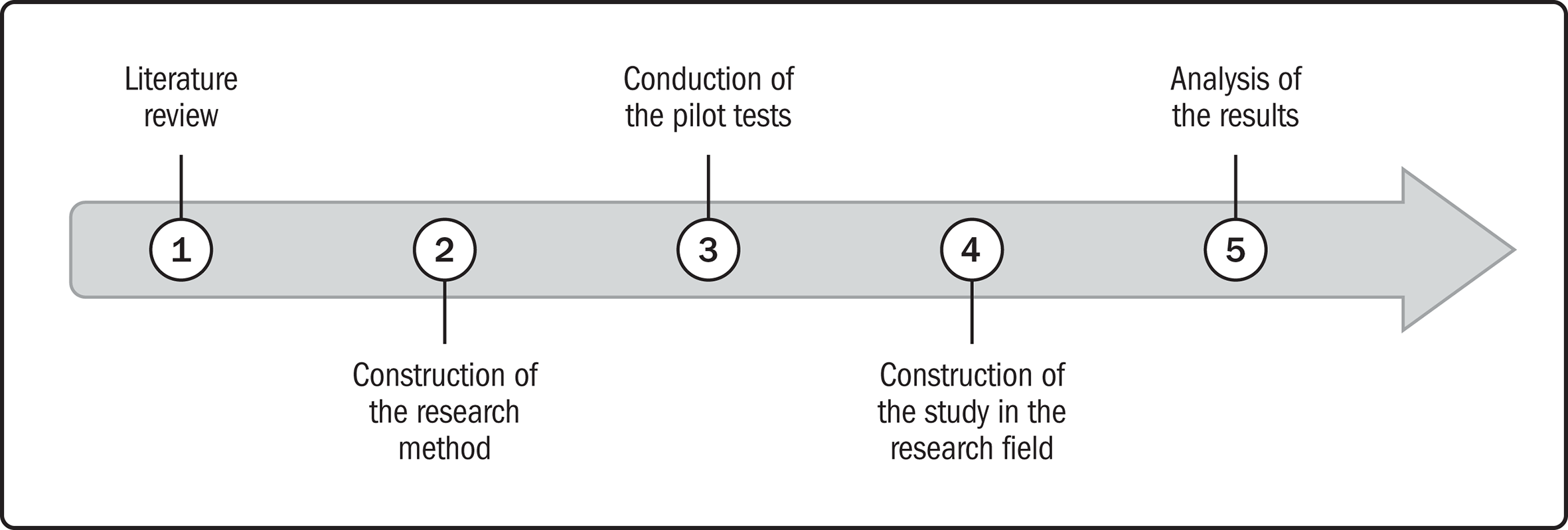
Research workflow.
The first phase consisted of the construction of the research theoretical background. According to Eisenhardt (1989), Voss et al. (2002), and Yan and Yin (2006), the development of a good theoretical framework is essential for mapping the literature and allows the construction of a robust and reliable research instrument. In the second phase, the research method was chosen and the research instrument was developed based on the most relevant theoretical references. According to Bryman (1998), and Creswell (1994), choosing the most appropriate method to answer the questions and to achieve the objectives of a study is fundamental to the research process. Therefore, it was verified that the questions and the objectives of the study have descriptive and exploratory characteristics, which are ideal for the application of the exploratory case study method (Eisenhardt, 1989; Voss et al., 2002). After defining the most appropriate research method for the study, the construction of the research instrument was conducted, taking into account the most relevant characteristics of each project management approach previously identified in the literature review, as recommended by Eisenhardt (1989) and Yan and Yin (2006). The construction of the instrument resulted in the research protocol and the interview script for field application, which are presented in the Appendix.
In the third phase, the research instrument was verified in a pilot test. According to Eisenhardt (1989) and Forza (2002), the objective of the pilot test is to verify the quality of the instrument and its ability to answer the proposed questions and to lead to a set of results, in accordance with the objectives initially proposed for the research. The pilot test was conducted through interviews with two project managers using a script developed for the purpose. Both interviews had an average duration of approximately one hour. The information was recorded using notes and an audio recording, with the appropriate authorization of the interviewees. From the results of the pilot test, it was possible to make adjustments in the protocol and in the interview script, and also to define the selection criteria for the companies to participate in the case studies, as suggested by Eisenhardt (1989) and Yan and Yin (2006). The research considered companies from different sectors and of different sizes that develop technology-based products and/or services. This was to be able to observe the practices of hybrid approaches to project management in different contexts.
Case studies provide a better understanding of the real world from the analysis of events that cannot be manipulated (McCutcheon & Meredith, 1993), and since the study was conducted in Brazil, case studies included Brazilian and multinational companies acting in the Brazilian market. To make sure the selected cases are representative and observable, the sample included companies from different sizes and sectors, resulting in a representative combination of cases. Therefore, selected case studies are relevant for the purpose of the study since they represent companies with different cultures and backgrounds that apply hybrid management approaches to solve their daily project management problems, allowing the analysis of the applicability and impacts of these approaches in the real world.
The fourth phase consisted of the execution of the field research initiative. In this stage, data were collected using semistructured interviews, document analysis, and in-person observation in each company using the research protocol and the interview script developed in the previous phase. Following the recommendations from Eisenhardt (1989) and Yan and Yin (2006), the interviews and visits were first scheduled with managers from the selected companies. The conversations were recorded with the authorization of the interviewees and notes were also taken. Documentation was made available by the interviewees and was subsequently analyzed and visits were made to the companies’ offices.
In the fifth phase, the collected data were transcribed, compiled, and organized to develop the narrative of the cases. The transcripts were sent for validation with the interviewees, as suggested by Eisenhardt (1989). Thus, data were collected from primary sources and also from secondary sources (Eisenhardt, 1989; Yan & Yin, 2006). The primary sources include data collected through interviews and in-person observation. The secondary sources include data collected from the analysis of the documentation made available by the interviewees, information from the companies’ websites, emails, and from informal conversations. The purpose of using multiple data sources is to gain a triangulation of the data collected, which offers greater robustness to the data analysis through the case study (Eisenhardt, 1989).
After the triangulation of the information, the results obtained in the field were analyzed and discussed using the theoretical framework developed for the research. However, it is important to note that, in practice, the fourth and fifth phases were executed in parallel; that is, while conducting the data collection in one company, data already collected in another company were organized and compiled. This strategy was adopted to optimize time in the field.
To guarantee the validity of the obtained results, four main aspects were observed (Farrington, 2003; Lee et al., 2010; Tüzün et al., 2015; Yin, 2008). The construct validity, which refers to the development of a logic capable of showing how the measurements effectively represent the constructs of interest for this research, was guaranteed with the consideration of different sources of evidence, which were registered, transcribed, and connected throughout the analysis process (triangulation); in addition, obtained reports were reviewed by interviewees. The internal validity, which aims to ensure the consistency between the observed variables and the obtained results, was obtained with the development of research tools based on the outcomes from the SLR and the conduction of multiple case studies that led to consistent results. The external validity, that is, ensuring that the study findings can be generalizable beyond the initial context, was obtained with the development of multiple case studies, the results of which were validated by two project management experts in a formal review process. Finally, regarding reliability, that is, ensuring that the study can be replicated either to test the findings of this study or to be applied in other domains, this article presents all research instruments and protocols.
Case Studies
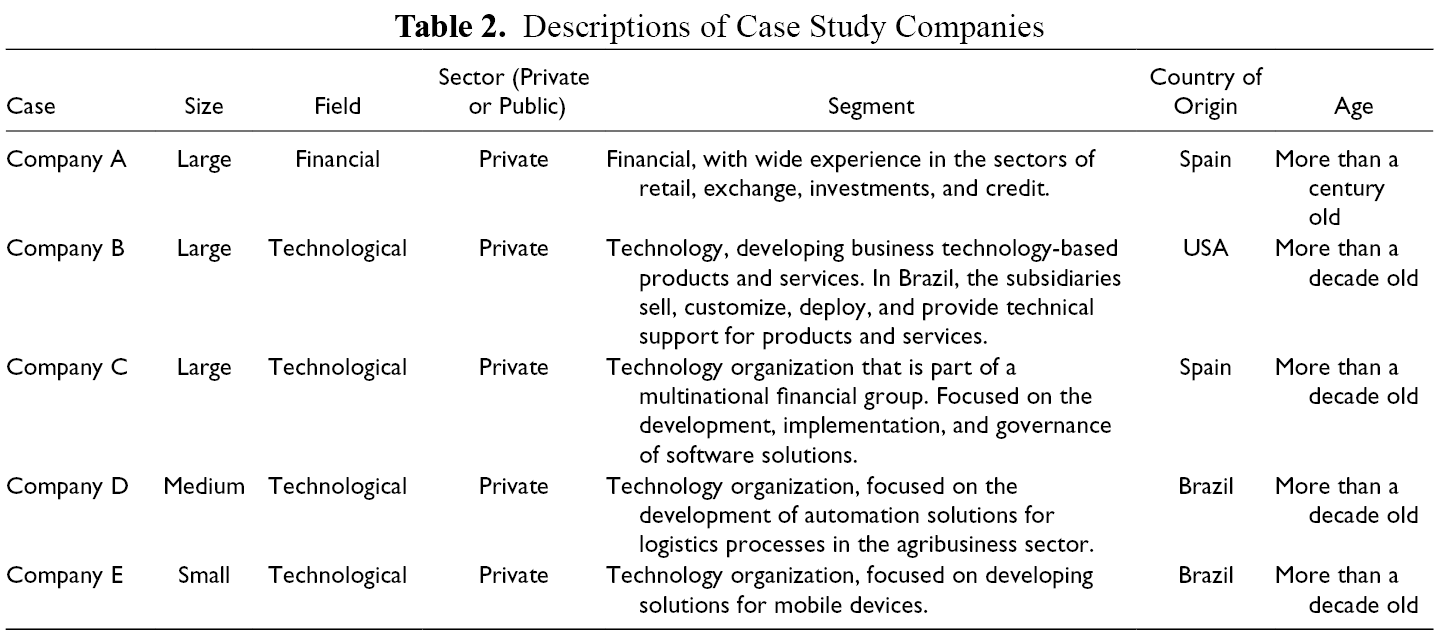
This section presents the case study companies and gives their most relevant characteristics in Table 2. Additionally, Table 3 briefly describes the observations made in the field.
Descriptions of Case Study Companies
Case Studies Presentation

Results and Discussion
This section presents and discusses the main results from cross-analyzing the information collected from the case studies and the literature review. The analysis was based on the topics presented in Table 1 (planning horizon, project planning, activities details, project scope, scope conformance, control and monitoring, and management style). The most relevant concepts identified in the literature were compared with what was obtained from the case studies, demonstrating how organizations effectively apply hybrid management, totally or partially in their specific contexts. Processes and techniques from the analyzed projects are also described and discussed.
Planning Horizon
The estimated duration of the project life cycle, time from the initial proposal until the end of the project, was classified similarly among companies: small (1 to 4 months), medium (5 to 12 months), and large (more than 12 months). Moreover, all studied companies had two horizons of planning for their projects under development (i.e., a long-term and a short-term horizon). The long-term horizon encompasses the overall project planning. It follows the traditional project management model, which is more detailed and covers the entire project life cycle. The short-term horizon covers the planning carried out for the iterations of the project. It has a lower level of detail and follows agile approaches to project management, according to the words of one of the interviewees:
Long-term planning allows you to see the project as a whole and short-term planning to make adjustments to the strategy by running and reviewing sprints.
In analyzing the documentation for the projects in companies B and D, it could be seen that the long-term horizon received more attention. The characteristics of the projects and the market sector in which these two organizations operate mean there is a greater need for the formalization of plans, according to one of the interviewees of company B:
We emphasize long-term planning due to the characteristic of the company and the market, which needs better formalization of the project plan.
However, in companies A, C, and E, the rigor of the long-term planning varied according to project size and product specification. Regarding the short-term horizon, all the companies maintained a simple planning process for each iteration, taking into account their objectives for the projects, according to one of the interviewees of company A:
The focus on project planning varies with the size of the project and the type of product to be developed, however, short planning for sprints is carried out regardless of the type of project.
Having two planning perspectives can also be observed as characteristics in the models proposed by Amaral et al. (2011) and Binfire (2016). Therefore, both the case studies and the models in the literature show that organizations use a long-term and a short-term horizon when using hybrid approaches to project management. Indeed, the horizon of planning in hybrid approaches to project management can be understood from these two perspectives, which are mutually complementary and, for projects in particular contexts, the two perspectives work together to bring about a successful outcome.
Project Planning
As discussed above, all the case study companies had both long-term and short-term planning horizons for their projects in development. In practice, having these two horizons meant there were several project plans in place for the same project. This was apparent from analyzing the organizations’ documentation.
The long-term plan in the case study companies contained a short explanation of the project scope, descriptions of the objectives and expectations, and the estimated number of iterations necessary for achieving the planned results for the project. Companies A, B, and D often used techniques such as roadmaps and work breakdown structures for their long-term planning. The use of these practices is also recommended for long-term planning in hybrid approaches to project management models identified in the literature (Amaral et al., 2011; Binfire, 2016; Hayata & Han, 2011).
On the other hand, in all the studied companies, the short-term plan had only a metaphorical and visual description of the objectives and of the expected results of each iteration, as reported by one of company A’s interviewees:
For long-term planning, we use techniques like activity roadmaps and work breakdown structures, while for short-term planning, we use simple techniques like Kanban with brief post-its descriptions.
These characteristics are similar to the practices found in the agile literature on project management (Highsmith, 2004; Schwaber, 2004; Schwaber & Sutherland, 2016). In particular, in companies A, C, and E, the short-term planning of each iteration was carried out directly by the project development team, and in companies B and D, directly by the project manager.
It is interesting to note that both the planning horizons and project plans followed a long-term and a short-term vision in all the analyzed companies. These characteristics are also identified in the hybrid approaches to project management models found in the literature (Amaral et al., 2011; Binfire, 2016). Therefore, the models in the literature and the practices of the case study companies tally in their use of hybrid project planning practice.
Activities Details
The detailing of the activities also followed the idea of a long-term and a short-term horizon in the projects of the studied companies; that is, the refinement of the scope in these projects is guided by long-term and short-term perspectives, just like in the project plan. In this way, the detailing of the activities is carried out from two distinct views: a general, long-term view that covers the whole life cycle of the project, and a specific, short-term perspective, that covers only the life cycle of an iteration, according to the words of one of the interviewees:
The activities are detailed according to the planning perspective, that is, long and short term.
In companies A, B, and D, the detailing of the long-term activities is fundamental for their projects because of the characteristics of the market sectors in which they operate. This detailing is accomplished with the use of the WBS technique, in which activities are grouped and classified according to the amount of iterations necessary for the project execution. In this context, iterations can be considered as subprojects, since they have planning and detailing of distinct activities, and, sometimes, even an entirely dedicated team, as reported by one of company D’s interviewees:
We detail activities through the use of the WBS, taking into account the number of sprints estimated to achieve the project goal. So, each sprint turns out to be a subproject ...
For companies C and D, the detailing of long-term activities was also performed, but with less rigor. The practices identified in the case study companies are also seen in the hybrid approaches to project management models found in the literature (Amaral et al., 2011; Binfire, 2016).
In the case studies, short-term activities were detailed for each planned iteration. However, it was possible to observe differences in the specific procedures adopted in each context. In companies A, B, and D, this detailing is performed by project managers, during the project planning phase. In companies C and E, activities are detailed by the development team, based on the objectives determined for each iteration by the project manager, during the overall project planning. However, in all the case study organizations, activities at the iteration level were visually represented using panels, such as Kanban, either through a physical mural or software specifically designed for the purpose.
An important fact concerning the practices of detailing the activities in the case study companies is that the long-term and short-term structures allow projects to be scaled, which aligns with the work of Robins (2016), who argues that with the deployment of the overall WBS, it is possible to generate several backlogs that can be independently tackled by different development teams. It is possible, therefore, to have several development teams working in parallel at different iterations, demonstrating the potential of hybrid approaches to project management to be used for large and complex projects.
Project Scope
In the case study companies, the scopes of the projects were always structured in formal documents. However, the content and rigor of the documents varied according to the type of project, the culture of the company, the nature of its activities, and its market. In companies A, B, and D, the construction of the project scope was generally more robust and formal, with details of the objectives and expected results, as well as extensive descriptions of the specifications and requirements of the final product. However, the level of detail of the description again varied according to the complexity of the project’s product, according to the words of one of the interviewees of company D:
We often use detailed descriptions of the project requirements, but this level of detail varies with the complexity of the product that will be developed.
In companies A, B, and D, the scope document was prepared and distributed by the project manager, who was also responsible for updating it throughout the project’s life cycle. In companies C and E, the scope document for the analyzed projects tended to be leaner and less descriptive. As with the other companies (A, B, and D), the document content often varied according to the complexity of the project. However, the development of the scope document was not only the responsibility of the project manager but also of the entire team, which acted as a co-author, as reported by one of the interviewees:
Scoping is not only the responsibility of the project manager, but the entire team, including the developers and key users.
It is interesting to note that, in all the analyzed companies, the idea of a short-term and a long-term horizon was also present in the project scope. The formal scope document was developed taking the perspective of long-term planning, which was then deployed into specific backlogs for a group of iterations, or even for an individual iteration. Consequently, there were two perspectives in the project’s scope: a long-term perspective, based on a formal document covering the project as a whole, and a more informal perspective, which was represented by backlogs with specific short-term objectives.
The characteristics of the scope identified in the case studies match those presented in the hybrid approaches to project management models in the literature (Amaral et al., 2011; Binfire, 2016; Hayata & Han, 2011). The idea aligns with Boehm’s argument (Boehm, 2002), which considers the complexity of the project’s product as a determinant factor for selecting the approach for developing the scope. Boehm states that it is preferable to opt for a more or less formal planning approach, taking into account the complexities of the product to be developed. Therefore, aligned with Robins’ (2016) argument, hybrid approaches to project management can help in the case study companies to guarantee this balance.
Scope Conformance
In the case study companies, conformity with the scope was also verified using long- and short-term horizon perspectives.
In the long-term perspective, scope compliance was verified by evaluating the results at the end of each phase planned for the project, when the specified scope items are confronted with the obtained deliveries (i.e., what was delivered is as described in the scope). This verification was done in formal meetings attended by project committees, as reported by one of the interviewees:
We check at the end of each phase or sprint whether the objectives have been met, that is, whether the project product meets expectations.
However, while all companies evaluated compliance with the scope from a long-term perspective, the periodicity and format of the meetings were determined by the nature of the project and by the organizational culture, as reported by one of the interviewees:
The ritualistic changes according to the type of project. For smaller projects, the meetings are more informal, resembling Scrum’s daily meeting.
Regarding the short-term perspective, compliance with the scope was not evaluated at specific events. In all the case study companies, compliance with the scope in the short term was verified throughout each iteration, and also at the end, in a continuous process. What was being developed, the planned objectives, and the expected results were continuously checked in an ongoing interaction.
In the case study organizations all the companies had both short-term and long-term perspectives in their scope conformity; this suggests that the scope must develop incrementally throughout the project life cycle. This idea aligns with another: that, for projects involving high risk and uncertainty, project management must be guided by a “vision” of what should be developed rather than an initially pre-established scope (Highsmith, 2004; Highsmith & Cockburn, 2001; Sliger & Broderick, 2008). However, in certain contexts, the characteristics of the industry require a minimum definition of the initial scope. Therefore, hybrid management practices contribute to balance these models and favor incremental developments, even in contexts in which these practices are not common.
Control and Monitoring
As the development of the scope and planning were guided by long-term and short-term horizons in the case study companies, project control and monitoring also followed the same model. Control and monitoring took the long-term perspective and followed the characteristics of traditional project management frameworks, with the presence of schedules, performance indicators, analytical panels, and reports. Long-term control and monitoring were performed directly by the project manager, who was responsible for detecting changes and deviations from the scope and planning throughout the project life cycle, according to the words of one of the interviewees:
Long-term control and monitoring processes generally follow traditional management techniques, but for the short-term perspective, agile techniques are more widely used.
On the other hand, in the short-term perspective, control and monitoring was performed during each iteration and basically followed the practices presented by project management frameworks using agile. In this type of control and monitoring technique, visual panels in the form of Kanban, which can be physical or digital, were used to control and monitor the activities and obtained results during the execution of the iterations.
In companies A, B, and D, short-term control and monitoring was done by the project manager and the development team together, as reported by one of company B’s interviewees:
Short-term controls are carried out by both the project manager and the development team. It’s a shared responsibility.
However, in companies C and E, iteration control and monitoring were done only by the development team, which was responsible for ensuring the expected results and reporting them to the project manager.
The characteristics of the control and monitoring of projects in the case study companies show similarities with those found in hybrid management models in the literature (Amaral et al., 2011; Binfire, 2016). This form of project control and monitoring seemed to assist the case study companies to deal with changes in a gradual manner, as in agile management, but without losing the robustness provided by traditional management in the long term. In this way, the evidence indicates that hybrid management can assist with balancing the flexibility to handle change against the rigor and control required for complex, large-scale projects.
Management Style
The management style used in the case studies varied according to the organizational environment and also with the economic sector of the companies. However, in all the case studies, there was a project manager role, with different levels of management centralization and decision-making activities.
Since companies A, B, and D operated in more traditional and formal organizational environments, the project manager role tended to be more centralized. However, in all of the analyzed companies, a team leader was identified, generally represented by the figure of the product owner, who reported to the project manager, as reported by one of company D’s interviewees:
Product owners report directly to the project manager, but have some degree of autonomy for strategic decisions and planning.
This leader was responsible for the indirect management of the team and had autonomy to make decisions and to conduct the internal planning of the iteration. However, these activities were always conducted together with the team, because this leader was not hierarchically above the other members. This was because the structure of these teams was entirely horizontal and is equivalent to that presented by Scrum (Cooper & Sommer, 2016; Hoda et al., 2012, 2013). This style of management is very similar to that found in the hybrid approaches to project management model proposed by Binfire (2016), in which there are two leaderships with different roles and responsibilities in the projects.
On the other hand, in companies C and E, the figure of the project manager was less centralized and focused more on strategic issues and decisions related to the projects. Unlike the other companies, the teams did not have the figure of a leader and reported directly to the project manager, according to the words of one of the interviewees:
Teams have a high degree of autonomy and report directly to the project manager, whose primary role is to strategically direct the project in the company, that is, the manager will not make the technical decisions of the project.
However, in the same way as in the other companies, the team had autonomy for decision making and the internal planning of the iterations, and it was their responsibility to ensure that the results generated were in accordance with the objectives and expectations of each project iteration.
Based on the leadership structure identified in the case study companies, it is interesting to note that the different roles allowed to scale the agile management model, especially with the extension of the role of the product owner (Bass, 2015). In this scenario, hybrid approaches to project management seem to be an effective way to scale agile approaches to project management, especially for projects of great complexity and size in companies and economic sectors that demand greater control and predictability.
Discussion
The analysis of the case study companies about the similarities and differences in the adoption of hybrid approaches to project management considering the seven main research themes identified in the literature review revealed advantages and disadvantages in the adoption of this approach in technological development projects in complex contexts. Table 4 highlights similarities and differences among the case studies, and the most relevant identified advantages and disadvantages are summarized in Table 5.
Similarities and Differences Among Studied Companies

Advantages and Disadvantages of Hybrid Approaches to Project Management

Aligned with the findings from the literature review, in all the case study companies hybrid approaches to project management were used for large projects, which involved several consultants, specialists, and partner companies, such as professional service projects (Chih et al., 2019). According to observations made during the research period, hybrid management was used for projects with complex scopes and great technical challenges, delivering risk and feasibility analyses but not limiting project scope, making possible the accommodation of the necessary changes demanded by the market, with appropriate response time. The approach was not generally used for small projects with low complexity scopes, since interviewees considered its inherent complexity to be a disadvantage of using hybrid approaches to project management in the everyday life of their companies. For example, in companies A and B, some respondents reported that attempts to apply hybrid management approaches to small and simple projects was costlier than the development of the product itself. This corroborates with Amaral et al.’s model (2011), which is targeted toward complex projects. It is relevant to note that other models in the literature do not make a distinction between the complexity and size of the projects for using hybrid management approaches. Therefore, evidence from the case studies reinforces the literature and makes clear that this type of management is recommended more for large and complex projects, corroborating with Boehm and Turner (2003). These authors argue that large-scale and complex projects require a management approach with a greater focus on project planning and control.
Hybrid approaches to project management have also proved to be appropriate for projects that need a higher speed and flexibility in the development phases but also need to maintain greater rigor and control in the initial and final phases because of the characteristics of the project and its environment, allowing projects to absorb changes considering the pace of market innovation, without disregarding the technical and financial viability planning of the projects (Binfire, 2016). In the cases of companies B and D, owing to the characteristics of their activities and the sectors in which they operate, the usual way of contracting projects requires that the planning, scope, and delivery of the projects are formalized. These companies use hybrid management to balance the need for more rigorous initial planning with agile development processes. This evidence resembles the models presented by Cohn (2005), and Hayata and Han (2011), who apply the traditional approach to the initial and final phases of the projects, and the agile approach to the development phase. In addition, hybrid management is also used to scale agile management in large projects. This strategy meets the objectives of the models proposed by Amaral et al. (2011) and Binfire (2016).
On the other hand, in all the analyzed companies, the successful application of hybrid approaches to project management is directly associated with the experience of the project manager, a characteristic that is currently being explored in the specialized literature (Akkermans et al., 2020; Lo Presti & Elia, 2020). Some interviewees reported that, because of the wide possibility of combinations among methods, techniques, and processes of both approaches, the choice of the most appropriate arrangement for each project context is the responsibility of the project manager, allowing the integration of agile management practices for the development of innovative solutions without conflicting with rules and guidelines for project development formalized in governance models. The application and use of hybrid approaches to project management relies on the project manager’s experience, and in the case study companies, the absence of competent managers was a limiting factor for the use of this type of approach. Hybrid approaches to project management processes lack standardization and there is no unique approach, demanding specific methods and tools for each project, dynamically customized and applied by the project manager.
Furthermore, in the case study companies, large or complex projects usually had several development teams, in the same way as the models proposed by Amaral et al. (2011) and Binfire (2016). This enables the creation of team structures similar to “development production lines,” also known as “squads,” which are demanded for the execution of specific iterations of portfolio projects in a concurrent manner, favoring a systematic and rational allocation of resources (Hobbs & Petit, 2017). This particularity allows the scalability of development activities, since several teams can strategically execute backlogs, either in an interdependent or parallel manner, favoring the application of the concept of agility in large projects or with highly complex scopes. Moreover, hybrid management makes it possible to geographically distribute the execution of the project in autonomous development cells, managed to achieve different goals, which together make up the objectives established for the project. However, according to some interviewees, the teams involved in such projects were sometimes resistant to new techniques and processes, in accordance with Boehm and Turner (2005). This is a disadvantage in the use of hybrid approaches to project management, since complex team structures configured in development production lines implies higher complexity of resource management, requiring the adaption of the project portfolio considering this paradigm, so that the benefits of hybrid management are achieved in its fullness.
On the other hand, all the analyzed companies indicated that hybrid management is ideal for innovative projects, those involving a high amount of uncertainty and that cannot be undertaken without some level of planning because of the constraints of the organizational environment or the business sectors (Martinsuo, 2019; Midler et al., 2019). In alignment with the results presented in SLR, suitable projects for adopting hybrid management include research and development of new technologies with innovative character and involving high levels of complexity, risks, and uncertainties. However, case studies also showed other categories of projects that are suitable for hybrid management: development and implementation of products and services, with less innovation and fewer risks and uncertainties, but with a moderate degree of complexity and technical challenges; as well as projects focused on operational needs, such as maintaining services, platforms, and applications in operation, with low risk and little complexity, but critical to sustaining business. Moreover, companies apply hybrid management for projects in order to create new business models, ensuring that the scope remains open, but avoiding the “endless” project effect, in which a scope is not fully attended due to several changes throughout the project life cycle. Hybrid approaches to project management adapt to business processes and governance models, avoiding possible conflicts and failures in project communication processes, as well as favoring the synergy between the project management approach and the organizational culture of companies. In company D, which works on projects for the public sector, it is not possible to start a project without the minimum formalization of planning and scope, mainly due to the bidding and contracting processes of the projects. Hybrid approaches to project management can be used in such instances to balance the risks and uncertainties of projects. Likewise, hybrid approaches to project management has also proved to be suitable for projects where tolerance to changes of scope is mandatory. In companies B, C, and E, the vast majority of projects are subject to constant changes of scope. However, these companies apply long-term and short-term planning, which allows them to deal with changes during iterations in a similar way to Binfire’s (2016). The ability to deal with risks, uncertainties, and constant changes is a relevant identified advantage in the application of hybrid approaches to project management in the case study companies.
As previously presented, the estimated duration of the project life cycle was similar among companies. Hybrid management is adopted for projects with long deadlines, because it is necessary to integrate and to manage different stakeholders, as well as maintaining stricter project planning and control. As a consequence, considering the innovative essence of products and services developed in these projects, there is the need to maintain flexibility to accommodate scope changes throughout the life cycle of the project, driven mainly by changes in strategy and market trends (Kosztyán & Szalkai, 2018).
Conclusions
In complex environments, project management requires the application of increasingly refined sets of techniques and tools (Saynisch, 2010), which can be adjusted according to the particularities and the evolution of each project. In turn, these adjustments should consider the requirements, specific cultural influences present in the clients, a fact that makes hybridity a natural path to this end, reinforcing the relevance of the project manager’s sensitivity in defining the method and making it difficult to identify “one size fits all” approaches. In hybrid contexts, each project manager has their own set of techniques, methods, and tools, which can be combined, experimented with, observed, and refined in different project contexts
The concept of placement, defined by Buchanan (1992) as the orderly and systematic application of techniques and tools in creative processes, is an analogy for the current context of hybrid approaches to project management. The application of a placement provides direction and guidance for a creative process; however, its application in a specific project can generate a new perception about the original process, and therefore, new possibilities to be experienced. Thus, in addition to direction and guidance, placements are sources of innovative ideas and show new possibilities when applied in specific circumstances. As demonstrated in this research, hybrid approaches to project management are more effective in complex projects, that is, large projects with a focus on the development of innovative applications. In this way, the placement of the project manager is applied to maximize the value delivered while considering the specificities of the project and the involved development teams. This enhances the importance of hybrid approaches to project management in the search for effective results in highly complex contexts.
The results of the research also evinced the practical characteristics of hybrid approaches to project management, which were analyzed in light of previous findings from the literature review, including similarities, differences, and the most relevant advantages and disadvantages. With regard to practical managerial contributions, the study illustrated the trend of the hybridization of project management in complex projects, with the combination of agile and traditional techniques and tools in two distinct moments and aligned with the previous models identified in the literature (Amaral et al., 2011; Binfire, 2016; Hayata & Han, 2011). However, case studies also showed the relevance of the project manager and their ability to customize techniques and tools in order to obtain the best productivity from distinct development teams. In the case study companies, hybrid approaches to project management resulted in fundamental practices that supported development processes, distinct organizational environments, specific processes of product and service development, contractual requirements, large project size, and technical complexity. These findings are useful for organizations that are experimenting with hybrid approaches to project management.
Results from the case studies are convergent and contribute to the design of future research. In particular, future case studies can replicate research protocols in other contexts to corroborate with results presented here and to identify other sets of relevant hybrid approaches to project management characteristics. In addition, a survey with a significant sample of companies can be conducted to analyze the characteristics observed in this study (initial hypothesis) and to identify other advantages and disadvantages from a large sample. Furthermore, the identified characteristics of hybrid management can be used in new studies to explore criteria for the selection of project management approaches, evolving toward a model for selection of the most appropriate project management approach for a specific environment.
There are limitations in this study: first, all analyzed companies operate in the Brazilian market. Therefore, although results can be contextually generalized, they cannot be extrapolated to other realities where innovation dynamics are significantly different. Second, the use of case studies as the research method captures a specific moment, occasionally demanding review in order to verify if assumptions and outcomes remain true. Moreover, the study requires other similar initiatives in different contexts, in order to guarantee consistency among the obtained results.
Footnotes
Appendix
Declaration of Conflicting Interests
The author(s) declared no potential conflicts of interest with respect to the research, authorship, and/or publication of this article.
Funding
The author(s) received no financial support for the research, authorship, and/or publication of this article.
Author Biographies