



Abstract
The impact of behavioral aspects on project success remains an area that requires more attention. Drawing on the social exchange theory (SET), our study tested the mediating role of project citizenship behavior (PCB) in the relationships of all four organizational justice dimensions (i.e., procedural, distributive, informational, and interpersonal justice) with project success. A time-lagged survey of project team members (n = 233) was conducted and analyzed through structural equation modeling (SEM). The results indicate that all four organizational justice dimensions are positively associated with project success, whereas informational justice appears to be the most influential dimension, and that PCB mediates all of these relationships. Project managers/sponsors should enact organizational justice and enhance project citizenship to achieve project success.
Introduction
Project success is probably the most extensively deliberated topic in project management literature. A vast number of factors have been identified that potentially enhance or improve the performance of projects—some of them are more generally applicable, such as tools, practices, and support (Jitpaiboon et al., 2019)—whereas others are focused on specific regions or industries, such as software or public–private partnership projects (Almarri & Boussabaine, 2017; Tam et al., 2020). However, project performance issues are continuing, and large amounts of money are being wasted on a daily basis due to poor performance and issues, such as overspend, scope creep, time overrun, and non-achievement of goals (Project Management Institute [PMI], 2020b). PMI’s recent Pulse of the Profession ® study found that, worldwide, over 11% of every dollar spent on projects is in fact lost (PMI, 2020b). Interestingly, it was also found that 65% of organizations see the development of their project professionals’ leadership skills as a high priority to improving this situation and it has been recognized that project managers will not get far without people skills (PMI, 2020a). This indicates that people and psychosocial aspects are gaining importance in addressing the challenges of weak project performance (Berssaneti & Carvalho, 2015; Maqbool et al., 2017; Williams, 2016). Nevertheless, there has been little empirical attention paid to psychosocial relationships and, more importantly, the effect of these relationships on project success (Unterhitzenberger & Bryde, 2019).
One approach that has shown promising results in this area is organizational justice (Loosemore & Lim, 2015; Unterhitzenberger & Bryde, 2019). Organizational justice focuses on how individuals perceive fairness in the workplace (Greenberg, 1987) and recognizes that the way employees are treated has an impact on their behavior at work. Meta-analyses from Cohen-Charash and Spector (2001), Colquitt et al. (2001), and Viswesvaran and Ones (2002) have established that organizational justice positively influences both employees and organizations, with the employee’s organizational citizenship behavior (OCB) being one of the key benefits (Chan & Lai, 2017; Fassina et al., 2008). OCBs are defined as behaviors displayed by employees that go beyond the contractual requirements and are above and beyond what organizations can legally demand (Fassina et al., 2008). OCBs have been recognized as being critical to the survival of organizations due to the ever-increasing competitive business environment. Projects are also generally regarded as competitive business environments with increased pressures because of their temporary nature (Bakker et al., 2013). Project team members are required to work under limited budget and time constraints, which often require them to go beyond the minimum job requirement and put more personal effort into a project than they are formally required to do by contract. On the project level, this phenomenon has been defined as project citizenship behavior (PCB; Braun et al., 2012).
With our research, we propose to investigate the four-dimensional organizational justice constructs and their relationships with project success, including the mediating role of PCB. Doing so is of relevance, as Colquitt and Jackson (2006) highlight the context-sensitive nature of organizational justice and suggest that it is perceived differently in various social and organizational contexts. We do not know if the strong support for the organizational justice and OCB relationship found in classic organizations holds true in the significantly different context of projects. Projects are complex social constructs viewed as temporary organizational systems that are distinct from permanent organizations (Braun et al., 2012; Hobday, 1998) in four key aspects. These aspects are time, which is limited in temporary organizations; task, which is the reason the project (or temporary organization) is launched; team, which focuses on the interpersonal relationships and the interplay with the permanent organization; and transition, which is about the requirement to achieve transformation as a result of the temporary organization (Lundin & Söderholm, 1995). Unterhitzenberger and Bryde (2019) utilized a simplified three-dimensional construct for organizational justice, which proposed an impact on project performance; however, this construct has limitations because it does not account for a nuanced investigation of the more detailed four dimensions of organizational justice. Furthermore, project citizenship behavior—or PCB—was not considered a mediator; therefore, this relationship remains unknown. Hence, we aim to answer the following research questions: (1) How do the different organizational justice dimensions impact project success? And (2) Is the relationship between dimensions of organizational justice and project success mediated by PCB?
We conducted a large-scale, time-lagged quantitative study with 233 participants and performed the analysis via partial least square structural equation modeling (PLS-SEM; Hair & Sarstedt, 2019). Our findings revealed that all four organizational justice dimensions positively impact project success and that this impact is mediated through PCB. We therefore contribute to the project management literature twofold. First, we enrich the project management literature by empirically investigating the impact of organizational justice dimensions on project success directly and indirectly through the mediating role of PCB. Second, we also provide recommendations for project leaders and managers to stimulate the exhibition of citizenship behavior in project teams, thus contributing to project success. In the next section, we will provide the theoretical background for our hypotheses; then we will consider methodological aspects, present our findings, and discuss the results. Finally, we will present the theoretical and managerial implications and limitations of our study.
Theory and Hypotheses
Organizational Justice
Traditionally, organizational justice has been defined as the degree to which an aspect of the organizational environment is perceived as fair and following certain rules or standards (Cropanzano et al., 2001). The concept is known to be subjective—as being “in the eye of the beholder” (Colquitt et al., 2018, p. 159)—and viewed as a phenomenon that is complex and multifaceted, “as individuals are concerned about fairness for several reasons, judge the fairness of several aspects of decision events, and use fairness perceptions to guide a wide range of key attitudes and behaviors” (Colquitt et al., 2005, p. 45). Initially, a differentiation among three different types (or dimensions) of justice was made (Colquitt, et al., 2005), namely: (1) Distributive justice focuses on the fair allocation of outcomes; (2) procedural justice focuses on the fairness of the processes used to determine outcome distributions or allocations; and (3) interactional justice focuses on communicating the outcomes and processes. However, it has also been recognized that for a more differentiated understanding of interactional justice, a distinction should be made between interpersonal and informational justice, whereas interpersonal justice means the quality of interaction and the treatment received; informational justice is concerned with the accuracy, truthfulness, and timeliness of the information shared (Colquitt, 2001). For our study, we will adopt the four-dimensional organizational justice construct, consisting of distributive, procedural, interpersonal, and informational justice and for which no empirical investigation has been conducted in the project context, as the only previous study by Unterhitzenberger and Bryde (2019) used the three-dimensional construct.
For decades, the research on organizational justice has suggested that it contributes positively to how individuals engage at work, for example, by predicting higher levels of job performance and OCB (Baer et al., 2018; Colquitt et al., 2018) as well as better work attitudes and behaviors (Huang et al., 2017). In particular, research has proposed consistently strong support for organizational justice as a predictor of OCB (Colquitt et al., 2013; Fassina et al., 2008). This association is often discussed using the theoretical lens of social exchange theory (Moorman & Byrne, 2005). Social exchange theory (SET) assumes that social life—including work life—consists of a series of transactions among different parties (Mitchell et al., 2012). These transactions comprise actions that are conditional on the rewarding actions of others and therefore create a process of reciprocity (Cropanzano & Mitchell, 2005; Cropanzano et al., 2017). Unlike economic exchanges, social exchange relationships are characterized by the exchange of less tangible, sometimes symbolic resources, with the exchange being governed by certain rules, such as reciprocity (Blau, 1964). This means that it is assumed that individuals respond to fair treatment from their supervisor by putting extra effort into their work and going beyond their contractual duties and, hence, engage in OCB, which is beneficial to their supervisor and organization (Fassina et al., 2008). Utilizing SET as a theoretical lens, we aim to investigate the association of organizational justice dimensions with OCB in the project setting.
The setting in which justice relationships are investigated is critical, as Colquitt and Jackson (2006) highlighted the context sensitivity of justice rules; they suggest that justice is perceived differently in different settings, as different aspects of justice are more important in certain contexts, whereas others are more important in other contexts. However, Colquitt and Jackson’s context was limited to a comparison of individual versus team perception and team characteristics of size and diversity. Additionally, Fortin (2008) considers only team environment, culture, and power as context, whereas team environment does not consider the unique characteristics of projects. The research on projects as temporary organizations shows that temporary organizations are distinct from permanent organizations. This distinction is based not only on the temporariness of projects but also on the other unique characteristics of team (demographics of members who work together); task (the purpose of project initiation and implementation); and transition (something needs to be changed because of the temporary organizations; Lundin & Söderholm, 1995). Hence, the project context, with temporary teams working on specific tasks toward the achievement of a transition or transformation is a context only scarcely addressed in organizational justice research (Loosemore & Lim, 2015; Unterhitzenberger & Bryde, 2019). Our work will therefore contribute to closing this gap.
Project Citizenship Behavior
The individual’s behavior at work, which goes beyond contractual arrangements, has gained much attention over the past decades, with OCB being at the core of many investigations (Dovidio et al., 2017; Podsakoff et al., 2000). Generally, OCB is referred to as the voluntary behavior of workers, which is neither expected nor formally required by the job description but has been recognized to carry immense significance for the effective functioning of firms (Organ, 1988; Podsakoff et al., 1997). Some examples of OCB are: (1) when individuals perform tasks efficiently to achieve the organization’s objectives, (2) proactively propose novel solutions to improve the work, or (3) assist a coworker without expecting any favor in return. It has been recognized, however, that OCB cannot simply be transferred to the project setting due to its unique characteristics of time, task, teams, and transactions (Braun et al., 2012; Lundin & Söderholm, 1995). According to Braun et al. (2012), project citizenship behavior (PCB) consists of four dimensions, which are related to but not identical to the seven dimensions of OCB. First, there is helping behavior, which relates to helping another individual or team from a different organization working on the same project. Second, project loyalty is a cross-organizational point of reference in addition to the employment organization. Third, project compliance is concerned with the compliance with formal and informal rules and regulations established for the project. Fourth, and finally, proactive behavior relates to the individual initiatives project team members from different organizations demonstrate and their civic virtue toward the project. These findings highlight the importance of a project context investigation of citizenship behavior. We will adopt Braun et al.’s (2012) concept of PCB to examine its association with organizational justice and project success.
Project Success
As stated earlier, project success has been addressed widely in the academic literature; consequently, there is a broad diversity of views on what constitutes project success. The only overarching agreement is that project success has moved on from simply considering the iron triangle of cost, time, and quality to a more holistic view of success, which incorporates different perspectives (Pollack et al., 2018). However, this has led to a situation where there is the danger of “comparing apples and oranges discussing project success” (Albert et al., 2017, p. 797) due to a lack of commonly agreed-on success criteria. It has been recognized that project success or failure might depend on the individual stakeholder’s interpretation of the success criteria (Davis, 2018), which indicates that a more nuanced view is required. Albert et al. (2017) concluded from a comprehensive literature review that a differentiation between hard and soft criteria is necessary, with hard criteria being aspects such as cost, time, performance, quality, and economic success and soft criteria representing different stakeholder perspectives. For this study, we determined that the aspects of time, cost, performance, client use, satisfaction, and effectiveness are suitable criteria to define project success following Aga et al. (2016). Effectiveness in this context is defined as the extent to which a project meets its objectives. These criteria represent a mix of hard (time, cost, performance) and soft (client use, satisfaction, effectiveness) aspects, which are captured according to the stakeholder’s perception, and therefore allow for the integration of different stakeholder perspectives (Aga et al., 2016). The definition of project success used in this study follows the recommendations by Albert et al. (2017) and Davis (2018) and will allow for a nuanced assessment of project success.
Hypotheses
Findings from previous studies suggest that organizational justice positively impacts the various facets of performance and success. Mahajan and Benson (2013) found that organizational justice positively impacts firm success; Swalhi et al. (2017) demonstrate an association between organizational justice and job performance; and Unterhitzenberger and Bryde (2019) showed some relationship with project performance. Hence, a general positive association between the overall concept of organizational justice and project success can be assumed; however, the more nuanced relationships with different organizational justice dimensions require further clarification. A number of studies have established that procedural justice impacts the task performance of individuals, and the importance of procedural justice in the context of performance has been widely accepted (Cohen-Charash & Spector, 2001; Colquitt et al., 2001; Zapata-Phelan et al., 2009). Conversely, the association between distributive justice and job performance is less clear as some studies have found support for it (Cohen-Charash & Spector, 2001; Skarlicki & Folger, 1997), whereas others have failed to do so (Swalhi et al., 2017). The picture is similarly contradicting for the association between interpersonal justice and task performance, as some studies found significant support for the relationship (Cropanzano et al., 2002; Rupp & Cropanzano, 2002), whereas others did not (Colquitt et al., 2006; Zapata-Phelan et al., 2009). Informational justice has rarely been investigated in relation to performance (Schumacher et al., 2020); however, the combined dimensions of interactional justice (interpersonal and informational justice) have shown promising support for a positive relationship with task performance (Zapata-Phelan et al., 2009). This shows that, although various studies have consistently found support for the overall relationship between organizational justice and performance (Mahajan & Benson, 2013; Swalhi et al., 2017; Unterhitzenberger & Bryde, 2019) the impact of the individual dimensions is less clear. Therefore, we argue that the relationships between the individual dimensions and project success need to be investigated and clarified. Based on the overall positive impact of organizational justice on performance, we assume that this support is also present through the individual dimensions. This assumption is grounded in the supportive findings outlined earlier, which provide us with sufficient theoretical underpinning to investigate these relationships in more detail.
We therefore hypothesize that the individual dimensions of organizational justice significantly and positively affect project success:
We have outlined earlier that organizational justice is one of OCB’s strongest predictors (Fassina et al., 2008). The meta-analysis by Colquitt et al. (2013) examined 493 independent samples and identified a positive association between each dimension of organizational justice and OCB (r = uncorrected population correlation; rc = corrected population correlation): interpersonal justice (r = .32; rc = .43), informational justice (r = .30; rc = .42), procedural justice (r = .23; rc = .30), and distributive justice (r = .17; rc = .21). This provides strong support for hypothesizing a positive association among the different organizational justice dimensions and OCB; however, we do not know if this relationship holds true in the project context. This is especially the case, as OCB cannot simply be transferred to the project context; it needs to be adapted and is characterized by four unique dimensions (Braun et al., 2012). Although Lim and Loosemore (2017) attempt to investigate this relationship, they do not consider the project context sufficiently and simply use traditional OCB definitions, which is inappropriate according to Braun et al. (2012). Therefore, we see the need to investigate this relationship in the project context. Utilizing the rationale of SET, we assume that individuals who are treated fairly in projects (based on the four dimensions of organizational justice) will engage in reciprocal transactions by putting extra effort into their work and going beyond contractual duties (Fassina et al., 2008). Based on this evidence, we hypothesize that the organizational justice dimensions are positively linked with PCB:
OCB has been recognized as being critical to the survival of organizations (Fassina et al., 2008) and leading to sustainable organizational effectiveness, for example, high productivity, improved coordination, high performance, enhanced capability to respond to changes in the environment, and so on (Podsakoff et al., 2000). Additionally, OCB increases an individual’s task performance (Allen & Rush, 1998) as well as the performance of work groups (Podsakoff et al., 1997). This linkage has also been examined in the project setting. Recent research carried out by Wang et al. (2018) established the positive effect of OCB on the performance of megaprojects. This suggests that there is evidence for a link between OCB and different aspects of performance. In line with this, PCB has demonstrated its impact on the effectiveness of projects by predicting success criteria, such as the iron triangle (Braun et al., 2013) or the achievement of project objectives (Ferreira et al., 2013). Hence, we have established that the different organizational justice dimensions are some of the most robust predictors of OCB (Colquitt et al., 2013; Fassina et al., 2008), and that OCB has impacts on different aspects of performance (Podsakoff et al., 2000). Following this, one may expect that PCB can help to clarify the nature of the linkage between the different organizational justice dimensions and success in the project context. Thus, we hypothesize that the demonstration of citizenship behavior by project team members due to perceived organizational justice supports the achievement of project success:
We have illustrated the hypothesized relationships in Figure 1.
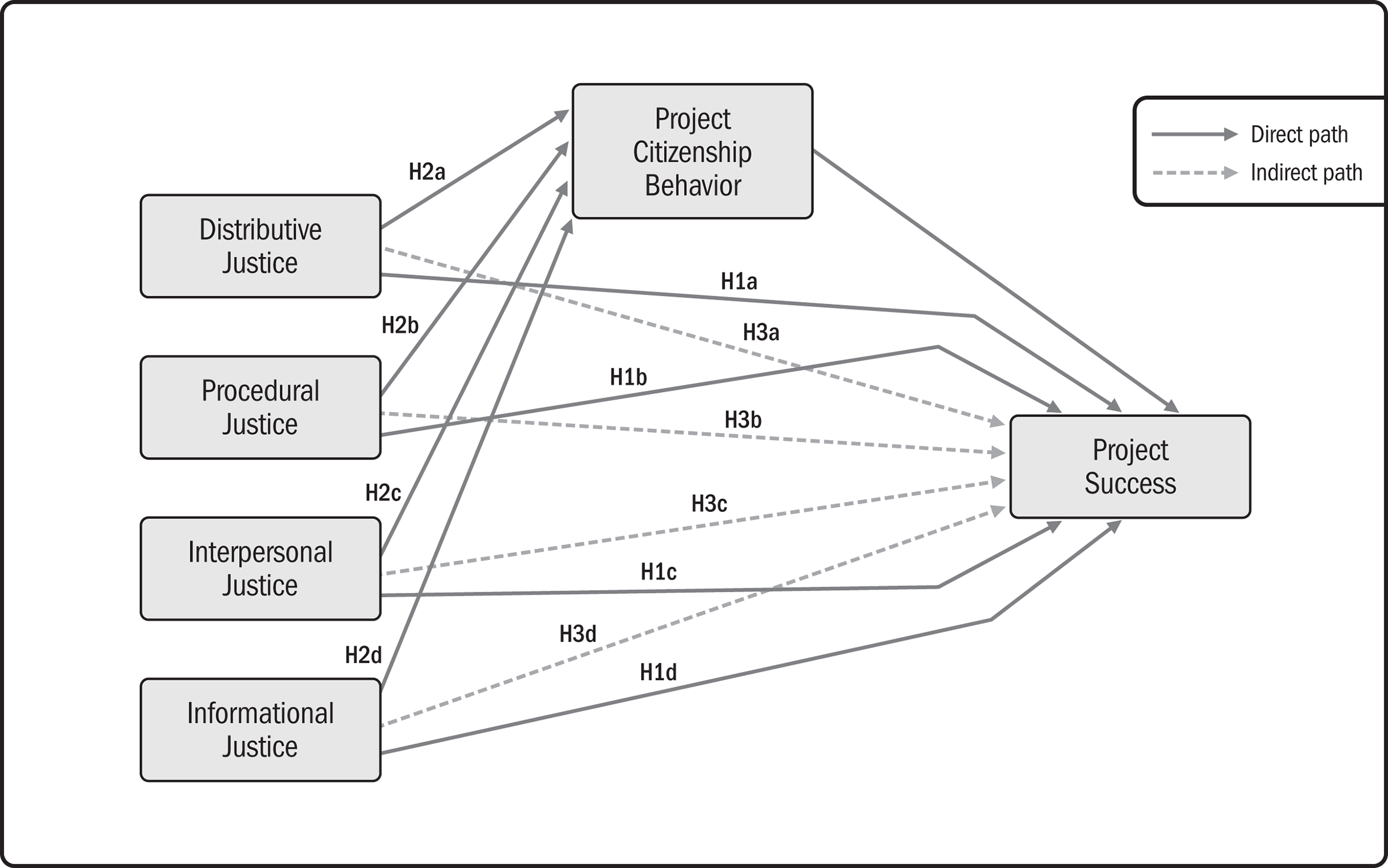
Hypothesized model.
In addition to the hypotheses, we control for potentially confounding variables that we need to account for but that do not drive our theory (Spector & Brannick, 2011). Our control variables are focused on the demographic characteristics of participants, including gender, marital status, age, position, and experience. These are the variables that could potentially have an influence on the relationship between the dependent and independent variables, but are not the focus of our study.
Methodology
Population, Sampling, and Data Collection
The research design of our present study was quantitative in nature, adopting a positivist research philosophy with a deductive approach. This allowed us to remain neutral and independent during the investigation while using a large sample to test hypotheses developed from existing theories (Saunders et al., 2019). The participants in our study had to fulfill the following criteria: (1) experience of at least 1 year working in or leading projects and (2) have worked in or led at least one completed project with knowledge about the results of that project. Participants belonged to various sectors, including engineering and construction, healthcare, education, and IT. Access to the participants was gained through professional contacts of the study authors using the convenience sampling technique. Participation in the survey was voluntarily and informed consent was obtained. All respondents were assured of data confidentiality and anonymity.
A time-lagged, self-reported questionnaire was used to collect data, which was administered in three intervals, scheduled 3 weeks apart. The independent variables (i.e., all dimensions of organizational justice) were collected in Time 1 (T1); the mediating variable (i.e., project citizenship behavior) was collected in Time 2 (T2); and the dependent variable (i.e., project success) was collected in Time 3 (T3). The purpose of time lags was to overcome common method bias and self-serving bias issues (Podsakoff et al., 2003). Codes were assigned to respondents in order to maintain their privacy and for the purpose of matching the responses with the same respondents from T1, T2, and T3.
At T1, we received 363 usable responses out of the 400 questionnaires we distributed (response rate of 91%). At T2, questionnaires were sent to only those respondents who responded in T1, and 314 usable questionnaires were returned (response rate of 87%). At T3, the same process was followed, with a total of 233 usable questionnaires returned, which were then considered for statistical analysis (response rate of 58%). There were 82.4% male respondents and 17.6% female respondents. Most of the respondents (93.6%) were between the ages of 18 and 40, 43.8% of our respondents were single, and 56.2% were married. Nearly one half of the participants worked in a managerial position (49.8%); 54.5% of the respondents had between 1 and 5 years of experience; 27.5% ranging between 6 and 10 years, 16.7% between 11 and 20 years; and only 1.3% between 21 and 30 years. None of the respondents had over 30 years’ experience.
Measures
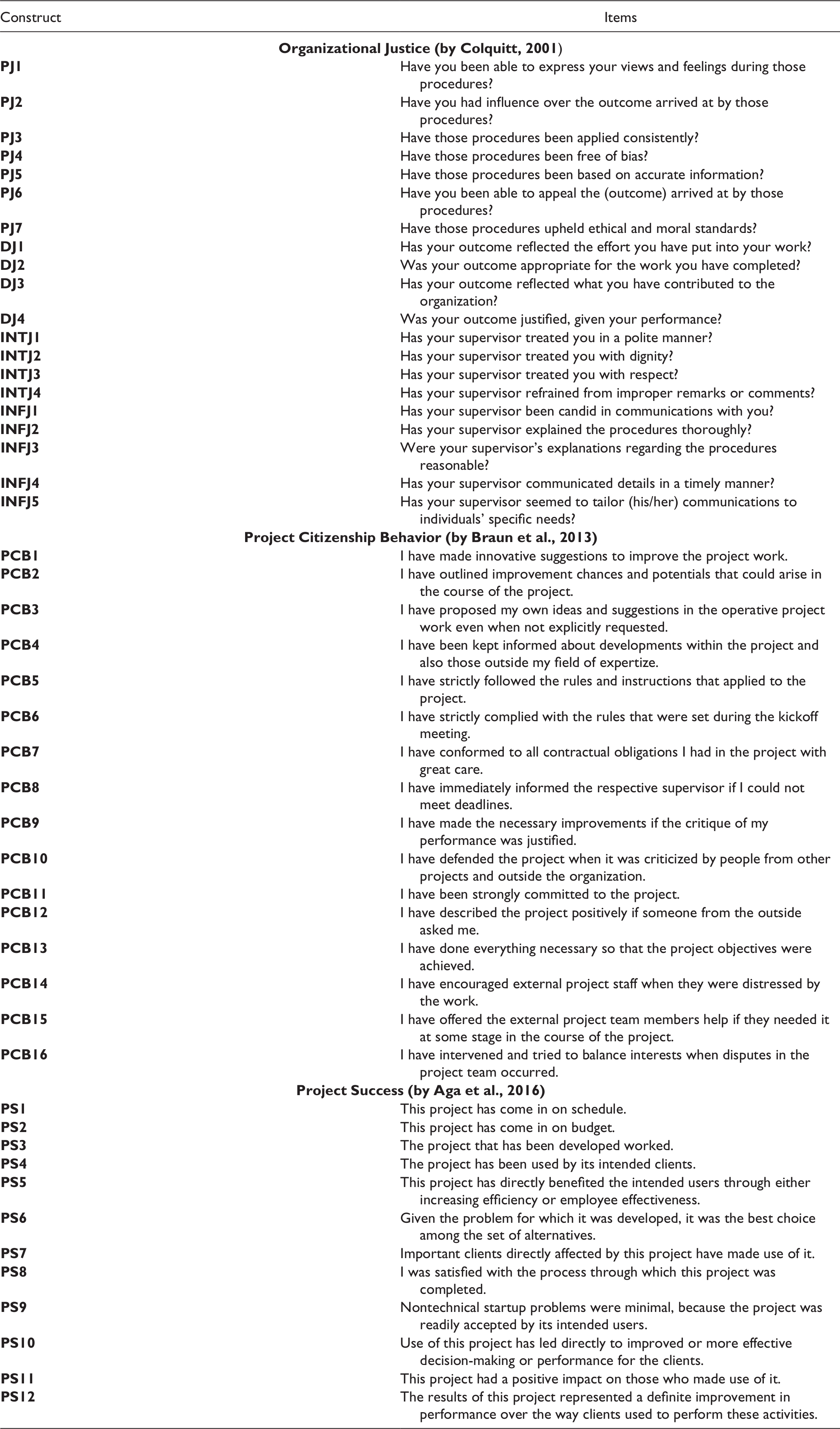
A 5-point Likert scale was used to assess responses for all variables, where 1 refers to strongly disagree and 5 refers to strongly agree. The detailed items with identifiers are presented in the Appendix at the end of the article, whereas an overview of the measures and sample items are provided below, as follows:
Data Analysis
Structural equation modeling (SEM) is a statistical analysis method commonly used to test structural relationships by combining factor analysis and multiple regression analysis. According to Kline (2011), SEM is used to specify, identify, estimate, test, and modify a measurement and structural model. Thus, in this study we used the partial least squares (PLS) method (Hair et al., 2011) to perform confirmatory factor analysis (CFA) through SmartPLS 3.0 to verify the fitness of our model with the data. For the structural model, the direct and indirect effects were determined through PROCESS macro, presented by Hayes (2013). The analysis was done by using the model 4 from the manual provided by Hayes (2013) as it is the classical model of mediation.
Results
Control Variables
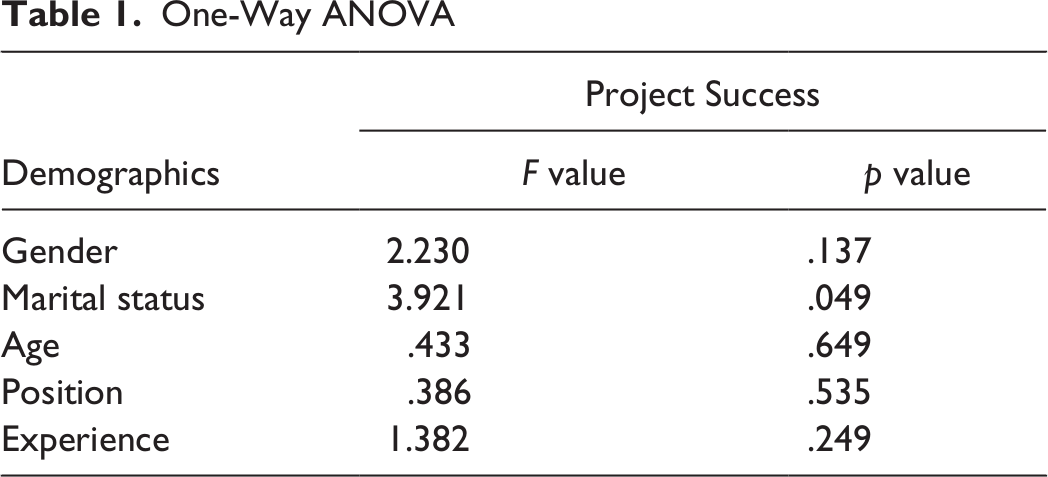
One-way analysis of variance (ANOVA) was performed to explore the impact of the control variables. Table 1 depicts that there is a significant difference in reported mean values of project success across marital statuses of respondents (f = 3.59, p < .05); therefore, marital status was controlled for in the regression analysis. We currently do not know, for certain, why marital status caused this significant difference. One reason might be that priorities and commitment to a job change after marriage but this needs to be explored in more depth in a separate study. It was also found that there was no significant difference in project success across the other demographics of respondents (i.e., gender, age, position, and experience).
One-Way ANOVA
Descriptive Statistics and Correlation
The mean values, standard deviations (SD), and correlation analysis are presented in Table 2. The data in Table 2 indicate that distributive justice (r = .520, p < .001), procedural justice (r = .553, p < .001), interpersonal justice (r = .554, p < .001), and informational justice (r = .627, p < .001) are positively associated with project success, thus giving preliminary support to our hypotheses. It furthermore shows that project citizenship behavior is positively associated with project success (r = .517, p < .001). Since all the correlation coefficient values (r) lie within the range of .3 to .7, there is no problem of multicollinearity in our data.
Descriptive Statistics and Correlation Analysis

Note. N = 233. *p < .05; **p < .01. gender (1 = male, 2 = female); mstatus = marital status (1 = Single, 2 = Married); age (1 = 18–25 years, 2 = 26–40 years, 3 = 41–60 years, 4 = 61 years and above); position (1 = managerial, 2 = non-managerial); exp = experience (1 = 1–5 years, 2 = 6–10 years, 3 = 11–20 years, 4 = 21–30 years, 5 = 31 years and above). DJ = distributive justice; INFJ = informational justice; INTJ = interpersonal justice; PCB = project citizenship behavior; PJ = procedural justice; PS = project success. Alpha reliabilities are presented in brackets.
Tests of the Measurement Model
To justify the measurement model, confirmatory factor analysis (CFA) was performed (Anderson & Gerbing, 1988), which consisted of six latent variables: distributive justice (DJ), procedural justice (PJ), interpersonal justice (INTJ), informational justice (INFJ), project citizenship behavior (PCB), and project success (PS). As per the results of the measurement model (1st level), all the indicators with factor loadings < .5 were dropped, including one item of interpersonal justice (INTJ2); seven items of project citizenship behavior (PCB6, PCB7, PCB8, PCB9, PCB10, PCB11, PCB12); and one item of project success (PS6), because elimination of these items improved the validity of our measurement model (Hair et al., 2011). Figure 2 shows the measurement model (2nd level) after removal of the items. We would like to note that PCB14, for which the outer loading was slightly lower than .5, was included because the validity of the measurement model was not compromised, and the item loading was very close to .5.

Measurement model (2nd level).
The convergent validity was assessed through internal consistency, CR, and AVE. For an adequate convergent validity of the scale, a minimum threshold of AVE is .50. However, convergent validity will be sufficient to measure any concept with an AVE <.50 if the composite reliability is >.60 (Fornell & Larcker, 1981). Thus, convergent validity is established according to the results reported in Table 3; after verification of the convergent validity, the discriminant validity was evaluated. Discriminant validity determines whether a construct is distinct from other constructs by empirical standards, if it is not highly correlated with other constructs. Table 4 indicates that the values on the diagonal exceed all the preceding values in the rows and columns of the matrix. This means that the square root of each construct’s AVE is greater than its correlation with other constructs, thus it suggests that discriminant validity is established (Hair et al., 2011).
Measurement Model (Estimates)

Discriminant Validity

Note. DJ = distributive justice; INFJ = informational justice; INTJ = interpersonal justice; PCB = project citizenship behavior; PJ = procedural justice; PS = project success.
Hypothesis Testing
We used the PROCESS macro by Hayes (2013) to determine the direct and indirect effects. Table 5 shows that distributive justice positively impacts project success (β = .529, p < .001) and project citizenship behavior (β = .375, p < .001), thus, H1a and H2a are supported. Moreover, the indirect relationship (.169) of project citizenship behavior between distributive justice and project success is significant, with a 95% confidence interval. Project citizenship behavior partially mediates the relationship between distributive justice and project success, thus, H3a is supported.
Results of Direct and Indirect Effects Among Distributive Justice, Project Citizenship Behavior, and Project Success
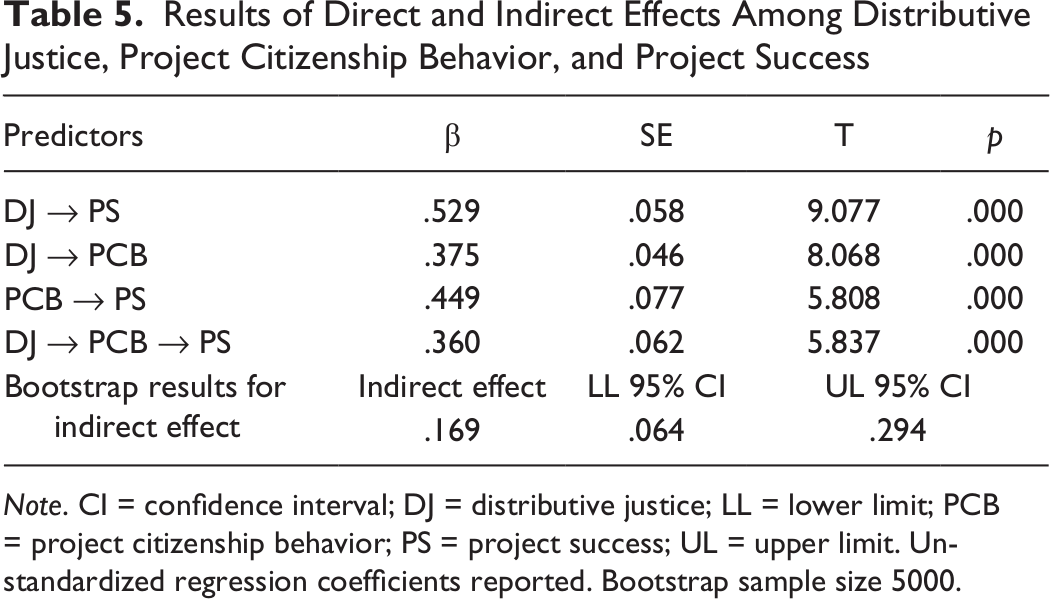
Note. CI = confidence interval; DJ = distributive justice; LL = lower limit; PCB = project citizenship behavior; PS = project success; UL = upper limit. Un-standardized regression coefficients reported. Bootstrap sample size 5000.
Table 6 depicts that procedural justice positively impacts project success (β = .561, p < .001) and project citizenship behavior (β = .449, p < .001); thus, H1b and H2b are supported. Moreover, Table 6 indicates the significant indirect effect (.174) of project citizenship behavior among procedural justice and project success, with a 95% confidence interval. Project citizenship behavior partially mediates the relationship between procedural justice and project success; thus, H3b is supported.
Results of Direct and Indirect Effects Among Procedural Justice, Project Citizenship Behavior, and Project Success
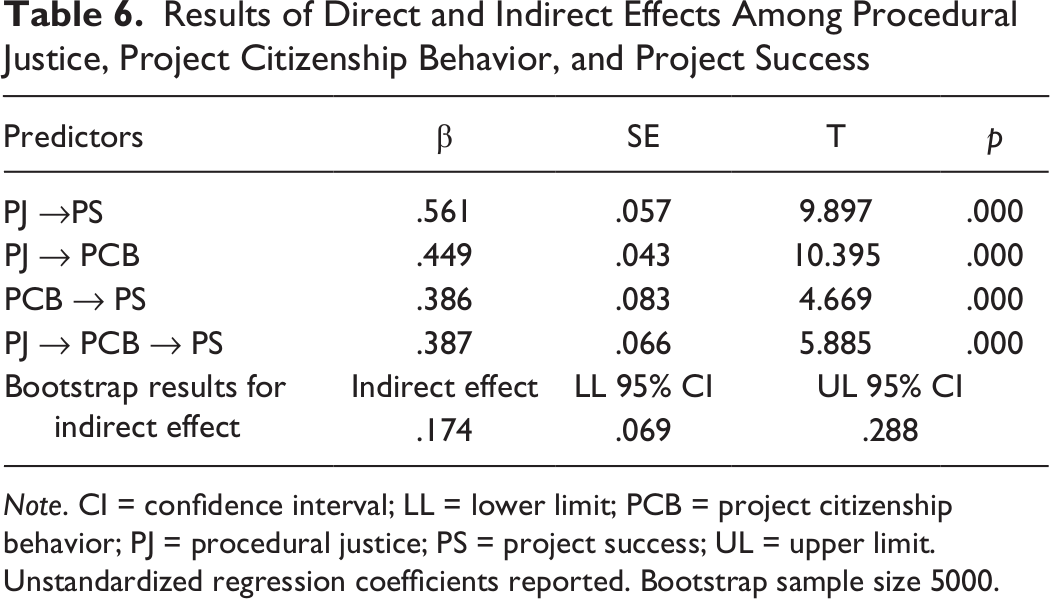
Note. CI = confidence interval; LL = lower limit; PCB = project citizenship behavior; PJ = procedural justice; PS = project success; UL = upper limit. Unstandardized regression coefficients reported. Bootstrap sample size 5000.
Table 7 indicates that interpersonal justice positively impacts project success (β = .519, p < .001) and project citizenship behavior (β = .260, p < .001); thus, H1c and H2c are supported. In addition, Table 7 shows that the indirect effect (.121) of project citizenship behavior among interpersonal justice and project success is significant, with a 95% confidence interval. Project citizenship behavior partially mediates the relationship between interpersonal justice and project success; thus, H3c is supported.
Results of Direct and Indirect Effects Among Interpersonal Justice, Project Citizenship Behavior, and Project Success

Note. CI = confidence interval; INTJ = interpersonal justice; LL = lower limit; PCB = project citizenship behavior; PS = project success; UL = upper limit. Unstandardized regression coefficients reported. Bootstrap sample size 5000.
Table 8 depicts that informational justice positively impacts project success (β = .685, p < .001) and project citizenship behavior (β = .365, p < .001); thus, H1d and H2d are supported. Moreover, Table 1 demonstrates the significant indirect effect (.142) of project citizenship behavior among informational justice and project success with a 95% confidence interval. Project citizenship behavior partially mediates the relationship between informational justice and project success; thus, H3d is supported.
Results of Direct and Indirect Effects Among Informational Justice, Project Citizenship Behavior, and Project Success
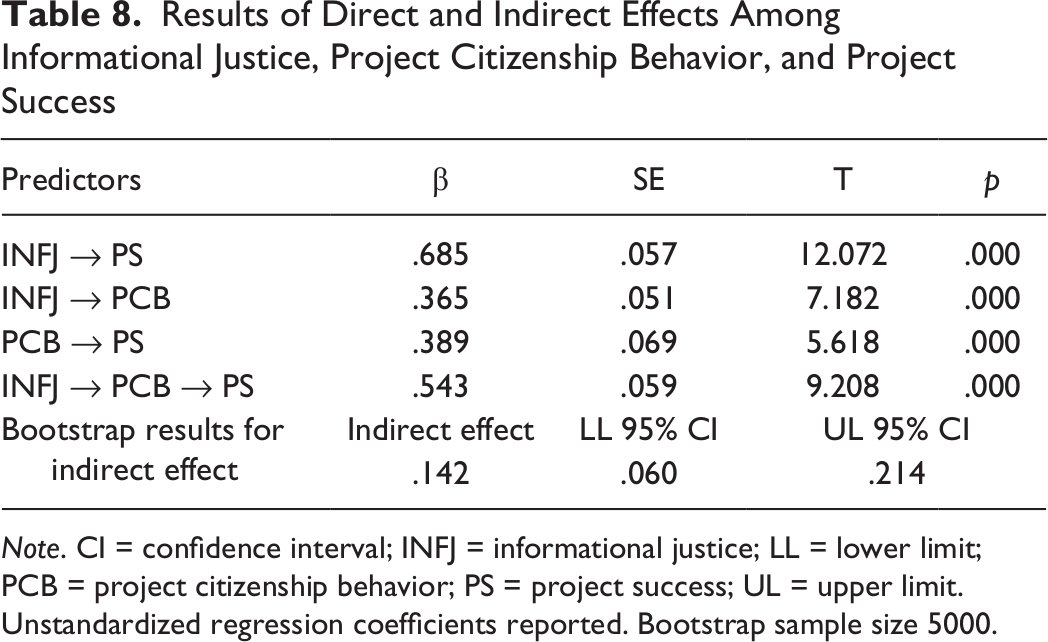
Note. CI = confidence interval; INFJ = informational justice; LL = lower limit; PCB = project citizenship behavior; PS = project success; UL = upper limit. Unstandardized regression coefficients reported. Bootstrap sample size 5000.
Discussion
This study provides new insights into how the four organizational justice dimensions impact project success through mediation of project citizenship behavior (PCB). The results of our research supported all the hypothesized relationships; we will discuss them in more detail as follows to develop an enhanced understanding of the underlying mechanisms. Altogether, these findings improve our understanding of the importance of organizational justice and PCB and their contribution to project success.
First, we found evidence that all four organizational justice dimensions (i.e., distributive, procedural, interpersonal, and informational justice) are positively associated with project success (supporting hypotheses 1a, 1b, 1c, and 1d). Interestingly, all four dimensions have about the same impact, with informational justice showing a slightly stronger relationship than the other dimensions. Unterhitzenberger and Bryde (2019) found that procedural justice was the most influential factor, with distributive and interactional justice having a significantly weaker impact. Despite the differences in the strengths of relationships, the findings of our study confirm Unterhitzenberger and Bryde’s (2019) findings that all organizational justice dimensions demonstrate a positive association with project success. This suggests that the implementation of fair principles and processes throughout the project and across different aspects is critical. Making decisions about the distribution of resources should be guided by the principles of need, equity, and equality to align with justice rules (Colquitt & Shaw, 2005) in order to encourage project team members to reciprocate the behavior and engage in the social exchange of beneficial actions (Cropanzano et al., 2017). The project manager’s implementation of fair procedures and principles strongly influences project success because project team members then use fairness perceptions as heuristic to evaluate if they can trust management (Proudfoot & Lind, 2015). The quality of the project team members’ relationships with their project manager strengthens when they perceive that project-related decisions are being made in a reliable and transparent manner (Colquitt et al., 2001).
Our study also reveals that the treatment of and communication with project team members are significant with regard to their impact on project success. When project team members are treated with politeness, dignity, and respect as required by interpersonal justice norms, they reciprocate by upholding their ethical beliefs and delivering project tasks effectively (Bies, 2015; Cheung, 2013). Similarly, when project team members are provided with reasonable justifications for decisions and when the communication of these decisions happens in a truthful way, they develop a strong identity with the project; thus, they respond by performing at a high level and contributing to project success due to perceived informational justice. We have also found this dimension to be most influential, which suggests that a truthful and just sharing of information is very important for project team members. This is unique to the project context and might be grounded in the fact that projects are often characterized by a high degree of uncertainty. Truthful and just communication reduces this uncertainty for project team members, who subsequently use this information to make more informed decisions to the benefit of the project.
Overall, the basic principles of organizational justice are applicable in the project context and that, despite the context sensitivity of the concept, significant benefits can be realized in projects (Colquitt & Jackson, 2006). It also highlights the relevance of SET (Cropanzano & Mitchell, 2005; Cropanzano et al., 2017) as a theoretical lens because it demonstrates that actions by the project manager in terms of fair treatment create reciprocal actions by the project team members, which subsequently contribute to enhancing project success. We therefore advocate that all four dimensions of organizational justice are crucial and should be present to facilitate project success. Thus, it is the responsibility of project managers and/or sponsors to make sure that all aspects of organizational justice are addressed throughout the project life cycle; this ranges from appropriate governance arrangements, to realistic planning assumptions, to day-to-day communications. At this stage it is not about defining specific tasks for the sponsor and the project manager, rather it is about raising awareness of organizational justice rules and adopting these rules as underlying principles of all actions throughout the project (Colquitt & Shaw, 2005).
Second, and perhaps most importantly, we demonstrated that all four organizational justice dimensions (i.e., distributive, procedural, interpersonal, and informational justice) are positively associated with project citizenship behavior (supporting hypotheses 2a, 2b, 2c, and 2d). This illustrates that the association between organizational justice and OCB is not only significant in permanent organizations (Fassina et al., 2008; Jafari & Bidarian, 2012), but that organizational justice is also a predictor of PCB in the context of temporary organizations. This is an important new finding, as PCB is related but not identical to OCB (Braun et al., 2012, 2013). Furthermore, unlike Lim and Loosemore (2017), who utilized traditional OCB measures in the project context, our study made use of the adapted and context-adjusted PCB measures. Through this we are able to establish that the use of context-specific measures matter, as Lim and Loosemore (2017) only found a significant association between interpersonal justice and OCB, but not with any of the other dimensions, which contradicts broadly accepted knowledge (Fassina et al., 2008). Our study, however, was able to demonstrate that organizational justice is indeed a predictor of OCB in the project context (i.e., PCB) if the appropriate measures are utilized. This is because OCB measures do not actually account for the context-specific characteristics of projects and consider generic aspects, such as general helping behavior, organizational loyalty, and organizational compliance, which do not appear to be impacted by justice perceptions in the project settings. In contrast to this, PCB measures such as project-specific helping behavior, project loyalty, and project compliance directly relate to the temporary organization and hence impacted by justice perceptions in the project.
We also found that PCB mediates the relationships of all four organizational justice dimensions with project success (supporting hypotheses 3a, 3b, 3c, and 3d). Despite the fact that there is strong theoretical underpinning for these hypothesized relationships, this is the first study that explicitly examined how PCB mediates the relationship between organizational justice dimensions and project success. Previous studies have proven that organizational justice is a robust predictor of OCB, and OCB has also been recognized as a survival factor for organizations (Colquitt et al., 2013; Fassina et al., 2008; Jafari & Bidarian, 2012); however, we believe that we are the first to establish this relationship in the project context. Having established that all four organizational justice dimensions have a positive impact on project success, we are able to explain this relationship through the mediation of PCB. PCB is the extra-role behavior that project team members demonstrate voluntarily in an interorganizational project environment (i.e., across the boundaries of permanent organizations; Braun et al., 2012). Our findings determine that PCB is encouraged by the implementation of fair processes and principles in projects, as is OCB in permanent organizations. Through its adapted dimensions of project-specific helping behavior, project loyalty, project compliance, and project-specific proactive behavior, PCB encourages individuals to put in extra effort, be more effective and productive (Basu et al., 2017), which subsequently facilitates project success.
Thus, we have contributed to the existing literature by providing insights on how PCB influences project success along with implications for project leaders and project managers to encourage project team members to put in extra effort beyond the formal obligations for effective project delivery.
Implications
Theoretical Implications
From a theoretical perspective, our study makes four contributions to the literature: First, we establish that the four-dimensional organizational justice construct significantly impacts project success, and that the implementation of fair processes and principles in the project context facilitates project success. By doing so we contribute to the literature on project success by strengthening the support for psychosocial relationships as success factors. Second, we demonstrate that organizational justice is a reliable predictor of extra-role behavior in the project context if the appropriate project-related measures are used. This is an important finding as it aligns the findings regarding the linkage of organizational justice and OCB from the project literature with the literature on permanent organizations. Through this linkage we contribute to the literature on project behavior and respond to the call for more integration of organizational behavior aspects into project studies (Unterhitzenberger & Müller, 2020). Third, we are able to partly explain the impact of organizational justice on project success through PCB. This is relevant as it highlights the significance of the voluntary behavior of project team members that goes beyond their contractual duties. And, fourth, we contribute to the literature on project behavior by further establishing the need for dedicated concepts, such as PCB, to be explored and utilized.
Practical Implications
The findings of this study also provide some valuable managerial implications, which can potentially alter the ways in which projects are currently being managed. In order to enhance project success, this study provides a different perspective to presenting project management approaches. This study highlights new areas of responsibility for project sponsors and/or project managers, as they should be familiar with the significance of justice rules, processes, and decisions in projects due to their significant impact on project success. Project managers should take fairness into account throughout the project life cycle. Some practical actions can be taken in the initial phases of a project, for example, the design of fair procedures and principles for decision-making; fair distribution of resources among participants based on need, equity, and equality; the truthful and justified sharing of sufficient information with project participants; and the communication of these procedures to participants with respect and dignity. Our findings suggest that, along with the implementation of organizational justice, project managers should also encourage project team members to exhibit PCB for effective execution of project tasks. Rewards either intrinsic (i.e., job autonomy, growth) or extrinsic, such as salary raise, bonus, allowances, and so forth, should be given to those project team members who show extra role behavior during the course of project delivery. In particular, the findings of our study can be used to highlight the importance of establishing and practicing fair and impartial practices during the execution of any project.
Limitations and Future Directions
Along with the fruitful insights, this study has a few limitations that should be addressed in future research. First, self-reported measures were used for data collection and, therefore, common method bias cannot be ruled out. Future researchers should move toward the use of multisource data collection through dyadic relationships in projects between project team members and project managers. Second, we collected data from employees working on projects situated in Islamabad, Pakistan, so, there are limitations to the generalizability beyond the specific cultural context. Various cultures have different interpretations and perceptions about organizational justice; consequently, the findings may only be applicable in the Pakistani context. Future studies must be carried out in other cultures—for example, in the Middle East, Asia, or Europe—to further look at the impact of cultural variations on the linkage among organizational justice, project citizenship behavior, and project success.
Conclusion
Despite the extensive deliberations in project management literature, there is a lack of scientific research focusing on psychosocial factors in project-based organizations and their impact on project success, except for a few promising attempts. Thus, our study contributes to the body of knowledge by providing evidence that all four-dimensions of organizational justice have a significant impact on project success, both directly and through mediation of project citizenship behavior (PCB). Altogether, these findings enhance our understanding of the importance of organizational justice and PCB and their contributions to project success. Findings of our study provide valuable managerial implications for project leaders and project managers by advocating that project team members’ perceptions of all four-dimensions of organizational justice (distribution of resources, enactment of procedures, polite treatment, and candid communication) are crucial and should not be ignored throughout the project life cycle in order to facilitate project success. Findings also suggest that project leaders and project managers should provide an environment that encourages project team members to put in extra effort beyond the formal obligations through fair treatment in order to enhance the likelihood of effective project delivery.
Footnotes
Appendix. List of Items Used For Each Construct
| Construct | Items |
|---|---|
|
|
|
|
|
Have you been able to express your views and feelings during those procedures? |
|
|
Have you had influence over the outcome arrived at by those procedures? |
|
|
Have those procedures been applied consistently? |
|
|
Have those procedures been free of bias? |
|
|
Have those procedures been based on accurate information? |
|
|
Have you been able to appeal the (outcome) arrived at by those procedures? |
|
|
Have those procedures upheld ethical and moral standards? |
|
|
Has your outcome reflected the effort you have put into your work? |
|
|
Was your outcome appropriate for the work you have completed? |
|
|
Has your outcome reflected what you have contributed to the organization? |
|
|
Was your outcome justified, given your performance? |
|
|
Has your supervisor treated you in a polite manner? |
|
|
Has your supervisor treated you with dignity? |
|
|
Has your supervisor treated you with respect? |
|
|
Has your supervisor refrained from improper remarks or comments? |
|
|
Has your supervisor been candid in communications with you? |
|
|
Has your supervisor explained the procedures thoroughly? |
|
|
Were your supervisor’s explanations regarding the procedures reasonable? |
|
|
Has your supervisor communicated details in a timely manner? |
|
|
Has your supervisor seemed to tailor (his/her) communications to individuals’ specific needs? |
|
|
|
|
|
I have made innovative suggestions to improve the project work. |
|
|
I have outlined improvement chances and potentials that could arise in the course of the project. |
|
|
I have proposed my own ideas and suggestions in the operative project work even when not explicitly requested. |
|
|
I have been kept informed about developments within the project and also those outside my field of expertize. |
|
|
I have strictly followed the rules and instructions that applied to the project. |
|
|
I have strictly complied with the rules that were set during the kickoff meeting. |
|
|
I have conformed to all contractual obligations I had in the project with great care. |
|
|
I have immediately informed the respective supervisor if I could not meet deadlines. |
|
|
I have made the necessary improvements if the critique of my performance was justified. |
|
|
I have defended the project when it was criticized by people from other projects and outside the organization. |
|
|
I have been strongly committed to the project. |
|
|
I have described the project positively if someone from the outside asked me. |
|
|
I have done everything necessary so that the project objectives were achieved. |
|
|
I have encouraged external project staff when they were distressed by the work. |
|
|
I have offered the external project team members help if they needed it at some stage in the course of the project. |
|
|
I have intervened and tried to balance interests when disputes in the project team occurred. |
|
|
|
|
|
This project has come in on schedule. |
|
|
This project has come in on budget. |
|
|
The project that has been developed worked. |
|
|
The project has been used by its intended clients. |
|
|
This project has directly benefited the intended users through either increasing efficiency or employee effectiveness. |
|
|
Given the problem for which it was developed, it was the best choice among the set of alternatives. |
|
|
Important clients directly affected by this project have made use of it. |
|
|
I was satisfied with the process through which this project was completed. |
|
|
Nontechnical startup problems were minimal, because the project was readily accepted by its intended users. |
|
|
Use of this project has led directly to improved or more effective decision-making or performance for the clients. |
|
|
This project had a positive impact on those who made use of it. |
|
|
The results of this project represented a definite improvement in performance over the way clients used to perform these activities. |
Declaration of Conflicting Interests
The author(s) declared no potential conflicts of interest with respect to the research, authorship, and/or publication of this article.
Funding
The author(s) received no financial support for the research, authorship, and/or publication of this article.