




Abstract
Negative consequences can arise if interpersonal conflicts in construction projects are not handled properly. This study aims to investigate the relationship among political skill, cooperative conflict management styles, and relationship quality. Multiple regressions were used to test the hypothesis based on 206 items of data collected from construction project practitioners in China. Results demonstrate the mechanism of action among political skill, conflict management styles, and relationship quality and verify the mediating effect of cooperative conflict management styles, providing enlightenment for future research on conflict management.
Keywords
Introduction
Conflict in construction projects is inevitable due to the complexity and uncertainty of the construction project itself and the incompleteness of construction project contracts (Qian & Zhang, 2018). Individuals involved in a project are affected by conflict, possibly leading to disturbed routines, decreased performance, and confrontational relationships among members (Chen et al., 2014; Shih & Susanto, 2010; Wu et al., 2017). In particular, Confucianism states that “harmony is the most precious,” and conflict is often understood as the precursor of poor management, internal division, or even project failure. Thus, project managers will attempt to eliminate conflict to maintain a “harmonious” state. However, conflicts are not all negative, and proper ways to resolve conflicts can effectively lead to positive results (Lu & Wang, 2017).
The contingency view holds that whether the outcome of the conflict is constructive depends on the conflict management styles undertaken; that is, conflict management style has a profound effect on the outcome of conflict (Chen et al., 2012). Rahim (1983) divided conflict management into five types—namely, integrating, compromising, obliging, avoiding, and dominating. Compared with avoiding and dominating styles, he regarded the first three as cooperative conflict management styles that are more concerned about others. Great gains can be obtained when people are highly concerned about others when confronted with conflict at work (Tjosvold, 2008). Existing studies show that cooperative conflict management styles such as integrating and compromising are associated with positive communication and constructive problem-solving, whereas competitive conflict management styles such as dominating and avoiding tend to lead to negative outcomes (Chen et al., 2012; Song et al., 2006). Ndubisi (2011) also believes that relationship building is based on self-sacrifice rather than self-indulgence, so he focuses on the conflict management style of caring more about others and drops the style of caring less about others. Therefore, we believe that the key to constructive conflict management lies in the adoption of cooperative conflict management. Then, how to promote cooperative conflict management is a problem worth studying.
In the study of conflict management styles, many studies focus on the choice of conflict management style (Antonioni, 1998; Caputo et al., 2018) and the effect of conflict management style on project performance (Prieto-Remón et al., 2015). However, the study of the antecedent causes of conflict management style is ignored. A series of studies has shown that political skill may provide a promising line of inquiry. Political skill is defined as the ability to effectively understand and influence others accordingly to help achieve individual or organizational goals (Ferris et al., 2005). Studies show that political skill can enhance team cohesion and performance (Lvina et al., 2018) and improve job satisfaction (Gallagher et al., 2016). Political skill can also assuage negative emotions, reduce tension and anxiety associated with conflict, and avoid offensive words and behaviors. Ferris et al. (2005) believe that people with high political skill are effective at conflict management. Therefore, we believe that political skill can promote cooperative conflict management.
Relationship quality has become an important aspect of project management. Relationship quality is the degree of close relationships and trust between members (Lages et al., 2005). Poor relationships in a project are likely to lead to poor project performance, such as cost overruns, schedule delays, or stakeholder dissatisfaction (Lu & Wang, 2017). This study integrates political skill into the research framework of the relationship between cooperative conflict management styles and relationship quality. As an important social skill, political skill plays an important role in social interaction. Individuals with high political skill can actively participate in interpersonal interactions and often have strong network capabilities and relationship resources (Ferris et al., 2005). Politically skilled individuals have been found to be sincere in the social process, helping them gain the trust of others (Bing et al., 2011). These individuals have significant implications for improving relationship quality. Although some studies showed that political skill can improve performance (Templer, 2018) and promote career development (Loi et al., 2014), research on the influence of political skill on relationship quality remains limited. In addition, research on political skill originates from the west, and few studies exist in the eastern cultural context. On the basis of Chinese collectivism and relationship-oriented thoughts, exploring the relationship between political skill and relationship quality in conflict situations seems highly realistic. Therefore, this study mainly aims to explore the relationship between political skill and relationship quality and verify the mediating role of cooperative conflict management styles on this relationship.
This study is the first to explore the relationship among political skill, cooperative conflict management styles, and relationship quality; enrich the knowledge system of conflict management and political skill; and provide some guidance for project managers when facing conflicts. The overall framework is presented in Figure 1. This article mainly includes five sections, including this introduction. In the next section, we present a literature review, including political skill, conflict management styles, and relationship quality. We also develop hypotheses about their relationships. In the third section, the method is introduced and the process of data collection and analysis is described in detail. In the fourth section, we discuss the results of hypothesis testing. In the last section, we present the contributions and deficiencies of the study, as well as the prospects of future research.
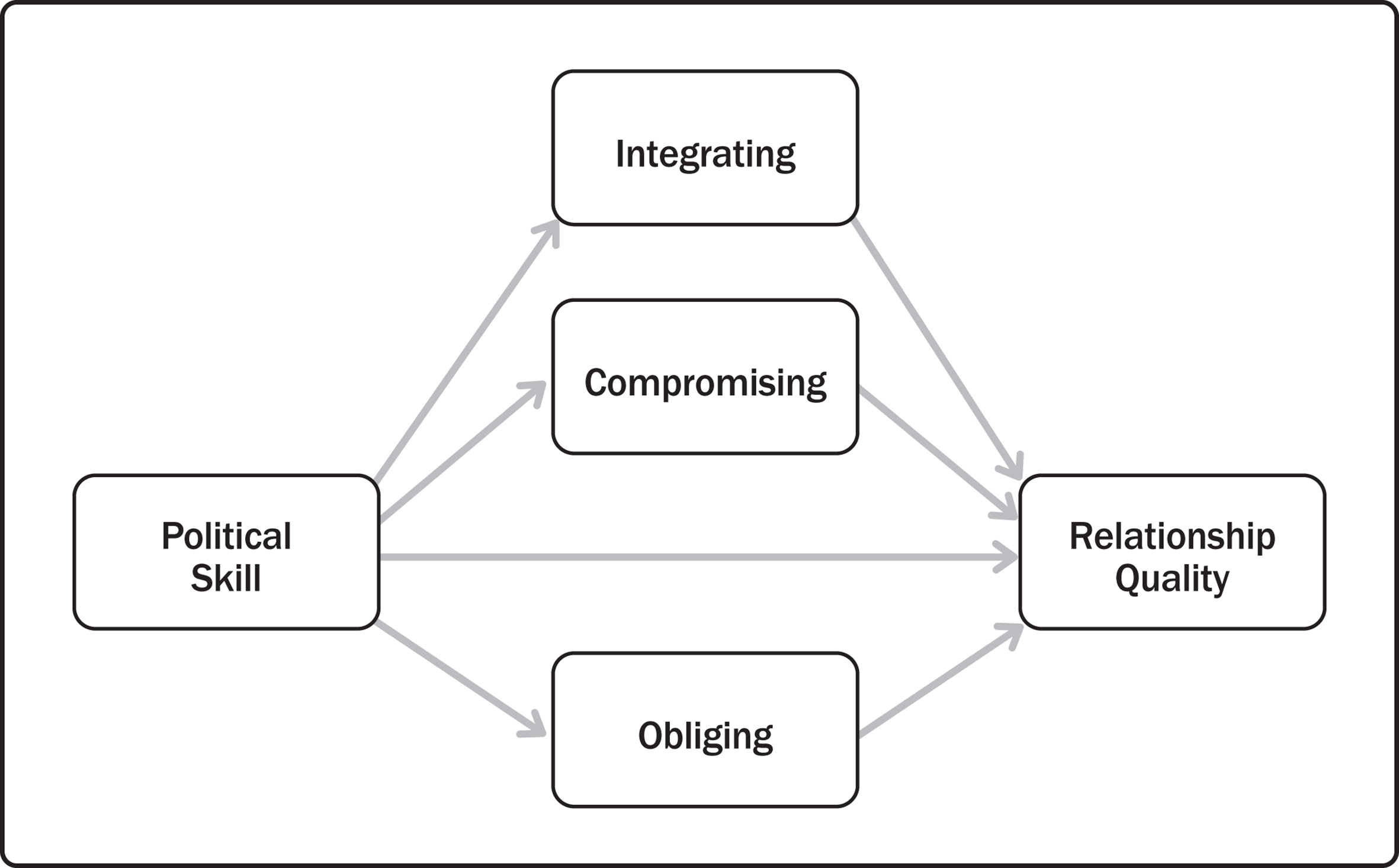
Conceptual framework.
Literature Review
Political Skill
The construction project environment is considered a natural political arena, requiring individuals to have certain political skills due to the competition of interests, limited resources, alliance building, and interdependence. Pfeffer (1981) proposed political skill for the first time in his article on organizational rights, believing that political skill is an important factor for individual success. Mintzberg (1985) believed that political skill could exert influence through persuasion, manipulation, and negotiation. Ferris et al. (2005) preliminarily explored the influence mechanism of political skill by developing a scale, and defined political skill as “the ability to effectively understand others at work, and to use such knowledge to influence others to act in ways that enhance one’s personal and/or organizational objectives.” Political skill is a multidimensional structure, including four dimensions of social alertness, interpersonal influence, networkability, and apparent sincerity. Social alertness refers to the ability of individuals to comprehend social interactions and accurately interpret their own and others’ behavior in social settings. Pfeffer (1992) referred to this characteristic as “sensitivity to others” and considered this ability important for one’s own gains. Interpersonal influence refers to a convincing personal style, suitable for adjusting one’s behavior according to different situations to elicit reactions from others. Networking capabilities represent an individual’s ability to build alliances, leverage alliances, and manage complex networks. People in these social networks tend to have resources that are valuable to personal and organizational success. Apparent sincerity focuses on the perceived intentions of the behavior exhibited, and politically skilled individuals appear to others to have a high degree of integrity and sincerity.
Political skill can predict many work-related outcomes, such as increased job satisfaction (Gallagher et al., 2016), improved performance (Templer, 2018), reduced turnover intention (Durrani & Cheema, 2016), and increased organizational status (Ferris et al., 2008). Among similar outcomes, the predictive validity of political skill was superior to similar constructs such as social intelligence, emotional intelligence, agreeableness, conscientiousness, self-monitoring, and leadership self-efficacy (Banister & Meriac, 2015; Semadar et al., 2006). Political skill can also enable individuals to develop good interpersonal relationships (Guo et al., 2020). Employees with high political skill receive positive comments from leaders and colleagues and thus enjoy a good reputation (Bing et al., 2011; Laird et al., 2013). Moreover, political skill strengthens the relationship between networking behaviors and promotability (Huang, 2020). To sum up, political skill is a comprehensive ability covering cognitive, affective, and behavioral manifestations (Zhang & Huo, 2015), directly affecting the outcomes of work and relationships.
Conflict Management Styles
Conflict management is measured in different ways. Researchers in social psychology and organizational behavior have proposed a simplified model of conflict management. Specifically, conflict management can be intuitively classified around the cooperation–competition dichotomy (Deutsch, 1973). However, the one-dimensional model cannot focus on the self and others simultaneously, and people doubt the ability of the dichotomy to reflect the complexity of an individual’s perceptions of conflict behavior. Scholars then developed two-dimensional networks to classify conflict management styles. Blake and Mouton (1964 and 1970) first proposed a conflict management grid from two dimensions—namely, people- and task-oriented. They then distinguished five styles of forcing, compromising, withdrawing, smoothing, and confrontation. Thomas and Schmidt (1976) then reevaluated and refined Blake and Mouton’s grid, dividing it into five types—namely, cooperative, competitive, accommodating, avoiding, and compromising. They then divided it into two dimensions—namely, cooperativeness (to satisfy each peer’s concerns) and assertiveness (to satisfy one’s own concerns). Although the conflict management styles are slightly different in name, the classification principles and basic descriptions of the various styles are very similar. Moreover, the five-factor model shows better data fitting compared with other conflict management models (Rahim & Magner, 1994).
On the basis of the above research, Rahim (1983) adopted similar principles (concern for self and others) to distinguish conflict management and proposed integrating, compromising, obliging, avoiding, and dominating. Specifically, in integrating, individuals have a high concern for oneself and others, integrate everyone’s viewpoints, face conflicts head-on, and achieve a win-win result. In a compromising style, individuals focus on themselves and others, each side gains and loses, and a suboptimal result is achieved. By contrast, in an obliging style, individuals care less about themselves and more about others, and they cater to others’ ideas, while passively accepting and giving up their own interests. In the avoiding style, individuals are less concerned about themselves and others, which is regarded as showing a lack of participation and being ineffective and inappropriate. In the dominating style, individuals are highly concerned with themselves and less for others. Thus, dominating individuals ignore other people’s needs or expectations and aim to achieve their own objectives.
Current research focuses on the choice of conflict management style and the effect of conflict management on results. Existing studies have found that cultural differences and status (Kozan, 1989), emotional intelligence (Zhang et al., 2015), leadership style (Chiocchio et al., 2011), mindfulness (Kay & Skarlicki, 2020), and threat perception (Zhao et al., 2020) influence conflict management. At the same time, different conflict management styles have different effects on results, and effective conflict resolution strategies are crucial to improving cooperation and performance in work (Ayoko, 2016). Cooperative management is a practical way to strengthen team relationships, while competitive approaches undermine confidence in relationships (Liu et al., 2020; Tjosvold et al., 2005). Tabassi et al. (2019) found that integration and avoidance can effectively improve performance through organizational coordination. Zhang et al. (2015) found that integrating style had a significant positive effect on employee innovation performance, but no significant relationship between other styles and innovation performance was found. Yin et al. (2020) found the positive impact of collaborative conflict management style on team innovation performance, and Wu, Zhao, et al. (2017) also demonstrated the functional results of conflict under cooperative strategies.
Among the five conflict management styles, this study focused on cooperative behavior in conflict management (integrating, compromising, and obliging) for two reasons. First, people are likely to act cooperatively in the face of conflict, specifically in China. Research shows that integrating and compromising are common ways to deal with conflict (Trubisky et al., 1991). Second, cooperative behavior in conflict management can often lead to a constructive effect of conflict. Studies showed that cooperative conflict management can promote the generation of constructive conflict and improve the performance of the executive team (Chen et al., 2012; Rispens et al., 2021). By contrast, avoiding and dominating can result in destructive conflict (Song et al., 2006), which should be avoided.
Relationship Quality
The concept of relationship quality first comes from relationship marketing. Levitt (1983) realized the importance of relationship quality early on and defined it as an intangible value that can influence the transactions between buyers and sellers. With the deepening of research, relationship quality has been developed in various fields. In service marketing, Crosby et al. (1990) summarize relationship quality as customers’ trust and satisfaction with sales staff, which is related to sales personnel behavior and service climate (Park & Tran, 2020). Holmlund (2001) defines the relationship quality between business partners in the business-to-business (B2B) field as the common cognitive evaluation of the business interaction by the individuals who influence one another in the business relationship. The connotation of relationship quality in construction projects is more abundant, including trust, commitment, satisfaction, teamwork, relational attitudes, team integration, and capability (Lu & Guo, 2019; Suprapto et al., 2015). Modern projects are complex and uncertain, and adapting to and handling project changes require agile project management (Williams et al., 2015); such agility requires high-quality interpersonal relationships within the project.
Many scholars have realized the importance of the relational dimension in project management. Results show that interorganizational teamwork and positive customer relationship management (CRM) promote project success and effectively improve project performance (Mir & Pinnington, 2014; Zou et al., 2014). Davis (2014) empirically found that cooperation, collaboration, negotiation, and communication are all factors for success. In recent years, relationship quality has been introduced into the construction industry to evaluate the state of bilateral relationships (Jelodar et al., 2015). A high-quality relationship can promote communication between participants and enable them to obtain effective information, also effectively limiting opportunistic behaviors and improving project performance (Lu et al., 2015). By contrast, the deteriorating relationship between the two parties often leads to poor project performance (Meng, 2012). Therefore, current research should focus on how to improve relationship quality in projects. Williams et al. (2015) found that the drivers of relationship quality changed significantly during the project, depending on whether the project was delivered on time. Lu and Guo (2019) found that task conflict had a negative effect on relationship quality. Hu et al. (in press) found that the combination of strength of ties and contractual flexibility had a positive effect on the relationship quality of megaprojects. This study focuses on the effect of a cooperative conflict management style on relationship quality.
Research Hypotheses
Political Skill and Relationship Quality
The quality of interpersonal relationships mainly depends on people’s acceptance of roles and whether their performance meets the requirements of others (Dienesch & Liden, 1986). Political skill is the ability to discover information about the preferences of others and satisfy them in a sincere and reliable manner. It is more goal-oriented and expresses the specific ability to achieve goals. Compared with similar constructs, such as social intelligence, emotional intelligence, agreeableness, conscientiousness, self-monitoring, and leadership self-efficacy, political skill shows better predictive validity for work-related outcomes (Banister & Meriac, 2015; Semadar et al., 2006). Therefore, we used political skill as a key predictor of relationship quality.
Social exchange theory holds that people tend to expand benefits in social interaction and obtain win-win or multi-win through mutual social exchange (Cropanzano et al., 2017). Political skill encourages people to exhibit organizational citizenship behavior, which is observed and rewarded positively, thereby improving their relationship quality (Laird et al., 2012). Therefore, social exchange theory can well explain the relationship between political skill and relationship quality. People with strong political skill often regard good interpersonal relationships as a necessary factor in work (Brouer et al., 2013). The social astuteness of political skill enables people to accurately understand the intentions of others, and the interpersonal influence ability ensures that an individual’s behavior conforms to such intentions. Apparent sincerity also allows highly skilled political people to inspire trust (Ferris et al., 2005). Furthermore, the networking ability of political skill enables individuals to obtain resources and share and invest those resources in the process of developing interpersonal relationships (Ferris et al., 2008). Thus, politically skilled individuals develop mutually beneficial relationships at work.
As an important social skill, political skill can effectively improve organizational commitment, personal reputation, and team cohesion (Laird et al., 2013; Lvina et al., 2018), possibly improving relationship quality. According to relationship marketing theory, trust and commitment are the decisive factors for the effectiveness of relationship marketing. The apparent sincerity of political skill focuses on other people’s perceptions of displayed behavior. People with high political skill show sincerity rather than coercive or manipulative intentions in social interactions, possibly enhancing others’ trust in them (Ferris et al., 2005). Commitment is an enduring desire to maintain a valued relationship. People with strong political skills are good at developing and exploiting networks of all types. The people in the networks often have assets that are valuable and necessary for successful personal and organizational operations (Ferris et al., 2005). Therefore, the two sides will try to sustain this relationship. Moreover, the degree of satisfaction is an important measure of relationship quality. Banister and Meriac (2015) found that political skill is the strongest predictor of job satisfaction among social intelligence, emotional intelligence, affinity, and sense of responsibility. The reason is that people with high political skill can effectively understand other people and situations (Ferris et al., 2005) and adjust their behavior accordingly to gain the desired outcome. Thus, satisfaction can be improved. On the basis of the above analysis, the following hypothesis is proposed:
Political Skill and Conflict Management Styles
Social exchange theory advocates using the input-output perspective to treat problems; that is, individual emotions and behaviors can be exchanged, thus forming interpersonal interaction (Cropanzano et al., 2017). On the basis of this theory, whether an individual will adopt a cooperative conflict management style that cares more about others in conflict situations depends on whether the individual feels the care of others and then gives more cooperative psychological and behavioral feedback from the perspective of exchange. Political skill may play a role; political skill includes the ability to accurately understand others and influence them accordingly. Thus, politically skilled individuals consider other interests when dealing with conflicts, recognizing the interests of others (Kamdar et al., 2006) and, to some extent, satisfying the interests of the others in promoting constructive conflict resolution (Jordan & Troth, 2002, 2004), which may be related to the style of compromising and obliging. At the same time, individuals with high political skill show sincerity in interpersonal interaction, which is conducive to building a relationship of trust and support, rather than being seen as manipulating or openly exerting influence (Ferris et al., 2005). Thus, both parties in conflict are more concerned about each other and choose cooperative conflict management styles.
In addition, in the face of conflict, individuals with high political skill can mitigate negative emotions and reduce aggressive discourse and behavior (Ferris et al., 2005) without allowing their own or others’ negative emotions to inhibit the cooperation of both parties; such emotional management ability also helps to properly handle conflict (Jordan & Troth, 2004). Moreover, political skill is more goal-oriented than other similar variables, such as extroversion and self-monitoring (Wang & Hall, 2019). Cooperative conflict management styles can produce great positive results, specifically integrating style, promoting job performance and the constructive effect of conflict to achieve individual or organizational goals (Gross & Guerrero, 2000). On the basis of these arguments, we developed the following hypothesis:
Conflict Management Styles and Relationship Quality
According to the reciprocity principle of social exchange theory, adopting a cooperative conflict management style that cares more about others in conflict situations is conducive to the establishment of high-quality exchange relationships. Deutsch (1990) found that team members will pursue common goals and increase mutual trust in dealing with conflict in a cooperative way. Studies also showed that cooperative conflict management style is positively correlated with the satisfaction of superiors (Korabik et al., 1993). Therefore, the cooperative conflict management styles of integrating, compromising, and obliging may be positively associated with relationship quality.
The integrating style has a high concern for others and self, requiring confronting problems and conflicts to solve problems (Kramer & Gray, 1990). Integrating is a win-win approach to conflict management, and several studies show that this approach is most appropriate and effective (Gross & Guerrero, 2000). The reason for this finding is that integrating focuses on reducing stress on both parties, consolidating commitments between them, and improving project performance and satisfaction (Lee, 2008). Thus, relationship quality can be improved.
In the obliging style, individuals have a high concern for others and a low concern for themselves. They attempt to downplay differences and emphasize commonality to meet the needs of others (Rahim & Buntzman, 1989), resulting in sacrificing oneself and being accountable to others (Zhang et al., 2015). This type of conflict management is indirect and cooperative (Blake & Mouton, 1964), thereby contributing to relationship quality.
In the compromising style, individuals give up less than do those in the obliging style, which is a compromise between two sides. Each side sacrifices some interests to make a decision acceptable to both parties (Sunindijo & Hadikusumo, 2014). When the goals of the conflicting parties are mutually exclusive or when both parties are equally powerful in a conflict, the compromising style may be an appropriate option that provides a partial win-win outcome for both sides (Tabassi et al., 2017), maintaining the quality of the relationship. Thus, we deduce the following hypotheses:
Political Skill and Relationship Quality: Mediating Effects of the Cooperative Conflict Management Styles
Conflict is unavoidable in construction projects (Jehn, 1995), and the improvement of relationship quality requires the proper handling of conflicts. Thus, we introduce cooperative conflict management styles as a potential mediating variable to further explain the relationship between political skill and relationship quality. In conflict situations, politically skilled individuals can help optimize cognitive processes to identify and exploit positive opportunities to resolve the conflict, possibly benefiting the quality of relationships. Individuals high in political skill have the ability to perceive, manage, and control emotions (Ferris et al., 2007). They also have a great understanding of conflict situations, possibly leading to functional conflict resolution. To better achieve personal and organizational goals, politically skilled individuals tend to choose cooperative conflict management styles, especially integrating style. Integrating style can balance the interests of both parties in conflict, achieve a win-win situation, make both parties satisfied with the result, and promote their relationship quality. Social alertness is also an important aspect of political skill (Ferris et al., 2007), and effective conflict management is a manifestation of this emotional ability. In conflict situations, individuals with high political skill can perceive and satisfy the interests of the other party, thus enhancing the trust of both parties (Deutsch, 1990). Specifically, a good relationship is maintained through compromising or even obliging style. Therefore, the individual’s political skill may not only directly affect the relationship quality in the context of conflict, but also indirectly affect the quality of relationships through the cooperative behavior of conflict management. To further explore the role of cooperative conflict management behavior in the process of political skill’s influence on relationship quality, the following hypothesis is proposed:
Method
This study used a questionnaire survey. We conducted a prediction test before the formal survey to ensure the quality of data collected from the questionnaire survey. The construction project practitioners in Shandong Province were chosen as respondents of the prediction test. A total of 75 questionnaires were collected, and SPSS 22.0 was used to test the data. The results showed that the reliability of all scales met the standard. We also adopted the respondents’ feedback on the questionnaire and modified some ambiguous items to improve the overall quality of the questionnaire.
Sample
The Chinese construction project practitioners were the subjects of the formal survey. We started with the respondents of the prediction test, and they were asked to fill in the improved questionnaire. Next, we expanded the survey scope through snowball sampling. Potential survey objects included project managers, department managers, project engineers, and others because they have more interpersonal interactions in the project, and their conflict management behaviors will have a greater influence on work performance than other workers. Snowball sampling may have the disadvantage of underrepresentation, but in this study, snowball sampling was mostly conducted through social group forwarding rather than direct recommendation, effectively expanding the sampling range and compensating for the deficiency of underrepresentation to a certain extent.
During the investigation, we clarified the purpose of the research and the investigation procedures, and then we informed them that the investigation was completely anonymous to increase the willingness of the invitees to participate. Then, emotional bias was avoided as far as possible in the design of the questions, and neutral expressions were used. Questionnaires were also collected by email instead of face-to-face investigations, thereby effectively weakening the social desirability of the participants (Nederhof, 1985). A total of 278 questionnaires were collected. Some data items were removed due to incomplete or evidently contradictory choices. The last 206 valid data items were used for the following data analysis, and the data efficiency was 74.10%, which was higher than the survey results in most construction fields (Akintoye, 2000; Zhao et al., 2015). Table 1 shows the descriptive statistical results of the final sample data. Of the respondents, 58.3% were male, and most of the respondents had a bachelor’s degree (79.6%) and could understand the survey questions well, with more than one half of the respondents (51%) having more than five years’ working experience, ensuring the reliability of the data. Moreover, G*Power 3.1 was used to determine the minimum sample size of 172, so the results of this questionnaire survey are suitable for further analysis.
Descriptive Statistics of the Sample

After sorting out the sources of respondents, we found that the samples came from 28 different provinces in China, the top three of which were Shandong (20.87%), Guangdong (10.19%), and Henan (6.80%). The remaining provinces each accounted for less than 5%, which were distributed in the north and south of China, and the geographical concentration was not serious. We conducted Harman’s one-factor test to verify the common method bias. Exploratory factor analysis was conducted for all the questionnaire scales. The unrotated results showed that a total of five factors were extracted, and the maximum sample variance was 34.75%, which is less than the standard of 40%. Therefore, common method variance was not a serious problem in this study.
Measures
Political Skill
We used Vigoda-Gadot and Meisler’s (2010) shortened, eight-item version of the self-reported Political Skill Inventory. The scale includes four dimensions of political skill—namely, social alertness, interpersonal influence, networkability, and apparent sincerity. Given that it is a shortened version and exploratory factor analysis only extracts one common factor, conducting statistical analysis in different dimensions is not necessary. When Zhang and Huo (2015) explored the influence of political skill on project performance, and Laird et al. (2012) explored the influence mechanism of political skill on reputation, both studies were carried out from a single dimension. Therefore, we believe that the use of this scale is reasonable. Invitees were asked to rate their performance in the project in relation to other people’s political skill levels. A seven-point Likert scale was adopted, in which 1 means strongly disagree and 7 means strongly agree. The coefficient alpha of the political skill scale was 0.905.
Conflict Management Styles
We used the Rahim Organizational Conflict Inventory-II (ROCI-II) scale to measure conflict management styles. This scale has been used by many scholars (Lu & Wang, 2017; Prieto-Remón et al., 2015). From ROCI-II, we extracted 17 items that were used to measure cooperative conflict management styles. Invitees were also asked to rate their own conflict management behavior in conflict situations within the project. A seven-point Likert scale was adopted, in which 1 means strongly disagree and 7 means strongly agree. The reliability estimate results of integrating, compromising, and obliging conflict management styles were 0.895, 0.873, and 0.897, respectively.
Relationship Quality
We measured relationship quality through psychological contract, relationship commitment, and knowledge sharing (Thompson & Heron, 2006). The invitees were asked to rate their relationships with colleagues on the project. Given the number of stakeholders in a project, this study focuses on interorganizational relationships. The scale consists of three items and adopts a seven-point Likert scale, in which 1 means strongly disagree and 7 means strongly agree. The coefficient alpha of the three items was 0.787.
Control Variables
The control variables of this research are gender, educational background, work experience, and organizational role in the project. As an acquired ability, political skill can be regarded as a type of cognitive ability in nature. Previous studies found that cognition influences conflict management behavior (Kay & Skarlicki, 2020). Educational background and work experience can effectively reflect cognitive ability, and the relationship between these two variables and conflict management behaviors may be obtained. Moreover, a construction project has many stakeholders, so the organizational type of the investigated object is incorporated into the control variable to explore whether the conflict management styles of different organizational types have differences.
Reliability and Validity
In addition to calculating the coefficient alpha of each scale to verify the reliability of the questionnaire, AMOS 21.0 was used to conduct confirmatory factor analysis to test the validity of the scale. As for convergent validity, standardized factor loading (SFL), structural reliability (SR), and average variance extracted (AVE) were used for testing. Table 2 shows the analysis results. The SFL of each item was greater than 0.5, the SR of each variable was greater than 0.7, and the AVE of each variable was greater than 0.5. Therefore, the data have good convergent validity (Fornell & Larcker, 1981). As for discriminant validity, Table 3 shows the correlation among variables. The italics on the diagonal represent the square root of the AVE, which is greater than other correlation coefficients in the same column, showing good discriminant validity.
Reliability and Validity Analysis

Means, Standard Deviations, and Correlation Coefficients
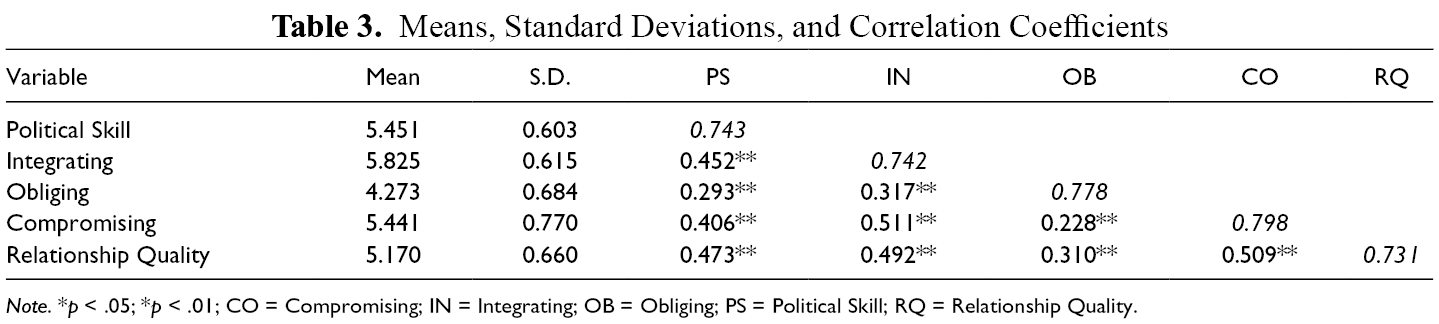
Note. *p < .05; *p < .01; CO = Compromising; IN = Integrating; OB = Obliging; PS = Political Skill; RQ = Relationship Quality.
Results
We conducted confirmability factor analysis on the model to assess the goodness-of-fit of the model using the following: CMIN/DF, comparative fit index (CFI), Tucker–Lewis coefficient (TLI), goodness-of-fit index (GFI), root mean square error of approximation (RMSEA), adjusted goodness-of-fit index (AGFI), and incremental fit index (IFI) indexes for testing. The results showed that all indexes met the requirements (CMIN/DF = 1.732, CFI = .923, TLI = .915, GFI = .834, RMSEA = .060, AGFI = .803, IFI = .924). The model had a good goodness-of-fit. Thus, this model could be used for further analysis.
Table 3 shows the mean, standard deviation, and correlation coefficients of all variables in this research. Among the three cooperative conflict management styles, the highest value of mean is the integrating style (5.83), the mean value of the compromising style is also at a high level (5.44), and the mean value of the obliging style is relatively low (4.27), consistent with the previous research results (Zhang & Huo, 2015). Furthermore, all the major variables were significantly correlated. Thus, their relationship needs further analysis.
Multiple hierarchical regression was conducted to verify the hypothesis. Table 4 shows the analysis results. Among the control variables, work experience was significantly associated with integrating (β = .155, p < 0.05), compromising styles (β = .219, p < 0.01), and relationship quality (β = .265, p < 0.001). However, after putting political skill into the regression model, work experience and integrating style are no longer correlated. Therefore, political skill may play a mediating role between work experience and integrating style.
Results of Hierarchical Regression Analysis

Note. *p < .05; *p < .01; *p < .001; n = 206.
In H1, political skill is positively related to relationship quality. Model 8 examines the relationship between political skill and relationship quality. The results showed that political skill is positively correlated with relationship quality (β = .457, p < 0.001). Thus, H3 is validated.
In H2, political skill is positively associated with cooperative conflict management styles—namely, integrating, compromising, and obliging styles. Models 2, 4, and 6 examine the relationship between political skill and integrating, compromising, and obliging styles, respectively. The results showed that political skill is positively correlated with integrating (β = .443, p < 0.001), compromising (β = .401, p < 0.001), and obliging (β = .294, p < 0.001). Therefore, H1 is supported.
In H3a through H3c, the conflict management styles of integrating, compromising, and obliging are positively related with relationship quality. Model 9 examines the relationship between integrating, compromising, and obliging styles and relationship quality. The results showed that integrating (β = .292, p < 0.001), compromising (β = .312, p < 0.001), and obliging (β = .137, p < 0.05) are positively correlated with relationship quality. Thus, H2 is supported.
We applied the bootstrap method to examine the mediating roles of cooperative conflict management styles as stated in H4. This method was considered preferable to some traditional analysis methods (Zhang et al., 2015), such as the causal steps approach and Sobel test. We use Preacher and Hayes’ bootstrapping SPSS Processor to test the indirect effect of mediating variables in our multiple mediator models. The data are bootstrapped 5,000 times, and the results showed that integrating (CI = [0.038,0.174]) and compromising (CI = [0.064,0.194]) styles have significant mediating effects between political skill and relationship quality. By contrast, the mediating effect of obliging style was not significant (CI = [−0.004,0.080]). Therefore, H4 was partially validated.
Discussion
The results show that the integrating and compromising styles are more commonly used forms of conflict management than obliging, consistent with previous findings (Shih & Susanto, 2010; Zhang et al., 2015). The reason is that integrating and compromising styles tend to have a positive effect on job performance (Shih & Susanto, 2010), personal innovation (Zhang et al., 2015), satisfaction (Lee, 2008), commitment (Ndubisi, 2011), and relationship quality (Lu & Wang, 2017). As a conflict management style aiming at a win-win situation, integrating is the first choice of people. Compromising requires some personal sacrifice but can also lead to partial win-win results. Compared with other industries, the conflict issues in the construction industry will be more competitive due to several participants in construction projects (Sunindijo & Hadikusumo, 2014). Sometimes, the integrating style may not completely consider the interests of both parties in the conflict, and as a suboptimal approach, the compromising style may be highly acceptable. Although obliging considers the interests of others and helps to maintain the cooperative relationship between both parties to a certain extent, obliging requires self-sacrifice and results in lose-win. Therefore, people’s willingness to choose the obliging style will be significantly lower than the first two approaches. This research result can draw scholars’ attention to political skill and provide a new way to maintain relationship quality.
We also found that work experience was significantly correlated with political skill, integrating style, compromising style, and relationship quality. Given that political skill is an acquired skill (Ferris et al., 2007), employees with considerable work experience are likely to improve their political skill along the way. Given that integrating and compromising styles can consider the interests of both sides and tend to promote positive results, people are more inclined to choose these two conflict management styles with the increase of work experience. Work experience not only represents the degree of cognition of the work, but also the interpersonal emotional factors (Chen & Peng, 2008). People’s experience of working together increases trust levels, in turn improving relationship quality.
The results of this research confirm that political skill is significantly and positively associated with relationship quality. The mechanism of action of political skill can be explained in terms of affective and instrumental support. From the perspective of emotional support, people with high political skill have a clear and correct understanding of the project situation and the people around them. On the basis of this understanding, appropriate emotional support (e.g., praise, approval, expression of concern) can be given to others in different situations to strengthen the identity and trust between individuals (Maher et al., 2018). From the perspective of tool support, people with high political skill have good network resources and social capital, enabling people who frequently interact with them to obtain additional organizational support (McCarthy et al., 2016). Particularly in societies in which rule by men and favoritism prevail, the relationship between political skill and relationship quality can be supported by the social exchange theory; that is, individuals with high political skill have the ability to benefit those around them, promoting a mutually beneficial relationship between individuals and improving relationship quality.
This research also verified the positive correlation between political skill and cooperative conflict management styles. The social alertness of political skill enables people to understand others clearly and accurately. On the basis of social exchange theory, people would be encouraged to choose a more caring conflict management style to deal with problems. This positive correlation also indicates that highly politically skilled individuals believe that cooperative conflict management styles can effectively resolve conflicts. Politically skilled individuals will actively participate in interactions and promote information sharing to face conflicts in integrating style. Political skill emphasizes taking appropriate behaviors according to specific situations, and cooperative conflict management styles also include concessions to a certain extent. Given the complexity of the project, sometimes the conflicting goals are mutually exclusive and difficult to reconcile, and project managers need to choose compromises to avoid more serious losses. However, the positive relationship between political skill and the obliging style is worth consideration. In regard to the obliging style, several studies show that this style is not a conflict management style where people are willing to choose because the obliging style puts their interests at risk. The results of this study may have something to do with the background of Chinese culture surveys; Chinese culture is characterized by long-term orientation and collectivism (Hofstede & Bond, 1988). In this context, personal or short-term interests are sacrificed for the sake of collective or long-term interests. This result also reflects the characteristics of conflict management behaviors of Chinese employees under the influence of traditional culture and values. Moreover, we believe that when some respondents are affected by unequal interpersonal relationships (e.g., subordinates facing superiors, construction staff facing owners, or supervisors), they may be inclined to choose the obliging style, which may be a new way to study conflict management.
In regard to the relationship between conflict management and relationship quality, we find that integrating, compromising, and obliging styles are significantly associated with relationship quality. Several studies found that the integrating style promotes good relationships (Gross & Guerrero, 2000; Lee, 2008; Ndubisi, 2011; Rahim & Buntzman, 1989). In conflict situations, both parties adopt the integrating style that can promote information sharing and explore differences (Rahim et al., 2000) to enhance mutual understanding and cooperation. The integrating style can also lead to a win-win result so that both parties can obtain the greatest degree of satisfaction, thereby improving relationship quality. Individuals using the compromising style often seek fairness and avoid cliques or arbitrary decisions to maintain friendships (Ndubisi, 2011). Although some studies found that the compromising style inhibits relationship quality (Lu & Wang, 2017), their research is at the organizational level. In the Chinese collectivism context, organizational and individual interests are different, and compromise at the organizational level will damage the interests of the organization and impair the quality of the relationship. However, at a personal level, people pay additional attention to fairness than a concession of interests. Thus, the compromising style may be conducive to the interpersonal relationship (Erkutlu & Chafra, 2015). This result also reflects the necessity of studying conflict management from the organizational and individual levels, respectively. The obliging style can promote “face-saving” for the other party, meet the needs of others to the greatest extent, and make the other party obtain high satisfaction. Although the loss of self-interest may undermine the quality of the relationship, the context of China’s relationship seems highly complex. Chen and Peng (2008) propose that the relationship among colleagues in China is a mutually beneficial relationship mixed with affective and instrumental components. In addition to improving the relationship quality by integrating and compromising in work interactions among colleagues, obliging style, as positive behavior, can improve the relationship quality of both sides on an affective level. This result also reflects the importance of culture in the study of conflict management.
We find a partial mediating effect of integrating and compromising styles; that is, political skill in construction projects can influence the relationship quality in direct and indirect ways. This result reflects the basic framework of social exchange theory in this study. Political skill, as a kind of social ability, will show certain relationship behaviors and improve the relationship quality. In the context of conflict management, this relationship behavior is embodied in the cooperative conflict management style. In a project, conflict is inevitable, and when conflicts occur, interpersonal relationships are seriously challenged. Highly politically skilled individuals are good at accurately understanding others and perceived as sincere, thereby gaining their trust easily (Ferris et al., 2007). Moreover, individuals with high political skill are good at interpersonal skills and have the ability to build relationships with others. Therefore, political skill can also directly affect relationship quality. People with high political skill tend to act on the concerns of others. When conflict occurs, they are more likely to choose conflict management styles that satisfy both sides based on social exchange theory, thereby maintaining good relationship quality. Highly politically skilled individuals actively participate in interactions and cooperate (Ferris et al., 2005), and adopt active conflict management styles such as integrating and compromising to deal with conflicts to maintain relationship quality. Therefore, political skill can indirectly affect the quality of relationships by integrating and compromising conflict management styles. The mediating effect of the obliging style has not been verified. We believe the reason is that obliging style may be detrimental to one’s own interests; people’s willingness to choose the obliging style is evidently lower than integrating and compromising styles among cooperative conflict management styles. Thus, the influence of political skill on relationship quality is mainly completed through integrating and compromising styles, in which the role of obliging style is relatively weak.
Conclusions
This study explores the relationship among political skill, cooperative conflict management styles, and relationship quality in the context of Chinese construction projects. This study also examines the mediating role of cooperative conflict management styles. On the basis of social exchange theory, we develop the hypothesis of the relationship between the main variables mentioned above. Exploring these questions can clarify the importance of cooperative conflict management styles in constructive conflict resolution and can effectively improve relationship quality. To our knowledge, no other research has explored the relationship between individual-level political skill, cooperative conflict management styles, and relationship quality in projects. This study has certain theoretical and practical significance.
Through a survey of 206 invitees regarding cooperative conflict management styles, integrating and compromising styles are more often chosen than obliging style (Shih & Susanto, 2010; Zhang et al., 2015). Political skill is positively correlated with integrating, compromising, and obliging styles, possibly significantly improving relationship quality. Furthermore, we verified the mediating effect of integrating and compromising styles between political skill and relationship quality. However, the mediating effect of the obliging style is not verified.
Theoretical and Practical Implications
On the basis of social exchange theory, this study constructs a theoretical model of political skill, cooperative conflict management and relationship quality, and contributes to the construction project management knowledge system. First, this study provides empirical evidence for the relationship between political skill, cooperative conflict management styles, and relationship quality in construction projects and helps people better understand how political skill affects relationship quality from the perspective of conflict management. Politically skilled individuals know how to use their keen understanding of themselves and others in social interactions to behave appropriately, thus showing strong influence over others. Specifically, politically skilled individuals understand the importance of caring for the needs of others and maintain good interpersonal relationships by adopting appropriate cooperative behaviors. Second, the mediating role of integrating and compromising style between political skill and relationship quality was verified. This result helps illuminate the black box with respect to the effects of political skill on relationship quality. Note that the mediating effect of obliging style has not been verified, which reminds us that although cooperative behavior plays an important role in establishing good relationships, we should pay attention to the degree of altruism and self-interest. Cooperative behavior that is altruistic without considering self-interest is not the way to establish relationships for individuals with good social ability. The theoretical model and conclusion of this study will help people better understand how to improve the quality of their interpersonal relationships and provide inspiration for subsequent research on relationship theory.
This study can provide some practical guidance for Chinese construction project managers. In the relationship-oriented organizational context, the importance of “soft power,” such as relationships, is to a certain extent higher than “hard power,” such as performance (Liu et al., 2007). Project managers can improve relationship quality by strengthening their political skill and adopting appropriate conflict management styles. Project managers and employees should recognize the importance of political skill in construction projects that involve complex interpersonal relationships with many stakeholders. On the one hand, managers should absorb additional politically skilled individuals when building project teams, specifically in high-impact positions. On the other hand, project managers should strengthen the training of employees in political skill (Ferris et al., 2007). Moreover, in the context of project conflict, people deal with conflict in different ways. Cooperative conflict management style is an effective way for people with good political skill to improve relationship quality. However, in the context of temporary background, lack of collaborative experience, and information asymmetry, project members are likely not to care about others and give up using a cooperative conflict management style. Managers should pay attention to the conflict management style preferences of project members and actively guide them in using cooperative conflict management styles, particularly integrating and compromising, which can also improve the relationship skills of project members. In conclusion, managers should focus on political skill and conflict management styles to better maintain good relationship quality and thus promote project success.
Limitations and Future Research
Although this study has certain theoretical and practical value, some limitations remain. First, the concept of political skill and measurement is affected by cultural background. The political skill inventory used in this study is based on the development of the western cultural background, and this study was conducted under the background of traditional eastern culture. Hence, the “modesty and inaction” and “moderation” characteristics cannot be measured, possibly affecting the accuracy of the research results to some extent. Future research on political skill should focus on the differences among various cultures and develop a scale suitable for an eastern cultural background. Second, the current research on political skill is mostly at the individual level. However, organizational or team political skill, as an important factor affecting team atmosphere and performance, should not be ignored. The relationship between teams and organizations involved in construction projects is more complex than that in other industries. Therefore, future research on political skill at the level of construction project teams or organizations is promising. Furthermore, this study regards conflict management styles and relationship quality as static variables. However, conflict in a project is constantly developing and changing, and people may adopt a variety of different conflict management styles at various stages of conflict development. Therefore, future studies can focus on whether differences exist in people’s choices of conflict management styles at different stages of conflict development and the effects of multiple combinations of conflict management styles.
Similar to Shih and Susanto’s (2010) study, this research focuses on conflict management styles and does not explicitly study the type of conflict. Similarly, Zhang and Huo (2015) focus on conflict in a broad sense rather than on the types of conflicts. Whether the research results of conflict management styles are different under different types of conflict backgrounds has not been a focus. In the future, the effects of task, relationship, and process conflicts on the research results of conflict management styles should be systematically studied. The influence of relationship type on the results of this study was not explored. The relationship types in construction projects are relatively complex, including not only the position relationship among subordinates, peers, and superiors, but also the unequal relationship between the subordinate organizations (e.g., subcontractor and general contractor, construction side and owner). The effect of these relationships on conflict management needs to be addressed in future studies.
Footnotes
Declaration of Conflicting Interests
The author(s) declared no potential conflicts of interest with respect to the research, authorship, and/or publication of this article.
Funding
The author(s) received no financial support for the research, authorship, and/or publication of this article.

Author Biographies