




Abstract
We examined the impact of knowledge-oriented leadership on project success via team cohesion and the moderating role of valuing people and project complexity on this relationship. We collected data from 121 project employees in Pakistan in a two-wave field survey at an interval of 15 days. The results showed a positive association between knowledge-oriented leadership and project success, and team cohesion partially mediated this relationship. Valuing people positively moderated the relationship between knowledge-oriented leadership and team cohesion. Project complexity had a negative but insignificant moderating effect on project success. The theoretical and practical implications of these findings are discussed.
Keywords
Introduction
Projects drive strategy into actions required for the social and economic progression of any country. In Pakistan, both public and private sectors collaborate in several infrastructure development projects, such as the China-Pakistan Economic Corridor and Naya Pakistan Housing program, with immense confidence to accomplish socially valued success. Nevertheless, most risk factors linked with project failures (Farid et al., 2020; Wagner, 2016) can be attributed to the neglect of human elements directly engaged in projects: leadership and team members. Despite having a strategic standing, the human factors have a dearth of inquiry in the realm of projects (Maqbool et al., 2017; Tabassi et al., 2017).
To survive and thrive in economic uncertainty, project managers look for critical factors that determine project success (Gunduz & Almuajebh, 2020). Project management capabilities broadly impact project success (Irfan et al., 2019) in dynamic and competitive business ecosystems. Significantly, human capabilities and knowledge creation figure out success throughout the project's life cycle (Jugdev & Müller, 2005). Therefore, a focus beyond the classic iron triangle of scope, cost, and time (Bronte-Stewart, 2015; Koops et al., 2016) would expand the capabilities and practices that facilitate innovation, competitiveness, and sustainability (Severo et al., 2020).
The fields of management, social, and behavioral sciences have reached a certain level of maturity in leadership research (Geoghegan & Dulewicz, 2008). Leadership style (Cleveland & Cleveland, 2020; Turner & Müller, 2005), manager behavior, and the team itself (Matthews et al., 2018) are the foundations of employee engagement in successful project organizations. Leadership styles such as transformational (Maqbool et al., 2017), shared (Imam & Zaheer, 2021), and ethical (Bhatti et al., 2021) are broadly researched with project success. Leadership capabilities are sought to attain project success (Gehring, 2007; Maqbool et al., 2017), including the capabilities to deal with diversity, complexity, and distinct personalities of team members in dynamic project environments. In this context, knowledge-oriented leadership prompts and reinforces knowledge creation, sharing, and use to shift thinking patterns and collective outcomes (Mabey et al., 2012).
Learning and integrating knowledge management capabilities are central to innovation-based competitive strategies (Amarakoon et al., 2018; Salunke et al., 2019). In project organizations, knowledge sharing helps prevent mistakes and the risk of failure (Ni et al., 2018). Knowledge donation and collection occur when employees demonstrate their attitudes and intention to share knowledge (Tohidinia & Mosakhani, 2010). Empowering leadership, team cohesion, and team climate facilitate knowledge sharing (Kakar, 2018; Xue et al., 2011). Therefore, project managers should prepare for the human aspects of their work to foster collective sensemaking abilities (van der Hoorn & Killen, 2021). Environmental, personal, and leadership factors influence team elements, affecting individual and group outcomes (Carron, 1982). The dynamic capability view of knowledge denotes the potential for better performance (Khaksar et al., 2020; Nazari et al., 2021). However, this relationship could not be assumed without empirical verification in the project context (Zahra et al., 2006). This study considered knowledge-oriented leadership, valuing people, and team cohesion as dynamic capabilities to facilitate project success, given their unique complexities.
Problem Statement and Research Gaps
The recently coined term of knowledge-oriented leadership is at the initial stages of its alignment with project management literature. This leadership style motivates team members to collectively create, share, and apply knowledge to improve project performance (Latif et al., 2021). In the present time of radical and rapid change, organizations require positive work approaches, such as team cohesion, from their employees to support business objectives (Javed et al., 2019). Project managers increasingly look for innovative and engaged employees to stay balanced and competitive in the market (Salunke et al., 2019; Severo et al., 2020; Yang et al., 2018). Leaders should value and acknowledge their team members and create a sense of trust to engage teams and obtain superior results. Growing business opportunities and global competition demand proactive knowledge-management strategies, developing new capabilities, and renewing existing capabilities. Intellectual capital is a critical factor for business startup success (Paoloni et al., 2020). It enables growth opportunities (Sardo & Serrasqueiro, 2018), firm performance (Abualoush et al., 2018; Hussinki et al., 2017), and innovation in projects (Egbu, 2004) that are mainly required for a sustainable competitive edge (Severo et al., 2020).
Researchers track critical factors that contribute to projects’ success or failure (Gunduz & Almuajebh, 2020; Olawumi & Chan, 2019). One vital factor influencing project success is the project managers’ leadership style (Cleveland & Cleveland, 2020; Rehman, 2020). The studies illustrate positive outcomes of knowledge-oriented leadership (Latif et al., 2021) and team cohesion (Chiocchio & Essiembre, 2009). Knowledge-oriented leadership can guide knowledge management processes that affect project success; however, it is scarcely investigated concerning project performance (Latif et al., 2021). Further, the mechanisms defining this relationship have not been adequately examined. Team cohesion promotes dynamic capability processes such as absorption, generation, storage, and adaptation of knowledge (Gonzalez & de Melo, 2019). However, team cohesion as a knowledge management mechanism and the relevant boundary conditions influencing project success remain less researched. There is a need to study multidimensional team cohesion (task and social cohesion) with team performance (Marques-Quinteiro et al., 2019). Scholars (Scott-Young & Samson, 2008; Turner et al., 2008) have also proposed empirical studies on comprehensive team-building practices in a project context.
Drawing upon the knowledge-based dynamic capabilities view, we assumed that knowledge-oriented leadership facilitates team cohesion by integrating employee competencies and experience (Callow et al., 2009). Valuing people (Laub, 1999, 2018; McNeff & Irving, 2017) could be another strategy used by project leaders to induce team spirit and cohesion to benefit from employees’ explicit and tacit knowledge resources. Knowledge-oriented leadership and valuing people may interact to build dynamic capabilities (McNeff & Irving, 2017), enabling performance through knowledge sharing and team cohesion (Huang, 2009). These may also develop teamwork quality through enhanced coordination, mutual support, and team effort (Hoegl & Gemuenden, 2001; Lindsjørn et al., 2016). As a result, each employee becomes a dynamic team member, accelerating team and project success, despite the prevailing and emerging project complexities. Hence, in response to recent calls for research on leadership, team performance, and project success (Latif et al., 2021; McNeff & Irving, 2017; Scott-Young et al., 2019), this study offers theoretical articulation to better understand the antecedents, mechanisms, and boundary conditions of project success. Specifically, the key questions we addressed through hypothesis testing are: (1) What is the nature of the relationships among knowledge-oriented leadership, valuing people, team cohesion, project complexity, and project success? (2) Does team cohesion mediate the relationship between knowledge-oriented leadership and project success? (3) Does valuing people moderate the relationship between knowledge-oriented leadership and team cohesion? and (4) Does project complexity moderate the relationship between team cohesion and project success? The findings have practical relevance to managers and organizations pursuing competing project goals.
Literature Review
This section reviews the literature on five study constructs (i.e., project success, knowledge-oriented leadership, team cohesion, valuing people, and project complexity) and the inter-construct associations constituting the basis of the conceptual model (Figure 1). The mediating role of team cohesion and the moderating effects of valuing people and project complexity are argued in the context of knowledge-oriented leadership and project success using the knowledge-based dynamic capabilities view (Khaksar et al., 2020; Nazari et al., 2021).

Proposed research model.
Successful projects contribute to socioeconomic and community well-being. The concept of project success, however, lacks consensus on a globally accepted definition. The definitions vary, from the nature and type of projects to who defines them and how different stakeholders view them. It is a multidimensional strategic concept, and “success means different things to different people” (Shenhar et al., 2001, p. 702). Project Management Institute (2017) offered the most popular definition of project success: balancing competing demands, such as project quality, scope, time, and cost, and meeting stakeholders’ concerns and expectations. Lindsjørn et al. (2016) conceptualized project success as team performance (leaders, members, and project owners in terms of quality, schedule, and budget) and team member success (work satisfaction and learning). Project success is also defined as project performance characterized by project schedule, cost, quality, scope, and safety (Hussain et al., 2020). Given their role in socioeconomic progression, we included a variety of projects in this study. Thus, we conceptualized and measured project success as a multidimensional construct: (1) teams’ task-related outcomes such as team task performance, (2) people-related outcomes such as team member success (Lindsjørn et al., 2016), and (3) project-related outcomes called project performance (Hussain et al., 2020).
This research benefits from the perspective of knowledge-based dynamic capabilities, which are interlinked and influence each other (Helfat & Peteraf, 2003). A knowledge-based view of dynamic capabilities describes a firm's ability to explore and exploit new opportunities by reconfiguring and protecting knowledge resources, competencies, assets, and technologies to realize a sustainable competitive advantage (Teece, 1998). It defines how firms adjust their knowledge base by acquiring, generating, and combining knowledge to identify and respond to their environmental dynamics (Khaksar et al., 2020; Zheng et al., 2011). There are three major knowledge-based dynamic capabilities (Zheng et al., 2011): knowledge acquisition, generation, and combination. Denford (2013) identified a set of eight knowledge-based dynamic capabilities, namely, knowledge creation, integrating, reconfiguration, replication, development, assimilation, synthesis, and imitation. Developing and integrating these capabilities facilitate worker productivity (Khaksar et al., 2020) and firm prosperity (Easterby-Smith et al., 2009) in changing market conditions. The leaders can help individuals recognize their capabilities, design a teamwork atmosphere, and guide organizational outcomes.
Leadership and shared vision serve as dynamic capability processes that enable the creation and flow of knowledge to bring innovation and performance in modern, knowledge-intensive societies (Nonaka & Takeuchi, 1995; von Krogh et al., 2012). It befits quite well for projects where team members’ learning behaviors and knowledge creation are linked to project success (Arumugam et al., 2013). Knowledge-oriented leadership and valuing people cultivate a culture of knowledge-based team cohesion based on trust and cooperation, facilitating distant and local group learning to attain group efficiency and innovation (Wong, 2004). Knowledge orientation of transformational leadership and team cohesion are rare and valuable sources of sustainable competitive advantage (Grant, 1996). These need to be examined as forms of knowledge-based dynamic capabilities (Idris & Ali, 2008). Developing such capabilities is expected to reinforce learning as a managerial process and yield high returns at the project level.
The Relationship Between Knowledge- Oriented Leadership and Project Success
Knowledge-based dynamic capabilities predict firms’ innovation processes and performance (Nazari et al., 2021). However, a parsimonious explanation of the relationship between knowledge-oriented leadership and project success is scarce (Latif et al., 2021). Knowledge-oriented leadership combines transactional and transformational leadership styles to focus on knowledge management (Donate & de Pablo, 2015). Leadership creates an awareness of shared interests and a typical mentality that strengthens the teams’ shared vision and cohesion capabilities to promote collective organizational goals (Bass et al., 2003). Through their knowledge management approaches and coaching skills, team leaders induce team members’ psychological engagement at work and foster high-quality teamwork, characterized by positive indicators, including team cohesion (Mariam et al., 2019, 2020). Leadership capability is highly valued for effective organizational outcomes. Leaders help organizations prepare for change through employee commitment, creativity, and innovative engagement at work (Iranzadeh & Bahrami, 2013). Likewise, project success depends on appropriate leadership behavior (Cleveland & Cleveland, 2020). Leaders’ knowledge orientation is a dynamic process capability that supports the creation of unique and strategic knowledge to leverage innovation and performance (Ferraresi et al., 2012). It recognizes, supports, and rewards knowledge-based efforts and employees’ capabilities (Ribière & Sitar, 2003). Knowledge-oriented leadership also discourages negative behaviors that threaten the transfer, sharing, and application of knowledge (Lakshman, 2009) while encouraging team building and project success (Aga et al., 2016; Latif et al., 2021). Based on this, we drew the following hypothesis:
The Relationship Between Knowledge- Oriented Leadership and Team Cohesion
Knowledge-based dynamic capabilities enhance knowledge workers’ productivity (Khaksar et al., 2020). Leadership unites people to accomplish team and organizational outcomes (Filho, 2019; García-Morales et al., 2011; Michalisin et al., 2004). Knowledge orientation is essentially a trait of transformational leadership (Donate & de Pablo, 2015), inspiring followers and increasing team cohesion, understanding and exchanging ideas, providing analytics across teams, and empowering teams to be self-managing (Aga et al., 2016). Team cohesion is the propensity of teams to stick together and pursue their ambitions in unison. It is an affective state of team dynamics characterized and measured in terms of task cohesion, social cohesion, and individual attraction to a group with a passion to remain in it (Carless & De Paola, 2000; Filho, 2019). Knowledge-based cohesion fosters team mental models, coordination, and collective efficacy, influencing team outcomes (Filho, 2019). It reflects a firm's capacity to develop skills and communications required to achieve planned objectives and a team spirit (Edmondson, 1999; Kakar, 2018), facilitating collegiality and a will to help others in the team. Socialization within firms makes it challenging to imitate the complex interactions that involve teamwork (Nonaka & Takeuchi, 1995). Marques-Quinteiro et al. (2019) called for research into multidimensional team cohesion (task and social cohesion) to find out how it evolves and affects performance outcomes.
Knowledge-based leadership approaches encourage expanding knowledge-intensive capabilities and innovative outcomes (Naqshbandi & Jasimuddin, 2018). Knowledge sharing contributes to the success of a complex project (Jamil et al., 2019). Knowledge-oriented leadership behavior supports creating, sharing, and utilizing new knowledge to bring a shift in thinking patterns and cumulative outcomes (Mabey et al., 2012). Knowledge-oriented transformational leadership improves cohesion, and subsequently, organizational outcomes (Callow et al., 2009; Shamir et al., 1998). It builds a cohesive team culture where each team member exerts optimal efforts to reach team and project success (Chiocchio & Essiembre, 2009). It gives the basis for the following hypothesis:
The Relationship Between Team Cohesion and Project Success
The spirit of organizational actions lies in the coordinated, synchronized, and integrated contributions of all members, who may be organized into subsystems, groups, and structures according to their functional roles (Tesluk et al., 1997). A team includes two or more people interacting socially to perform specific tasks, with distinct roles and responsibilities for achieving interdependent, common goals in an organizational system under a broader context and task environment (Kozlowski & Ilgen, 2006). Team building is a superior component of human resource management practices in project organizations (Turner et al., 2008) and a fundamental indicator of project success (Aga et al., 2016). It prompts the teamwork quality required for innovative projects’ success (Hoegl & Gemuenden, 2001).
Team cohesion refers to the extent to which individuals come and remain together to pursue tasks or socially interdependent goals (Filho, 2019; Pescosolido & Saavedra, 2012). It is a valuable and dynamic capability that powerfully determines effective teamwork (Menges & Kilduff, 2015), competitive growth, and success (Filho, 2019; Michalisin et al., 2004). The cohesion and trust in teams anticipate project success (Imam & Zaheer, 2021). The cohesive team members remain united to achieve common goals, essential for business teams’ performance (Menges & Kilduff, 2015). It is because they can effectively share and exploit the knowledge that they can thus develop in a more absorptive capacity. This knowledge-based cohesion within the team drives innovation performance (Nazari et al., 2021) and project success (Emiliano de Souza et al., 2021). A strong degree of cohesion in teams is more likely to produce better coordination and performance outcomes over time (Marques-Quinteiro et al., 2019). Accordingly, we hypothesized as below:
The Mediating Role of Team Cohesion
The mediator is a variable that transfers the effect of an antecedent to a criterion variable. Mediation is when a mediator describes the causal link between any two variables (Mathieu & Taylor, 2007). In team development processes, the individual, team, and organizational contexts influence emergent states and outcomes (Mathieu et al., 2008). “Teams are multitasking entities that perform multiple processes simultaneously and continuously to orchestrate goal-directed taskwork” (Marks et al., 2001, p. 1). Teams and their effectiveness are central to the everyday social component of work. Organizational systems, contextual contingencies, and environmental dynamics determine team tasks and situational demands, influencing team effectiveness through emerging team processes (Kozlowski & Ilgen, 2006; Menges & Kilduff, 2015). Through related group outcomes, individual-level factors turn to organizational outcomes (Chiocchio & Essiembre, 2009). Project management is concerned with teams and their social mechanisms, essential to project outcomes (Hennel & Rosenkranz, 2020). Project and organizational outcomes emerge from teamwork processes that express interdependent activities to pursue team goals (Marks et al., 2001). Team cohesion is imperative to team outcomes (Filho, 2019), superior industry returns (Michalisin et al., 2004), and project success (Din, 2017). Project managers’ personalities (Hassan et al., 2017), leadership styles, teamwork (Yang et al., 2011), and quality of teamwork (Lindsjørn et al., 2016) influence project success.
The literature reveals that leadership is related to team cohesion, which improves performance (Callow et al., 2009) and project success (Imam & Zaheer, 2021) by improving teamwork quality (Hoegl & Gemuenden, 2001). We conceptualized team cohesion as a potential mediator to explain the relationship between knowledge-oriented leadership and project success. Several mechanisms may illustrate this mediation process; knowledge-oriented leadership encourages knowledge sharing (Shariq et al., 2019) and team building (Braun et al., 2013). It defines the tie between collaborative culture and innovative capabilities (Yang et al., 2018). A culture of knowledge sharing encourages cooperative interactions (Ni et al., 2018) and trustworthiness (Kipkosgei et al., 2020) among team members, leading to better team performance (Huang, 2009) and project success (Braun et al., 2013). The interaction and trust may ease individuals’ attractions to the group, task cohesion, and social cohesion (Carless & De Paola, 2000). Cohesive teams achieve project success, as team members agree on performance goals, standards, and shared interests and approaches at work (Eisenbeiss et al., 2008). Therefore, we hypothesized that:
The Moderating Effect of Valuing People
Human capital is the foundation for any successful business strategy. It is a compelling source of competitive advantage (Bartlett & Ghoshal, 2002), since “putting the people first” determines organizational success (Pfeffer & Veiga, 1999). Valuing people is a servant-leadership behavior (Laub, 1999). It refers to how often leaders acknowledge their subordinates by creating a sense of trust, belonging, and appreciation of their knowledge, skills, and expertise (McNeff & Irving, 2017). Leaders work with people and need to value people to benefit from their unparalleled knowledge, expertise, and experiences. Valuing people may strongly impact organizational culture and serve as the foundation for leadership behaviors. Therefore, the need to examine valuing people relating to leadership behaviors and organizational outcomes is realized (McNeff & Irving, 2017).
Healthy organizations value and develop their people (Laub, 2018). Leaders recognize that people have present value as well as future potentiality. People have an innate ability to know whether they are being trusted and valued or not. Effective leaders recognize an individual's value straight away; they trust them without asking them to earn it. Organizations want their employees to engage at work and exhibit proactive behavior, initiative, and responsibility for personal and organizational development (Patrick & Bhat, 2014). In this respect, valuing people may have a powerful, reciprocal effect on the organization's business culture (McNeff & Irving, 2017).
The knowledge-based dynamic capability view supports that the team members who feel valued about their knowledge, competencies, experience, and work contribution would exhibit more team collaboration to share and apply their knowledge at work. Knowledge-oriented leadership is relevant when employees want to see leaders being more active and committed to supporting knowledge and learning activities by valuing their existing knowledge and expertise (DeTienne et al., 2004). In this view, leadership's effect on the team and organizational performance may be contingent on how much leaders value their people. Accordingly, we hypothesized that:
The Moderating Effect of Project Complexity
Projects vary in size, distinctiveness, and complexity, and accordingly, project success may vary (Müller & Turner, 2007). Project complexity refers to the difficulty of establishing the processes required to facilitate coordination, fitting the parts together, and responding to unpredictable interdependencies in conditions changing over a specified time (Hirschman, 2014). It also considers the numbers and heterogeneity of interrelated project elements (Burke & Morley, 2016). Modern-day projects are complex in scope, constituencies, technologies, resources, and so forth (Luo et al., 2017; Mathieu et al., 2008). We conceptualized and measured project complexity in terms of the task, goal, and technological complexity (Luo et al., 2017).
Project complexity of any type diminishes project success (Jamil et al., 2019; Ma & Fu, 2020). Baccarini (1996) maintained that complexity significantly impacts project management methods and practices. Müller et al. (2011) supported that project complexity negatively moderates the relationship between project leaders’ competencies and project success. McComb et al. (2007) also noticed that project complexity moderates the flexibility-performance relationship. It is thus likely that project complexity may reduce the positive effects of certain success factors on project success, in other words, sustainability (Malik et al., 2020) and agile response to change (Nguyen & Mohamed, 2020). Therefore, we theorized that despite knowledge-oriented leadership, valuing people, and team cohesion, project success would decline with the growing project complexities. Accordingly, we hypothesize that:
Method
Context and Participants
All projects strive to improve the living conditions of the larger population surrounding them. We conducted an online field survey involving project employees from a diverse range of public and private sector organizations from different sectors of the economy (i.e., buildings and highways; communication networks and software; dams, canals, and bridges; education and learning management systems; power systems; healthcare systems; mass transit and airports; manufacturing operations; and water resource management). The participation criteria included the individual employees having worked on a project team in any role in some of the most recently completed knowledge-intensive/infrastructure development projects in Pakistan.
The survey concluded with a simple random sample of 121 project employees (male = 89.3%, female = 10.7%). The majority of participants were younger (25–30 years = 53.7%, 31 years and above = 46.3%), highly educated (minimum master's level = 100%, doctorate = 9%), and rich in experience of working in project-based organizations (1–5 years = 55.4%, 6 years and above = 46.6%) from across Pakistan (Table 1).
Personal Profile of Participants (n = 121)

Data Collection Procedure
The primary, quantitative, and self-reported data were collected from 121 experienced project employees (see Table 1). Initially, a random list of 50 potential participants comprising senior and middle-level project employees (engineers, consultants, and contractors) was prepared by obtaining their contact details through the author's personal networking in different projects and the Pakistan Engineering Council—a statutory body regulating the engineering profession in Pakistan. This targeted random sample was approached through email and WhatsApp to fill in the research questionnaires, and respondents were asked to share the survey link with their project colleagues for participation in this research. The data collection was temporarily separated into two waves, in other words, time 1 and time 2 (15 days after time 1) from May 2020 to July 2020, to avoid the likelihood of common method bias (Podsakoff et al., 2003). The potential respondents were informed, through a cover letter, about the purpose of the research, eligibility criteria for participation, no intentional physical or psychological harm, the requirement of an email address for two-wave data collection, and the complete confidentiality of their responses. The respondents indicated their informed consent for volunteer participation by responding to the question: “Can you please volunteer for participation in this academic survey in a few minutes? (Yes/No).” Only those who opted for “Yes” were allowed to fill out the questionnaire; those opting for “No” were asked not to participate in the survey.
At time 1, data on demographic characteristics, including an email address needed for contact for the time 2 survey, independent variable (knowledge-oriented leadership), mediating variable (team cohesion), and moderators (valuing people and project complexity) were collected. Participants were instructed to: “Please think of the most recently completed knowledge-intensive/infrastructure development project that you have worked on in Pakistan in any role. Keeping that project in mind, please respond to the given statements using a 5-point scale of 1 (Strongly Disagree) to 5 (Strongly Agree).” We sent the initial survey link to 50 selected senior and middle-level project employees with the request to forward the survey within their professional networks. A week after the launch of this survey, we asked the respondents through an email to share the survey link within their professional networks to maximize the sample size. The survey was concluded after 15 days with 170 respondents.
At time 2, only the 170 respondents of the time 1 survey (15 days after their response to the time 1 survey) were emailed another questionnaire to collect data on the dependent variable (project success). This time, the participants were instructed to “Please recall the project that you thought about while responding to the Phase 1 survey some 15 days back (that was the most recently completed knowledge-intensive/infrastructure development project that you had worked on in Pakistan). Keeping that same project in mind, please respond to the following statements on a 5-point scale of 1 (Strongly Disagree) to 5 (Strongly Agree).” A week later, the nonresponsive participants were reminded three times. Fifteen days after initiating the time 2 survey, we concluded the data collection process. The final sample of 121 project employees was achieved (with a response rate of 71%, with the loss of 29% of responses received at time 1).
Measures
We used English-language versions of the following existing reliable measures. Like prior research in Pakistan (Naseer & Raja, 2019), the translation of measures in any local language was not considered. The study involved respondents who are well versed in English, highly educated, and frequently communicate professionally in this language.
Knowledge-Oriented Leadership
Knowledge-oriented leadership was measured at time 1 using six items coded as KOL (composite reliability/CR = 0.93) developed by Donate and de Pablo (2015). The participants rated their observation on how the managers in their projects exhibited given leadership behaviors. For example, “Managers reward employees who share and apply their knowledge.” In the present study, the scale showed excellent internal consistency (CR = 0.91, Cronbach's alpha/α = 0.88).
Valuing People
Valuing people was measured at time 1 using five items coded as VP (α = 0.75) adapted from McLean et al. (2005). The participants rated how leaders and managers in their projects valued individual employees in their teams. One sample item is “In decision-making, my leader emphasizes feelings over logic.” In the present study, the scale showed excellent internal consistency (CR = 0.87, α = 0.82).
Team Cohesion
Team cohesion was measured at time 1 using 10 items (α = 0.92) developed by Carless and De Paola (2000). The scale consists of three dimensions measuring the extent to which cohesion exists among team members. Task cohesion (α = 0.74) consisted of four items coded as TsC (three items were reversed): “Our team is united in trying to reach its goals for performance.” Social cohesion (α = 0.84) consisted of four items coded as SC (three items were reversed): “Our team would like to spend time together outside of work hours.” Individual attraction to group (α = 0.63) comprised two items coded as IAG: “Some of my best friends are in this team.” In this study, the overall scale (CR = 0.70, α = 0.65), as well as its three dimensions, reflected reasonable overall reliability.
Project Complexity
Project complexity was measured at time 1 using 11 items (Luo et al., 2017) along three dimensions (task, goal, and technological complexity). The respondents indicated the extent to which they observed given aspects related to task complexity (three items coded as TKC, α = 0.73; sample item “Diversity of tasks”), goal complexity (four items coded as GC, α = 0.64; sample item “Number of stakeholder requirements changes”), and technological complexity (four items coded as TGC, α = 0.65; sample item “Risk of using highly difficult technology”). In this study, the overall scale (CR = 0.94, α = 0.90) and each dimension returned a very good reliability level.
Project Success
Project success as evaluated at time 2 using 28 items along three dimensions: team members’ success, team task performance, and project performance. The scale for team members’ success (Lindsjørn et al., 2016) consists of eight items along two subdimensions: work satisfaction and learning. The work satisfaction measure comprises four items coded as WS (α = 0.84; sample item “The team members will like to do this type of collaborative work again”). The learning measure includes four items coded as LR (α = 0.83; sample item “Teamwork promotes one professionally”). The scale used to measure team task performance (Lindsjørn et al., 2016) comprises 15 items along two subdimensions: efficiency and effectiveness. Efficiency contains five items coded as EFY (α = 0.92; sample item “The company is satisfied with how the teamwork progresses”). Effectiveness encompasses 10 items coded as EFS (α = 0.87; sample item “Going by the results, this teamwork can be regarded as successful”). The scale to measure project performance (Hussain et al., 2020) consisted of five parameters coded as PP (α = 0.912) indicating project performance in terms of schedule, cost, quality, scope, and safety. In the present study, the overall scale (CR = 0.96, α = 0.94) and each dimension showed a sound level of reliability.
Analytical Procedure
We matched the responses received at times 1 and 2 using the email address collected as a unique key for the times 1 and 2 surveys. The participant's response on three items of team cohesion (TsC2R to TsC4R) and three items of social cohesion (SC2R to SC4R) was reversed, being reverse coded items. We followed the deductive approach to test hypotheses using empirical data collected in this study. The descriptive statistics, reliability coefficients, and inter-construct correlations were computed using SPSS. The measurement and structural models were tested using SmartPLS software.
Results
Measurement Model
This study's measurement model indicated a high level of reliability and convergent validity. Figure 2 shows that all the factor loadings exceeded 0.700, except one item for valuing people (VP1 = 0.601). Table 2 shows that the values of Cronbach's Alpha (>0.700), composite reliability (>0.700), and average variance extracted (AVE) above 0.500 met the minimum thresholds. The composite reliabilities of all constructs were also greater than their respective AVEs. We also examined discriminant validity; the square root of all AVEs should be higher than the correlations between constructs (Fornell & Larcker, 1981). Table 3 shows that square roots of AVEs (as reported in Table 2) are higher than inter-construct correlations, which established discriminant validity. Hence, the measurement model was trusted to be sufficiently reliable and valid to proceed with hypothesis testing in the structural model.
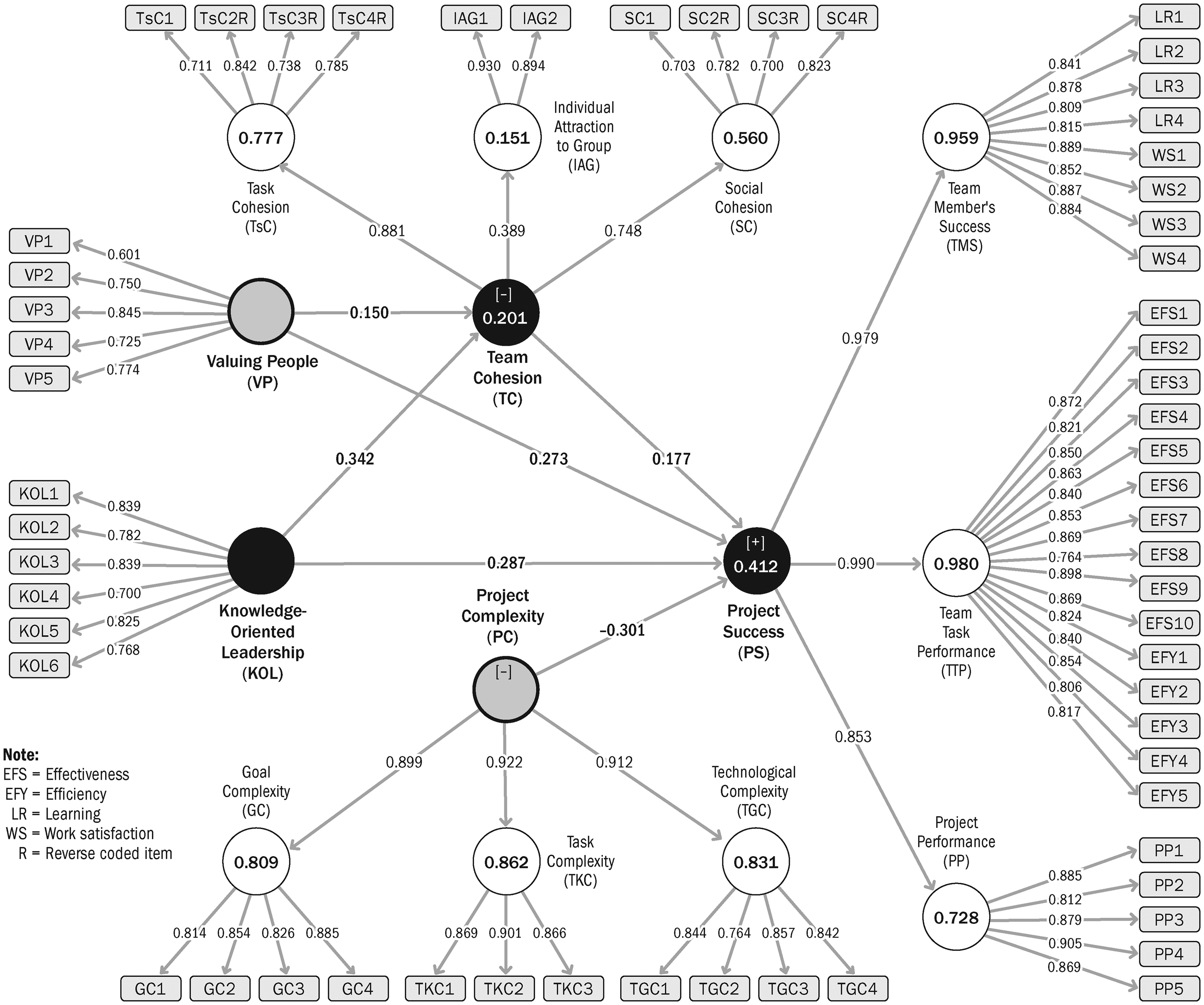
Measurement model.
Convergent Validity
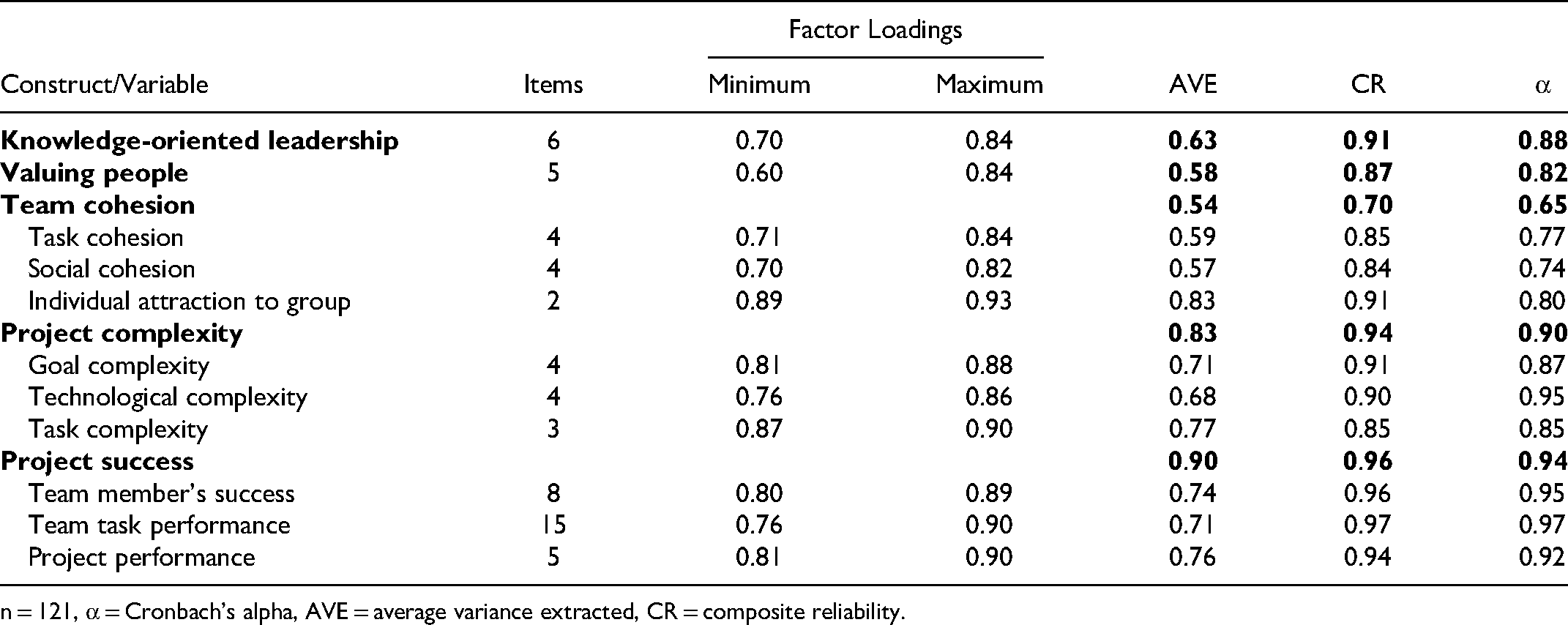
n = 121, α = Cronbach's alpha, AVE = average variance extracted, CR = composite reliability.
Correlations and Discriminant Validity

n = 121, **p < .01, SD = standard deviation, boldface values in the diagonal are √AVE.
Descriptive and Correlational Analyses
Table 3 shows the mean, standard deviations, and correlation coefficients for the study variables. As expected, knowledge-oriented leadership indicated significant positive correlations with team cohesion (β = 0.474, p < .01) and project success (β = 0.462, p < .01). Valuing people reflected a significant positive correlation with team cohesion (β = 0.537, p < .01) and project success (β = 0.478, p < .01). Project complexity revealed an insignificant correlation with team cohesion (β = 0.031, p > .10) and a significant negative correlation with project success (β = −0.248, p < .01). These correlations indicated the potential for predicting theorized relationships without any risk of multicollinearity in this study.
Structural Model and Hypothesis Testing
We used a partial least square (PLS) approach to path analysis. The direct, indirect, and total effects were examined to test the proposed hypotheses, as shown in Table 4. First, we observed the direct and total effects of knowledge-oriented leadership (KOL) on project success (PS) and team cohesion (TC). Secondly, direct and total effects of KOL on TC and of TC on PS were examined. Thirdly, the mediation effect of TC on the relationship of KOL and PS was observed using the four-step procedure of Baron and Kenny (1986).
Path Analysis
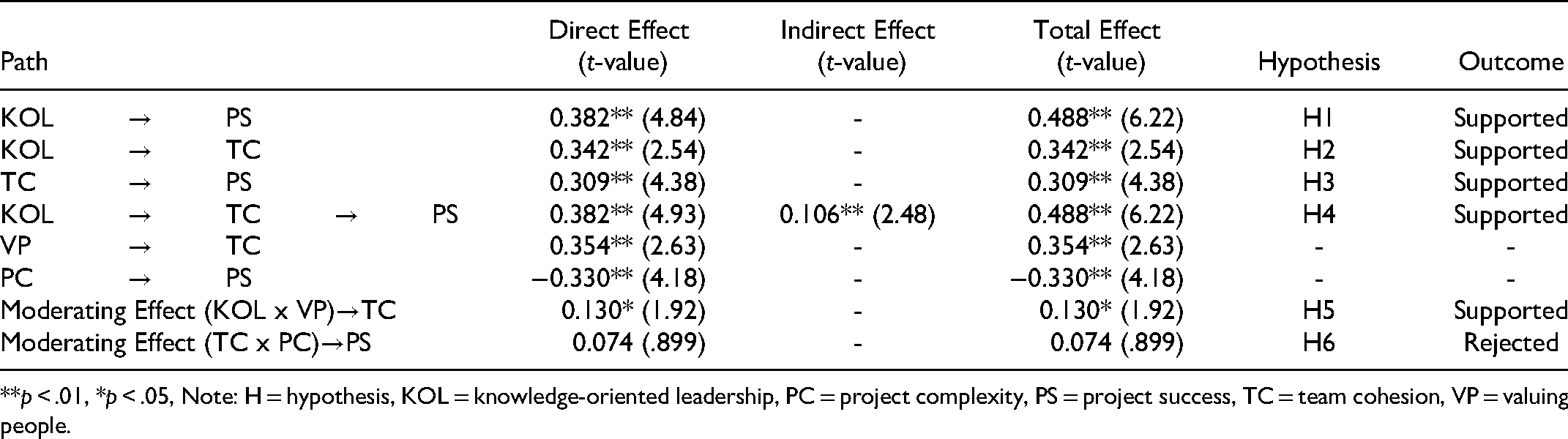
**p < .01, *p < .05, Note: H = hypothesis, KOL = knowledge-oriented leadership, PC = project complexity, PS = project success, TC = team cohesion, VP = valuing people.
Finally, we examined the moderating effects of valuing people (VP) and project complexity (PC) on TC and PS, respectively. The estimated PLS path model (Figure 3) shows that KOL (β = 0.342), VP (β = 0.354), and their interaction term (KOL x VP; β = 0.130) explain a 34.7% variance in TC (R2 = 0.347). The complete moderated-mediated-moderated model, after considering the effects of TC (β = 0.309), PC (β = −0.330), and their interaction term (TC x PC; β = 0.074), accounted for a 41% (R2 = 0.413) variance in PS.
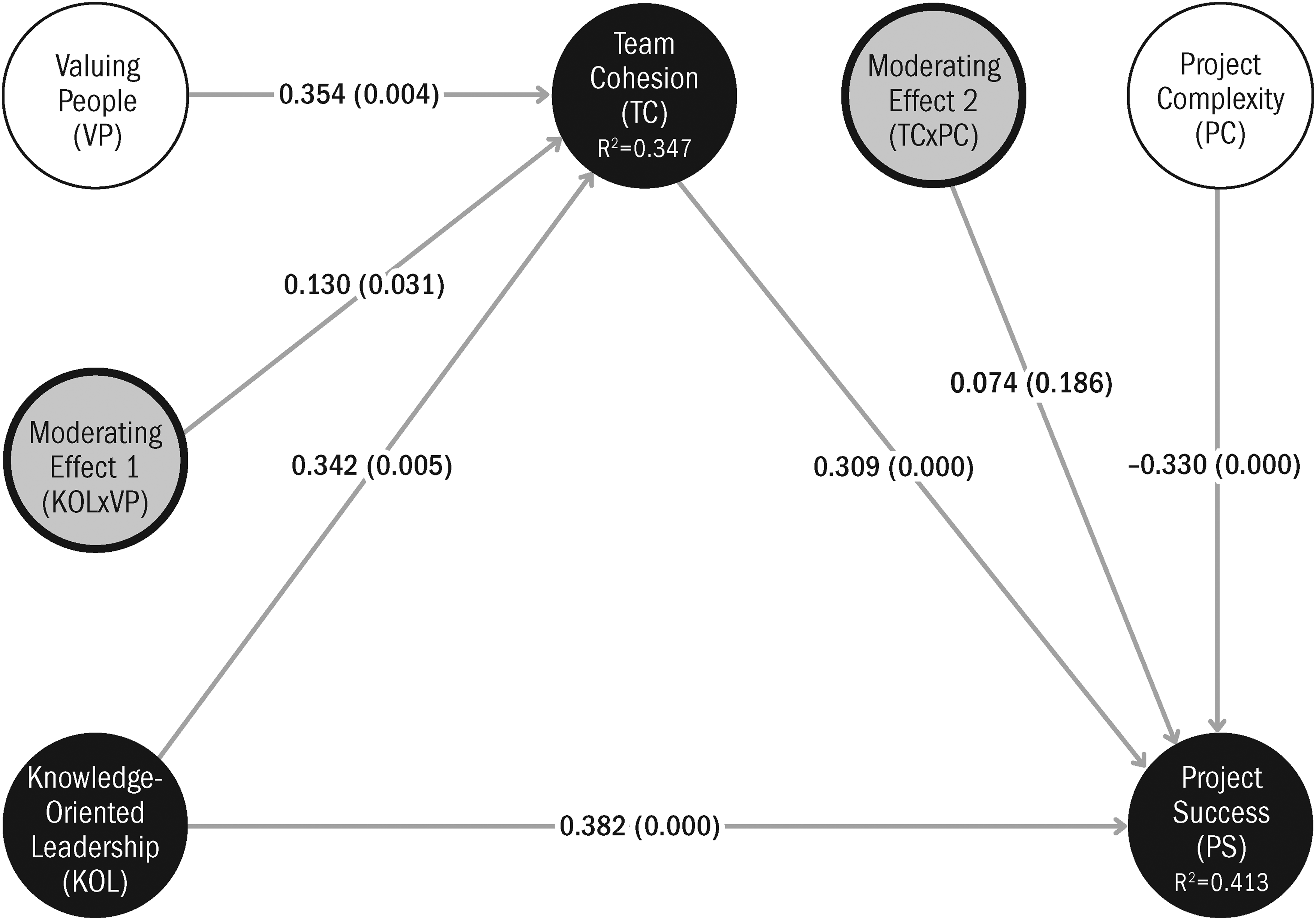
Estimated PLS path model.
Hypothesis 1 stated that KOL has a significant positive association with PS. The results of path analysis (see Table 4) show that the direct (β = 0.382, t = 4.84, p < .01) and total effects (β = 0.488, t = 6.22, p < .01) of KOL on PS are positive and significant, supporting this hypothesis.
Hypothesis 2 proposed that KOL has a significant positive association with TC. The specified path analysis (see Table 4) indicates that the effect of KOL on TC (β = 0.342, t = 2.54, p < .01) is positive and significant, supporting this hypothesis.
Hypothesis 3 suggested that TC has a significant positive association with PS. The effect of TC on PS (β = 0.309, t = 4.38, p < .01) turned out to be positive and significant (see Table 4), which supports this hypothesis.
Hypothesis 4 anticipated that TC mediates the relationship between KOL and PS. Keeping in view that acceptance of hypotheses 1, 2, and 3 fulfill the conditions of mediation (Baron & Kenny, 1986), the specified path analysis (see Table 4) revealed that KOL has an indirect effect on PS (β = 0.106, t = 2.48, p < .01) through TC. The total effect of KOL on PS (without a mediator; β = 0.488, t = 6.22, p < .01) reduced to a significant direct effect in the presence of the mediator (β = 0.382, t = 4.93, p > .05). This finding pointed toward the presence of partial mediation by TC between KOL and PS. Hence, hypothesis 4 was confirmed.
Hypothesis 5 stated that VP positively moderates the relationship between KOL and TC. Results of path analysis showed that VP itself significantly contributed toward TC (β = 0.354, t = 2.63, t < 0.01) and its moderating effect (KOL x VP) on TC (β = 0.130, t = 1.92, p < .05) was positive and significant, which supported this hypothesis, suggesting that, at higher levels of VP, the relationship between KOL and TC becomes stronger.
Hypothesis 6 stated that PC negatively moderates the relationship between TC and PS. The path analysis indicated that PC itself has a significant negative contribution toward PS (β = −0.330, t = 4.18, p < .01). However, despite the existence of this relationship, the interactive effect of PC (TC x PC) on PS (β = 0.074, t = 0.899, p > .05) was insignificant. Hence, hypothesis 6 could not be supported.
Discussion
Firms accumulate valuable resources to achieve competitive advantage and success; it is also true for project-based organizations. However, just accumulating resources is insufficient to maintain a competitive advantage in complex and dynamic environments. The resources need rapid integration and reconfiguration into dynamic capabilities to match a changing environment (Eisenhardt & Martin, 2000). Knowledge is a critical strategic resource with a high propensity for contributing to competitive advantage (Grant, 1996). The firms need to develop knowledge-based dynamic capabilities such as knowledge acquisition, integration, and combination capabilities to maximize employee productivity (Khaksar et al., 2020) and drive innovation performance (Nazari et al., 2021). As shared leadership is related to team cohesion, knowledge sharing, and project success, knowledge-oriented leadership would better inspire team cohesion and knowledge sharing by valuing employees for their knowledge, competencies, experience, and contributions at work. Thus, create and encourage a team culture to develop knowledge-based dynamic capabilities, yielding higher levels of project success, even in complex projects.
This study examined the mechanism of team cohesion and the conditions of valuing people and project complexity, explaining how knowledge-oriented leadership contributes to predicting project success. As hypothesized, the PLS path model predicted a significant positive association between knowledge-oriented leadership and project success through team cohesion. This finding suggests that project leaders should consider knowledge orientation to inspire knowledge-based team cohesion at the task and social levels. This approach would build teams and develop knowledge-based dynamic capabilities for realizing project success in terms of team member success, team task performance, and overall project performance. This finding also answers the call by Turner and Müller (2005) who underlined that the project management literature failed to give sufficient attention to the role of project managers’ leadership styles. Team cohesion indicated a significant positive relationship with project success, supporting that team building positively predicts project success (Aga et al., 2016).
Project-based organizations can outperform their competitors if project team members interact, collaborate, and remain united to develop knowledge-based dynamic capabilities of creating, sharing, and applying new knowledge to meet challenges and solve problems in critical situations (Troth et al., 2012). However, team communications and conflicts can influence project success (Wu et al., 2017). Therefore, to tackle complex projects and critical situations, and create cohesion among team members, leadership plays a fundamental role and directly links with the project's success. In line with this, our results confirm that valuing people is a team-building intervention by the project leadership. Its interactive effect with knowledge-oriented leadership styles positively contributes to project success by developing team cohesion characterized by task cohesion, social cohesion, and individual attraction to the group. This result indicates that if project leaders are knowledge-oriented and value people, they are likely to motivate and inspire cohesion among team members, encouraging them to share and practice their knowledge, expertise, and experience to enable project success.
In line with existing literature, we observed that project complexity negatively contributed to project success. However, contrary to our assumption, its interaction effect with team cohesion on project success was not significant. This finding supports the positive role of knowledge-oriented leadership, valuing people, and their interactions in mitigating project complexity's adverse effects and strengthening the likelihood of project success.
Theoretical Implications
We consider the contribution of the present study to theory in three ways. First, it adds to team development theory by understanding how team cohesion acts as a dynamic capability to explain the relationship between knowledge-oriented leadership style and project success. The present study is the first that explicitly identified and tested team cohesion as a mechanism to explain the relationship between knowledge-oriented leadership and project success.
Second, we also examined valuing people and project complexity as two boundary conditions that may influence the proposed mediation model's effectiveness. The findings confirm that project managers and leaders should also explicitly recognize and encourage employees by appreciating their knowledge, expertise, experience, and contribution, apart from mere knowledge orientation. This sense of value and recognition will further inspire their commitment to project success through enhanced knowledge-based team cohesion.
Third, each team member is required to exhibit positive behaviors, including psychological availability, commitment to the task, knowledge sharing, and work engagement to achieve the set project objectives. The present study examined how the interactive effects of knowledge-oriented leadership and valuing people induce team cohesion: task cohesion, social cohesion, and individual attraction to the group. It advances the team-building role of project leaders by practicing knowledge orientation and valuing people approaches.
Fourth, we found an insignificant interactive effect of project complexity on project success. A possible explanation is that the positive combined effects of knowledge-oriented leadership, valuing people, and team cohesion enable teams to deal with project complexities and effectively facilitate project success. It implies that the application of our model can successfully mitigate the adverse effects of project complexity. However, the generalizability of these findings needs verification through further research in different project contexts.
Practical Implications
One of the primary goals of leadership is to undertake interventions that positively affect team functioning. Leadership styles aimed at team building help improve team performance (Burke et al., 2006; Klein et al., 2009) and realize project success (Aga et al., 2016; Ali et al., 2021). Our findings suggest that, in their team-building efforts, project managers should consider knowledge orientation and valuing people as interventions to induce knowledge-based team cohesion, characterized by task cohesion, social cohesion, and attraction to the group. It will provide team members with an increasing sense of being valued at work. As a result, they will positively contribute their knowledge, expertise, and prior teamwork experience to effectively deal with project complexities and facilitate much-desired project success. It has great potential to enhance teamwork quality (Mariam et al., 2020), ultimately achieving project success to all stakeholders’ satisfaction. We suggest that project-based organizations’ leadership and management development programs should focus on developing knowledge orientation, valuing people, and team cohesion.
Limitations and Directions for Future Research
The present study has some limitations to be considered during the practical application of its findings. First, we used previously established reliable measures to collect data from diverse project employees, yet those are subjective and self-reported. The objective measures of project success may vary from project to project, depending on its nature and scope. Future researchers in project sector-specific studies may consider this aspect. Second, levels of the specification may influence analysis outcomes (Kozlowski & Klein, 2000). Our findings support that individual-level concepts (i.e., leadership and valuing people) are linked with group-level concepts (i.e., team cohesion), which may influence project-level concepts (i.e., project complexity and project success). However, we assessed all these concepts (five study variables) using individual-level responses (i.e., project employees). Future research may consider measuring these concepts at their appropriate specification levels (i.e., employee, team, and project). Third, our results are tested for reliability, validity, and model fitness using the PLS path model bootstrapped at 5,000 samples, yet the findings are based on a limited sample size (n = 121). The present research model may be considered for a replication study using a larger sample to authenticate its generalizability and effectiveness. Fourth, we collected data using the time lag approach in two waves, which has its limitations. We recommend future studies based on action research and experimental approaches to examine the prevalence of knowledge orientation, valuing people, team cohesion, and their impact on objectively assessed project success. Fifth, team cohesion indicated partial mediation to predict project success in the present study; we propose exploring other mechanisms explaining the relationship between knowledge-oriented leadership and project success. Likewise, we suggest examining other conditions that may positively or negatively influence team cohesion levels, and thereby, project success. Sixth, we observed an insignificant moderating effect of project complexity on project success. It warrants further research exploring the mechanisms and conditions to better understand how to mitigate project complexity's harmful effects on project success.
Conclusion
The present study has demonstrated project leaders’ knowledge orientation, valuing people, and team cohesion in the context of knowledge-based dynamic capabilities required as critical factors for project success. The estimated path model significantly accounted for the proposed mechanism and conditions explaining how these factors contribute to project success. Team cohesion mediated the relationship between knowledge-oriented leadership and project success, while valuing people enhanced this relationship by significantly increasing team cohesion. The study accounted for project complexity as a condition that may reduce these factors’ positive impacts on project success. We observed an insignificant moderating effect of project complexity, implying that team cohesion developed through knowledge-oriented leadership and valuing people can effectively deal with project complexities and ultimately achieve project success. We suggest that project managers focus on knowledge orientation and valuing people to build knowledge-based cohesive teams that would be more collaborative, cooperative, and committed to the tasks to attain project success to all stakeholders’ satisfaction.