



Abstract
Timing, that is selecting the right time or speed, is critical in urgent projects, yet there are few studies addressing timing in project management. This article emphasizes event time to better understand that timing is not simply a given externality and points to the importance of enacting events and urgency. Furthermore, the article distinguishes between synchronic and diachronic time perspectives. By transferring insights from disaster management and fast-response organizations, the article shows that (synchronous) coordination is best done by organizational improvisation and fragmentation, whereas (diachronic) pace and rhythm are marked by seizing opportunities, deliberately induced interruptions, and periods of patience.
Introduction
Projects as a temporary form of organization have always been thought of in terms of time: a defined start and a (temporally) defined end are constitutive for projects (Kenis et al., 2009; Sydow & Braun, 2018). Temporal issues in project management are normally understood as scheduling and sequencing. Gantt charts, the program evaluation review technique (PERT), and the critical path method (CPM) marked the beginning of both practical development and scholarly research on projects (Kwak, 2005; Morris, 2012). Not long ago, agile approaches turned upside down the relationships among scope, cost, and time (Fernandez & Fernandez, 2008). Recent research on time and temporality in project management concentrates on philosophical foundations of time and temporality (e.g., Bakker & Janowicz-Panjaitan, 2009; Biesenthal et al., 2015); temporal plurality in megaprojects (Brookes et al., 2017); temporal misfits in inter-institutional projects, and temporal boundary spanning (e.g., Dille & Söderlund, 2011, 2013; Dille et al., 2018; Stjerne et al., 2019), as well as tensions between temporary and permanent organizations (e.g., Stjerne & Svejenova, 2016; van Marrewijk et al., 2016).
While tools for managing time structure are standard nowadays, temporality becomes a growing concern for practitioners in times of uncertainty, ambiguity, and complexity. Time constraints play a vital role, especially when project managers do not have enough time to search for additional information and plan in-depth to attain an adequate reaction, or can draw on reserves, access fresh resources, and shift some tasks. Time buffers allow for an uncoupling from the external pressures, groups can muddle through, and individuals can delay decisions and actions until the proper time has come. Many approaches focus on speed and the reduction of processing time. There is little doubt that performance could be improved if conditions allowed sufficient processing time, but this is rarely the case in an environment characterized by urgency. Nevertheless, Biesenthal et al. (2015) complain about the dearth of literature in project management emphasizing the importance of temporal skills. Only a few studies are devoted to timing in project management (e.g., Geraldi et al., 2020; Granqvist & Gustafsson, 2016; Rämö, 2002), though its importance is acknowledged in the case of long-lasting, temporally complex projects (Nachbagauer & Schirl-Böck, 2019; Remington & Pollack, 2007; van Marrewijk, 2018).
“Timing is everything” in fast-response organizations and disaster management (Janssen et al., 2010, p. 4). Research on disaster management and fast-response organizations (Dahlberg et al., 2017; Faraj & Xiao, 2006; Kapucu & Boin, 2016) promises to provide deeper insights into timing, as urgency is inherent in these operations. Fast-response organizations are expected to respond as fast as they can—that is, after all, their raison d’être. For example, wildfires or flooding obviously require decisive actions, immediate organization of mitigation, and flexible tasking throughout delivery, regardless of whether they were foreseeable or not. However, even emergency situations are not characterized by constantly high or even increasing speed. Rather, we find phases of acceleration as well as deceleration, and, if the operation is of sufficient duration, also phases of time-out. Time efficiency—reallocation of attention and tasks—and timing—selecting the best time for doing something to achieve the desired or maximum result—are vital: The focus on acceleration only often overlooks that increased speed is likely to impair or even prevent the achievement of the operation's goal.
Research emphasizes that time, timing, and urgency can and must be managed carefully in incidents (Geiger et al., 2020; Wolbers et al., 2013). Connecting subjective time and resilience provides valuable insights into managing timing (Barton & Sutcliffe, 2010; Barton et al., 2015), cross-institutional coordination and flexibility, and the quick adaption of roles and structures (Bechky & Okhuysen, 2011; Schakel et al., 2016; Waard et al., 2013). Furthermore, this article takes stock of what we know about timing in organizational improvisation (Crossan et al., 2005; Kamoche et al., 2002) and fragmentation (Geiger et al., 2020; Wolbers et al., 2018).
The purpose of this article is to develop an alternative perspective on timing while managing projects based on insights from disaster management and fast-response organizations. This article focuses on project work on the ground, in other words, actions and decisions necessary in daily business. By grounding the perspective in social constructionism (Luhmann, 1984), this article stresses event time and the construction (enactment) of urgency as central features for better understanding time and timing in projects.
The following sections discuss theoretical considerations of time and timing, which may be expressed in terms of a fundamental objective–subjective dichotomy: clock time or Chronos versus event time or Kairos and develop the idea of enacting time and use it to highlight the need to stage events and urgency. The main part of the article examines mechanisms of actions in the concurrent (synchronous) time perspective, in other words, the coordination of various actions and processes inside and outside, and in the sequential (diachronic) time perspective, in other words, pacing and rhythm in the sequence of actions based on experiences in disaster management and fast-response organizations. The article concludes by discussing some implications of this alternative temporal lens for project management research and practice.
Chronos Versus Kairos
Time, as commonly seen, comprises past, present, and future, as well as schedules and deadlines. Conceptions of time also include speed and time pressure, change, acceleration, anticipation of the future, and progress (Dawson & Sykes, 2016; Slawinski & Bansal, 2017). In their literature overview, Biesenthal et al. (2015, p. 46) combine two bipolar time concepts, summarizing that at “the core of these dualisms is the distinction between an objective and subjective perception of time.” The first major dichotomy is linear time (limited organizational resource) versus cyclic time (recurring pattern). This article emphasizes the second major dichotomy: Chronos versus Kairos. Chronos is “the chronological, serial time of succession […] time measured by the chronometer not by purpose” (Jaques, 1982, pp. 14–15). Kairos, on the other hand, is defined by events, not by a timepiece. “Events shaped by humans and enacted through social construction together form the event-time” (Halinen et al., 2012, p. 216).
In (Western) organizations, clock time dominates visibly for everyone, and organizations are coordinated accordingly (Bakker & Janowicz-Panjaitan, 2009; Bluedorn & Denhardt, 1988). But time in this linear and calibrated understanding is quite a recent phenomenon. For most of history, time was not structured by simply dividing the day, month, or year into equal parts, standardized by a central institution worldwide, though attempts to measure time have a long history (Joerges, 2003). For the common people, time was more structured by rituals and religious calendars, or natural cycles, for example, daylight hours, rain, or flood cycles (Dawson & Sykes, 2016), resulting in a plurality of times in societies, organizations, and groups.
The dominance of chronological time is closely connected to labor extraction and the organization's needs when shifting from task-oriented labor to time-oriented labor in industrialization and factory-like organizing (Reinecke & Ansari, 2017). Clock time can be standardized and categorized, used to plan, coordinate, and measure. A second strand of arguments emphasizes the need for a unified time model for coordination in larger areas, starting with train services and culminating in astronautics. Czarniawska (2004, p. 777) laconically states: “If, however, organizations ran on kairotic time only, no train would ever leave on time.” All that predestines clock time to become an anchor value in project management. Only recently, novel approaches seem to be trying to get back to task-orientation while preserving the coordinating effect of clock time.
In practice, however, the distinctions are not as clear as in scholarly concepts. Both organizations and individuals use clock and event time elements and combine them with linear and cyclic times (Cuganesan, 2021; Molotch, 2017). Hassard (1989) emphasizes the distinction between the microsocial times of groups and the macrosocial times of systems and organization. In fast-response organizations, training, strategies, and operation planning usually follow clock time, while operation on the ground is oriented toward event time (Geiger et al., 2020). Orientation to these time perspectives is often divided along hierarchical positions. Management is usually oriented toward linear clock time, while on the shop floor time is aligned to the event cycles of production, ultimately leading to constituting diverging temporal groups (Bluedorn & Denhardt, 1988). Recently, Geraldi et al. (2020) showed that managers on varying levels experience temporal tensions regarding time horizon, pace, and temporal perspective. It is therefore to be expected that planning at the management level of projects and programs is often oriented to clock time, whereas practical project work tends to run according to patterns of event time.
Enacting Time
Weick (1977) illustrates that when people act, they bring structures and events into existence and set them in action. They therefore also enact time structures like clock time and event time: “Time is subjective, experienced and enacted in different ways by different people” (Cunliffe et al., 2004, p. 275). Actions in organizations must be coordinated and aligned to internal and external time cycles and events. Actors scan the environment for temporal cues to reflectively (re-)act in attunement with relevant others and in alignment to clock time and social events. In organizations, actors produce and reproduce a variety of temporal structures through their everyday actions, and these in turn shape the temporal rhythm and form of both their ongoing practices and the organization (Orlikowski & Yates, 2002). So constructing time is not arbitrary or an individual endeavor (Weick, 1995).
The repeated, coherent action of the different participants in each situation, oriented toward a common time perception, in other words, meeting schedules, project deadlines, and financial calendars, adds up to institutions (Luhmann, 1984), in other words, structures of temporality, speed, and timing. Orlikowski and Yates (2002) argue that both event time and clock time are enacted and made meaningful and consequential in organizations by practicing time. Clock time in this perspective only appears to be objective: “Because such temporal structures are often routinely and unproblematically drawn on, they tend to become taken for granted. As such, they appear to be given, invariant, and independent, creating the impression that time exists externally” (Orlikowski & Yates, 2002, p. 686).
Temporal structures simultaneously constrain and enable coordinated action (Giddens, 1984). However, institutions and expectations do not determine the definition of the situation or the framing of observations; rather, they define a zone of likelihood for alternative interpretations; misunderstandings, time conflicts, and shifts in temporal interpretation are common. Geraldi et al. (2020) stress the paradoxical nature of time: Multiple temporal structures co-exist in organizations and projects, but it is exactly this ambivalence that helps managers to pursue goals in a complex and ambivalent environment.
Staging Events
Events in kairotic time perspective must be staged as events, otherwise they are lost in the uniformity of the stream of experiences (Schütz, 1932/1974). Events are important both as “markers” (Luhmann, 2000, p. 174) and “interdependency interrupters” (Luhmann, 1993, p. 238) in the linear representation of time and as a source for constructing stories for sensemaking and sensegiving in organizations (Dawson & Sykes, 2016). Timing and time management are therefore the management of punctuations in the course of time. Czarniawska (2004, p. 776) sums up: “Nobody is aware that an important event is happening when it takes place […]. Events must be made important or unimportant.” Only if the event—the interruption of the normal course of action—is recognized and communicated, can people dedicate themselves to managing the situation. At the same time, time patterning mechanisms based on observable (and observed) events foster negotiation and shared understanding of sequences of actions even in disparate environments (Kremser & Blagoev, 2021), an ability particularly relevant in contexts characterized by time pressure (Crossan et al., 2005).
Meyer and Simsa (2018) report on lessons from one of the largest organizations in the field of emergency relief during the 2015 refugee crisis. The Red Cross has well-established plans for emergency aid in natural disasters and well-trained staff, and the inflow of refugees was thought to be just another case of emergency. The organization was well prepared in the first few days, and reactions were flexible in the time dimension, as they continued to be during the first weeks. Yet, even for the Red Cross, the challenge was unique in terms of size and urgency, because the Red Cross is prepared to act spontaneously in sudden crises, but not to maintain these intensive activities over longer periods. Subsequently, the organization became overloaded. Only after declaring the crisis as exceptional did the Red Cross start to implement second-order structural changes, which were hitherto unprecedented in the organization, especially regarding volunteers.
Staging Urgency
Time always seems to be short in organizations and this is especially true for projects as time-driven endeavors. Time boundaries create a sense of urgency (Lundin & Söderholm, 1995). Especially when focusing on clock time and linear time, as is common with traditional project management, “time is understood as a limited organizational resource that […] is subject to planning and allocation […]” (Biesenthal et al., 2015, p. 46).
From the perspective of constructivism, time scarcity and thus urgency are socially constructed: “Time in and of itself is not scarce. The impression of the matter of time only arises from the overstraining of experience through expectation” (Luhmann, 1971, p. 149, my translation). What is urgent and therefore important is decided within the organization. Some organizations perceive an unremitting feeling of urgency, and when confronted with unexpected events, they might react with acceleration and an increase in work intensity, whereas others may follow a more relaxed but nevertheless successful management style (Du Gay, 2017). Even more so, what is a shock for one organization (e.g., a fire in a plant), might be an expected routine for another (e.g., for the local fire brigade). At the same time, urgency has to be made visible. Firefighting operations require an event to be explicitly upgraded to a major incident by the operation command, so that not only can additional forces be called in, but also the entire operational tactics are changed (Nachbagauer et al., 2020).
Controlling time lines makes it possible to control organizations by generating expectation pressure through time pressure (Luhmann, 1971). In organizations, scheduling seems to be an appropriate mechanism to generate attention and meaning for a task by declaring it temporary and urgent: Articulating crisis, limiting time for preparation, and prioritizing issues create urgency; deadlines break up decision-making processes, trigger meetings and stimulate communication; and enacted urgency helps to create momentum for change (Geraldi et al., 2020; Granqvist & Gustafsson, 2016).
Shortage of time and deadline pressure often distort factual necessities and priorities in organizations. The observance of deadlines becomes more important than the quality of the problem solution, because the first is clearly visible and easy to control. Furthermore, cooperation and communication, both of which are bound to deadlines, become more important than doing conceptual work, rethinking situations, and weighing solutions. And, ultimately, values that can be transformed into decisive deadlines gain in importance and those that remain informal are pushed back. Speed as such becomes an absolute justification (Luhmann, 1971).
Timing
Following the common notion, this article will concentrate on timing as selecting the proper time or speed for doing something, in other words, when to observe, communicate, decide, act, wait, to achieve the desired or maximum result (Cambridge Business English Dictionary, 2019; The Merriam-Webster.com Dictionary, 2019). First, the proper time must be marked to be visible to all; timing must be enacted. Timing then relates to either a concurrent (synchronous) or a sequential (diachronic) time perspective.
The synchronous perspective of timing focuses on social synchronization and coordination. Thus, it matters greatly what kind of time is used as a synchronization medium and whether the times to be synchronized are compatible to achieve good timing. Successful coordination of organizational activities depends on the ability of actors to react to the timing of other actors’ activities and at the same time to follow their own temporal logic. This can be done either as negotiation and entrainment, in other words, as synchronization and alignment to internal and external time cycles and events, or by selective demarcation. Organizational improvisation and fragmentation in particular allow for the creation of an autonomous time-space with only selective coordination.
Addressing especially the diachronic perspective of timing, Blount and Janicik (2001) discern three components of organizational temporal structures: (1) explicit schedules, sequencing patterns, and deadlines; (2) implicit rhythms and cycles of behavior; and (3) sociotemporal structures, in other words, time norms related to an organization's culture. Sequencing refers to the order in which events unfold, with an assumption that a certain order is important to the integrity of a phenomenon. Effective sequencing relies, in part, on appropriate timing of every intervention in each sequence of interventions. Rhythm refers to a pattern of variability in the intensity and frequency of organizational activities, marked by periods of accelerated activity that makes it possible to seize opportunities on the one hand, and deliberately induced periods of slowed activity, patience, and interruptions on the other hand (Huy, 2001). In relation to the environment, it is a concern to maintain one's own time pattern in the face of dysfunctional external moments and, on the other hand, to seize opportunities that make use of better receptivity and more bountiful resources. Table 1 summarizes the functions and mechanisms of the temporal perspectives.
Temporal Perspectives, Functions, and Mechanisms
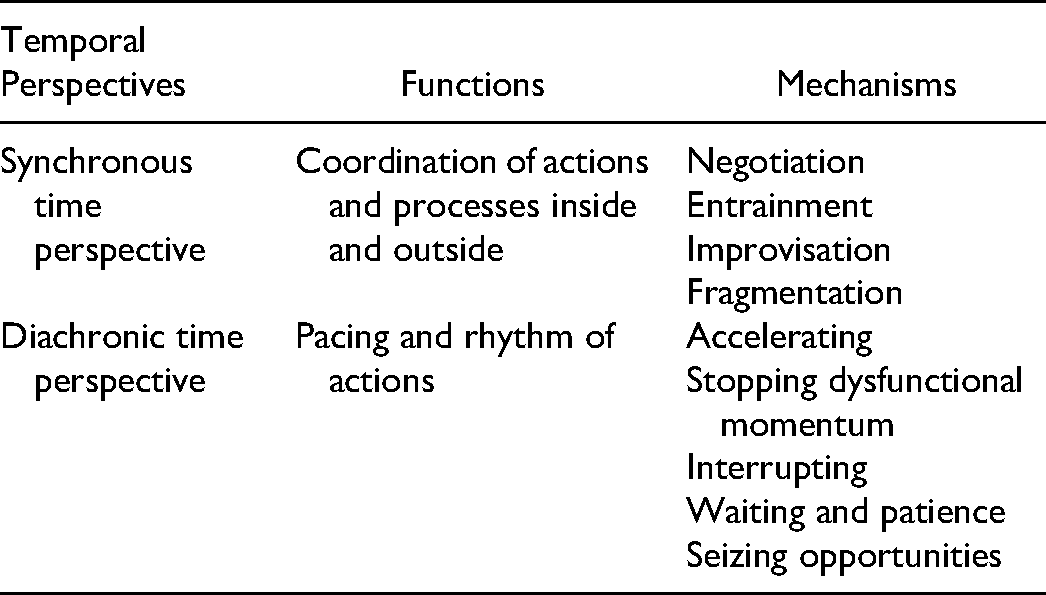
Synchronous Time Perspective: Temporal Coordination
From the perspective of controlling organizations, time management is primarily concerned with coordinating actions and processes and aligning to internal and external time cycles and events (Ancona et al., 2001). Timing then includes considerations on how to synchronize various parts of the project, adjust to the needs of the situation, and regulate structures and processes accordingly. Coordination of time structures and events becomes even more challenging when projects span organizational boundaries. While negotiation and entraining essentially try to align time structures, improvisation and fragmentation make it possible to respect the pace of relevant stakeholders and environmental rhythms, without disrupting the internal pace of the organization.
Negotiation and Entraining
Typically, large projects involve different stakeholders and overlapping organizational structures with different ideas about time horizons, temporal perspective, and speed (Dille & Söderlund, 2011; Dille et al., 2018). Stjerne et al. (2019) found a small number of temporal boundary-spanning practices, referring to the various bundles of activities and everyday occurrences in which actors engage to address temporal tensions. Pacing tensions of various kinds are best addressed by synchronizing, in other words, setting a new pace that fits both organizations’ needs. Lead time in the production flow might be redefined to allow for a shared temporal frame for interorganizational collaboration. This is done primarily through negotiations on equal terms.
Synchronizing includes adjusting optimal timing norms by visualizing and discussing the current lead time; lowering the power distance to enable open and honest debate; challenging status quo timing norms and discussing optimal solutions; and going beyond the front stage of standardized glorious sales speeches to a deeper engagement that enhances understanding the other party's timing norms and needs. Likewise, timely and adequate communication is essential for responding to emergencies. Wolbers et al. (2013) demonstrate, using the example of the Amsterdam Schiphol Airport Train Tunnel Fire, that three approaches—time slices, two-mode analysis, and information pathways in interorganizational communications networks—are powerful means to understand and overcome confusing periods and misunderstandings during major incidents.
Contrary to this approach, Dille and Söderlund (2013, p. 565) argue that the temporal cycles of projects and organizations become entrained through powerful external pacers, in other words, people or entities that essentially work as the ultimate definer and legitimator of the temporal cycles, “typically provided by industry leaders, governing bodies, or governmental entities/operations, including budget and audit cycles and reporting dates.” When the scope of a project spans institutional boundaries and macropacers are not aligned, the coordination of time might be problematic. This is even more problematic when local timing cycles at the organizational level play a significant role. Depending on the types of temporal misfits and complexity involved, they call for measures for synchronizing by powerful external pacers. Earlier, Midler (1995) pointed to the importance of the power and capacity of the project manager to transfer the scope of projects to various players in order to enforce the specificity of diachronic project temporality in relation to the units’ synchronic functional conceptions of time.
However, in situations where managers and experts from different organizations come together and must develop measures quickly, necessary common social and cognitive resources are not easily available. Furthermore, one is not only confronted with a multitude of demands from several stakeholders and conflicting interests, but also with unexpected turns of events and acute time pressure. Studies on emergency coordination show that interdependencies between activities constantly shift during the coordination process, making it necessary to negotiate adjustments of time structures within the framework of the organization. Actors then try to reconcile their differences directly during the action or over time (Faraj & Xiao, 2006). When multiple groups of people are responsible for parts of a joint action, misunderstandings and ambiguities affect coordinated action. Typically, actors attempt to reduce this ambiguity by interpreting environmental messages, grounding their actions on these interpretations, and by communicating their interpretations (Brown et al., 2015).
In many situations, however, time constraints and the physical distance between the actors make it impossible to develop and agree on a shared view (Wolbers et al., 2013), recognizable pacers—authorities that provide for a common setting of event time—are absent (Geiger et al., 2020), and ambiguous situations and necessary switches from one practice to another lead to a multitude of interpretations and to different task concepts and paths of action being pursued (Schakel et al., 2016). Literature emphasizes that discontinuity and ambiguity make it difficult to predict how the situation will evolve and, above all, how others will act and react to one's own actions. (Bechky & Okhuysen, 2011; Okhuysen & Bechky, 2009). As a result, plans are often disrupted in unexpected ways, existing authority structures are challenged, and discontinuity arises. Under conditions of ambiguity and temporal uncertainty, entraining to external pacers is often not feasible, and urgency makes it impossible to time actions by engaging in time-consuming negotiations.
Improvisation
In times of temporal tension and urgency, temporal structuring must instead be done internally and autonomously. Instead of entraining and aligning temporal structures, coordination practices within and between organizations are then reminiscent of (professional) improvisation. Professional improvisation is understood as an unplanned, case-by-case arrangement based on a spontaneous and rapid rearrangement of existing action elements and creativity on-site. Research on organizational improvisation has been strongly inspired by the performing arts (Barrett, 1998; Kamoche et al., 2003). Pace, rhythm, and timing play a central role, the tuning-in toward a common perception of time being the key element of success (Böhle, 2017). Good musicians react immediately to cues in the music and are attentive to mutual cues, responses, and initiations.
Biesenthal et al. (2015) ascertain that improvisation plays a critical role in temporal reflexivity as it demonstrates the arrangement of temporal features in project-related work. Crossan et al. (2005) argue that improvisation allows for a synthesis of apparently contradictory views of time and is highly welcome in turbulent environments, because improvisation has an intrinsic dialectical nature, blending conflicting concepts such as planning and acting, discipline and freedom, control, and spontaneity. They propose that improvisation is the place where time to plan converges with time to act.
Likewise, Moorman and Miner (1998, p. 698) defined improvisation as “the degree to which composition and execution converge in time”; at the same time, they suggest time pressure or uncertainty, or both, are stimuli of improvisational processes. Cunha (2004) relates improvisational strategies—as opposed to action and planning strategies—to event time and synchronizing via boundary-spanning pacing. Böhle (2017), in his account of improvisation, stresses the combination of planned and experimental procedures, formalized analytical knowledge and associative, experience-based knowledge, exact noticing, and complex sensing.
Research on the permanent technical service, a city emergency unit, scrutinized by Nachbagauer et al. (2020) found this emergency unit to be improvising when not executing simple actions. Rule orientation and pre-set procedures seem to prevail at first glance, but a closer look reveals a large remainder of situation-based decisions and coordination. Timing is based on interpreting both situations and relatively vague rules, technical demands, and interpersonal experience. Quick decisions are based on gut feelings and (private) simple rules.
Okhuysen and Bechky (2009) list three conditions for successful coordination. Firstly, accountability makes responsibility visible, either based on formal standards of authority and organization or through emergent coordination. Secondly, predictability enables actors to assess how subsequent tasks will be carried out. Thirdly, a collective understanding ensures a common perspective on the objectives of task fulfillment measures. In crises, however, discontinuity and ambiguity are an unavoidable reality that impair coordination and thus integration. This can ultimately lead to the collapse of collective meaning—one of the prerequisites for improvisation and successful action in crisis situations (Weick, 1990, 1993).
Fragmentation
A fire officer reports that senior commanders give their deployment orders to the group commanders but cannot control for the execution. In a respiratory protection operation, once the group marches into a burning or smoky building, the officer cannot see them anymore and has no radio contact. He simply does not know what is going on inside. An even more salient point, especially in emergency situations, is that it is more important that things get done, and less important how they get done. If officers order a group to break open a door, they are not interested in how they do it. If officers provide one group with fire protection for a vehicle that has been involved in an accident and have the other group get the injured person out of the vehicle, they are only marginally interested in how they do it. This is, ultimately, a matter of professionalism and trust (Nachbagauer et al., 2020).
A recent study of the Hamburg fire service by Geiger et al. (2020) suggests that under temporal uncertainty, actors must strive for temporal autonomy, rather than temporal fit. “By performing temporal boundaries, actors can realign collectively held temporal expectations with the evolving situation without jeopardizing the reliability of routine performances” (Geiger et al., 2020, p. 35). Temporal boundaries help create predictable temporal patterns, which in turn allow firefighters to perform based on pre-established rhythms that arise and become visible only at the intersection of clock time and event time. Even if temporal autonomy is vital, that does not imply complete temporal uncoupling, or autarky. Enacting temporal boundaries allows fire service units to selectively react to specific temporal cues and to temporally adapt to selected events.
Wolbers et al. (2018) suggest that, instead of the methods of integration mentioned in the literature that are appropriate for an individual organization, forms of fragmentation ensure collective performance. Fragmented coordination practices such as working around procedures, delegating tasks, and demarcating expertise strengthen the normative, functional, and knowledge boundaries rather than bridge them, thus limiting the number of interactions. This results in three characteristics of fragmentation: (1) ad hoc adjustments are initiated based on the need for rapid action, leading to (2) a delegation of tasks and separate areas of control that (3) prevent the collective creation of meaning and lead to a multiplicity of interpretations. The authors show that, paradoxically, it is precisely the officers’ coordination practices that lead to the fragmentation they seek to avoid. What were intended as solutions contribute to increased discontinuities and further misunderstandings and, in sum, increase fragmentation. However, the researchers conclude that fragmentation should not be understood as a lack of integration, but rather as an important advantage that allows for rapid coordination and a high level of flexibility in changing environments, because it allows for sensitivity to operations and for autonomous timing within one's own area. Baseline coordination is ensured primarily through planned, regular interactions between teams and commanders.
Diachronic Time Perspective: Pacing and Rhythm
While the synchronous time perspective is mainly concerned with the coordination of actions and processes inside and outside the organization—such as negotiated synchronization, entrainment, improvisation, and fragmentation—the diachronic time perspective looks at the pace and rhythm of actions. In addition to the notorious acceleration, this section is all about stopping dysfunctional momentum, interrupting, waiting and being patient, and seizing opportunities.
In urgent situations it is often considered crucial to react quickly to challenges of action and coordination (Bechky & Okhuysen, 2011; Danner-Schröder & Geiger, 2016) while focusing on acceleration of action (Faraj & Xiao, 2006; Geiger et al., 2020; Schakel & Wolbers, 2019). Getting ahead of time is aimed for, that is, to control the situation, always be well prepared to adapt to uncertain and changing elements, and avoid being forced to react to an evolving situation hastily and without proper preparation (Geiger et al., 2020).
In projects too, the enactment of momentum, the setting of impulses, and the creation of the right timing for decisions and actions, are considered the main tasks of project managers in time-critical projects and essential for project success (Geraldi et al., 2020; Granqvist & Gustafsson, 2016). This is also believed to be true of management: “It's the Fast That Eat the Slow” (Jennings & Haughton, 2002) and society in broader terms (Rosa, 2015). Acceleration is well understood today, both in emergency operations and projects. This article will focus more on the forgotten side of the speed dualism: reducing the speed of developments, interrupting, waiting, and patience.
In the context of disaster control or in the case of emergency organizations, most events, as surprising as they may be to outsiders, will be treated as expected routine, even if the exact time of the event and its development are not known in advance. Nevertheless, combining urgency to react with the uniqueness of the event and its development multiplies uncertainty, especially for those organizations that are trained to expect urgency as normal (Boin et al., 2019).
Stopping Dysfunctional Momentum
Barton and Sutcliffe (2009, 2010) are particularly interested in firefighting missions in forest fires. The starting point of their considerations was a fire at the Bandelier National Monument in New Mexico in May 2000, in which a 300-hectare overgrown area burned out. A tiny flame source that flared up every time firefighters thought they had wiped it out escaped attention and grew into the forest fire of Cerro Grande, one of the most devastating in New Mexico's history. Among the many factors that contributed to the disaster at Cerro Grande, the most important was the occurrence of a destructive dynamic. In a destructive dynamic, people continue to work toward an original goal without pausing to recalibrate or review their processes, even in the face of indications that suggest a course change. What happened to firefighters in New Mexico, according to Barton and Sutcliffe, is not unusual. Even if the environment is stable, seemingly insignificant actions that occur in the normal process of an organization can cause waves throughout the system and require rapid adjustments.
Disasters often start small, with minor problems managers notice but do not worry too much about. The interdependencies of the components of complex organizations and projects often lead to minor changes in one part of the system affecting several other parts. Sometimes the effects remain small, but just as often—and often surprisingly—the effects in other areas grow rapidly and dynamically. Too often, managers are too involved in the day-to-day action to notice that circumstances have changed or they ignore the warning signals (Perrow, 1984).
However, dysfunctionality of the momentum is not only the effect of external developments; common reactions on the part of the organization and the actors contribute to their reinforcement. Momentum, according to Barton and Sutcliffe (2010) can become dysfunctional for at least five (internal) reasons: action orientation, inflexible planning, ripple effects, rationalization, and deference to perceived expertise. Slowing down is precisely what very few of those responsible probably want to do in the middle of a crisis—and what few outsiders would expect from them.
Barton and Sutcliffe (2010) criticize in particular the widespread speed and action orientation in management. Based on their studies on fire brigade services, they conclude that it would be wrong to react too quickly and thoughtlessly to rapid developments. Just noticing early warning signs, though necessary, is not sufficient to drive change. The problem is that the more one becomes preoccupied with ongoing plans and activities, the more the dynamics prevent re-evaluating plans and activities (Barton & Sutcliffe, 2009). However, the most successful firefighters in their sample were those who found ways to create or welcome interruptions based on situated humility. Giving voice to concerns and actively seeking alternative perspectives appear to be key drivers of re-evaluation and breaking the vicious circle of external uncontrollable developments and internal blind devotion to pure actions.
Interrupting
At first sight, slowing down and interrupting actions seem to be counterintuitive in an emergency setting where timely responses to coordinate challenges are critical. But being aware of kairotic event time permits stopping dysfunctional momentum and turning to individual timing: “If a system always had to react to the environmental events that befall it the minute they happen, it would have little chance to select its mode of reacting” (Luhmann, 1984, p. 255, my translation). Contrary to being at the mercy of an external development, the organization's orientation to event time allows the handling of events to be postponed to a later point in time and processed according to internal needs (Luhmann, 1976).
Interrupting is a practice that is consciously enacted to address coordination and pacing challenges (Barton & Kahn, 2019; Darkow, 2019). Slowing down does not mean doing nothing or just pretending to act. On the contrary: interruptions are filled with searching for information and thinking about solutions as well as restoring trust and confidence. “Interruptions—not necessarily of operations but of the thought processes based on assumptions that may no longer be valid—provide an opportunity to question the ongoing story. And it is not the quantity of interruptions that matters as much as their quality” (Barton & Sutcliffe, 2010, p. 54). A lack of interruptions poses a threat to the ability to understand a growing problem and, if necessary, change the approach.
Breaks have positive consequences when they activate mindful or controlled information processing, learning, and adaptation, resulting in task engagement and a change in perceptions of task-related activities (Jett & George, 2003). Interruptions are useful for estimating the exact need, place, and time of action. This can prevent already scarce resources from being wasted on unnecessary measures. Interruptions also prove to be an important practice for coordinating the activities of those involved (Geraldi et al., 2020). Interrupting makes it possible to observe the activities of other central actors on whom one is dependent and then to act in accordance with the observations. In the absence of a central plan and under rapidly changing conditions, such observations are the only way to understand the intentions of others and coordinate one's own activities.
A second essential element of interruptions is to provide for the necessary distance to enable reflection and analysis. In urgent emergency situations, everyone is shouting out about what they see, voicing their opinions, and asking questions, making it difficult for the person in command to understand the situation (Schakel & Wolbers, 2019). It is therefore important for decision makers to be free from other current activities to concentrate on dealing with the event. Practices in resilient organizations such as the search for gaps, distancing (both physical and psychological) from the events, shifting of priorities, and time-outs, are central to coordination and replace—at least in part—traditional coordination means (Darkow, 2019).
Interruptions are important for the project manager and team to get stress, fears, and emotions under control. As Nachbagauer et al. (2020) point out, individual resilience seems to be crucial to successfully managing turbulences. Firstly, this allows managers to have an active role, feel that they are not just a passive part of the game, and understand that they still have options. Even if quick action is required, patience and observation are essential. It is the team leader's job to pick up signals from the group and actively interrupt in order to deal with stress and despair. Relational pauses (Barton & Kahn, 2019) devoted to capturing the situation and emotion in the team and come out of the feeling of powerlessness are important.
Waiting and Patience
Schimank (2019) scrutinized the probably typical case of an office manager of a German municipal authority in organizational stress who was confronted with unforeseen turbulence. In addition to notoriously unfavorable general conditions, a number of problems arose on the same day, which at first glance demanded an immediate reaction. Overwhelmed by this situation, it is no longer a matter of rational, planned action in difficult legal matters with customer relationships that are prone to conflict, but only a matter of “the fact that this decision maker […] with all her decisions somehow had to get through the day” (Schimank, 2019, p. 196, my translation). He sums up coping strategies: “If the decision maker is at a loss over longer periods as to what goals can be specified for her in the longer term, she can do no more than wait until this is clarified—however and by whatever means” (Schimank, 2019, p. 210, my translation).
Although we find reports of interruptions in accounts of rapid-response organizations (Barton et al., 2015; Schakel & Wolbers, 2019; Wolbers et al., 2013), there are few accounts of waiting and patience. These organizations are designed to respond on the spot, preferably using well-trained standardized workflows (Nachbagauer et al., 2020). Nevertheless, modes of waiting and patience seem to be quite common in disaster management; actors spend a great deal of their time waiting for all kinds of reasons.
Typically, disaster operations extend over a longer period and are characterized by the alternation of phases that require environmentally driven rapid action and periods in which hardly any targeted activities are possible (Darkow, 2019). In wildfires, actions are taken to prevent the spread far away from the burning areas. Firefighters often have to wait to determine the direction of the fire or just track the changes overnight (Barton et al., 2015). Timing, accelerating, and slowing down in these cases are based less on well-learned routines than on experience from similar operations (Weick & Sutcliffe, 2007), information and interpretive gains through networks (Kapucu, 2006), and learning through implicit and informal experiences when working with colleagues on the job (Moynihan, 2008).
In the case studies on emergency organizations scrutinized by Nachbagauer et al. (2020), one firefighter commented, with reference to an exceptionally large gas explosion, that it simply takes a certain amount of time until one is oriented and on the right track. In very complex situations, the reconnaissance takes a correspondingly long time so that the team has a picture of the situation, how many people are injured, where the fire is, and where something is in danger of collapsing. The team is simply bound to wait for things to clear up. Even for experienced teams there is now a way to speed up the process, even if they are not overwhelmed in the initial phase as might be the case with less experienced teams.
Seizing Opportunities
Timing is of utmost importance in fast-response organizations and disaster management, especially when it comes to seizing opportunities. The art of seizing opportunities is to start neither too early nor too late. Too late action may fail to prevent damages or losses, whereas if too early, it may be neglected or a useless waste of resources. Opportunities often arise unexpectedly and only for a brief time (Schakel & Wolbers, 2019). Since opportunities often reveal themselves only through weak signals, one must constantly monitor the environment with a wide range of observation tools. Barton et al. (2015) talk about anomalizing, the ability to accept small deviations as not normal. Expecting the unexpected, staying open, being less attached to history, and questioning known routines are crucial. However, weak signals are ambiguous and can lead you down the wrong track; therefore, one must be careful with the interpretation and avoid premature determinations.
To ensure a common awareness of the situation, actors must transfer issues into events and make them meaningful to team members and stakeholders. Opportunities must be staged—or even produced—as (externally given and transient) opportunities. To accomplish this, opportunities must be flagged as urgent and linked to (particular) interests and priorities on the one hand and entrained to (external) timing norms (Granqvist & Gustafsson, 2016) on the other.
Once an event presents itself as an opportunity, fast reactions are required, often much too fast to be decided centrally or to start with a complete plan. This is a risky endeavor for managers, given limited rationality and a volatile future (Lagadec, 2007). While opportunities must be staged as undisputed and seemingly irreversible, it may well happen that opportunities arise too late or somewhere else or perhaps even not at all. And one can also be wrong about the opportunity: Managers decide on an idea and at the same time overlook the fact that a much better option appears shortly afterwards or even risk making a mistake that will make the situation worse (Schimank, 2019). So, it is important to avoid making far-reaching decisions that cannot be made up for, creating disastrous lock-ins. Timing, then, is about developing appropriate adaptive behaviors: retreating and pushing forward, evaluating, choosing one path over another, and otherwise taking actions that favor overall performance.
Timing in Projects
The issue of project speed is not new both in terms of acceleration and temporal coordination. Many approaches in project management theory and practice are concerned mainly with acceleration and the reduction of processing time (Lundin, 2015). These currents developed especially in the early 1990s, in the field of new product development projects, when time-to-market strategies imposed themselves in a competitive context (Stalk & Hout, 1990) marked by competition through innovation in the automotive industry (Midler & Navarre, 2004), aircraft development (Akkermans & van Oorschot, 2016), and in change management (Dawson, 2014; Dawson & Sykes, 2016).
However, focusing on acceleration often overlooks the fact that increased speed is likely to impair or even prevent achievement of the project goals. Reports on fast-response operations, though, teach us that especially in urgent situations, it is more important to use time efficiently to mitigate or avoid disastrous developments than to simply speed up. Moreover, slowing down sometimes ultimately reduces the time required to manage urgent projects.
Experience in fast-response organizations suggests that it is feasible to reduce external time pressure by emphasizing the organization's or project's own specific time. Kairotic time allows the organization to detach itself from the external pressure of expectations. “Kairotic time, ‘the right time,’ is that which creates a temporal autonomy for the system” (Czarniawska, 2004, p. 776). For this purpose, events must be defined autonomously within the project. Such events characterize subjective time structures in organizations and above all projects, for example, by determining project start, milestones, project review, and project end.
Coordination by events instead of clock time has a long tradition. In the research on critical chain scheduling, Goldratt (1990) challenges traditional planning approaches based on the importance of constructing relevant milestones. Milestones, instead of traditional time spans, are precisely the artifacts coordinating the different actors involved. Similarly, Lenfle (2011), using the example of the Manhattan Project, shows that events are important as a means of coordination in projects with uncertainty. In fact, projects can create time autonomy more easily than process-driven organizations by orienting toward events instead of linear time.
Following the literature, this article distinguishes between a synchronic and a diachronic time perspective of timing. Table 2 summarizes the modes of temporal action of disaster management and fast response. In the synchronous time perspective, coordination is actuated by a set of integrating mechanisms, in other words, negotiation on equal terms and top-down entrainment, or by selective demarcation, in other words, improvisation based on a common rhythm and fragmentation, calibrated only at regular, scheduled intervals. The diachronic time perspective is concerned with pacing and, rhythm, in other words, the patterns of variability in the intensity and frequency of organizational activities. While disaster management and fast-response organizations are primarily associated with acceleration, this article emphasizes the importance of stopping dysfunctional momentum and interrupting, waiting and patience, and seizing opportunities.
Temporal Perspectives, Functions, Mechanisms, and Modes of Action
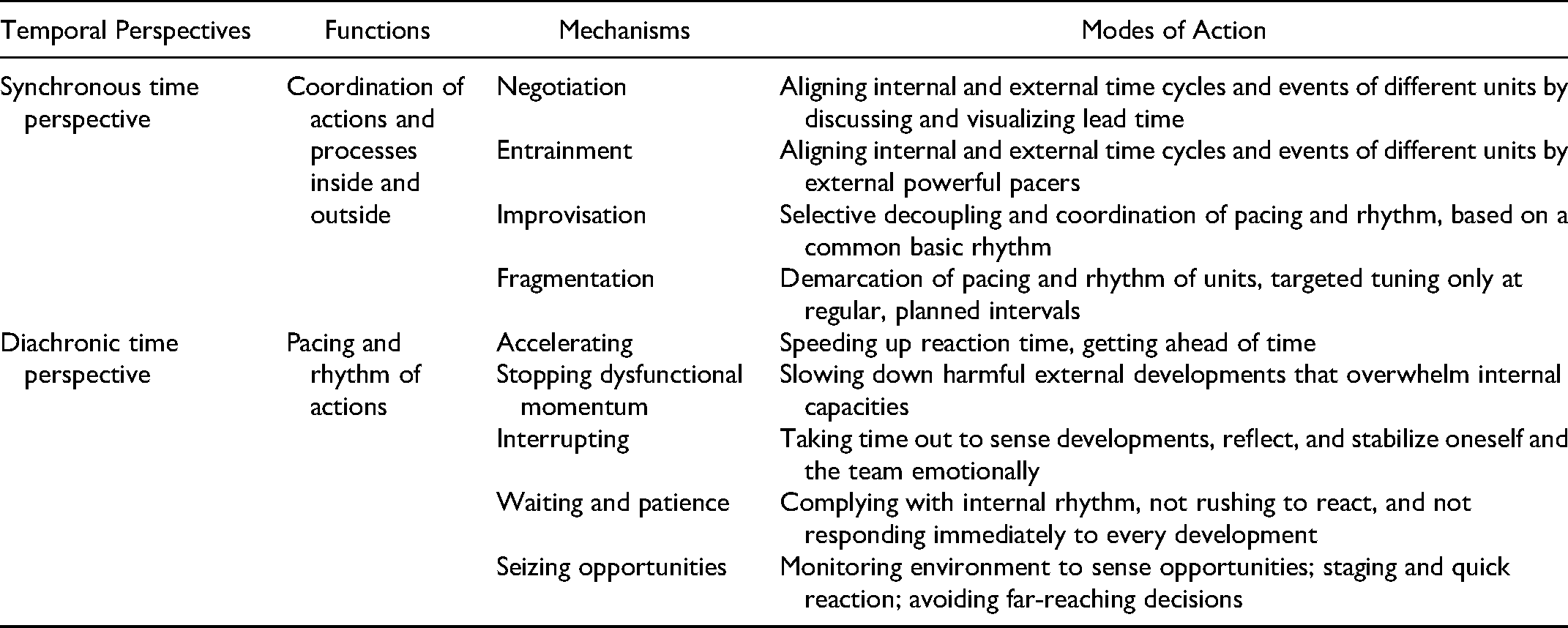
Temporal coordination in projects is often thought of in terms of even closer connectedness of internal and external time cycles and events. In the examples of Stjerne et al. (2019), tensions were mainly reduced by negotiation and mutual adaptation of expectations for establishing cooperation and coordination even in unequal power relations, whereas Dille and Söderlund (2013) and Midler (1995) stress the importance of powerful external pacers.
For situations of normal operation within the comfort zone, coordination mechanisms such as negotiated synchronization and entrainment are sufficient. But these mechanisms are of very limited use for situations that are characterized by urgency and ambiguity. Ultimately, the mechanisms lead to a suboptimal overall result because they are too time-consuming, ignore the recursive effects of aggregated action, and do not consider the necessary orientation to internal time structures. However, detachment is particularly required in emergency situations to prevent the system from being additionally burdened by external time norms. Therefore, coordination mechanisms, such as improvisation and fragmentation, are more appropriate in these situations.
These procedures make it possible to temporally uncouple from the unfolding situation, thus preserving the ability to adapt to autonomously selected events. Emergency services try to enact temporal autonomy by relying on rhythms developed during training and by opening to the evolving situation only when transitioning between routines (Geiger et al., 2020), without having to take into account the temporal orientation of other groups. Especially when acting beyond the comfort and stretch zone—in the danger zone—going with the flow in each unit (Schakel & Wolbers, 2019) is crucial to preventing further developments from becoming uncontrollable.
The goal here is to gain confidence and speed by concentrated and coordinated application of well-learned routines in (small) groups. Nevertheless, improvisation and fragmentation are conditional: both are based not only on technical proficiency but also many years of experience; the ability to sense the rhythm of the other players and, at best, many years of joint work in the team, facilitating the interpretation of each other's clues and, above all, trust.
Projects confronted with volatility and uncertainty challenge the fundamentals of traditional project management approaches at their core (Conforto et al., 2014). In contrast, agile approaches to project management accept the iterative and adaptive character of projects, the prelaminar character of requirements, and discovering the details of the overall solution by using intermediate and parallel solutions (Fernandez & Fernandez, 2008). In this respect, decentralized agile teams are strongly reminiscent of SWAT teams storming a house (Bechky & Okhuysen, 2011) or firefighting teams entering a smoke-filled building (Nachbagauer et al., 2020). An officer, once they have given the order to deploy, cannot control the execution; they just doesn’t know what's going on in the field until the next agreed-upon reporting time.
Picking up on the idea of fragmentation, agile projects enable actors and teams to follow their own time patterns and priorities, whereas coordination is ensured primarily through planned, regular interactions between teams and stakeholders (Niederman et al., 2018). However, regular interactions must not resemble traditional deadlines for completing content-related tasks, as this would again undermine the team's time autonomy. Iterative cycles in agile settings should therefore be more closely aligned with project content and goals than to fixed schedules, for example, monthly cycles (van Oorschot et al., 2018). In contrast to planning approaches in project management, it is precisely the temporal freedom within the team and the external orientation toward a role-based prioritizing of requests that make it possible to adhere to overall time targets, even if there are significant conflicts and deviations from planned times in between (Kremser & Blagoev, 2021).
Recent research shows that intentional interruptions are especially common and have positive effects on agile projects (Wiesche, 2021), whereas patience, working in loops and simultaneous work, and seizing opportunities seem to be more suitable for projects that resemble long-term operations such as innovation projects (Akkermans & van Oorschot, 2016; Lenfle, 2016). The integration of the flow concept into agile approaches to projects promises to overcome time-boxed procedures in favor of continuous work and an end-to-end perspective, mirroring the call to go with the flow in opaque and urgent situations (Dennehy & Conboy, 2018).
Concurrent project strategies use ideas of selective slowdown and patience to generate an overall speed and quality advantage. These strategies maintain that it is more important to expand knowledge on the project in early phases than simply to speed up (Midler, 1995). Akkermans and van Oorschot (2016) showed that the time gained from early feedback and faster learning overcompensates for a possible time loss from rework due to the early start. In doing so, concurrent project strategies and similar approaches make clever use of the difference between the diachronic temporality of projects and the synchronic temporality of the functional actors involved. Concurrent project strategies emphasize, among other things, the importance of physical proximity to reduce the inertia of communication, but also the quality of trust and collective learning—activities that take time and thus reduce speed initially but lead to acceleration in subsequent phases and allow time windows to be used.
Nevertheless, it is important not to make final, irreversible determinations too early in order to avoid costly lock-ins, committing to one version too early, and remaining open to alternative, better solutions. In exploratory projects, monitoring the expansion of knowledge in unknown dimensions, while maintaining the ability to respond flexibly to change and evolve over time, is more successful than advantages associated with a quick start due to an early determination (Lenfle, 2016).
On the individual level, Söderholm (2008) showed that project managers, while initiating extensive meetings to keep up team commitment and urgency, regularly detach from operative activities. In cases examined by Nachbagauer et al. (2020), successful projects tend to prefer slow reactions to new challenges. Even though urgency was an issue, successful project managers did not react quickly and recklessly and avoided far-reaching decisions. When asked about recommendations for coping with turbulence, most project managers responded with statements such as “keep calm,” “keep a cool head,” and “take time to reflect and plan.” The ability to wait is also a prerequisite of staying in the game: to gain time while hoping to find a solution.
In projects, however, there is a difficult tension between activism and waiting. Timing is a process constrained between the perceptions of individuals and the organization and embedded into society: “The temporality of social interaction is structured by unwritten rules that ensure an appropriate sequence and the rhythmic dance of turn-taking” (Flaherty & Fine, 2001, p. 157). Most managers are expected to react immediately to what happens when it happens, and they are expected to get things done. Against the background of the manager-as-hero, wait and see is dismissed as a deficit. The more important a problem is, the more important it is then to build facades that insinuate a confident handling of incidents. Managers then pretend to have a well-considered plan, so that patience does not appear as unforgivable procrastination, but rather as clever stalling.
What is needed, however, is not a one best way that always considers acceleration as the only solution. To cope with urgent challenges in project management, project managers should be empowered and enabled to use a variety of temporal options for action. The entire range of time management competencies—the “person's capacities for punctuality, procrastination, task distribution, time allocation, synchronization, and coordination” (Brunelle, 2017, p. 12) —are important building blocks for adequate actions. Not least, project managers need to know and reflect on temporal structures and their capacity to change.
Conclusions and Limitations
This article contributes to our knowledge of temporal issues in project management beyond scheduling and a purely instrumental view. By focusing on the special temporal issue of timing while managing urgent projects, this article sheds light on a field that remains marginal in project management theory despite its importance in practice. Rooted in social constructionism, this article confirms that project managers must consider subjective event time more intensely to better understand responsiveness to temporal requirements and urgency. Project managers need to accept that time is not scarce in organizations and projects per se; rather, scarcity of time is socially constructed, and urgency is not simply a predefined externality but is enacted. Timing and urgency can and must be managed carefully.
By transferring insights from disaster management and fast-response organizations, this article has investigated timing along two time perspectives. Regarding the synchronous time perspective, common ways of coordination, such as entrainment or negotiated timing, are sufficient for business as usual, but not suitable in time-critical situations. In urgent projects, improvisation and fragmentation are more promising. Selective time demarcation and decoupling of pacing and rhythm allow for the creation of an autonomous time-space with only selective coordination. Regarding the diachronic time perspective—pace and rhythm of actions—this article has shown that good timing is typically characterized by the evocation, the production of periods of accelerated activity making it possible to capture windows of opportunity on the one hand and deliberately induced interruptions and periods of patience on the other. On a practical level, learnings from disaster management recommend a more relaxed management style: in contrast to the common belief, the art of patience, interrupting, and waiting is indispensable for managing urgent projects. Managing timing is then a valuable resource for overcoming widespread feelings of being at the mercy of external time-setting authorities.
Arguments are limited by the research approach. The article does not strive for completeness of the literature review, theoretical considerations, or recommendations. Instead, the intention of this conceptual article is to advance the discourse on timing in project management. It concentrates on those insights that become obvious when shifting the theoretical lenses, and on providing fresh insights and disputable hypotheses. While we have a quite good comprehension of timing in disaster operations and fast-response organizations, we need more empirical research in projects and project-oriented organizations to understand in-situ performances enacted by members. Future research may emphasize the interaction between the project context on the one hand and the perception and construction of timing on the other, as well as the impact of organizational structure and culture on these interactions. Other approaches might explore the shift of timing in projects as they move from normal operations to the danger zone and back again.
Footnotes
Declaration of Conflicting Interests
The author declared no potential conflicts of interest with respect to the research, authorship, and/or publication of this article.