



Abstract
This study operationalizes and tests a multilevel governance model for interorganizational project networks. Results of a qualitative multicase study are used to develop a framework model with three levels of governance, namely metagovernance, governance of networks, and network governance. This framework is validated through a global survey with 225 responses. Type I and Type II governance are confirmed as the organizational elements of network governance, and the relationships between the different levels are established. Metagovernance directly impacts network governance and this relationship is mediated through governance of networks for Type I governance and moderated through governance of networks for Type II governance.
Introduction
Network governance as a hybrid form of organizing, located between market and hierarchy, has caught the attention of researchers for a number of years (e.g., Grandori & Soda, 1995). Networks are often defined as a group of three or more organizations connected in ways that facilitate repetitive achievement of a common goal (Provan et al., 2007). Interorganizational networks regularly develop, conceive, and change themselves to adapt to evolving environments and enhance the performance of their joint projects and their networked organizations (Sydow & Braun, 2018). These interorganizational interactions require governance over time, which is typically referred to as network governance. Kapucu and Hu (2020, p. 5) define network governance as “the use of formal and informal institutions to allocate resources and coordinate joint action in a network of organizations.” However, this typical definition of network governance is insufficient to account for the recurrent collaboration of networked organizations in projects, which takes place over time and simultaneously. A higher level of governance is required, which must consider a number of simultaneous networks established by the project-specific combination of organizations in different projects. To account for this difference in the context of a single interorganizational network, we follow Müller et al. (2022) and adopt the differentiation between ‘network governance’ for the governance of a single network and ‘governance of networks’ for the governance of a number of networks (Morris, 1997; Müller et al., 2014). Earlier research regarded networks as a form of governance for the networked organization, not as a governed entity in its own right (e.g., Provan et al., 2007). Therefore, the focus of these studies is on what is required for the network to govern itself (e.g., Pryke et al., 2018), rather than the governance of these networks. In order to take into account the governance of a number of networks occurring over time and simultaneously in interorganizational projects, a multilevel governance perspective must be adopted. This will allow the development of an end-to-end theory on how networks are governed in large and megaprojects. Hence, we post the following research question: How are longer term interorganizational networks governed for recurrent collaborative projects?
Building on this research question, the aim of the present article is to address this omission by testing and validating a framework model for multilevel governance of interorganizational project networks recently developed by Müller et al. (2022). This framework builds on political governance theory and identified three distinct but interrelated layers of governance, namely metagovernance, governance of networks, and network governance. Based on 28 interorganizational project network cases in 10 different countries, the framework is generalizable. However, to further enhance its applicability, this present article tests and applies it by quantitatively operationalizing the formerly qualitative scales and validates them through a worldwide survey. The study results test a framework for the governance of interorganizational networks for projects, from formation to execution, and presents findings from moderation and mediation analyses.
The next section of this article reviews the most relevant literature on multilevel governance including metagovernance, governance of networks, and network governance, and hypotheses are developed. This is followed by a brief overview on the research design, details on data collection and analysis, and results of the quantitative study. The article finishes with a discussion of the findings and a conclusion, where the research question is answered, and the contribution to knowledge is elaborated.
Literature Review
As indicated previously, our interest lies in the governance of networked organizations that recurrently execute joint projects, in other words, the governance of project networks. Governance is the framework that outlines the boundaries for management’s execution of their tasks and what they will be held accountable for (Müller, 2019). Governance refers to the rules, relationships, systems, and processes for exercising and regulating authority, as well as for holding actors accountable for their work (Biesenthal & Wilden, 2014), in other words, the conditions for self-regulation (Clegg et al., 2002).
Large and complex projects are often accomplished through a network of organizations (Adami & Verschoore, 2018; DeFillippi & Sydow, 2016). These networks are characterized by a multitude of layers of actors, including both vertical and horizontal relationships that evolve throughout the project life cycle (Denicol et al., 2021). The vertical relationships refer to the hierarchical relationship between the actors setting up the collaboration like the sponsor and tier 1 suppliers, where the initiating party determines the rules of the game. The horizontal dimension refers to the network of formal and informal relationships between suppliers and other collaborating partners (Denicol et al., 2021). Organizations recurrently collaborate with different sets of organizational actors in performing projects and therefore take part in multiple networks at the same time (Lundin et al., 2015). This complexity poses challenges to governance (Šimkonis et al., 2021), which will be addressed through a discussion of three interrelated layers of governance in the realm of recurrent joint project execution, namely metagovernance, governance of networks, and network governance.
Metagovernance
On the metagovernance level, public government organizations or private large-scale investors are responsible for overseeing how networks are formed for project execution. Metagovernance therefore represents the (semi-)permanent policies and guidelines within which individual networks are governed through network governance. Building on political sciences, metagovernance constitutes the “governance of governance” (Torfing, 2016, p. 525) that manages and directs the networks by drawing boundaries for their self-governance. Jessop (2009) proposes that governance failures come as a consequence of insufficient understanding of the circumstances of actions or coordination problems at different levels or lack of alignment regarding the object of governance, the time and space of action, or the way actions are related to power and interests of the involved parties. To govern the complex and dynamic relationships of diverse parties in project networks, there is a need for metagovernance norms and principles to facilitate clear governance structures (Kooiman & Jentoft, 2009). Jessop (2009) develops a metagovernance framework for investors that includes four modes of metagovernance that are directed by a fifth one. The first mode is metaexchange, which refers to the reflexive design of markets and the subdivisions they include. In the project context this refers to market-level decisions investors make, for example, in regard to new power generation or smart city technologies (Braithwaite, 2020; Müller et al., 2022). The second one, metaorganization, is about the design of organizations, intermediate organizations, and ecologies of organizations such as the authorization of special purpose vehicles (Müller et al., 2022; Sainati et al. 2017). Metaheterarchy, the third mode, refers to conditions for self-regulation and includes the choice on how certain networks are formed in projects (e.g., emergent versus orchestrated) (Lejano et al., 2014; Müller et al., 2022). The fourth mode, metasolidarity, is about enabling opportunities for collaboration among actors, for example, through knowledge sharing in projects (Ansell, 2000). The fifth mode, modification of the balance, stresses that the emphasis placed on each of the other four modes depends on situational contingencies and the context of the project.
Metagovernance has been vaguely addressed in the context of projects (e.g., Li et al., 2018), and a recent study suggests that governance issues in the realm of metagovernance are a cause for failure in megaprojects (Denicol et al., 2020). Müller et al. (2022) found that metagovernance in the context of interorganizational project networks recognized conditions for how project networks are formed. They identified that metagovernance is typically set by the owner or investor and its settings determine varying network typologies and governance approaches across governance layers. Modes of metagovernance that were identified in the interorganizational project networks investigated include metaexchange (to establish the purpose of the network), metaorganization (to determine the network partners), metaheterarchy (to define the power balance and structure of the network), metasolidarity (to detect the required composition of the network for a mutual understanding toward collective delivery of future projects), and the balance of metagovernance modes with the objective of minimizing the risk of failure in the governance of a network.
Governance of Networks
Different types of networks can be found in the context of projects, including networks for project execution, for formal and informal knowledge sharing, or for training and education. Each of the networks requires a specific form of governance and a consideration of their formation, their structure, and the overall governance principles. Networks are formed in different ways and can be more or less formal depending on their formation process. When networks are deliberately initiated and designed, in other words, orchestrated for a certain purpose, they tend to rely on more hierarchical governance structures (Denicol et al., 2021). For example, answering to a tender, a client organization will set up and configure the network to deliver a megaproject (Denicol et al., 2021). Networks can also be emerging as actors seek collaboration for various purposes, without the presence of one actor orchestrating the network, for example knowledge-sharing networks, or networks for training (DeFillippi & Sydow, 2016). Hence, the characteristics of a network are contingent on how the network was formed.
The governance structure of networks refers to how a particular network is implemented, how participants are related, how relationships are established and maintained, and the governance mechanisms in use for defining and monitoring boundaries for self-regulation (Denicol et al., 2021). It reduces inconsistencies and conflicts in measures to accomplish organizational goals and enables strategic action (Müller, 2009). The structure can include horizontal and vertical relationships and a mixture of both formal and informal elements (Inkpen & Tsang, 2005).
The general governance principles for enabling efficient and ethical collaboration—transparency, accountability, responsibility, and fairness (Aras & Crowther, 2010)—apply also to the governance of networks. At the heart of transparency lies the openness and accuracy of information and decisions, for example in disseminating information among stakeholders or making it public, or implementing audits or audit-like practices (Power, 1997). Accountability focuses on the roles, rights, and responsibilities of project participants and guarantees that the organization (and in our case the network) has the ability to achieve its objectives by holding individual project roles accountable (Müller, 2017). In contrast to this, responsibility is concerned with the conformation with professional standards, laws, and accepted professional practice (Müller, 2017). The principle of fairness is concerned with how fairly individuals and organizations are treated in terms of the distribution of resources, the processes of decision-making, and interpersonal interactions in performing the work (Unterhitzenberger & Moeller, 2021).
Müller et al. (2022) found that organizations sustain a portfolio of interorganizational project networks, which enables them to work toward short- and long-term goals. Networks have been found to be either generic or project-specific in nature. They identified that upcoming business opportunities are typically triggers for the formation of these networks, and the approach to formation subsequently determines the structure of the network. Emerging networks lead to more democratic collaborations between the network partners and are often based on chance meetings or previous working relationships. They found more powerful Type II governance in these networks. In contrast to this, orchestrated networks are typically initiated by the prime contractor and follow a more hierarchical structure with dominance of Type I governance. However, the majority of networks Müller et al. (2022) investigated were based on hybrid formations representing a combination of emerging and orchestrated networks.
Network Governance
Overall, research on network governance typically addresses cooperation, coordination issues, and power distribution for long-term operations (Gulati et al., 2012) or one-time efforts like megaconstruction projects (Denicol et al., 2021). Most of the project governance theories focus either on the hierarchical or the networked part of the project (Šimkonis et al., 2021). Network governance, however, involves hierarchical and nonhierarchical structures at the same time and cannot be explained by classic governance theories. Therefore, the multidimensional nature of network governance is revealed by analyzing it through multilevel governance theory (Hooghe & Marks, 2001). Although initially multilevel governance theory was used in political science, Šimkonis et al. (2021) tested the theory in interorganizational project settings. Multilevel governance theory is revealed by two types of governance taking place simultaneously: Type I governance represents the hierarchical nature of the network. This is a formal structure, which involves the owner of the project, prime-contractor, and subcontractors in their hierarchical relationship. In this vertical structure the autonomous project network participants bring specific competencies and are steered by the project network owner or prime contractor to achieve effectiveness (Hooghe & Marks, 2001). Type II governance represents the nonhierarchical structures of the network, where units interact at the task level to accomplish shared goals and strive for efficiency (Hooghe & Marks, 2001). Type II governance is characterized by a more democratic relationship between all project network members and emerges within Type I governance. While Type I is more formalized and institutionalized, the Type II happens informally, on a case-by-case basis, or can be formally predefined as well.
Network governance recognizes the governance of the joint execution of projects through the network. Adopting multilevel governance as the theoretical lens, Müller et al. (2022) found that the hierarchical structure typically found at the top of hybrid formations of interorganizational project networks can be explained through Type I governance with clear roles and responsibilities, distinct accountabilities, and based on traditional governance theories (Davis et al., 1997; Williamson, 1985). Additionally, they found that the more democratic interactions at the lower end of the hierarchy can be explained through Type II governance and by being more situation dependent.
Figure 1 summarizes the discussion on the network governance framework developed by Müller et al. (2022) on the basis of 28 case studies, each representing a network for a project, using 124 interviews in 10 countries.
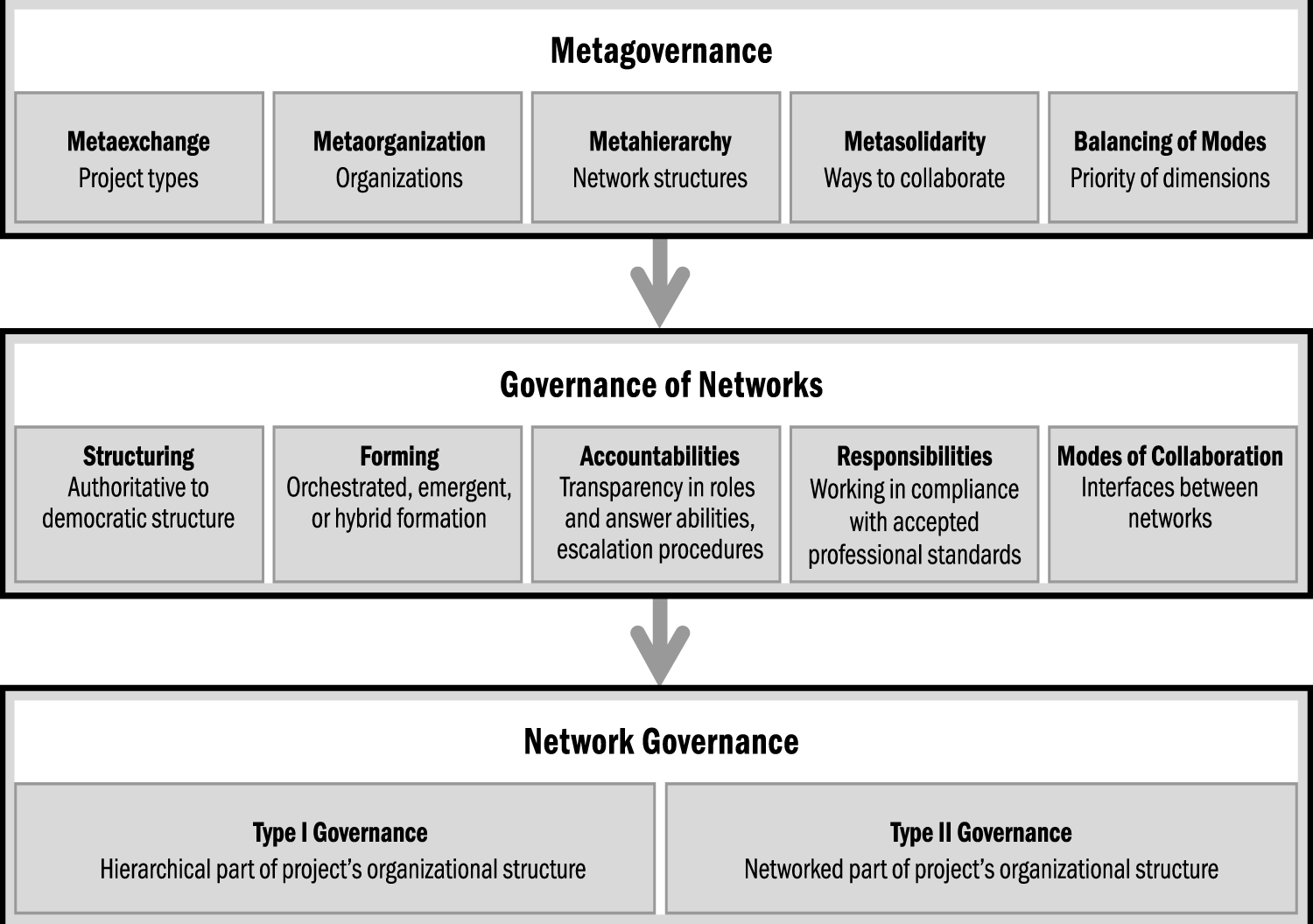
The network governance framework (after Müller et al., 2022).
Hypotheses Development
The literature review revealed the concepts of metagovernance, the governance of networks, and network governance. Building on multilevel governance theory (Hooghe & Marks, 2001) and on the findings by Müller et al. (2022), we identified two different types of network governance for interorganizational projects, namely Type I and Type II. As outlined in the preceding section, Type I governance is concerned with the hierarchical parts of the network, whereas Type II is concerned with the nonhierarchical and horizontal interactions in the network. We therefore propose that:
The types of governance findings also indicated that they represent levels that are interrelated with a timely, logical sequence. Müller et al. (2022) found that metagovernance provides the context in which the networks can emerge. The specific modes applied in metagovernance act as boundary conditions for the types of networks that can emerge, the types of networking being performed, the types of self-organizing, and the types of actors that take part in the network (Torfing, 2016). This represents the metagovernance and governance of networks interface. Having put these metagovernance dimensions in place, the governance of networks determines the governance requirements for the different networks such as their interfaces, their collaboration and coordination measures, their accountabilities, and responsibilities. The requirements for the governance of networks lay the foundation for network governance with a particular focus on the governing mode as well as the accountabilities and responsibilities of the individual network members. Hence, we propose that:
Following this, governance of networks is situated in between metagovernance and network governance and, therefore, filters the influence of metagovernance on the hierarchy of networked organizations, representing a mediating relationship (Müller et al., 2022). Hence, we propose that:
At the same time, governance of networks facilitates the link between metagovernance and the governance of the network of horizontal and nonhierarchical organizations, representing a moderating relationship (Müller et al., 2022). Hence, we propose that:
By proposing H2.1 and H2.2, we hypothesize that governance of networks acts as a mediator and as a moderator at the same time. This is appropriate in the context of this study as we test the relationship with different dependent variables, namely network governance Type I and Type II. The impact of the governance of networks on these different types of network governance varies, as we hypothesize that governance of networks filters the influence of metagovernance on Type 1 governance, but facilitates the influence on Type II governance. The hypothesized relationships are visualized in the simplified framework model of multilevel governance for interorganizational project networks in Figure 2.
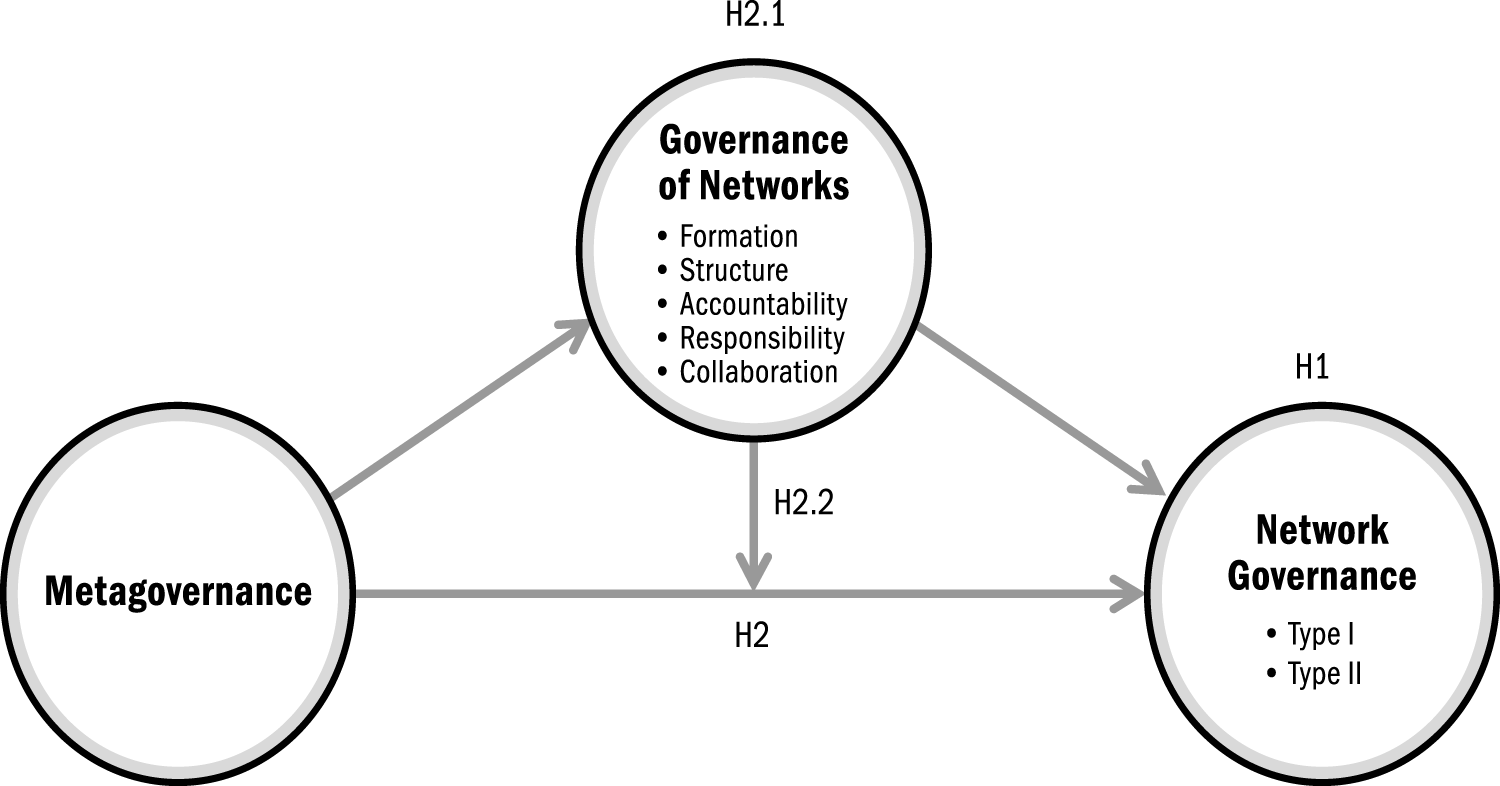
Simplified framework model of multilevel governance for interorganizational project networks (measurement model).
Research Design
In designing the research, we followed Saunders et al.’s (2019) six-step process. We took critical realism’s ontological and epistemological stance by assuming a mind-independent reality, where subjectively interpreted phenomena are underpinned by objective and observable occurrences (Bhaskar, 2016). We conducted a global survey to validate Müller et al.’s (2022) framework model as depicted in Figure 2 with the hypothesized relationships between metagovernance, governance of networks, and network governance. Data were collected through a questionnaire and analyzed through factor analysis, and mediation and moderation relationships were tested aligned to the hypotheses. In the following sections we present the details for the quantitative study, including data collection and analysis and presentation of the findings.
Data Collection
We operationalized the constructs from the results of Müller et al. (2022) as described and developed a questionnaire. Following is a brief overview of the measurement constructs, whereas the detailed questionnaire items and their grouping by subjects are shown in the Appendix at the end of the article.
The questionnaire started with questions on the network topology of the respondent’s project and the location of their organization in the network (i.e., hierarchy, network, or hybrid). Using analysis of variance (ANOVA), these data were used to assess significant differences in governance by network topology.
Network Governance was operationalized to assess Type I and Type II governance as multi-item constructs, which were later factor analyzed into two distinct network governance constructs. Following Müller et al. (2022), Type I questions asked for nonoverlapping accountabilities, use of special purpose vehicles (SPVs), formal management authority, and delivery through Type II organizations. Type II questions asked for overlapping accountabilities and informal governance. All items used 5-point Likert scales, ranging from Strongly Disagree to Strongly Agree.
In a similar vein, Governance of Networks used multi-item constructs for structuring of networks (using dimensions for governance, leadership, and control approaches), setting of accountabilities (clearness of definition, knowledge of them internal and external to the project), responsibilities (working conforming to accepted standards, its monitoring, and possible punishment), and the ways of collaboration across networks (freedom in choice of collaboration partners). Formation was assessed on a one-item scale ranging from formal selection to informal activities. Each of these constructs was measured on semantic-differences 5-point Likert scales, and afterwards factor analyzed in their respective factor, except for Formation, which was normalized using z-scores, for compatibility with the factor scales.
In the interest of parsimony in an already complex model of eight constructs over three levels, Metagovernance was designed as a single compound construct, consisting of five questions. These were metaexchange (type of market), metaorganization (freedom in organizing), metaheterarchy (freedom in governance structures), and metasolidarity (sponsor’s support in finding collaboration partners). All items were measured on 5-point Likert scales, ranging from Strongly Disagree to Strongly Agree. The answers were factor analyzed into the related metagovernance variable.
This was followed by questions on network and governance performance (which were adapted from Müller et al., 2016) and demographic questions on the role and tenure of respondents, geography, industry, costs, and scope of the project, as well as size of the respondent’s organization.
Snowball sampling was used by contacting professional organizations for project managers and the researchers’ existing networks and asking them to distribute the questionnaire to eligible individuals in project management, management, or project team member roles related to interorganizational networks for projects. The invitation email contained a link to a website of one of the researchers’ universities, where the details of the study, its aims and research questions, the use of personal data, and the respondent’s rights in terms of general data protection regulation compliance were explained. A link on that website led to the online questionnaire. The chosen sampling approach does not allow for the calculation of a traditional response rate. Two hundred and twenty-eight answers were collected. Three responses were excluded because two respondents entered the same data twice, and one respondent negatively answered the question on study consent. The final sample consisted of 225 usable responses.
Data Analysis
Factor analysis using principle component analysis with varimax rotation was used to validate the constructs outlined previously. Regression analyses were used for meditation tests and hierarchical regressions analysis (HRA) for moderation tests.
Possible mediation effects of the relationship between metagovernance (MetaGov) and network governance (NWG) were tested separately for network governance Type I (NWGT-I) and network governance Type II (NWGT-II). The proposed mediators, in other words, the governance of networks (GoN) variables, were tested for correlation with MetaGov to determine if they qualify for mediation analysis. We applied Kenny’s (2009) four-step process and variance accounted for (VAF) thresholds of <20% for no mediation and >80% for full mediation (as defined by Hair et al., 2014).
Possible moderation effects were tested through HRA for each of the two dependent variables, NWGT-I and NWGT-II. The first step introduced the control variables for the respondent role, experience, project scope, organization size, network size, industry, and project costs. The second step added the independent variable to test the primary effect of MetaGov on network governance (NWG). The proposed governance of network moderator variables GoNForm, GoNStructure, GoNAcc, and GoNResp were added in the third step, and finally, the interaction terms in the form of the products of independent and moderator variables were entered in the fourth step. Moderator effects can either modify the form (i.e., the slope of the regression curve) or the strength (the R2) of the relationship between independent and dependent variables. To identify the particular type of moderation effect of the potential moderator variables, we followed Sharma et al.’s (1981) process to identify the specific nature of the types of moderator variables:
In case of significant interaction between the moderator and independent variable (step iv), proceed to step ii, otherwise to step iii. If the moderator relates to the independent variable, it is a “quasimoderator” (i.e., a mix of antecedent and moderator variable). Alternatively, it is a “pure moderator” that influences the relationship between independent and dependent variables. A significant correlation between moderator and the independent or dependent variable indicates it is not a moderator but a possible antecedent variable. In case of no correlation, it is a potential homologizer, which is tested in step iv. The sample is split into subgroups on the basis of the hypothesized homologizer. These subgroups are tested for significant differences in predictive validity (R2). In case of significant differences of R2 values across subgroups, the moderator is a homologizer, which influences the strength of the relationship between independent and dependent variables. Otherwise, it is not a moderator.
Validity and Reliability
Validity of the data was pursued by deriving measurement constructs from existing literature and the qualitative study described in the preceding. A pilot test with eight respondents from academia and industry validated the constructs’ face validity and helped correct minor spelling mistakes and rephrasing of one demographic question. The answers of the pilot respondents on this demographic question were excluded from the final analysis.
Confirmatory factor analysis was conducted to test for convergent and discriminant validity. For convergent validity we measured the average variance extracted (AVE) and all constructs had an AVE at or above the 0.5 threshold, suggesting that all variables within each construct correlate well with each other (Hair et al., 2017). All items loaded highest on their respective construct and the indicator loadings on other constructs are smaller than the square root of the AVE, indicating no issues with discriminant validity (Fornell & Larcker, 1981; Hair et al., 2017). Reliability was assessed using Cronbach Alpha tests (Cronbach, 1951) and all constructs were at or above the 0.6 threshold with a significance of .05 or better. For composite reliability all constructs were at or above the 0.7 threshold (Hair et al., 2017). Multicollinearity was measured through the variance inflation factor (VIF) with all values between 1.0 and 1.9, which is far below the maximum threshold of 5.0 for collinearity (Hair et al., 2017).
Common method bias (CMB) was addressed following Podsakoff and Organ (1986) by including ex ante reminders for anonymity of data, that there are no right or wrong answers, and that answers should be related to the last finished project. A Harman ex post test identified 41 factors, of which the largest explained 21% of the variance, which is far below the threshold of 50%. Moreover, the VIF below 3.3 for all constructs is indicative of the lack of CMB issues (Kock, 2015). Hence, we assumed CMB not to be an issue.
Analysis and Results
Descriptive Statistics
Respondents came from the following industries: construction (37%), engineering/manufacturing (18%), IT/telecom (13%), finance (4%), transport (4%), education (4%), and others (20%). Fifty-seven percent of the projects the respondents reported on were of a construction/engineering/manufacturing type, and 20% IT/telecom, 7% organizational change, and 16% others. Seventy-seven percent of the projects were national and 22% international. Most of the projects were from China (64%) and Europe/North America (24%). The most popular size of projects is between €1 and 5 million in costs (30%), with less 0.1 million (9%), 0.1–1 million (26%), 5–50 million (21%), and above 5 million (12%). The hybrid structure was the most popular project network topology (53%), 30% hierarchical, and 17% network. Of the respondents, 71% were project managers or other managers, 19% were team members, and 4% owner/sponsors. Most of the respondents have more than 10 years of experience in their role (33%), 11% less than 2 years, 28% between 2 and 5 years, 28% between 6 and 10 years. The size of the respondents’ home organization was most often 250 to 1,000 employees (39%), 10% less than 50, 25% between 50 and 250, 11% between 1,001 and 5,000, and 15% more than 5,000. The network size was in the majority less than 10 organizations (53%), with 38% between 10 and 50, 5% between 51 and 100, and 4% more than 100.
The questionnaire items had missing values of less than 2.2%, skewness within ±2, and kurtosis within ±3, indicating eligibility of the data for the chosen analysis techniques (Hair et al., 2003). Table 1 shows the descriptive statistics of the constructs, which are the normalized results of factor analysis, hence all have a mean of 0 and a standard deviation of 1. The skewness and kurtosis indicate again normality of the data, whereas the larger minimum values (as opposed to maximum values) of NWGT-I and NWGT-II indicate that a few network governance setups varied from the mean by having overlapping responsibilities, no SPVs, or did not use Type-II organizations for project delivery. Similarly, the larger minimum values for GoN accountabilities and responsibilities indicate that these are not clearly defined in a few of the assessed networks.
Descriptive Statistics
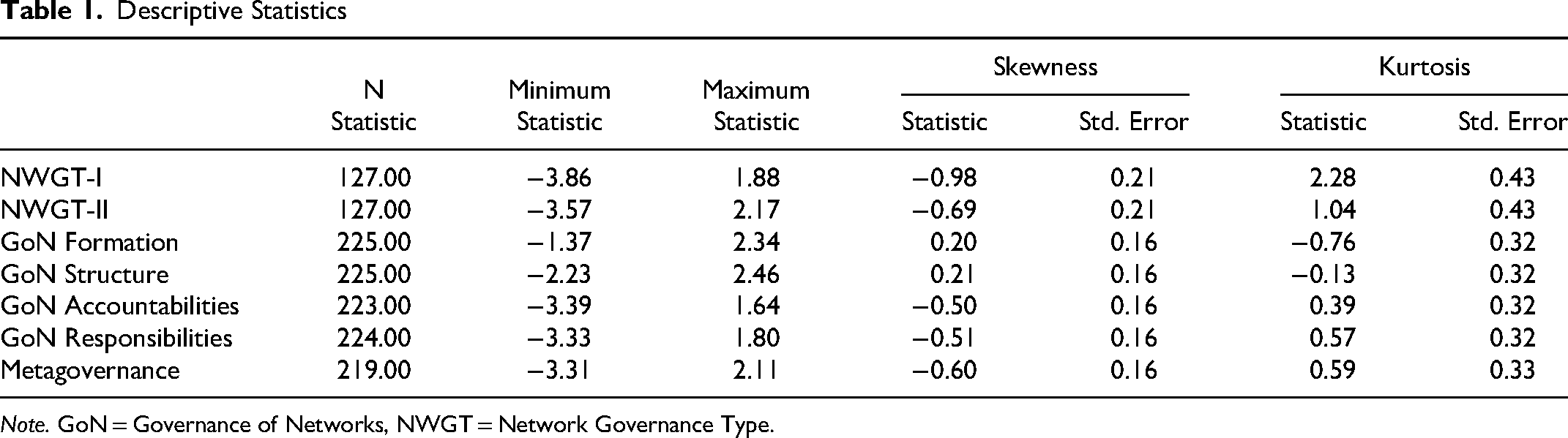
Note. GoN = Governance of Networks, NWGT = Network Governance Type.
Factor Analyses
The factor analyses, including factor names, loadings, and measures for variance explained, Kaiser-Meyer-Olkin (KMO) test, significance, and Cronbach Alpha are shown in Table 2. Questions on network governance loaded on two factors. The first comprised the questions on the governance of the hierarchical management of the network, in other words, network governance Type I (NWGT-I), and the second the governance of the delivery of the project outcome through the networked organizations (nonhierarchical), in other words, network governance Type II (NWGT-II). This confirmed the distinction in Type I and Type II governance for network governance, where the former addresses the hierarchical and managing part of the project network structure and the latter the networked delivery part. This supports hypothesis H1.
Factors
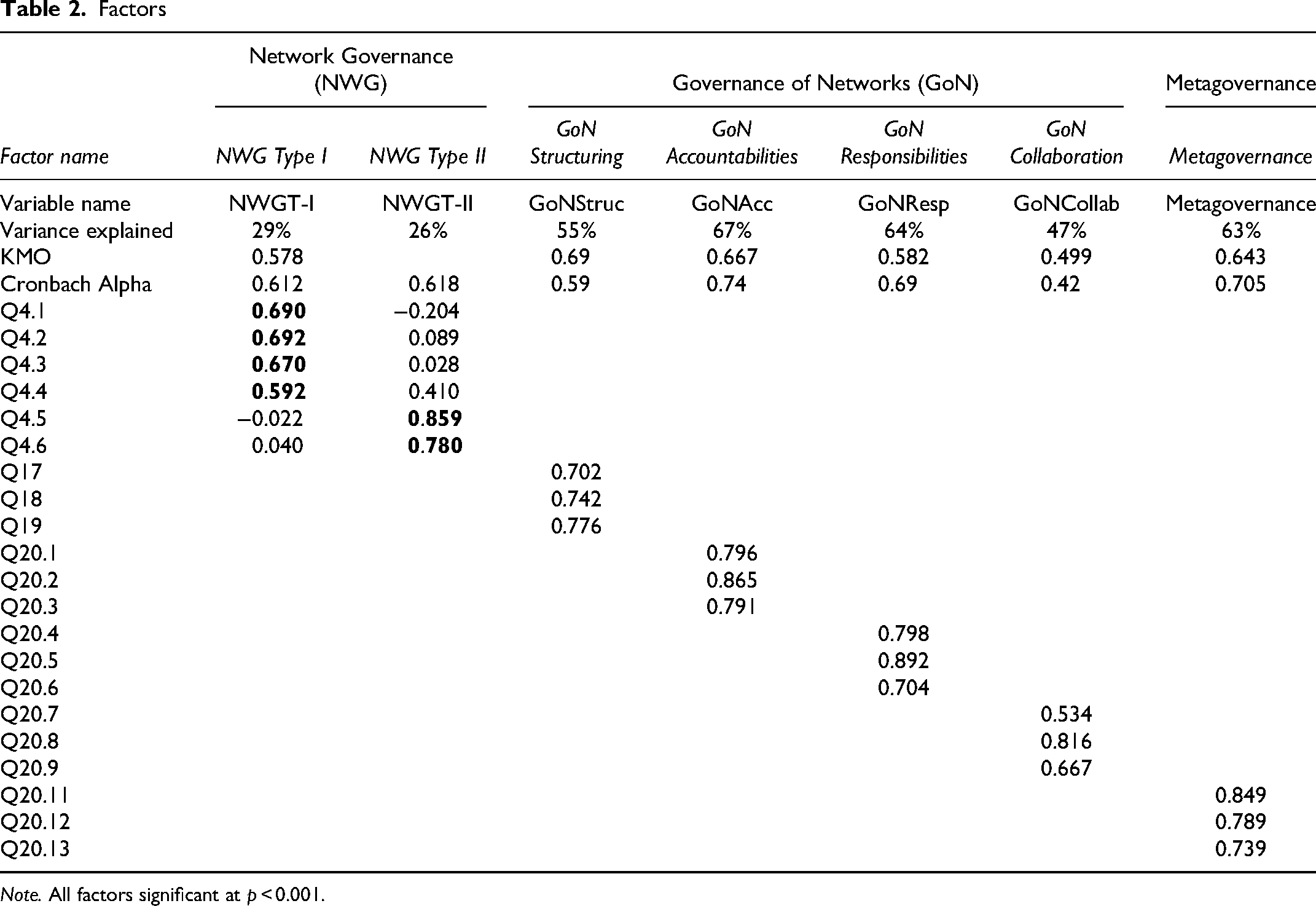
Note. All factors significant at p < 0.001.
Factors for governance of networks (GoN) and metagovernance (MetaGov) were extracted individually for each variable, with each set of questions loading on a single factor. Table 2 shows that reliability and other quality measures met the established standards and thereby mirrored the theoretically derived concepts, except GoN collaboration. This factor did not reach the minimum of 50% variance explained, KMO of 0.5, and Cronbach Alpha of 0.6, and was excluded from further analyses. All other factors replaced the original questionnaire items in subsequent analyses (Hair et al., 1998).
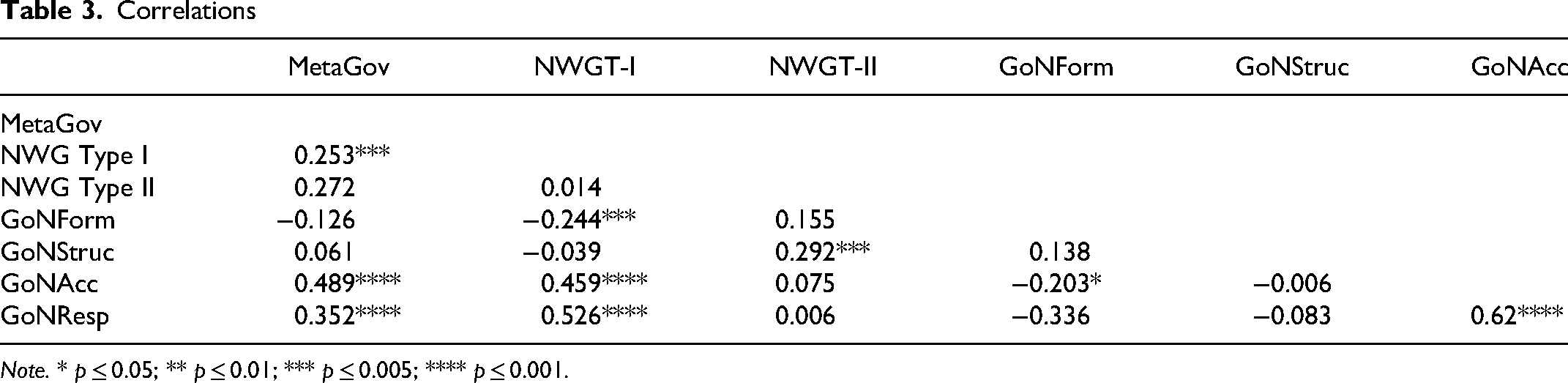
The correlations between the variables are shown in Table 3, indicating the strength, significance, and direction of the pairwise correlations. Both positive as well as negative correlations exist, giving a first support of the model and its variables. This provides for the subsequent regression analyses, where the parameters for a linear equation are identified to predict values of the dependent variable.
Correlations
Note. * p ≤ 0.05; ** p ≤ 0.01; *** p ≤ 0.005; **** p ≤ 0.001.
As shown in Table 3, MetaGov significantly correlates with NWGT-I, but not with NWGT-II, giving partial support for hypothesis H2.
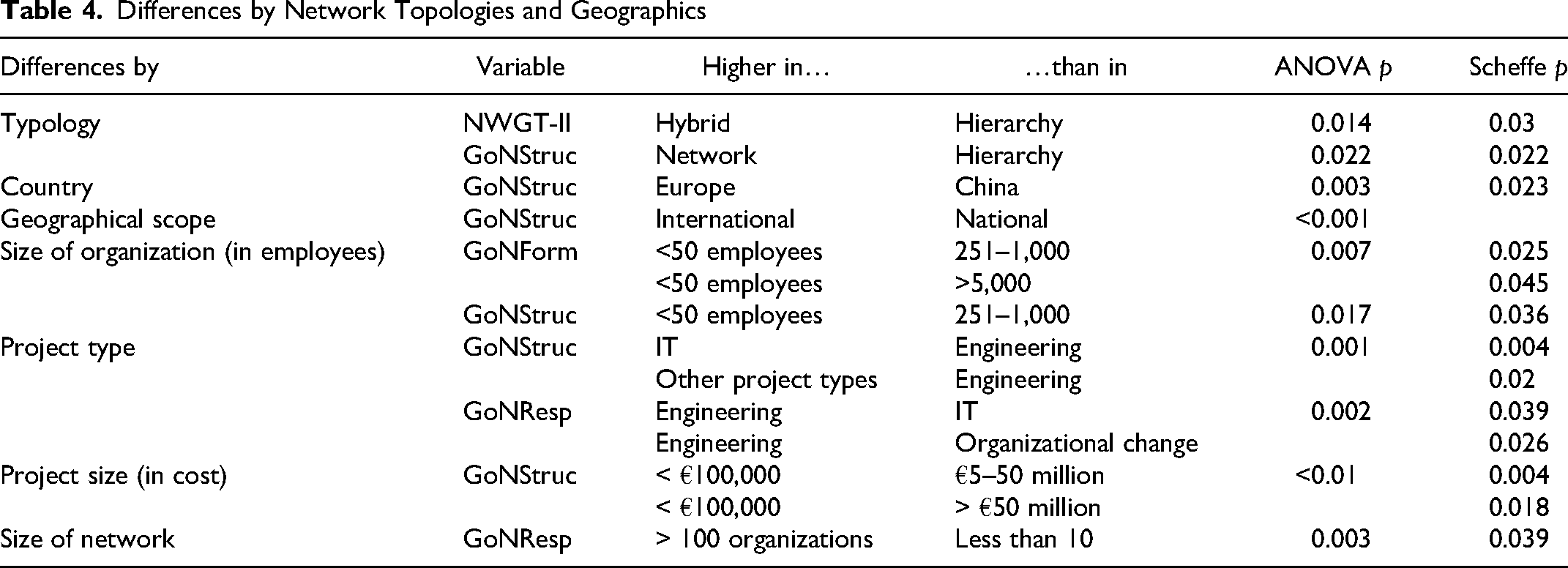
Analysis of variance (ANOVA) tests for differences by network topologies and sample demographics showed no significant differences in most analyses (including tests for differences by national cultures). The differences found are shown in Table 4. An obvious result is that network governance Type II (NWGT-II) is stronger expressed in hybrid than in hierarchical networks. More interesting is that liberal (in contrast to structured) governance, democratic (in contrast to authoritarian) leadership, and outcome (in contrast to behavior) control are significantly more expressed in network topologies compared to hierarchies, in Europe (compared to China), in international (compared to national) projects, and in larger (compared to smaller) projects. Informal selection of network partners is significantly more used by smaller organizations and IT (compared to engineering/construction) projects. Working according to, and enforcing the compliance with, professional working standards is significantly more expressed in engineering (compared to IT and organizational change) projects and in large networks of more than 100 companies (compared to networks with less than 10 companies).
Differences by Network Topologies and Geographics
Mediation Analysis
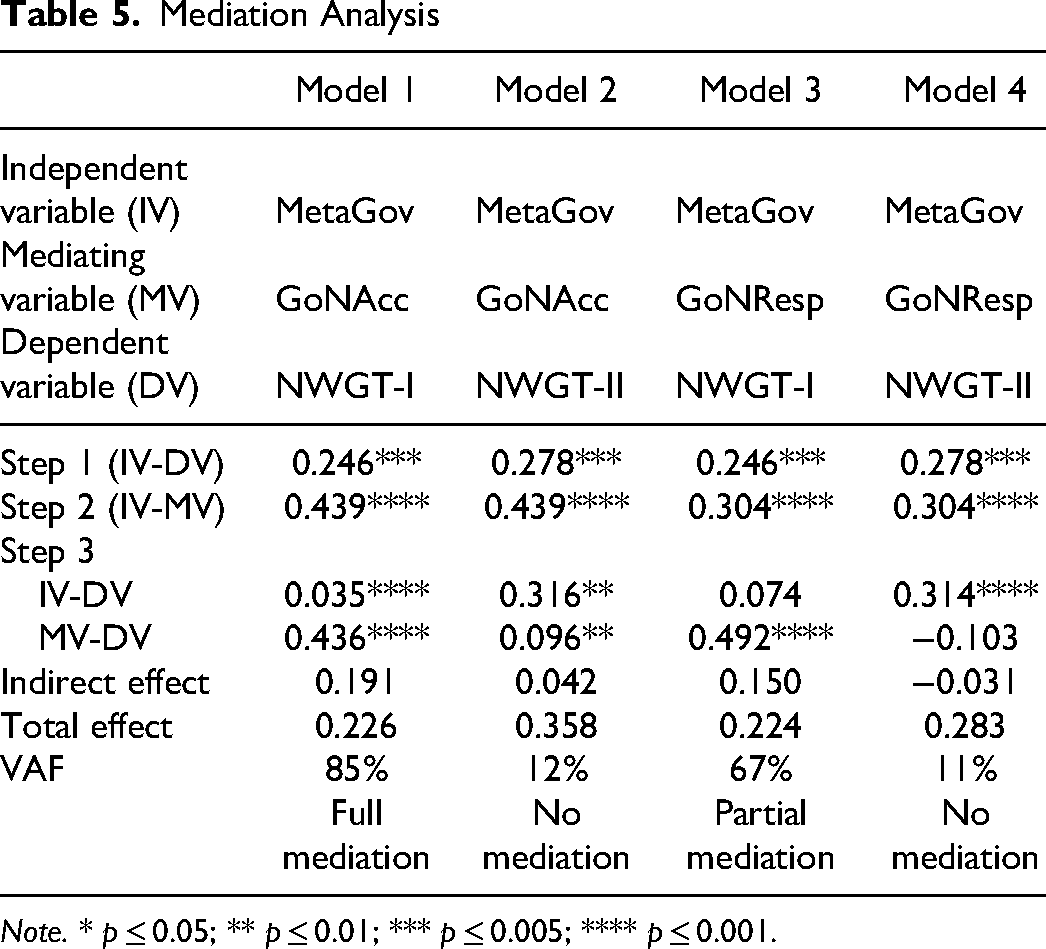
A possible mediation effect of the governance of networks GoN variables on the relationship between metagovernance (MetaGov) and network governance (NWG) was tested separately for the NWGT-I and NWGT-II dependent variables. Of the GoN variables, only GoNAcc and GoNResp correlated with MetaGov, hence qualified for the analysis. The results are shown in Table 5.
Mediation Analysis
Note. * p ≤ 0.05; ** p ≤ 0.01; *** p ≤ 0.005; **** p ≤ 0.001.
We applied Kenny's (2009) four-step process, and variance accounted for (VAF) thresholds of <20% for no mediation and >80% for full mediation (as defined by Hair et al., 2014). Table 5 indicates that GoNAcc fully mediates (85%) the relationship between MetaGov and NWGT-I (Model 1), as shown by the drop of the beta coefficient of the relationship between MetaGov and NWGT-I from 0.246 Step 1 (without mediator variable) to 0.035 (with mediator variable). For the same relationship, a partial mediation (67%) by GoNResp is identified in Model 3. The mediation effect of GoNAcc and GoNResp on the MetaGov and NWGT-II relationship is negligible (Models 2 and 4). Hence, GoN partly mediates the impact of MetaGov on network governance (NWG), giving support for hypothesis H2.1. More detailed, the effect of MetaGov on the NWGT-I is absorbed by the diligence with which accountabilities and responsibilities of the networked organizations are defined at the governance of networks (GoN) level. The final mediation model is visualized in Figure 3.
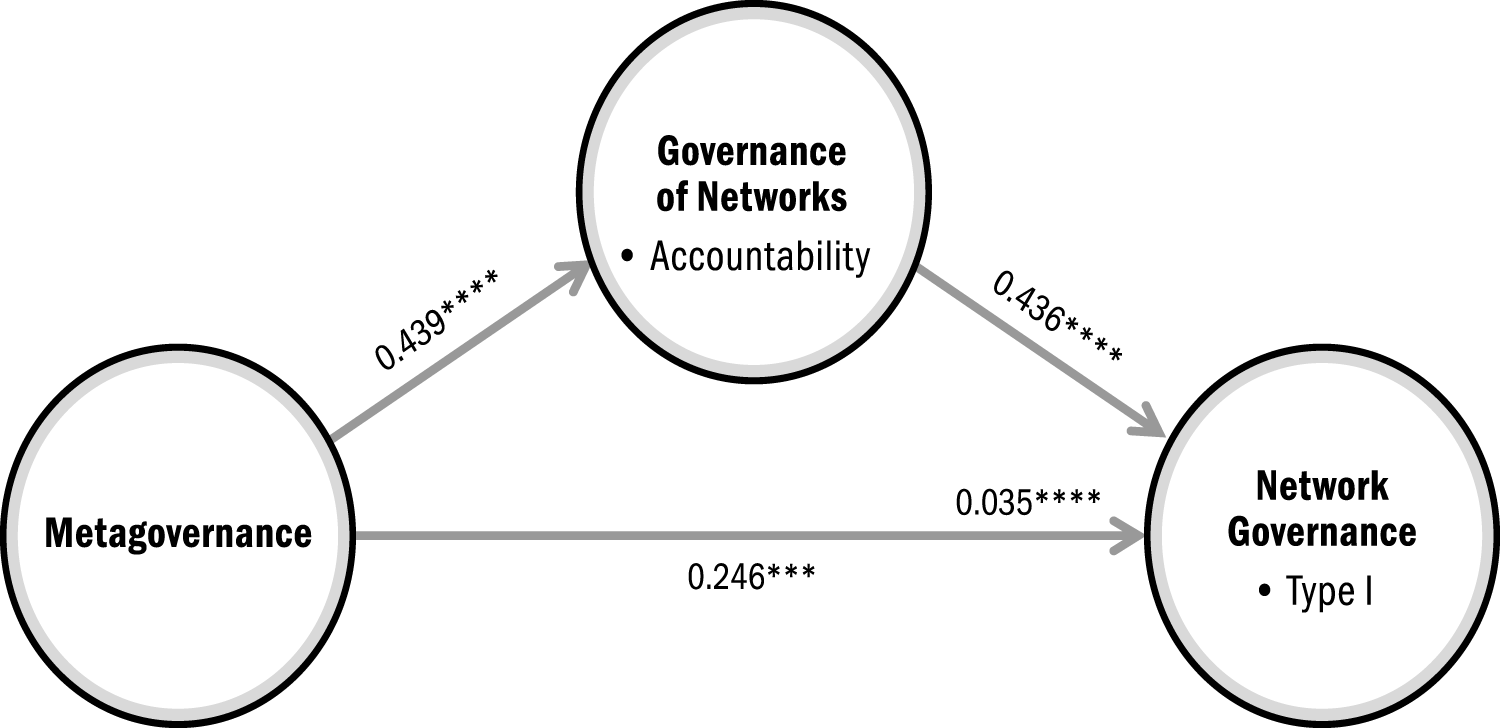
Final mediation model.
Moderation Analyses
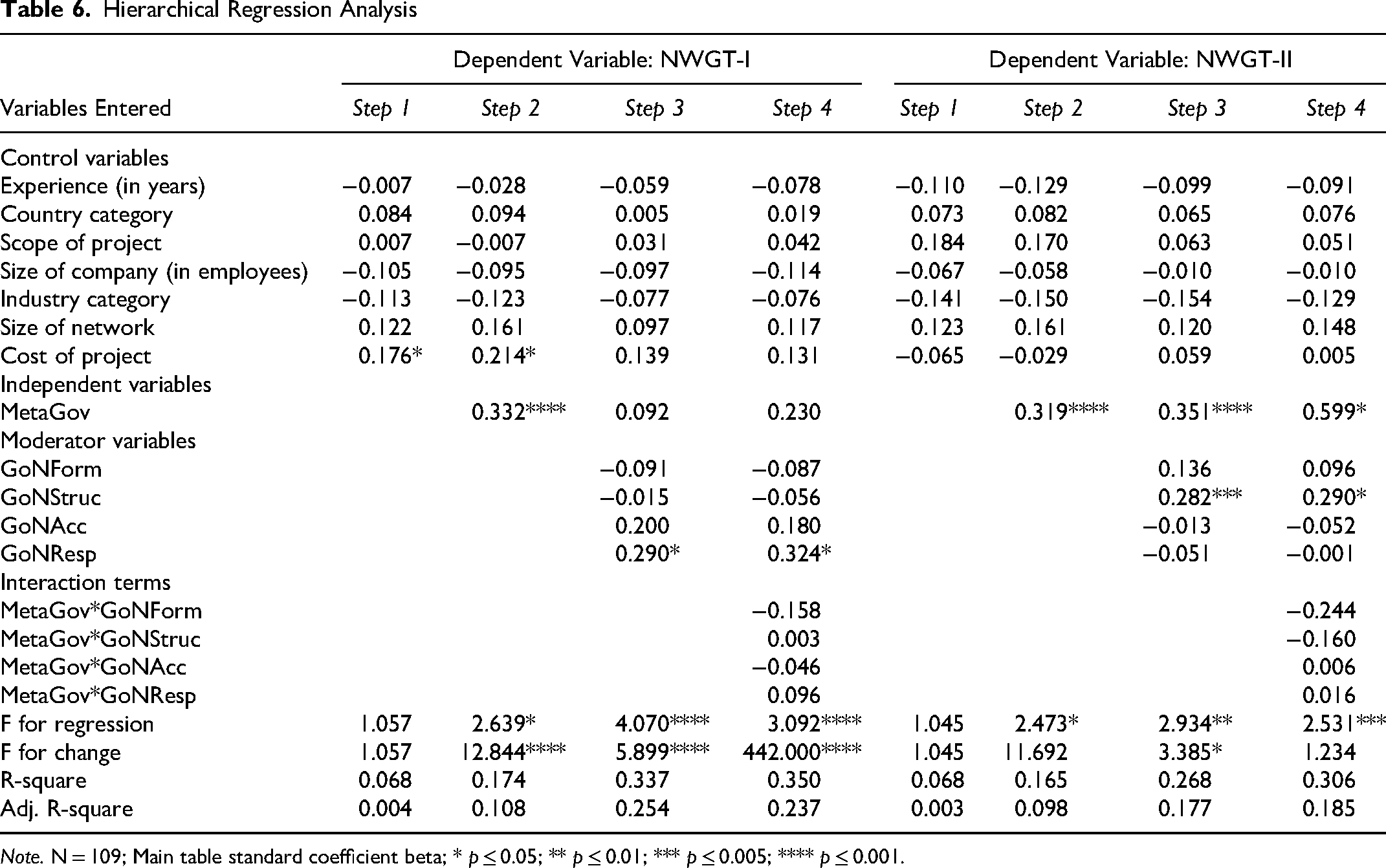
Possible moderation effects were tested through HRA for each of the two dependent variables, NWGT-I and NWGT-II (see Table 6). The left side of Table 6 shows the results for NWGT-I as the dependent variable. The model is significant with an adjusted R-square of 26% (p ≤ 0.001). Step 2 shows a significant main effect between MetaGov and NWGT-I. The significant result for the proposed moderator GoNResp in Step 4 and its correlation with MetaGov (see Table 3) classify it as quasimoderator, which is not a moderator. It combines the characteristics of independent and moderator variables, holding an indeterminable role in the tested relationship.
Hierarchical Regression Analysis
Note. N = 109; Main table standard coefficient beta; * p ≤ 0.05; ** p ≤ 0.01; *** p ≤ 0.005; **** p ≤ 0.001.
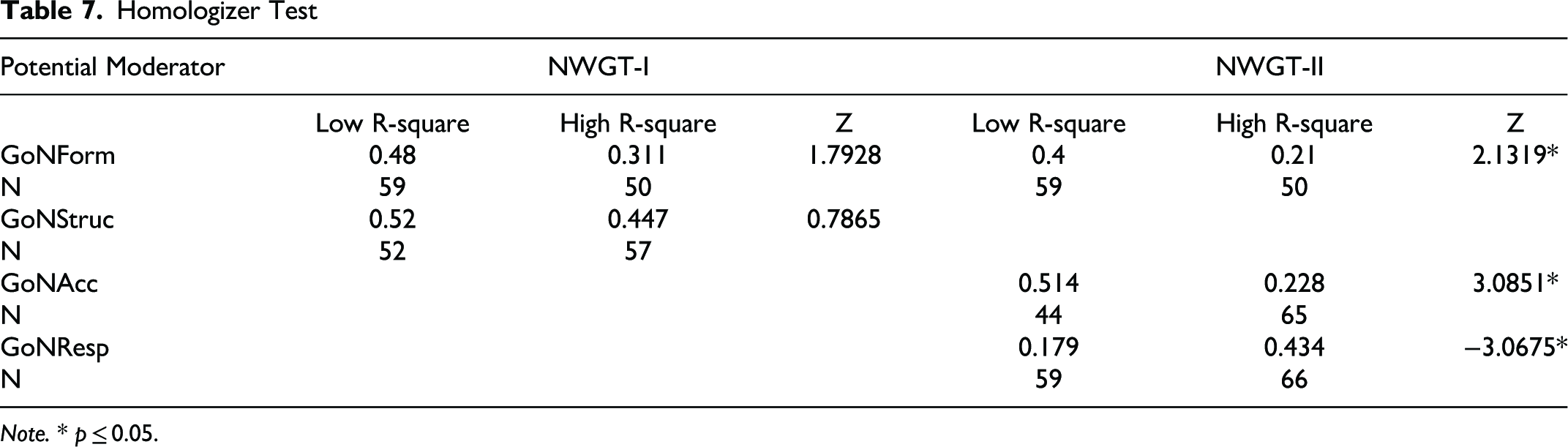
The correlation with MetaGov classifies GoNAcc (see Table 3) as another antecedent variable, not as a moderator. The insignificant correlation results for GoNForm, GoNStruc, and GoNAcc to the other moderators (Step 3) and interaction terms (Step 4) indicate that they have no interaction with the independent variable and are not related to either the independent or the dependent variable. This identifies them as candidates for homologizer tests, with Table 6 showing the results thereof. Subsample tests using GoNForm and GoNStruc indicate no significant differences in R2 across samples. Hence these variables and none of the other proposed moderators meet the moderator criteria for the MetaGov–NWGT-I relationship.
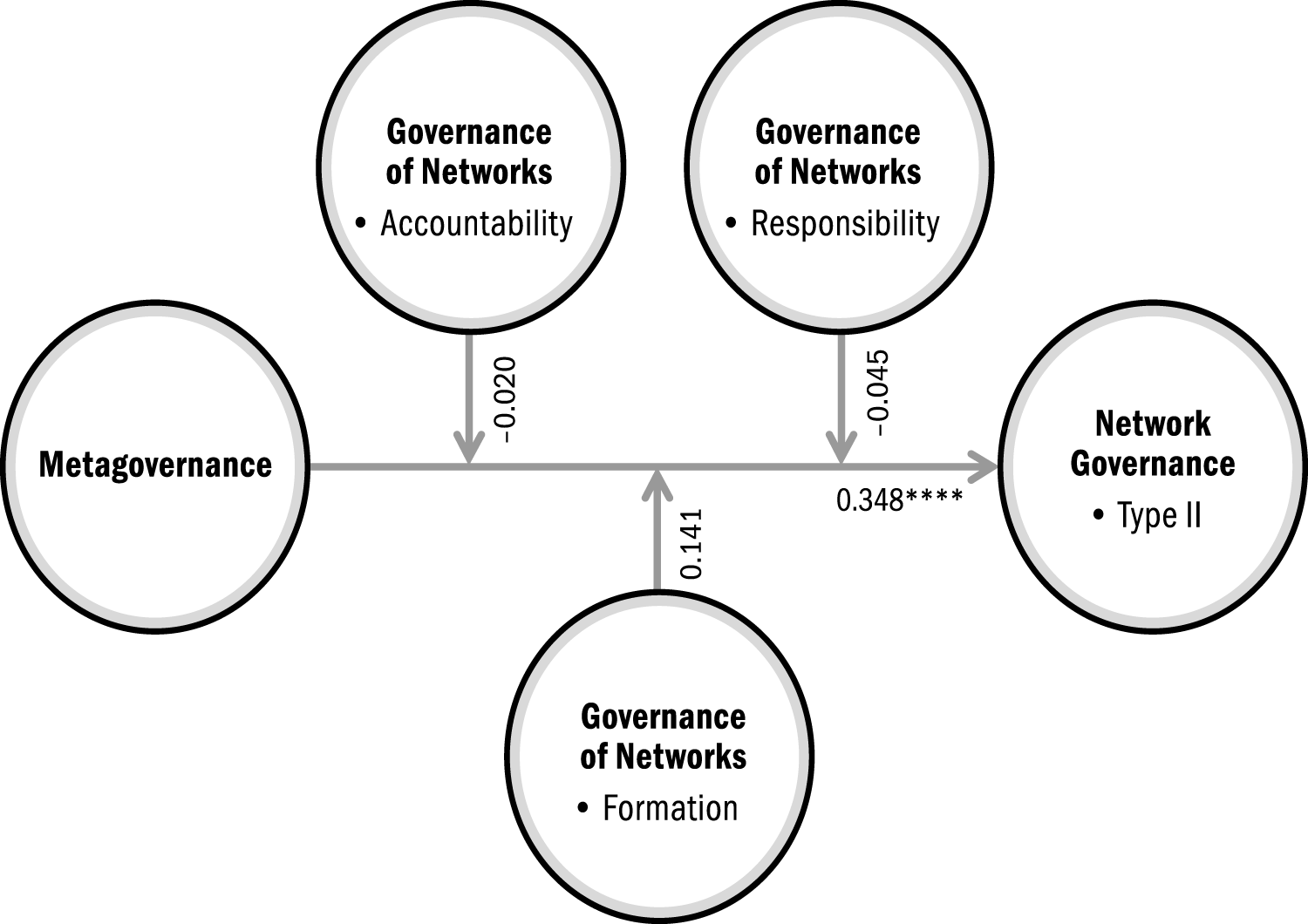
The right-hand side of Table 6 shows the hierarchical regression model for the dependent variable NWGT-II. The model is significant, with an adjusted R-square of 17%. The correlation between NWGT-II and GoNStruc qualifies the latter as another antecedent variable, not a moderator. The insignificant moderator and interaction variables qualify them for homologizer tests, shown in Table 7, right side. All three (GoNForm, GoNAcc, and GoNResp) are homologizers as they significantly influence the R2 between MetaGov and NWGT-II. However, their impact varies. While the increase of GoNAcc and GoNForm decreases the strength of the relationship, an increase in GoNResp increases it. Hence, governance of network (GoN) moderates the MetaGov to NWGT-II relationship, which supports Hypothesis H2.2. Higher levels of defined accountabilities and informal partner selection processes at the GoN level reduce the strength of the MetaGov to NWGT-II relationship, whereas clearer defined responsibilities strengthen this relationship. The final moderation model is vizualized in Figure 4.
Final moderation model.
Homologizer Test
Note. * p ≤ 0.05.
In summary, the results indicate that clearness of accountabilities and responsibilities at the governance of networks (GoN) level:
Mediates the impact of MetaGov on the network governance Type I (NWGT-I). Moderates the strength of the relationship between MetaGov and network governance Type II (NWGT-II).
Formality in the selection of partner organizations in the network strengthens the impact of MetaGov on the network governance Type II (NWGT-II).
Discussion
This study is the first to investigate the relationship between metagovernance, governance of networks, and network governance for interorganizational project networks. The quantitative confirmation of the qualitatively developed model by Müller et al. (2022) allowed to validate the original model and identify the nature of the relationships of the underlying dimensions of each governance level. This provides insights into the relationships between governance layers, which is frequently described as complex, multifaceted, or indeterminable (e.g., Frey & Ramírez, 2019; Joslin & Müller, 2015). The proposed and conformed hierarchical governance model implies a causality stemming from metagovernance as the most permanent form of governance in this model, via governance of networks at the intermediate level, on to network governance at the lowest level. The results show the nature of the intervening role of governance of networks is multifaceted and differs by the targeted dimension at the network level.
The five reflective dimensions of metagovernance—metaexchange, metaorganization, metaheterarchy, metasolidarity, and the balancing thereof (as defined by Jessop, 2009)—are empirically confirmed as a suitable construct for measuring the concept. Moreover, the study showed metagovernance’s influence on both subordinated governance layers. Hence, the investor and/or project sponsoring organization’s reflective capabilities in defining the ‘rules of the game’ to avoid governance mistakes at lower levels play a crucial role in the hierarchy or network of governance layers/nodes. This is in line with Sørensen and Torfing (2007, p. 169), claiming that “…it is not possible to regulate governance networks by means of traditional sovereign forms of detailed, hierarchical, and bureaucratic regulation. Sovereign forms of regulation would inevitably undermine the self-regulating capacity of the networks.” Instead, metagovernance allows for the continuous adaptation and refinement of the five dimensions over time, thus allowing the subordinated self-regulating networks to act and react in a fine-tuned balance of stability and flexibility, which provides the greatest possible freedom to act within limits needed to avoid governance failure (Jessop, 2009). Thus metagovernance, as identified in this study, echoes the definition by Kooiman and Jentoft (2009, p. 823) by providing “governance order where values, norms, and principles are advanced according to which governance practices can be formed and evaluated.”
Network governance emerged as a two-dimensional construct. One dimension (NWGT-I) represents Type I governance’s structural characteristics and its hierarchical relations with nonoverlapping accountabilities, including the networked structure of Type II organizations. Thus, the governance of the management of the network. The other dimension (NWGT-II) represents the dynamic and overlapping accountabilities of the delivery partners in the network and their ad hoc coordination of resources. Thus, the governance of the delivery in the project. This mirrors the Type I and Type II governance concepts for multilevel governance as outlined by Hooghe and Marks (2001) and validated for projects by Šimkonis et al. (2021). The dimensions are differently influenced by metagovernance, with NWGT-I being mediated and thereby partially absorbed by dimensions of governance of networks. Contrarily, the impact on NWGT-II is moderated by governance of networks dimensions, by partly strengthening and partly weakening the impact of metagovernance. This confirms findings from political science where changes in metagovernance, such as new policies for competition, have diverse influences, for example, on organizations’ designs at Type I and Type II governance levels (Flinders & Huggins, 2021).
Governance of networks has a pivotal position by controlling the impact of metagovernance and providing additional antecedents that influence network governance. For NWGT-I the governance of networks dimension for strict to liberal governance and leadership (GoNStruc) has no impact, whereas the network formation process (GoNForm) is an antecedent where increasing formality correlates with the increased strength of network governance. The governance of networks dimension for responsibility in terms of following and enforcing professional working standards (GoNResp) partly absorbs and replaces the impact of metagovernance on network governance, whereby a higher level of professional standards correlates with stronger network governance. Finally, the definition of accountabilities at the governance of networks level fully absorbs the impact of metagovernance and replaces it by its own positive correlation with network governance. In summary, a strong definition of accountabilities, responsibilities, and formal network formation processes strengthen Type I governance (NWGT-I).
The NWGT-II is subject to different influences. Here, the governance of networks dimension for strict to liberal governance and leadership (GoNStruc) positively correlates to network governance. Hence, more liberal governance and more democratic leadership lead to stronger Type II governance for delivering the project outcomes. Informal formation processes for network formation and definition of accountabilities at the governance of networks level do not impact network governance directly but weaken the impact of metagovernance on it. Emphasis on professional working standards strengthens this relationship. Hence, governance of networks coexists with metagovernance and impacts both directly (through GoNStruc) and indirectly, by influencing the strength of the relationship between metagovernance and the networked Type II governance. More liberal and democratic approaches and responsible working standards lead to a stronger impact by metagovernance, which provides the values and ‘rules of the game’ to orient network governance. Informal formation of networks and clear accountabilities set at the governance of networks level lead to a weaker impact of metagovernance on Type II governance (NWGT-II); thus, they provide Type II governance with a context that allows for decision-making at the network level, stemming from the freedom in formation and the possible clash between accountabilities set at the metagovernance and the governance of networks level, and the situational requirements at the network level. This echoes McGuire and Agranoff’s (2013) finding that complex network contexts require increased decision-making authority at the network level.
We can now refine the originally descriptive theory developed by Müller et al. (2022) into a predictive theory (in the sense of Svejvig, 2021). We use the guidelines for presenting theory as the what, how, why, and where/when/how of an observed regularity (Whetten, 2002). Metagovernance, governance of networks, and network governance constitute the variables (the what) in the hierarchical and time-sequenced governance model. This sequence implies a theoretical causality in the same order, which might be disturbed through recursion or nesting in practice. In terms of interaction (the how), metagovernance influences the two other variables directly and positively. That means higher levels of metagovernance lead to higher levels of the two other governance variables. Metagovernance impacts both dimensions for network governance, albeit in a complex intervention through the dimensions for accountabilities and responsibilities at the governance of networks level. Governance of networks impacts network governance by providing antecedent variables for the governance of the structure (NWGT-I) in the form of the informal formation processes for networks and fully mediating the impact from metagovernance through the definition of accountabilities, and partly mediating it through clarifying responsibilities. The network governance dimension for the governance of delivery (NWGT-II) is positively impacted by setting liberal and democratic structures at the governance of networks level. The impact of metagovernance increases in cases of clearly defined responsibilities, unclearly defined accountabilities, and formal selection processes at the governance of networks level.
The underlying reasons (the why) for these effects are partly explained by contingency theory (Donaldson, 2001), whereby the dependent variable (network governance) is optimized by the independent variable (metagovernance), taking on different values contingent on contextual influences (governance of networks). For example, the maximization of NWGT-II as a dependent variable through the impact of metagovernance as an independent variable is contingent on the governance of networks dimension for network formation, accountabilities, and responsibilities. The particular combination of these dimensions steers the strength of metagovernance’s influence on network-level governance. Similarly, governance of networks absorbs some of the influence of metagovernance on NWGT-I when the specific dimensions, such as defined accountabilities and responsibilities of governance of networks, are present.
The theory’s boundary conditions (the where/when/who) were initially defined as large infrastructure projects, as these were the sample characteristics of the qualitative study. With the present study’s mix of different project types, sizes, and network sizes, this limitation becomes blurred. The sample size of 225 different networks provides the quantitative base for the generalization of the results. However, boundary conditions still prevail, as the theory reflects predominantly project and other managers’ perspectives, and the theory mainly applies to their particular view of networks. Similarly, the dominance of engineering, construction, and IT projects limits the theory’s applicability to other project types. Further limitations can be identified by comparing the circumstances to which the theory should be applied for presence in the Appendix and Table 5. Circumstances not present there could be interpreted as limitations to the theory.
Conclusion
This study provided insights into the complex interrelationships between metagovernance, governance of networks, and network governance for interorganizational projects. Its focus was global, and tested a qualitative model quantitatively to provide deep understandings concerning multilevel relationships between governance levels. A number of significant theoretical contributions were made: First, the most prominent contribution is the development of a predictive theory on multilevel governance of interorganizational project networks and validation of a framework model in that regard. The governance of interorganizational project networks has long been a black box for governance researchers in the field of project studies. This theory and the corresponding model provide in-depth understanding of the dynamic and complex relationships between the different levels of governance in such networks. Second, the five reflective dimensions of metagovernance were empirically verified as a suitable construct for measuring the concept, and Type I and Type II governance were established as distinct approaches to network governance. Third, the proposed hierarchical governance model implied the presence of causality from metagovernance, as a permanent form of governance, to governance of networks to network governance at the lowest level. Higher levels of metagovernance led to enhanced governance of networks and network governance. Governance of networks was found to impact network governance through antecedent variables for the governance of structure through information formation processes for networks and fully mediating the impacts of metagovernance via definition of accountabilities and partially mediating through clarifying responsibilities. Impacts of metagovernance increased where there were examples of clearly defined responsibilities, unclearly defined accountabilities, and a formal selection process at the governance of networks level. This implication of causality from metagovernance to governance of networks to network governance contributes to the academic understanding of how interorganizational project networks are governed.
This work also has practical implications as it demonstrates that practitioners have a range of options in structuring interorganizational networks, that the different levels of governance require proactive management between them, that clear accountabilities are essential for project success, that standards should be defined for the network coordination, and that an “iron cage” of being trapped in Type I or Type II structures should be avoided. This knowledge will enable practitioners to proactively design their interorganizational project networks to suit their requirements knowing the influence of different governance options.
A few limitations were apparent in this research and include reliance on project and other managers’ perspectives, which may entail certain biases and a myopic lens; dominance of engineering, IT, and construction projects; and dominance of geographical locations in the sample in a purported global study. This might be balanced by strengths given through use of existing and validated theories, as well as the strong qualitative study underlying this validation study, with its large, global sample and number of interviews.
Future research should investigate the role and impact of the individual metagovernance dimensions on the two subordinated governance layers, and hence use a disaggregated perspective toward metagovernance to better understand the details of its functioning in complex governance settings. Furthermore, it will be of interest in the future to understand the roles of the various governance dimensions in project performance. To that end, studies investigating the impact of governance layers, or governance variables, on the performance of projects executed through networks are indicated to establish a framework of governance with levers to fine-tune the governance settings for performance optimization. Other studies could probe projects in other sectors and locations to test the applicability of our model in other contexts. Furthermore, the role of individual actors in the networks should be explored to deepen the understanding of their impact on the three levels of network governance. Additionally, the deeper underlying influences of sociodemographic variables of individual actors, such as gender, concerning the governance of networks and network governance could be explored.
Footnotes
Acknowledgments
We would like to thank Þórdís Arnardóttir and Helga Kristín Gunnlaugsdóttir, Alumni of MSc Project Management, University of Iceland, for their support in analyzing some of the data. Furthermore, we would like to thank the Project Management Institute, which funded parts of this research.

Notes
Author Biographies
Appendix. Questionnaire
Types of scales: 1 = multiple choice, 2 = Strongly Disagree to Strongly Agree, 3 = Semantic differential scale, 4 = free text entry.
Question
Dimension
Question
Scale
Q1
Consent question
1
Network design
Q2
Topology
Structure of the organization in the project (hierarchy, network, hybrid)
1
Q3
Location of the organization in the network (hierarchy, network, both)
1
Network governance
Q4.1
Type 1 governance
Responsibilities of T1 organizations do not overlap
2
Q4.2
SPVs are allowed
2
Q4.3
T1 organizations formally steer the project
2
Q4.4
T2 organizations deliver the products/services required to accomplish the project's objectives
2
Q4.5
Type 2 governance
T2 organizations’ responsibilities can overlap
2
Q4.6
T2 organizations informally steer the ad-hoc use of resources
2
Governance of networks
Q14
Formation
The selection of organizations for my project was done … formal selection process versus informal activities
3
Q15
Other networks the organization is a member of
4
Q16
Nature of the network refrerred to in answering this questionnaire
4
Q17
Structure
Governance of the project … strict versus liberal
3
Q18
Leadership of the project … authoritarian versus democratic
3
Q19
Control approach … behavior control versus outcome control
3
Q20.1
Accountability
Accountabilities in the network are clearly defined
2
Q20.2
Knowledge of who to contact in case of technical problems
2
Q20.3
Knowledge of who to contact for technical issues that require external help
2
Q20.4
Responsibility
Work is executed following professional standards
2
Q20.5
Conformance with standards is controlled or monitored
2
Q20.6
Non-conformance with working standards gets punished
2
Q20.7
Collaboration
Collaboration with other networks is promoted by management
2
Q20.8
Sponsoring organization suggests collaborating organizations
2
Q20.9
Organizations collaborate because there are no alternatives
2
Metagovernance
Q20.10
Metaexchange
Market of the project …. new versus traditional
2
Q20.11
Metaorganization
Sponsor allows for SPVs
2
Q20.12
Metaheterarchy
Sponsor allows to set up own governance structures
2
Q20.13
Metasolidarity
Sponsor informs about opportunities to collaborate with new actors
2
Demographics
Q22
Personal
Role in the project
4
Q23
Years of experience in this role
4
Q24
Project
Country in which the project took place
4
Q25
The project geography was… national versus international
1
Q26
Organization
Company size (in employees)
3
Q27
Industry
4
Q28
Project type done in the organization
1
Q29
Project
Approximate project costs
1
Q30
Network
Network size (in number of organizations)
1