




Abstract

We continue the series of editorials with guidance for future submissions to Project Management Journal® (PMJ). The series started in the October 2018 issue with recommendations to help authors establish a theoretical contribution relevant to project studies. Many other subjects followed and are available at https://journals-sagepub-com-s.web.bisu.edu.cn/topic/collections-pmx/pmx-1-author_resources/pmx. This editorial continues this discussion and focuses on the information required to interpret research findings or theories: philosophical stance and the theoretical lens taken during the study.
With this editorial, we want to encourage prospective authors to unambiguously report their onto-epistemological choices and chosen theoretical perspective(s) in their submissions to PMJ. We (the editors) acknowledge our research community’s varying levels of knowledge about ontology and epistemology due to differences in cultures and traditions in scientific fields such as natural versus social science. No matter the scientific tradition a submission emerges from, the impact of onto-epistemological choices on study design and interpretation of research results should be clearly presented and justified in the paper.
We have split this editorial into two parts. The first part discusses the need to clarify underlying philosophy and theoretical perspectives and is written for all potential readers of this editorial. The second part describes the concepts of ontology and epistemology in more detail, thus providing an update for readers feeling less familiar with these concepts. For those readers, we also provide some Recommended Readings at the end of this editorial.
Reporting Onto-Epistemological Choices and Theoretical Perspectives
PMJ publishes research that advances theory, meaningful discussion, and evidence-based practice. This research is not limited to particular philosophical stances and theoretical perspectives. With the former, we refer to the onto-epistemological choices made at the outset of a study, such as the nature of investigated reality (i.e., ontology), be it, for example, merely objective and measurable or merely subjective, by aiming to understand the lifeworlds of the people studied. Along with the particular ways of investigating these ontologies (i.e., epistemologies), be it, for example, merely through measurement and observation from a distance or through interaction and becoming part of the phenomenon investigated. The onto-epistemological choices made at the outset of a study govern the subsequent decisions in research design and execution; they set the ground rules for the way research is executed. Particular combinations of onto-epistemological choices became popular and emerged as research paradigms (Kuhn, 1996). When known, these onto-epistemological choices or paradigms provide readers (including editors and reviewers) with insight into the researcher’s choices in purpose, design, methods, analyses, and results interpretation. In addition, knowing the onto-epistemological choices of a study provides the reader with key information to build credibility for research design and its results. This knowledge will disclose clashes or incompatibilities between ontological stances and epistemological processes, such as those reported by Tavares et al. (2021) where, among others, phenomenological analysis results were reported using inappropriate positivistic measures. In other words, credibility and correct interpretation of study findings (such as theories) require explicit knowledge of the onto-epistemological context in which a study is executed.
This editorial is not the forum in which to discuss the merit of the different onto-epistemological perspectives; our aim is to build awareness among prospective authors of the importance of reporting such perspectives and explicitly discussing them in their papers.
Many scholars have addressed the need to make onto-epistemological choices explicit, because research findings can only be interpreted and applied correctly when knowing its underlying philosophical assumptions. For example, “Kuhn places value on scientific theories only in the particular context in which they are put forth and not as better or closer to a larger goal or truth” (Loving, 1991, p. 6). Habermas (1973, p. 160) reminds us that “the constituent elements of social systems cannot be adequately understood without epistemological clarification.”
Philosophical clarification is needed for the reader to understand the nature and correctly interpret the study’s findings. The need to know a study's underlying philosophies to make use of its findings might be shown through an example. Here's the context: You want to attend a soccer game in a large stadium, along with your smaller children. You are concerned about hooligans and their possible aggressive actions. So you read related research studies, which were done taking different philosophical stances, such as those shown in Table 1, and evaluate the implications of the different onto-epistemological stances for interpreting the research results. After working through Table 1, which types of studies would you prefer to make a decision to attend the soccer game with your children? What if the philosophical stances would not be known? Would it lead to the same decision? Definitions of the categories for paradigms, ontologies, and epistemologies can be found in popular research methods books such as those listed under Recommended Readings at the end of this editorial
Research Philosophies and Their Meaning for Theories
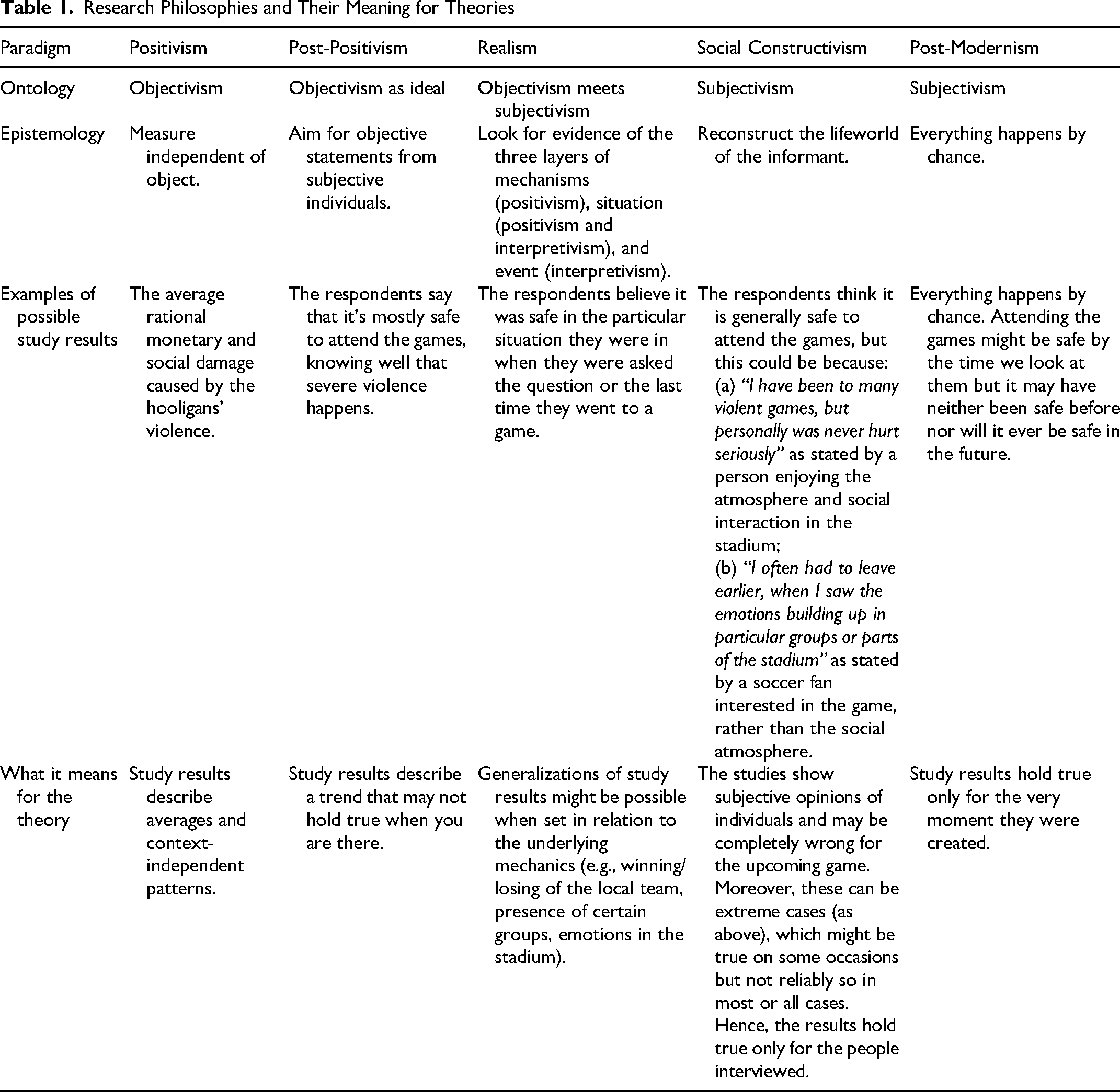
The example shows the need to report on the underlying philosophical stance to make sense of a study’s findings and apply them in practice. With the increase in methodological complexity, given through mixed methods and other combinations of ontologically different methods (see, e.g., Cameron & Sankaran, 2013), reporting philosophical stances becomes necessary, independent of sector or study type. Collins et al. (2012) defined clarity in philosophical stances in research reports as a quality criterion showing the researcher’s awareness of philosophical assumptions and stances concerning the components, claims, actions, and uses of research methods. A lack of philosophical clarity will most likely affect a study negatively (Onwuegbuzie, 2016).
Unfortunately, project management research often falls short of this clarity. Many submissions to PMJ do not identify the onto-epistemological assumptions underlying the reported studies. Even more concerning, sometimes they declare certain onto-epistemological assumptions but their research is not consistent with the reported stances. The same was found in assessing 15 years of research in the IRNOP conference papers published between 1994 and 2007. Only a fraction of the papers provided philosophical clarity, leaving the majority of submissions open for wild guesses regarding making sense of the findings and applying them in practice.
With this editorial, we would like to raise awareness that philosophical clarity is important to building credibility for a study and a quality criterion assessed in PMJ reviews. Submissions are expected to provide philosophical clarity so that methodological choices can be understood and findings can be interpreted in the appropriate onto-epistemological context. We are aware of the wide variety of terms, concepts, stances, and paradigms. Therefore, we do not ask for exhaustive explanations of onto-epistemological choices but rather a concise statement about the decisions made and the related implications for research design and methodology. Examples can be found, among others, from the research by Buchan and Simpson (2020, p. 39), who describe their ontology and epistemology for a conceptual study: “Whereas much of the project-based research to date has been constructed from a substantialist, or being ontology, we set out to formulate a processual view that is based in an ontology of becoming (Langley & Tsoukas, 2010). A key contribution that we offer then is to reformulate projects not in the familiar terms of milestones and resources, but rather as a perpetual process of novelty-generation and change. Our argument draws on the philosophical assumptions of American Pragmatism, which is fundamentally concerned with developing practical accounts of knowing-as-doing in the everyday social experience of living and working together.” “This research is based upon a postpositivist view, which posits that bias is inherent, and all of our observations are affected by our personal experiences and world views (Guba & Lincoln, 1994).”
A most recent example of an article that outlines the underlying theoretical perspectives is that by Boonstra and Reezigt (2023), who described their contingency theory perspective as the theoretical lens toward developing a complexity framework for project management strategies. By doing this, they established the contextual dependency of the examined phenomenon early on in the article and provided it as a key criterion for sensemaking in the conclusions.
Another advantage of a clearly articulated theoretical lens is its support in developing a theoretical contribution at the end of an article. As described in earlier editorials (Klein & Müller, 2022; Müller & Klein, 2018), this contribution should answer four questions regarding the observed phenomenon: (1) the what (the variables), (2) the how (the interaction between the variables), (3) the why (the reason behind the interactions), and (4) the where/when/how (the contextual contingencies for the theory to hold). Theoretical lenses are especially helpful in answering the why question, because the theory underlying the theoretical perspective already explains the nature of the observed item’s interaction (or the why).
Theoretical contributions are rarely about developing entirely new theories or disproving an existing theory but typically about expanding existing theories into the realm of projects. Here the theoretical perspective often helps with a new why or provides an alternative why, thus creating a new perspective to explain an already known phenomenon. To that end, the theoretical perspective complements the efforts of the researcher to explain the findings and eases the development of a crystal clear story that explains the findings of a study.
In summary, we expect to see more future submissions with clearly described onto-epistemological choices and theoretical perspectives. This will allow reviewers and readers to better understand the study design and appropriate use of the study findings in practice.
The remainder of this editorial provides a short introduction to ontology and epistemology. It is meant to help readers unfamiliar with the terms to make the above text more accessible. Ontology and epistemology are wide fields of philosophy with a large number of different concepts and perspectives. The following explanations are by no means meant to replace textbooks or articles on these subjects, but rather to motivate potential authors to study those books before writing their paper or, even better, before starting their research. For a deeper introduction, the readers are referred to the books and articles listed at the end of this editorial.
The Concepts of Ontology and Epistemology
In management research, ontology refers to the branch of philosophy concerned with the nature of existence, beings, and the world. It is used to study and understand the fundamental concepts and categories in a particular domain and to develop a shared understanding of the meaning and relationships between these concepts. This can help to provide a common language and framework for research, facilitate communication among researchers, and improve the rigor and consistency of management research. For instance, asking “What’s a project?” or “What’s a successful project?” are popular ontological questions we have faced in the last few decades. For instance, a detailed discussion of such ontologies can be found in work by Ika and Bredillet (2016).
There are different perspectives in ontology, for example, objectivism. Objectivism, as an ontology, is a philosophical perspective that holds that reality is objective and exists independently of individual perception or interpretation. This perspective asserts that objects and events in the world have a fixed and unchanging nature and that the truth about these objects and events can be discovered through objective observation and analysis. Because the objects are assumed to exist before they are uncovered through research, this ontology is often referred to ‘being’ ontology. Subjectivism, as an ontology, assumes that reality constantly develops and is subjectively interpreted by individuals. In this ontology, the reality is ‘becoming.’ Heraclitus (500 BCE) visualized it through his famous sentence: “You can never step into the same river twice; for other waters are ever flowing on to you.”
Epistemology, in the context of management research, is the branch of philosophy concerned with the nature of knowledge and how we acquire it. It refers to the beliefs and assumptions about how knowledge is created and eventually validated in the field. It includes questions about what constitutes valid evidence and how to determine the reliability and validity of research findings. Understanding the epistemological assumptions of a study can provide insights into the research methods used and can inform the interpretation of research results. In management research, various epistemological perspectives exist, including positivism, interpretivism, and critical theory, each of which has different assumptions about the nature of knowledge and the methods used to acquire it.
What is the relation between ontology and epistemology? Objectivism as an ontology is often associated with a positivist epistemology, where researchers aim to uncover objective and universal laws and principles (to, for example, explain going over budget in megaprojects) through the scientific method. This approach values empirical data and quantitative methods and seeks to establish causality and make generalizable conclusions about social phenomena. Accordingly, subjectivism is often associated with phenomenological or social constructivism, which aims to understand the lifeworld of individuals. However, given the wide variety of research questions and methods, these associations are not fixed. For example, some studies use quantitative methods to investigate subjective phenomena. An example of a study using quantitative methods to investigate subjective phenomena is the following. Let’s say that we aim to study which Sustainable Development Goals (SDGs) are more relevant for project-based organizations. A method could be based on downloading the sustainability reports of such organizations, and following a deductive content analysis, we could code the content of these reports using SDGs as aggregate dimensions. The number of words for each SDG (or the percentage of words for each SDG) could be a quantitative measure of the subjective relevance project-based organizations attach to the different SDGs.
Let us use another example to understand the importance of ontology and epistemology. For instance, let’s say we want to study why megaprojects are over budget. First, we need to ask some ontological questions: “What is a megaproject?” (i.e., is it just a matter of budget or does complexity also play a role?), and what does “being overbudget” mean (i.e., which of the many budgets over the life cycle are we considering? Should inflation be considered? What about scope changes?).
Second, we must ask ourselves what a valid way to develop such knowledge is and here we make a tough decision. For instance, we can take a “positivistic perspective.” Under this perspective, we believe that megaprojects can be objectively studied and understood through the scientific method, often using quantitative data and statistical analysis. This approach assumes that megaprojects operate according to fixed laws, such as Newton’s Laws, and, like Newton’s Laws, these laws can be discovered through empirical observation and analysis.
In project management research, positivism is often associated with a deductive research approach, where researchers start with a theory in the form of a proposition or hypothesis, collect data to test it, and often use statistical methods to generalize the findings to a larger population. This approach typically uses objective and quantifiable data and aims to uncover universal laws and principles that can be used to make predictions about future events or outcomes.
A (radical) alternative approach would be to take a constructivist approach, in other words, an epistemological perspective that holds that knowledge is constructed through social interaction and negotiation rather than being discovered through objective observation of the world. This perspective assumes that reality is socially constructed and subjective, and that multiple perspectives and interpretations exist for any given phenomenon. So, going back to the example of megaprojects, “being overbudget” would be explainable by more contextual and specific factors. In project studies, constructivism is often associated with an inductive research approach, where researchers start with empirical observations and data (e.g., a case study or a group of case studies) and develop theories and understanding through a process of interpretation and reflection. This approach values the subjective and interpretive aspects of research and aims to understand the meaning and context of phenomena (the overbudget of megaprojects) rather than uncovering universal laws and principles. Constructivist research often uses qualitative methods, such as in-depth interviews, case studies, and participant observation, to collect data and gain insights
Summing up, we encourage prospective authors to consider the above recommendations and earlier editorials available through open access at https://journals-sagepub-com-s.web.bisu.edu.cn/home/pmx.
Our recently opened YouTube channel videos cover former editorials, thoughtlet articles by authorities in the field, and other topics of relevance for potential authors (see https://www.youtube.com/@projectmanagementjournal4610). Stay current by following updates on Twitter @PMJ_Editors and join our LinkedIn Group.