




Abstract
This study examines the approach and range of thinking project management practitioners apply when dealing with issues that have ethical considerations. This article presents a nuanced view of processual engagement with ethics rather than a narrower decision model-based approach based on responses to various ethically challenging scenarios that may confront project managers. Based on qualitative data from a more extensive study we find that practitioner considerations regarding specific ethical decisions range from precursors to the development of a situation as a problem through particular actions and decisions, to potential ways that adverse outcomes can be remediated, and positive ones enhanced. We find that these concerns arise in addition to ethical decision-making considering all three core ethical views collectively, though not necessarily by each individual. The findings suggest broadening the investigation of ethical behavior from making better judgments to structuring the environment where such choices are made, laying solid foundations for ensuring positive choices, and working with even poor choices when they are still the best available to mitigate and control consequences.
Introduction
The consequences of unethical decision-making in project management have significant financial and cultural impacts on organizations. Research shows that project success has been built on a project management culture based on the shared cultural values of the organization’s members (Kendra & Taplin, 2004) and the collective readiness of the project team to act ethically (Kloppenborg & Petrick, 1999). It is also strenuously argued that individual project management success relies on a variety of skills, which must incorporate ethical standards and behaviors (Bredillet et al., 2015). Developing a deeper understanding of how project managers approach ethical scenarios and what actions they take to arrive at responding actions can provide organizations with knowledge to build programs for prospective ethical decision-making rules and guidance. Note we use the term “rule” as a synonym rather than a component of the umbrella term “standard” as used by Bredillet (2003) given that we find the concept described as “rules based” frequently in ethics literature.
Project managers do have codes of ethics to which they adhere. Still, it is unclear how central this type of guidance plays in practical ethical decision-making for project managers other than serving as a professional or organizational standard. Leicester (2016) found that project managers generally found codes of ethics not to be necessary and less useful as ethical guidance than organizational processes and guidelines, good judgment, and an internal moral code. This view is mirrored by Sarhadi and Hasanzadeh (2022), whose examination of four cases revealed both a desire to adhere to ethical codes (when project managers were aware of them) and organizational rules, but also an awareness that these do not cover all moral obligations. Context around ethical decisions and conflicting stakeholder outcomes on projects always make an impact, yet how much of an effect and at what point in the project manager’s ethical analysis or decision-making process these contextual factors are considered is not clear.
Based on Rest’s (1986) definition of moral judgment, deciding which course of action is morally right, this study examines the rationale for practitioners’ judgments in choice making relative to situations calling for ethical judgment. If practitioners followed the code of ethics, one would expect to see point-in-time (what we call “moment of choice”) decision-making processes that reflect a particular philosophical view of ethics: rules based, values based, or consequentialist. Bredillet et al. (2015) present rules based (where actions are considered ‘right’ or ‘good’ regardless of outcome) and consequentialist (where actions are judged by outcomes regardless of rules or norms) as the two standard ethical approaches. This work argues for the superiority of a third approach that follows from Aristotelian ethics, which emphasizes instilling and exhibiting positive values. These three central ethical positions are mirrored in the work of Sarhadi and Hasanzadeh (2022) and Ljungblom and Lennerfors (2018). Xu and Smyth (2023), in contrast, reference and seek to provide an alternative to “dominant moral or ethical theories,” which include Kantian (rules based), Aristotelian (values), and utilitarian (consequentialist) views. The authors present the alternative of “care ethics,” which to our reading would seem a subset of virtue ethics where care exemplifies a particular virtue. Note we did not find in our data any particular reference to “care” per se, though many comments showed an attitude of caring about the well-being of the whole range of stakeholders.
Thus, the study’s first purpose is to examine whether theoretical ethical frameworks—notably rules based, values based, and consequentialist—are recalled and applied to problematic choices during such reasoning. In reducing from 33 to eight items comprising a scale for assessing ethical judgment of particular decisions, Reidenbach and Robin (1990) defined three dimensions: (1) a broad-based moral equity dimension; (2) a relativistic dimension; and (3) a contractualism dimension. As will be seen, each of these was observed in the data we collected, but these would not account for the full range of observed comments. An adherence to applying theoretically based ethical frameworks would signal tendencies practitioners display in their thinking. This adherence would also point out possible areas to consider adding to those already used (as an explanation, perhaps, for particular examples) or as areas not often mentioned that can be additionally emphasized in the codes to stimulate additional awareness. This decision-making approach would indicate the nature of the impact on a practitioner’s judgment of having a professional code of ethics.
However, if practitioners are using a process view to analyze ethical scenarios, one would expect to see ethical judgment making processes more along the lines of Nutt (1984) and Mintzberg et al. (1976), where the ethical judgments are made over time and within a particular context to shape the scenario outcome. Thus, the study’s second aim is to consider reasoning outside or in addition to these three theoretical principles. This investigation examines whether such frameworks are used and if they are comprehensive in describing the practitioner’s thought process. We argue that if additional reasoning occurs in the practitioner space, this points out a possible weakness and source of ambiguity in existing codes. It simultaneously presents an opportunity for the extension of the code of ethics guidelines, with the potential for providing additional support for practitioners at the point of choice making.
This study contributes to the project management literature by applying process theory to ethical decision-making. It contributes by (1) introducing the notion of ethical decision-making as a process rather than solely as a choice adding consideration of precursors and follow-ups of such choice–decisions; (2) eliciting insights regarding ethical decision-making from a broad array of practicing project managers drawn from a wide variety of industries; and (3) extending methodology from studies of information systems ethics to project management. This last contribution draws upon overlaps between the practices of much of information systems (IS) and the prevalence of IS development and management tasks occurring through project activities. Additional insights into project management and ethical decision-making are presented by exploring the point-in-time approach in contrast to the process theory approach by practitioners. As a result, project managers will also have new insight into shaping ethical decision-making on their projects.
It is worth noting the subtle but significant differences between our process-oriented model and Jones’s (1991) integrated model of decision-making. In his work, various steps are involved in selecting or choosing the proper decision to guide subsequent actions; in contrast, we propose that the precursors and subsequent environmental conditions surrounding the point-in-time decision need to be equally considered. In other words, our process extends from finding the most ethical solution to a particular problem to addressing the conditions initiating the problem and adjusting the consequences thereof as part of the moral problem-solving framework.
Applied Ethical Decision-Making
The ethical behavior of employees tends to be strongly affected by the tone and conduct set by managers in an organization. A manager’s evaluation of an unethical/illegal act significantly affects an employee’s decision to undertake the action and the expectant outcomes that will result from being associated with the misconduct (Müller et al., 2013; Smith et al., 2007). Additional to such direct observation and behavior modeling, the factor found to be most strongly related to observed unethical behavior in organizations was the embodiment of codes of ethics by senior and local management. The most significant impact in lowering observed unethical conduct was the local and senior managers’ better embodiment of these codes (Kaptein, 2011).
Thus, professional and organizational codes of ethics have substantially influenced applied ethical decision-making. Ethical codes are a mark of mature professions and organizations, developed based on practical ethics scholarship (Gray, 2005). As required by their organization, profession, or both, project managers follow the guidance of these codes of ethics when evaluating scenarios with an ethical dimension. This approach would indicate that the ethical decision-making process is a point-in-time process. The project manager evaluates the situation, applies the code’s guidelines, and makes the decision. This approach does not have much flexibility to be adapted to particular circumstances of any one ethical scenario, as such codes do not offer contingent or contextual decision-making guidance.
Ethical Decision-Making and the Process Model Framework
An alternative approach to applied ethical decision-making posits that this type of decision-making is a process phenomenon. Our model for a process view of ethical judgment in decision-making derives from Simon (1965), incorporating the extensions of Nutt (1984) and Mintzberg et al. (1976). They independently elaborated in studies of generic problem-solving on this model. Both extended the model to a more nuanced set of steps. Both found significant variance in the pace of action taking, the interim between steps, and the tendency to iterate back through earlier steps. Each study examined a set of instances of problem-solving, observed several patterns of moving through the stages, and equated these clusters of instances with the relative success of outcomes.
In this view, ethical judgment is also a process phenomenon, similar to the entire ethical decision-making process, positing the judgment or choice stage as a process within a process. Ethical judgments involve a higher level of agency for the decision maker, so much so that depending on the span of control over the scenario, the decision maker can have complete control of the actions to be taken. Niederman (2021) outlines the taxonomy of processes that can be applied to the process of ethical judgment. For ethical scenarios where the entities are within the organization, the judgment process would be that of an action plan or pathway. An action plan consists of “a sequence of steps intended to address a particular outcome” (Niederman, 2021, p. 70). The level of agency is high in this process type, whereas the determination level is intermediate. The ethical judgment process is more of a coevolution process for ethical scenarios where the parties span organizational boundaries. Coevolution can be characterized as “two or more agents who select and implement actions where there is mutual influence such that the actions of each create results influencing the future actions of each and their continuing actions and results further into the future” (Niederman, 2021, p. 77). The level of agency in a coevolution process is less than that in an action path process. The level of determination tends to follow more of a pattern rather than having the outcome be unknown. This coevolution acknowledges that the decision maker is not the only party making ethical judgments in the scenario. Thus, potential prior relationships or culture among the entities could be brought to bear to make the final judgments. The relevance of this process approach is that managers can design and build an environment that preempts ethical choices having to be made or redresses issues that are inevitable for some while others are benefiting, rather than having to rely solely on good decisions at the point of choice.
This study follows a traditional scenario appraisal methodology. Still, it suggests that reasoning by practitioners regarding judgment, which can occur in these earlier and later process stages, may also illuminate ethical reasoning and the use of the code of ethics, along with the focus on the judgment stage. Implications of focus on prior and follow-up to the judgment process would suggest additional ethical thinking for leaders to avoid or prevent the need for ethically significant choices. It would also consider how to minimize damage when potentially harmful choices remain the best available option. This approach is not unrealistic in scenarios where a fixed resource must be divided among stakeholders unevenly, such that some “win” and some “lose.” Positive ethics-seeking leaders may benefit from an ethics code describing approaches to minimizing harm for those who receive fewer resources.
Research Questions
Professional groups comprised of project managers present codes of ethics for their members to follow when making decisions. These groups include the Association for Project Management (APM), the International Project Management Association (IPMA), and Project Management Institute (PMI). The PMI Ethical Decision-Making Framework (EDMF) (PMI Ethics Standards Development Committee, 2011) describes a sequence of questions to stimulate ethical analysis presented as a guide for critical thinking throughout the decision-making process. These begin with recognizing and assessing the issue and end with a decision and action. This approach is a clear example of prescriptively addressing ethical issues within the decision-making framework. Our goal with this research is to investigate whether such prescriptions manifested as references to ethical moral frameworks are indeed considered by project managers when confronted with ethically challenging situations. This leads us to the following research questions:
Methods
Much work in IS occurs within the context of projects (e.g., development of new applications, receipt and distribution of new hardware, evaluating the purchase of software packages); at the same time, a sizeable percentage of all projects occur in terms of work with the design and implementation of new systems. Since IS as a discipline has some tradition of examining ethical behaviors, it is a reasonable source for extending such thinking to project management. No claim is made that it is the only possible source of models for research in the application of ethics to business decisions.
Parker (1968) introduced a method of using business scenarios for IS ethics research purposes, investigating the relative perceived appropriateness of particular actions regarding a wide range of IS-related situations. The assumptions and conclusions of individuals regarding the specifics of the scenario are viewed as reflecting wider meaningful choices and tendencies regarding issues generally. Where the judgment about an incident is described as a “crime” by one individual and a “mistake” by another, we can infer differences in their cognitive interpretation of the incident and gain insight into the range of ways that situations can be perceived.
Additional research into various aspects of IS ethics, including moral intensity (Goles et al., 2006), has used these ethical scenario vignettes to elicit the values and perceptions of individuals faced with IS-related ethical situations. Loo (2002), in his empirical work, extended the use of vignettes to elicit insights into ethical dilemmas in project management. Niederman et al. (2011) updated the set of IS-related scenarios, developing an instrument to investigate values and norms of ethical judgment regarding behaviors involving information systems. Our study approach has respondents evaluating these scenarios and capturing their process for analyzing the decision-making scenario.
In this research, project managers are surveyed as exemplars of practitioners guided by professional codes of ethics. The ethical scenarios in Niederman et al. (2011) were modified to apply to working project management practitioners facing a range of situations with ethical choices implicit in the behaviors and policies of those involved. Twelve scenarios were presented to the project management participant, reflecting each of the four values (pillars) identified in the PMI Code of Ethics and Professional Conduct, presented from the three different stakeholder perspectives: the team member, the project manager, and the client/outside stakeholder perspective. More specifically, we asked respondents to state judgments regarding the propriety of each decision or behavior and provided open-ended questions for further examination of assumptions, contingencies, and qualifications. Respondents were asked to assess the ethicality of these scenarios and rate each on a scale ranging from 5 (acceptable) to 1 (unacceptable). These scenarios were embedded in a survey format to collect research data. This modified survey is presented in Table 1.
Scenarios Presented to Respondents by Pillar and Stakeholder Focus
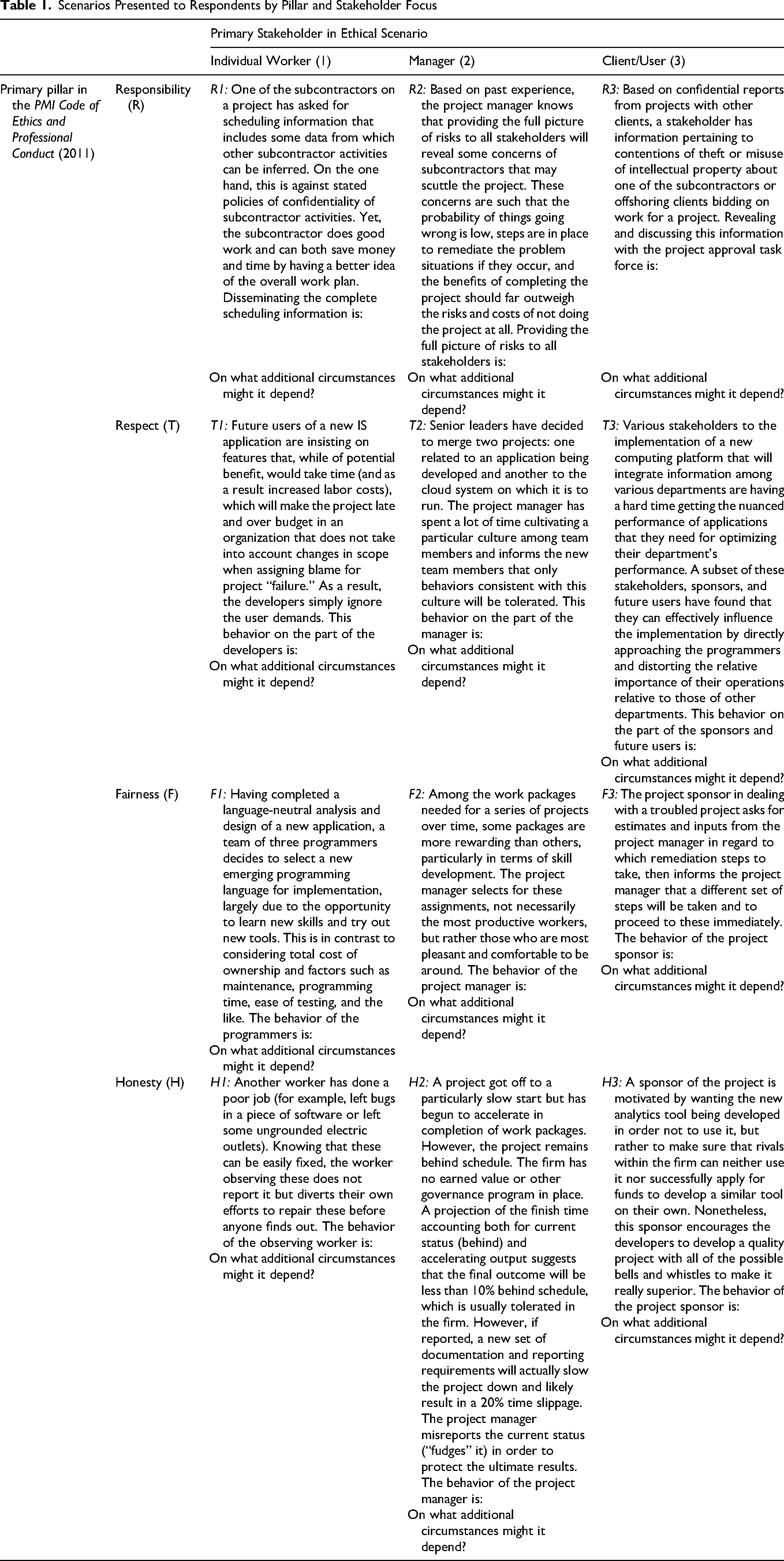
The survey was administered at monthly meetings of three PMI chapters in coordination with PMI chapter leadership, gathering responses from 124 participants. Printed surveys were distributed to each participant. The facilitator asked the participants individually to render a quantitative judgment for each scenario. Participants also had the opportunity to indicate what change in circumstances might influence their view of the situation by providing qualitative feedback. This step is essential to surface considerations that are only implicit in the scenario. These are open ended but intended to capture reflections on the ultimate harm or lack of harm from the decisions, who is or is not responsible, and what alternatives might be to the actions selected. Individual completion of the questionnaire allowed the participant to think through each scenario and judge the ethical implications of scenarios that approximate ones the participant might encounter. Demographics on the respondent’s current industry and number of years in that industry, number of years as a project manager, and if they held any current PMI certifications were also collected.
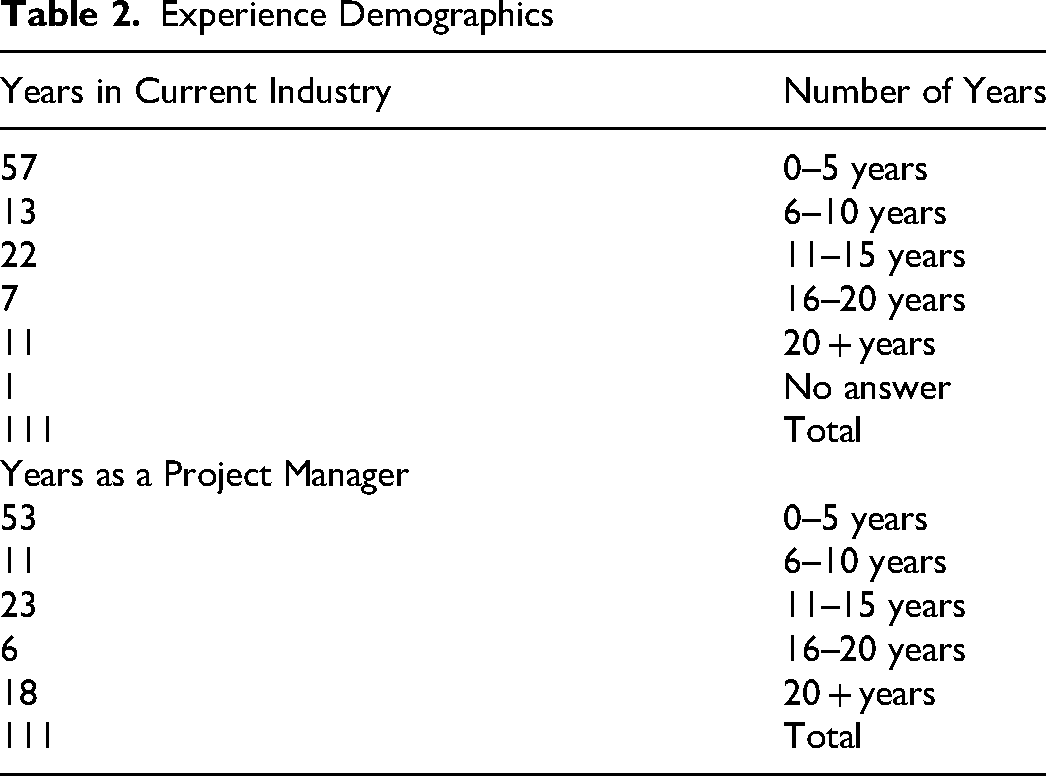
Participants received no direct incentive; however, their participation counted for continuing education credit. A total of 124 respondents participated in the sessions and completed the exercise. Of these 124, 13 participants chose not to answer any demographic questions, leaving 111 respondents with demographic information available. Of these 111, gender was indicated as 58 responding male and 53 responding female. Some 92 reported having obtained a PMI certification, 17 reported not having obtained a certification, and two others did not respond. Additional demographic information is presented in Tables 2, 3, and 4.
Experience Demographics
Industry Distribution

Analysis
For the qualitative analysis to evaluate RQ1 and RQ2, each respondent’s comments for each question were assembled as a column in a separate Microsoft Word (Version 16.70) table for each question; each comment was read and reflected upon multiple times. During the initial reading, an initial code was applied for each comment. At the end of the consideration of each question, the researchers added more substantial initial conclusions in the form of “memos,” a technique borrowed from grounded theory methodology (Glaser & Strauss, 1967; Urquhart & Fernandez, 2006; Wiesche et al., 2017). When all codes were assembled from the initial reading of all questions, those with varied wording for the same essential idea were consolidated and terminology was standardized. By this means, a “master code” was developed. In a second pass-through examination of each question, prior codes were reexamined and brought into conformity with the reduced and more carefully defined coding scheme. The portion of memos about generalizations based on the data was examined for persistent validity and “tested” against each subsequent question. This “testing” was done in the sense that Glaser and Strauss (1967) refer to each interview as a case and to theory derived from the first instance being tested against each of the following until the remaining theory remains stable. Note that our process resembles grounded theory and is intended to have a similar theory-building purpose and outcome. However, given the data-gathering procedure, the theoretical sampling tactic was impossible to implement by revising questions and refocusing subsequent interviews. Thus, the qualitative analysis results, mainly the range of views expressed, apply across the scenarios and responses even though there may be significant differences in content from one scenario to the next.
Findings
We found references to rules, values, and consequences in all scenarios. However, we found numerous additional comments suggesting a wider variety of approaches to circumstances with ethical implications. Numerous comments pertained to rules-based issues, while fewer referred to values-oriented or consequentialist issues. Complexities were observed within each of these coding types. Rules-based issues included simple decisions to follow the rules. They also included consideration of looking for exceptions, rules regarding exceptions, and procedures for changing the rules. Values-oriented issues considered the actors’ motivation and an overall desire to find a mutually satisfactory solution. The consequentialist primarily showed interest in the project and organizational outcome and addressed personal risk.
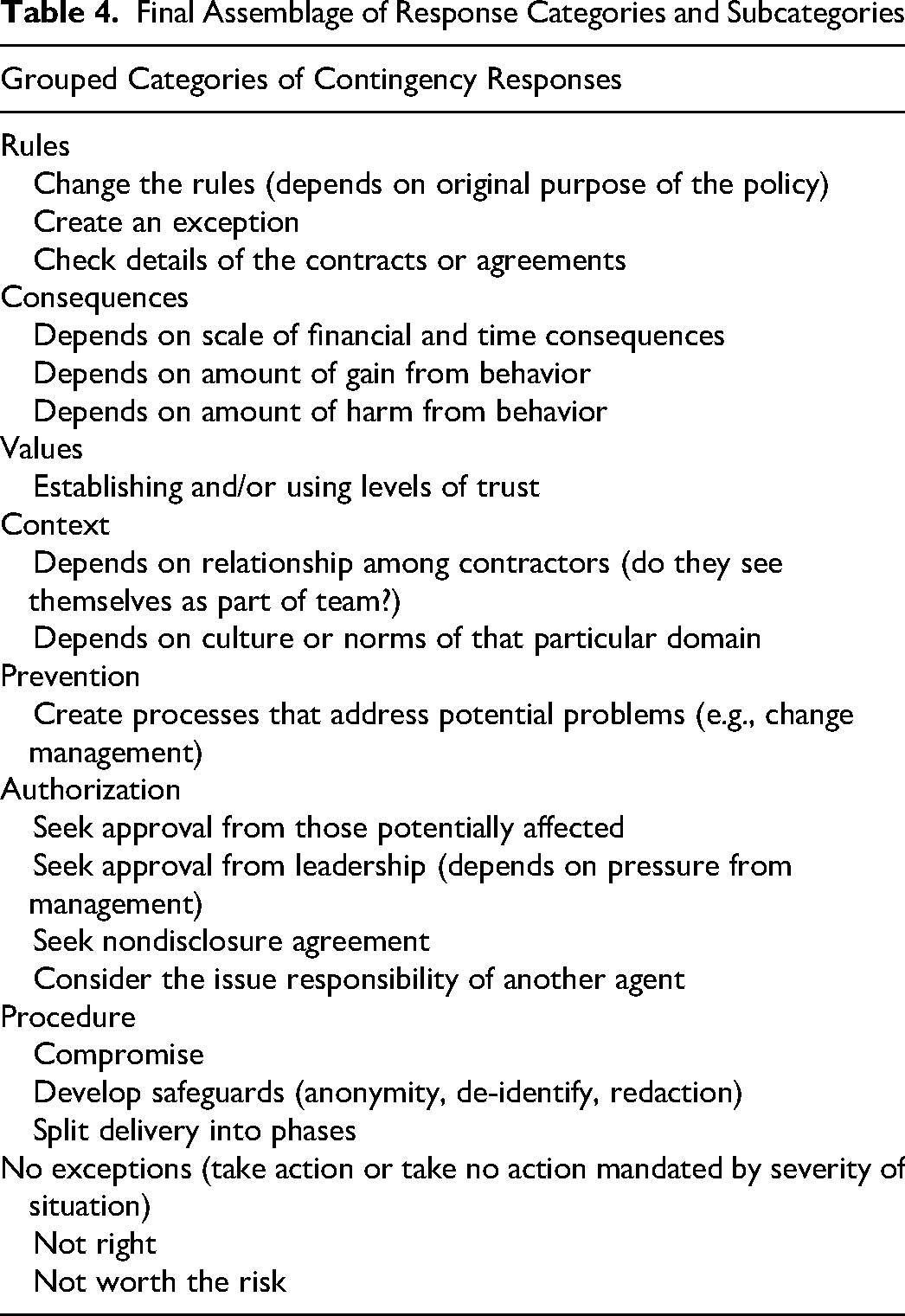
Numerous comments, however, did not fit easily into these three categories and extended the range of ethical considerations. These comments are typically aimed at preempting the issue (e.g., having initial contracts or nondisclosure agreements in place) and thus preventing the problem from developing or evolving into an ethical issue. Alternatively, they addressed the problem by suggesting actions that would limit negative or expand positive consequences. Context suggested several contingencies based on the specific rules relative to each circumstance, the attitudes of stakeholders, and the team culture, among others. Prevention pertained to actions particular to the situation that might change the choices available or the ramifications of the options. Authorization did not directly change the choices but changed the distribution of responsibility for the choice. Procedure typically fine-tuned choices indicating how such actions could be implemented to decrease risk or consequences or generate offsetting benefits. Finally, the assertion that there should be no exceptions in some comments reaffirmed a negative judgment about the behaviors presented in the case that would preclude enacting them in any circumstance. The final coding scheme is shown in Table 4. Conclusions and observations regarding each question are presented in the Appendix at the end of the article.
Final Assemblage of Response Categories and Subcategories
From the qualitative analysis, we find that project managers are generally willing to make ethical judgments regarding behaviors at a point in time but often expand consideration of the situation forward to its origins and backward to its possible and likely conclusions. In other words, the assumption that project managers deal with ethical issues as judgments relative to a set of fixed choices at a point in time is frequently offset by extending consideration to both before and after the moment of choice, resulting in a more extensive process for addressing ethical problems. Early considerations—for example, prior actions, details of policies, and failure to implement general organizational controls and best practices—are viewed as critical flaws leading to the emergence of the ethical dilemma. At the same time, consideration of possible and likely consequences sometimes is viewed as offsetting a violation of rules. Still, it should trigger alternatives, such as processes, for generating or at least considering exceptions, reconsideration of the values statements and details, and, on a rare occasion standing for principle despite possible sanction.
We observe that project managers directly reference the three fundamental ethical views primarily when looking at conditions pertinent to their assessment of the “rightness” about ethically challenging scenarios concerning potential theoretical approaches to ethical judgment making. They rarely view an ethically challenging situation as settled, requiring the application of a particular set of guidelines. Instead, they tend to examine and consider exploiting a wide range of actions that may modify the situation to (1) clarify what rules apply or need to be changed; (2) take actions that modify the situation; and (3) consider contingencies that distinguish more from less ethical behaviors relative to the actors involved. With respect to clarifying what rules apply or need to be changed, project managers may face a situation where no rules have been stated explicitly or none of the stated rules appears to apply in the case. They may react either to implicit understandings and norms, seek clarification or the creation of policy, or simply act based on their own reading of the situation. As pointed out by Ferrer et al. (2020), behaviors deviating from organizational standards are more frequent when expectations are not explicitly specified. Referencing consequences often manifests in comparing relative costs and benefits of action versus inaction—considering actions based on scale differences between these—and only rarely concerning variance or uncertainty in estimating likely consequences. Collectively, project managers consider each of the three major ethical views when assessing ethically challenging scenarios. Yet, few comments by project managers show consideration for more than one primary ethical view.
Among the comments reflecting theory-predicted considerations (e.g., rules, consequences, and values based), the preponderance of comments pertained to rules, with a number also focusing on consequences and values. Regarding particular principles or templates, various viewpoints were expressed within each. Project managers might interact with rules in several ways. One may follow the rule simply because it is there. Alternatively, one may challenge it by acting without regard to it, acting to change it permanently, reexamining and possibly revising the policy, or seeking an appeal or exception. One may also look for loopholes or implicit exceptions based on context.
Regarding consequences, one may look at the consequences relative to the project (will compliance save money and time or lead to adverse outcomes?) or focus attention on one’s personal consequences for taking or failing to take the prescribed action. Comments suggesting a values orientation targeted the actors’ motivation in the case and whether larger values, such as seeking compromise or other negotiated settlement among actors, could be brought to bear. The following comment illustrates how one individual might incorporate all three types of theory—consequentialist (depends on ROI), rules based (investigate policy), and values based (look for compromise)—in one reaction to the scenario: Depends on the ROI for providing data. I’d investigate the formation of that policy to see what really is behind it and if there is a middle ground that can provide spirit of the policy without being too heavy-handed. (Respondent)
Thus, these fundamental approaches need not be considered mutually exclusive. For the same scenario, one may consider whether to follow the rules or policies, forecast the effects of following or not following the rules, weigh likely outcomes, and apply broader values. One may question whether the rules or policies are consistent with overall values, resulting in either a positive assessment and following the rules or a negative one and not following or seeking to change the rules. A values-based orientation is likely to consider both the rules (e.g., following the rules may be a component of some values) and the consequences (e.g., the value may be toward enhancing personal relationships). Thus, ethical decisions may involve estimating how actions will affect that particular outcome. It is likely easier to evaluate and classify statements than it may be to distinguish pure applications of theoretical templates in practice.
These and similar comments suggest an interaction among the three prominent theoretical positions. Depicting the nature of this interaction, whether it is a set of values may initiate the development of particular rules (a deductive-type approach), or a set of rules may suggest broader values principles (an inductive-type approach). Both may be tempered and shaped by expected consequences and may indicate that the three underlying principles, while available for separate analysis, in practice are found together in an inseparable but somewhat elusive relationship. On the surface, this conflagration would seem to contradict our finding that respondents rarely mention more than one of the theoretical perspectives. However, we put forward the possibility that in application to a particular problem, one or another is foremost of concern, but that in times of reflection, all play a role in shaping individuals’ mental framework for considering ethical issues. The data set suggests that all ethical considerations are likely to be applied by the collection of individuals, even if few individuals apply them all at a given time. This approach leaves open the potential for group discourse, particularly applied to ethical problems, to be reasonably expected to surface a broader range of concerns leading to positive divergent thinking to be applied to specific cases (Habermas, 1993).
Discussion
Many comments regarding alternative approaches to dealing with the scenarios followed tracks that reflected three major ethical theories. However, many comments were not easily categorized into one of these three buckets. We found it helpful to consider additional categories, including context and action. Context generally refers to contingencies unstated in the scenario that would affect the propriety of the actors’ stance in the scenario. Such contingencies included differences in the status of the stakeholders and multiple interpretations of specific roles. These differences likely affected the interpretation of the facts of the particular case. Habermas (1993) suggests two levels of ethical consideration: the moral and the ethical. The moral level was statements that could reflect the group consensus of everyone and always about what is right. The ethical level refers to how these statements are applied in particular cases. From Habermas’ perspective, the idea of contingency enacted by variations in context is a pathway to translate maxims into specific judgments.
Comments regarding action posited steps that could be taken that might affect the ethical status of the scenario’s stated behaviors. Such actions included soliciting additional information, taking smaller probing steps toward estimating likely consequences, and rearranging organizational work practice. The relationship between decision and action can be subtle, considering that decisions in practice may not be stated precisely, leaving room for differing interpretations. Actions following from a particular decision intended to implement it may vary, and the manner in which actions are instantiated may have different characteristics, depending on the enthusiasm of agents enacting it, intermediate feedback, or simple logistics in assembling needed personnel, equipment, or opportunity. The richness and diversity of contextual and action considerations presented by the individual respondents suggested a general tendency not to accept organizational issues at face value, but to continue probing for alternatives that meet objectives while providing ethical safeguards.
Based on reorganizing the accumulation of submitted comments through the scenario examination process, we offer for consideration the process stage model (Figure 1). These more detailed lists of specific actions reflect the range of considerations identified for each of these three stages.
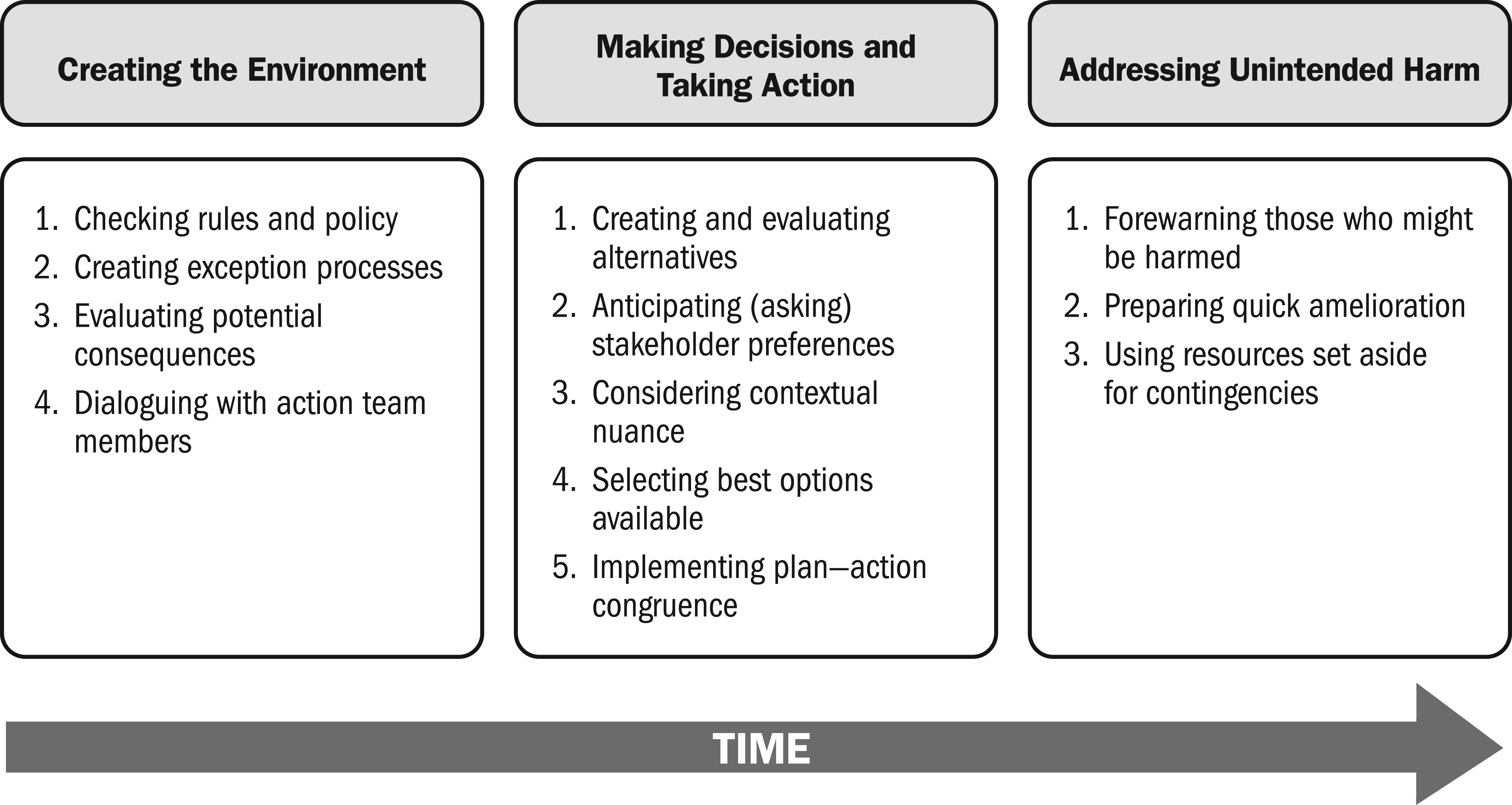
Stage model of organizational ethics emphasizing processes including those preceding and following the ethical decision per se.
This approach is consistent with the process approach to problem-solving’s emphasis on problem formulation and alternative creation preceding choice (Mintzberg et al., 1976; Nutt, 1984; Simon, 1965). It is not a distant step from anticipating that such an approach to defined but open-ended scenarios suggests that project managers are likely to apply a variety of content thinking and action proposing in at least early and middle, but perhaps also the late stages, of ethical decision-making and action taking in practice. For example, a subset of comments suggests that organizations or project managers head off ethical issues by creating organizational policies and practices that have anticipated and addressed future issues. These comments point to carefully defining contractual relationships relative to privacy and information sharing, defining processes for seeking policy exceptions, and carefully considering policies that address potential ethical issues as they arise. The presence of comments on the three core ethical views shows that, consciously or not, project managers collectively are using them, whether proactively or retrospectively in considering ethical problems; the number and diversity of additional comments suggest that managerial thinking extends beyond “moment of choice” decisions.
These qualitative findings paint an emerging picture challenging the “moment of choice” approach of the PMI Ethical Decision-Making Framework (EDMF) (PMI Ethics Standards Development Committee, 2011) and many professional codes of ethics. The findings suggest that framing an ethical judgment can be improved by addressing how project managers deal with ethically challenging events as an evolving scenario with access points from before through the end and an emphasis on feedback loops before settling on the final judgment. Thus, framing ethical judgment making as a “moment of choice” decision is not as appropriate as framing it as process shaping. Project managers collectively can be better described as considering ethical situations through a process perspective, including actions before, during, and after a crisis, as well as actions that change the number and quality of alternatives than they consider, focusing exclusively on making better choices per se. We feel this suggests broadening the investigation of ethical behavior from focusing on making better judgments to structuring the environment where such choices are made, laying solid foundations for ensuring positive choices, and working with even poor choices when they are still the best available to mitigate and control consequences. To support project management training on making better judgments, we support the current call for enhanced learning for project managers that includes the practical application of ethics to various ethical project management scenarios, thereby developing ethical analysis competence in project managers (Helgadóttir, 2008). We further suggest that this approach extends the concern expressed by Bredillet (2003) with the appropriation by organizations and individuals of community codes of ethics while also attending to the importance of creating, maintaining, and interpreting local standards across and within project instances.
Framing ethical judgment as a process-shaping rather than choice-making enterprise raises some interesting research opportunities, which include:
Assuming active programs for shaping project environments to promote virtuous behaviors and minimize ethical breaches, descriptively, are any of the three major frameworks (rules based, consequentialism, and virtue based) used in designing effective preventative interventions? Prescriptively, does the use of any of these help in developing stronger preventative interventions? Can a process view minimize the number of ethical choices that project managers or team members must make and/or can a process view lead to better outcomes when ethical choices remain necessary? Can consideration, not only of possible consequences but means to preempting harm when negative effects occur, create fewer harms and quick amelioration when such harm does occur? Can programs designed to integrate ethical thinking across these three stages provide net reduction of problematic situations and created harms? We would envision such opportunities generating research experiments (by examining actions based on varied treatments), cases (by observing the actions and consequences of particular ethical thinking as it occurs and/or retrospectively), and through design science and action research where interventions and programs are devised based on process thinking and tested to measure their effects.
Although we frame the ethical process in a linear manner in terms of occurrences before, during, and after the decision and action process, we fully expect that a broader view of this process as a cycle may even better describe some instances. For example, the behavioral action that supports an organizational policy but creates unnecessary harm may in turn stimulate revision of rules or creation of an exemption process. This is a logical formulation that could benefit from empirical examination.
Limitations
Because many comments referred to structuring problems before the “moment of choice” and building potential for remediation following critical actions and decisions, we infer at least an awareness of the problem-solving occurring over time. However, this study does not directly address actions and decisions as they may occur over time or whether individuals do indeed think of problems holistically as they play out over time. Verifying these through future research would provide confidence in how these occur or a nuanced understanding of how project managers treat such problems over time. It is difficult to anticipate future ethical decision opportunities. Thus, it would be fortuitous for such to occur during a research study; however, a re-creation of longitudinal actions and decisions in such cases might provide further insights into the unfolding of ethical problems and managerial reactions as they play out.
Once committed to writing, it is relatively straightforward to classify most comments while reserving challenging ones for creating new categories. On the other hand, although this generates significant data for analysis of the underlying structure of the offered comments, it tends to smooth over (1) points where the way individuals express their view differs from the values they hold if expressed more fully and in conversation; (2) abbreviations where the individual offers a summary of a more substantial and nuanced view; (3) the initial of multiple views where time pressures or insufficient memory lead to respondent shortcutting; and (4) fatigue from repetition or the sheer volume of scenarios available for comment. The potential for missing such information, which might be captured from data collection through interviews, is offset, at least in part, by collecting data from a more extensive set of respondents—something likely to be intractable with more intense data collection methods. As a result, findings from this study should be examined closely with fewer but more detailed explorations with project managers.
All data were collected from individuals attending PMI chapter meetings in one southeastern state in the United States. The self-selection of actively engaged project managers will tend to highlight interested professionals but may skew results away from more indifferent but still employed project managers. Moreover, their awareness of the content of professional ethics codes is likely to vary. We chose not to remind participants of the details of these codes in an effort to evaluate their tendencies better, regardless of such recall. Alternative designs might fruitfully address the intentional following of professional ethical codes as distinct from organizational norms and practices. Although there is no evidence to indicate any bias deriving from the location of respondents, regional cultural tendencies may play a role in these findings. Project managers in this study reflect a representative type of practitioner bound by a professional code of ethics. However, there is a broad variance among project managers and among different types of practitioners. This study did not strongly differentiate project managers by their amount of authority or by the complexity and innovativeness of their work.
Conclusion
Applied ethical decision-making in project management is a critical issue for organizations and project managers. This study investigated how project managers approached the decision-making process involving scenarios with ethical implications. Decision-making as a point-in-time analysis was contrasted with decision-making as a process phenomenon in analyzing how project managers undertook applied ethical decision-making. Findings show that project managers as a group approached ethical decision-making using a process approach. This has implications for how project managers might consider structuring projects in the future to focus more intently on the environment in which the decisions are made rather than on better judgments made by individual project managers.
Footnotes
Declaration of Conflicting Interests
The author(s) declared no potential conflicts of interest with respect to the research, authorship, and/or publication of this article.
Funding
The author(s) received no financial support for the research, authorship, and/or publication of this article.
