




Abstract
While the concept of project success remains largely open nowadays, we introduce here the Phoenix phenomenon, namely a project being both a success and a failure. Our analysis of an automotive vanguard project exhibits key characteristics of a Phoenix phenomenon: the very innovative and ambitious nature of the project; a project management approach that hybridizes causal innovative project development and effectual approaches; the strategic and operational capacity of the company to recover and valorize after the initial failure; and the learnings from and the achievements of the project in renewed scenarios. We conclude that project evaluation must now combine retrospective and prospective assessments methods to evaluate both achieved outcomes and potentialities of a project.
Keywords
Introduction
Is this project a success or a failure? This question has fueled research in the field of project management for decades. Traditionally, the answer is obtained by comparing the results of the project with the quality, cost, and development deadline objectives that were assigned to it at the beginning. Any discrepancy is then a sign of failure, which fits well with the primary mindset of project management: “get the things done.”
But this vision has also been debated for a long time, because some projects that had led to major deviations from the initial targets have turned out to bring major benefits afterward. In the field of megaprojects, the Suez Canal, the Channel Tunnel, and the Sydney Opera House are emblematic cases of major deviations on the classic criteria of time and cost (Flyvbjerg, 2014). Moreover, many authors discuss these evaluations in the name of the narrowness of the reference frame for the evaluation of such projects with broad socioeconomic issues (Lehtonen et al., 2017). In the field of new product development, we can cite the case of the drug Viagra®, for years a cash cow for the biopharmaceutical firm Pfizer, but once a failure in its primary objective to address angina disease (Goldstein et al., 2019). Another well-known example is the 3M Post-it® Note, based on the deceptive technological project of “the glue that did not glue” (Garud et al., 2018, p. 130). The project experimented a long and chaotic path from scientific junk to become one of the firm’s bestsellers (Garud et al., 2018; Nayak & Ketteringham, 1986).
In short, some projects can paradoxically be both a failure and a success. Of course, this ambivalent judgment may be due to a difference in evaluation methods: the project can then be a success according to certain criteria and a failure according to others. This is often the case with megaprojects where the societal benefits are positive, while the results on traditional project evaluation criteria are often bad or even catastrophic. But the resolution of the failure–success enigma is less obvious when there is no such heterogeneity in evaluation criteria.
This article addresses such a phenomenon, which we call the Phoenix-type project and characterize as follows:
A Phoenix-type project is a project that fails in its ability to achieve the goals initially given. It is a project that continues beyond this failure to achieve a result that proves, ex post, to be a success. Finally, it is a project whose final success could not have been envisaged without the failure of the objective defined ex ante. This third characteristic is important, because it indicates that the trajectory leading to success is not the simple correction of a wrong initial objective or insufficient management performance as many ex-post judgments might conclude.
Although other streams of literature, such as those related to the sociology of science or entrepreneurship, have already made significant contributions to understanding situations where the application of processes does not lead to the achievement of expected results, we affirm that there is still work to be done to understand these situations, which are becoming more and more important in the management of contemporary projects. Firstly, because such projects, which combine the notions of failure and rebirth—as a necessary condition for achieving ultimate success— are not as exceptional as that. Then, because knowing how to reuse the strengths of previous failures becomes essential as the instability of the contexts of innovation projects increases, while at the same time resources are becoming increasingly rare and expensive.
Consequently, our intention is to deepen our knowledge of these phenomena and thus contribute to the research stream of project management by addressing two research questions:
The case we study here is the development of an automobile product, which bore the code name “KZE” and was developed in collaboration among three automakers. This project is innovative as much by its functional and technological content as by the novel and uncertain character of the market for which it is intended. It is a vanguard project (Brady & Davies, 2004) and its fate is typical of a Phoenix phenomenon.
This article is organized in five sections. The first section introduces the theoretical context of processes whose application does not produce the expected results and of project evaluation. It also specifies the research gap and our research questions.
The second section is devoted to research design and methodology. We explain how we selected our case, introduce the research context, and present the data collection process. We also introduce the analytical framework we have defined to grasp the key elements of the project trajectory and to allow the analysis of its dynamics.
In the third section, we analyze the dynamics of the project by highlighting the tension between the initial objectives and the major events opposing their realization, some of which are in the realm of classic risk management, others unforeseeable. We show that, depending on when we stop the clock to evaluate this project, it appears as a success, then a failure in its initial market; finally, in a third time, it experiences a rebirth and impressive success in another market and leads. Such a trajectory makes this case an emblematic example of Phoenix failure and rebirth trajectory.
In the fourth section, we use lessons learned from the analysis of the KZE project. We characterize an ex-post pattern of the trajectory of a Phoenix-type project and propose an ex-ante identification of potential candidates for the Phoenix-type project. Finally, we draw out more general lessons about the theory and practice of project evaluation. Because it makes Phoenix-type projects appear to be sunk costs, the standard evaluation practice of comparing the outcome at the end date with the original goal is no longer appropriate. The case study suggests to combine retrospective and prospective approaches, the latter allowing for the evaluation of opportunities and assets created during the project. Finally, we summarize the contributions of this exploratory case research to the stream of project management research and identify its limitations and prospects for future research they call for.
Theoretical Background
“A Phoenix is an imaginary bird which, according to ancient stories, burns itself to ashes every five hundred years and is then born again” (Collins English Dictionary). We use this metaphor here to name projects that fail to achieve the goal assigned to them at the beginning and which, beyond this failure, “rise from their ashes” to reach a final success.
Such a definition refers, first of all, to research already carried out to analyze why the application of processes does not lead to obtaining the expected results. It also calls for a conceptual clarification of project evaluation, which is the basis of the notions of success and failure as well as of the paradox inherent in the attribution, to the same project, of the qualifiers of success and failure.
The field of scientific research provides multiple examples where important discovery did not result directly from processes aimed at achieving the targeted problem. The term “serendipity,” coined by Merton and Barber (2004), is generally used to describe those processes where the positive and unexpected productions of the explorations are not the results of the intentions explicitly aimed by the scientists. To illustrate the concept of serendipity, we summarize the emblematic example of the Viagra® drug. Since 1986, Pfizer’s cardiovascular R&D group had been focusing on treatments for angina, and in 1993 the compound (sildenafil citrate) did not demonstrate increased efficacy compared to known treatments. As penile erection was also noted as a side effect, two scientists made the assumption that the drug could have an effect on arterial dilatation that could be required for erections to occur, which was effectively demonstrated shortly after. “Scientists converted what appeared to be an unremarkable drug for angina into a successful treatment for a completely unexpected condition, resulting in the serendipitous history of sildenafil (Goldstein et al., 2019, p. 118).”
Elaborating on the rich case base developed by Merton and Barber (2004), Yaqub (2018) shows the generality of the phenomenon revealed by numerous cases in all areas of physical and natural sciences. He also proposes a taxonomy to characterize different configurations of serendipity by drawing a relationship between the research process (is the research finalized or not by a target objective?) and the phenomenon of serendipity (is the result a solution to the problem posed or not?). The case of non-finalized research clearly differs from the problems studied in the field of project management. In the case of research with a target objective, the author distinguishes between cases where the solution discovered responds to the problem sought (“Mertonnian serendipity”) and those where the discovery appears to be a solution to a problem different from the one studied by the researcher (“Walpolian serendipity”).
Yaqub insists on the importance of four mechanisms at the origin of the serendipity phenomenon: (1) the existence of a pre-existing theoretical framework, which will allow the unexpected discovery to be revealed as an interesting deviation from existing knowledge; (2) the individual skills of scientists, their capacity for observation and for innovation in instrumentation; (3) the tolerance of error, which often plays an important role in the discovery of unexpected results; and, (4) the importance of scientific networks, which are as necessary to recognizing the interest of an unexpected discovery as to asserting its validity in the scientific field.
Another relevant contribution for our purpose is the exaptation process, a complementary notion to the serendipity phenomenon, characterized by Garud et al. (2018). Analyzing the context of science-based innovation projects, they propose a theory by which the result of a scientific discovery can find an unanticipated functionality that will give the project its value for users. The Post-it® Note, one of 3M’s flagship products, is a very good example of the application of the “exaptation process” that could follow a serendipitous event. In their paper, Garud et al. analyze the complex organizational processes and arrangement that transformed a valueless scientific discovery of “a glue that did not glue” (Garud et al., 2018, p. 130) into the market jackpot of the 3M Post-it® Note: (1) the importance of narratives to explore and communicate on new potential valuable usages; and (2) the existence of communication platforms, and forums where innovation could circulate in a perennial way inside the organization to allow the meeting between an offer formulated in an open way and a specific need. The exaptation process appears as the exact contrary of the traditional definition of projects: a solution in search of a problem to be solved as opposed to the traditional problem-solving characterization of projects: the key bottleneck is not the development of a new offer but the search for a value niche for an existing one.
Therefore, serendipity and exaptation theories could be useful sources of inspiration to explain the conditions of the appearance of Phoenix-like projects.
Nevertheless, it should be remembered what the differences are between scientific exploration and project management domains. At the epistemological level, the scientist seeks to discover the laws of a world that are external to them, whereas project management—a science of the artificial (Simon, 1969)—seeks to construct artifacts that respond to the identified problems it seeks to solve. The question of the coherence between result and target is thus both much more decisive and, to some extent, easier because the project reframes, if necessary, a world adapted to its aims, according to Donald A. Schon’s brilliant metaphor of design activities as “reflective conversations with the situation” (1987, p. 132). Therefore, the existence of the phenomenon of Phoenix projects in the field of projects is, a priori, more surprising than the phenomenon of serendipity in the field of natural sciences.
At the organizational and social levels, the world of scientific research and that of projects are two fields of action whose professional structures have been and still are different, even if for several decades the world of science has appropriated the techniques and methods of project management to implement scientific programs mobilizing larger and larger teams and increasingly heavy investments. 1 In short, projects, in technological and business contexts, have been managed for decades to ensure this coherence between initial intentions and final results, whereas the legitimacy of projects as a relevant tool to manage scientific activity has long remained, until today, a widely debated question (Laillier & Topalov, 2022).
The Phoenix phenomenon thus appears as a deviation from the best practices often searched for in the field of project management. This was already noted by Lenfle in his analysis of strange projects (2008, 2016) for which the comparison with a precise target value defined ex ante is clearly insufficient to evaluate success or failure.
The entrepreneurship literature informs us about another context where the result of innovative dynamics often deviates from the goal set in the initial trajectory. The phenomenon highlighted here is the pivot of start-ups, where the very definition of the intended target is an integral part of the learning process (Ries, 2011). The literature has identified this form of management under the term effectual logic in the field of entrepreneurship (Huff, 2016; Sarasvathy, 2001; Silberzahn, 2014).
This logic, which consists of continuously analyzing the firm situation in order to adapt its trajectory, contradicts the causal way of managing projects, which is to define ex ante a desirable goal and mobilize the resources and processes necessary to achieve it. Effectuation can be summarized as follows: (1) an original combination of successive short-term steps to achieve learning that is by its very nature uncertain; (2) caution in monitoring these trajectories based on the economic use of available resources; (3) focus on admissible costs and not on maximization of value; and (4), a capacity for deviation of the target that allows for the avoidance of an insurmountable obstacle when it arises. The effectual concept can therefore also be a source of inspiration for understanding the Phoenix project phenomenon.
However, here again, the differences between project management and entrepreneurship must be highlighted. Entrepreneurship addresses start-up trajectory, which generally encompasses several successive projects, rather than the management of a single project. More conceptually, Huff (2016) pointed out that the effectual and causal approaches involve logical and pragmatic contradictions. This ability to maintain these two antagonistic behaviors within the same project in the face of hazards is still an essential management dilemma.
If sociology of science and entrepreneurship literatures can be fruitful sources of inspirations to understanding the Phoenix phenomenon in the project management field, it is also necessary to come back to the notions of success and failure defined in project management theory.
For most of the (ancient) project management literature, the notion of success or failure is simple: whether or not the project succeeds in meeting the objectives set at the outset, according to the golden triangle encompassing delivery time, cost, and quality.
With the wide deployment of projectification (Midler, 1995) in increasingly diverse application contexts, the criteria and, more generally, the points of view for evaluating the outcomes of projects have diversified beyond the initial vocation of projects as temporary organizations for getting things done. Whereas academic research on project success is old and abundant (Pinto & Slevin, 1988), this very success of project management in contemporary society paves the way to an academic revival of the old notion of project evaluation, as evidenced by recent papers (Aubry et al., 2021; Fregolente et al., 2022; Pinto et al., 2021; Rode et al., 2022; Scheepers et al., 2022).
Since the 1990s, project management has expanded considerably to new domains (Lundin et al., 2015; Schoper et al., 2018), including public management (Hodgson et al., 2019) and sustainable developments (Cerne & Jansson, 2019). Since then, the points of view of performance evaluation have been diversifying at the same time as projects deal with more diversified stakeholders and increasingly heterogeneous societal issues encompassing complex and heterogeneous dimensions. The development of research, on both benefits management and the role of stakeholders in projects, reflects the need to study this new complexity of evaluating project results (Aubry et al., 2021).
Logically, the abundance of research on the evaluation of megaprojects, such as the Sydney Opera House (Gaim et al., 2022) or those studied by Flyvjberg (2014), crystallize these debates on the evaluation of success or failure because they embody, in an emblematic way, this new complexity of the field of application of project management. Their duration, their complex and colossal stakes as well as their symbolic, political, financial, and operational dimensions create a favorable ground to conflictual evaluation perspectives. That can be said more generally in public-driven projects such as infrastructure developments (Sergeeva & Winch, 2021).
The second area of extension of the scope of projects concerns the coordination of increasingly uncertain explorations. Traditionally, it was typical to hear this about the management of upstream and research activities: “this is not a project.” In fact, project management was confined in companies to product or service development. Yet research in the field (Lenfle, 2008, 2012; Loch et al., 2006) has shown how much the coordination of exploratory activities could benefit from project management methods. They have also shown how this broadening of the scope of project management implies a questioning of the traditional project management paradigm, since it is as much about producing new knowledge as it is about obtaining results that conform to an initial objective that is often imprecise and risky. In this context, the traditional criteria for evaluating projects are no longer relevant (Volden & Welde, 2022). The notion of success must be broadened to include the possibility of deviation from the initial objective and to take into consideration both the learning generated by the exploration and the results obtained. The perspective here is reversed: success or failure is not measured by the deviation from the ex-ante objective but by the potentialities generated by the knowledge and assets produced along the way, which confirms that projects produce much more than they deliver (Iansiti & Clark, 1994; Nonaka & Takeuchi, 1985; Shenhar & Dvir, 2007). Those new assets have to be valorized by subsequent projects, thus contributing to the dynamic capabilities of the firm (Teece, 2007) according to, for example, a logic for managing successive project lineages (Le Masson et al., 2010; Maniak & Midler, 2014).
Finally, these different extensions of the project concept invite us to rethink the traditional process of evaluating the success or failure of a project. It is no longer the measurement of a simple deviation from the target defined ex ante on the basis of stable criteria, but a complex process—both multidimensional and dynamic—associating retrospective and also prospective perspectives and allowing for the views of various observers. This is a complexity that is summarized by Rode et al., when they state: “for project evaluation to be beneficial, there must be acknowledgment of its holistic nature… (2022, p. 416).”
Coming back to the Phoenix phenomenon, we wonder how a project can be both a failure and a success. The ambiguous evaluation exhibited in a Phoenix situation is of a different and more radical nature than those just mentioned. The contradiction between the evaluation of success or failure is not due to a weighting of heterogeneous criteria or the expression of different observers’ points of view. Using the notion of “holistic evaluation” proposed by Rode et al. (2022, p. 416), the same project is evaluated globally as a failure and a success by the same communities of actors involved but at different times during its course. The Phoenix phenomenon involves a time sequence, which we underline in the third condition of the definition of the Phoenix concept: failure is the condition of further success. In other words, the project, directly aiming at the final target, would never have been engaged. Here we find the link with the metaphor of the Phoenix: the mythical bird rises precisely from its own ashes: learnings and technical and industrial assets, which, in another perspective, would have been analyzed as sunk costs.
In conclusion, while the project management literature provides ex-post analyses of projects that have had a trajectory profile close to that of the Phoenix, to our knowledge, there is no theory of the phenomenon that is sufficiently coherent to both characterize the trajectory of such a project and to formulate ex-ante hypotheses on the qualification of a project as a potential Phoenix. Indeed, the phenomenon of serendipity and the concept of exaptation from the literature in the sociology of science or the concept of effectuation, from the literature in entrepreneurship, could be sources of inspiration for understanding the Phoenix phenomenon. As we have shown that they are not directly applicable in the context of project management, our research aims to deepen our knowledge of these phenomena and thus contribute to the construction of such a theory by focusing on two questions:
Methodology
Qualitative Research
Most research on the success or failure of projects proceeds from a posteriori analysis based only on second source documents. Such a method is unsuitable for the analysis of a Phoenix phenomenon project, which requires understanding how situations are evaluated along the way and how the trajectory of the project is constructed according to the knowledge and uncertainties at a given date.
The concept of trajectory is central to Strauss’s theory of collective action, which he studied specifically in the medical field. It is the result of a process of negotiation among actors of organizational arrangements, events, and so forth, which gradually build the dynamics of interactions (Glaser & Strauss, 1967; Strauss, 1993). Qualitative or comprehensive research based on case studies is adapted to account for these complex dynamic interaction processes (Dana & Dumez, 2015; Yin, 2009).
An analysis of the project in real time is therefore necessary to account for, without bias, the ex-ante indeterminacy of this trajectory and to understand the specific determinants of the process that builds it.
Such epistemologies, for example, the grounded theory approach, advocate continuous contact between theorizing and data collection (Glaser & Strauss, 1967; Strauss, 1993). In the domain of project evaluation, we have used the trailing research method, defined as “The research is trailing the program’s activities in ‘real time’ and aims at providing almost instantaneous feedback (Finne et al., 1995, p. 11).”
Research Context: The KZE Project in a Nutshell
The Phoenix phenomenon is analyzed through a normal new product development project case, with a clearly defined ex-ante objective, which explains why the non-achievement of the objective is clearly experienced as a failure.
The project addresses an automobile development for the Chinese market in collaboration with three automakers of European, Japanese, and Chinese origins during the second half of the 2010s. This project, named here “KZE,” is innovative as much by its functional and technological content—an affordable electric vehicle, two characteristics often considered incompatible—as by the novel and uncertain character of the Chinese industrial context and electric vehicle market for which it is intended.
Most of the project best practices, such as autonomy in decision-making from parent companies and heavyweight project management in an ambidextrous environment, have been implemented in KZE. Thus, and despite many major adverse events, some of which totally unpredictable in their definition and magnitude, the product was developed in accordance with its main objectives, namely, performance, cost, quality, and delivery schedule. The product was successfully launched in the Chinese market and quickly met its sales targets by the end of the first year.
At the beginning of its second year of marketing, KZE faced new obstacles, leading to a rapid halt in its commercialization and a serious failure: despite large investments, neither sales nor profitability targets were met.
The project governance team then decided to pivot by targeting the European market, which had been envisaged at the beginning of the project but for a much more distant horizon. In addition to important engineering work to adapt the product to the new context, the project team had to make an important effort to convince the company that saw the arrival of this unexpected product as competition that could jeopardize what was planned.
Finally, this new scenario was implemented, and its launch was a great success: KZE, named Dacia 2 Spring in Europe, quickly became one of the top three sellers in one of its main target markets and has remained there ever since. 3
This succession of an initial success, followed by a serious failure and a new success—all evaluated according to the same criteria, by the same actors, and at different times during the course of the project—provides a relevant study case of a Phoenix type phenomenon.
Data Collection
In concrete terms, the research was carried out in four stages over a period of six years.
A first stage of analysis took place between 2014 and 2015, as part of a PhD thesis (Chen, 2018) conducted under the supervision of the first author within the product planning department of the European automaker. The objective was to explore the Chinese market that the automaker aimed to conquer at the time, as well as the different product scenarios capable of realizing this ambition. This phase allowed analysis of the emergence phase of the studied project, in particular how the scenario of electrification of an existing low-cost vehicle developed for the Indian market imposed itself compared to the other options.
A second stage of analysis was realized at the request of the program director in the last week of March 2018 and was focused on the product development phase that the project (now named KZE) was going through. At that time, the authors interviewed 13 members of the project team (including the program director and the CEO of the joint entity of the three automakers in charge of operating the development of the project) as well as two top executives from the European and Chinese automakers. Another extensive interview with the program director took place in October 2018, just before he stopped working on the project.
The third stage of analysis started in September 2020 at the request of the CEO of the joint entity of the three automakers in charge of the development of the KZE project. The objective was to analyze the industrialization and marketing phases of the product developed by the KZE project in China. Therefore, between October 2020 and June 2021, interviews were conducted with some members of the project teams in order to deepen our understanding of these two phases; finally, interviews with the actors of the commercial launch of the project in China allowed us to understand the reasons of its initial success as well as those of its subsequent failure.
In spring 2020, following the failure of the vehicle commercialization in China, the European automaker quickly made the decision to pivot and launch the product, after some adaptations, in Europe. The fourth round of analysis then focused on the launch of the product in Europe and led to a new series of interviews, held between June and December 2021, with the actors in charge of this new commercial launch.
Table 1 summarizes the number of interviews according to the role of the interviewees on the project (team member or stakeholder) as well as the time they were conducted.
Summary of Interviews

While the 2018 interviews were conducted face-to-face, the 2020 and 2021 interviews were conducted virtually, with the interviews recorded at that time. Interviews typically lasted from one to two hours. All interviews were conducted by the authors who then cross-referenced their notes.
The authors also had access to inside operational documents provided by team members (notably the program director and the CEO of the joint development entity), which they cross-checked with the information gathered during the interviews. All verbatim quotations in this article have been validated by their authors.
A book had been published relating the whole analysis of the case and the various learnings that it led to (Midler et al., 2023). This article provides an original exploitation of this empirical corpus through the theoretical lens of a Phoenix-type project.
Data Analysis
To answer our research questions, we used the data from the interviews and the documents provided by the project actors to reconstruct two dynamics: that of the trajectory of the objectives pursued and that of the realization of the project. This allowed us to characterize, at different stages of the project, the successive evaluations that were made and the decisions made accordingly.
The temporal framework of the analysis was structured by the phases leading to the main milestones instituted in the company: emergence, preliminary project, product and industrial development, and commercial deployment. In the trajectory of this specific project, a fifth stage was added: the rebound of the project on the European market.
Consequently, our methodology consists in systematically identifying, at each phase, four main variables that had an impact on the project trajectory:
The aim of the project, in other words, the specifications and the main characteristics of the project target. The key events happening in the environment of the project (Chinese industrial, regulatory, and market contexts), which had a significant impact on its course. The dynamics of the mother company that define the context in which the project is processed. The internal project decisions and management processes that treated those variables in the project implementation.
Table 2 presents the analytical framework we used to perform this analysis.
Template of the Analytical Framework Supporting the Analysis of the Project

During the analysis of each of the project phases, the analytical framework is completed with the key elements that will make it possible to answer the two identified research questions.
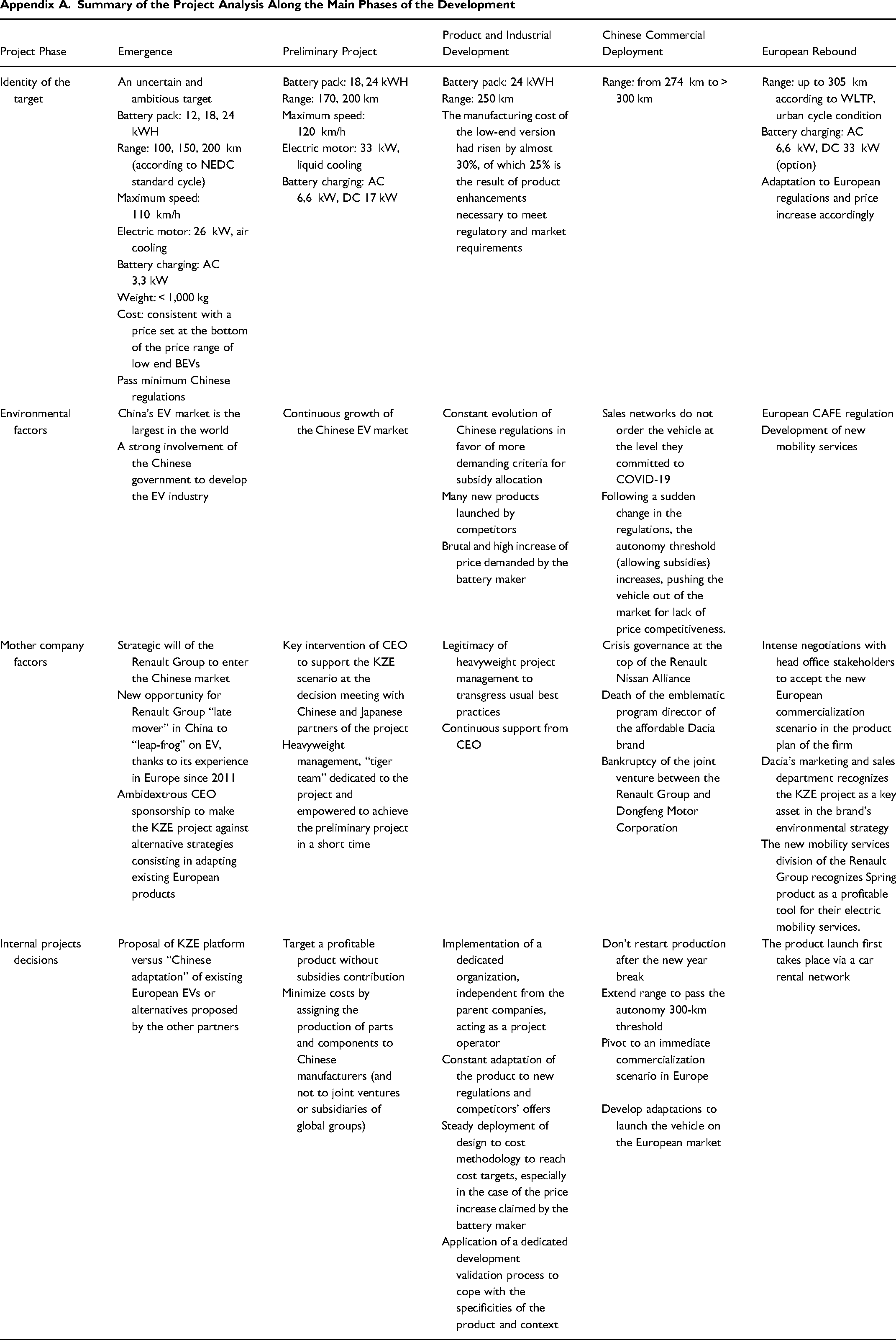
With regard to the identity of the target, we give the definition fixed during the phase of emergence, whereas for the other phases we only provide its main evolutions. The project analysis along the main phases of the development is summarized in Appendix A at the end of the article.
The Odyssey of KZE
A Laborious Strategic Genesis and a Tense Emergence Phase (mid-2014–2015)
The story of this project begins in mid-2014, with Renault Group’s strategic will to penetrate the Chinese market after multiple attempts, all of them doomed to failure. The explosion of the electric vehicle (EV) market in China, strongly stimulated by Chinese public policies, seemed to be an opportunity for this European EV first mover to finally succeed in establishing itself there.
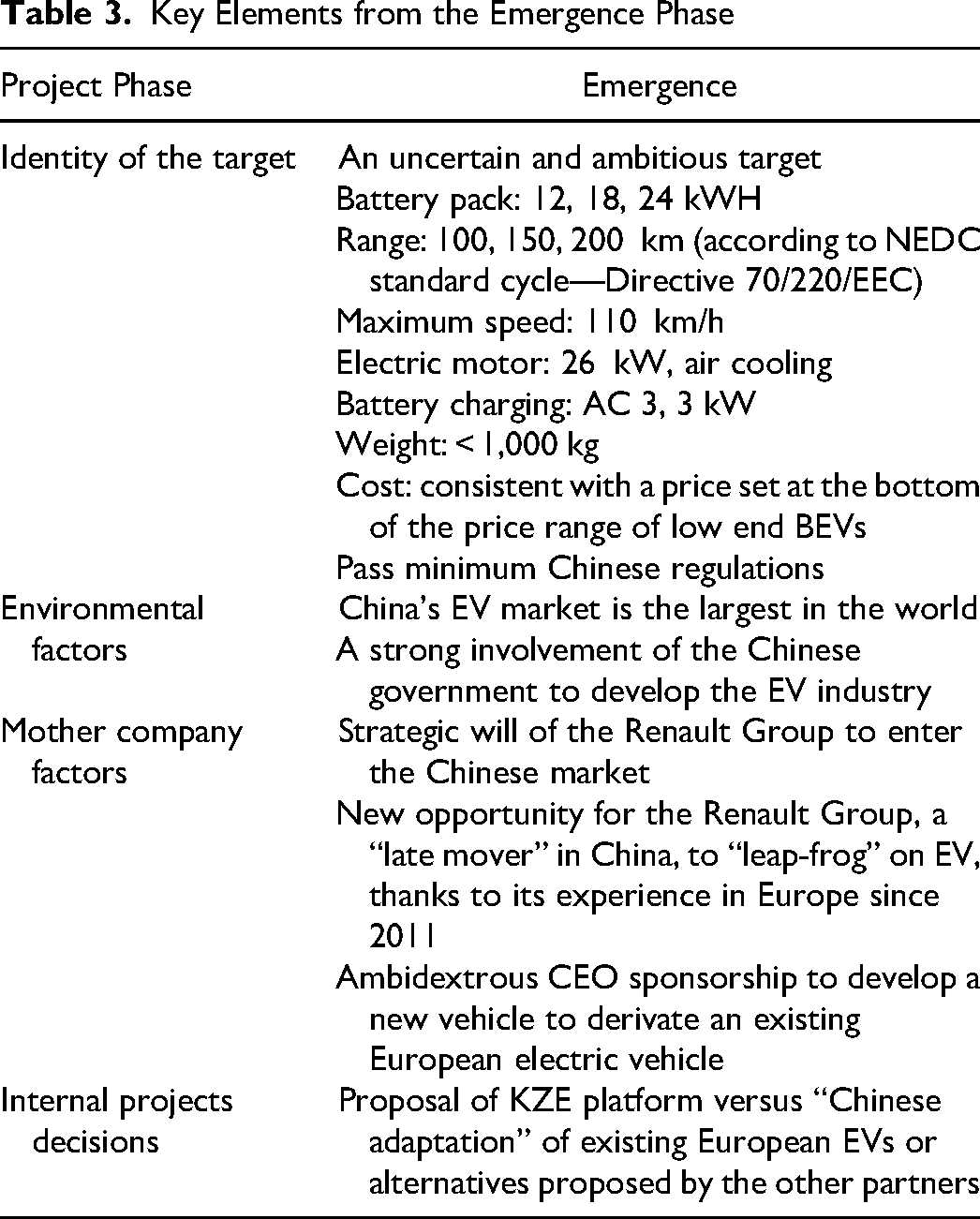
However, all projects developed to adapt existing European EVs to the Chinese market failed one after the other, because their price/performance ratio was far out of line with the requirements of this market. Finally, a tiger team, led by the project director of an A-segment, low-cost vehicle previously developed in India, managed to achieve a credible breakthrough based on the electrification of this vehicle. After multiple loops to evaluate the advantages and disadvantages of these different projects, the company’s CEO validated this project and at the end of 2015 launched the preliminary project phase of KZE under the responsibility of the program director who had conducted the preliminary study (Table 3).
Key Elements from the Emergence Phase
Exploring the Possibilities in the Preliminary Project Phase (2016)
The tiger team carried out a first phase of rough exploration of the market, the technical solutions, and the Chinese industrial partners to evaluate the manufacturing cost of the vehicle: “In total, we arrived at an amount that was approximately the same as the admissible selling price as it appeared in the market studies. This coarse-grained calculation was and would remain the cornerstone of the project.” 4 This first estimate will play—as the project actors will recall several times in the interviews—the key role of compass during the whole development process. Apart from that, all the variables of the project in terms of product definition, industrialization, and marketing scenarios remain to be explored and validated in a totally new context: the European automaker knew neither the Chinese market of EVs nor the automotive industrial environment with which it would be able to produce the car.
Moreover, the target objective was very ambitious: the project must be profitable and therefore have a minimum investment and a cost maintained within the initial target objective; the development time must be that of a typical project, while it involves the design of an entirely original electric powertrain, the permanent adaptation to fast moving Chinese regulations, and the preservation of subsequent marketing in Europe.
In nine months, the preproject team accomplished the tour de force of confirming the target cost of the vehicle (including electric powertrain components), selecting the car’s production site, detailing the minimum regulatory level, building a KZE prototype to test its future performances and, finally, negotiating with five potential commercial partners the construction of a sales network to maximize volumes. As a team member of the preproject study put it about the confirmation of the targeted cost: “This helped us to convince our partner, Dongfeng, who had some doubts at the time about our ability to keep costs down: 70% of the car’s structure had been analyzed, so it was empirically proven.”
The CEOs of the three automakers 5 met in September 2016 to decide on the launch of a joint project, as the Chinese and Japanese automakers had studied alternative scenarios. After long and tense discussions, the KZE project was validated for a launch of an A-segment EV, sold through five different sales networks on the Chinese market, and potentially—in the longer term—in Europe. But the clear target is the Chinese market, as emphasized by the Dongfeng CEO in the minutes of the meeting: “The Renault-Nissan team has to keep in mind that this product is designed for China, not for India or Brazil.” 6
KZE entered the development phase with a consensus on the overall vision of the project, but the (few!) compromises implicit in its definition still needed to be worked out. In addition, key elements for the success of the project remained to be clarified: the economic model and the respective responsibilities of the partners in this scenario. The key elements of the preliminary phase are summarized in the Table 4.
Key Elements from the Preliminary Project Phase

An Agile Development in an Unprecedented Context (2017–2019)
After the difficult convergence to a common project, the question of how (to make it) remained largely unresolved, exacerbated by the fact that it was taking place in the complex context of cooperation among three automakers of different origins, cultures, and histories and the presence of five sales networks.
Quickly an organization was put in place to operate the development of the project: an independent company—named eGT 7 —was created to which the three automakers brought cash and industrial contributions, the latter representative of their respective strengths and skills to carry out the project. eGT and the associated contractual framework were organized according to the model of heavyweight project functions (Clark & Fujimoto, 1991; Midler, 1993) providing unicity of development, responsibility toward a global objective, a target shared by the partners, and a scope integrating all the variables of the project.
From September 2016 to March 2018—when the car’s definition was fixed—there was a continuous inflation of the performance and benefits of the intended target. As KZE Chief Vehicle Engineer explained: “In such a fluctuating market, we had no choice but to be agile. Every six months, we had to adapt to changes in regulations and competitors.” 8 In addition, the project team had to overcome other obstacles. They had to converge with the suppliers on very ambitious cost objectives—in particular on the battery when the supplier wanted to unilaterally increase its price and reduce production capacity. They needed to find an economical solution to meet the differentiation requirements of the five sales networks. They had to meet the key engineering challenge of incorporating a 200-kg battery on a platform that originally weighed 750 kg.
The evaluation of the project at the end of the development phase was quite positive. The information gathered from the project documents confirmed this positive evaluation. In terms of production cost, there was a significant reduction of one-third on the cost of the vehicle produced in China versus the cost of the vehicle produced in Europe (see Appendix B at the end of the article 9 ).
The combination of design to cost 10 and cost sharing resulting from the cooperative strategy among the three automakers and the five sales networks allowed an impressive reduction in investment. The entry ticket of this almost totally new vehicle was one-eighth of that of adapting, for the Chinese market, a product already developed in Europe (see Appendix C at the end of the article).
In terms of development time, the KZE was developed in 36 months, from the development agreement in September 2016 to the production launch date in September 2019 and the first sales in October 2019 (see Appendix D at the end of the article).
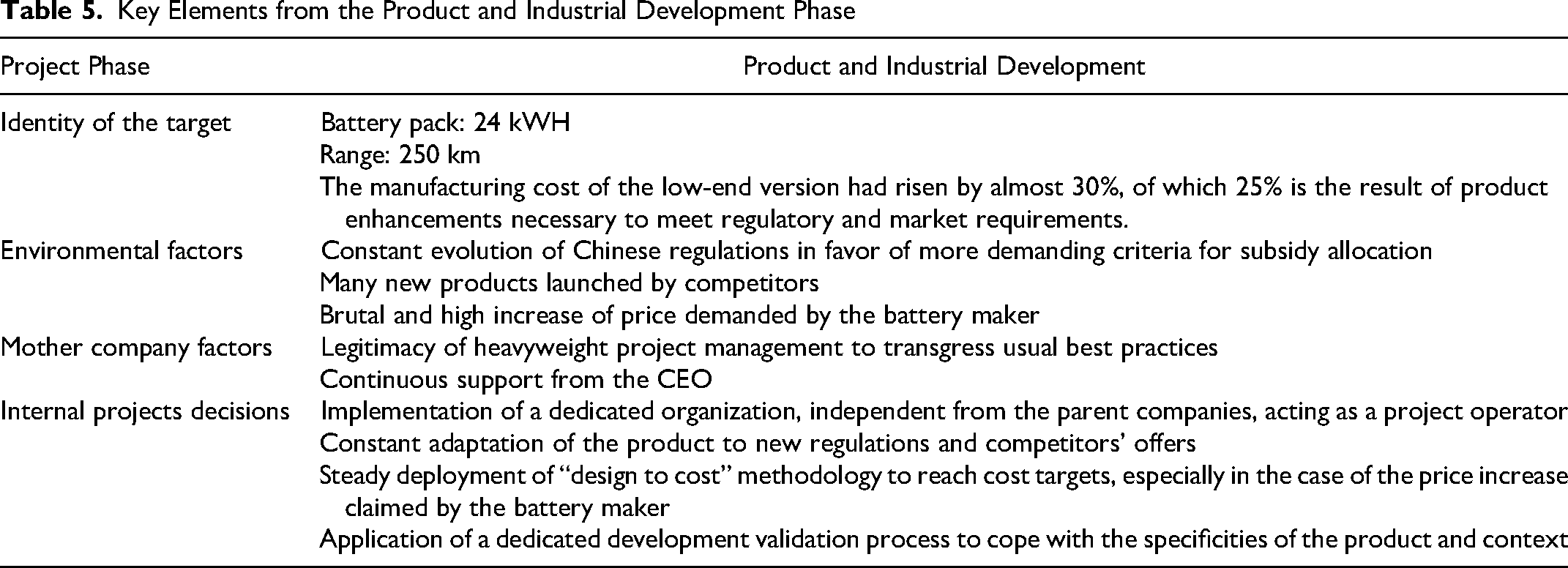
As far as quality is concerned, the SVP of the European automaker 11 in charge of project development, clearly stated that: “Technically, the product respected all the company’s quality standards and has not given rise to any problems since it was launched.…” Table 5 is a summary of the main events of the development phase.
Key Elements from the Product and Industrial Development Phase
Successful but Quickly Stopped Marketing in China (2020)
April 2019 was a key moment for the commercial launch of KZE as it was unveiled to the public at the Shanghai Motor Show and the tests were carried out by the specialized Chinese press. The reception was excellent, as reported by a top executive of one of the automakers we interviewed: “In terms of price–customer value balance, the product was excellent compared to competitors in the segment,” 12 and sales began under a brand of the European automaker in September 2019. Sales were on target and the car quickly reached its target of 5% of its segment by the end of 2019.
Therefore, in December 2019, when the production stopped, as it is usual in China at this time of the year, the path to success seemed clear for the project. But, four months later, it appeared as a spectacular fiasco, definitely stopped by the combination of four strong obstacles, some of them of unknown-unknown types (Loch et al., 2006):
The joint venture between the European and Chinese automakers encounters serious failures with conventional vehicle sales and strapped for cash, do not place additional orders by the end of 2019; worse, it filed for bankruptcy in March 2020. Three of the five sales networks don’t place any order, which prevents the expected volumes from being reached in China. The COVID-19 pandemic places the whole of Hubei province, where KZE’s engineering and production facilities are located, under lockdown. Finally, while the vehicle has been developed to the minimum regulatory level for autonomy, a sudden increase in the latter deprives it of purchase subsidies, taking it de facto out of the market because of a too high price.
Consequently, the production doesn’t restart in March 2020. However, in this context of multiple crises, radical and quick decisions were needed: the reengineering of KZE to increase its autonomy beyond the minimum threshold in autumn 2020, and the industrialization of the European version were adopted unanimously by the members of the eGT governance. The contract among the partners (Renault, Dongfeng, and Nissan), increasing the production volume for Europe, was signed in March 2020. Table 6 is a summary of the key elements from the Chinese commercial deployment.
Key Elements from the (Chinese) Commercial Deployment

Success in Europe (2021–2022)
How would the KZE electric car project, coming from elsewhere, fit into a strategy that was now quite different from that of the group that had decided to launch the project in late 2015? In addition, this possible launch in Europe raised suspicions, inside the corporate divisions, about both the quality of a product developed in full autonomy in China and the risk of cannibalization of products designed in Europe for the European market.
But the product quickly found three important and motivated allies within the company. First, the Renault Group’s commercial division in the European area, faced with the need to comply with European regulatory requirements (CAFE) 13 ; second, the management of the Dacia brand of the Renault Group, which combines the brand identity of less expensive vehicles with convenience and reliability. As analyzed by CEO of Dacia: “Spring meets the needs of both those who do not have a large budget to devote to their car mobility and those who, by choice, do not wish to allocate more than is reasonable.” 14 Finally, the new subsidiary, responsible for developing and marketing the company’s new mobility services, welcomed a non-polluting vehicle that was easier to make money from than the more expensive and sophisticated existing European electric vehicles.
The launch then took place in two stages: first the vehicle was proposed by a short-term car rental operator, which allowed the product to become known and tested by customers in real conditions and then deployed in different electric car–sharing services.
Marketing to final customers began in March 2021 in several European countries with a pre-order phase: about 16,000 reservations were made by the end of June, and waiting lists were opened in several countries.
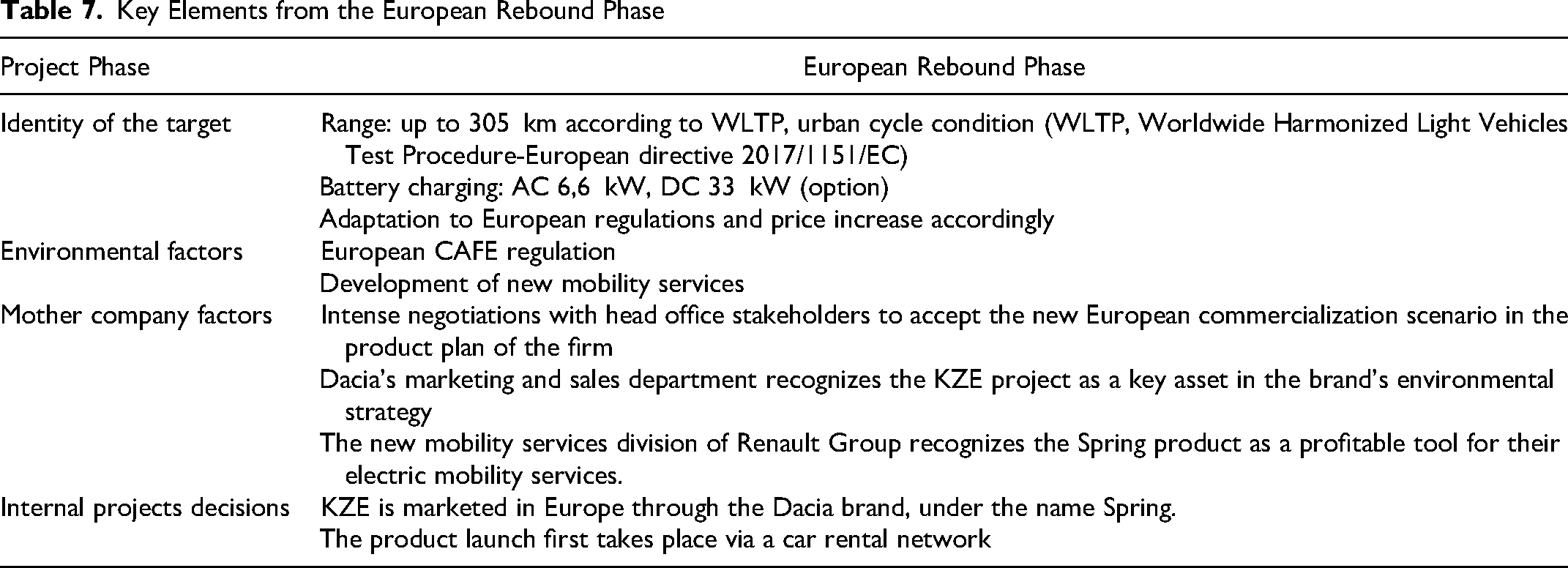
While KZE’s use in electric mobility services is still very new, it is certainly too early to draw any conclusions in terms of user satisfaction; in terms of sales, 2022 exhibits a monthly rate of 5,000 orders, and the vehicle is one of the top three sellers in one of its main target markets. Table 7 is a summary of the key elements from the European rebound phase.
Key Elements from the European Rebound Phase
KZE: An Archetype of a Phoenix Project
The history of the KZE project shows a representative trajectory of a Phoenix project: depending on whether one stops the clock in April 2020 or in December 2021, it appears as a clear failure or, on the contrary, a success. But it is the third characteristic of a Phoenix project that is best illustrated here: the final result, in other words, the marketing, in Europe in 2021, of an accessible electric vehicle could not have been achieved without the failure in China.
During the project, the design scenario for the car in China created a performance/cost/weight combination that did not exist in the European competition and would have required prohibitive levels of investment had it been developed in Europe from the outset. But the product was dedicated, at least in its first years of marketing, to the Chinese market, Europe being targeted later after the success in China. Consequently, all the production capacities and marketing efforts were focused on the Chinese market. The sudden and unexpected failure—due to the strong headwinds we have described—of KZE in China reshuffled the cards and pushed the stakeholders of the project to find a way to leverage the assets developed during the project.
At the time of its launch in 2016, the KZE project would certainly not have found its place in the company’s product plan as it was in direct competition with the range developed specifically for Europe. At the beginning of 2020, the need to meet the CAFE objectives and the capability to produce a vehicle with a magic triangle (price/mass/autonomy) unmatched on the market at a time when all competitors launch their EV line-up, prompted the company to introduce it on the European market with the success we have come to know since then. The passage through the Chinese failure thus appears to have been the condition for the European success.
Discussion: From Characterization of the Phoenix Trajectory to a Theory of the Phoenix Phenomenon
The trajectory of the KZE project is thus the result of multiple and varied factors. In this discussion, we propose to group them around four variables from which we will formalize an ideal type of Phoenix-type project trajectory: (1) the characteristics of the project brief; (2) the importance of project and innovation culture inside the company; (3) the capacity to hybridize causal and effectual project management, and lastly, (4) the flexibility of the firm to revive a failed project.
The Project Brief: Pitfalls and Opportunities of a Vanguard Project
The ambitious, innovative, and uncertain nature of the project’s target identity appears to be an important factor in its dynamics. On the one hand, it is a source of surprises and risks leading to unforeseen drifts and bifurcations. On the other hand, it is also a lever for learning in areas previously unknown to the company, leading to the creation of original assets that proved to be key resources in the rebound phase. Here we find the characteristics of vanguard projects, already identified in the literature on project-based learning (Brady & Davies, 2004). Conversely, a project that does not innovate much is probably more likely to achieve its ex-ante defined objective but brings little knowledge and new assets to the company. This characteristic is also in line with the results of the sociology of science, which emphasizes the importance of the existence of a deviation from the known domains as the origin of the phenomenon of serendipity.
The Importance of Projectification Maturity and Innovation Culture of the Firm
The case shows the importance of the firm’s managerial projectification maturity and innovation culture on the Phoenix’s trajectory.
Innovative Development Process
In traditional approaches, such a risky development just wouldn’t have gotten off the ground. The electric powertrain was entirely new and was developed with Chinese partners the European automaker had never worked with. More generally, Chinese suppliers were not listed in the company’s supplier panels, which is normally a mandatory condition for them to be selected. The production plant, a choice imposed by the Chinese automaker, was far from the requirements defined by the company’s process engineering division. As the project director put it, it was a “Zola like factory” that needed a complete renovation. We would then have expected a two-stage process for exploring such an uncertain target, in line with the stage gate approach (Cooper, 2008), which is highly institutionalized in the automotive sector. Firstly, a proof of concept was needed to validate the new technologies of the electric drive train and the attractiveness of the concept during the advanced engineering phase; then, if positive, the launch of the vehicle development. On the contrary, here vehicle development integrates both the exploration activity and the realization of the objective. The KZE development practices are in line with the characteristics of what had been formalized in project management literature as the innovative development model (Midler, 2019) or triple A project management model (Kock & Gemünden, 2021). Such models associate heavyweight project management structure, inside agile exploration/decision processes, and autonomy from the standard processes through the support of an ambidextrous governance. The unfortunate end of the Chinese phase of the project in 2020 demonstrates the importance of a strong ambidextrous governance to sustain the innovative development model: the mobilization of the Chinese marketing networks in the described context would have required a powerful intervention of the general management of the Renault Group to persuade the Chinese partners to continue the marketing effort in China despite the problems encountered. This was, at the time, impossible in the context of the crisis of the Renault-Nissan-Mitsubishi Alliance and the disappearance of the emblematic director of the KZE project.
Frugal and Reverse Innovation Strategy is a Successful Experience
The other learning on which the project was able to rely on to emerge and assert its specific identity is the strategic experience of the Renault Group in the field of low-end disruption strategy and reverse innovation. This experience began in the early 2000s, with the Logan project in Eastern Europe and the Kwid project in India (Midler et al., 2013). The success of this strategy allowed, on the one hand, to constitute a professionalism of design to cost and agility of exploration, which were mobilized with profit within the project; on the other hand, it reinforced the legitimacy of the sponsorship of this new project, despite the tensions it brought with the development standards in place in the headquarters.
We can bring this characteristic closer to the conditions identified in the literature of the sociology of science concerning the phenomenon of serendipity: the interest of the unexpected discovery appears only because the surprise makes sense in relation to a problem worthy of interest for those who assess the project.
Project Management That Hybridizes Causal and Effectual Approaches
However, although this capacity enabled the development of product and process engineering, it failed to overcome the major obstacles imposed on the project: inflation of performance standards imposed by Chinese regulations and competitors, battery rising price in a context of soaring demand, failure of Chinese sales networks and, last but not least, the COVID-19 pandemic. In the face of these crises, the project has achieved a bifurcation from an innovative development model, consistent with a causal approach (Huff, 2016) and driven by the initial target—a true project compass—to an effectual approach, where redefinition of the target can occur along the way (Sarasvathy, 2001; Vanderstraeten et al., 2020).
Such a bifurcation, although necessary under the circumstances, nevertheless appears to be a denial of the management principles that the project management team had asserted from the start. In other circumstances, it could have caused the loss of credibility of the project management team and its immediate stop. In the case studied, the strong legitimacy of the program director, acquired through the experience of his previous successes, as well as the colocated management team were certainly facilitating conditions to maintain these two antagonistic behaviors over time in the face of hazards. Similarly, the sponsorship of the CEO of the European automaker, well known in the Chinese industry, played a decisive role in the key moments of the project, when it could have been stopped or deeply questioned.
The Strategic and Operational Flexibility of the Firm to Revive the Project From Its Ashes: The Exaptation Side of the Project
The last characteristic revealed by the case as a possible Phoenix trajectory trait concerns the strategic and organizational context of the company where it takes place: it is the ability to revive the project after its first failure. According to the last principle of the effectual approach, it is the identification of new sponsors, likely to appreciate the bifurcation of the project, which is the condition for its continuation after the failure of the initial scenario.
Firstly, the case demonstrates that such recovery is not obvious. On the one hand, from the group head office, the sudden availability of a new original electrical product following the failure of the Chinese marketing appeared to be a surprise and out of step with scheduled plans, since the launch of KZE in Europe had not been part of any product strategy for several years. On the other hand, the project, which took place on the periphery of the company and often applied its own processes, which differed from the company’s standards, did not make many internal allies. This is a typical difficulty of structural ambidexterity situations (O’Reilly III & Tushman, 2013), well identified in the literature: the autonomy of the project, which was a necessary condition for its development, is not conducive to its recovery by the parent company. Not surprisingly, such capacity is first attested in the domain of corporate venturing (Keil et al., 2009), where start-up death and pivoting are usual practices. In more traditional project management–oriented contexts, the failure would likely have become a sunk cost.
The lessons of the sociology of scientific discoveries are interesting: taking advantage of serendipity is not evident. It needs an exaptation capability (Garud et al., 2018) where it is no longer a question of finding a solution to fixing an identified problem but rather the opposite: to find a market target that could value an existing offer. A project where the key players are changing; they are no longer the R&D people but the marketing ones. To overcome such difficulties and value the KZE opportunity, the company has to implement an exaptation process through modifying what was planned and improvising a new strategy. The project illustrates the elements of these exaptation processes identified by Garud et al. (2018): (1) the importance of narratives, which transform a discourse focused on the relevance of the project for the Chinese market into an opportunity to be seized for the strategy of the Dacia brand in Europe; and (2) the mobilization of networks of allies to legitimize this unexpected shift.
The development of such a renaissance capacity is an important issue in line with the dynamic capability school (Teece et al., 1997), as innovative development projects emerge in an increasingly chaotic and unstable world as well as in radically new and dramatic areas such as war or climate crises. The existence of an intrapreneurial culture and exaptation arrangement within the firm appear as potential leverages for such rebirth capability (Kaufmann et al., 2021; Keil et al., 2009).
Conclusion
Phoenix trajectories are certainly surprising but not unpredictable. From the analysis of our study case, we have characterized four conditions that can support ex-ante diagnoses of their potentiality.
These conditions relate, first of all, to the very nature of the project: is it radically new, ambitious, and therefore uncertain? They also have to do with the maturity of the company in the field of innovative project management: has it built a capacity for innovative development management? Can this management legitimately switch to an effectual logic when faced with imponderables? Finally, they are related to the company’s capacity to accept and value these pivots, to make the project rise from its ashes and not to consider it as a sunk cost. These are all conditions that can be diagnosed in a company and be built as key dynamic capabilities in the contemporary world.
Beyond a contribution to the management of Phoenix projects, this study brings a more general lesson concerning the evaluation of projects. Phoenix projects, of course, cannot be called successful in the strict sense of the term but they are not complete failures, as they appear to be at first sight. This study emphasizes, in a particularly clear way, the key importance in today’s chaotic and uncertain context of an evaluation that is not only retrospectively focused on the achievement of previously defined objectives, but also on the prospective assessment of the potentialities made possible by the project’s outcomes. Today, projects are as much about making new things possible as they used to be about getting things done (Obstfeld, 2012). In a context that combines urgency, radicalness, and uncertainty of the transitions to be made, we can expect that companies will be challenged to quickly develop riskier projects, leading to higher failure rates. The ability to revive them and, even better, to anticipate from the start those that have the potential to become Phoenixes, constitutes an asset in the contemporary period in order to enhance the overall performance of the project portfolio.
On a theoretical level, this research shows the interest in feeding the developments of the field of project management with the contributions of other disciplines—here those of the sociology of sciences and entrepreneurship. On a more general epistemological level, it confirms the fruitfulness of the pragmatism paradigm, and especially the Strauss approach (1993), to research on and understand project processes.
Obviously, the status of this case-based research is exploratory. We formalized our hypotheses for the Phoenix project theory, but they will have to be tested and validated by other researchers. Our objective here is to outline new perspectives for the discipline of project management, which must, like other institutions, evolve to confront the new challenges of the 21st century.
Footnotes

Notes
Author Biographies
Project Phase
Emergence
Preliminary Project
Product and Industrial Development
Chinese Commercial Deployment
European Rebound
Identity of the target
An uncertain and ambitious target
Battery pack: 12, 18, 24 kWH
Range: 100, 150, 200 km (according to NEDC standard cycle)
Maximum speed:
110 km/h
Electric motor: 26 kW, air cooling
Battery charging: AC 3,3 kW
Weight: < 1,000 kg
Cost: consistent with a price set at the bottom of the price range of low end BEVs
Pass minimum Chinese regulationsBattery pack: 18, 24 kWH
Range: 170, 200 km
Maximum speed: 120 km/h
Electric motor: 33 kW, liquid cooling
Battery charging: AC 6,6 kW, DC 17 kWBattery pack: 24 kWH
Range: 250 km
The manufacturing cost of the low-end version had risen by almost 30%, of which 25% is the result of product enhancements necessary to meet regulatory and market requirementsRange: from 274 km to > 300 km
Range: up to 305 km according to WLTP, urban cycle condition
Battery charging: AC 6,6 kW, DC 33 kW (option)
Adaptation to European regulations and price increase accordingly
Environmental factors
China’s EV market is the largest in the world
A strong involvement of the Chinese government to develop the EV industryContinuous growth of the Chinese EV market
Constant evolution of Chinese regulations in favor of more demanding criteria for subsidy allocation
Many new products launched by competitors
Brutal and high increase of price demanded by the battery makerSales networks do not order the vehicle at the level they committed to COVID-19
Following a sudden change in the regulations, the autonomy threshold (allowing subsidies) increases, pushing the vehicle out of the market for lack of price competitiveness.European CAFE regulation
Development of new mobility services
Mother company factors
Strategic will of the Renault Group to enter the Chinese market
New opportunity for Renault Group “late mover” in China to “leap-frog” on EV, thanks to its experience in Europe since 2011
Ambidextrous CEO sponsorship to make the KZE project against alternative strategies consisting in adapting existing European productsKey intervention of CEO to support the KZE scenario at the decision meeting with Chinese and Japanese partners of the project
Heavyweight management, “tiger team” dedicated to the project and empowered to achieve the preliminary project in a short timeLegitimacy of heavyweight project management to transgress usual best practices
Continuous support from CEOCrisis governance at the top of the Renault Nissan Alliance
Death of the emblematic program director of the affordable Dacia brand
Bankruptcy of the joint venture between the Renault Group and Dongfeng Motor CorporationIntense negotiations with head office stakeholders to accept the new European commercialization scenario in the product plan of the firm
Dacia’s marketing and sales department recognizes the KZE project as a key asset in the brand’s environmental strategy
The new mobility services division of the Renault Group recognizes Spring product as a profitable tool for their electric mobility services.
Internal projects decisions
Proposal of KZE platform versus “Chinese adaptation” of existing European EVs or alternatives proposed by the other partners
Target a profitable product without subsidies contribution
Minimize costs by assigning the production of parts and components to Chinese manufacturers (and not to joint ventures or subsidiaries of global groups)Implementation of a dedicated organization, independent from the parent companies, acting as a project operator
Constant adaptation of the product to new regulations and competitors’ offers
Steady deployment of design to cost methodology to reach cost targets, especially in the case of the price increase claimed by the battery maker
Application of a dedicated development validation process to cope with the specificities of the product and contextDon’t restart production after the new year break
Extend range to pass the autonomy 300-km threshold
Pivot to an immediate commercialization scenario in Europe
Develop adaptations to launch the vehicle on the European marketThe product launch first takes place via a car rental network