




Abstract
It is important to include non English speakers in health services research to ensure not only the generalisability of findings but also to address health inequalities and promote social justice. One approach is to use interpreters but there is little guidance for working with an interpreter in interviews. Involving an interpreter presents challenges in the planning and conduct of research interviews which can be minimised by an awareness of various theoretical and practical implications and of potential pitfalls. Drawing both on our experiences of involving interpreters in research and on the literature, we raise some issues that researchers need to consider.
Introduction
High quality health services research requires good communication between researchers and participants. This presents a challenge for potential participants whose preferred language is not English. A lack of English language skills is sometimes an explicit research exclusion criterion, or can lead to inadvertent exclusion when resources for recruitment and translation or interpretation are inadequate. However, the exclusion of certain groups constitutes poor science 1 as regards the validity and generalizability of research findings. 2 As research may affect the allocation of health care resources, the exclusion of certain groups on the basis of their language skills also raises issues of social justice. 3 Given the extent of the challenges it is surprising that there is so little guidance available on how to work with interpreters.4,5
The purpose of research interviews
The style of interpreting can be anywhere on a continuum from passive to very active.5–7 If the aim of the research is to obtain objective facts then a passive style, where the interpreter translates verbatim, reports in the first person and acts merely as a conduit of information will be appropriate. When research requires detailed in-depth information, for example in phenomenology, then active interpretation where the interpreter conducts much of the interview and reports back to the researcher only at certain stages may be more appropriate. Most health services research will require a style in between these poles, aiming to give interviewees as full a voice as possible while accurately representing their views. This is a complex task to achieve,6,8,9 and each study has to decide where ‘in between’ lies.
Style of interpreting and impact on validity of the data
A researcher interviewing with an interpreter will inevitably lose some control over the interview.6,9 They have, for example, to rely on the interpreter to keep questions non-leading and neutral. 9 The presence of an interpreter will make conversation disjointed, 6 less spontaneous, and prompting becomes difficult. 10 Experienced researchers find that techniques they use in the context where both researcher and interviewee speak the same language become redundant. Once a response has been translated, the moment when both verbal and non-verbal prompts would have made sense has been lost and an interjection may be inappropriate. It is also difficult to identify where misunderstanding of a question or answer may have occurred between the researcher and the interpreter or between the interpreter and the interviewee. 10
Issues of accuracy in relation to the interviewee's responses cannot be guaranteed and translation will limit trans-lingual research. 5 Decisions have to be made about balancing the need for gaining in-depth information and obtaining valid data. A more active style of interpretation, where the interpreter is given the opportunity to prompt directly and ask their own questions, is likely to engender longer answers, more in-depth information and data which are more conversational and informal. However, interpreters have their own interests and perspectives, and the more autonomy they have, the greater the effect on the validity of the data and the more the researcher's control over the interview is reduced.5,6,11 This is compounded when, for linguistic necessity, there are several interpreters working on one study who may have different understandings of the aim of the research and different priorities for information.
It is understandable that interpreters begin to ask their own questions once they have become interested in the interview topic 9 and a more active model may be more appropriate once the interpreter becomes familiar with the aims of the interview and its questions. 7
The interpreter's role
If the style of interpreting is active, then the interpreter's role will be more than just translating. Initially establishing a trusting relationship between the three parties is crucial. Interpreters see it as their role to make the environment as comfortable as possible, using smiling and appropriate body language to relax interviewees and reassure them. Their understanding of culture and the community is also helpful. Interviewees are often interested in who the interpreter is and may ask for their opinions before consenting to take part in the research.
Planning
How many interpreters should work on a study? There is a balance to be struck between matching them to participants by factors such as ethnicity, sex and age, and minimising the number, to provide consistency. Both approaches have advantages and disadvantages. Matching some characteristics is likely to help the interviewee identify with the interpreter.4,10,12
It may be difficult to find interpreters who have undertaken research interviews. This is very different to other interpreting situations. Those who have worked for legal, health and social care organizations are likely to have had training on issues such as open and closed questions and bring experience which combine to create transferable skills. Less experienced interpreters find the task difficult. An interpreter drawn from the community of the interviewees can engender trust, respect and credibility, or equally mistrust and anxieties about confidentiality.8,11
Preparation
Interpreters need to understand the aims of the research, their role, be familiar with the interview schedule4,11 and understand confidentiality. Other issues that might be discussed include how much autonomy the interpreter has regarding asking follow-up questions, the principles of qualitative research and the difference between open and closed questions.4,9,11,13,14 Some written guidance might be useful but this might deskill them if it is too prescriptive.
It is important for researchers to understand how much it is reasonable for the interpreter to translate at once. It might also be useful for the researcher to understand the interpreter's position in the community. Might they be known? Do they have an official role through their job or religion? It might be appropriate to ask them for any information they can give about the local community.
Interviewing with an interpreter is tiring for all parties. Interviewees may have time constraints, and involving an interpreter will tend to lengthen an interview. Researchers and interpreters may feel conscious of how long an interview is taking and worry about whether the interviewee is becoming bored or uncomfortable. It may be necessary to prioritize topics for discussions.
The interview
A triangular seating arrangement where everybody can see each other is recommended.12,15 Sometimes the interviewee turns towards the interpreter and effectively ignores the researcher. This is most likely when both interpreter and interviewee are the same sex and the researcher is other sex.
The way introductions are made sets the tone and gives interviewees an impression of the relative roles of the researcher and interpreter. 9 The interpreter will quickly get to know the initial information and it seems artificial, impolite and a waste of time for the researcher to say each thing and wait for it to be translated. However, if the interpreter gives the information directly this can have a negative impact on the interviewee's perception of the researcher, possibly rendering them marginal.
Considering non-verbal communication is important because interviewing is about emphasis, subtlety of voice, facial expressions and body language as well as about verbal interaction. When interviewing with an interpreter, it is difficult to link non-verbally expressed feelings to spoken words, when the words come later. Thus emotions attached to statements can be lost and pursuing particular themes is more difficult.
It is also important for the researcher to be aware of body language and be friendly because it is harder for them (than the interpreter) to build a relationship with the interviewee as they are from a different culture.
Interpreters feel uneasy when they report something that did not seem to make sense or to be related to the question that had been asked. They may seem apologetic in the way they present these responses, as if they feel some responsibility for what the interviewee said and possibly for the quality of data being collected.
After the interview
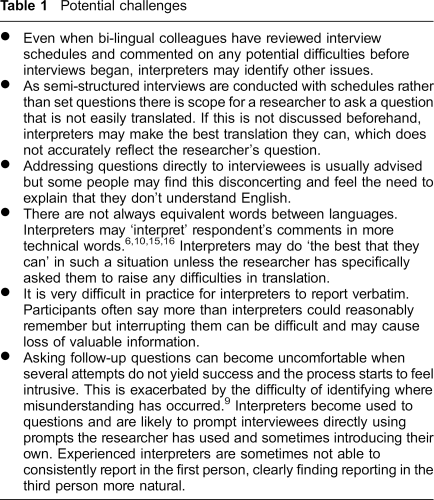
As well as discussing any observations, the researcher and interpreter can evaluate the process of the interview, identify any problems and consider how to overcome them. Interpreters may also be able to offer advice about dissemination, are often in an ideal position to know how to communicate with communities who participated. If deemed appropriate, they can also play a role in analysis and interpretation. Table 1 identifies some challenges that may occur during interviews.
Potential challenges
Conclusions
Undertaking interviews with interpreters is an important way of including non-English speakers in research. The style of interpreting depends on the nature and purpose of the research. There will always be some compromise between acquiring in-depth data and maintaining its validity. Planning preparation and an awareness of potential problems allows researchers to make informed decisions about how best to meet a study's needs.
Footnotes
Acknowledgements
Department of Primary Care Clinical Sciences is a member of the National School of Primary Care Research. SR is funded by the National Institute for Health Research (NIHR) through the Birmingham and Black Country Collaborations in Leadership in Health Research and Care (CLAHRC-BBC). The views expressed in this publication are not necessarily those of the NIHR, the Department of Health, NHS Partner Trusts, or the CLAHRC-BBC.