




Abstract
Abstract
AvMA undertook the survey in order to examine whether Rule 35 of the Civil Procedure Rules that governs expert meetings was operating effectively. The survey was initially restricted to Claimant lawyers as this is the group that AvMA has most contact and dealings with. However, the survey was subsequently expanded to include some Defendant lawyers as well as medicolegal experts themselves. The scope of the study was to look at issues arising from the expert meeting. Although the survey referred to the expert ‘meeting’, in practice, many discussions between experts take place without the experts meeting at all. The term ‘expert meeting’ was to encompass all forms of discussions between experts. This paper presents a review of the survey returns with particular emphasis placed on problems encountered in the context of the expert meeting. The level of response to the survey from Claimant lawyers was higher than AvMA expected. The response to the survey from Defendant lawyers is less than would be needed for the claims to be considered representative of Defendant lawyers in general. For resource reasons surveys to medicolegal experts were restricted to those for whom AvMA already had e-mail details. This limited the scope of potential medicolegal expert responses. Notwithstanding this, general themes have been picked out throughout this study that AvMA regards as indicative of feelings within both the legal and clinical professional groups. The main findings were as follows:
It is rare for lawyers to attend expert meetings; The majority of Claimant lawyers (72%) believe that lawyers should be present at the expert meeting. This contrasted with 33% of experts believing that lawyers should be present and with only 20% of Defendant lawyers agreeing. Less than 2% of Claimant lawyers attend an expert meeting. Less than 60% had ever attended an expert meeting; Less than 50% of lawyers had ever made an application to court in order to be present at an expert meeting; Ninety-eight percent of Claimant respondents reported difficulties in getting Defendant lawyers or the court to permit the presence of lawyers.
Introduction
Claimant lawyers
The genesis to the AvMA survey goes back to an AvMA London Lawyers' Support Group meeting in September 2006 in which Master Ungley spoke about the operation of the Civil Procedure Rules relating to clinical negligence specifically. Following Master Ungley's talk there was some discussion about the expert meeting and the desirability of lawyers' presence at the meeting. Given the interest aroused on this subject, AvMA arranged for a dedicated discussion on this subject at AvMA's Referral Panel meeting in November 2006. Once again, a great deal of debate and interest was aroused. The focus of interest was the fact that Claimant lawyers had some very negative experiences of the expert meeting. In particular, many had experience of having to discontinue or significantly compromise a claim following an expert meeting in circumstances where previously the expert had appeared robustly to support the issues in the case. This ‘turnabout’ in cases perplexes the lawyer and causes great distress to the Claimant. It is often very difficult to know, understand and explain what the basis for the retreat is. Up until this point a great deal of both financial and emotional expense will have been expended, only for the Claimants' case effectively to be determined not by a court of law, but by clinicians in a meeting that takes place behind closed doors with no legal representative there to observe.
Prior to undertaking the survey, AvMA had an anecdotal understanding of Claimant lawyers' distrust of the expert meeting. AvMA was keen to commission more hard data on this subject which relates to potentially the most crucial part of the litigation process. Essentially, the key issues are candour, transparency and accountability.
The following summary analysis is based on the responses of 60 Claimant lawyer firms completing a survey online (however, some responses were received by hard copy in the post) between 30 March 2007 and 9 November 2007. Claimant lawyers completing the survey were all members of AvMA's Lawyers' Resource Service. This resource service has 247 Claimant solicitor member firms with 1343 individual lawyers. We asked that one representative, usually the head of the clinical negligence department, respond to the survey. We received 60 responses to the survey from Claimant lawyers.
There were some notable differences in responses between Claimant lawyers firms who had more than 4–5 members in the department specializing in clinical negligence from those small firms with less than five members in the clinical negligence team. Many in the former category have members of the team who are specialist clinical negligence practitioners (i.e. they have been accredited by either the AvMA or Law Society specialist clinical negligence panel). As there has been no adjustment or weighting of the responses, this needs to be taken into account when considering the findings.
Defendant clinical negligence lawyers
In September 2007, the survey was extended to include Defendant clinical negligence lawyers following the recommendation of Master Ungley who is a specialist clinical negligence Master at the High Court in London. As AvMA does not have direct access to Defendant lawyers, Christian Dingwall, head of clinical negligence at Hempsons in London, agreed to circulate the survey to key Defendant lawyers. It has to be noted that the number of Defendant solicitor firms that are instructed on behalf of the NHSLA or Medical Defence Organisations is very small (perhaps a dozen or so in the whole of England). Seven responded. Notwithstanding the size of the sample, there was a very high degree of unanimity in the responses from the Defendant lawyers. For this reason, AvMA felt that it would be useful to include this information in any event.
Medical experts
So far as the medical experts were concerned, it had never been AvMA's intention to survey this group. It has to be emphasized that AvMA, a registered charity, had no specific funding to undertake the research and therefore resources were very limited. However, AvMA was asked to present the data collated in relation to the expert survey to the Clinical Disputes Forum (CDF) who were hosting a seminar on this subject. The CDF asked AvMA to extend the scope of the survey to include medical experts as well. A disappointing number of survey responses from experts were returned within the stipulated time-frame. However, several surveys did arrive after the date on which this data was evaluated. In total, 37 doctors provided answers to the general questions in the survey out of 580 who were circulated initially.
Where not otherwise stated the analysis in this report is based on the responses of experts who are clinicians currently acting as expert witnesses and have experience of the court process. Once again, some of these expert witnesses are more experienced than others. Again, AvMA identified notable differences between the more experienced specialists from those less experienced. As with the evaluation of responses from lawyers, AvMA did not weight them.
Analysis of responses from Claimant, Defendant and expert witnesses
The presence of lawyers at expert meetings
Medical experts and lawyers from both sides were asked whether it was desirable for lawyers to be present at the expert meeting. Figure 1 shows the results.
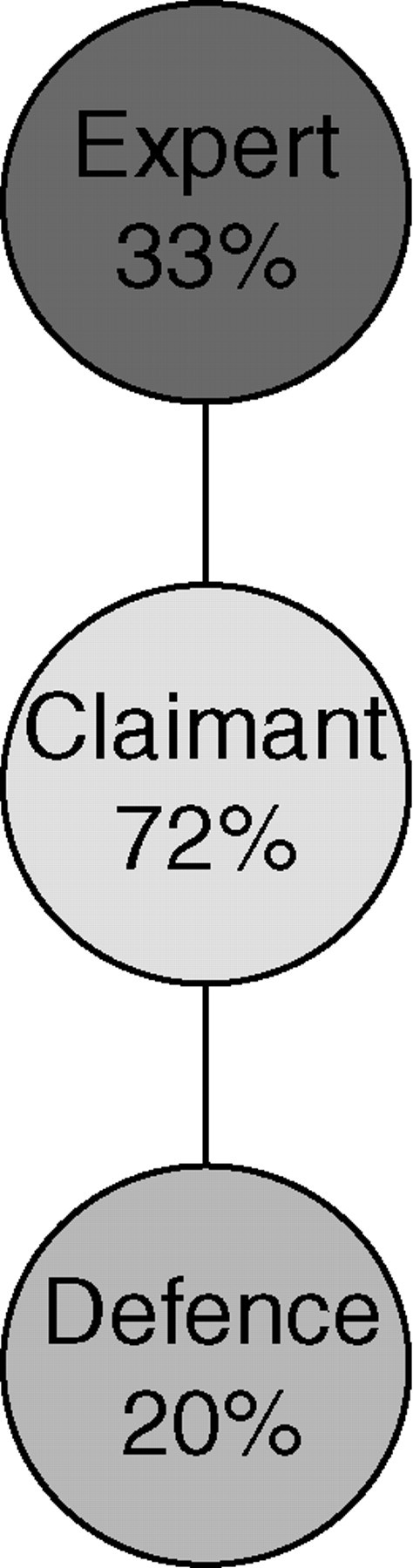
The proportion of Claimant, Defendant and expert witnesses at the expert meeting
The majority of experts were very clear that they did not want lawyers to be present at the meeting. There was a perception that lawyers' presence would ‘interfere’, be ‘adversarial’ or ‘lengthen’ the meeting. Several suggested that if lawyers were to be present their role should be an ‘advisory’ one rather than ‘adversarial’. One expert suggested that if a lawyer is there it should be as ‘silent observer’ in order to see ‘fair play’. One expert commented that the meeting ‘enables experts to explore the issues in depth although exceptionally (in theory) it could allow one expert to dominate someone less experienced’. The comments from experts in relation to question 1 are interesting viewed in the context of question 2 which asked lawyers of both sides whether they had made applications to court to be present at expert meetings.
Out of all the experts responding to the survey, only two had actual experience of an expert meeting with lawyers present. This raises the question as to whether the experts' view is one based on experience or theory.
Furthermore, many of those responding negatively to the notion of lawyers being present in the meeting gave equivocal or conditional responses: ‘not generally… there are exceptions though…’, ‘not in the main although in some circumstances their presence would be justified…’, ‘No… provided experts are familiar with general principles…’, ‘As long as experts are provided with a tightly-worded agenda…’. For the purposes of this survey, these responses were recorded as negative. Experts too suggested that there may be pros and cons to attending such meetings, one saying: ‘I don't mind them [lawyers] sitting in but find it more difficult to trade a little in order to get agreement on the big issues. Personally, I prefer them not to be present.’ Another voiced: ‘They [lawyers] will not necessarily understand the technical points arising’. More worryingly, another jested: ‘I generally know my colleague and I can joke and chide and make them feel relaxed. We can have frank off-the-record discussion before reaching agreement in writing. Formalizing the process would interfere.’
To the question to lawyers as to whether applications to court had been made to secure lawyers' presence at expert meetings, only 44% of respondents had made such applications. Of those, 52% had been successful in such applications. Those who said they had not made applications to court indicated that they were unwilling to apply because it was the practice of the local court to refuse such applications. Cost penalties acted as a deterrent.
We asked whether lawyers attended expert meetings. The answers are set out in Figure 2.
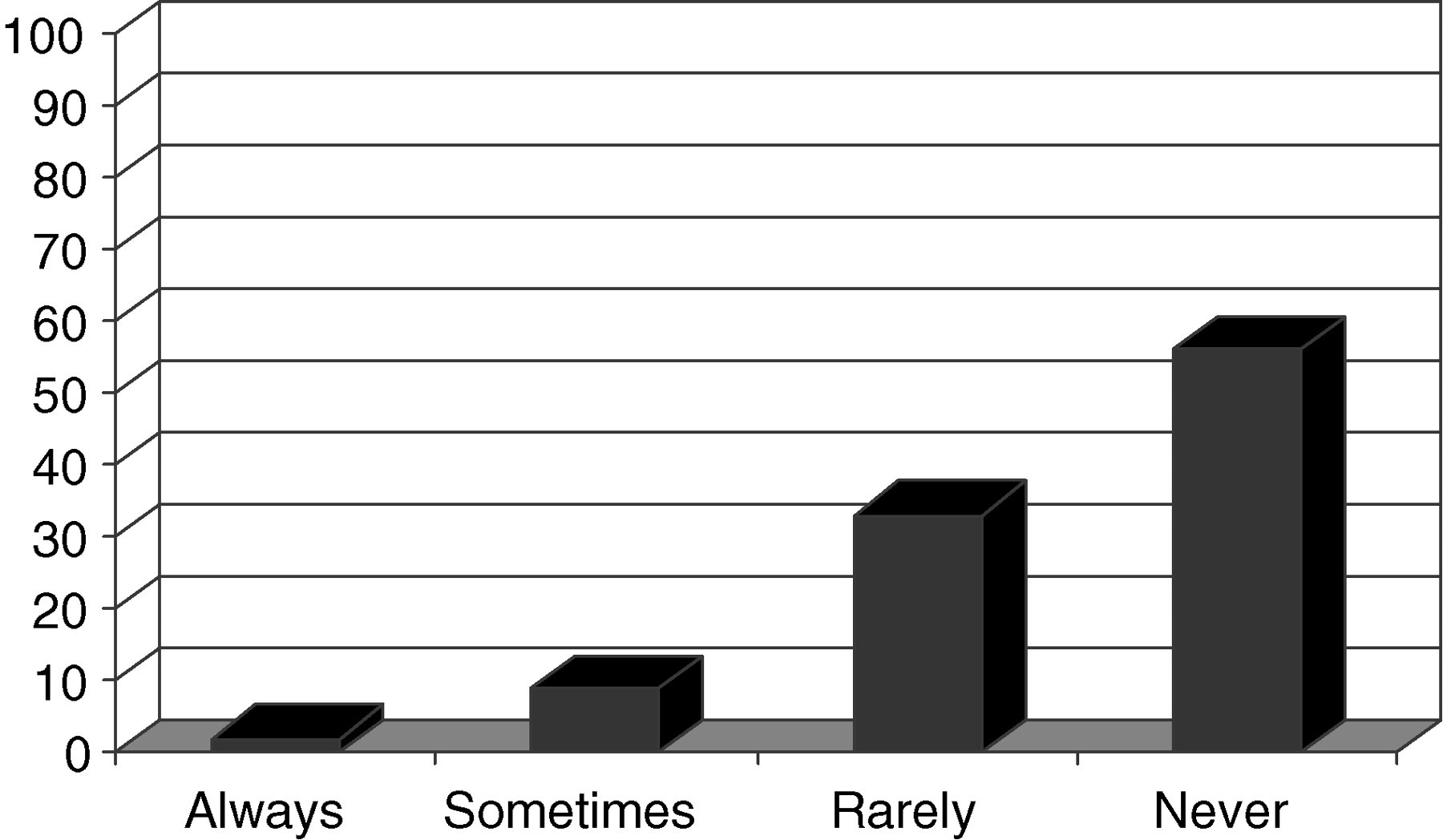
The attendance of lawyers at expert meetings
This was followed up by asking whether Claimant lawyers encountered difficulties in getting the Defendant and/or the court to agree to lawyers' presence at an expert meeting. Ninety-eight percent of Claimant respondents reported such difficulties. The sort of problems that Claimant lawyers encountered with regard to the expert meeting consisted of the following:
Expert failing to answer all the questions and deal with the issues; Vagueness/inappropriate use of legal terminology; Failure to work through issues not anticipated by the expert agenda; Altering the agreed position in the joint statement; Failure to work through ‘Bolitho’ chain of consequences after the experts identify omission amounting to breach of duty; Mismatch of seniority/powerful advocacy; Mismatch of preparedness; Ambush: the other party producing literature or additional documentation not agreed in the bundle; Not producing the agreed joint statement in time; Experts ‘settling’ issues of fact; Failing to understand what was required of them; Need to clarify the basis on which the answers were given; Making concessions unknowingly.
One lawyer reported: ‘…Expert changed his view because he did not want to get the Defendant surgeon “into trouble” or disagree with a colleague. Had I known this and been present, the case might have settled…’ Interestingly, one Defendant lawyer stated: ‘I know of three cases where joint statements required very significant clarification after completion’.
Even experts, who on the whole did not want lawyers present, reported some difficulties including: ‘… a surgeon… referred to medical literature that had not been previously provided…’. Another stated: ‘… the Defendant experts “ganged up” on me and attempted (unsuccessfully) to bully me to not include parts of my opinion in agreed minutes’. Another reported: ‘I encountered an expert who had drafted lengthy prepared responses to the questions supported by obscure reference’.
Are expert meetings necessary in all cases?
Fifty-six percent of solicitors thought not with 61% of experts agreeing. One expert remarked: ‘… it often seems like a hoop that has to be jumped through simply to fulfil a role’.
AvMA asked Defendant and Claimant lawyers whether there were particular circumstances in which the respondent envisaged lawyers should or should not be present. The shared view was lawyers should be present:
In complex claims; Where there are more than two disciplines involved; Where there is no agreement on a single agenda; With difficult experts; Where a ‘neutral’ was likely to be required. In simple claims; When the experts were well briefed and where the agenda was agreed;
Conversely, lawyers were not required:
Drafting the agenda
We asked who, in general, was responsible for drafting the agendas for expert meetings. Forty-six percent of Claimant lawyers responded that it was a combination of both counsel and solicitors, and sometimes the expert too.
Accountability
AvMA asked at question 12 whether in circumstances where lawyers were not present at meetings, whether the discussion that ensued in the course of the expert meeting was recorded in any way (other than by way of minutes taken and agreed by the experts in the joint statement). For example, by video, tape recording or transcript. Eighty-five percent of lawyers, both Claimant and Defendant, answered ‘no’ to this question. One respondent advised that the meeting was recorded by video, but several indicated that telephone conferences were set up by BT Conferencing and a transcript was available.
Telephone meetings
As already indicated, many expert discussions do not involve an actual meeting at all but are conducted on the telephone. We asked at question 13 whether telephone expert meetings were satisfactory in the main. There was a great deal of consensus on this from all participants of the survey regardless of discipline: 83% of Claimant lawyers felt such meetings were acceptable and 100% of Defendant solicitors agreed. Interestingly, only 64% of experts found them satisfactory.
There was unanimity on the issue as to when telephone discussions would not be appropriate and this was in the following circumstances:
Where the discussion is of a multidisciplinary nature; Would involve more than two experts; Would involve interpretation or reference to documents, scans, X-rays, etc. One expert view was: ‘…[telephone discussion]… not suitable if one expert is ill-prepared… [1] … had one meeting where the other expert was spreading papers out on the bed…’. Abolish meetings; Lawyers' presence (18); Recording/videoconferencing/transcript needs to be available (4); Clear agenda (8 respondents); A mandatory agreed paginated bundle of documents available to all experts (3); Standard practice direction/model preamble to agenda addressing issues (2).
To the question as to what improvements or changes to the structure of the expert meeting might aid the litigation process the following responses are notable:
Improvements to the process of the expert meeting
AvMA asked whether a mandatory interval (‘cooling-off’) period following the expert meeting but before the trial might benefit the litigation process. In the questionnaire we suggested three months. All Defendant respondents agreed with this notion. This contrasted with 64% of Claimant lawyers. However, in the latter category, many more liked the idea, but queried whether a three-month interval would be viable as there were concerns regarding delays. This suggests there was general approval to the notion of a mandatory cooling-off period.
Finally, AvMA asked whether there would be value in a neutral presiding over the expert meeting. This notion did not find favour with either Defendant or Claimant lawyers or experts with 65% of experts rejecting the idea as against 75% lawyers.
Summary and conclusions
Adopting a broad-brush approach to the results of the survey indicates that there is consistency to the extent that Defendants remain happy with the status quo so far as the expert meeting is concerned, in that they do not wish lawyers to be present. This contrasts with the view of Claimant lawyers. The question has to be asked as to why this should be so and suggests that Claimants have rather more negative experiences at expert meetings than Defendants. Experts too are generally resistant to the notion of lawyers being present. Nevertheless, it takes little imagination to comprehend the concerns and anguish that any change of view from Claimant experts following expert discussions can be not only baffling to the Claimant who has gone perhaps several years down the line with the expert supporting the claim only to find the expert has performed an ‘about turn’. The expert meeting takes place behind closed doors between clinicians in the absence of the Claimant without his or her legal representative present. In a climate where scrutiny, accountability, transparency and fairness all form part of the modern lexicon, it seems anomalous that a crucial part of the litigation process seems to depart from the general principles of natural justice.