




Abstract
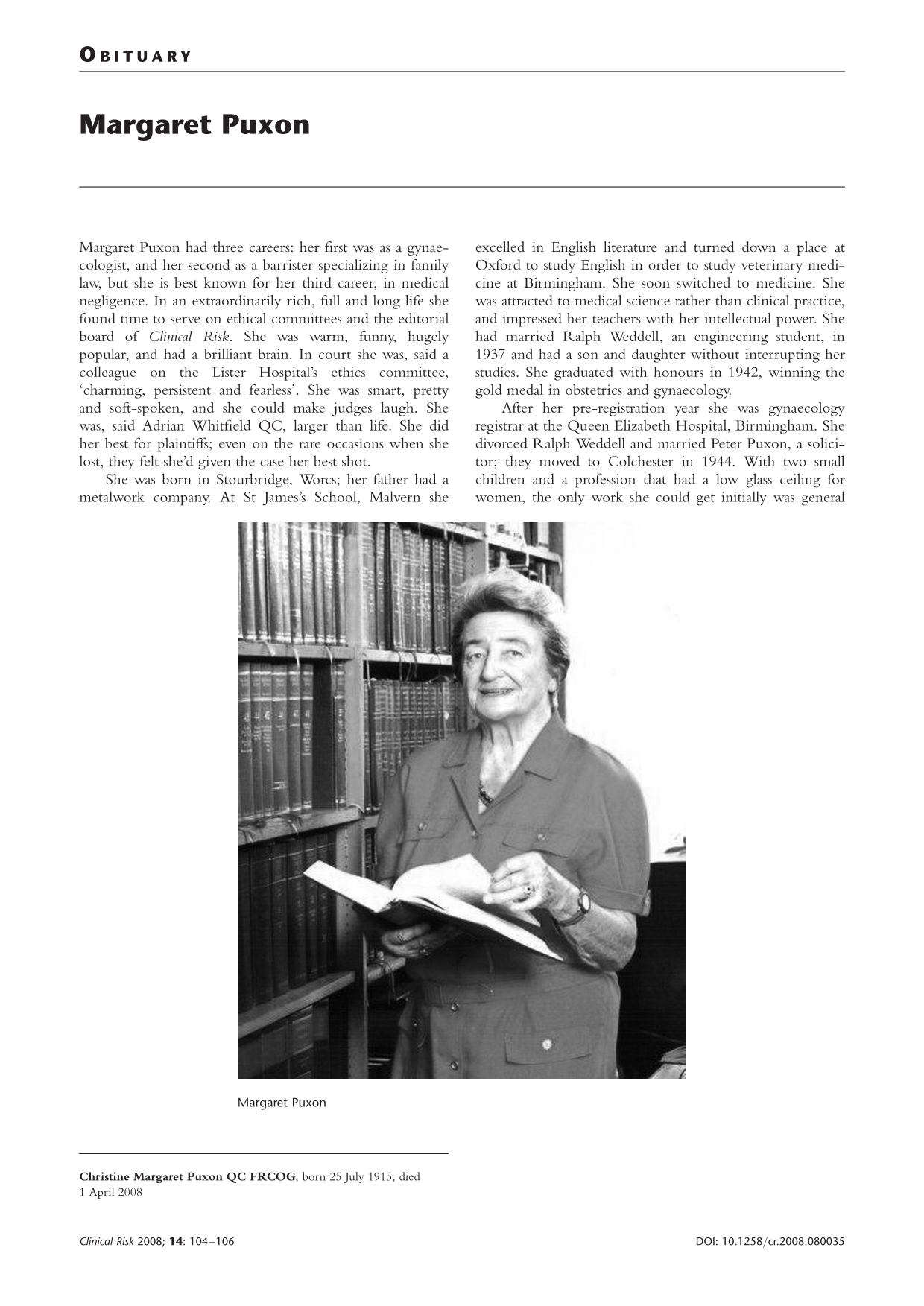
Margaret Puxon had three careers: her first was as a gynaecologist, and her second as a barrister specializing in family law, but she is best known for her third career, in medical negligence. In an extraordinarily rich, full and long life she found time to serve on ethical committees and the editorial board of Clinical Risk. She was warm, funny, hugely popular, and had a brilliant brain. In court she was, said a colleague on the Lister Hospital's ethics committee, ‘charming, persistent and fearless’. She was smart, pretty and soft-spoken, and she could make judges laugh. She was, said Adrian Whitfield QC, larger than life. She did her best for plaintiffs; even on the rare occasions when she lost, they felt she'd given the case her best shot.
Margaret Puxon
She was born in Stourbridge, Worcs; her father had a metalwork company. At St James's School, Malvern she excelled in English literature and turned down a place at Oxford to study English in order to study veterinary medicine at Birmingham. She soon switched to medicine. She was attracted to medical science rather than clinical practice, and impressed her teachers with her intellectual power. She had married Ralph Weddell, an engineering student, in 1937 and had a son and daughter without interrupting her studies. She graduated with honours in 1942, winning the gold medal in obstetrics and gynaecology.
After her pre-registration year she was gynaecology registrar at the Queen Elizabeth Hospital, Birmingham. She divorced Ralph Weddell and married Peter Puxon, a solicitor; they moved to Colchester in 1944. With two small children and a profession that had a low glass ceiling for women, the only work she could get initially was general practice locums. She studied for her membership of the Royal College of Obstetricians and Gynaecologists, which she got in 1946. Birmingham University awarded her an MD in obstetrics a year later, and she was appointed consultant gynaecologist for Essex County. In 1949, after two miscarriages, she was advised to give up work when she became pregnant again. To keep her mind active she took a correspondence course in law, and liked the clarity of being a barrister advising solicitors, rather than the untidier task of being a solicitor advising the public. The clerk of her chambers told her he would not put any work her way, and was as good as his word, but solicitors soon made their way to her door.
She separated from Peter Puxon in 1955 and moved to London because that was where the work was. She married another solicitor, Morris Williams, in 1957, and he was supportive of her career. Over the following 15 years she built up a distinguished reputation in family case law. After she applied to join an all-male firm and was turned down; the head of chambers told a mutual acquaintance that ‘I don't take niggers or women and on the whole I prefer niggers’.
She wasn't one to take this sort of thing lying down. She took on legal aid divorce work for returning servicemen, which few other barristers wanted, and eventually built up a fashionable divorce practice. Later, in the 1970s, she was head of chambers with offices in Colchester and Norwich, and continued to practice in London at the same time.
Her clients included rock star Bill Wyman in his divorce from Mandy Smith. She appears on the Rolling Stones' website—called Everybody Must Get Stoned—‘I was in London to have dinner with my barrister, a very accomplished lady called Margaret Puxon QC … [she] liked to keep in touch with what youth was up to.’
One of her landmark cases—it went to the House of Lords—was J v C, where a mother wanted to regain custody of a child she had given up for adoption. The case established that the welfare of the child was paramount in wardship proceedings and always trumped all other considerations.
By 1970 she was a leading authority in family law when she switched to medical negligence. Doctors were losing their apparent immunity from legal action. She usually represented plaintiffs. This failed to endear her to her own Royal College, that of Obstetricians and Gynaecologists. In 1979 she was elected to fellowship of the RCOG at the instigation of Janet Bottomly and Dame Josephine Barnes. The College largely ignored her and when they set up a medicolegal committee in the 1980s they did not invite her to join it.
It was with her encouragement that Roger Clements started on his career as an expert witness, and many of his early cases were with her.
Her famous cases included Krishnamurthy v Cambridge Area Health Authority. Sunil Krishnamurthy was profoundly handicapped from negligent management at Addenbrooke's Hospital in the 1970s. The case came to court a decade later and may have been the first such case brought under the Congenital Disabilities (Civil Liability) Act 1976. Margaret Puxon was up against Ian Kennedy QC—famously described in the Times, when he was prosecuting Wendy Savage, as having mistaken his way. ‘He appeared to think he was at Nuremberg.’ Margaret ran rings round Kennedy and he threw in the towel around the 10th day of the trial.
Scuriaga v Powell (1980) was the first case to deal with a failed termination of pregnancy. The plaintiff claimed the cost of raising the child, and the MDU defended it, hoping that they would get a judge who would hold it contrary to public policy that a woman should be rewarded for having a baby rather than a termination. The plaintiff was a pretty girl who had been devastatingly crippled by childhood polio. Powell, who had set up an abortion clinic shortly after the 1968 abortion act, could have settled the case for a pittance on the first day of the trial, but the MDU were uninterested in his welfare. The case destroyed his reputation and the judge—Tasker Watkins VC, chairman of the Welsh Rugby Football Union—awarded the plaintiff huge damages. For the record, the Court of Appeal did significantly reduce the award (from £18,750 to £4250).
In the early 1980s Bourn Hall, the private fertility clinic, consulted Margaret on the wording of the consent form for sperm and egg donors. The Family Planning Association (FPA) consulted her when threatened with legal action for ‘aiding and abetting a miscarriage’ when prescribing the morning-after pill. It was her opinion that ‘if there was no carriage there can have been no miscarriage’: if the pill was taken within 72 hours the ovum had not embedded in the womb and therefore there was not an abortion within the meaning of the Act. The day after she advised the FPA, Sir Michael Havers, the Attorney General, gave the same opinion in the House of Lords.
In Biles v Barking and Havering and Brentwood Health Authority (1988) she won substantial damages for a young woman who had been sterilized after being told, wrongly and with crass insensitivity, that she was unfit to bear children and would die young of kidney disease. Mrs Biles had suffered a kidney infection as a teenager. When another doctor asked her when she was going to start a family she questioned whether she has been properly advised and subsequently underwent repeated fertility treatment and suffered an ectopic pregnancy. It was the first case on damages for sterility for 30 years. Damages (£45,000) were awarded for probable permanent infertility, the pain and suffering of the procedures she underwent, scarring, impairment of sexual function, future expenses and special damages, and pain and suffering and loss of amenity.
In the early 1990s she was the first woman in the Society of Doctors in Law, a dining club, and she became its chairman. She edited Medical Law Reports (now called Lloyd's Reports, Medical) was appointed by the Privy Council to the council of the Pharmaceutical Society, and was a deputy circuit judge from 1970 to 1978 and a recorder from 1986 to 1993, when she reached 78. She served on several ethics committees including that of the Lister Hospital and the Royal College of General Practitioners.
She wrote or contributed to The Family and the Law (1963, 1971), Progress in Obstetrics and Gynaecology (1983), In Vitro Fertilisation: Past, Present and Future (1986), Gynaecoloogy (1991, Shar, Souter and Stanton, eds.), Safe Practice in Obstetrics and Gynaecology (1995, Clements, ed.), and wrote many papers for medical and legal journals. In the same year she and Morris set off on a round the world trip, and Morris died suddenly in India.
She took a pot-shot at Cherie Booth QC in 1996 when the latter took to the appeal court, Goodwill v BPAS, where a mother had sued the British Pregnancy Advisory Service because her partner's vasectomy—performed three years before they met— had been unsuccessful. She had become pregnant and decided against an abortion. The case was struck out but Mrs Blair took it to the Appeal Court, using legal aid. Lord Justice Gibson described the case as ‘unsubstantial’ and ‘manifestly unsustainable’. Lord Justice Thorpe described it as ‘far fetched’. In her comment in Medical Law Reports Margaret Puxon held the case up as a prime example of ‘hopeless cases being brought to trial with the help of legal aid’, adding that such cases are often settled on poor terms that do not reflect the underlying merits of the case but were ‘legal aid blackmail’. ‘If the legal aid system is to be preserved for cases where justice would otherwise be denied.’ She added, ‘Some protection for the fund must be devised.’
In old age she lost much of her sight and hearing and she needed a wheelchair to get around art galleries, but her memory and intellect remained as sharp as ever. So, also, did her enjoyment of opera, food and drink. She was a superb home-maker. Her interest in people, especially the young, was also undiminished. ‘She knew more about my children's career aspirations than I did,’ said Lizanne Gumbel QC.
Her funeral was conducted by the reverend Richard Collier who, like her, had more than one career; he had at one time been her instructing solicitor. He spoke of ‘the vitality and breadth of this extraordinary woman… [she was] audacious, courageous, demanding, difficult, flirtatious, formidable, funny, impossible, intelligent, naughty, single minded and unreasonable.’ He said that she may have appeared the epitome of an establishment figure but had a deeply rebellious streak, was bothered that the establishment was bureaucratic and small-minded, and cared passionately about justice end equity.
Her two sons—a musician and a solicitor—and daughter survive her.
Personal note
‘I met Margaret in 1987 when she led me in my first clinical negligence case, thereafter she became not only a colleague but a close friend. The last case she led me in was X v Bedfordshire County Council [1995] 2 AC 633. Margaret was instructed by the Official Solicitor for the five children in this case; she saw their plight as a shocking injustice and was determined to pursue the case. She retired (nearly in her 80s) soon after the first application but followed the case with interest as it made its way to the House of Lords and then to Strasbourg where the children finally recovered damages. The result came as no surprise to her. Nobody who knew Margaret well could fail to be inspired by her, she combined fierce competitiveness and determination, with a flirtatious gentle femininity and genuine concern for others – a truly rare combination.’