




Abstract

Introduction
Most surgery involves some blood loss, and major surgery or trauma may involve massive transfusion. Although superficially a straightforward issue, the remedy is more complex than simply replacing packed red cells. Managing blood loss appropriately involves a range of pre- and perioperative factors which encompass evidence-based decision-making at an individual level and healthcare infrastructure and policies on the broadest scale. This article will briefly cover salient points with particular regard to risk management issues.
General preoperative management
Identification of likely bleeding preoperatively is important and requires a functional healthcare system, e.g. pre-assessment clinics and theatre teams working within locally agreed guidelines and protocols for transfusion thresholds, cell salvage, re-infusion devices and anti-platelet agents such as clopidogrel. These agreements may vary between different surgical specialties. Such clinics can reduce risks by identifying patients who do not require transfusion, and those for whom particular strategies are useful, e.g. preoperative use of erythropoietin or transfusion alternatives, and also those with rare blood subgroups and important transfusion-related antibodies. Any such policies should be updated as new clinical evidence becomes available, e.g. increasing numbers of patients have operations without stopping clopidogrel, either for surgical reasons (e.g. carotid endarterectomy) or concurrent medical reasons (e.g. drug eluting cardiac stents). In the former, despite increasing minor bleeding and prolonging the operative time, clopidogrel may reduce the potential for neurological and cardiological complications. 1 In the latter, additional minor surgical site bleeding is outweighed by increased coronary stent thrombosis risk consequent on stopping clopidogrel. 2 However, the current clinical evidence is incomplete, and considerable uncertainty exists regarding best management for many patients at present. Good communication between the relevant specialists is essential for optimal decision-making.
Perioperative management
Surgical techniques are constantly being improved to reduce blood loss, ranging from ultrasonic or argon beam dissectors and minimally invasive surgery to radiological alternatives, e.g aortic aneurysm endovascular stent repair. Preoperative chemotherapy or tumour embolism can also reduce blood loss intra-operatively. For severely injured trauma patients, an early decision to carry out damage control surgery can avoid the irreversible fatal triad of acidosis, coagulopathy and hypothermia. Anaesthetic techniques can influence blood loss. Examples include adequate patient warming (recent NICE guidance has been published 3 ), hypotensive anaesthesia, and early identification of blood loss intra-operatively. Simple clinical examination has been repeatedly demonstrated to be insensitive for diagnosing even quite significant hypovolaemia. 4 A failure to identify and manage intra-operative hypovolaemia early is mainly measured in terms of relatively minor morbidity to individual patients (delayed gut function, minor wound infections, etc.) but translates to a 20–30% longer hospital length of stay, along with associated financial costs. An increasing range of devices are available for monitoring intravascular volume, although not all have an equal clinical evidence base to support their use. At present, the Osephageal Doppler monitor has the greatest quality and quantity of support from published studies, 5 and such monitoring may soon become a standard of expected care. Combined with arterial blood gas analysis and other point of care (POCT) or near patient care testing (e.g. Hemocue, thromboelastography, i-Stat coagulation monitoring) early identification of significant bleeding is possible, allowing a rapid and appropriate response. POCT is useful to identify actual haemoglobin concentration and coagulopathy and thus guide transfusion practice more accurately than clinical judgement alone. This is a developing field, although various historical problems of calibration and accuracy with various POCT devices are diminishing. Overall, specific tailored clinical decisions about the requirements for particular anaesthetic and surgical techniques allow best balance of risk and benefit for an individual patient (e.g. staged surgery, hypotensive anaesthesia, relative anaemia, etc.).
Transfusion
Transfusing blood is not without risk, and most easily avoided by not transfusing. Anaemia may also be perilous, but the magnitude of this risk is difficult to quantify accurately for an individual patient. Historically, transfusion to a haemoglobin level of at least 10 g/dl was standard UK practice. Because of transfusion acquired infections (especially among haemophiliacs), there was a drive to reduce the risk of infective blood and product therapy. The additional processing involved has significantly increased the cost of blood and product therapy, which has provided further stimulus to reduce unnecessary blood use. Over the last decade, there has been greater understanding of the non-infective risks of blood transfusion, and current transfusion thresholds are lower than previously (typically 7–8 g/dl). 6,7 Much of this work is based on animal models of anaemia, supplemented by observational data from specific groups (e.g. Jehovah's Witnesses), and confirmed in clinical trials in a variety of patient types. The concept and safety of permissive anaemia now seems well established, although currently we cannot accurately predict the lowest safe haemoglobin concentration for an individual patient, and it is likely that this varies with time as well as between individuals. 7
Overall, the potential for achieving decreased blood use nationally is more than counterbalanced by increased demands on a shrinking donor pool for more complex surgery in an increasingly numerous and aged population. The cost of unnecessary transfusion to a patient and the NHS is unknown but is likely to increase. Arrangements at national level will be required to manage this challenge.
Once a decision has been made to transfuse blood or products to an individual, additional risk arises. Serious hazards of transfusion (SHOT) reports show that many of the fatal and near fatal problems with transfusion relate to incorrect identification at the bedside of the patient-blood product combination. 8 One potential solution (in use at the author's institution) is to have a bar-coded patient identity bracelet which is read electronically using a handheld scanner (Figures 1 and 2). This scanner is then used to identify the blood product and confirm the correct match prior to transfusion. Nationally, risk reduction has been improved by the UK Blood Safety and Quality Regulations 2005, which set standards for clinical governance and mandatory reporting processes.

Device for confirming patient/blood cross-match compatibility. Handheld scanner (A) confirms staff and patient identities as well as blood bag number; packwood blood bag tag label inserted into slot (B); sample match confirmed on screen (C)
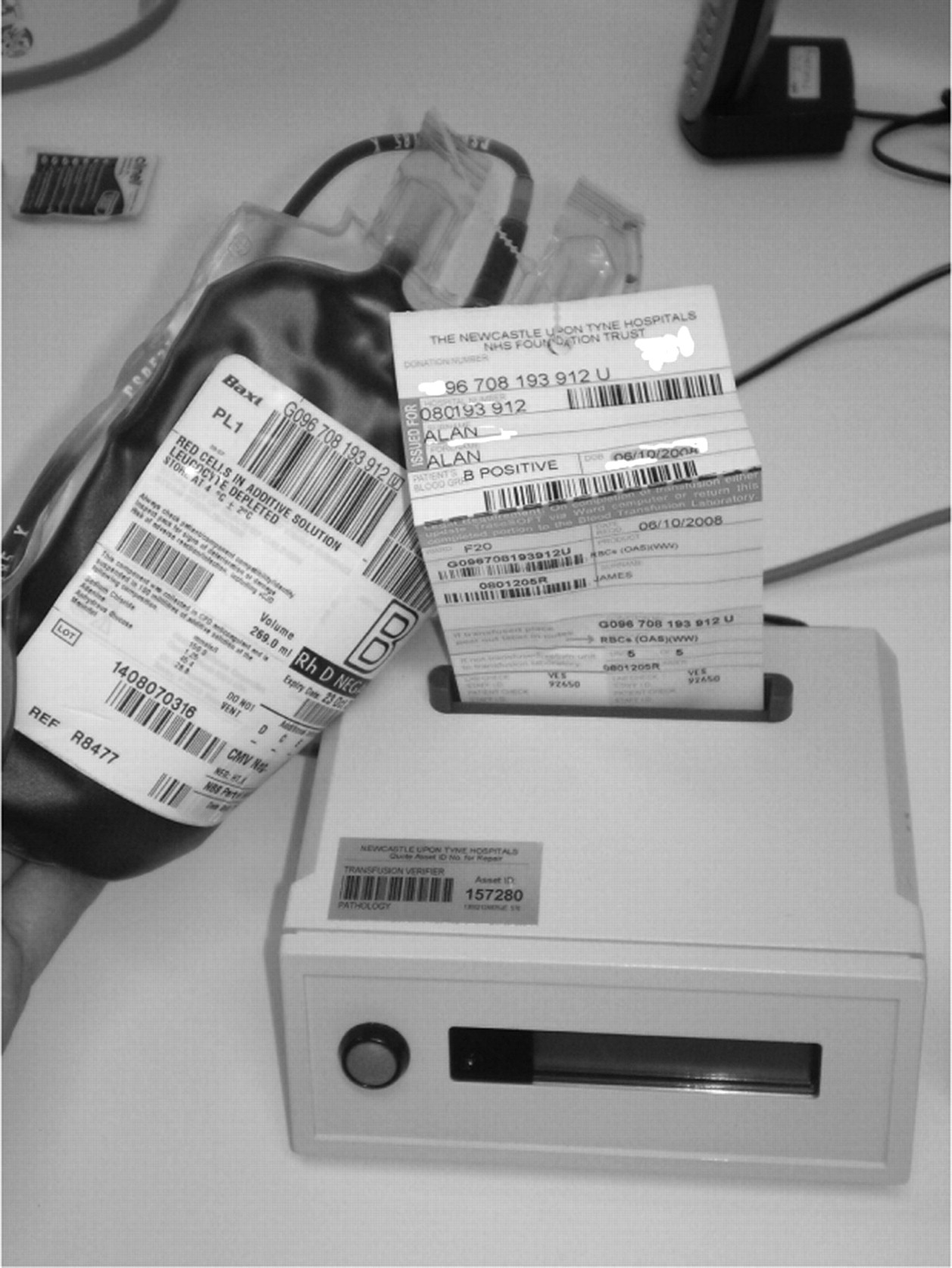
Scanner in use
Cell salvage
One of the most effective ways to reduce the risks of transfusion is to return the patients own shed blood to them. This may be using a relatively simple device such as a re-infusion drain following orthopaedic surgery (essentially a drain with a filter and reservoir) or more complex technology involving centrifugal spinners and washing devices (e.g. Cell Saver) to separate red cells from operative and other debris before re-infusing the red cells in a saline suspension. 9 The more sophisticated versions can provide platelet rich fluids and gels as well as red cells only. This technology, although expensive, does reduce patient risk and blood usage, and becomes more efficient with higher blood losses. Overall, it is likely to expand its place in surgical practice.
Specific issues
Major haemorrhage in trauma patients
Risks from major haemorrhage include hypoperfusion related organ failure and exsanguination. Between 30% and 70% of trauma deaths may be due to uncontrolled blood loss. It has become clear that coagulopathy develops earlier than previously appreciated in trauma patients, often before significant blood loss has occurred. Increasing research efforts are being directed at the specific management of this in addition to red cell replacement. Reviews of large trauma databases and an increasing number of smaller prospective studies suggest that a ratio of packed cells to fresh frozen plasma of 1:1 (and probably also more aggressive platelet transfusion) is associated with improved outcomes (Anticipatory Treatment of Trauma associated Coagululopathy [ATTaC]). 10,11 Most military and many civilian organizations have changed their major haemorrhage protocols in the light of this evidence, and ongoing research will undoubtedly refine current recommendations, especially with regard to the targeted treatment of acquired coagulopathy. Increasingly, large databases will allow trend analysis both for risk identification and hypothesis generation.
Aprotinin
Aprotinin has been in use for almost 20 years, and despite multiple studies showing an acceptable safety profile, events over the last three years have severely curtailed its use. The UK licence has been restricted since 2006 due to concerns about renal dysfunction. In 2007, the Canadian BART trial (Blood Conservation using Antifibrinolytics: A Randomized Trial in High-Risk Cardiac Surgery Patients) was stopped early after a significant trend towards increased mortality in aprotinin-treated patients. Marketing was voluntarily suspended, although it is still available via a special access protocol. There is ongoing debate about the quality of the studies which showed adverse effects, and the fine details of the BART study are not yet available, but it seems unlikely that aprotinin will be used frequently irrespective of the outcome of the current controversy. 12,13 As with pulmonary artery catheterization (PAC), there seems to be a tipping point of opinion against the technique even if not confirmed objectively. Unlike the PAC, most authorities agree that the alternatives are less useful in their prescribed role (of reducing blood loss).
Warfarin
Warfarin is commonly prescribed for a range of indications, but the concordance between guidelines regarding indications for use is poor. 14 This constitutes an appreciable risk to patients, since perhaps 0.3% of anticoagulated patients suffer a fatal bleed annually due to their medication, and anticoagulation is indicated for up to 1.5 million people in the UK. New oral anticoagulants (e.g. dabigatrin and rivaroxaban) are now becoming available, and it is likely that warfarin use will diminish over the next few years assuming post marketing surveillance proves the safety of the new drugs.
Reversal of warfarin effect can be achieved in a number of ways (Table 1). There are different risks and benefits with each, and the correct choice depends on the individual clinical circumstances.
Time to reverse warfarin effect (to INR <1.5)
Fresh frozen plasma and prothrombin complex concentrate
Although fresh frozen plasma (FFP) is the current mainstay of coagulopathy management for many patients, it is relatively dilute plasma (80% plasma and 20% water) and standard dosing requires a significant volume of fluid to be given – several litres in many cases. Additionally, even large doses of FFP will frequently not raise plasma levels of II, VII, IX and X into normal reference ranges. This is part of the rationale for the British Society of Hamatology recommendations not to use FFP as a sole reversal agent for warfarin over-anticoagulation. 15
Despite this recommendation, FFP continues to be used in a significant number of patients for this purpose. FFP derived from female donors is more likely to precipitate acute lung injury and respiratory distress syndrome, so most haemovigilence programmes now exclude female donor plasma. 16
Prothrombin complex concentrates (PCC) are derived from pooled plasma, and in the UK, Beriplex is the most commonly available. Administration of Beriplex 15–35 u/kg (Factors II, VII, IX, X plus Protein C, S) rapidly reverses warfarin effects for 6–8 hours and usually raises clotting factor levels into the high normal range. PCC contain no factor V or VIII, but the former is present in both natural and transfused platelets, and the plasma concentrations of the latter increase in stress, so these deficiencies in PCC may not be clinically important.
Although licensed for and predominantly used for reversal of over-anticoagulation, PCC are increasingly being used as an alternative to FFP in a variety of situations including massive transfusion, cardiac surgery and some Jehovah's Witnesses.
PCC are more expensive (around £750 per dose for a 70-kg patient, compared to £250 for 1 litre FFP), but are likely to have an increasing role in the management of acquired coagulopathies. In cardiac surgery, the restrictions on aprotinin use may drive increased PCC use, and in more general use, patients who may not tolerate intravascular volume expansion (e.g. because of poor cardiac function or euvolaemic haemodilution) may also be appropriate for PCC use.
PCC may unmask or exacerbate hypercoaguable states, especially in patients with liver disease, so prophylactic heparin should be considered.
Recombinant activated factor Seven
Recombinant activated factor Seven (rFVIIa) is licensed for use in haemophilia patients, but is frequently used off-license for rescue therapy in acquired haemophilia and major bleeding. First described for trauma use in 1999, it has subsequently been subject to a series of trials under different circumstances ranging from major trauma to urology. Although some promising results have been noted, and rFVIIa is part of many major haemorrhage protocols, a recent Cochrane review advised that the trend towards benefit from treatment with rFVIIa was insufficient to recommend routine use. It was also recommended that rFVIIa should only be used in the context of ongoing trials. 17 A phase 3 trial of rFVIIa for trauma was recently suspended on grounds of futility (the mortality rate in the study was much lower than anticipated, and it was evident it would be severely under-powered). This is an example of the enthusiastic widespread adoption of a clinical strategy without adequate supporting evidence, and it may be that FVIIa use declines as this information reaches clinical practice. It may, however, still have a role in military situations where platelets and cryoprecipitate are logistically difficult to transport and store.
Desmopressin
Initially used for haemophilia patients, desmopressin acts by increasing release of von Willibrand factor from platelets. It has been investigated as a haemostatic agent for a variety of conditions, including actual or functional thrombocytopenia, cardiac, spinal and aortic surgery, as well as liver transplantation. It has only a limited effect for patients without pre-existing haematological abnormalities. 18
Novel haemostatics
A variety of novel haemostatics are available including QuikClot, HemCon and Celox. QuikClot is a powder which acts as a zeolite by absorbing water from blood, increasing the local concentration of clotting factors. HemCon is a flexible dressing which uses electrostatic charges to increase red cell adhesion. Both are in routine military use for extremity and junctional zone injuries, but are not licensed for intra-cavity use, although there are case reports of successful use in the face of significant ongoing thoraco-abdominal haemorrhage. Already, these products have been purchased by various civilian agencies, although the demographics of likely patient groups are quite different from those for which these products were developed and trialled. Again, this is perhaps an over-enthusiastic adoption of a technology for a purpose other than that it was designed for, and additional specific studies are required to justify their continued use in the civilian environment.
Red cell substitutes
Despite prolonged and intensive research, and limited current clinical use in South Africa, a recent meta-analysis of artifical haemoglobins showed a significant increase in adverse events, and recommended that no further advanced (e.g. phase 3) studies be carried out. 19 Despite this, the huge potential dividends from a successful red cell substitute and increasing difficulties with ensuring an adequate donor pool, make it likely that research in these products will continue unabated.
Conclusion
It seems currently unlikely that blood transfusion as a treatment will ever be completely avoidable, but the risks associated with perioperative transfusion can be mitigated by careful preoperative assessment, planning and appropriate use of a wide range of management options. These involve linking together a range of strategies such as individual patient-centred decision-making about transfusion thresholds and blood conservation techniques. This may be based on hospital-wide audits of transfusion practice and staff education, as well as high quality clinical studies. Expert consensus agreements and directives (e.g. NICE guidance on warming in the perioperative period) or snapshot studies such as SHOT have a role in emphasizing particular topics and encouraging problem-solving behaviours. High quality information is essential to allow trend analysis among large patient populations, which in turn lead to hypothesis generation and promote well-designed clinical trials which in turn can improve mainstream practice.
Each of these techniques may be flawed – expert consensus may be wrong, many influential studies are poorly constructed or executed, individual clinical decision-making is frequently inconsistent and rarely subject to audit, and so on. However, great changes have been seen in transfusion practice over the last decade using such techniques, and they are likely to continue to form the mainstay of practice developments for the near future.