




Abstract

Clinicians are experienced and trained in the technical aspects of medicine that have brought significant improvement for patients, both in diagnosis and in treatment. They are also practiced and often skilled communicators with patients and their families, yet they often have little training in the ethical and legal aspects of practice — which also advance at pace, with new legislation, guidelines or test cases. And a rapidly ageing population coupled with the rising prevalence of dementia means that practical application of ethical and legal principles in practice are increasingly important for many clinicians and for their employing organizations, where patients with impaired mental capacity may be cared for.
This article discusses a number of the difficult issues that doctors have to take into account in relation to treating older patients with impaired mental capacity — where clinicians walk a difficult line in discharging their duties. Ultimately, clinicians’ decision-making must be legally defensible and they must cite the evidence supporting their decisions. It is not possible to provide an in-depth review of the Mental Capacity Act 2005 (“MCA”) or issues around informed consent. The purpose in this article is to highlight and analyse some of the difficulties doctors face every day.
In establishing a patient's involvement with medical treatment, the law is now seemingly clear. A doctor must presume the patient has the mental capacity to consent or refuse medical treatment. This is based upon the principle known in law as the inviolability of autonomy. While a simple premise, it competes with another medicolegal principle: the sanctity of human life. This is reflected in the European Convention on Human Rights, where Article 8 provides patients with a right to private and family life; however, there is now a growing number of cases which imply a positive obligation under Article 2, the right to life. 1
Even a doctor who is trained and comfortable in assessing mental capacity may fall foul of the law in other ways. For instance, a patient who refuses a pressure relieving mattress may develop a pressure ulcer, which, once septic, can lead to death. Where there is a potential for culpable human failure 2 regarding the cause of death, a Coroner may convene an inquest to establish the cause of death. Although Coroner's are not permitted to find liability, 3 they may find a doctor to be the cause of death and issue a Rule 43 4 criticizing the doctor and the Trust. So where does a doctor start? The case study below illustrates some of the difficulties and potential solutions for doctors. The following case contains facts which are commonly encountered.
Case study
Dorothy is an elderly lady with dementia and questionable mental capacity. Her clinical picture is complicated by the co-existent presence of a related neurological condition (Parkinsonism) raising the potential of an element of reversibility. However, she appears unable to process information relating to her ongoing care needs to a sufficient level to allow a balanced informed decision; verbal communication is nil. A nasogastric (NG) tube is passed; however, she has since pulled out the NG tube. Dorothy has a son and a daughter, one of whom wishes the tube to be re-inserted, and the other disagrees and wishes no further medical treatment for her mother. They both cite previous wishes of their mother in that she, Dorothy, was religious and believed that only God could take life; however, she was a nurse and had stated that she “wouldn't want to live like that” alluding to elderly patients with dementia.
Mental capacity assessment
If a doctor has a concern around the mental capacity of a patient, the doctor must assess for mental capacity to make that particular decision. Under section 3 of the MCA 2005 the assessment is broken into a two-stage test. Stage 1 is the diagnostic/functional test to establish whether the patient has an impairment of or a disturbance in the functioning of the mind or brain (whether temporary or permanent). Is their an impairment of or a disturbance in the function of the person's mind or brain? The Cerbral Vascular Accident (CVA) (stroke) could 5 constitute such impairment depending on the level of severity 6 which is then dependent on the treating doctor's opinion.
If they do, does the impairment or disturbance make the person unable to make the particular decision?
Once this is established, the doctor moves on to the second-stage test. If the patient is unable to make the particular decision after all appropriate help and support to make a decision has been given to them (e.g. information, yes/no cards, paper and pen, etc.) they can not:
Communicate their decision (whether by talking, drawing, signs, etc.); Understand the information relevant to that decision, including understanding the likely consequences of making, or not making the decision; Retain the information; Use or weigh up the information as part of the process of making the decision, then the doctor can find that the patient does not have mental capacity for that particular decision.
The five principles:
A presumption of capacity; The right for individuals to be supported to make their own decisions; Individuals must retain the right to make what might be seen as eccentric or unwise decisions; Best interests — anything done for or on behalf of people without capacity must be in their best interests; Least restrictive intervention — anything done for or on behalf of people without capacity should be the least restrictive of their basic rights and freedoms.
Mental capacity is decision specific — the person may have mental capacity for one thing, but not for another;
Is there an impairment of or a disturbance in the functioning of the persons mind or brain (whether temporary or permanent)?
If so:
Does the impairment or disturbance make the person unable to make the particular decision?
The person will be unable to make the particular decision if after all appropriate help and support to make a decision has been given to them (e.g. information, yes/no cards, paper and pen, etc.) they can not:
Communicate their decision (whether by talking, drawing, signs, etc.); Understand the information relevant to that decision, including understanding the likely consequences of making, or not making the decision; Retain the information; Use or weigh up the information as part of the process of making the decision.
Questionable mental capacity
What if the patient refuses to engage in an assessment or is unable to, by virtue of a third party? Under section 48 of the MCA, an urgent “interim order” can be made even if it has not been proved that the person lacks mental capacity. This is expensive and a significant curtailment of fundamental rights, temporary, and ought to be of last resort. There are two important cases which exercised this power prior to the MCA.
In Re C (Adult: Refusal of Medical Treatment) [1994] 7 an older man with paranoid schizophrenia refused amputation for his gangrenous leg despite delusions of grandeur; he believed himself to be a great doctor who could cure himself. The court found that, despite his mental illness, he could make the decision to refuse the amputation. C had researched medical treatment for gangrene and came to the decision that surgery would be a greater risk to him than conservative treatment.
Compare that to Re MB (an Adult: Medical Treatment) [1997] 8 where a pregnant woman was found to be mentally incapacitated to refuse a Caesarean section. MB had no underlying impairment other than a phobia of needles. Although she originally consented to an emergency Caesarean section, she refused in theatre and an urgent court order was sought. The court found her to be “impervious to reason” as she had “an impossibility of adjustment following a period of reflection”.
There are numerous other cases that lie between these two extremes; however, it is useful to examine the facts more closely. There are some obvious differences between the cases. Gender, age, liberty and pregnancy. Which matter most? There is insufficient research on findings of the court around incapacity and gender. Age can play a role in determining aspects regarding refusal of medical treatment. Gangrene in older age grows slowly, while the risks of complications in surgery are higher. 9 Conversely, a Caesarean section has its risks of complications which have to be weighed against the risks of not having the surgery.
The fact that C was detained would play no difference. Indeed being detained by the state raises the duty of care to ensure medical needs are met. Regarding MB, an unborn child has no legal rights 10 and would thus not officially play a role in the judges’ decision. There are, however, subtle differences. Firstly, MB was decided urgently, indeed it was taken to the court of first instance (the Family Division, now the Court of Protection) and subsequently to the Court of Appeal — in the same day. It is this author's submission that judges are alive to the human realities and consequences the law can inadvertently facilitate, in this case the death of a healthy child and possibly the mother. A mentally disordered offender may not receive the same amount of intervention against his will unless there is a public policy of doing so. 11
How is a doctor to use these cases in compliance with the MCA? The MCA was largely a consolidated piece of legislation, sweeping up the case law into one statute. The previous case law which does not overtly contradict the MCA still stands until overruled or distinguished by subsequent case law. These types of cases allow some discretion to a doctor, particularly when the decision is urgent, and/or life-threatening, and based upon an adverse emotional state, such as phobia. It is submitted that there is no such discretion where the decision does not involve urgency and life. However, the courts have further muddied this difference.
Inherent jurisdiction
The MCA is a Statute of Parliament — the highest law. However, the inherent power of the High Court can appear to obviate certain elements of it. In the case of Re: SA (Vulnerable Adult With Capacity: Marriage) [2005]
12
Lord Justice (Sir James) Munby held that the inherent jurisdiction extended to vulnerable adults who had mental capacity, commenting: “… the inherent jurisdiction is no longer correctly to be understood as confined to cases where a vulnerable adult is disabled by mental incapacity from making his own decision about the matter in hand and cases where an adult, although not mentally incapacitated, is unable to communicate his decision. The jurisdiction, in my judgment, extends to a wider class of vulnerable adults.”
Situational mental incapacity
Munby LJ defined those “vulnerable adults” who can be regarded as covered by the jurisdiction: “the inherent jurisdiction can be exercised in relation to a vulnerable adult who, even if not incapacitated by mental disorder or mental illness, is, or is reasonably believed to be, either: (i) under constraint; or (ii) subject to coercion or undue influence; or (iii) for some other reason deprived of the capacity to make the relevant decision, or disabled from making a free choice, or incapacitated or disabled from giving or expressing a real and genuine consent.”
Criticism
The case has been criticized. In Ealing LBC v KS [2008]
13
Mr Justice Sumner, referring to Munby LJ's dicta, took a different approach: “Mr Justice Munby [now Lord Justice] was, I respectfully suggest, simply indicating that there are instances where a person cannot in truth consent although not incapacitated within the meaning of the 2005 Act. He was, I suggest, talking of persons who are deemed not to have capacity in the true sense, and not of persons where a paternalistic authority considers the acts unwise.”
Best interests
If it is established that Dorothy does not have mental capacity to make the particular decision, the assessing doctor must establish the existence, or otherwise, of an Advanced Decision, 14 a Lasting Power of Attorney 15 or an Appointed Deputy. 16 Assuming there are no such issues, the doctor must treat in best interests. This is not defined under the MCA. Clinical staff of various professions often have the erroneous belief that once mental incapacity is established, the treating professionals can “act in best interests”. This is a misnomer. Aside from checking for an Advanced Decision, a Lasting Power of Attorney or an Appointed Deputy, in establishing a patient's best interests, one must take into account the previous wishes of the patient. 17 Otherwise known as “substituted judgment” it requires information from family and friends of the patient. The dilemma can be when family disagree with each other or with the treating professionals. A practical means of establishing this would be to invite the family to a best interests meeting ensuring that appropriate family members are present (ascertained by a comprehensive family history). At the meeting a balance sheet is written:
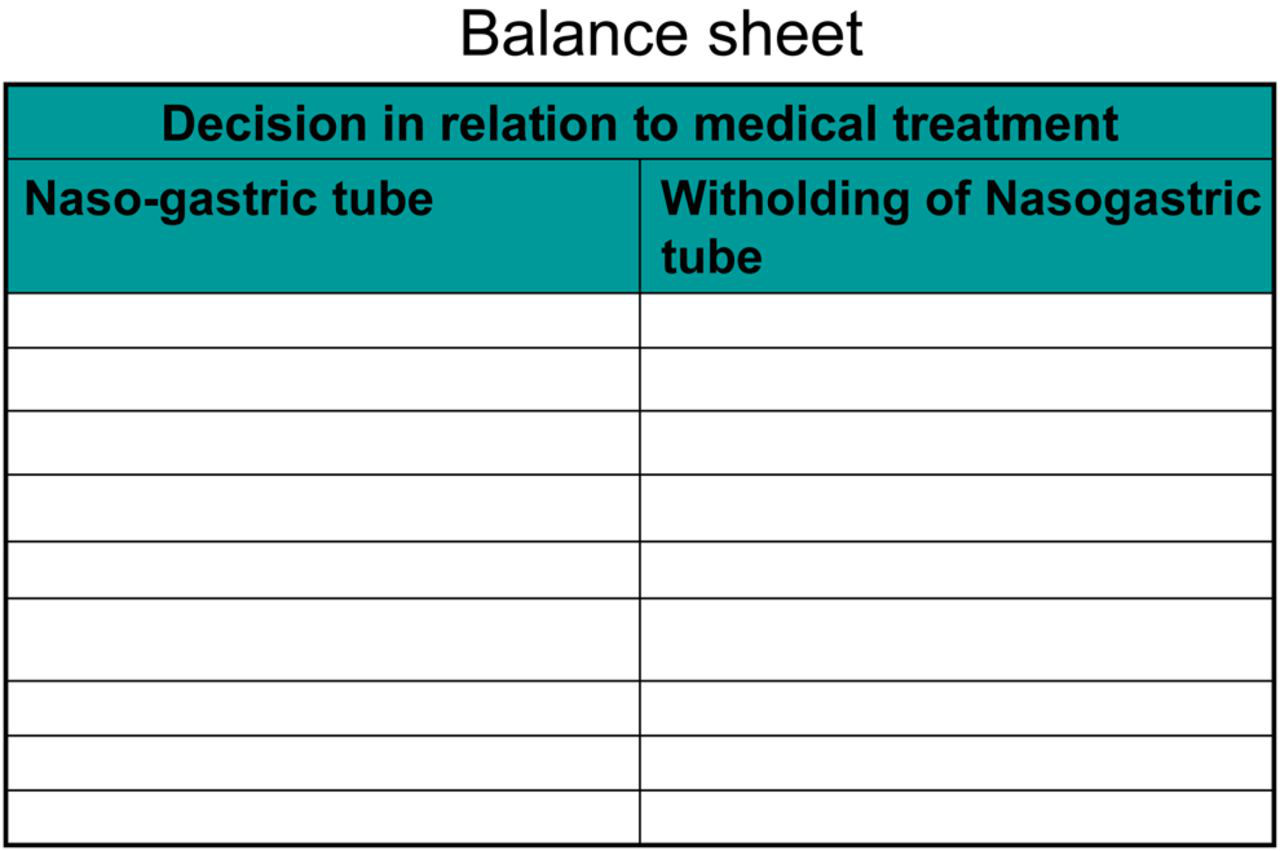
The case law which relates to best interests is highly useful and will be addressed below. Firstly, however, the doctor must ascertain the previous wishes of the patient. 18 This is known as Substituted Judgment and has no history in English Law until the MCA brought this provision in. It can be difficult to ascertain the previous wishes of the patient. The best practice for establishing the best interests is the balance sheet. This is not merely the best medical interests, but may also include best social interests. 19 This includes familial contact.
Where the legislation provided this novel change to English medical law, the courts removed it. In W v (1) M, (2) S, (3) A NHS Trust [2011] 20 the Court undertook a balance sheet exercise in ascertaining M's best interests with the presumption of life being given greater weight than M's previously expressed wishes and beliefs; this is in complete contrast to the legislation which does not state such. In his judgement, Mr Justice Baker reminded those considering a similar application at Paragraph 82 that: “All cases involving a decision to withhold artificial nutrition and hydration must be referred to the Court.” This appears to subjugate the provisions under the MCA, particularly section 4(6) and sections 24–26. It is this author's submission that where the lawful process has been followed under the MCA, and that the decision to withhold a NG tube has been agreed as not in the patient's best interests, it is lawful not to prescribe the tube feeding. The fine distinction lies between the withdrawal of ANH for people in PVS, against withholding of such treatment for people at end of life.
The legislation does not prohibit the withdrawal of artificial 21 nutrition and hydration (“ANH”). However, the Code of Practice states at Chapter 6.18: “The Court of Protection must make decisions relating to the proposed withholding or withdrawal of artificial nutrition and hydration from a patient in a permanent vegetative state (‘PVS’)”. What of other levels of consciousness? The Courts and the General Medical Council (“GMC”) are not in full agreement on this subject. In the Burke [2005] 22 case, the Court of Appeal fortunately overruled a judicial review decided by Munby LJ at first instance which had found the GMC guidance on end-of-life to be unlawful. Nevertheless, as stated above, Munby LJ is now a Court of Appeal judge and may attempt to alter such a ruling on any future case.
This question was debated in a recent publication by the Royal College of Physicians, Oral Feeding Difficulties and Dilemmas
23
which states at Chapter 4.56: “The Court of Appeal has cast recent doubt on the desirability of getting court authorisation in many cases in which it would seem prudent to ask for it. In the Burke case (in the context of a debate about the withdrawal of ANH), Munby J, at first instance, said that the court's guidance should be sought.” “Unfortunately Munby J [as was] rather overstated things, saying that there was a legal obligation to seek approval from the court in these circumstances, rather than it being desirable.” “Of these, 30% die in the unit or on the wards. Most of these deaths are a result of the withdrawal or limiting of treatment — albeit in circumstances where the treating clinicians conclude that treatment would be likely merely to prolong the process of dying. There is not always agreement on the part of all concerned about the withdrawal of treatment.”
In the case study above, RB has pulled out the NG tube herself. Does this make a difference? Where a physically objecting mentally incapacitated patient requires life-sustaining treatment, it may not be in their best interests where the treatment becomes reasonably impracticable. 24 If she were to continue to pull out the NG tube, despite the use of hand-mittens to prevent her doing so, the treatment is likely to meet the limits of practicability. Nevertheless, it may still be necessary to seek a declaration to escape any future liability.
Conclusion
Medical law is fraught with difficult decisions and frequent legal contradictions. The route to safe practice is defensible decision-making; the focus on the process followed rather than the end decision itself. By following the legal process set out under the MCA and Code of Practice, doctors and other health professionals are more likely to evidence the decision. A further consideration for treating professionals is the blind ratchet of medical treatment; often simple to prescribe, potentially unlawful to withdraw. Where doctors and other health professionals follow the legal process, they are less likely to make this mistake. “the answers must be on sensible risk appraisal, not striving to avoid all risk, whatever the price, but instead seeking a proper balance being willing to tolerate manageable or acceptable risks as the price appropriately to be paid in order to achieve some other good — in particular to achieve the vital good of the elderly or vulnerable person's happiness.