




Abstract
The aim of the paper is to assess nitric oxide (NO) production during aerobic training and its role on the progression of diabetic nephropathy in rats. Induction of diabetes mellitus (DM) was achieved in adult male Wistar rats with streptozotocin. Half of the animals underwent training on a treadmill and the others (sedentary) stayed on a turned-off treadmill for the same period according to the following groups: sedentary control (CTL + SE); training control (CTL + EX); sedentary diabetic (DM + SE); and training diabetic (DM + EX) (n = 9 for all groups). The training on treadmill was carried out at a work rate of 16 m/min, 60 min/d, 5 d/week for eight weeks. Before and after the exercises, rats were placed in individual metabolic cages with standard chow and water ad libitum, for 24-h urine collection, followed by three hours' fasting blood sample withdrawal from the retro-orbital plexus, under anesthesia. Diabetic animals showed reduction of body weight, creatinine and urea depurations and NO excretion, increased blood glucose concentrations, albuminuria and thiobarbituric acid reactive substance (TBARS) excretion, when compared with the respective controls. All these alterations induced by DM were attenuated in the DM + EX versus DM + SE group. Analysis of insulin concentrations at the end of the protocol showed no significant change between the DM + SE and DM + EX groups. In conclusion, our data show that a routine physical exercise resulted in a better control of glycemia with an increased NO bioavailability and oxidative stress control, associated with an amelioration of renal function. We suggest aerobic training and the control of oxidative and nitrosative stress as useful non-pharmacological tools to delay the progression of diabetic nephropathy.
Keywords
Introduction
Diabetes mellitus (DM) is a metabolic disease responsible for about 5% of all deaths each year, which will likely increase by more than 50% in the next 10 years. 1 DM leads to micro- and macrovascular disease characterized by endothelial dysfunction 2 and several studies suggest its association with a diminished generation of nitric oxide (NO) in endothelial cells. 3,4
The free radical NO, one of the most widespread signalling molecules in mammalian biology, synthesized from
Some studies showed that endothelial NOS (eNOS) activity is increased in skeletal muscle during acute exercise. 6 It has been shown that exercise, performed in conjunction with insulin infusion, enhanced the action of this hormone by increasing the availability of glucose and its stocks in the muscles of both non-diabetic and diabetic subjects. 7 Balon and colleagues 8 found evidence that NO is involved in the signal transduction mechanism of glucose transport in skeletal muscle during exercise.
On the other hand, acute physical activity can induce oxidative damage to tissues, because of increased whole body and tissue rates of oxygen consumption, but a routine that includes exercises, enhances antioxidant defenses in different organs. 9 The aim of this study was to assess NO production during aerobic training and its role on the progression of diabetic nephropathy in rats.
Methods
Male Wistar rats of eight weeks of age and weighing between 170 and 210 g were obtained from the Central Animal Housing of Escola Paulista de Medicina. All protocols were approved by the Ethics Committee in Research of Universidade Federal de São Paulo, protocol #1456/06. The animals were maintained in the Animal Housing of Nephrology Division at temperatures of 22 ± 1°C and at a light/dark cycle of 12/12 h, beginning at 06:00 hours. Rats were allocated into four groups: CTL + SE (sedentary control); CTL + EX (training control); DM + SE (sedentary diabetic); and DM + EX (training diabetic); n = 9 for each group.
DM induction
Animals received a single intravenous administration of streptozotocin (Sigma Chemical Co, St Louis, MO, USA) (60 mg/kg BW) dissolved in 0.1 mol/L citrate buffer, pH 4.5. Two days later, blood was collected from the retro-orbital plexus under anesthesia (ketamine chloridrate at 60 mg/kg and xylazine chloridrate at 12 mg/kg, both intraperitoneal). DM was defined in this study as fasting blood glucose >200 mg/dL; animals failing this criteria were excluded. 10
Physical training
The exercise protocol started on the fifth day after induction of DM; it consisted of a moderate running on a motor-driven treadmill for 60 min/d at 16 m/min, 5 d/week, during eight weeks. 11 The sedentary group stayed on a turned-off treadmill for the same period. Animals of all groups were placed in individual metabolic cages with water and food ad libitum for 24-h urine collection, prior and after the eight weeks' protocol. The animals were removed from the metabolic cages and a blood sample from the retro-orbital plexus was collected after three hours' fasting (same day). All samples were placed in a freezer at −20°C. At the end of the exercise protocol, the animals were sacrificed with a high dose of anesthetic (ketamine chloridrate at 90 mg/kg and xylazine chloridrate at 18 mg/kg, both intraperitoneally).
Renal function
Plasmatic and urinary levels of creatinine were measured by a colorimetric assay creatinine kit Labtest® (Centerlab Ltda, Sao Paulo, SP, Brazil). The plasma and urinary urea concentrations were measured by urea kit CE Labtest® (Centerlab Ltda).
Albuminuria
The urinary excretion of albumin, an early marker of diabetic nephropathy, was determined by a method of radial immunodiffusion. 12
Insulin
Plasma insulin was assayed by enzyme-linked immunosorbent assay (ELISA) using a commercial rat/mouse FGF-21 ELISA KIT (Millipore, St Louis, MO, USA), to verify the persistence of type 1 DM at the end of the protocol.
Tissue preparation
The renal cortex was removed and immediately transferred to ice-cold containers with 0.9% NaCl and homogenized in 0.1 mol/L Tris-HCl buffer (pH 7.4). After centrifugation at 3000 rpm at 4°C for 10 min, the supernatant was collected and stored at −80°C to be used for NO and lipid peroxidation assays. 13
NO measurement
NO was measured to evaluate the magnitude of vascular damage and the oxidative stress equilibrium in diabetic rats. NO is extremely unstable; however, we used a method in which the nitrite and nitrate present in the urine and renal cortex homogenates were re-converted to NO through reaction with vanadium.
14
This NO was quantified by a chemiluminescence method using a Nitric Oxide Analyzer (Sievers Instruments, Inc, Boulder, CO, USA), a high-sensitive detector for measuring NO, based on a gas-phase chemiluminescent reaction between NO and ozone:

The emission of a photon from electrically excited nitrogen dioxide is in the red and near-infrared region of the spectrum, and it is detected by a thermoelectrically cooled red-sensitive photomultiplier tube. The sensitivity for measurement of NO and its reaction products in liquid samples is ∼1 pmol.
Estimation of lipid peroxidation
The lipid peroxidation in terms of malondialdehyde (MDA) was estimated by using the thiobarbituric acid reactive substance (TBARS) method 15 and MDA concentration was calculated using a molar extinction coefficient of 1.56 × 10⁵ mol−1 cm−1 16,17 in 24-h urine 18 and renal cortex 19 at the end of the eight weeks' exercise protocol.
Histological analysis
At the end of the exercise protocol (eight weeks), the kidneys were removed under anesthesia, fixed in 10% formaldehyde and embedded in paraffin, sectioned at 4-μm thickness and stained with hematoxylin–eosin (HE), periodic acid-Schiff reagent (PAS) and Masson trichrome. The analysis was carried out at a magnification of ×400 and analyzed by a pathologist under blinded conditions.
Statistical analysis
The results were expressed as mean ± SEM and as box plots with medians. The values were compared with one-way analysis of variance with Student–Newman–Keuls post hoc analysis. We used the Pearson's test for analysis between NO and albuminuria and between NO and TBARS. Significance was defined as P < 0.05.
Results
Metabolic profile
The groups at the eighth week of protocol showed some differences between measures of body weight (g), water (mL/24 h) and chow (mg/24 h) intake, diuresis (mL/24 h) and blood glucose (mg/dL). CTL + EX showed a reduction in body weight, a similar water and chow intake, diuresis and blood glucose, when compared with CTL + SE (Table 1). It was observed that in DM + SE, all parameters mentioned above, except for body weight and urinary creatinine, were significantly increased when compared with CTL + SE. On the other hand, DM + EX showed higher body weight and reduction of water and chow intake, and attenuation of urine output and glycemia when compared with DM + SE, all P < 0.05 (Table 1).
Body weight, blood glucose, diet and water consumption, diuresis, plasma and urinary concentrations of creatinine and urea after the eighth week of exercise protocol
CTL + SE, sedentary control; CTL + EX, training control; DM + SE, sedentary diabetic; DM + EX, training diabetic
Results are represented as mean ± SEM. Statistical analysis: one way analysis of variance with post hoc analysis of Student–Newman–Keuls
P < 0.05: * versus CTL + SE; † versus CTL + EX; ‡ versus DM + SE
Insulin
The CTL + SE and CTL + EX groups, at the eighth week of protocol, showed distinct levels of insulin (ng/mL); there was a reduction of this hormone in CTL + EX compared with CTL + SE (0.81 ± 0.1 versus 2.0 ± 0.2; P < 0.05). There was no difference between the diabetic rats with or without exercise (0.2 ± 0.08 versus 0.08 ± 0.05); however, these levels were significantly reduced when compared with the respective controls (Figure 1).

Insulin concentrations after the eighth week of exercise protocol. n = 9 for all groups. Results are represented as medians. Statistical analysis: one way analysis of variance with post hoc analysis of Student–Newman–Keuls; P < 0.05: *versus CTL + SE; †versus CTL + EX. CTL + SE, sedentary control; CTL + EX, training control; DM + SE, sedentary diabetic; DM + EX, training diabetic
Renal function
Plasma concentrations of urea (mg/dL) and creatinine (mg/dL) were not different between CTL + EX versus CTL + SE, but DM + EX showed normalization of creatinine and reduction in plasma urea when compared with sedentary diabetic animals (Table 1). The depuration of these two metabolites was marked by intense reduction in diabetic animals when compared with their controls. The DM + EX animals maintained increased levels of creatinine and urea excretion when compared with DM + SE (Table 1). The 24-h albumin excretion (mg/24 h) in DM + SE showed an increase of nine times when compared with CTL + SE (6.47 ± 0.5 versus 0.71 ± 0.07; P < 0.05) and almost four times more than DM + EX (1.66 ± 0.4; P < 0.05) (Figure 2).
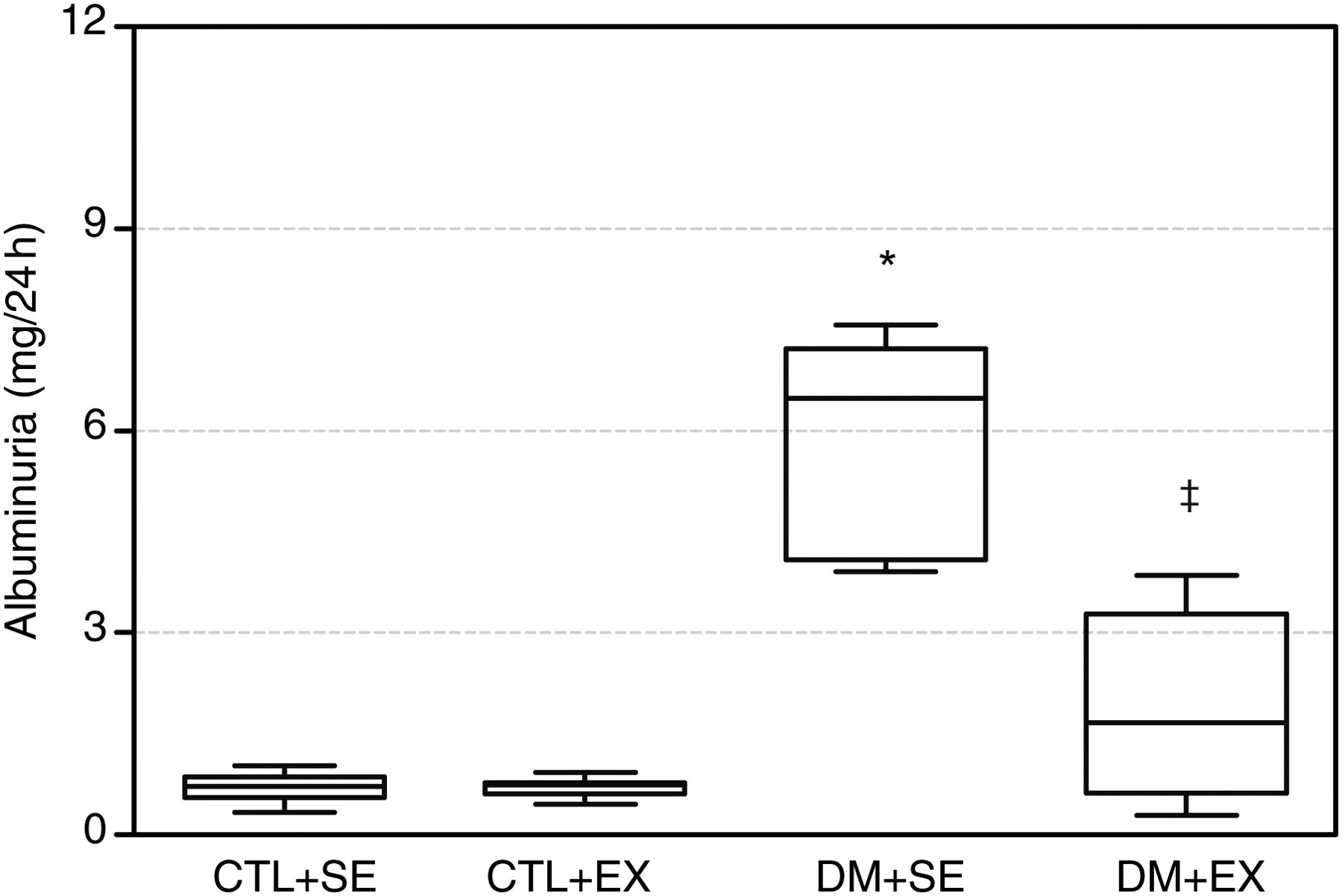
Albuminuria after the eighth week of exercise protocol. n = 9 for all groups. Results are represented as medians. Statistical analysis: one way analysis of variance with post hoc analysis of Student–Newman–Keuls; P < 0.05: *versus CTL + SE; ‡versus DM + SE. CTL + SE, sedentary control; CTL + EX, training control; DM + SE, sedentary diabetic; DM + EX, training diabetic
NO, albuminuria and oxidative stress
In the eighth week of the exercise protocol, the 24-h urinary NO (μmol/24 h) was higher in CTL + EX compared with CTL + SE (30.35 ± 4.0 versus 15.22 ± 2.5; P < 0.05). NO excretion of DM + EX was five times higher compared with DM + SE (17.15 ± 4.7 versus 3.15 ± 0.4; P < 0.05) (Figure 3a). The levels of urinary TBARS (nmol/24 h) at the end of the protocol showed no difference between CTL + SE and CTL + EX (439.9 ± 17.5 versus 425.7 ± 21.0), but in DM + SE animals they were three times higher when compared with CTL + SE (1325.0 ± 260.3 versus 439.9 ± 17.5; P < 0.05) and also higher than DM + EX (998.8 ± 232.7; P < 0.05) (Figure 3b). The Pearson's test showed a significant association between increased levels of NO excretion and reduced albuminuria (P < 0.0001) with a negative correlation between them (r = −0.63) (Figure 4). There was also a significant association between increased levels of NO excretion and reduced TBARS (P < 0.0019) with a negative correlation between them (r = −0.5). NO (μmol/mg protein) and TBARS (nmol/mL × mg protein) on homogenates of renal cortex showed that in CTL + EX, the renal NO concentrations were elevated when compared with CTL + SE (22.4 ± 4.5 versus 5.9 ± 1.0; P < 0.05); TBARS were similar between the two groups (4.7 ± 1.0 versus 5.8 ± 1.2; respectively) (Figures 5a and b). In diabetic animals, renal NO was higher in DM + EX compared with DM + SE (8.9 ± 0.6 versus 6.2 ± 0.6; P < 0.05). However, the levels of lipoperoxidation of DM + EX were lower when compared with DM + SE (6.3 ± 0.6 versus 8.9 ± 0.6; P < 0.05) (Figures 5a and b).
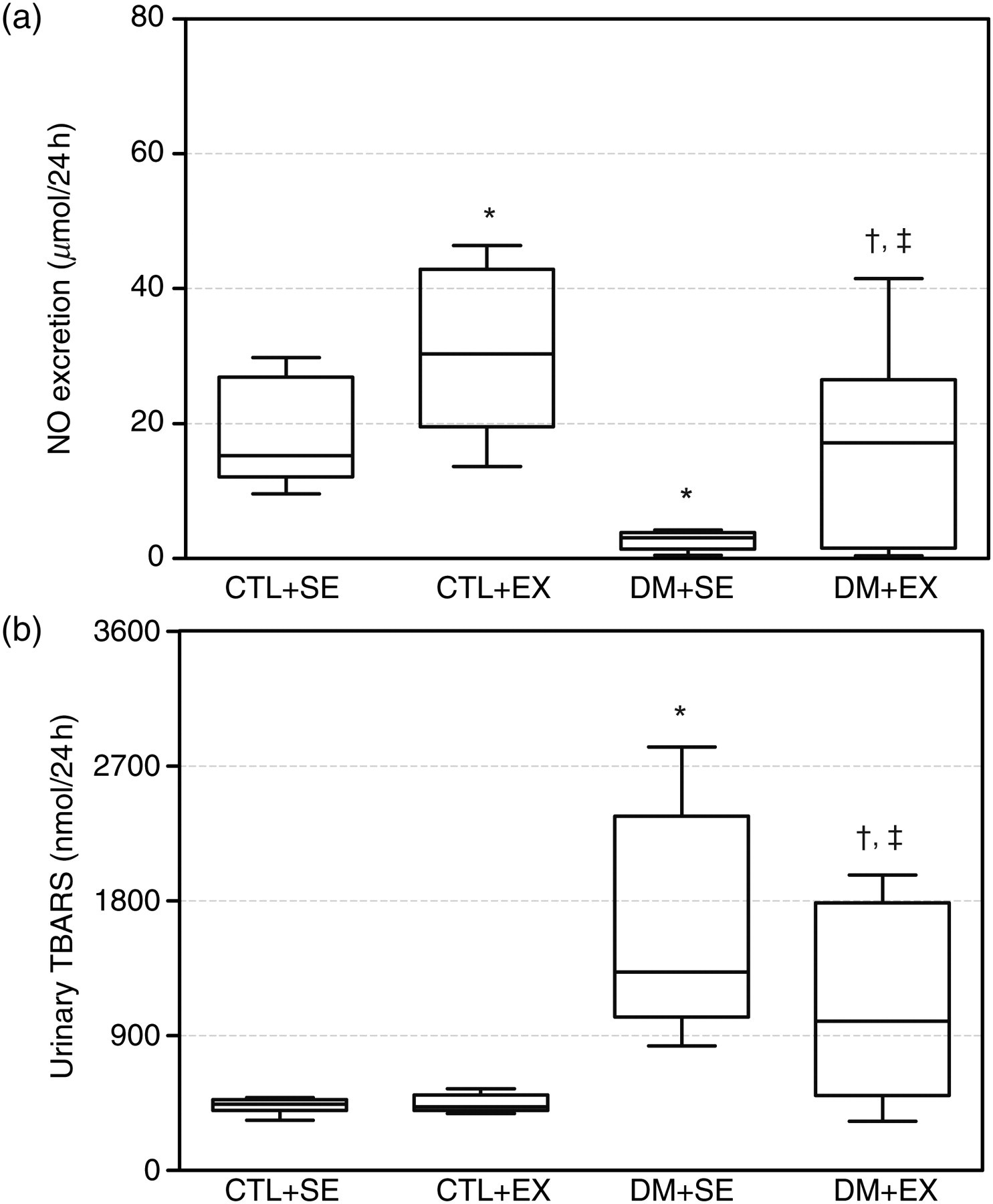
(a) Nitric oxide (NO) excretion and (b) urinary thiobarbituric acid reactive substance (TBARS) after the eighth week of exercise protocol. n = 9 for all groups. Results are represented as medians. One way analysis of variance with post hoc analysis of Student–Newman–Keuls; P < 0.05: *versus CTL + SE; †versus CTL + EX; ‡versus DM + SE. CTL + SE, sedentary control; CTL + EX, training control; DM + SE, sedentary diabetic; DM + EX, training diabetic
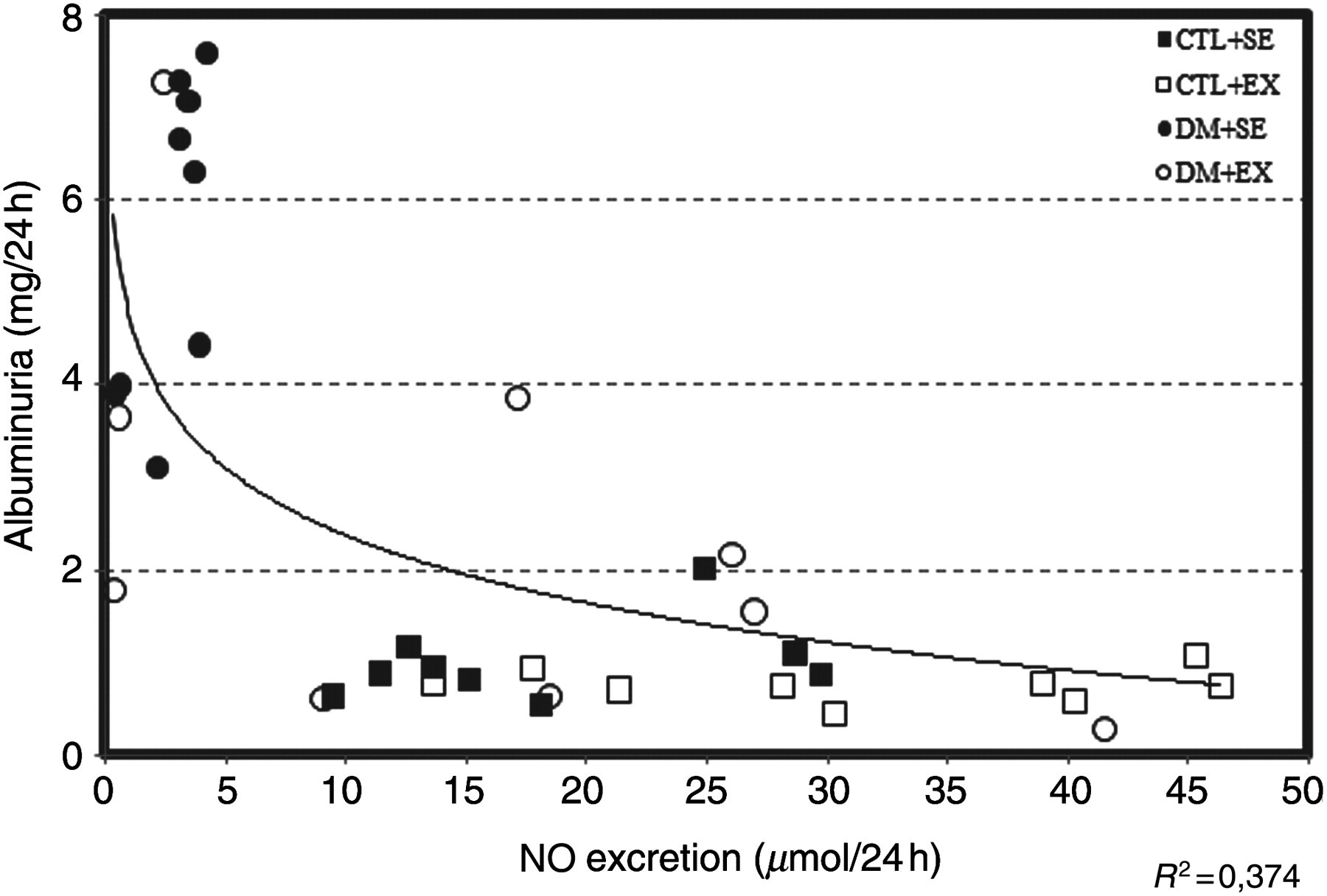
Albuminuria and nitric oxide (NO) excretion after the eighth week of exercise protocol. n = 9 for all groups. Pearson rank coefficient r = −0.63, P < 0.0001. CTL + SE, sedentary control; CTL + EX, training control; DM + SE, sedentary diabetic; DM + EX, training diabetic

(a) Renal nitric oxide (NO) and (b) renal thiobarbituric acid reactive substance (TBARS) after the eighth week of exercise protocol. n = 9 for all groups. Results are represented as medians. One way analysis of variance with post hoc analysis of Student–Newman–Keuls; P < 0.05: *versus CTL + SE; †versus CTL + EX; ‡versus DM + SE. CTL + SE, sedentary control; CTL + EX, training control; DM + SE, sedentary diabetic; DM + EX, training diabetic
Histological analysis
The optical microscopy (Figure 6) stained with HE, PAS and Masson's trichrome showed constriction of glomeruli with reduced capillary lumens, i.e. mesangial expansion only in DM + SE. No further glomerular alterations were seen. In DM + SE we also observed vacuolar degenerative changes in the tubules (shown by arrows), which were not observed in DM + EX.
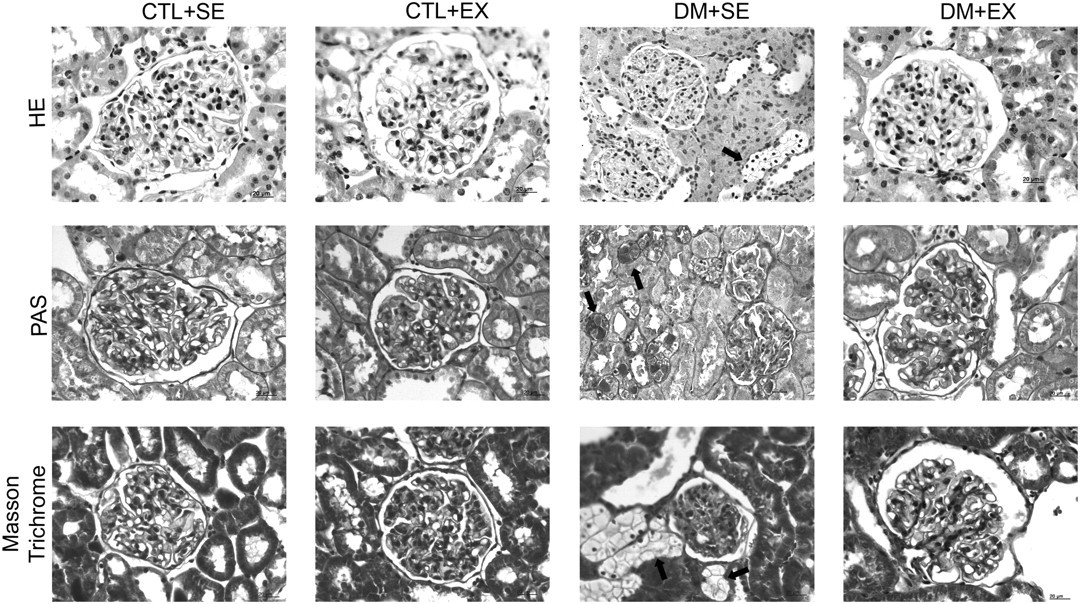
After the eigth week of exercise protocol, the optical microscopy stained with hematoxylin–eosin (HE), periodic acid-Schiff reagent (PAS) and Masson's trichrome showed constriction of glomeruli with reduced capillary lumens i.e. mesangial expansion only in DM+SE. No further glomerular alterations were seen. In this group, we also observed vacuolar degenerative changes in the tubules (shown by arrows), which were not observed in DM+EX. Bar=20 µm and original magnification ×400. CTL + SE, sedentary control; CTL + EX, training control; DM + SE, sedentary diabetic; DM + EX, training diabetic
Discussion
Among the most important findings in this study, training of diabetic rats resulted in attenuation of diabetes complications, with renal function improvement and reduction of albuminuria and TBARS concentrations, associated with partial recovery of urinary NO and kidney lesion amelioration. Plasmatic insulin concentrations were significantly decreased in DM rats when compared with the respective controls, without differences between sedentary and trained animals.
Despite the fact that DM + SE had higher food ingestion compared with the other groups, this group had the lowest body weight, with similar values through the experiment, indicating an altered metabolism in these animals. The CTL + SE group had a progressive weight gain as expected in the normal curves of growth.
Comparative studies analyzing the metabolism of diabetic animals 20 corroborate with our results, as our diabetic rats showed, at the end of the protocol, increased ingestion of chow and water due to increased metabolism and polyuria due to the osmotic effect of glucose. 21
In the initial phase of DM, the polyuria may also arise from high NO concentrations; however in the progression of disease, factors such as increased reactive oxygen species reduce the vasodilator bioavailability. 22 The polyuria at this moment is more due to the osmotic effect of glucose in the tubules. 21
A negative correlation between sedentarism and renal function had been previously observed in elderly individuals. 23 In our experiments, the renal function was decreased in sedentary diabetic animals, as shown by the plasmatic and urinary creatinine and urea, which improved in the trained diabetic group.
The role of physical training in improving renal function and reducing albuminuria is still controversial. Some studies showed that exercises can, in fact, increase albumin excretion in healthy humans 24 and animals. 25 In patients with incipient diabetic nephropathy, it was shown that exercise increased the already abnormal albumin excretion. 26
On the other hand, there is evidence that exercise can reduce albumin excretion in diabetic rats. 27 Other experimental studies showed that aerobic training promoted little or no change 28 or significant improvements in glycemic control and kidney function, in both animal and human models. 29,30 The controversial results about renal function associated with exercise on diabetes are most likely due to different methodological approaches. Different results may be due to variations on exercise protocols; for example, it is known that acute aerobic exercises can generate great oxidative stress in the individual. 31
Our results indicated a beneficial effect of exercises by reducing the albuminuria, associated with renal function amelioration as seen by biochemical and histological analysis. Probably, the initial stress of training, when systematized (volume, intensity and frequency of training), would promote an important body physiological response 32 and this adaptation could influence the development of diabetic complications.
The training has also been shown to have favorable effects on hyperglycemia-induced oxidative stress, which could be a fundamental form of intervention to prevent or to revert the endothelial dysfunction. 33 In our study, TBARS, which estimates the lipid peroxidation, was increased in the urine of DM rats, suggesting an increased oxidative stress in these animals; however, DM + EX showed significant reduction of TBARS concentrations after eight weeks of exercises.
It has also been suggested that exercise acts like an inducer for constitutive NOS (cNOS), and this would occur because muscle contraction itself needs high calcium concentrations, which is one of the co-factors to cNOS stimulation. 6
In our study, there was a significant reduction of urinary NO in DM + SE when compared with CTL + SE. This could be explained by the NO scavenging properties of glucose, directly 34 or through increased superoxide anions. 35,36 Brodsky et al. 34 showed that hyperglycemia promotes the chemical inactivation of NO.
Hyperglycemia induces acute changes on intracellular metabolism, including alterations in the polyol pathway, diacylglycerol-protein kinase C and on the formation of advanced glycation end-products (AGEs), all resulting in oxidative stress. 37 AGEs are formed by the non-enzymatic Maillard reaction and have been associated with the pathogenesis of diabetic complications, with long-term accumulation on extracellular matrix proteins and probably also on DNA; 38 AGEs also have the effect of chelating NO 39 and inhibiting endothelial production of NOS. 40 The increased concentration of urinary NO shown by DM + EX in our study could be a reflection of the improved glycemic control in these animals, a reduced oxidative stress level, as shown by lower levels of TBARS in these rats, or both.
According to the literature, in the early phase of diabetic nephropathy, NO could be increased due to the inflammatory process and could be related to the hyperfiltration seen in this condition. 41 However, in our study, NO was measured after eight weeks of exercise protocol, in a late phase of the disease. At this stage, NO synthesis was probably decreased due to diabetic vascular damage. 42 Unlikely, lipid peroxidation increases in the course of an uncontrolled glycemia due to higher NADPH oxidase activation, i.e. in a more advanced stage of the disease. 43 Studies have suggested that besides this small molecule (NO) playing its classical role as a physiological vasodilator, it also develops other important functions at glycemic control; evidence has shown that NO can lead to increased translocation of sarcoplasmatic bubbles repleted with glucose transporters (GLUT) to sarcolemma, which could result in a larger influx of glucose into muscle cells with the exercises, decreasing blood glucose concentrations. 8 This agrees with our results, as the trained animals had significantly reduced blood glucose.
At the course of the experimental protocol, we measured insulin because there was a possibility that streptozotocin-induced DM animals could have recovered insulin production. However, we observed that insulin concentrations among the diabetic animals were very close to nil, without differences between trained and untrained DM animals, but with its plasmatic levels significantly reduced when compared with respective controls. Although CTL + EX had decreased insulin concentrations compared with CTL + SE, they probably acquired better sensitivity to this hormone with training, maintaining normal blood glucose concentrations. 44,45
In our study the bioavailability of NO is increased with training, perhaps because of shear stress. 46 NO in turn has great importance in glucose uptake, independent of insulin, through the activation and release of second messengers such as guanylate cyclase, which can modulate the insulin sensitivity. 47
Other studies suggest that there is an improvement of the insulin receptor autophosphorylation capacity, as an adaptation to exercise training in humans 48 and animals, 49 with it being related to enhanced mitochondrial function in both humans and animals. This is in agreement with our findings, in which CTL + EX presented reduced levels of insulin when compared with CTL + SE, probably due to a better utilization of this hormone caused by the exercises.
Another significant effect of NO is the inhibition of mesangial cell growth and also mesangial matrix production; 50 NO also acts as a strong repressor of connective tissue growth factor, a key to the development of interstitial glomerular fibrosis. 51 The absence of renal NO in diabetic rats would lead to an excessive mesangial matrix production associated with type I collagen accumulation, 52 and in fact, a mesangial expansion was observed in the renal histology of our DM + SE rats.
The importance of NO production in the kidney was also suggested in recent studies with eNOS knock-out diabetic mice. In those animals, a greater susceptibility to the diabetic nephropathy was evidenced, with an intense albuminuria, hypertension, mesangiolysis, lower glomerular filtration rate, glomerular basement membrane thickening, 53 mesangial expansion and development of mesangial nodular (Kimmelstiel–Wilson) lesions. 53,54
Other investigators showed that during the diabetic nephropathy progression, the tubular lesion precedes the glomerular damage. 55 These data corroborate with our experiment, since in DM + SE histological analysis we observed focal vacuolar alterations in the tubules, which were not present in DM + EX.
Hartell et al. 56 showed that the intact vascular wall could acutely stimulate NO production through the insulin receptor, without increasing the levels of intracellular calcium. For this reason, we did not use insulin on our animals, to avoid interference with the NO measurements. Furthermore, insulin concentrations do not necessarily imply in direct modulation of NO production, because the synthesis of this vasodilator is multifactorial. Many studies showed that aerobic training is a strong inducer of NO production, as the exercise increases blood flow and the shear stress acts as an intense stimulus on the endothelium. 57,58
As stated earlier, as the levels of insulin were not different between trained and untrained diabetic rats in our experiments, it is suggested that there was no interference of endogenous insulin concentrations on NO production in these animals.
In summary, aerobic training during eight weeks had beneficial effects over the metabolic profile of DM rats, with better glycemic control, weight increase, associated to a reduction of albuminuria and TBARS, amelioration of the kidney's function and NO production, and absence of renal lesions. This study suggests that aerobic training associated with a better control of oxidative and nitrosative stress can be used to delay the progression of diabetic nephropathy.
Footnotes
ACKNOWLEDGEMENTS
This work was supported by Fundação de Apoio a Universidade Federal de São Paulo (FAP) and by Conselho Nacional de Desenvolvimento Científico e Tecnologico (CNPq): # 132197/2007-3 and 474691/2007-1.