




Abstract
In the comment article kindly sent by the editor of EMB, Kistler et al. raised several questions regarding to the results in this paper. In review of the comments along with some of the published relevant papers, we would like to generously provide a point-by-point response seen below to Kistler et al.'s stated comments.
First, Kistler et al. state that cultured podocytes are notoriously difficult to transfect and a transfection efficiency exceeding 5% cannot usually be achieved, and the low transfection efficiency precludes meaningful analysis of cell lysates by Western blot. However, Okamura et al.
1
used the transfection reagent GeneJuice to transiently transfect podocytes with plasmid constructs and obtained significant luciferase activity changes after stimuli. In our laboratory, we successfully detected the alterations by Western blot in the podocytes transiently transfected with mutant podocin.
2
In addition, in previous studies from other groups, the protein expression could be detected in podocytes transfected with different related constructs.
1,3,4
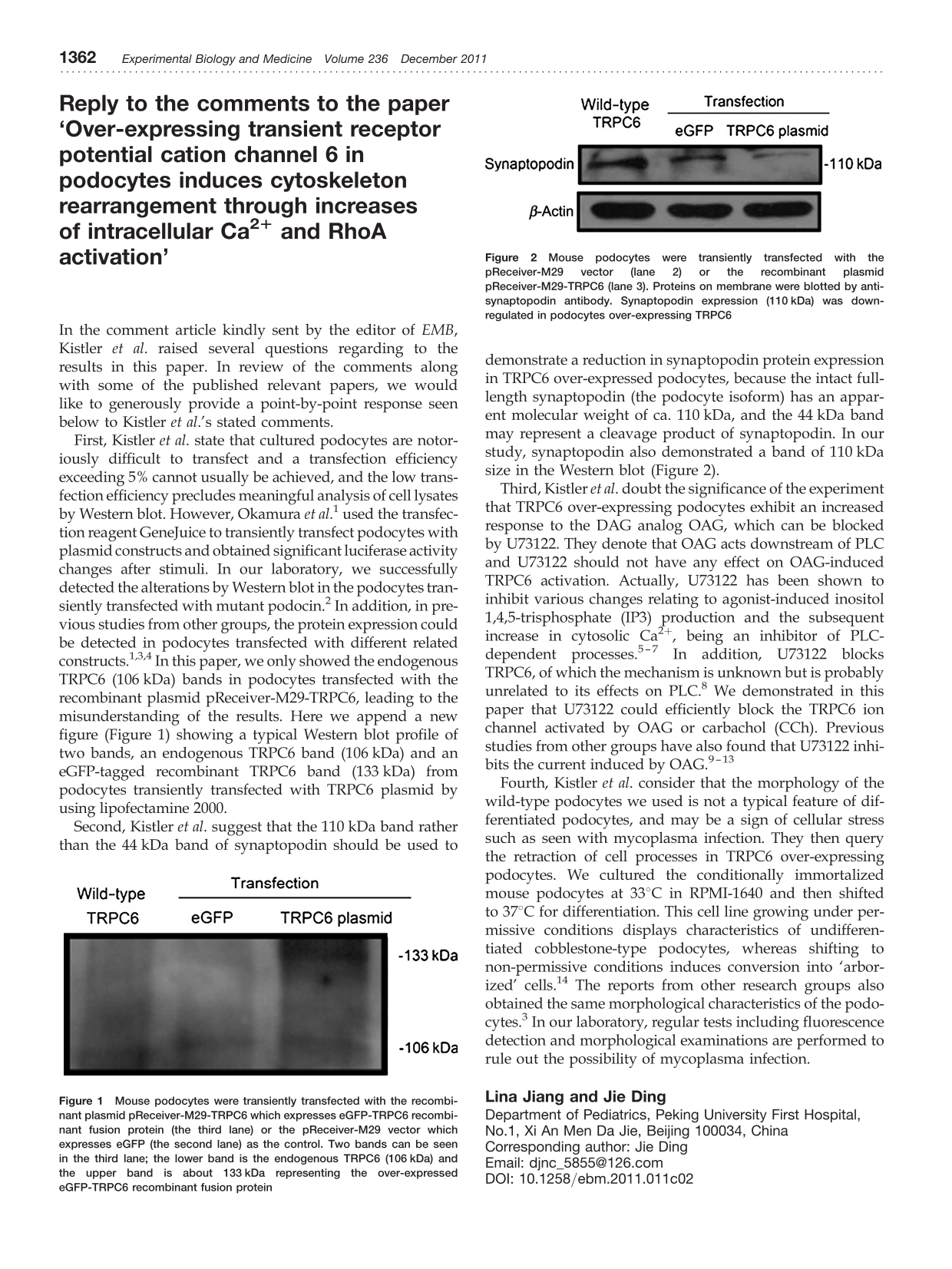
In this paper, we only showed the endogenous TRPC6 (106 kDa) bands in podocytes transfected with the recombinant plasmid pReceiver-M29-TRPC6, leading to the misunderstanding of the results. Here we append a new figure (Figure 1) showing a typical Western blot profile of two bands, an endogenous TRPC6 band (106 kDa) and an eGFP-tagged recombinant TRPC6 band (133 kDa) from podocytes transiently transfected with TRPC6 plasmid by using lipofectamine 2000. Mouse podocytes were transiently transfected with the recombinant plasmid pReceiver-M29-TRPC6 which expresses eGFP-TRPC6 recombinant fusion protein (the third lane) or the pReceiver-M29 vector which expresses eGFP (the second lane) as the control. Two bands can be seen in the third lane; the lower band is the endogenous TRPC6 (106 kDa) and the upper band is about 133 kDa representing the over-expressed eGFP-TRPC6 recombinant fusion protein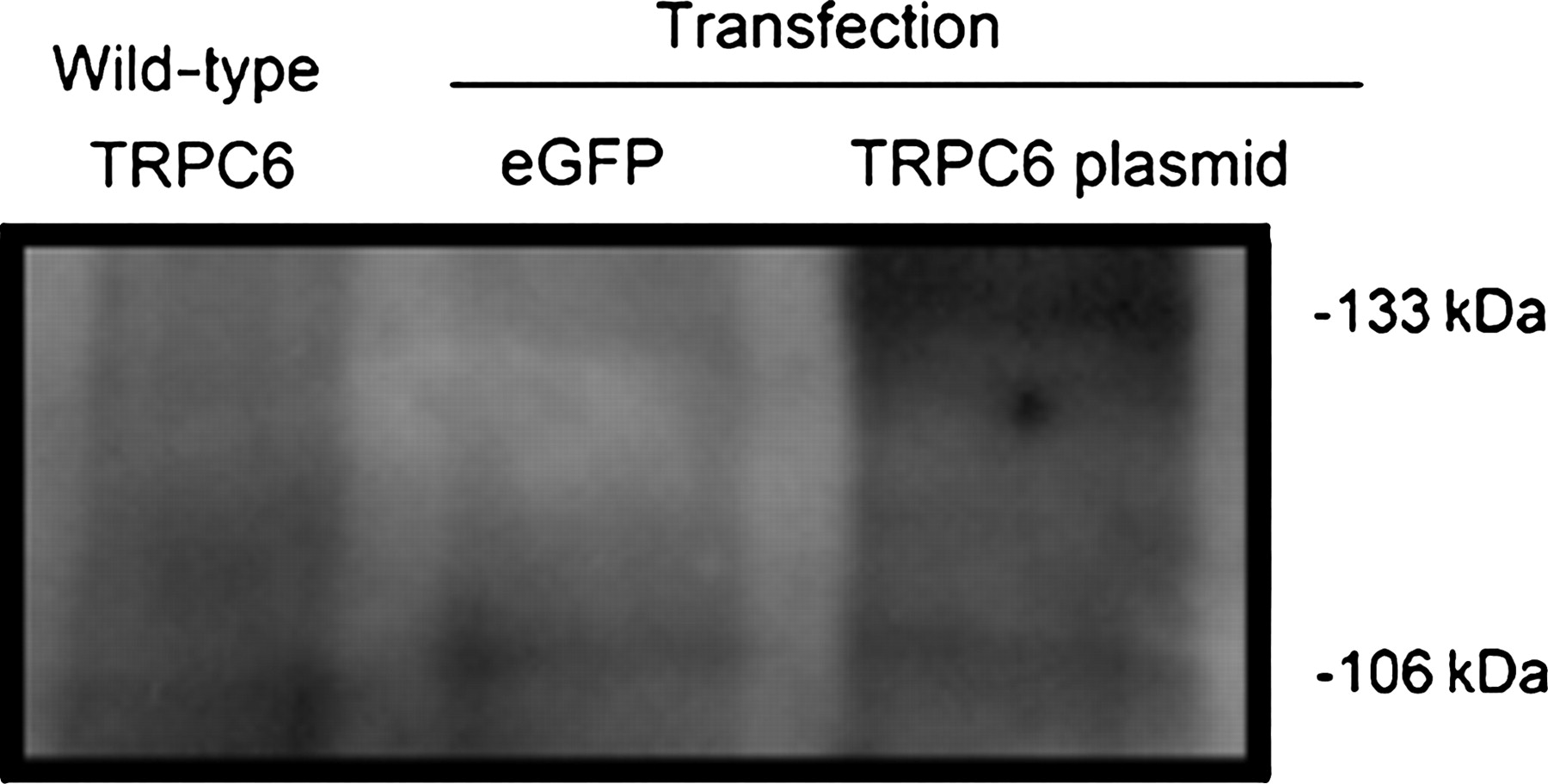
Second, Kistler et al. suggest that the 110 kDa band rather than the 44 kDa band of synaptopodin should be used to demonstrate a reduction in synaptopodin protein expression in TRPC6 over-expressed podocytes, because the intact full-length synaptopodin (the podocyte isoform) has an apparent molecular weight of ca. 110 kDa, and the 44 kDa band may represent a cleavage product of synaptopodin. In our study, synaptopodin also demonstrated a band of 110 kDa size in the Western blot (Figure 2). Mouse podocytes were transiently transfected with the pReceiver-M29 vector (lane 2) or the recombinant plasmid pReceiver-M29-TRPC6 (lane 3). Proteins on membrane were blotted by antisynaptopodin antibody. Synaptopodin expression (110 kDa) was down-regulated in podocytes over-expressing TRPC6
Third, Kistler et al. doubt the significance of the experiment that TRPC6 over-expressing podocytes exhibit an increased response to the DAG analog OAG, which can be blocked by U73122. They denote that OAG acts downstream of PLC and U73122 should not have any effect on OAG-induced TRPC6 activation. Actually, U73122 has been shown to inhibit various changes relating to agonist-induced inositol 1,4,5-trisphosphate (IP3) production and the subsequent increase in cytosolic Ca2+, being an inhibitor of PLC-dependent processes. 5–7 In addition, U73122 blocks TRPC6, of which the mechanism is unknown but is probably unrelated to its effects on PLC. 8 We demonstrated in this paper that U73122 could efficiently block the TRPC6 ion channel activated by OAG or carbachol (CCh). Previous studies from other groups have also found that U73122 inhibits the current induced by OAG. 9–13
Fourth, Kistler et al. consider that the morphology of the wild-type podocytes we used is not a typical feature of differentiated podocytes, and may be a sign of cellular stress such as seen with mycoplasma infection. They then query the retraction of cell processes in TRPC6 over-expressing podocytes. We cultured the conditionally immortalized mouse podocytes at 33°C in RPMI-1640 and then shifted to 37°C for differentiation. This cell line growing under permissive conditions displays characteristics of undifferentiated cobblestone-type podocytes, whereas shifting to non-permissive conditions induces conversion into ‘arborized’ cells. 14 The reports from other research groups also obtained the same morphological characteristics of the podocytes. 3 In our laboratory, regular tests including fluorescence detection and morphological examinations are performed to rule out the possibility of mycoplasma infection.