




Abstract
Vulval adhesion is a rare but recognized local complication following genital herpes infection. We believe this is only the second reported case of successful resolution of vulval herpetic adhesion using topical potent corticosteroid as the primary early treatment.
CASE
A 32-year old White British insulin-requiring diabetic woman referred herself to the Genitourinary Medicine Department of Derriford Hospital, Plymouth. She gave a seven-day history of increasing vulval pain and swelling. On day one she had self-treated with oral fluconazole 150 mg and external clotrimazole cream. On day two she had consulted the practice nurse who had suggested further external clotrimazole cream and the application of ice packs. On day four she saw the out-of-hours general practice service, who prescribed fluconazole 50 mg o.d. and topical ecostatin cream. Despite these measures her symptoms continued to get progressively worse.
She was diagnosed with type 1 insulin-requiring diabetes at the age of six. She admitted that ‘diabetes control could be better’ (blood glucose averaged between 10 and 12 mmol/L). She had been in a monogamous relationship for six months and used Depo Provera for contraception.
On examination there was gross vulval swelling with typical widespread herpetic lesions. A clinical diagnosis of primary genital herpes was made. Oral aciclovir and analgesics were commenced. She was counselled at some length regarding general measures and self-hygiene.
On review one week later, she reported that the pain and swelling were much improved. On examination there was a 2 cm band of adhesion joining the labia majora (Figure 1). It was not possible to insert a speculum. Attempts to pull apart the adhesion manually caused bleeding and severe pain. Surgical division was considered. However, the adhesions were only recently formed and, after a discussion of the possible treatment options, the patient elected to try medical treatment, while understanding the uncertainty of success. She was given betamethasone valerate cream to apply twice daily, suppressive aciclovir cover (400 mg b.i.d.) and advice to attempt to separate the labia daily in the bath. At follow-up two weeks later, the labia were completely separated, the swelling had resolved and the vulva appeared normal (Figure 2). Herpes simplex virus type 1 was isolated by polymerase chain reaction. Investigations for chlamydia, gonorrhoea, candida and syphilis were negative.
Midline vulval adhesion Complete resolution of adhesions after treatment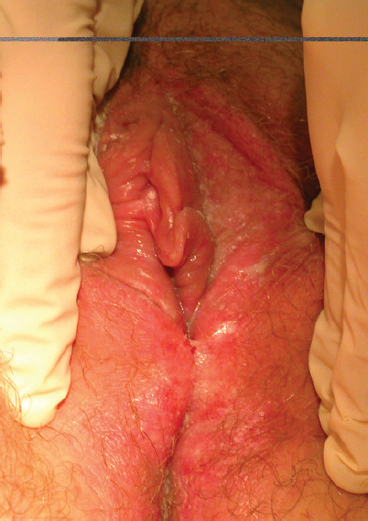

Discussion
There has been a number of case reports of vulval adhesion1–10 and one of preputial occlusion 11 following severe genital herpes. Primary prevention is the first line of management. Diabetes may worsen the severity of genital herpes and it appears from case reports that this local complication may be more common in insulin-requiring diabetics. We suggest that patients with diabetes should be specifically warned about this possible complication and the importance of local hygiene and manual labial separation particularly emphasized. Patients with severe genital herpes should be considered candidates for diabetic screening.
Most previous case reports have described surgical division of the adhesions. There is only one previous case report to our knowledge, which reported successful management of the adhesions with topical potent corticosteroids. 1 We believe that steroids may have a place in the early treatment of this rare but recognized local complication of genital herpes.