




Abstract
Summary
Eight new cases of human immunodeficiency virus (HIV) were diagnosed in the antenatal population of Milton Keynes within the first two years of our ‘opt-out’ antenatal testing scheme; the majority (6/8) occurred in women of black African origin. Since it is suggested that individuals from high-risk groups are more likely to decline HIV testing, we were concerned that women from this high-risk ethnic group might not be accepting testing. Such a situation would increase the risk of undiagnosed HIV-positive women delivering at Milton Keynes and undermine the potential benefits of the screening programme. Retrospective review of pregnant women delivering in our area over six months was performed. Hospital obstetric and microbiology databases were analysed for results of HIV screening and ethnic origin of patients. A total of 1586 women delivered during the study period. Among the black African women 13/158 (8.2%) declined screening, compared with 120/1214 (9.8%) and 15/153 (9.8%) of white and Asian women, respectively. The high uptake of testing across all groups suggests that the policy of offering and recommending HIV screening to all women is being appropriately implemented. Black African women were more likely to have undergone screening than white or Asian women, although the differences were not statistically significant.
Introduction
The Health Protection Agency estimates that there are 63,500 HIV-positive adults living in the UK today with one-third (20,100) of these individuals being unaware of their infection. 1 In 1997 over 70% of HIV-positive pregnant women remained undiagnosed at the time of delivery, resulting in the vertical transmission of HIV infection to 52 infants that year. 2 Since it was known that antiretroviral therapy, elective caesarean section and bottle-feeding could reduce vertical transmission to infants, the Department of Health introduced a policy that HIV testing should be offered to all pregnant women. 2 Maternity units had to implement testing by the end of 2000, with a target uptake of 90% set for the end of 2002.
It has been suggested that individuals at a higher risk of HIV infection are more likely to decline testing.3,4 In terms of high-risk ethnicity, Schwarcz et al 3 in California looked at ethnic group and HIV testing of Sexual Health Clinic patients. They found that African-Americans – a group with high-HIV prevalence – were less likely to have been tested for HIV on the day of the visit or in the past compared with white patients (adjusted odds ratio 0.3).
In the UK, over 70%of HIV-positive women are black African. 1 A five-fold increase in African-born women settling in our area is thought to explain the high number of new cases, we have diagnosed since antenatal screening began in 2001. Anonymous screening studies predicted that three new cases of HIV would be diagnosed in our antenatal population over a two-year period; 5 the actual figure for January 2001 to December 2002 was 8. This rose to 14 for the 24-months of 2005–2006. Over 80% of these cases were in women of African origin. We were concerned that women from high-risk ethnic minority groups might be over-represented among those declining screening, allowing cases of HIV to go undetected in our pregnant population.
Methods
A retrospective review of women delivering at Milton Keynes General Hospital during the six-month period from 1 January 2005 to 30 June 2005 was performed. All women had been offered testing for HIV using an ‘opt-out’ policy.
The hospital obstetric (the PROTOS® maternity information system [isoft Group plc. Sydney, Australia]) and microbiology databases were analysed for the results of antenatal HIV screening and ethnic origin of the patients.
Women were classified as ‘acceptors’ or ‘decliners’ of antenatal HIV testing in that pregnancy. If no evidence of any antenatal blood tests could be found the patient was excluded from the study. Microsoft Excel® (Microsoft Corp., WA, USA) and SPSS® (SPSS Inc. Chicago, IL, USA) were used to analyse data.
Results
A total of 1655 women delivered during the study period. Sixty nine (4.2%) were excluded as no evidence of any antenatal blood testing was found. Of the remaining 1586, 76.5% were white (n = 1214), 10.0% were black African (n = 158) and 9.7% were Asian (n = 153).
The number and proportion of decliners in each group are shown in Table 1, along with odds ratios for declining screening (with the white group as reference).
Women declining antenatal HIV testing according to ethnic group
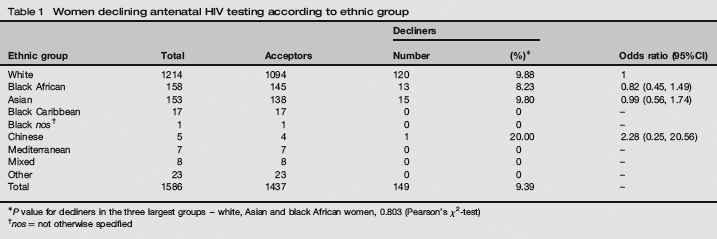
P value for decliners in the three largest groups – white, Asian and black African women, 0.803 (Pearson's χ 2 -test)
nos = not otherwise specified
During this period five HIV-positive women delivered at Milton Keynes General Hospital. Three of these cases were diagnosed during the pregnancy and involved women of black African origin.
The ethnic mix of the 69 excluded cases was similar to that of the overall population.
Discussion
This study confirms that overall acceptance of antenatal HIV testing is over 90% in the Milton Keynes area, fulfilling Department of Health targets.
Similarly, high rates of acceptance were seen across white, black African and Asian groups. Black African women appeared more likely to accept testing than their White or Asian counterparts, but this was not statistically significant. Thus, ethnic origin is not a risk factor for declining antenatal HIV testing. These results are reassuring and are similar to those mentioned in previous reports from Birmingham 4 and London. 6