




Abstract

Sir: I read with interest the articles by R Gooney, et al. and EM Carlin and DJ Kellock on genitourinary (GU) medicine 48-hour access appointments.1,2
One of the ways for increasing the capacity of the clinic is to increase the numbers of asymptomatic clinics, which could be performed by nurses/health-care assistants. This would help to achieve the GU medicine 48-hour access target and to narrow the gap between offered and seen. 3
A retrospective case-notes review of 50 consecutive male and 50 consecutive female patients attending asymptomatic nurse-led clinics in our department from 1 February 2008 was carried out. Patients were booked by the reception staff after telephone conversations with them. Fourteen percent (seven) of male patients and 32% (16) of female patients attending the asymptomatic nurse-led clinics had symptoms. Thirty-two percent (16) of male patients and 36% (18) of female patients were seen/discussed with a doctor/senior nurse. Reasons for seeing a doctor/senior nurse are shown in Table 1. Twenty-two percent (11) of male patients and 18% (nine) of female patients were diagnosed with a sexually transmitted infection, as shown in Table 2.
Reasons for patients to be seen/discussed by doctor/senior nurse

NSU = non-specific urethritis; UTI = Urinary tract infection
Sexually transmitted infections diagnosed
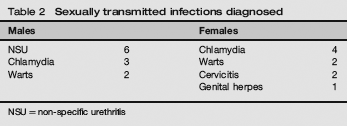
NSU = non-specific urethritis
This study showed that patients’ perception of symptoms might be different from the actual symptoms. Some times leading questions are necessary to obtain the real symptoms of the patients’.
‘Streaming’ patients, as suggested by the Department of Health ‘Genitourinary Medicine 48-hour access, getting to target and staying there’, would help to deal with this issue so that patients could be seen by appropriate health-care workers.
This study highlights the need for streaming patients to achieve the GU medicine 48-hour access target and staying there.
Footnotes
Acknowledgement
I would like to thank the departmental staff who have contributed to this study.