




Abstract
Clients of sex workers in Germany used to be unapproachable for issues of sexual health. Thus, prevention of HIV and sexually transmitted diseases used to focus on sex workers only, even though many sex workers accuse clients preferring unprotected sex. When prostitution was decriminalized in Germany in 2002, a till then unknown platform emerged on the German internet. Clients set up forums for themselves and their peers. These community forums were primarily meant to serve as platforms for the exchange of information, e.g. on the quality of services. We describe the development and expansion of these web-sites for clients of female commercial sex workers, and the clientele and operation of such sites. To study and to describe the sites, a close cooperation with their webmasters and administrators was crucial. The clients' community forums mark a change in paradigm, as clients became an accessible and addressable target group for sexual health and prevention issues on the internet. The Sexsicher sites have been developed to adequately target this group.
INTRODUCTION
Public health approaches to sex work have largely focused on the sex workers rather than the clients. The limitations of this approach are that often the sex workers are in the more powerless position with regard to using condoms, as the purchaser may have the option to insist on the transaction without a condom or offer more for sex without a condom. In situations where the sex worker needs the money for basic survival needs or a drug habit, such demands may be difficult to refuse. Rather than attempting to change just one side of the sex transaction equation, or attempting to alter the sexual safety of the frequently more powerless individual in the dyad, effective HIV/STD prevention public health approaches to sex work need to also target the client of the sex worker. This may be difficult in conditions where prostitution is criminalized and such legal sanctions are enforced. Usually, enforcement is aimed at the sex worker rather than the client, although some countries such as Sweden aim the legal sanctions at the client rather than the sex worker.
Prostitution has been somewhat decriminalized in Germany by the Federal Law on Prostitution (Prostitutionsgesetz) on 1 January 2002. 1 Before this law, prostitution was not completely illicit, but any agreements between sex workers and their clients were regarded to be immoral – and therefore invalid. In this atmosphere of illicit business, clients of sex workers have become unknown, unidentifiable and unreachable for public health approaches. 2,3 The latest large-scale research project dealing with clients and their access to safer sex knowledge and behaviour dates back to 1994. 4
Only recently has the perception of the unknown clients shown some changes; graduate and postgraduate students started to focus on clients in their research papers, 5 and journalists explore the topic more frequently. The internet may play a significant role in this shift. 6
Before the days of the internet, clients (commonly known in Germany as ‘Freier’ which is an equivalent for ‘Johns’) had only a single platform to experience, exchange and feel as a client: it was the setting in which they dealt with the sex worker, no matter if that was a brothel, a club or any other area of a red light business. However, the internet opened new platforms for those clients who want to share their knowledge about the sex business and who want to communicate within their identity as a client. These users started to set up forums.
A NEW INTERNET FORUM FOR CLIENTS OF SEX WORKERS
Forums are platforms on which internet users can communicate with each other. In distinction between chat rooms where postings are seen only by the participating users, postings in forums are being archived and can be accessed by all (registered) users, even years or months after the date of their origin.
There are at least two categories of Johns' forums to be distinguished among: those that are set up by clients themselves for their peers (community forums) and those that are set up by adult internet providers and/or providers or agents of pay sex establishments in order to promote their business (commercial clients' forums).
Looking at the community forums of Johns, one finds these forums to be comprised of several sections. Most of the forums have a portal site where users have to undergo certain procedures in order to ensure that only adults can enter the forums. Since some of the forums have been moved from German servers to foreign.com-providers, they are more easily accessible as they can omit safeguards (all servers in Germany, identified by the suffix‘.de’, operate under the German Law to protect the Youth).
Commonly, Johns' forums are set up with regional sections, sections for certain settings (e.g. brothels, clubs, street) and/or affinities such as sado-masochism, fetishes or transgender persons. Some have sections for polls, and all have a residual category that may be termed ‘off topic’, ‘this and that’, ‘coffee kitchen’ or else (miscellaneous). The main purpose of Johns' forums is the exchange of information about where to expect or to get which service and comments about the service – a form of consumer review. Their motto is ‘poppen und posten’ (‘fuck and post’).
Forums differ in many respects depending on their webmasters and moderators. They differ in matters of visual appearance and style of language. Most webmaster and moderators cooperating with sexsicher.de are committed to a respectful and decent way of communication.
One of the first community-based forums of sex workers' clients was the forum ‘Bordellcommunity’ (
HEADING TOWARDS A GOAL
It was the German Federal Center for Health Education (Bundeszentrale für gesundheitliche Aufklärung, BZgA) that initiated the first German ground-breaking research project on clients in the internet back in 2002. One result of this research was that the internet could and should serve as a venue for STD prevention. 8 Evidently, issues of sexual health were already present and discussed in the clients' forums. This discussion included safer sex practice, risk management and exchange of experience. Even though medical staff, prevention activists and self-appointed experts were discussing these topics in elaborate threads, there was no approved authority available within the forums. It became apparent that the internet, and specifically these client forums, was an excellent opportunity for community-based outreach to educate and role model safer sexual behaviour to clients of female sex workers; a population that was both hard to find and hard to reach for HIV/STD prevention.
In order to find out how the options of the internet could be used for HIV/STD-prevention for Johns, a group of 16 experts was identified and invited to a round table discussion in February 2003 by the BZgA. STD/HIV-prevention experts from government organizations (representatives of the BZgA and a local health department), non-government organizations (NGOs) (representatives from the association of German Aids-help services Deutsche Aids-Hilfe), from three prostitution projects (one urban, one rural, one for prostitution among MSM), social science experts, internet experts, adult internet providers and last but not least two representatives from the major clients' forums attended. In addition, a representative from the Swiss Internet outreach project directed towards clients, Don Juan, was present. Their meeting resulted in an already well-elaborated conception for a specific internet platform that would become the internet project
Much thought went into the naming of this site. The name ‘Sexsicher’ offers a multiple play on words in German. In translation, sexsicher means safe sex; however it also carries the connotation of ‘being competent in sex’ and it plays on the question and answer: ‘Sex? Certainly!’ It also resembles the German word ‘Sexsucher’ which means sex seeker. The suffix.de denotes the site origin in Germany – an abbreviation of ‘Deutschland’.
Sexsicher.de could not have been developed without the early and comprehensive participation of the target group, the webmasters of the clients' community forums and the clients themselves. It was they who provided the most crucial knowledge about the needs, interests and requirements of the target group. Since the intervention methods of sexsicher.de are made up by the strategy of peer involvement, sexsicher.de mainly cooperates with the community forums.
For instance, the input of these groups determined the navigational structure of sexsicher.de's portal. Rather than looking for diseases or pathogens, searches are organized by certain body fluids. This approach is strongly supported by prevention experts; they, too, state that much of their counselling focuses on experienced (or feared) contact with body fluids. Furthermore, it was the webmasters of the clients' forums who organized and accomplished intricate pretesting of the sexsicher.de-drafts. For months, dozens of users of clients' forums worked on the language that is used by the sexsicher.de sites: they have provided for an informal but respectful address with easy to understand words and sentences.
Since the emerging of the forum ‘Bordellcommunity’ in the late-1990s, a growing number of Johns' forums have been set up. While there is no concrete knowledge about how many forums of Johns are prevalent on the German internet, the sexsicher.de project presently (summer of 2006) deals with about 20 major forums that are identifiable as community forums. Some of them evolved to form some sort of pooling. These pools, named xxx-forums or ladies-forums, provide mainly regional access, but also sections for certain affinities, e.g. sauna clubs or Golden Showers (
All of these forums have committed themselves to take part in or to be partner of the sexsicher.de project. The most evident proof of this commitment is a series of banners for sexsicher.de that prominently appears on most xxx-forum and ladies-forums.
Still, some major forums are not yet part of the project. Especially those forums that are determined to propagate unsafe sex (known as Tabulos-Forum, AO-Forum) (Tabulos – ‘no taboos’, meaning no condoms or safer sex; ‘AO’ – Alles ohne, ‘all without’ condoms or safer sex practices) and therefore present a special challenge to the project. There is an inherent tension, if not contradiction, in promoting safe sex on a site specifically devoted to unsafe sex. It is one of sexsicher.de's outstanding tasks to convince these forums to join in, even if this may prove to be extremely difficult.
Since numbers in the internet are only somewhat reliable and fluctuate from day-to-day, we assume that some 10,000 active users are reachable by the forums. The following figures show the amount of registered users at some xxx-forums and were generated in the first week of October 2006.
There is no approved data on the numbers of prostitutes or their clients in Germany. Experts estimate the numbers of female prostitutes in Germany to lie between 50,000 and 200,000. 10 Projections on the number of clients are even less reliable.
THE INTERNET PORTAL SEXSICHER.DE
When sexsicher.de went online in February 2004, it started with around 100,000 hits and 3000 visits per month (Figure 1). A slow but permanent increase summed up to an almost constant average of 150,000 monthly hits and 5000 visits for 2005 and early 2006 (Figure 2).
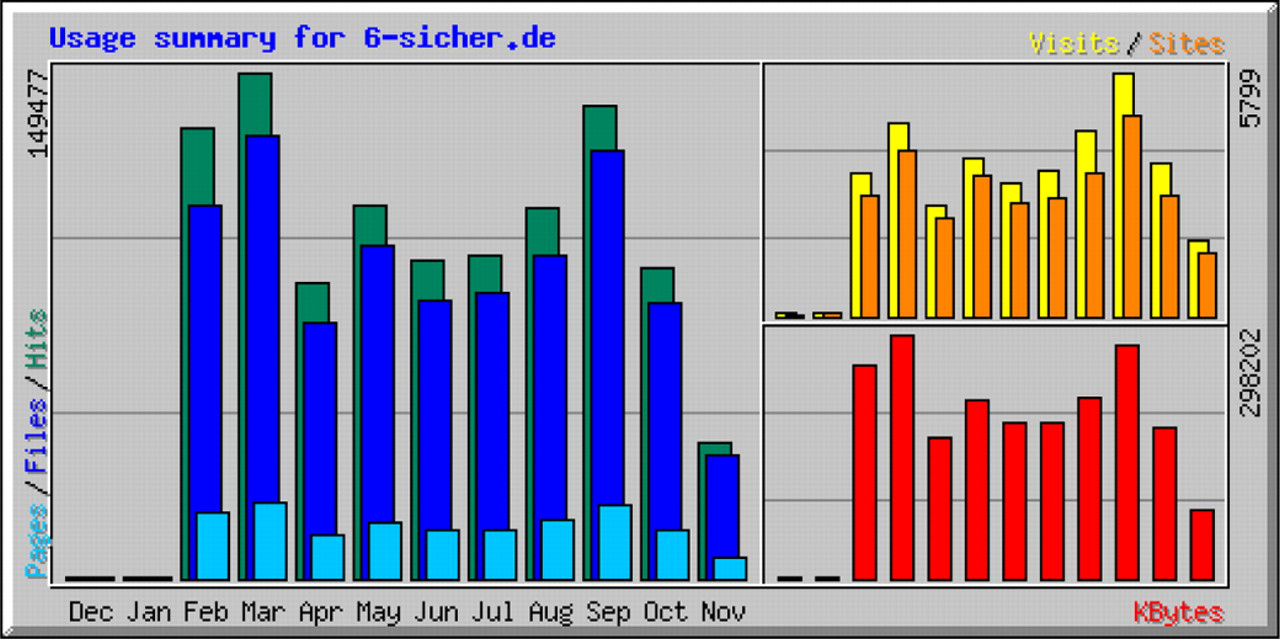
Usage summary for Sexsicher.de, generated by Webalizer (10 November 2004)

Usage summary for Sexsicher.de, generated by Webalizer (5 October 2006)
A major increase in usage figures at sexsicher.de happened in May 2006 when all relevant values have tripled. Even though numbers have slightly decreased meanwhile, monthly hits sum up to more than 400,000 and monthly visits add up to more than 15,000.
Analysing the sudden usage increase we found several indices. First, there is a timely correlation with the release of press information regarding the upcoming Spanish version of sexsicher.de (
While a direct search on

How users get to sexsicher.de – segmentation of referrers; more than 52% of all reported referrers are generated by websites of the target group; graph by Harriet Langanke, using absolute figures generated by Webalizer logfiles for September 2006. Screenshot 1: Portal site of
Sexsicher.de sites are easily found by Johns frequenting clients' forums. Screenshots 1–3 show where links leading to sexsicher.de are placed. Although some forums use the respective space for commercial ads, the webmasters of the forums never ever charged the sexsicher.de project for those links, indicating the close cooperation between the forums and sexsicher.de.
Sexsicher.de has been funded as a project in public–private partnership. The BZgA as the main German public health agency financed the initial phase of sexsicher.de. The BZgA also financed the initial research, the round table and they provided numerous project resources. Private partners, such as the provider of the commercial ladies-forums paid for the designing and programming of the websites. Moreover, commercial and non-commercial adult providers support the project with their cooperation and free advertising space. However, sexsicher.de does not have a regular financial basis yet. This is a handicap that has to be overcome.
In addition to the links that have been set up by webmasters of the community clients' forums, a growing number of mentions appears within the forums. These mentions and postings are not necessarily posted by webmasters or moderators, but also by ordinary users. They all show an emphatic appreciation for the project. A typical statement says: ‘Wirklich erstaunlich, dass mal jemand an uns Freier denkt!’/‘Really amazing that someone cares about us Johns’!
For example, in July 2006 there was a discussion at the Rheinforum about the risk of getting gonorrhoeae. A user with the nick name Satyr refers to sexsicher.de in equal measure as to the sites of Wikipedia or Netdoktor (a medical guide). He even adds a working link to his mention.
Im Netz findet man diverse Beschreibung zum Tripper, z.B. bei Wikipedia,
Feedback on the sites of sexsicher.de has also been given by entries into the guest book of sexsicher.de. About 99% of all comments are positive; ranging from supportive to enthusiastic comments (
As an unforeseen but welcome outcome, numerous public health departments from all over Germany and some NGOs have linked their websites to sexsicher.de (see Screenshot 4). ‘6-sicher.de’ has been chosen as some servers in Germany block the term ‘sex’; the German word for the number 6 (‘sechs’) resembles the word sex.
PRESENT EFFECT AND PUBLIC POLICY
Since the beginning of the project in 2002, a shift in paradigm has occurred. When the project started, moderators and webmasters of Johns' forums were very reluctant about being known as clients of prostitutes. They did not want to be known by their real names, they needed the discretion of the internet and did not show their identity as a John beyond the virtual world. They were hardly reachable for prevention interventions.
With the destigmatizing Law on Prostitution from 2002 and a remarkable growth of the forums, Johns are nowadays much more likely to come out as clients. Most Johns' forums have added a category for appointments so that Johns can meet as Johns even in the real world. This is to allow them to meet as clients and visit brothels and clubs as groups. Or they meet as men who share the same ‘hobby’ (‘enjoying pay sex’) and discuss soccer or whiskey brands as any other regular forum might. Some have established regular regional gatherings and get-togethers. During their meetings, sexual health is as much an issue as in their virtual forums.
Members of the project sexsicher.de have been invited to some real life meetings in order to present the project and to pass on knowledge about STD prevention. Such meetings include discussion with visiting foreign public health professionals to describe the project. The editorial team of sexsicher.de is frequently invited to participate in the forums' threads and discussions.
The illusive target group ‘clients of female prostitutes’ in Germany has become better known and accessible for intervention methods. This is partly arising from decriminalization, and partly arising from a grass-root movement to provide consumer reports on sex work services. The target group members that are part of the Johns' forums internet community are also developing a particular identity that discloses a low threshold access to sexual health interventions.
Sexsicher.de has started as a project of peer involvement and is heading towards becoming a peer-powered project. A conjunction of interests between Johns' forums and public health outreach and meetings that allowed for detailed input by the forums' members and a high degree of ‘ownership’ of sexsicher in terms of presentation and language has lead to an apparently unique safer sex internet site that is closely linked to the Johns' forums.
DISCUSSION
This project has several important policy implications. First, decriminalization of sex work was associated with destigmatization that could lead to the development of Johns' forums. In turn, a joint recognition by these forums and public health authorities that safer sex was a topic of interest lead to a joint collaboration that resulted in sexsicher.de. Secondly, such a joint collaboration, rather than an imposition of material by public health authorities, led to language, organization and content being developed by the target population in what is essentially a peer outreach collaborative effort. Thirdly, and most important, it is clear that a previously hard-to-reach target group, clients of female sex workers, can be accessed if a climate of trust and collaboration is provided. We are not aware of a similar development of Johns' forums and recognize that this is a necessary condition for the development of projects such as sexsicher.de. However, allowing a legal and public health climate conducive to the grass-roots development of such forums is a policy-linked goal that may be stimulated by decriminalization and destigmatization of sex work.