




Abstract
Summary
As the incidence of genital warts increases, warts arising in the mouth, throat and other sites can occasionally be seen. Condyloma gigantea in genital sites are often reported, but literature on genital warts in transsexuals is rare. We present a case of C. gigantea in a 23-year-old male-to-female transsexual, whose warts arose on the transplanted skin of a neovagina and in the perianal region. We conclude that although C. gigantea can occur in transsexuals, the best way to treat it is not clear.
Keywords
INTRODUCTION
Condyloma gigantea, also known as Buschke-Lowenstein tumour, 1 is occurring more frequently as genital warts are becoming one of the most commonly reported sexually transmitted infections worldwide. The tumour is usually sited on the perineum, around the anus or on the vulva or penis, 2 but documentation about giant genital warts developing in post-transsexual patients is rare. We have found three documented cases whose warts developed in the genital site post-transsexual change. 3–5
CASE REPORT
A 23-year-old homozygotic twin patient, who was a male-to-female transsexual, presented at the Department of Dermatology of our hospital on 29 March 2007, with a seven-month history of growths arising around the vulva, neovagina and anus, which had been aggravating for two weeks. She had undergone sex reassignment surgery in August 2005 in a hospital department of plastic and reconstructive surgery. The labium majus had been constructed using a penile and a scrotal skin flap, and the wall of the neovagina had been constructed using rectal membrane. Although the result was not altogether satisfactory, the patient was sexually active and suffered from post-coital pain and bleeding. Growths had been arising around her neovagina and anus since September 2006, but the patient did not seek medical help until she came to our hospital in March 2007.
There were no apparent abnormalities on physical examination. Her mental condition was normal, and her speech was feminized. Breasts had been constructed by means of plastic surgery one year previously. Her identical twin was healthy, without any physical or mental problems.
On dermatological examination, the penis and testes had been excised, the external genitalia resembling a female one with two folds of scrotal skin used to form the labia majora, and wall of the neovagina had been constructed using rectal membrane. The remnants of the scrotum hung in the artificial posterior perineum. The anatomy was unclear because of the C. gigantea, which arose following an imperfect trans-sexual operation. Giant segmented cauliflower-like growths, about 6 cm × 10 cm, which looked like an upside-down ‘U’ encircled the artificial labium and vagina. The warts were pinkish red, soft, with a foul smell (Figure 1). Multi-cauliflower-like growths and sporadic red papules could also be seen around the anus.
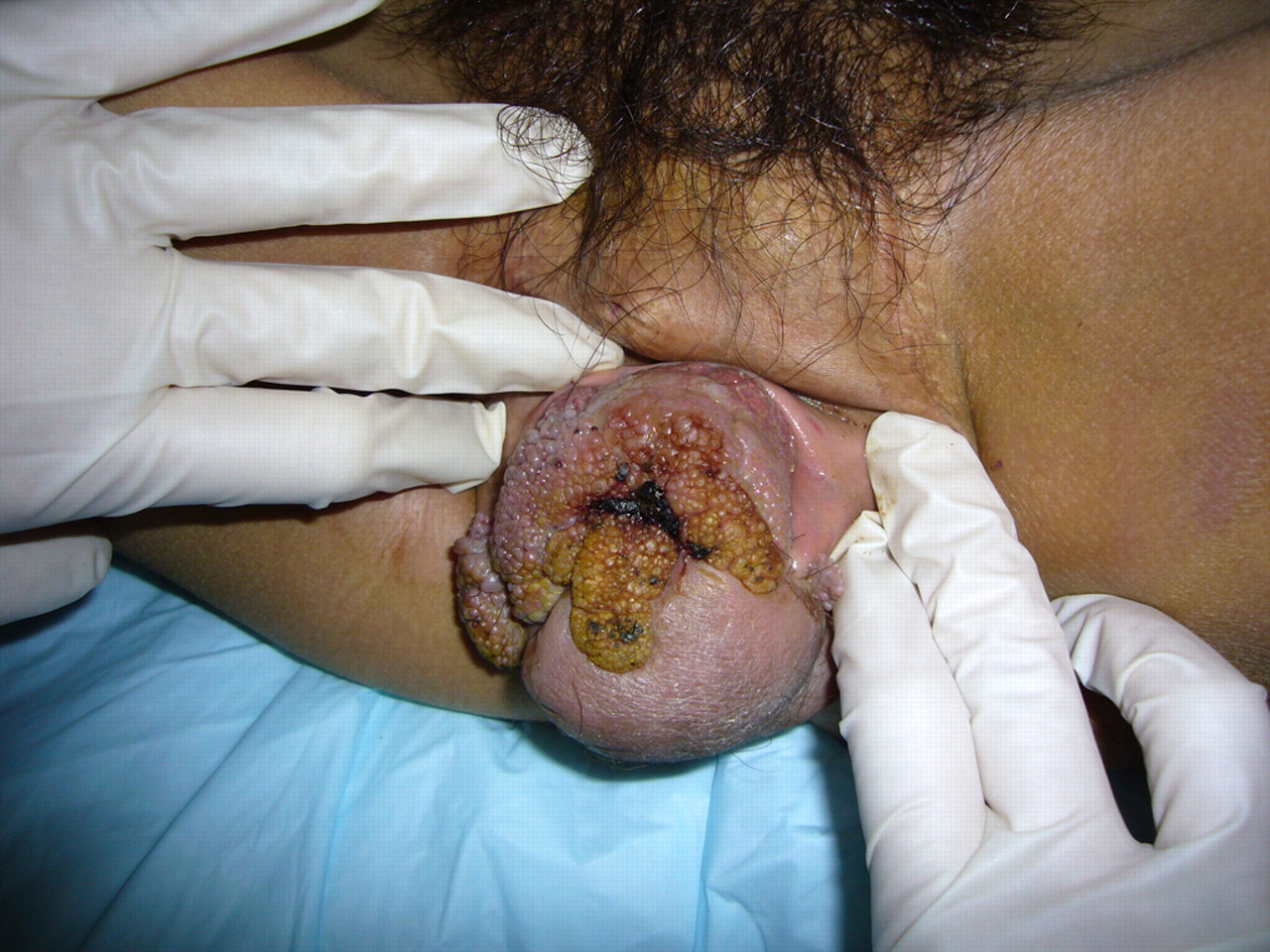
Condyloma gigantea before treatment
Laboratory examination showed normal blood, urine, stools and hepato-renal function. Rapid plasma reagin and Treponema pallidum particle agglutination tests and HIV-Ab(−) all proved to be negative. No abnormality was seen following chest X-ray, electrocardiogram and Beta type ultrasound. The acetic acid test was positive.
Histopathology revealed a benign C. gigantea with no evidence of malignancy and cytological atypia. Biopsy has been performed at different points of infected tissue. A growth pattern of squamous epithelial cells with hyperkeratosis and papillomatosis was identified; no squamous cell carcinoma was seen. Human papillomavirus (HPV) type 11 infection was confirmed by real-time polymerase chain reaction (PCR) analysis.
After the first session of treatment with a holmium laser under a local anaesthetic, nearly one-third of the condyloma was removed. However, this treatment had to be abandoned because of the complex topographical structure and the adverse effect of the anaesthesia. This was followed by the application of liquid nitrogen cryotherapy for intervals of five to seven days per time. After five treatment sessions the warts had been cleared.
DISCUSSION
There is little in the literature about the development of giant genital warts in post-transsexual patients. We have found three documented cases whose warts developed in a genital site. The three cases were male-to-female transsexuals. 4 Our patient's warts developed due to active coitus after 1.5 years post-transsexual, and C. gigantea developed gradually without timely treatment.
Epidemiological and molecular studies performed over the past three decades have convincingly demonstrated that both cervical in situ neoplasia and invasive cancer are associated with HPV. 6 Despite the histologically benign appearance of the C. gigantea, it behaves clinically in a malignant fashion, is locally invasive, destroying adjacent tissues and is regarded as an intermediate entity between ordinary genital warts and squamous cell carcinoma. 7 In general, HPV types 16, 18, 31, 33 and 35 have a close relation with cancer of the cervix; in contrast, HPV6 and 11 are usually responsible for benign warts, such as genital warts. Our patient had an HPV type 11 infection, confirmed with real-time PCR analysis, and histopathology revealed a benign C. acuminata with no evidence of malignancy.
A possible cause for the development of giant and extensive warts in this case was that the artificial labium majus was constructed from the prepuce and the scrotum. The HPV types demonstrate specificity to site and lesion morphology, 5 and the prepuce and scrotum are HPV predilection sites. Another possibility is that the warts are caused by HPV type 11, which is believed to cause C. gigantea. 8 We did not observe any differences between C. gigantea of non-transsexual and trans-sexual patients.
The treatment of giant genital warts is still a challenge to patients and physicians, and depends on their morphology, number, distribution and the patients' endurance. It is very difficult to treat C. gigantea in a post-transsexual patient because of the changed anatomic structure and the patient's tolerance.
One case which was successfully treated by extensive resection and electrovaporization under epidural anaesthesia, was reported by Liguori et al., 4 and dealt with C. gigantea of the neovagina in a HIV-Ab(+) male-to-female transsexual. Our present patient cannot bear the pain caused by holmium laser treatment and refuses to accept epidural anaesthesia. Repeated application of liquid nitrogen cryotherapy in the outpatient clinic was therefore adopted after initial laser treatment, but the patient suffered greatly at every treatment session. The warts were cleared successfully after 12 treatment sessions (Figure 2). There has been no relapse during the following three months, and the patient is still under follow-up.
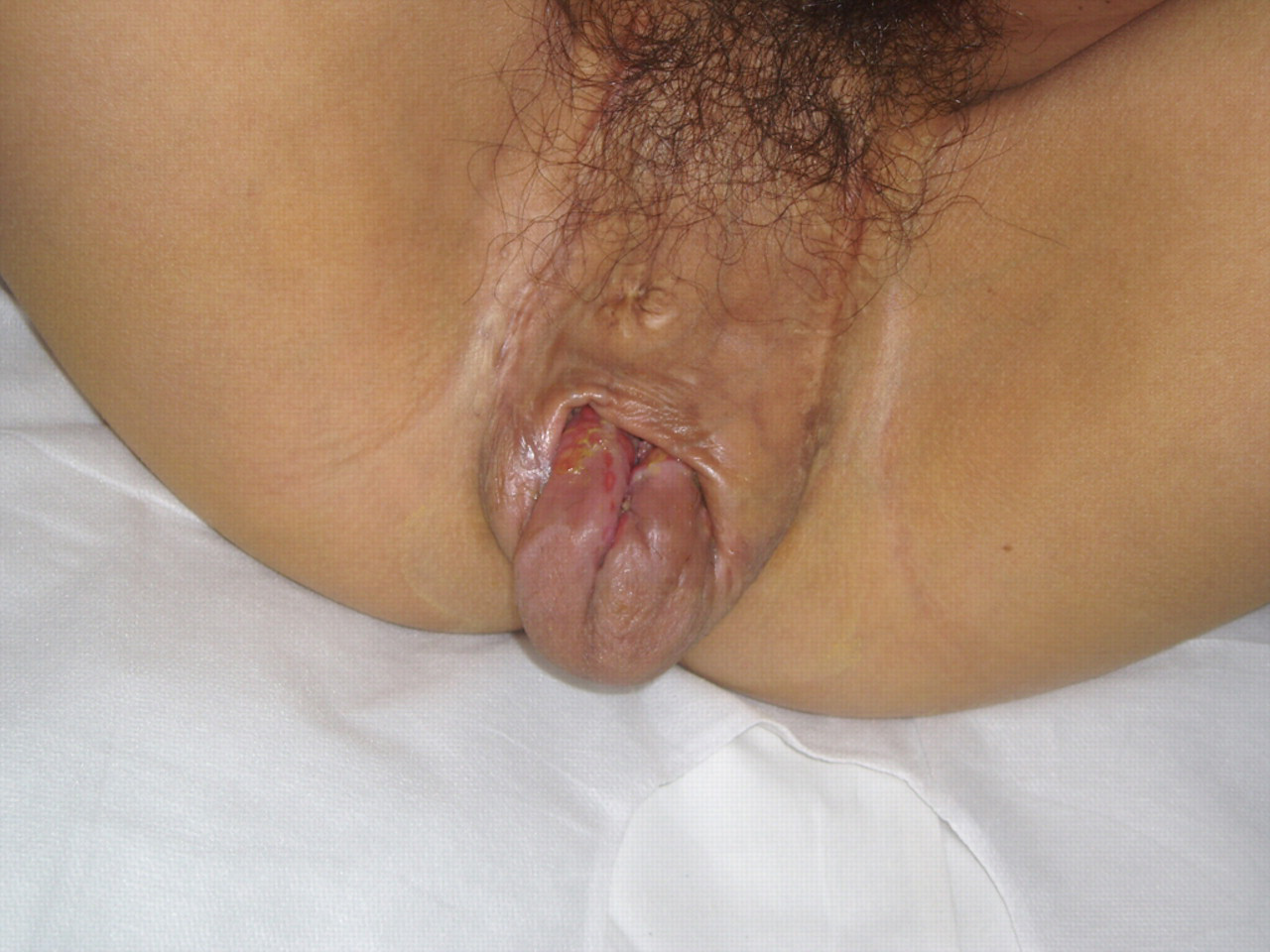
Condyloma gigantea after last treatment
A long period of follow-up is required to discover whether a patient's sexual life has been affected because of wound surface adhesions resulting from unsatisfactorily reconstructed genitalia externa and repeated cryotherapy.